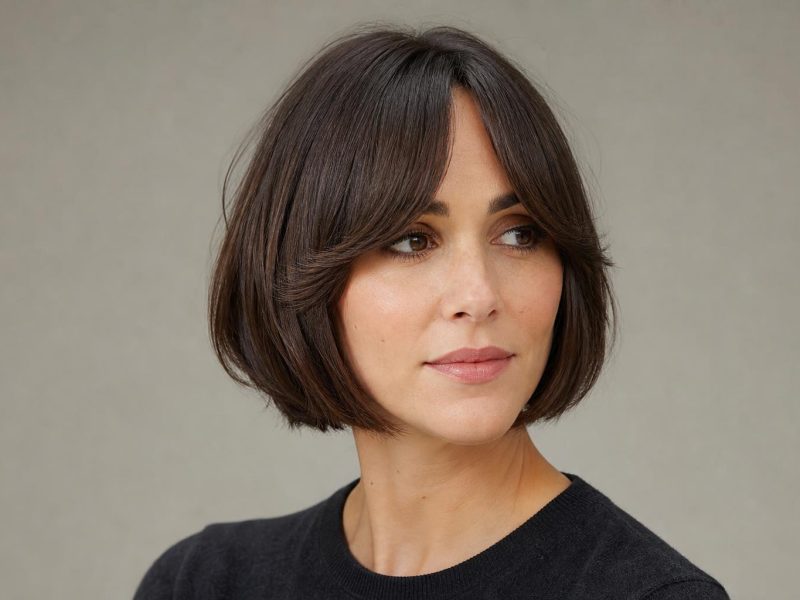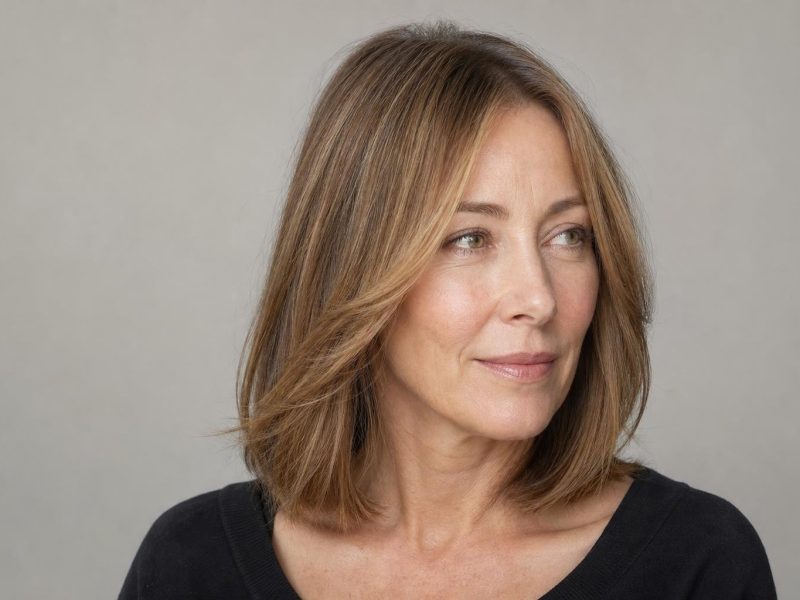

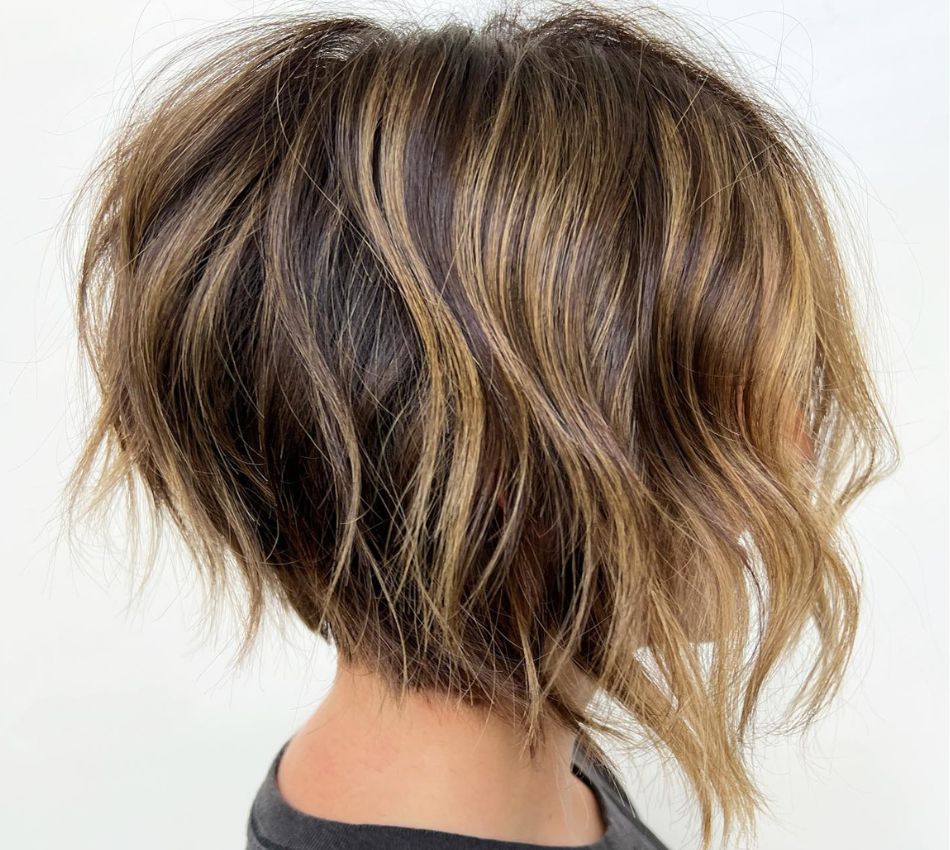
If confidence came in haircut form, it would be the stacked bob: bold, sculpted, and impossible to ignore.
Stacked bob haircuts use graduated layers at the back of the head to create a rounded, lifted silhouette, and these 35 variations show how far you can push that basic architecture. Whether your hair is fine and needs every bit of volume it can get or thick and fighting you at the nape, each entry covers the cutting technique, who it flatters, and what to tell your stylist.

The gallery is organized by variation type: classic short cuts, angled versions, medium-length options, textured modern takes, texture-specific cuts, and color-enhanced styles. After the gallery, you’ll find a face shape guide, maintenance breakdown, and salon communication tips.
Classic Short Stacked Bobs
The short stacked bob is the original — graduated layers at the nape stack on top of each other to build a rounded, full shape at the crown. These work especially well on fine to medium hair, where the technique adds body that the hair can’t produce on its own.
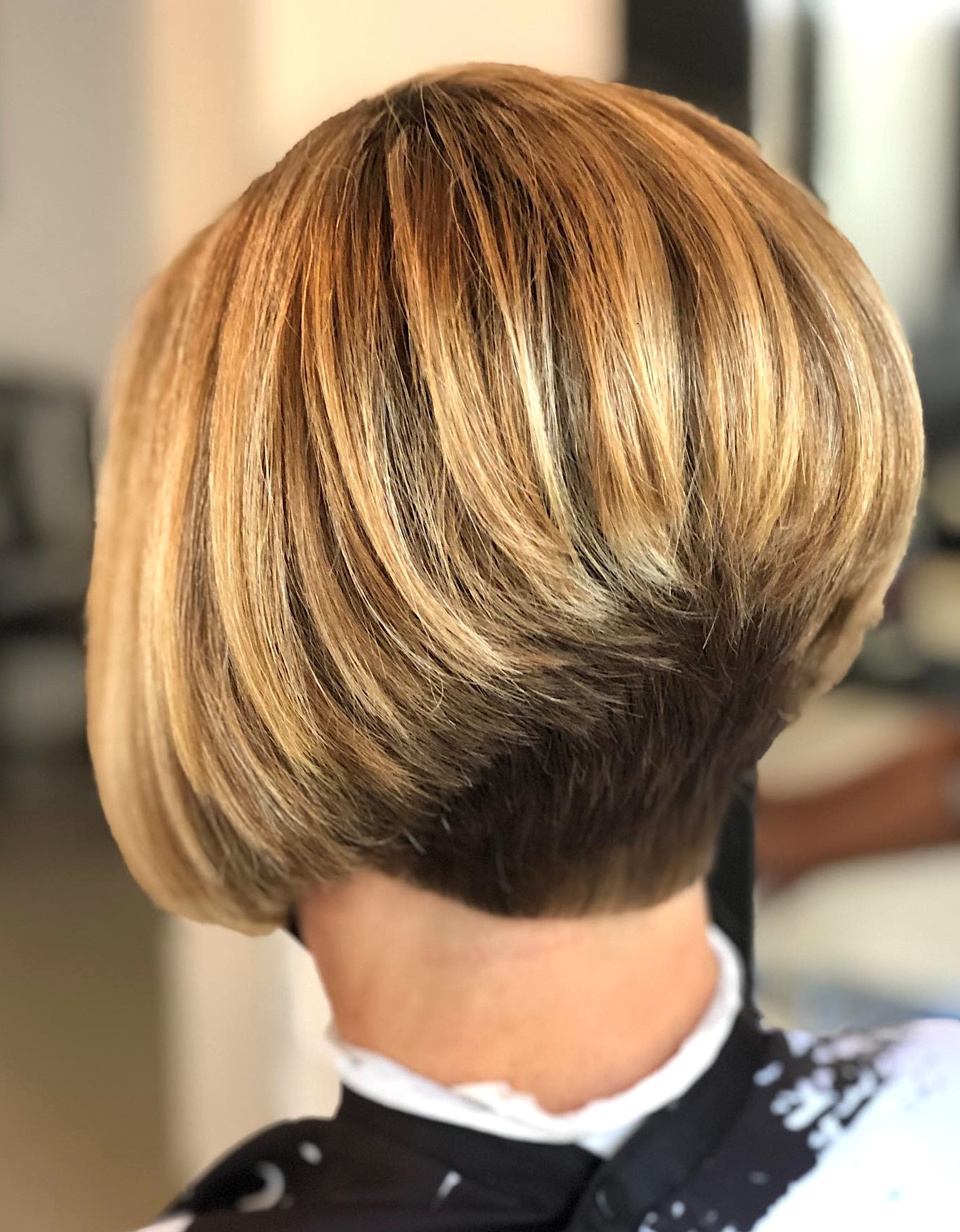
1. Classic Graduated Stacked Bob
The razor-cut graduation at the nape builds volume layer by layer, giving fine hair a full, rounded back profile. A slight bevel at the perimeter helps the ends turn under naturally. Trims every 5–6 weeks; once the nape layers outgrow their stacking point, the shape flattens fast.
2. Short Stacked Bob with Undercut
Ideal for thick, coarse hair that bulks up at the nape. The undercut removes excess weight underneath, so the stacked layers above actually hold their volume. Ask for a disconnected undercut hidden when the hair falls naturally.
3. Stacked Wedge Bob
A wedge takes graduation to its extreme with a dramatic triangular profile and layers cut at steep angles, pushing volume upward. High-commitment: trims every 4–5 weeks to maintain the sharp geometry.
4. Stacked Bob for Fine Hair
Fine hair benefits most when the stylist uses point cutting rather than razor cutting at the back. Razor cuts can thin already delicate ends, while point cutting preserves density and creates the illusion of thickness through the graduated layers. A walnut-sized amount of volumizing mousse at towel-dried roots makes a noticeable difference.
5. Chin-Length Stacked Bob with Blunt Perimeter
Stacking concentrated at the back of the crown, with a blunt, even perimeter at chin level all the way around. The clean outline keeps the cut refined, and the tuckedaway graduation builds lift from within. Oval and round faces wear this length well.
6. Textured Stacked Bob with Piece-y Ends
Texturizing shears on the last inch of each stacked layer create separated, piece-y ends that look effortless without losing volume. A small amount of matte styling paste raked through dry ends holds the texture all day.
7. Stacked Bob with Nape Fade
Unlike a full undercut, a nape fade gradually tapers the shortest layers into the skin. This approach is subtler, less edgy, and grows out more gracefully. The stacked layers above still create that signature rounded volume with a modern, clean nape.
Angled and A-Line Stacked Bobs
Adding an angle means the front falls longer than the back. The angle draws the eye forward toward the jawline while the stacked back maintains volume, solving two problems at once: a flat back and no face-framing length.
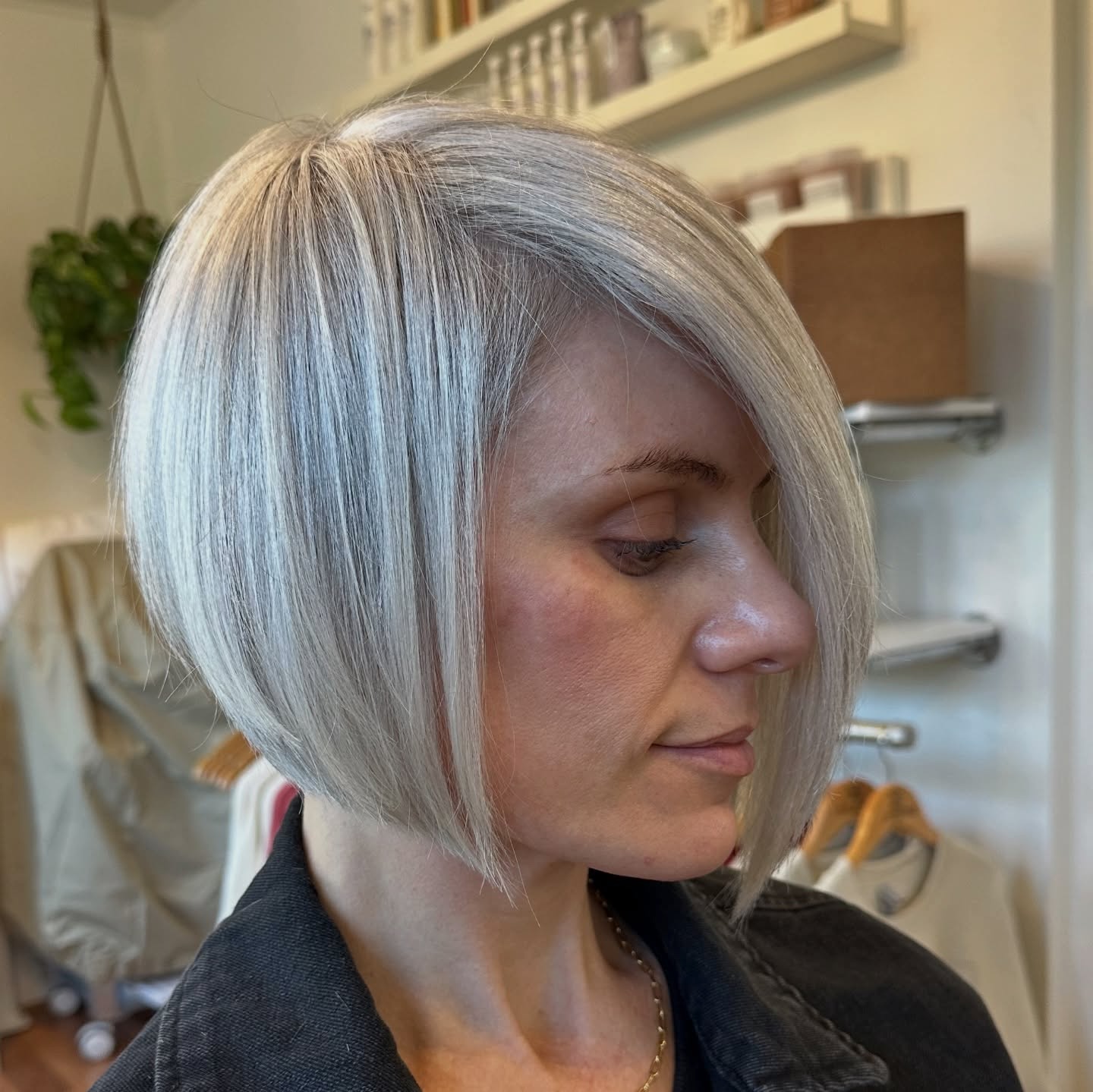
8. Dramatic A-Line Stacked Bob
Front pieces fall 3–4 inches below the chin; the back, by contrast, sits at or above the nape. Works best on straight to slightly wavy hair, where the angle is clearly visible. Square and oblong faces benefit from the long front panels softening angular jawlines.
9. Subtle Angled Stacked Bob
The low-risk entry point: maybe an inch longer in front than in back, with graduated volume behind the ears. Grows out naturally, so you can stretch trims to every 7–8 weeks.
10. Inverted Stacked Bob
When sitting in the chair, ask for “a steep inverted graduation with weight removed at the nape.” That language tells the stylist exactly where to concentrate the layering — sharper angles than a standard A-line, with more volume pushed into the upper back and crown.
11. Angled Stacked Bob on Thick Wavy Hair
Thick, wavy hair can make a standard stacked bob feel mushroom-shaped. Combining the angle with internal layers (layers hidden inside the silhouette) reduces bulk without losing volume on an inverted bob cut. A smoothing cream before blow-drying keeps the wave controlled in humidity.
12. Stacked A-Line with Side-Swept Bangs
The dimensional highlights here emphasize the layering in the back. Lighter pieces catch the graduation, making the stacking visible from a distance. Heart-shaped faces suit this pairing, with bangs balancing a wider forehead while the angled front narrows at the chin.
13. Disconnected Angled Stacked Bob
A visible break between the short stacked back and longer front sections is more editorial than everyday. Requires precise blow-drying to maintain the separation; air-drying tends to blur the disconnect.
Medium-Length Stacked Bobs
You don’t have to go short for the stacked effect. Medium-length versions — chin to collarbone — use the same graduated principle but preserve enough length for ponytails and more versatile styling.
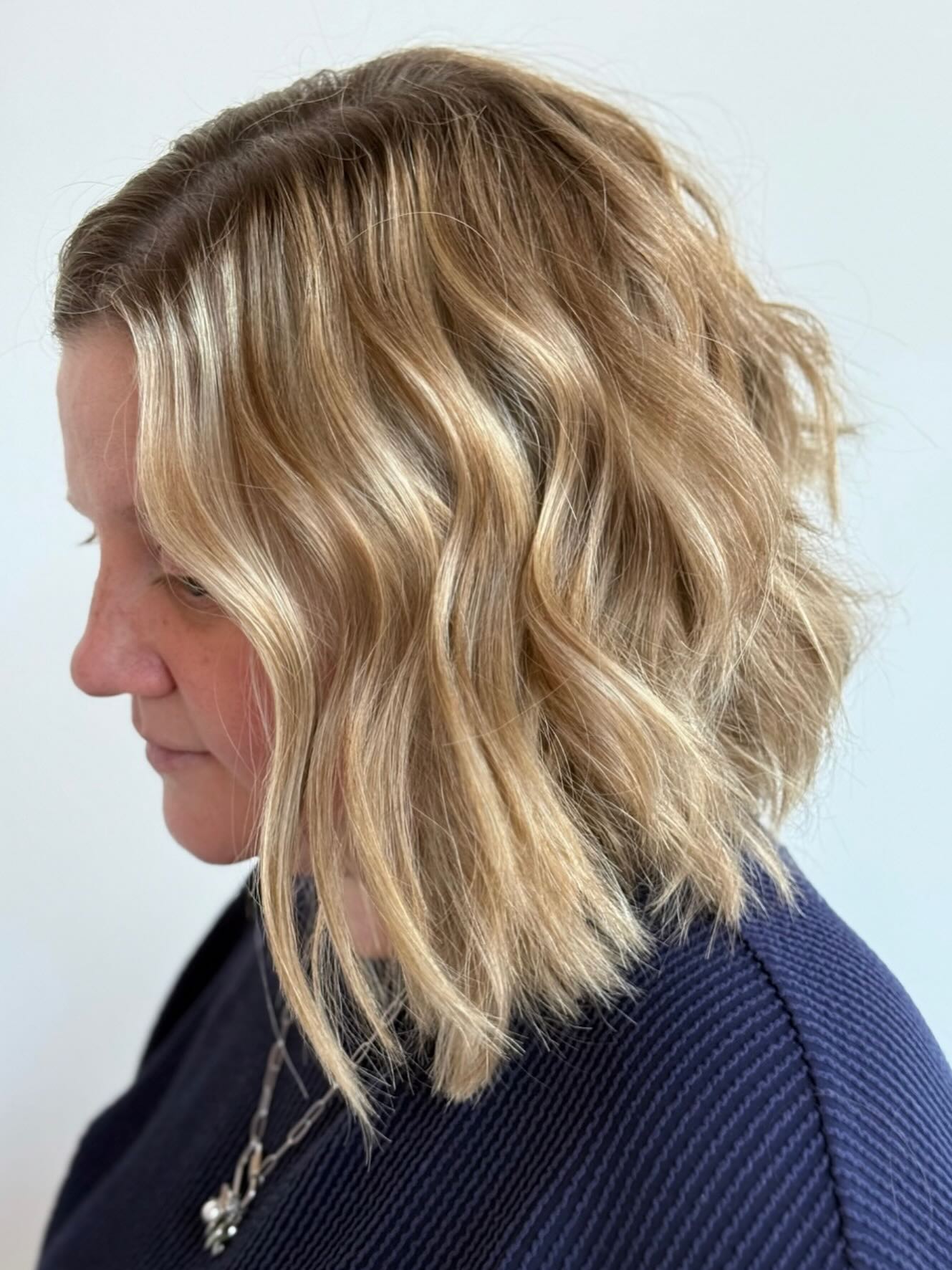
14. Stacked Lob with Graduated Back
Stylists generally recommend this for clients testing a stacked shape before committing to short. The front hits the collarbone, the back is 2–3 inches shorter with graduated layers building volume above the nape. You keep ponytail length while getting the lifted back profile.
15. Shoulder-Length Stacked Bob with Layers
Surface layers through the mid-shaft activate the graduated back and prevent the cut from reading as a plain one-length bob from the front. Blow-dry with a medium round brush, lifting at the root and directing heat toward the back of the crown.
16. Stacked Bob with Curtain Bangs
Two zones of movement — soft, parted fringe at cheekbone level framing the face, and lifted, rounded layers at the back. Oval and heart-shaped faces benefit most, where the curtain bangs highlight cheekbones and the stacked back adds proportional volume.
17. Medium Stacked Bob on Naturally Curly Hair
The key is a stylist who cuts curly hair dry. Wet cutting doesn’t account for shrinkage, and a chin-length cut on wet curls can bounce to ear level once dry. Ask for the graduation to start higher, around the occipital bone, so curls have room to spring upward without creating a flat nape.
18. Layered Stacked Bob with Face-Framing Highlights
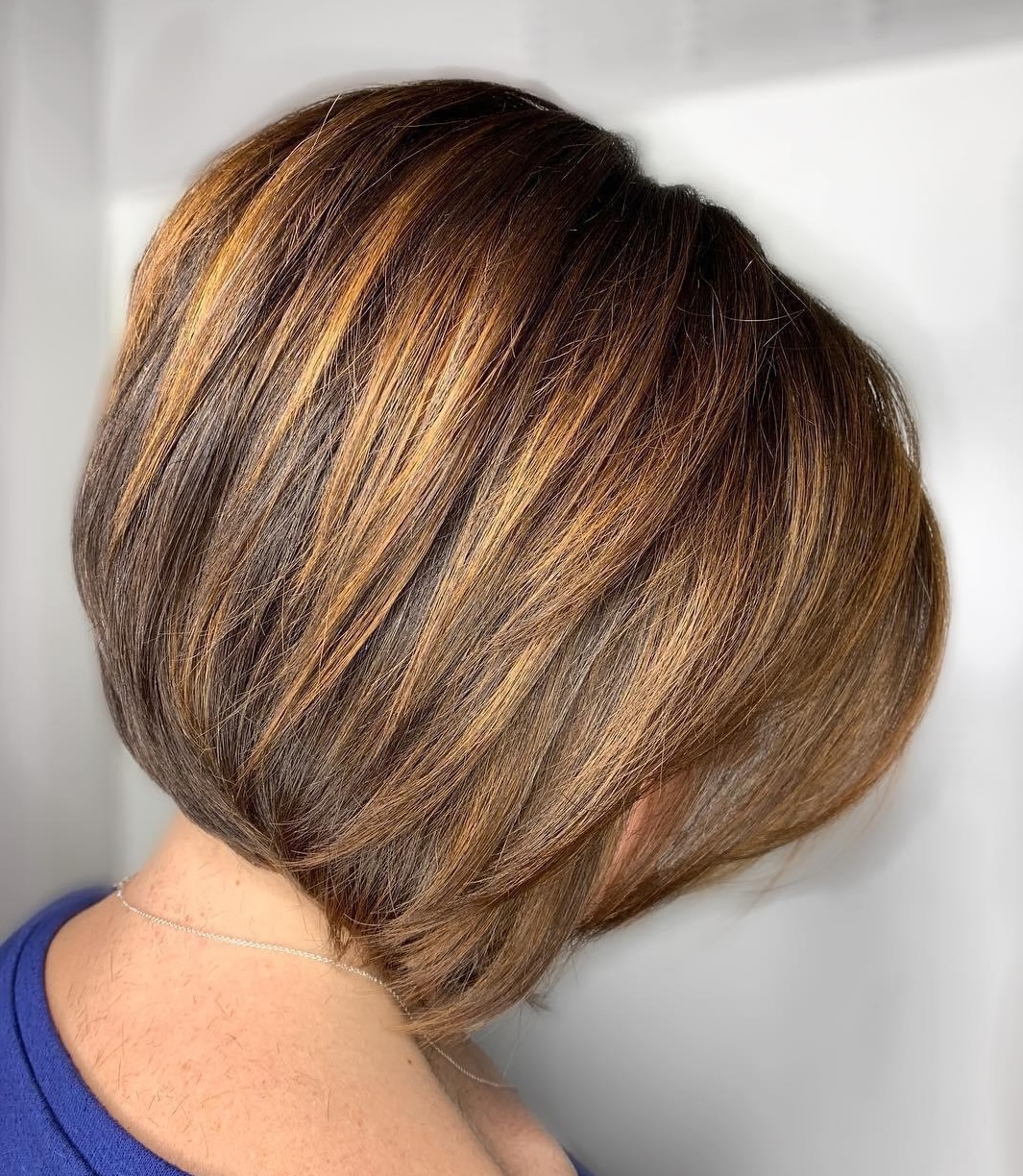
Strategically placed highlights on the front pieces and outermost stacked layers make the graduation visible even in low light. The color contrast between lighter top layers and darker underneath creates built-in dimension. Expect balayage-style maintenance every 8–10 weeks.
Textured and Modern Stacked Bobs
Modern versions lean into rougher, more relaxed textures using razor cutting, slide cutting, and heavy texturizing. They bring out movement that holds without heat styling. If your daily routine tops out at five minutes, start here.
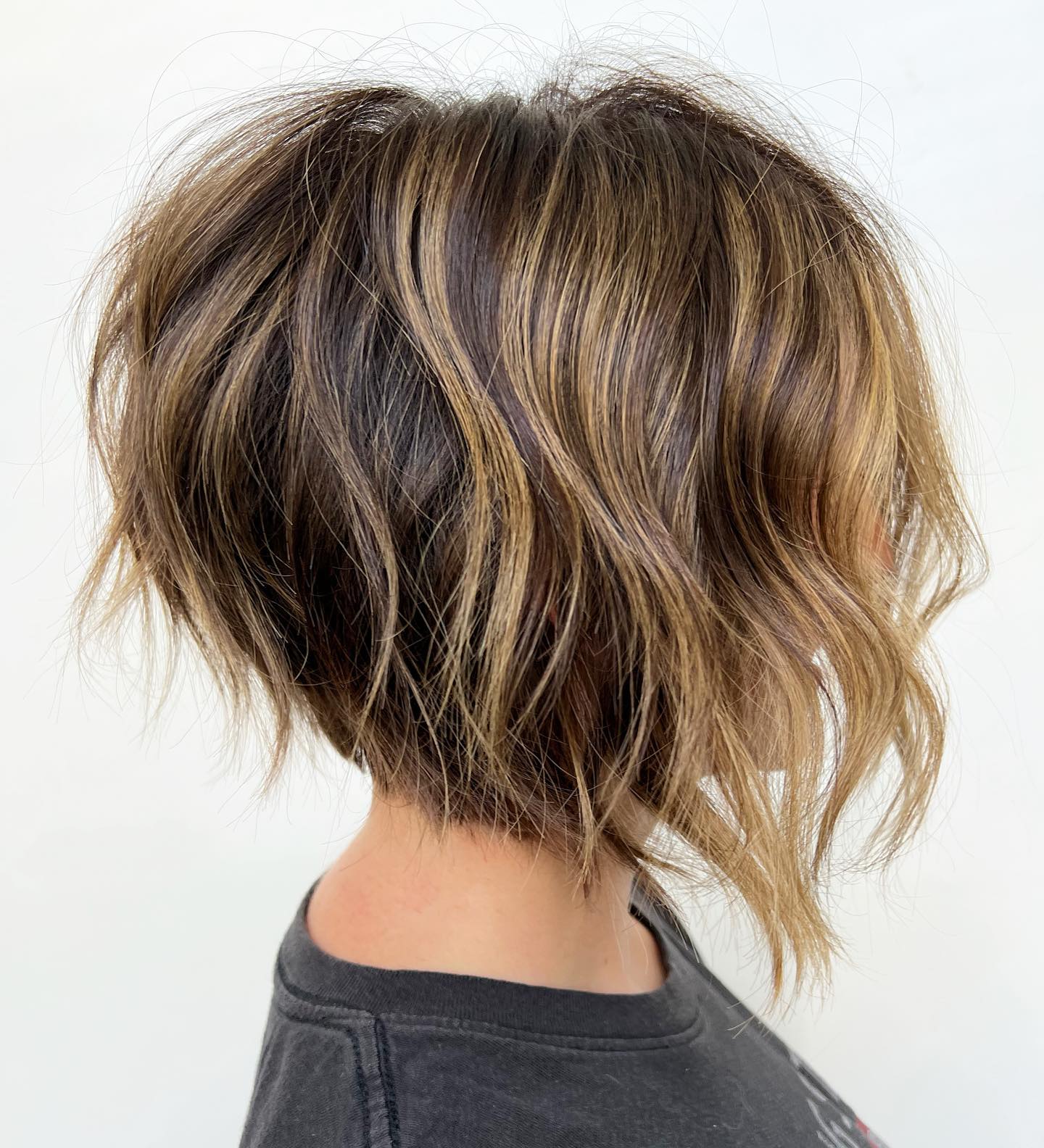
19. Razor-Cut Stacked Bob
A razor creates softer, feathered ends where layers blend rather than sitting in distinct tiers. The trade-off: razor cuts work best on medium to thick hair. Fine hair can lose too much density. Ask for razor cutting on surface layers only, with scissors maintaining the graduation underneath.
20. Choppy Stacked Bob
Deliberate unevenness gives the stacked back a deconstructed quality. This is a wash-and-go cut on wavy hair: scrunch in a sea salt spray, air dry, and the choppy layers handle the rest.
21. Messy Stacked Bob with Waves
Bring this photo and ask for “a stacked bob with soft internal layers and a textured perimeter.” The waves are created with a 1-inch curling wand, alternating curl direction, and raking through with fingers. The stacked layers underneath keep the back from going flat.
22. Shaggy Stacked Bob
Heavy, visible layers throughout deliberately disrupt the clean graduation. Closer to a short shag than a traditional bob, but the stacking at the crown still provides the lifted shape. Not a polished cut, and that’s the point.
23. Stacked Bob with Wispy Ends
Slide cutting, when shears are held open and slide down the hair shaft, thins the last 2–3 inches into feathered, tapered points. This softens the transition between short back and longer sides, making the graduation feel seamless. Suits fine hair well.
24. Edgy Asymmetrical Stacked Bob
One side falls an inch or two longer than the other, while the back maintains its stacked graduation. Ask for the deeper side part on the shorter side to emphasize the difference. Works especially well on straight, sleek hair where every line is distinctive.
Stacked Bobs by Hair Type
Let’s be real: your hair’s DNA is the ultimate creative director here. You can’t treat a 4C coil the same way you treat a 1A silk strand and expect the same “oomph.” The magic of a stack is its versatility, but the engineering has to pivot based on your density and texture. From weight-stripping for the thick-haired girls to density-faking for the fine-haired crowd, here’s how to make the physics work in your favor.

25. Stacked Bob for Thick, Coarse Hair
Without adequate thinning, a stacked bob on thick hair becomes a helmet. Thinning shears on the interior layers remove up to 30% of bulk from mid-shaft down and keep the outermost layers intact. This technique lets the stacking create shape instead of just adding mass.
26. Stacked Bob for Straight, Silky Hair
Straight hair shows every angle of the graduation with precision. The downside: it also reveals uneven cutting, so this demands a sharp pair of shears and a stylist checking symmetry from multiple angles. Maintenance every 6 weeks; straight hair grows out of shape fastest.
27. Stacked Bob for Wavy Hair (2A–2B)
Wavy hair is the sweet spot for stacked bobs — the natural bend amplifies volume with less active layering than straight or fine textures need. Air-drying with a curl-enhancing cream preserves the wave while the stacked layers prevent the back from going flat. Low maintenance to style daily, trims every 6–7 weeks.
28. Stacked Bob for Women Over 50
Hair density decreases with age, and a stacked bob compensates by creating fullness through its graduated architecture. Keep the front at chin-length or slightly above, as too much front length drags features downward. A root-lifting spray at the crown and back sections adds volume where aging hair thins first.
29. Stacked Bob on 4A–4C Natural Hair
Coily and kinky textures produce the most dramatic stacked effect of any hair type. The natural volume is already there, and graduated cutting shapes it into a deliberate silhouette. Cut entirely on dry, stretched hair. A leave-in conditioner and lightweight oil seal the ends and define curls through the stacked layers.
Color-Enhanced Stacked Bobs
If the cut is the architecture, the color is the lighting that makes the whole building look expensive. A stacked bob is already a structural masterpiece, but the right hue can turn those layers into a 3D experience. Whether you’re using shadow roots to fake depth or high-voltage highlights to catch the “stack” in the back, your color choice should act as the ultimate hype-man for your silhouette.
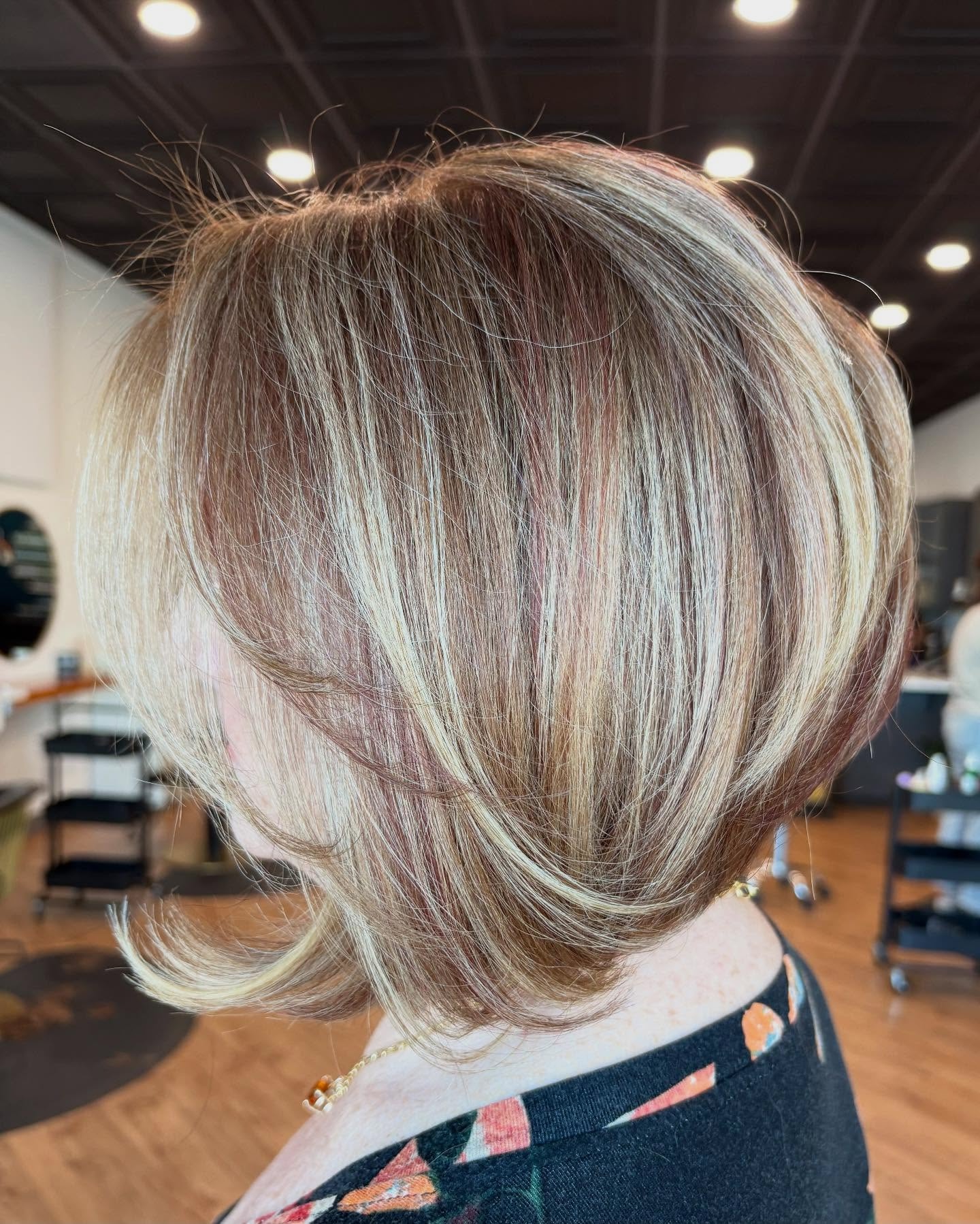
30. Stacked Bob with Balayage Highlights
Hand-painted balayage along the stacked layers creates a gradient that emphasizes the graduation. Lighter pieces on outermost layers catch light differently than the darker base underneath. Maintenance every 10–14 weeks since balayage grows out without a harsh root line.
31. Platinum Blonde Stacked Bob
Single-process platinum removes all color variation, meaning the cut’s architecture carries the entire visual weight. Every graduation angle is visible, and so is every imperfection. Achieving this from natural brown requires multiple lightening sessions spaced 4–6 weeks apart; a single visit risks severe damage.
32. Stacked Bob with Shadow Root
Darker at the scalp, gradually lighter toward the ends, the shadow root adds depth at the crown that makes stacked layers look more dimensional. Extends time between visits to 8–12 weeks.
33. Copper Red Stacked Bob
Red tones shift hue in different light, and each graduated layer catches light at a slightly different angle. Copper complements warm and neutral skin tones. The trade-off: red fades faster than any other color family. Consider touch-ups every 4–6 weeks and sulfate-free shampoo between appointments.
34. Two-Tone Stacked Bob
A dark base with a dramatically lighter top layer turns the graduation into a bold color statement. The contrast makes each individual layer visible, amplifying the volume effect. Plan for 6–8 weeks between color appointments to keep the contrast sharp.
35. Stacked Bob with Peek-a-Boo Color
Hidden color panels underneath the stacked layers reveal themselves when the hair moves. Outer layers stay natural while interior graduated layers carry a contrasting tone. Workplace-friendly experimentation. Pastels fade in 4–6 washes; darker jewel tones last 6–8 weeks.
How to Choose the Right Stacked Bob for Your Face Shape
| Face Shape | Best Variation | Avoid |
|---|---|---|
| Oval | Any length or variation | Very short with no front length (overexposes forehead) |
| Round | Angled stacked bob past the jaw + deep side part | Chin-length with center part (emphasizes roundness) |
| Square | Textured with soft layers at jaw level + side-swept bangs | Blunt perimeter at exact jaw level (mirrors the hard edge) |
| Heart | Chin-length stacked bob with curtain bangs | Very short with no bangs (exposes the widest forehead point) |
| Oblong | Short stacked bob at/above chin + side-swept fringe | Long angled version (adds length, exaggerates elongation) |
| Diamond | Crown volume + gentle layers around the cheekbones | Slicked-back with no face framing (highlights wide cheekbones) |
Stylist tip: Bring 2–3 reference photos showing the stacked back you want, and a separate photo for the front length and framing. Stylists combine elements from different photos more easily than interpreting a verbal description.
What to Ask Your Stylist
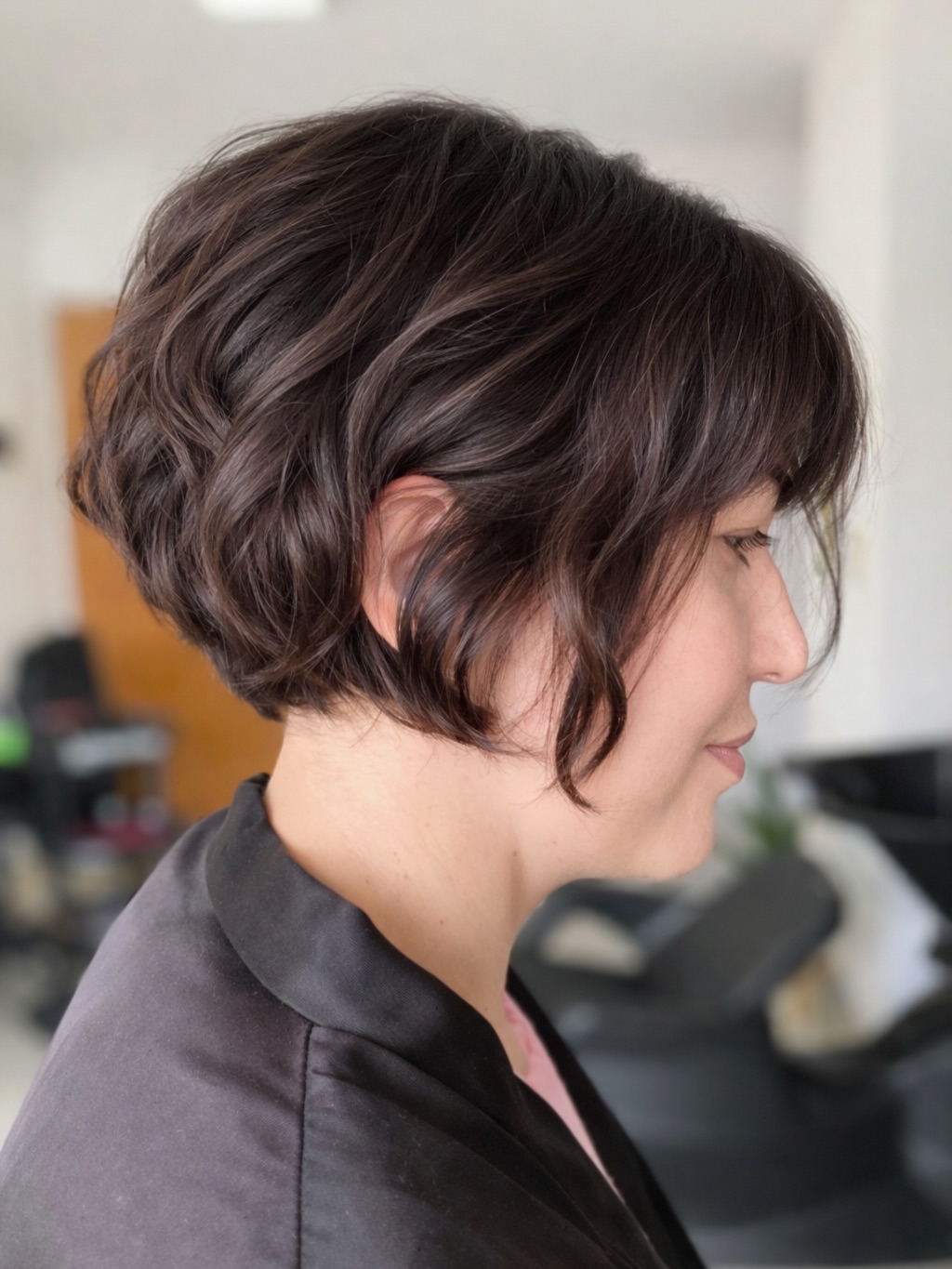
For back volume: “I want graduated layers at the back that stack and create a rounded shape at the crown.” Add “steep graduation angle” for aggressive stacking, or “soft graduation, just enough to add lift” for something subtle.
For the nape: “Tapered close” (clean, tight) or “length left at the nape” (softer). For an undercut: “disconnected undercut at the nape, hidden under the stacked layers.”
For the front: Specify “chin level,” “jaw level,” or “collarbone.” Face-framing pieces start shorter (cheekbone level) and blend into the main length; mention them separately.
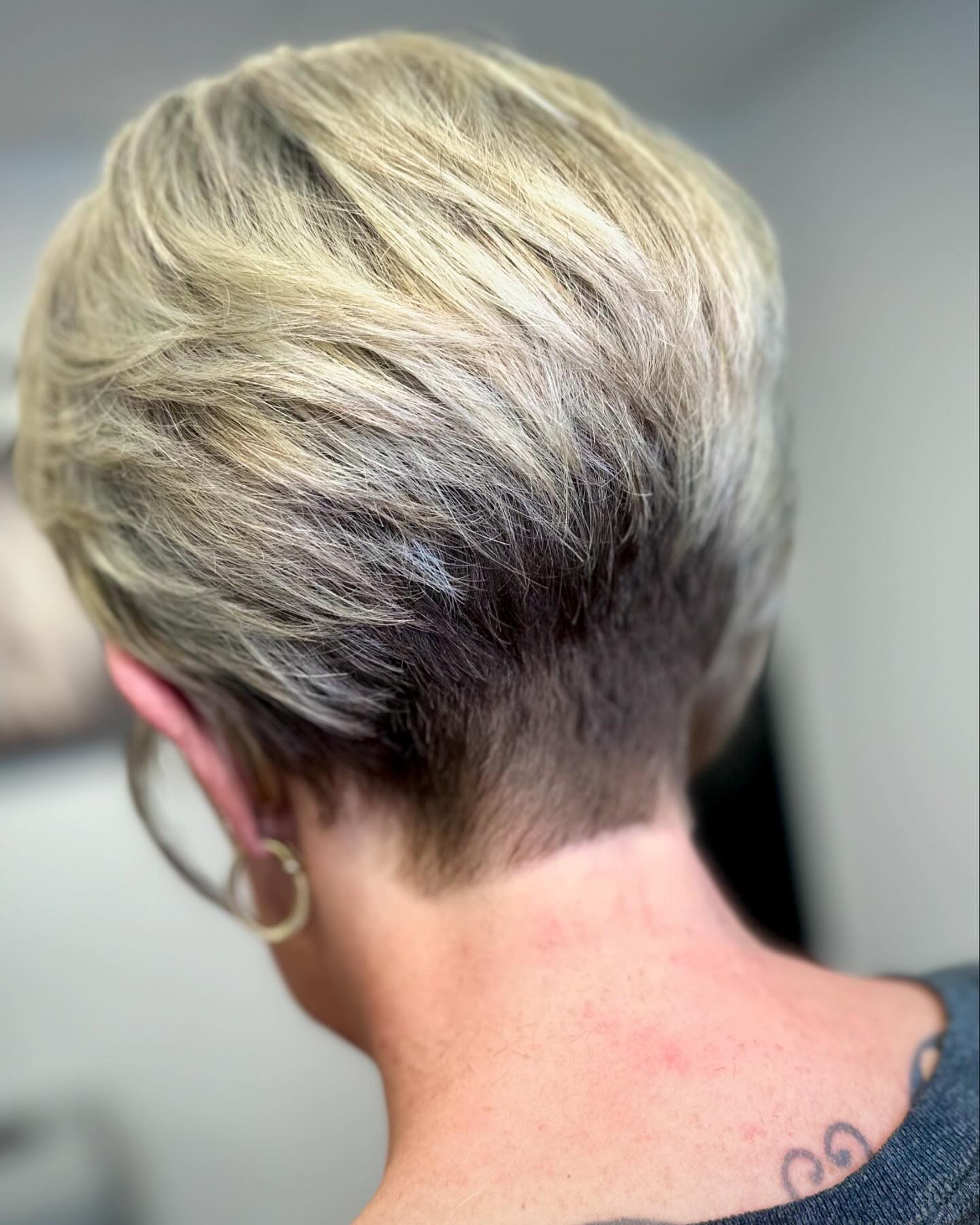
Stylist tip: Show the back view of your reference photo first. Most bob photos are front-facing, but the back is where a stacked bob lives or dies.
FAQ
What is a stacked bob haircut?
A stacked bob features graduated layers at the back cut progressively shorter toward the nape, “stacking” on top of each other to create a rounded, voluminous shape at the crown. The front stays longer — chin to collarbone — while the back does the architectural work of building lift.
Is a stacked bob the same as a graduated bob?
Closely related but not identical. A graduated bob refers to any bob with layers getting shorter toward the nape. A stacked bob specifically emphasizes layers cut to sit on top of each other and push volume upward. All stacked bobs are graduated, but not all graduated bobs create that rounded stacked shape.
Do stacked bobs work on fine hair?
Fine hair is one of the best candidates because the graduated layers create volume and density that fine hair lacks on its own. Point cutting preserves more weight at the ends than razor cutting, which can make fine ends look sparse.
How often does a stacked bob need trimming?
Every 4–7 weeks, depending on the variation. Classic short versions with tight graduation need attention every 4–5 weeks. Longer, textured versions stretch to 6–8 weeks because the looser shape camouflages growth better.
Can curly hair get a stacked bob?
Yes, but the stylist must cut the hair dry and account for curl shrinkage. The graduation should start higher than on straight hair — around the occipital bone — so curls have room to contract without creating a flat nape.
What’s the difference between a stacked bob and a layered bob?
A layered bob distributes layers throughout the entire head for overall movement. A stacked bob concentrates layering specifically at the back and nape, where graduated layers build volume and a rounded shape. The front of a stacked bob can be one length.
How do I keep a stacked bob from going flat?
Root-lifting spray or volumizing powder at the crown before blow-drying sets the foundation. During the day, flip your head upside down, shake roots loose, and reset with dry shampoo or texture spray. A silk or satin pillowcase helps overnight — cotton friction pushes stacked layers flat.
Finding the right look for your next salon visit is all about balancing your natural hair texture with the architectural precision of graduated layers. Whether you choose a dramatic A-line or a soft, sun-kissed version, stacked bob haircuts remain a timeless choice for anyone looking to add structure and incredible lift to their style.
Hair results vary based on your natural hair type, texture, density, and condition. Always consult with a licensed hairstylist before making significant changes, especially with chemical treatments or dramatic length changes. Photos may show styled results that require professional tools and products to replicate.