
A comb asks a few strands to separate at a time and a brush asks dozens at once, which is the whole argument in one sentence.
A wide-tooth comb has widely spaced teeth that engage a small number of hairs per pass, so a knot yields gradually and you feel resistance before anything breaks. A detangling brush has many flexible bristles of varying height that engage a much larger section, which is faster and puts more strands under load simultaneously. On wet hair, where every strand is at its weakest, that difference decides how much breakage you cause.
This guide covers what contact density means in practice, a side-by-side comparison of the two tools, which to reach for by texture and by whether your hair is wet or dry, the detangling technique that matters more than either choice, and what to check before buying.
The Real Difference Is How Many Strands Are Under Load
Detangling is a mechanical problem. A knot is a set of hairs wrapped around each other, and undoing it means either separating them or breaking one. Whichever tool you use, the outcome depends on how much force lands on how many strands at once, and on whether you notice the resistance in time to stop pulling.
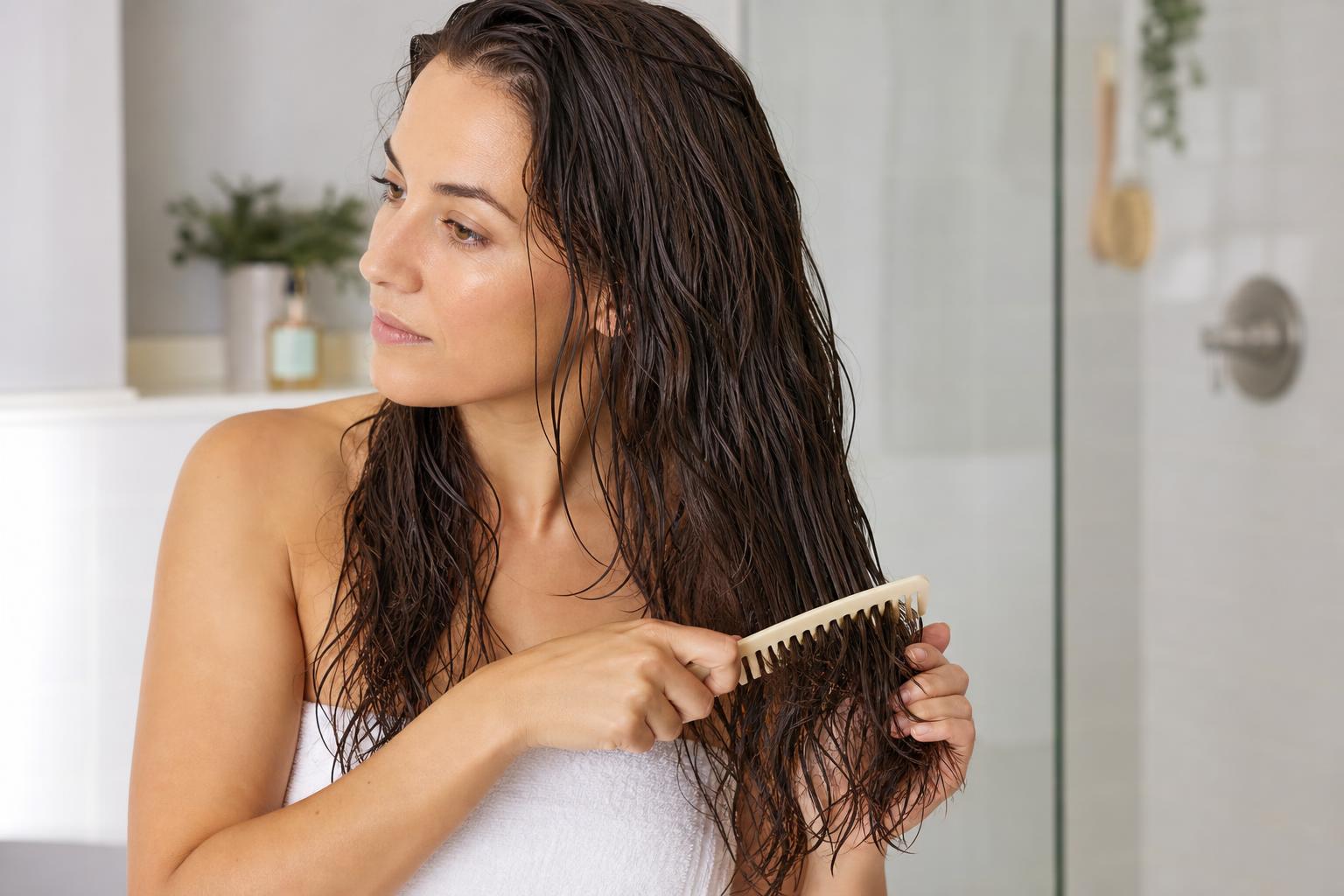
A wide-tooth comb concentrates force through a handful of teeth. You feel a knot as a distinct catch, which gives you the chance to stop, hold the hair above it, and work it loose. The trade is speed, because a full head of long hair takes real time this way.
A detangling brush spreads force across many flexible bristles, which is why it feels gentler in the hand even though it is engaging far more hair. That flex is doing genuine work, since bristles that give way rather than dragging reduce the peak force on any single strand. The risk is that the same flex hides resistance, so you keep pulling through a knot you never felt.
Stylist tip: Whatever tool you hold, the hand that is not holding it matters more. Grip the hair firmly just above where you are working so any resistance pulls against your fist instead of your scalp. People who detangle without anchoring the section cause most of their damage at the roots without realizing it.
Comb and Brush Compared
Both belong in most bathrooms, and the useful question is which one to pick up at a given moment rather than which to own. The wet-hair row is the one that matters most for damage.
| Feature | Wide-Tooth Comb | Detangling Brush |
|---|---|---|
| Strands engaged per pass | Few, so knots yield one at a time | Many, so sections clear together |
| On soaking wet hair | The safer choice, especially with conditioner in | Usable on fine or loosely wavy hair, riskier on tight curls |
| Speed | Slow, several minutes for long hair | Fast, often half the time |
| Feedback when you hit a knot | Clear, you feel the catch immediately | Muted, the bristles flex and you may pull through |
| Effect on curl clumps | Separates them, so use before product | Separates them more, and harder to reclump after |
| Product distribution | Good, teeth carry conditioner through evenly | Very good, more contact spreads product further |
| Scalp comfort | Can scratch if the teeth are sharp or seamed | Generally kinder, ball tips distribute pressure |
Which Tool for Which Texture
Texture changes the answer more than anything else, because the tighter the pattern, the more contact points each strand has with its neighbors and the more a knot resists. Find your row and treat it as the default rather than a rule.
| Hair Type | Wet Detangling | Dry Detangling | Notes |
|---|---|---|---|
| Fine straight | Either, brush is fine here | Brush | Fewest contact points, so knots are shallow and yield easily |
| Thick straight | Comb first, brush to finish | Brush | Density is the challenge, not tangling; work in sections |
| Wavy 2a to 2c | Comb, with conditioner in | Avoid both, use fingers | Dry detangling flattens the wave pattern for the day |
| Curly 3a to 3c | Comb, always with slip | Never, on either tool | Detangle only while conditioner is in and hair is soaking |
| Coily 4a to 4c | Fingers first, then a wide comb | Never | Work in four or more sections and keep each one damp throughout |
| Fragile or bleached | Comb, slowly | Brush lightly, only when fully dry | Less margin for error, so slow down rather than changing tools |
The pattern across the table is that the tighter the curl, the earlier in the process you should be detangling and the more slip you need on the hair while you do it. Anyone with a defined pattern should also detangle before styling product goes on, since combing through a set clump undoes the definition, which is the same reason air-drying curly hair without frizz depends on leaving the hair alone once the product is in.
Technique Beats Tool Choice
Two people can use the same comb and get completely different results, because the sequence matters more than the object. Nearly all detangling damage comes from starting in the wrong place and from working on hair with no slip on it.
Step 1: Add Slip Before Anything Touches the Hair
What you need: Conditioner in the shower, or a detangling spray or leave-in outside it.
How: Saturate the mid-lengths and ends, and give it thirty seconds to absorb before you start.
Why: Slip lets hairs slide past each other instead of gripping. Detangling dry, unconditioned hair is the single most damaging version of this task.
Common mistake: Combing in the shower before the conditioner has been through the tangled section.
Step 2: Section It, Even If You Think You Do Not Need To
What you need: Two to four clips.
How: Split the hair into manageable panels and clip away everything you are not working on.
Why: A sectioned panel lets you see and feel each knot. Working on a whole head at once means dragging finished hair back through tangled hair repeatedly.
Common mistake: Skipping this on medium-length hair, where it saves the most time relative to effort.
Step 3: Start at the Ends and Move Up in Short Passes
What you need: Your chosen tool and your anchoring hand.
How: Work the last two inches until they run clear, then start an inch higher, then higher again, always finishing each pass through the ends.
Why: Combing from the roots down pushes every small tangle ahead of the tool and compacts them into one dense knot at the ends.
Common mistake: Long root-to-tip strokes, which feel productive and cause most of the breakage in this whole process.
Step 4: Use Fingers on Anything That Resists Twice
What you need: Nothing but patience.
How: If a knot does not yield on the second pass, put the tool down and separate it with your fingers, pulling the tangle apart sideways rather than downward.
Why: Fingers give you far more information than any tool and can work a knot loose in a direction a comb cannot.
Common mistake: Forcing a third pass, which is usually the moment the strand breaks.
What to Check Before You Buy Either
Tool quality varies more than price suggests, and two details separate a good one from a bad one regardless of brand.
For a comb, run your thumbnail along the inside of the teeth. Injection-molded plastic combs often have a seam, a thin ridge left where the mold halves met, and that ridge catches and shreds the cuticle on every pass. Look for a comb that has been sanded or one cut from a single piece, whether that is cellulose acetate, sandalwood, or a well-finished plastic. Rounded tooth tips matter too, since sharp ones scratch the scalp.
For a brush, the flex is the whole product. Press the bristles against your palm: they should give easily and spring back, and bristles of varying heights engage the hair more gradually than a uniform bed does. Ball tips should be molded rather than glued, because glued tips come off and leave a sharp stub behind. A vented or flexible base helps the brush conform rather than fight the shape of your head.
Stylist tip: Replace a detangling brush the moment you find a missing ball tip. One bare bristle end passing through your hair hundreds of times a week does more damage than the entire brush prevents, and it is the most common overlooked cause of unexplained mid-length breakage.
What Not to Use on Wet Hair
Wet hair stretches further and breaks more easily than dry hair, so several common tools are a poor idea before it has dried.
- A boar-bristle brush is built to distribute oil along dry hair, and its dense, stiff bristles have no give at all on a wet knot.
- A fine-tooth comb engages far too many strands at once and will snap them rather than separate them. It has a place on dry hair for parting and precision styling, and none on wet hair.
- A round brush belongs in a blow-dry once the hair is already detangled and about 80 percent dry, not before.
- A paddle brush with rigid bristles is for smoothing dry hair, and the rigidity is exactly the problem when a strand is at its weakest.
- Any tool at all, on curls, once styling product has set, since you will separate clumps you cannot reform until the next wash.
If your ends tangle badly no matter which tool you use or how careful you are, the tool is not the problem. Roughened, high-porosity ends catch on each other because the cuticle is damaged, and that is a condition issue rather than a technique one. It usually means splits that need trimming out, or a protein and moisture balance that has drifted.
FAQ
Can I Just Own One of Them?
If you own one, make it a good seamless wide-tooth comb, because it is safe on every texture in every condition while a brush is not. A detangling brush is a speed upgrade for people whose hair tolerates it, which mostly means fine to medium straight or wavy hair. Curly and coily textures lose nothing by skipping the brush entirely.
Is a Detangling Brush Bad for Curly Hair?
Not by itself, but it separates curl clumps more thoroughly than a comb does, which costs definition. Used in the shower with conditioner saturating the hair, it is safe enough on looser 3a patterns. Tighter than that, most people get better results with fingers followed by a wide comb.
Should I Detangle Before or After Washing?
Before, if your hair tangles badly, since shampooing a knotted head makes the knots worse. Then again during conditioning, which is when you have the most slip available. Detangling once before you get in the shower and once with conditioner in is the routine that causes the least breakage for most people.
How Often Should I Detangle?
Straight and wavy hair benefits from daily gentle detangling, since tangles compound if left. Curly and coily hair usually detangles on wash day only, because handling between washes disturbs the pattern and creates more knots than it removes. Anyone growing their hair out should lean toward less frequent, more careful sessions, which is one of the retention habits in our guide to growing long hair.
Does a Wooden Comb Work Better Than Plastic?
A well-finished wooden comb generates less static than plastic, which is a genuine advantage in dry weather. Beyond that the material matters far less than whether the teeth are smooth and seamless. A cheap wooden comb with rough teeth is worse than a well-made plastic one.
Why Does My Hair Tangle So Much at the Nape?
That section rubs against collars, pillows, and the back of your neck constantly, so it takes the most friction of any part of your head. It is also where the shortest broken pieces gather. Containing the length overnight helps considerably, which our guide to sleeping with long hair covers in detail.
The wide-tooth comb vs detangling brush decision comes down to how many strands your hair can safely have under load at once, and tighter textures and wetter hair both push the answer toward the comb. Buy a seamless comb whatever else you own, check a brush for missing ball tips regularly, and remember that starting at the ends with slip on the hair does more for your breakage rate than either tool will. The rest of your hair tools matter less than the two minutes of technique.
Hair results vary based on your natural hair type, texture, density, and condition. Always consult with a licensed hairstylist before making significant changes, especially with chemical treatments or dramatic length changes. Photos may show styled results that require professional tools and products to replicate.