Only two oils, rosemary and pumpkin seed, have been tested head to head against minoxidil in people, and knowing that one fact saves most women months of rubbing the wrong bottle into their scalp.
The best hair growth oil for women, based on current human evidence, is pumpkin seed oil or rosemary oil applied to the scalp, used daily for at least three to six months. Pumpkin seed oil is the only oil tested in a trial made up entirely of women with female pattern hair loss, and rosemary oil matched 2% minoxidil for hair count at six months in a trial of 100 people with pattern hair loss. Castor, coconut, argan and most essential oils have either animal data only or no growth data at all, even though they fill most of the “best oil” lists.
This guide ranks the common oils by the quality of their evidence, explains which ones belong on the scalp and which belong on the lengths, shows how to apply them without irritation, sets a realistic timeline, and flags the types of hair loss that no oil will fix.
| Factor | Details |
|---|---|
| Strongest evidence | Pumpkin seed oil and rosemary oil, each tested against minoxidil in people |
| Where to apply | Growth oils go on the scalp; conditioning oils go on the lengths and ends |
| Time to judge results | 3 months at the earliest, 6 months for a fair verdict |
| Works for | Mild to moderate pattern thinning, as a first step or alongside medical treatment |
| Will not fix | Sudden heavy shedding, patchy loss, scarring loss, or loss caused by low iron or thyroid problems |
What a Hair Growth Oil Can and Cannot Do
A hair growth oil can only help follicles that are still alive. In female pattern hair loss, follicles gradually shrink and produce thinner, shorter hairs; the oils with human data appear to slow or partly reverse that shrinking when used for months. No oil makes healthy hair grow faster than its normal rate, and none regrows hair where follicles have scarred over.
That distinction matters because most women searching for a hair growth oil fall into one of two groups. Some have thinning at the part or crown, which is where oils have a real, if modest, role. Others want long hair to get longer, and for them the problem is usually breakage, not growth. Hair grows roughly half an inch a month either way; what changes the result for the second group is keeping the ends intact, which is a job for conditioning oils on the lengths.
Stylist tip: Before buying anything, take a photo of your part in the same light once a month. Most women cannot tell whether an oil is working because they compare against memory, and a straight-down photo of the part at the crown is the only reliable way to judge three months later.
Hair Growth Oils Ranked by Evidence
The ranking below is based on the type of study behind each oil, not on how popular it is. A randomized trial in people counts for far more than a mouse study, and a mouse study counts for more than a lab claim about an ingredient.
| Oil | Best Evidence Available | What It Showed | Where It Belongs |
|---|---|---|---|
| Pumpkin seed oil | Randomized trial, 60 women with pattern hair loss | Improvements similar to 5% minoxidil foam over 3 months | Scalp |
| Rosemary oil | Randomized trial, 100 people with pattern hair loss | Hair count rose at 6 months, no different from 2% minoxidil; less itching | Scalp |
| Peppermint oil | Mouse study | More and deeper follicles over 4 weeks; no human trial | Scalp, well diluted |
| Lavender oil | Mouse study | More follicles over 4 weeks; no human trial | Scalp, well diluted |
| Coconut oil | Lab study on hair fibers | Reduced protein loss from the hair shaft; not a growth study | Lengths, before washing |
| Castor oil | No human growth trial | Growth claims rest on ingredient theory only | Ends and brows for shine and softness |
| Argan and jojoba oil | No growth trial | Useful as carriers and for frizz, not for growth | Lengths, or as a carrier |
Pumpkin Seed Oil Is the Only Oil Tested in Women With Pattern Hair Loss
In a 2021 randomized trial in the Journal of Cosmetic Dermatology, 60 women with female pattern hair loss used either topical pumpkin seed oil or 5% minoxidil foam for three months. Both groups showed fewer thin vellus hairs, less variation in strand thickness, and more new upright regrowing hairs under dermoscopy. The trial was small and short, but it is the closest match to the question most women are actually asking. Pumpkin seed oil is a heavy, green-brown oil, so most women apply it at night and wash it out in the morning.
Rosemary Oil Matched 2% Minoxidil at Six Months
A 2015 randomized trial published in Skinmed gave 100 people with pattern hair loss either rosemary oil or 2% minoxidil for six months. Neither group changed at three months; both had a significant rise in hair count at six months, with no difference between them, and scalp itching was more common with minoxidil. Two things are easy to miss here: the three-month result was flat, so quitting early means you never find out, and the comparison was with the weaker 2% minoxidil, not the 5% many women now use. Our guide to rosemary oil for hair covers the full study picture, and if you prefer to blend your own, see how to make rosemary oil at home.
Peppermint and Lavender Oil Have Only Mouse Data
A 2014 study in Toxicological Research found that 3% peppermint oil applied to mice for four weeks increased follicle number and depth more than the other groups tested, including 3% minoxidil. A 2016 study by an overlapping research group found similar effects for lavender oil in mice. Mouse skin cycles through hair growth very differently from the human scalp, so these results are a reason to study the oils in people, not proof they work in people. Both are strong essential oils and must be diluted.
Coconut and Castor Oil Protect Length Rather Than Grow Hair
Coconut oil is often cited as a growth oil because of a 2003 study in the Journal of Cosmetic Science, but that study measured protein loss from hair fibers, not growth. It found coconut oil, unlike mineral or sunflower oil, reduced protein loss when used before and after washing, likely because its small, straight molecules can enter the hair shaft. That is a real benefit for length retention, and it is why coconut oil belongs on the mid-lengths before shampooing. Castor oil has no human growth trial at all; its thickness makes it good for sealing dry ends, and not much else is proven.
Where to Apply Each Oil: Scalp or Lengths
Most disappointing results come from putting the right oil in the wrong place. Growth-targeted oils need to reach the scalp, where the follicles are. Conditioning oils do their work on the hair shaft, and on the scalp they mostly add grease and can clog things up for women prone to dandruff or an itchy scalp.
| Goal | Oil | Where | When |
|---|---|---|---|
| Thinning at the part or crown | Pumpkin seed or diluted rosemary | Scalp along parts spaced about an inch apart | Daily, left on at least a few hours or overnight |
| Breakage and split ends | Coconut oil | Mid-lengths and ends | 20 to 60 minutes before shampooing |
| Dry, rough ends | Castor or argan, a few drops | Last 2 to 3 inches | On dry hair after styling |
| Carrier for essential oils | Jojoba or argan | Mixed with rosemary, peppermint or lavender | Whenever the essential oil is applied |
How to Apply a Scalp Oil Without Irritation
Scalp oils only work if you can use them every day for months, so the routine has to be comfortable and quick. These steps take about five minutes.
Step 1: Dilute Essential Oils Before They Touch Skin
What you need: A carrier oil such as jojoba, a small dropper bottle, and your essential oil.
How: Mix a few drops of rosemary, peppermint or lavender oil into a tablespoon of carrier; many ready-made scalp oils are already diluted, so check the label before adding more.
Why: Undiluted essential oils can burn or sensitize the scalp, and a reaction ends the routine before it has time to work.
Common mistake: Adding extra peppermint for a stronger tingle. The tingle is not a sign of growth, and too much causes redness and flaking.
Step 2: Patch Test for 48 Hours
What you need: The diluted oil and a small patch of skin behind the ear or on the inner arm.
How: Apply a drop, leave it for two days, and look for redness, itching or bumps.
Why: Plant oils are a common cause of contact allergy, and the scalp covers a large area.
Common mistake: Testing on the back of the hand, where skin is thicker and less reactive than the scalp.
Step 3: Apply to the Scalp Along Parts
What you need: A dropper or applicator-tip bottle and a tail comb.
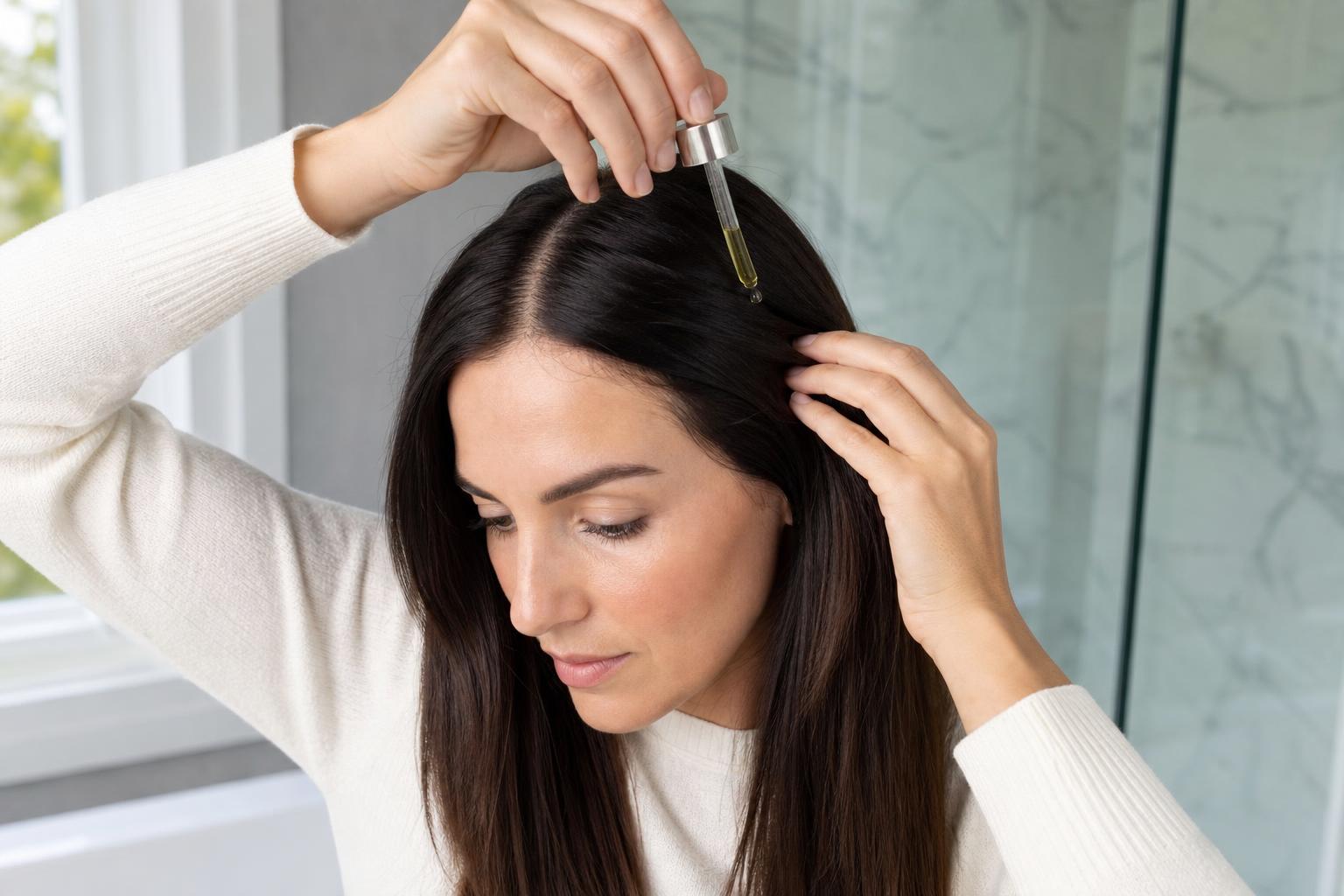
How: Part dry hair into rows about an inch apart over the thinning area and place a few drops along each part, then massage with fingertips for two to four minutes.
Why: Pouring oil on top of the hair coats the strands and leaves the scalp underneath almost untouched.
Common mistake: Using a teaspoon or more. A scalp routine needs roughly 1 to 2 milliliters; more just ends up in the lengths.
Step 4: Wash Out on Your Normal Schedule
What you need: Your usual shampoo, and a clarifying shampoo once a week if oil builds up.
How: Leave the oil on overnight or for several hours, then shampoo twice, focusing the first wash on the scalp.
Why: Oil left for days on end can feed yeast on the scalp and make flaking worse.
Common mistake: Skipping washes to let the oil work longer. Daily contact matters; days of buildup do not.
Stylist tip: If you have fine hair and wash every day, apply the scalp oil at night and shampoo in the morning. Fine hair shows oil within an hour, and trying to style over a scalp oil is the most common reason women give up after two weeks.
How Long Hair Growth Oil Takes to Work
In both human trials, nothing measurable happened in the first six weeks, and in the rosemary trial nothing changed at three months either. Plan on a six-month commitment before deciding.
| Time | What to Expect |
|---|---|
| Weeks 1 to 6 | No visible change; the scalp should feel calm, not irritated |
| Months 2 to 3 | Possibly less shedding in the shower; short new hairs may appear at the part |
| Months 3 to 6 | The window where the trials found measurable change; compare monthly part photos |
| After 6 months | If photos show no difference, the oil is not enough on its own; see a dermatologist |
When Oil Is Not the Answer
Oils are reasonable for early, gradual thinning. Several common causes of hair loss in women need a diagnosis instead, and using oil for six months while the real cause goes untreated can cost you hair you would otherwise keep.
- Sudden shedding two to four months after a stressful event: childbirth, illness, surgery or major weight loss can trigger telogen effluvium, which the American Academy of Dermatology notes usually settles within six to nine months once the trigger passes; oil does not change that course, and hairstyles for postpartum hair loss can help in the meantime.
- Round bald patches: patchy loss can signal alopecia areata, which needs a dermatologist.
- Redness, scaling, pain or shiny skin where hair is gone: these can mean a scarring condition, where early treatment protects the follicles that are left.
- Thinning with fatigue, feeling cold, or heavy periods: low iron and thyroid problems both cause diffuse thinning, and a blood test is the fix, not an oil.
- Visible widening of the part over a year or more: this is the classic pattern of female pattern hair loss, and the AAD’s guidance on female pattern hair loss lists 2% and 5% minoxidil as FDA-approved non-prescription treatments for women; oil can be used alongside it, but the medical options are covered in our hair regrowth treatments for women guide.
Common Hair Growth Oil Myths
Most of the confusion around hair oils comes from mixing up studies on the hair shaft with studies on the scalp, and from treating ingredient theory as proof.
Myth: Castor Oil Is the Best Oil for Hair Growth
Reality: Castor oil has no published human trial that shows it grows hair. It is thick and coats the hair well, which makes lashes, brows and ends look fuller and glossier, and that visual effect is where the reputation comes from.
Myth: More Oil Means Faster Results
Reality: The scalp absorbs a small amount; the rest stays on the surface and in the lengths. Heavy application raises the chance of irritation and flaking, which can make shedding look worse.
Myth: If It Tingles, It Is Working
Reality: The cooling tingle from peppermint oil is menthol acting on nerve endings in the skin. It says nothing about the follicles, and a strong burn is a sign to dilute further.
Myth: Oiling the Lengths Makes Hair Grow Longer
Reality: Oiling the lengths reduces breakage, so you keep more of the length that grows. It does not speed growth at the root; if your hair seems stuck at one length, regular trims of split ends matter as much as the oil.
What to Tell Your Dermatologist or Stylist
If you see a dermatologist, bring your monthly part photos and say something like: “My part has widened over the last year. I have used pumpkin seed oil daily for four months. I’d like to check iron and thyroid levels, and I want to know whether I should add minoxidil.” That gives the doctor a timeline, a treatment history and a clear question.
At the salon, ask your stylist to look at your part and crown under bright light and tell you whether the density has changed since your last visit; stylists see your scalp every six to eight weeks and often notice thinning first. Ask, too, for a cut that removes weight from the ends, since styles built for thin hair make the most of the density you have while a treatment has time to work.
FAQ
What Is the Best Oil for Hair Growth for Women?
Pumpkin seed oil has the most relevant evidence, because it is the only oil tested in a trial made up entirely of women with pattern hair loss. Rosemary oil is a close second, having matched 2% minoxidil for hair count at six months. Either should be applied to the scalp daily for at least six months.
Does Hair Oil Actually Make Hair Grow Faster?
No oil has been shown to make healthy hair grow faster than its normal rate. What the better-studied oils may do is help thinning follicles produce thicker hair over several months. Oils on the lengths help you keep length by reducing breakage.
Can Rosemary Oil Replace Minoxidil?
Rosemary oil matched 2% minoxidil in one six-month trial, but it has not been compared with 5% minoxidil and the evidence is far thinner. For noticeable female pattern hair loss, minoxidil remains the FDA-approved option. Some women use both, but ask a dermatologist before combining them on an irritated scalp.
How Often Should I Put Oil on My Scalp?
Once a day is the pattern used in the human trials. Apply at night if your hair shows oil quickly, and wash it out on your normal schedule rather than letting it build up for days.
Is Castor Oil Good for Thinning Hair?
Castor oil is fine for making ends and brows look glossier, but there is no human evidence that it treats thinning. If thinning is your concern, pumpkin seed or rosemary oil on the scalp is a better use of the same effort.
Can Hair Oil Make Hair Loss Worse?
It can if it irritates the scalp or builds up enough to cause flaking and inflammation. Always dilute essential oils, patch test for two days, and stop if you see redness or scaling.
Sources
- Journal of Cosmetic Dermatology (2021): pumpkin seed oil vs 5% minoxidil foam in female pattern hair loss
- Skinmed (2015): rosemary oil vs 2% minoxidil for androgenetic alopecia
- Toxicological Research (2014): peppermint oil and hair growth in mice
- Toxicological Research (2016): lavender oil and hair growth in mice
- Journal of Cosmetic Science (2003): coconut, sunflower and mineral oil and hair protein loss
- American Academy of Dermatology: female pattern hair loss
The best hair growth oil for women is the one with real evidence behind it, applied to the scalp, every day, for long enough to find out. Start with pumpkin seed or diluted rosemary oil, photograph your part monthly, and if six months pass with no change, take those photos to a dermatologist rather than switching to another bottle.
This article is for general information and is not medical advice. Hair loss has many causes, some of which need diagnosis and treatment. See a board-certified dermatologist if you notice sudden shedding, patchy loss, or scalp pain, and patch test any new oil before applying it to your scalp.