
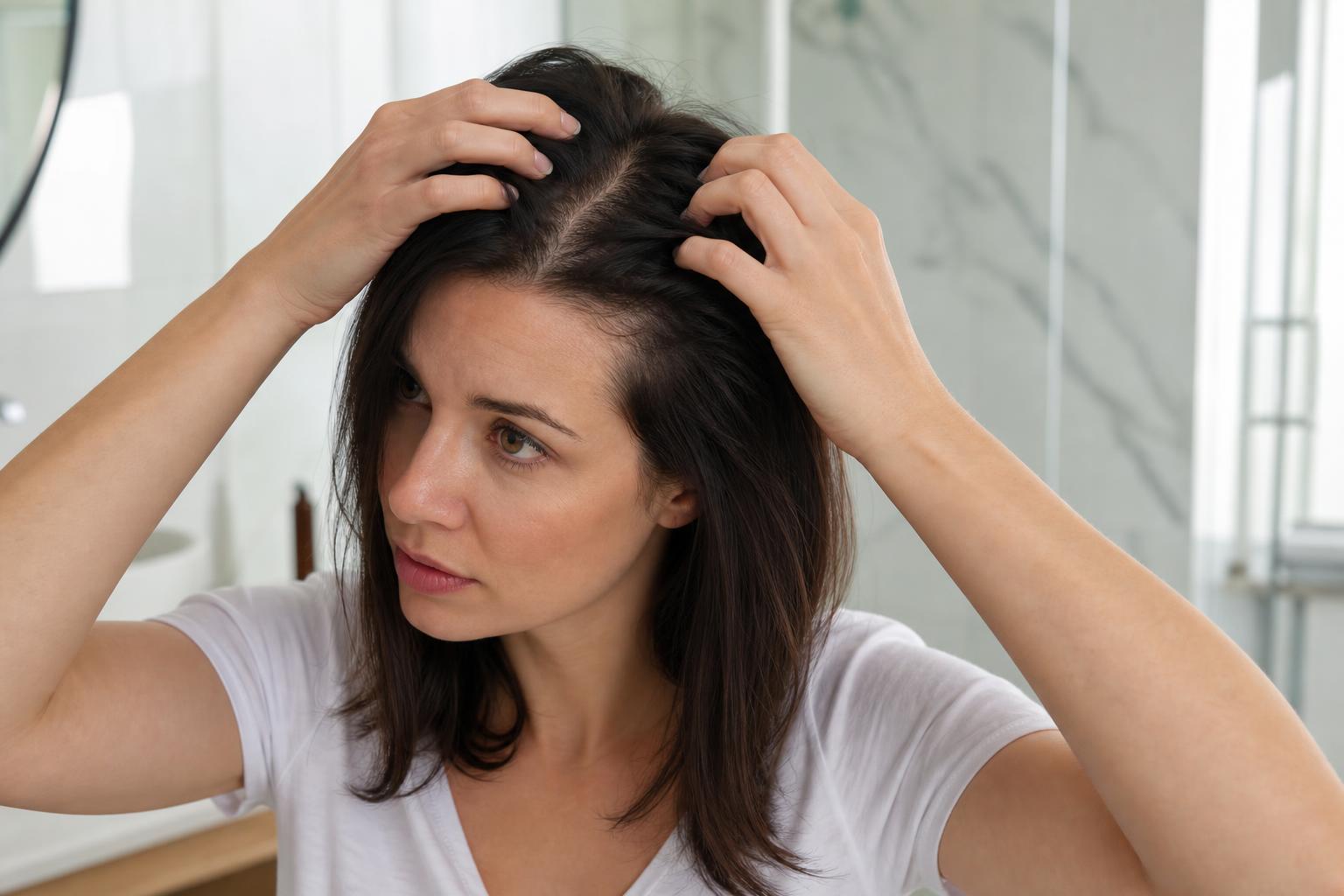
The two conditions look nearly identical in the mirror and need opposite treatments, which is why so many people spend months making theirs worse.
Dandruff flakes are large, slightly yellow, and greasy to the touch, and the scalp underneath feels oily. Dry scalp flakes are small, white, and powdery, and the skin underneath feels tight, the same way the skin on your shins feels in winter. That single difference decides everything, because dandruff is driven by an overgrowth of yeast on an oily scalp and needs an antifungal shampoo, while a dry scalp needs moisture and gentler washing.
This guide gives you a side-by-side symptom check, explains what is actually happening on the skin in each case, compares the active ingredients worth buying, walks through the application technique most people get wrong, and draws a clear line for when the problem stops being a shampoo question and becomes a dermatologist appointment.
The Three-Point Check That Tells Them Apart
Flake size, scalp feel, and oiliness settle it in under a minute. Part your hair under bright light in the middle of the day, ideally before you wash, and look at the skin rather than the flakes on your shoulders. Then run a fingertip across the crown and check what comes away on your finger. The table below is the whole diagnostic.
| Sign | Dandruff | Dry Scalp |
|---|---|---|
| Flake size and color | Large, irregular, off-white to yellow | Small, fine, uniformly white and powdery |
| Flake texture | Slightly waxy, clings to the scalp and roots | Dry, falls freely onto clothing |
| How the scalp feels | Oily by the second day, sometimes tender | Tight, occasionally rough, never greasy |
| Redness | Often visible pink patches at the hairline and crown | Usually none, skin looks pale and matte |
| Skin elsewhere | Face may be oily, flaking around the nose and brows | Arms, legs, and hands dry at the same time of year |
| What washing does | Frequent washing helps | Frequent washing makes it worse |
| Seasonal pattern | Often worse in cold months and under stress, present year-round | Appears in winter or after a change in water or climate |
The last row is the one people find most useful. If washing your hair more often makes the flaking better, you are dealing with dandruff, and if it makes things worse, your scalp is dry. That relationship holds up more reliably than flake appearance alone, particularly for anyone who has already been using a harsh medicated shampoo and has muddied the picture.
Dandruff Is a Yeast Overgrowth, Not a Hygiene Failure
Everyone carries Malassezia yeast on their scalp. It feeds on the fatty acids in sebum, and in some people the by-products of that process irritate the skin, which speeds up skin cell turnover dramatically. Instead of shedding invisibly over about a month, cells clump together and come off in visible clusters within days. That clumping is what gives dandruff flakes their size and slight yellow cast, and the oil is why they cling.
This matters because it reframes the whole treatment. You are managing a microbial population on oily skin, which is why the fix is an antifungal active rather than a moisturizer, and why washing more often helps rather than hurts. Dandruff is also widely understood as the mildest end of the same spectrum as seborrheic dermatitis, and the research literature on Malassezia and seborrheic dermatitis treats them as a continuum rather than separate conditions. If your flaking comes with visible redness and swelling, you are further along that spectrum.
Stylist tip: Stress and cold weather both make dandruff flare, so if yours arrives every January and again during a busy work period, that pattern is diagnostic on its own. Nothing about your washing habits changed. The yeast just got a better environment.
Dry Scalp Is Water Loss on the Skin, Same as Anywhere Else
A dry scalp is skin that has lost too much water through a damaged barrier, and the causes are the boring ones: hot showers, cold dry air, over-washing, harsh surfactants, and mineral-heavy water. There is no microbial component, no inflammation in most cases, and no excess oil. The flaking is fine and powdery because the cells are shedding individually rather than in clumps.
Two causes get missed constantly. The first is washing frequency, since stripping the scalp of sebum daily removes exactly what it needs to hold water, and stretching the interval fixes many cases without any product at all. Our guide to how often you should wash your hair covers how to make that transition without a greasy adjustment period. The second is water quality, because mineral deposits from hard water leave a film on the scalp that both dries the skin and blocks whatever you apply on top of it.
The counter-intuitive part is that anti-dandruff shampoo makes a genuinely dry scalp measurably worse. Those actives are built to reduce oil and yeast, and applying them to skin that has neither produces tighter skin, more flaking, and a person who concludes their dandruff must be severe. It is the single most common self-treatment error in this category.
Choosing the Right Active Ingredient
If your check points to dandruff, the product decision comes down to one line on the back of the bottle. The American Academy of Dermatology names six actives worth looking for, and they work through different mechanisms, so the one that fails for a friend may be the one that works for you. Match the active to how stubborn your flaking is, and give any choice at least four weeks before deciding it does not work.
| Active Ingredient | How It Works | Best For | Watch Out For |
|---|---|---|---|
| Zinc pyrithione | Slows yeast growth and reduces flaking | Mild to moderate dandruff, first thing to try | Effect can plateau after months of continuous use |
| Ketoconazole | Antifungal that targets the yeast directly | Flaking that has not responded to zinc | Drying on lengths, keep it on the scalp only |
| Selenium sulfide | Reduces yeast numbers and slows cell turnover | Heavier, more persistent scale | Can discolor blonde, gray, and color-treated hair |
| Salicylic acid | Loosens and lifts scale that is already stuck down | Thick patches, useful paired with an antifungal | Does not address yeast, so it rarely works alone |
| Sulfur | Antimicrobial with mild exfoliating action | Oily scalps that flare with sweat | Distinct smell that some people cannot tolerate |
| Coal tar | Slows the rate at which skin cells are produced | Stubborn cases, often used short-term | Raises sun sensitivity and can stain light hair |
Rotating between two actives with different mechanisms works better than sticking with one indefinitely, because the yeast population adapts to constant pressure from a single agent. A practical pattern is zinc pyrithione as the everyday choice with a ketoconazole shampoo once a week, then swapping which one leads if flaking creeps back after a few months.
Application Technique Decides Whether It Works
Anti-dandruff shampoo is a topical medication that happens to come in a shampoo bottle, and treating it like a cleanser is why so many people report it doing nothing. The active needs contact with the skin, and it needs time. The AAD guidance on how to treat dandruff at home is specific about both points.
Apply it to the scalp rather than the hair, using your fingertips to work it into the skin in sections rather than piling it on top of your head. Leave it on for five to ten minutes before rinsing, which feels like a long time in the shower and is the step almost everyone skips. Then condition the lengths only, keeping the conditioner away from the roots, since the actives are drying on hair even when they are helping the skin.
Frequency should follow your hair type rather than the box. Fine or oily hair can take a medicated wash twice a week alongside regular shampooing, while curly and coily textures generally do better with once a week and the product confined strictly to the scalp. That restraint matters more for textured hair, where a scalp routine built around the length of the hair keeps the skin treated without dehydrating the strands.
Fixing a Genuinely Dry Scalp
If the check pointed the other way, the plan is subtraction before addition. Drop the water temperature, because hot water strips the lipid barrier faster than any shampoo does, and lukewarm is enough to clean. Stretch the interval between washes by a day and hold there for two weeks before stretching again. Switch to a sulfate-free or low-surfactant cleanser and stop scrubbing the scalp with your nails.
Then add moisture directly to the skin rather than to the hair. A lightweight scalp oil or a leave-in serum with humectants applied to the parted scalp overnight, once or twice a week, does more than any conditioner reaching the roots by accident. Rice bran, squalane, and jojoba are light enough not to weigh hair down at the root. Heavier oils such as coconut work but need washing out properly, which partly defeats the purpose if over-washing is the original cause.
Stylist tip: Run a humidifier in the bedroom through the winter if your dry scalp is seasonal. It is unglamorous advice and it outperforms every scalp product on the shelf for people whose flaking arrives with the heating and leaves in spring, because you are fixing the cause rather than treating the symptom.
When to Stop Self-Treating and See a Dermatologist
Both conditions are meant to respond to over-the-counter care within a few weeks. When they do not, something else is usually going on, and several scalp conditions mimic dandruff closely enough that self-diagnosis stops being reliable. Book an appointment with a board-certified dermatologist if any of the following apply.
- Four to six weeks of correct treatment has produced no change. Persistent flaking that resists the right active often turns out to be psoriasis, eczema, or a fungal infection needing prescription treatment.
- The scalp is visibly red, swollen, or weeping. Inflammation at that level is past the dandruff end of the spectrum and needs a proper look.
- There are thick, silvery, well-defined plaques. That pattern points toward scalp psoriasis, which does not respond to standard anti-dandruff shampoo.
- You are losing hair in the affected areas. Flaking with patchy hair loss can indicate a fungal infection or a scarring condition where early treatment genuinely changes the outcome.
- The scalp is painful, tender, or has open sores. Pain is not a feature of either dandruff or dry scalp, and it warrants a medical opinion rather than another shampoo.
- Flaking started after a new medication. Several drug classes affect skin turnover, and your prescriber needs to know.
FAQ
Can I Have Dandruff and a Dry Scalp at the Same Time?
Yes, and it is more common than people expect, usually because months of harsh medicated shampoo have dried the skin on top of an existing yeast problem. Treat the dryness for two weeks with gentler washing and a scalp oil while keeping just one medicated wash per week, then reassess. Trying to fix both at full strength at once tends to leave the scalp worse than either condition alone.
Does Dandruff Mean My Hair Is Dirty?
No, and the belief that it does causes real harm, because embarrassment pushes people toward over-washing and harsher products. Dandruff is a response to yeast on an oily scalp, and clean hair develops it just as readily. Washing more often does help, but as a way of managing oil and yeast rather than as a correction for poor hygiene.
Will Anti-Dandruff Shampoo Fade My Hair Color?
Some actives will, and selenium sulfide and coal tar are the two most likely to shift tone on blonde, gray, or color-treated hair. Zinc pyrithione and ketoconazole are the safer picks if you color regularly. Applying strictly to the scalp and rinsing thoroughly limits contact with the lengths, which is where the color lives.
Is a Scalp Scrub a Good Idea for Flaking?
A physical scrub can help lift stuck scale before a medicated wash, used no more than once a fortnight. It is a poor primary treatment though, because removing flakes does nothing about the yeast producing them, and vigorous scrubbing on an inflamed scalp makes redness worse. If you use one, apply it before shampooing rather than after.
Can Diet Cause Dandruff?
The evidence for specific foods triggering dandruff is weak, and eliminating dairy or sugar rarely produces a visible change on its own. What does have a documented relationship is stress, which reliably worsens flaking for many people. Sleep and stress management are the lifestyle factors worth the effort here.
Why Does My Dandruff Come Back Every Time I Stop the Shampoo?
Because the treatment controls the yeast population rather than eliminating it, and the yeast is a permanent resident of your scalp. Most people need an ongoing maintenance wash once a week or once a fortnight indefinitely, in the same way that managing oily skin is continuous rather than curative. Stopping entirely once things look clear is the usual reason for a flare six weeks later.
Does Dry Scalp Cause Hair Loss?
Dry scalp on its own does not cause hair loss, though heavy scratching can break hairs near the root and create the appearance of thinning. Untreated inflammatory conditions are a different matter, which is why persistent redness or soreness alongside shedding deserves a dermatologist rather than another product. Building a gentler overall hair care routine usually settles the scratching within a couple of weeks.
Getting the dandruff vs dry scalp question right the first time saves months of buying products aimed at the wrong problem, and the three-point check takes less time than reading a label. Look at flake size, feel the skin rather than the flakes, and notice whether washing helps or hurts. If four to six weeks of the correct approach changes nothing, the next step belongs to a dermatologist rather than another bottle, and the rest of your hair care will work better once the scalp underneath is settled.
Hair results vary based on your natural hair type, texture, density, and condition. Always consult with a licensed hairstylist before making significant changes, especially with chemical treatments or dramatic length changes. Photos may show styled results that require professional tools and products to replicate.