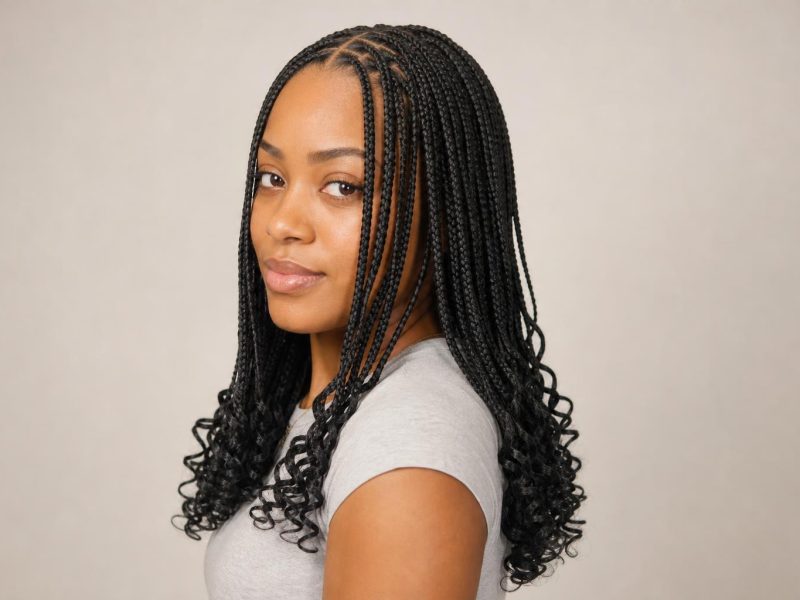

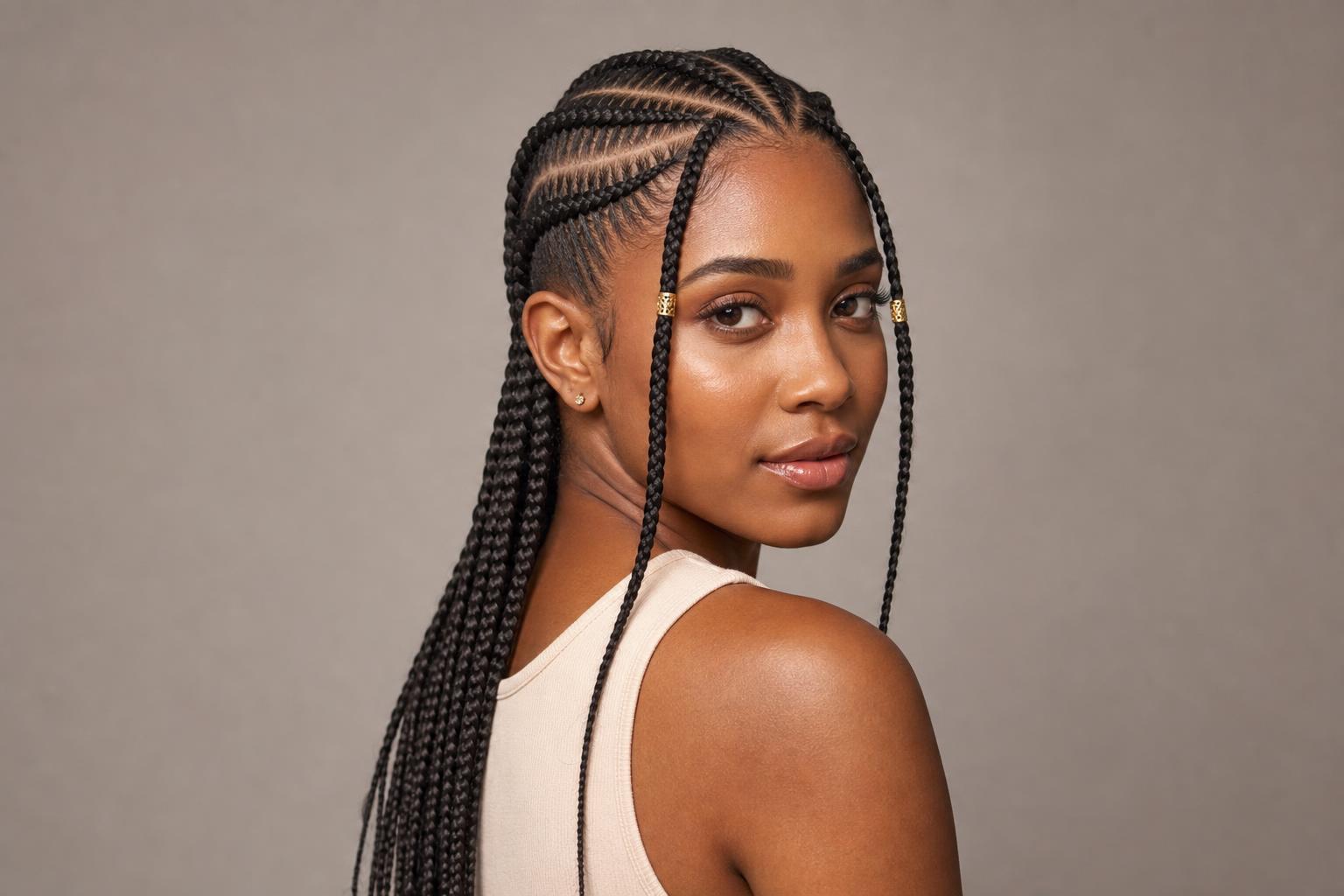
Fulani braids are recognized by their layout rather than their size: a cornrow running down the center of the head, cornrows angled back on the sides, and one or two braids left loose to frame the face.
Fulani braids take their name and their pattern from the Fulani people of West Africa and the Sahel, where the arrangement of a woman’s braids has long carried information about her age, her family, and her status. The style that reaches most salons today keeps the core layout: a braid or cornrow down the middle, cornrows angled back on either side, and long braids left hanging at the temples, usually finished with beads or metal cuffs. Below are 30 versions grouped by pattern, by the accents used, by braid weight, and by the updos they gather into.
After the gallery come the parts that decide whether you actually enjoy wearing them: how to describe the pattern you want to a braider, what install time and cost look like, how long they realistically last, and how to protect your edges through the wear. If you want the same protective idea in a different layout, the wider range of braided styles for Black hair covers the alternatives.
| Factor | Details |
|---|---|
| Best for | Type 3 and 4 textures with at least three inches of length to braid from |
| Install time | 4 to 8 hours depending on braid size and whether extensions are added |
| How long they last | 4 to 6 weeks, with 8 weeks as the absolute limit before takedown |
| Avoid if | Your edges are already thinning, or your scalp is currently sore or inflamed |
| Upkeep | Scalp wash every 8 to 10 days, satin covering nightly, oil twice a week |
Classic Fulani Braid Patterns
These keep the traditional geometry with no added accents, so the pattern itself does all the work. A braider builds them by parting the center section first, laying the middle cornrow, then working outward on both sides so the angles stay symmetrical. Getting that first center part straight is the hardest technical part of the whole style.
1. Center Cornrow with Side Braids
The braider lays a single cornrow straight down the middle of the head from the front hairline to the crown, then feeds the side sections into cornrows angled backward toward the ears. Two braids at the temples are left to hang loose against the face. This is the closest version to the traditional arrangement and the base every other style in this gallery builds from.

2. Five-Braid Traditional Pattern
Five long braids frame the face in the older Fulani arrangement, two on each side and one following the center line, and the extra face-framing weight softens a broad forehead or a strong jaw. Square and round faces gain the most, since the vertical lines running down both sides narrow the outline.

3. Fulani Braids on Fine Natural Hair
Fine 4a and 4b hair cannot support heavy extensions, so the braids are kept small and the added hair is limited to about half what a thicker head would take. Ask for the cornrows to be laid slightly wider apart, which spreads the same tension across more scalp.

4. Fulani Braids Styled Half Up
Gather the back half of the loose braids into a soft puff at the crown and secure with a covered elastic, leaving the face-framing braids down. This keeps the pattern visible from the front while getting the length off your neck. It takes about a minute and puts no extra pull on the roots.

5. Long Fulani Braids to the Waist
Waist-length braids add real weight, and weight is what pulls on the roots over a six-week wear, so this length is best kept to four or five weeks rather than pushed to eight. Sleeping with the length gathered loosely at the top of the head rather than lying flat under you takes a surprising amount of strain off the hairline.

6. Honey Blonde Fulani Braids
Honey blonde extension hair against a dark natural root makes the cornrow pattern far easier to see, because the parted scalp lines stand out against the lighter braids. Pre-colored braiding hair avoids any lightener touching your own strands, which is the safest way to wear a light shade in a protective style.

7. Fulani Braids with a Zigzag Part
Ask for a zigzag center part instead of a straight one, and say how many peaks you want across the front so the braider can space them evenly. The phrase braiders recognize is zigzag part on the center cornrow. A zigzag also disguises an uneven natural part line, which a straight center cornrow exposes completely.

8. Fulani Braids with Straight-Back Cornrows
Where stitch braids run every cornrow straight back in parallel lines, the Fulani layout angles the side rows toward the ears and breaks the symmetry with a center row running the opposite way. Combining the two gives you clean parallel rows at the back with the Fulani face-framing braids at the front.

Fulani Braids with Beads, Cuffs, and Cowrie Shells
Accents are part of the tradition rather than a modern addition, and in Fulani culture cowrie shells and metal ornaments carried meaning about wealth and status. What you choose changes the weight of the style as much as the look, since a full head of beads adds noticeable pull at the roots. Most braiders will place accents only on the front and face-framing braids for this reason.
9. Gold Cuffs on the Front Braids
Metal cuffs slide over a finished braid and are pressed closed with pliers, so they can be moved or removed without touching the braid itself. Three or four spaced along each face-framing braid gives the pattern definition without loading the whole head.

10. Cowrie Shell Fulani Braids
Cowrie shells threaded onto the front braids draw the eye to the temples and cheekbones, which balances a narrow forehead or a pointed chin. Heart and diamond face shapes benefit most from placing the shells high, closer to the ear than the end of the braid.

11. Beaded Ends on Thick Coily Hair
Dense 4b and 4c hair produces heavier braids to begin with, so beads at the ends should be kept to the outer few braids rather than the full head. Wooden beads weigh roughly half what glass ones do at the same size, which matters over a five-week wear.

12. Beaded Fulani Braids Gathered to One Side
Sweep the full length over one shoulder and secure the gathered braids loosely at the nape with a satin scrunchie. Beads clustered near the ends land against the collarbone this way, which is where they catch the most light. Undo it before sleeping so the pull is not held in one direction all night.

13. Minimal Cuffs for Everyday Wear
Two cuffs total, one on each face-framing braid, gives the style its Fulani signature with almost no added weight and nothing to catch on a coat collar or a car headrest. This is the version that survives a full six weeks with the least edge stress.

14. Copper Beads on Dark Braids
Warm copper and bronze read strongly against jet black braiding hair, where silver tends to disappear into the darkness at any distance. If your braiding hair is a dark brown rather than true black, copper blends instead of contrasting, so silver or gold is the better pick.

15. Fulani Braids with Wooden Beads
Tell your braider how many beads per braid and where you want them stopped, because left open-ended most will bead all the way to the tips. A useful instruction is beads on the front four braids only, three per braid, none past the shoulder.

16. Fulani Braids Without Any Beads
Stripped of accents, the style relies purely on the parting geometry, which puts more pressure on the braider to lay clean, even lines. It also drops perhaps a third of the total weight, making it the sensible choice if you have worn braids recently and want to give your edges an easier round.

Knotless and Lightweight Fulani Variations
Knotless braiding starts with your own hair and feeds the extension in gradually over the first inch, rather than anchoring it with a knot at the root. That change in method removes the concentrated pull at the scalp that traditional knots create, which is why most braiders now recommend it by default for anyone whose edges have been stressed before.
17. Knotless Fulani Braids
The braider begins each braid with your natural hair alone, then adds small pieces of extension across the first inch so the weight builds up gradually instead of all at once at the root. This adds roughly an hour to the install and is the single most effective change you can make to how the style feels, particularly in the first three days. The medium knotless approach applies the same method at a size that balances install time against wear.

18. Short Bob-Length Fulani Braids
Cutting the braids to jaw or chin level puts the visual weight right at the jawline, which flatters a long or oblong face by adding width where the face is narrowest. Round faces should take the length to the collarbone instead so the outline stays vertical.

19. Fulani Braids on Relaxed Hair
Relaxed hair is chemically weakened at the point where the treated section meets new growth, and that line is exactly where braid tension concentrates. Wait at least two weeks after a relaxer before braiding, and ask for looser tension at the roots than you would on natural hair.

20. Boho Fulani Braids with Loose Curls
Curly extension pieces are left unbraided along the length so loose spirals fall between the braids, softening the geometry of the cornrows at the front. Scrunch the loose curls with a water and leave-in mix every few days to bring the pattern back. The same finish drives boho knotless braids, which use curls the same way at a different scale.

21. Medium Fulani Braids for a Six-Week Wear
Medium braids, roughly the width of a pencil, are the size that reliably reaches six weeks, because small braids frizz at the roots by week four and jumbo ones pull too hard to leave in that long. Install takes five to six hours at this size.

22. Ombre Fulani Braids from Black to Caramel
Ombre braiding hair shifts from your natural depth at the root to a lighter shade partway down, so the color change lands below the cornrow section and leaves the pattern reading in solid dark. Caramel is the most forgiving landing shade against deep skin tones and dark roots.

23. Jumbo Fulani Braids
Ask for jumbo braids by naming the finished thickness you want, roughly the width of a thumb, and confirm how many braids total that works out to. Jumbo sizing cuts install time to about three hours but concentrates weight into fewer anchor points, so tell your braider you want them left looser than usual.

24. Side-Swept Fulani Braids
Where lemonade braids send every cornrow sweeping to one side in parallel, this keeps the Fulani center row and angled sides but shifts the whole pattern off-center so it leans one way. The result reads as Fulani from the front and lemonade from the side, and it suits anyone who wants asymmetry without giving up the face-framing braids.

Fulani Braids in Buns, Ponytails, and Updos
Gathering the length up is how most people wear Fulani braids after the first fortnight, once the novelty of the length wears off and practicality takes over. The important rule is to vary where you gather them, because holding the same updo daily concentrates pull at the same spots on the scalp for weeks. Rotate between a high bun, a low bun, and down.
25. Fulani Braids in a High Bun
All the braids are gathered at the crown and coiled around themselves, then pinned with two or three long bobby pins pushed inward toward the center. The cornrow pattern at the front stays fully visible, which is the point: a high bun is the updo that shows the most Fulani geometry.

26. Fulani Braided Ponytail
A ponytail gathered at the mid-back of the head lifts the cheekbones and lengthens a round face without the severity of a tight high pony. Long or oblong faces should keep the gather lower, at the nape, so the head does not read as taller still. The same placement logic runs through most braided ponytail variations.

27. Fulani Braids Coiled into a Low Bun
Dense hair with a full set of long braids can weigh a surprising amount once gathered, and a low bun at the nape carries that load along the strongest part of the scalp rather than the crown. If your braids reach past the waist, this is the only updo worth holding for a full day.

28. Fulani Braids Wrapped into a Top Knot
Twist the gathered braids into a rope, wind the rope around its own base, and tuck the end underneath rather than pinning it, so the knot holds by tension instead of hardware. It takes about thirty seconds and comes down without catching a single braid.

29. Half-Up Fulani Bun for Week Four
By week four the roots have grown out enough that the parting lines look fuzzy, and a half-up bun hides the crown section while leaving the crisp front cornrows on display. This is the style that buys most people the last two weeks of a six-week wear.

30. Burgundy Fulani Braids in a Low Ponytail
Deep burgundy braiding hair carries enough red to lift warm undertones in the skin while staying dark enough to keep the cornrow lines defined. Gathered into a low ponytail, the color concentrates below the shoulders where the braids fall together.

What Makes a Braid Style Fulani
Fulani braids are named for the Fulani, also called the Fula, a large ethnic group spread across Senegal, Mali, Guinea, Niger, and northern Nigeria, among other countries. Within Fulani communities the arrangement of a woman’s braids and the ornaments worn in them communicated real information about her age, her marital status, and her family’s standing, which is why the pattern is specific rather than decorative.
Three elements make a style Fulani rather than simply a set of cornrows: a braid or cornrow running down the center of the head, cornrows angled backward on both sides rather than straight back, and at least one braid left loose to frame the face. Accents such as cowrie shells and metal rings are traditional, though a style without them is still Fulani if the geometry holds. The name tribal braids is often used for the same look, a broad label that flattens dozens of distinct West African traditions into one term, so naming the pattern specifically is both more accurate and more useful when you book.
How to Choose Fulani Braids for Your Face Shape
The face-framing braids are the part of this style that interacts with your features, and where they fall changes what the style does for you. Braids ending at the jaw add width there, braids ending at the collarbone lengthen the whole face, and where you place beads pulls the eye to that height.
| Face Shape | Best Version | Bead Placement | Avoid |
|---|---|---|---|
| Oval | Any length, classic center pattern | Anywhere along the braid | Nothing structural |
| Round | Long braids past the collarbone | Low, near the ends | Chin-length bob braids, which widen at the cheeks |
| Square | Five-braid pattern with soft face framing | Below the jaw | A tight high bun with no braids left down |
| Heart | Cowrie shells set high near the temples | High, at cheekbone level | All the weight at the ends, which narrows the chin further |
| Oblong or long | Bob-length braids ending at the jaw | At jaw level | Waist-length braids plus a high bun |
| Diamond | Face-framing braids left fuller at the front | High and low, skipping the middle | A center part pulled flat and tight |
What to Tell Your Braider
Book a consultation or send photos ahead, because Fulani braids involve more decisions than most protective styles: pattern, braid size, length, whether extensions are added, knotless or knotted, and what accents go where. A complete brief sounds like this: “Knotless Fulani braids, medium size, mid-back length, straight center cornrow, three gold cuffs on each face-framing braid and none anywhere else.”
Stylist tip: Say the words “please braid my edges loose” at the start of the appointment, not after you feel the pull. Braiders work to the tension they are used to, and the baby hairs at your hairline are the finest strands on your head, so they are the first to break and the slowest to come back.
Ask what weight of braiding hair is being used and how many packs. Three to four packs is typical for a mid-back medium set; if a braider reaches for six, the finished style is going to be considerably heavier than the photo you brought. Pre-stretched braiding hair also saves time and reduces the pulling that comes from separating fibers mid-braid.
Install Time, Cost, and How Long They Last
Fulani braids last four to six weeks, and eight weeks is a hard ceiling rather than a target. Past that point your own regrowth has loosened the braid at the root while the extension weight stays constant, which is the exact combination that puts strain on the follicle. Frizz at the roots is the honest signal that the style has reached the end of its useful life.
| Braid Size | Install Time | Realistic Wear | Weight on the Scalp | Takedown Time |
|---|---|---|---|---|
| Small | 7 to 9 hours | 4 to 5 weeks | Light per braid, heavy in total | 3 to 5 hours |
| Medium | 5 to 6 hours | 5 to 6 weeks | Balanced, the usual recommendation | 2 to 3 hours |
| Jumbo | 3 to 4 hours | 3 to 4 weeks | Concentrated into few anchor points | 1 to 2 hours |
| Knotless, medium | 6 to 7 hours | 5 to 6 weeks | Gradual, easiest on the roots | 2 to 3 hours |
Stylist tip: Wash your scalp every eight to ten days rather than avoiding water for the whole wear. Dilute a clarifying shampoo in a squeeze bottle, apply it along the parted rows only, and rinse in the direction the braids hang. Skipping washes entirely is what produces the buildup and itching most people blame on the braids themselves.
Protecting Your Hairline Through a Braided Style
Tension at the roots held over weeks can cause traction alopecia, a form of hair loss the American Academy of Dermatology explains in its guidance on pulling hairstyles, and it names tightly braided hair and cornrows among the styles that carry the risk. Caught early it reverses; once scarring begins it does not. These are the signals worth acting on rather than waiting out.
- Your scalp still feels sore or tender more than 48 hours after the install. Normal tightness settles within two days, and pain past that means the tension is too high. Ask your braider to take down and redo the tightest rows rather than living with it.
- You see small bumps or pustules along the parted rows. That is inflammation at the follicle, not a product reaction, and continuing to wear the style makes it worse.
- Short broken hairs appear along the hairline when you take the braids down. This is the earliest visible stage, and the response is to stay out of tension styles for two to three months.
- Your edges have not fully returned from a previous braided style. Going straight back in compounds the damage. Wear a low-tension style such as two-strand twists for a cycle first.
Nightly protection makes a measurable difference across a six-week wear. Cover the braids with a satin scarf or bonnet, or sleep on a satin pillowcase if a bonnet slides off, since cotton pulls moisture out of both your hair and your scalp and creates friction at every parted row. The difference between the satin and silk options matters less than simply using one of them.
FAQ
How Long Do Fulani Braids Last?
Four to six weeks for most people, with eight weeks as the outer limit before takedown becomes necessary. Braid size is the main variable: small braids frizz at the roots around week four, medium ones hold to six, and jumbo braids pull too hard to leave in past four. Your own growth rate matters too, since faster-growing hair loosens the braid at the root sooner.
Do Fulani Braids Damage Your Hair?
Not when installed at a reasonable tension and taken down on time, though the risk is real when either of those slips. The damage comes from three things: braids installed too tight, extension weight held too long, and going straight from one braided style into the next without a break. Give your hair two to three weeks loose between protective styles and the risk drops sharply.
What Is the Difference Between Fulani Braids and Tribal Braids?
Fulani braids name a specific pattern from a specific culture, while tribal braids is a catch-all marketing term covering many West African braiding traditions at once. In practice most salons offering tribal braids are producing the Fulani layout. Naming the pattern you want makes the booking clearer and credits the tradition it came from.
Can You Get Fulani Braids on Short Hair?
Yes, provided you have roughly three inches of length for the braider to grip and anchor the extension into. Below that, the cornrow section will not hold and braids slip out within days. If your hair is shorter, wait for the extra growth rather than having a braider work with an inch, which requires much higher tension to stay in.
How Much Do Fulani Braids Cost?
Pricing varies enormously by region, braider experience, and braid size, so the more useful thing to ask about is time: five to six hours for a medium set, seven to nine for small, three to four for jumbo. Most braiders price against those hours plus the braiding hair, and knotless installs cost more because they take an extra hour or so.
Can I Wash My Hair with Fulani Braids In?
You should, roughly every eight to ten days. Use a diluted shampoo in a squeeze bottle applied directly to the parted rows, work it in with fingertips rather than nails, then rinse downward in the direction the braids fall. Drying matters as much as washing, since a damp scalp under braids is what produces the musty smell people associate with long wears.
Do Beads Damage the Braids?
Beads themselves do not, but their weight adds up and the clamps used to secure them can crimp a braid if fitted too tightly. Wooden beads weigh about half what glass ones do at the same size, and keeping them to the front braids alone gives you the look without loading the whole head. Remove them before the final week if the style starts feeling heavy.
Fulani braids reward specificity more than most protective styles, because the pattern, the braid size, and the accent placement are three separate decisions that a braider cannot guess for you. Decide those before your appointment, ask for loose edges out loud, and set a takedown date in your calendar the day you get them installed. That last habit protects your hairline better than any oil.
Hair results vary based on your natural hair type, texture, density, and condition. Always consult with a licensed hairstylist before making significant changes, especially with chemical treatments or dramatic length changes. Photos may show styled results that require professional tools and products to replicate.