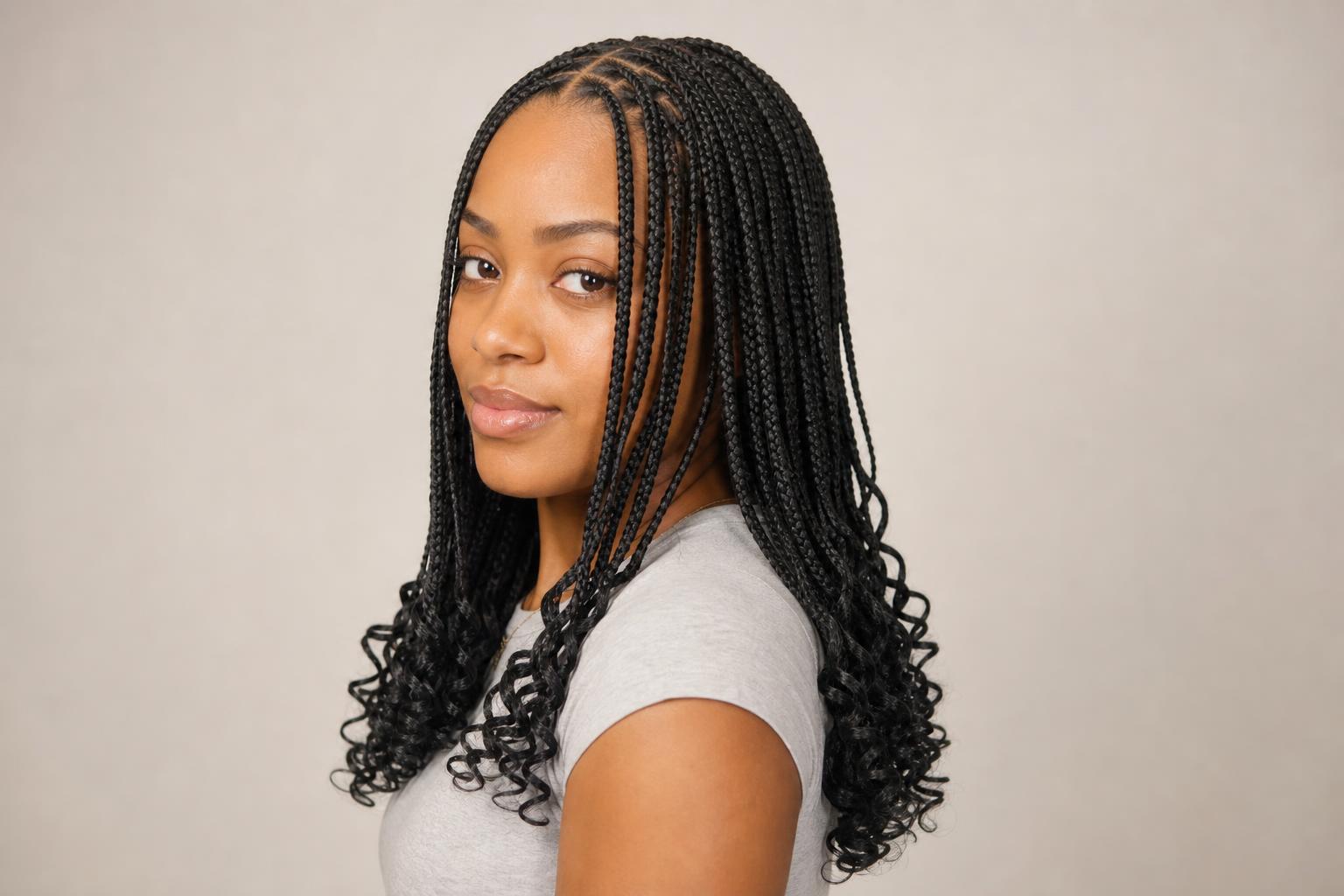
French curl braiding hair is a pre-curled synthetic fiber with a loose S-wave pattern, fed into the last few inches of a braid so the ends fall in soft ringlets instead of a straight plait.
The whole appeal sits in the ends. Your braider plaits your natural hair with regular braiding fiber, then swaps to French curl hair somewhere between the ear and the mid-back depending on how much curl you want, and the braid finishes in a defined spiral that needs no rod setting and no hot water dip. A full head runs 4 to 8 hours and lasts 4 to 6 weeks before the curls start matting at the ends.
Below are 25 variations grouped by length, then by texture mix and color. After the gallery there are concrete pack counts by length and part size, a face shape guide, exact wording for the consultation, a refresh routine that keeps the curls from tangling, and the situations where this style is a poor idea for your hairline.
| Factor | Details |
|---|---|
| Best for | Type 3 and 4 textures with at least 3 inches of natural length to braid |
| Install time | 4 to 8 hours; jumbo parts closer to 4, small parts closer to 8 |
| Wear time | 4 to 6 weeks; the curls degrade before the braids do |
| Hair needed | 5 to 9 packs depending on length and part size |
| Avoid if | Your edges are already thin, or you have had traction damage before |
| Rest period after | Two weeks minimum before the next protective style |
Bob and Shoulder-Length French Curl Braids
Short French curl styles put the curl right at the jaw or collarbone, which is where it gets the most attention and the least tangling. They also cut install time roughly in half and weigh far less on the scalp, so they are the sensible starting point if you have never worn a heavy protective style. Smaller parts matter more at this length, because a bob with chunky sections looks sparse.
1. Chin-Length French Curl Bob
Braiders plait to just below the ear and let three or four inches of curl fall from there, which lands the ringlets right at the jaw. Small parts are essential here; with jumbo sections a bob looks thin from the crown down. Install runs about four hours.
2. Collarbone Bob with a Middle Part
A clean center part suits oval and heart-shaped faces because it splits the volume evenly on both sides of the face. The braided portion is short enough that the weight sits forward instead of pulling backward on the crown. Expect this one to hold its shape better through week four than any longer version.
3. Shoulder-Grazing Bob with Side-Swept Parting
Shifting the part off center puts more mass on one side and softens a square jaw or a wide forehead. Ask for the parting line to be cut diagonally from the crown rather than straight back. It changes the fall of the whole style.
4. Knotless French Curl Bob
Feeding hair in gradually instead of anchoring with a knot at the root removes most of the tension at the scalp, which is the difference between a comfortable first week and three nights of headaches. The technique works exactly as it does with standard knotless braids, just with curl fiber at the ends. Nobody should be installing curl braids with knots in 2026.
5. Layered Bob with Staggered Curl Points
Swapping to curl fiber at different heights across the head creates layers, with the front braids curling higher than the back. The effect reads as a shaped haircut rather than a uniform plait. Tell your braider you want the transition point raised by about an inch on the face-framing sections.
6. Bob with a Cornrow Crown
Flat cornrows across the top for four or five rows, then loose curl braids from the crown back, gives structure at the scalp and movement everywhere else. Dense hair benefits most because the cornrows control bulk that would otherwise sit high on the head. Frontal cornrows also protect the edges from the pull of loose braids.
7. Bob with Curled Ends and a Blunt Perimeter
Trimming every braid to land at the same point creates a defined bottom line, which is a departure from the tapered ends most curl styles have. The result photographs sharply and suits anyone who likes a polished finish. Ask for the perimeter to be evened up after the install, not before.
Mid-Back and Waist-Length French Curl Braids
Longer French curl styles are the version most people picture, and they carry two costs the e-commerce blogs skip: real weight on the scalp and real tangling at the ends. Both are manageable, but they should factor into your decision about part size. A waist-length style with small parts is a genuinely heavy install that puts sustained tension on the follicle.
8. Mid-Back Knotless with Curls from the Elbow Down
Starting the curl fiber around elbow level gives roughly eight inches of ringlet at the bottom, which is the most common proportion and the easiest to maintain. The braided section above it keeps its neatness far longer than the curls do. Six to seven packs covers most heads at this length.
9. Waist-Length Jumbo Curl Braids
Larger parts drop install time to about four hours even at this length and take the weight down considerably, since there is less added fiber overall. Fine or low-density natural hair holds jumbo parts better than small ones, because each braid needs enough of your own hair at the root to grip. The trade-off is visible scalp between sections.
10. Butt-Length Curls for Special Occasions
At this length the style becomes an event look rather than a six-week protective style, and most braiders will tell you honestly that the weight is not sustainable for long wear. If you want it for a wedding or a trip, plan to take it down within three weeks. Sleep in a satin bonnet from night one.
11. Mid-Back with a Center-Parted Frontal Section
Leaving the front two rows parted down the middle and swept back creates a frame that opens the face, which flatters round and full face shapes by adding vertical line. The rest of the head can be parted however you like. This is a styling choice made at the install, not afterward.
12. Small Knotless Curls for Maximum Density
Smaller sections mean more braids, which reads as fuller hair and gives more styling flexibility for buns and half-up looks. Install stretches toward eight hours and you will need eight or nine packs. Anyone with a history of tension headaches should think carefully before committing to a full day in the chair.
13. Curl Braids with a Deep Side Part
Dropping the part low on one side sweeps a heavy section of braids across the forehead, which softens a high or uneven hairline. The asymmetry also breaks up a long face shape. Keep the swept section light enough that it does not drag on the opposite edge.
14. Half-Up Bun with Curls Left Down
Gathering the top half into a bun and leaving the lower braids loose is the most practical everyday styling for a long install, and it takes the weight off the nape for a few hours. Use a large soft scrunchie rather than an elastic. Anything tight at the gather point creates a break line in the braids.
15. Curl Braids Gathered into a Low Ponytail
Pulling everything back low leaves the curls cascading from a single point, which is the least stressful way to wear a heavy style for a long day. The braided ponytail approach distributes weight across the whole scalp rather than concentrating it at the crown. Never secure it high; a high ponytail on long braids is how edges break.
Boho and Mixed-Texture Variations
Mixing French curl fiber with loose wavy hair, or leaving curly pieces free along the braid, produces the softer bohemian look that has largely replaced the smooth uniform braid. These styles hide new growth better and grow out more gracefully, though the loose pieces need more attention on wash day.
16. Boho French Curls with Free-Flowing Pieces
Loose curly strands left out along the braid shaft, rather than only at the ends, give the deliberately undone finish that defines boho knotless styles. Ask for the loose pieces to start below the ear so they do not interfere with the parting. They tangle faster than the braided sections, so plan on more frequent detangling.
17. Goddess Braids with French Curl Ends
Wavy human hair blended through the braid plus French curl fiber at the tips creates two different textures in one style. The combination looks more like natural hair than either does alone. Bring photos of both textures to the consultation, because braiders interpret “goddess” very differently.
18. Curl Braids with a Wavy Middle Section
Introducing loose wave through the middle third and reserving the tight curl for the last few inches gives a graduated texture from top to bottom. Thick natural hair carries this best because it can support the extra fiber. It also disguises the transition point where the curl hair starts.
19. Bohemian Bob with Face-Framing Curls
Two loose curled pieces left free at the temples soften the hard line a bob parting creates and give something to tuck behind the ear. Keep these pieces short enough to sit above the collarbone. Longer face-framing strands catch on clothing constantly.
20. Curl Braids Blended with Fulani-Style Cornrows
Running a few cornrowed rows along the crown and down one side before releasing into curls borrows the structure of Fulani braiding patterns without the full commitment. The flat sections give the style a defined shape from above, which matters in photographs. Add cuffs or beads to the cornrowed sections only, never to the curls.
21. Chunky Boho Curls with Wide Parts
Wide sections with abundant loose curl hair produce a full, soft silhouette in roughly five hours. Lower-density hair reads as much thicker in this configuration than in small tidy parts. The look is closer to a curly wig than to a braided style, which some people want and others do not.
Colored and Statement French Curl Braids
Because the fiber is synthetic, color comes pre-made and involves no chemical processing of your own hair, which makes this the lowest-risk way to try a shade you would never commit to. Buy all packs of a color in the same batch, since dye lots vary noticeably between production runs.
22. Honey Blonde Curls on a Dark Braided Base
Keeping the braided portion in your natural depth and switching to blonde only at the curl point creates a graduated effect that reads like balayage. The contrast sits well away from the face, so it flatters most complexions. Order one extra pack of the blonde, because light fibers show gaps more.
23. Burgundy Curls Mixed Through Black Braids
Alternating a burgundy pack with a black pack across the head gives a dimensional finish that shows most when the hair moves. Deeper warm reds read as subtle indoors and obvious in sunlight. This mixing method is far more forgiving than a full head of one bright color.
24. Ombre Curls Fading from Brown to Caramel
Pre-ombred French curl packs shift color along the fiber, so the lightest tone lands in the curl itself. It suits anyone who wants brightness without a hard line where the color starts. Check that every pack in your order has the fade beginning at the same point.
25. Jet Black Curls with a Sleek Braided Crown
The most restrained version in this gallery: flat, precise parting at the top and glossy uniform curls below, with no color and no loose pieces. It suits formal settings and is by far the easiest to keep looking neat past week four. Edge control on the parting lines does most of the work here.
How Much Hair You Actually Need
Under-buying is the most common planning mistake, and running out mid-install means either an unplanned shop trip or a mismatched dye lot. These numbers assume standard-size packs and a full head; buy one extra pack beyond what the table says, because unopened packs are returnable and half-finished heads are not.
| Length | Jumbo Parts | Medium Parts | Small Parts | Install Time |
|---|---|---|---|---|
| Bob | 3 to 4 packs | 4 to 5 packs | 5 to 6 packs | 3 to 5 hours |
| Shoulder | 4 to 5 packs | 5 to 6 packs | 6 to 7 packs | 4 to 6 hours |
| Mid-back | 5 to 6 packs | 6 to 7 packs | 7 to 8 packs | 5 to 7 hours |
| Waist | 6 to 7 packs | 7 to 8 packs | 8 to 10 packs | 6 to 8 hours |
Stylist tip: Buy the braiding fiber for the base and the French curl fiber separately rather than using curl hair for the whole braid. Curl fiber is springier and harder to plait flat at the root, and using it top to bottom is why some installs look bulky at the scalp and cost two extra packs.
Choosing Length and Part Size for Your Face Shape
Braid length and where the curl starts do more for your proportions than the parting does. The rule that holds across face shapes: volume placed at the widest part of your face emphasizes it, and volume placed above or below it balances it.
| Face Shape | Best Length | Where Curls Should Start | Avoid |
|---|---|---|---|
| Oval | Any | Anywhere; proportions are already balanced | Very heavy curl right at the cheekbone |
| Round | Mid-back or longer | Below the collarbone, keeping length sleek above | Chin-length bobs with curl at the jaw |
| Square | Shoulder to mid-back | Just below the jaw, with a side part | Blunt perimeter bobs ending at the jawline |
| Heart | Collarbone bob | At the chin, adding width low on the face | Heavy volume above the temples |
| Oblong | Bob to shoulder | High, around the ear, for horizontal width | Waist-length styles, which lengthen further |
| Diamond | Shoulder length | Below the cheekbone, with face-framing pieces | Slicked-back parting with no volume at the temples |
What to Tell Your Braider
Most disappointing installs come from unstated assumptions rather than poor technique. Braiders work fast and follow whatever they are handed unless told otherwise, so cover these five points before anyone starts sectioning.
- Tension: “Knotless throughout, and please keep the first inch loose. If I say it is too tight, I need it redone rather than loosened.”
- Curl start point: “Switch to the curl hair at about elbow length,” or name a body landmark rather than a number of inches.
- Part size: bring a photo of the parting itself, not just the finished style, since part size is the single biggest driver of both cost and install time.
- Edges: “Do not braid my baby hairs into the front sections; leave them out entirely.”
- Finish: “No hot water dip on the curl fiber,” unless you have confirmed with the manufacturer that the specific fiber tolerates it.
That last point catches people out. French curl hair arrives with its pattern already set, and dipping it in hot water the way you would seal a straight braid can relax the curl into a limp wave. Sealing applies to the braided portion only, and even then it is optional with modern pre-stretched fiber.
Stylist tip: A tight install does not last longer. The braid grips your natural hair through friction along the shaft, not through tension at the root, so a painful install buys you nothing except follicle damage. If you leave the chair with visible bumps around the hairline, that is inflammation, and the style should come out rather than be waited out.
Keeping the Curls from Frizzing
The braided section will look fine for eight weeks. The curls will not, and they are the reason to take the style down. Most of the wear happens at night through friction, and most of it is preventable.
| Task | How Often | Method |
|---|---|---|
| Night protection | Every night, no exceptions | Loosely gather the curls, wrap in a satin scarf or large bonnet |
| Curl refresh | Every 3 to 4 days | Mist with water, smooth on a light foam mousse, scrunch upward |
| Scalp cleansing | Every 10 to 14 days | Diluted shampoo in an applicator bottle, straight onto the parts |
| Scalp oiling | Twice weekly | Lightweight oil along the parts only, never on the fiber |
| Detangling curls | Weekly | Fingers only, from the tips upward, on damp mousse-coated hair |
| Edge care | Daily | Light gel with a soft brush; skip stiff hold products entirely |
Take the style down at the first sign of matting at the ends rather than pushing to week eight. Detangle each braid before you unravel it, work in small sections with plenty of conditioner, and expect the shed hair that collects at the root: that is normal growth cycle shedding held in place by the braid, not breakage. Give your scalp a full two weeks and a proper deep condition before the next install, whether that is another set of curls or spring twists.
When French Curl Braids Are Not the Right Choice
This style is genuinely protective when installed properly, and genuinely damaging when it is not. Four situations warrant a different choice.
- Thinning edges or a receding hairline. Any braid that pulls on the perimeter accelerates traction alopecia, and the front sections carry the most tension. Cornrowed styles that anchor further back are a safer alternative while the hairline recovers.
- Recent chemical processing. Relaxed or freshly colored hair is already compromised at the shaft, and the added weight plus the takedown friction is more stress than it can take. Wait at least six weeks after any chemical service.
- An active scalp condition. Braids make medicated shampoo nearly impossible to apply properly, so flaking, psoriasis, or a fungal issue will get worse under a four-week install rather than better.
- Natural hair under about three inches. There needs to be enough length for the braid to grip, and shorter hair either slips out or gets braided so tightly it breaks at the root. Small twists or smaller box braids on a shorter base are the workaround.
FAQ
How Long Do French Curl Braids Last?
Four to six weeks is the realistic window for the style to still look good. The braided section holds for eight weeks or more, but the synthetic curls start frizzing and matting at the ends around week four, and matted fiber is difficult to take down without pulling your own hair. Nightly satin protection is what stretches the wear time.
Can You Wash French Curl Braids?
Yes, and you should every 10 to 14 days, but the technique matters. Put diluted shampoo in an applicator bottle and aim it at the parts rather than lathering the whole head, then rinse thoroughly and squeeze rather than rub. Soaking the curls repeatedly is the fastest way to lose their definition.
Do French Curl Braids Damage Your Hair?
Not by default, but three things make them damaging: tension at the root, wearing them too long, and rough takedown. A knotless install that is comfortable on day one, taken out at week five with conditioner and patience, leaves hair in good condition. Repeated back-to-back installs with no rest period cause more damage than any single style does.
Is French Curl Hair Different from Regular Braiding Hair?
Yes. It is a softer synthetic fiber with a permanent loose curl pattern already set into it, so it needs no rods, no perm rod setting, and no hot water dip to hold its shape. It is also springier, which makes it awkward to plait flat at the root, and that is why most braiders use standard fiber for the base and switch to curl fiber further down.
How Much Do French Curl Braids Cost?
Prices vary enormously by region and by braider experience, and part size drives the number more than length does. Small parts can double the labor cost of the same style in jumbo sections. Ask for a quote based on a photo of the parting rather than the finished look, and confirm whether the hair is included or billed separately.
Can I Get French Curl Braids with Fine or Low-Density Hair?
Yes, with two adjustments: choose larger parts so each braid has enough of your own hair to grip, and choose a shorter length to keep the weight down. A collarbone bob with medium parts is far kinder to fine strands than waist-length small braids. Ask your braider to skip the front hairline entirely if your edges are sparse.
The two decisions that shape any set of French curl braids are where the curl starts and how big the parts are, and both are worth settling before you sit down rather than mid-install. Take a photo of the parting alongside your inspiration picture, say plainly that you want it knotless and comfortable, and set a takedown date around week five so the curls come out before they mat. Treated that way, french curl braids give you five clean weeks and hair that is in better shape at the end than at the start.
Hair results vary based on your natural hair type, texture, density, and condition. Always consult with a licensed hairstylist before making significant changes, especially with chemical treatments or dramatic length changes. Photos may show styled results that require professional tools and products to replicate.