Tribal braids is a salon umbrella term, and knowing which named style you actually want is what gets you the right result in the chair.
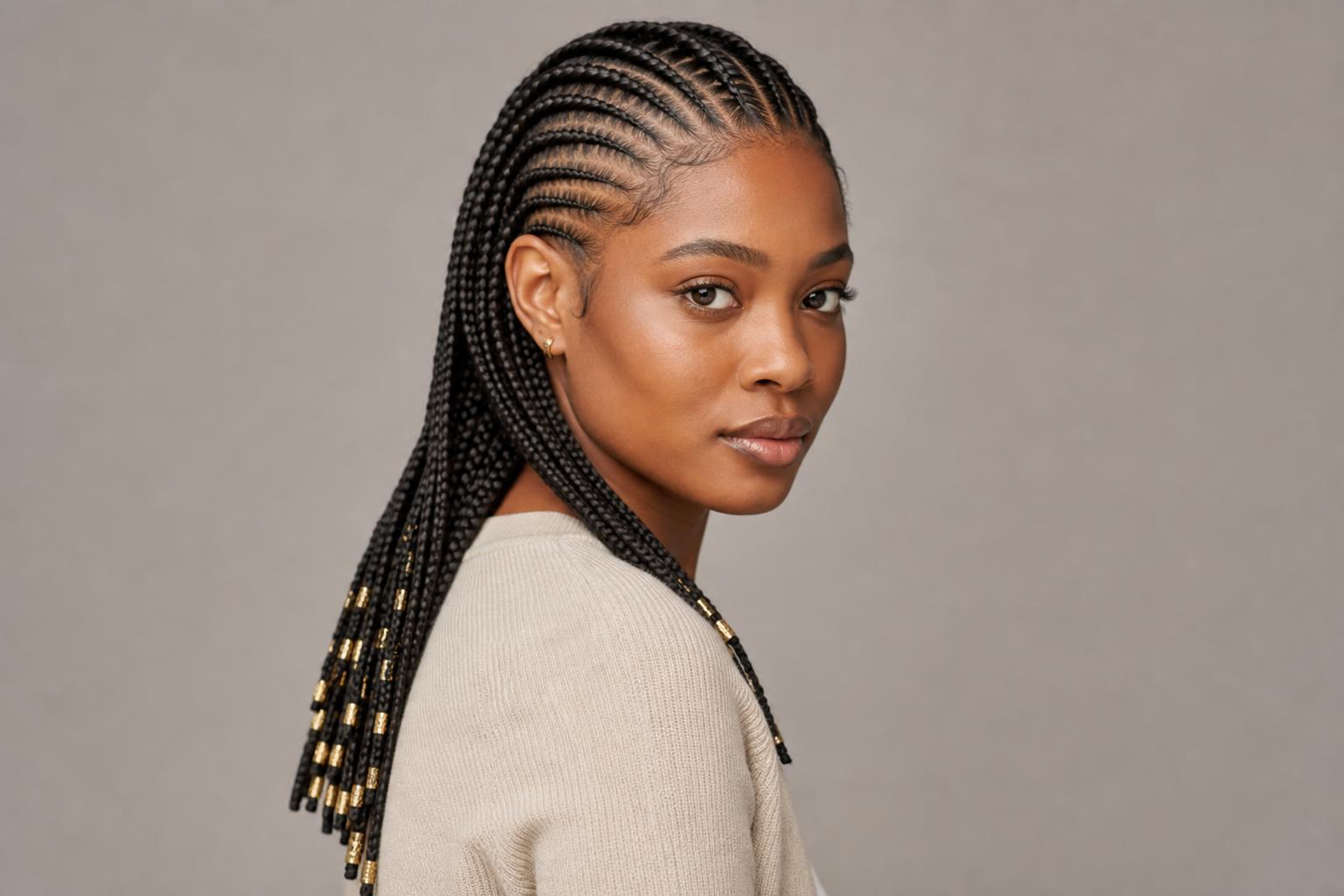
Tribal braids combine cornrows braided flat against the scalp with free-hanging braids at the back, usually finished with beads or metal cuffs, and a full set takes three to seven hours depending on braid size. The 30 styles below are grouped by the pattern doing the work, from Fulani-inspired center partings through Ghana braid sweeps to knotless lengths and braided updos.
Sections move from the smallest scalp patterns to the longest hanging styles and finish with short and updo options. After the gallery you will find install times and wear limits by braid size, a parting guide by face shape, the exact language to use when booking with a braider, honest edge-protection limits, and a care routine for the weeks the braids stay in.
| Factor | Details |
|---|---|
| Best for | Type 3B through 4C hair with at least 3 inches of length to grip |
| Maintenance | Wash every 1 to 2 weeks, oil the scalp twice weekly, take down by week 8 |
| Works with | Knotless or knotted installs, added braiding hair, beads and cuffs |
| Avoid if | Your edges are already thinning, or your scalp is sore from a recent set |
| Salon time | 3 to 4 hours for jumbo, 6 to 8 hours for small or micro sizes |
What Tribal Braids Actually Refers To
Tribal braids is a modern catch-all, not the name of one technique. What salons list under it is usually a Fulani-inspired arrangement, meaning cornrows braided flat along the scalp in a set pattern with the remaining hair left in individual plaits or box braids, often decorated with beads and cuffs. The styling tradition it borrows from belongs to the Fula people of West Africa and the Sahel, where the center parting with side braids and gold ornaments carries specific meaning.
Knowing that matters practically, not just culturally. If you book a tribal braids appointment without specifics, one braider will give you a center-part Fulani layout and another will give you Ghana braids swept to one side, and both are correct under the umbrella. Naming the pattern, the size, and where you want the partings removes the guesswork entirely, and it is the same specificity that makes any braid style booking go smoothly.
Fulani-Inspired Tribal Braids
These are the styles most people picture, built on a cornrowed center section with braids running back or to the sides and beaded ends. The scalp pattern is the whole design here, so the parting quality matters more than the length that hangs below it. Most sets in this section take four to six hours and hold their shape for four to six weeks.
1. Classic Center-Part Fulani Braids
One wide cornrow runs down the exact center of the head from hairline to crown, with narrower cornrows angled back on either side and the rest left in individual plaits. The center braid is fed with even pickups the whole way so its width stays constant, which is the detail that separates a clean install from a rushed one.
2. Curved Side-Sweep Fulani Pattern
Rather than a straight center line, the scalp braids curve toward one temple before releasing into loose length. Round and full faces gain the most from the diagonal, since an off-center sweep breaks up horizontal width in a way a symmetrical center part cannot.
3. Micro Fulani Braids with Gold Cuffs
Fine and lower-density hair carries micro sizing better than jumbo, because small sections spread the weight of the added hair across far more anchor points. The trade-off is time, since micro sets run six to eight hours and cost proportionally more.
4. Beaded Half-Up Fulani Braids
Gather the top third into a high bun and leave the beaded lengths hanging, which takes about a minute and completely changes the silhouette. A satin scrunchie holds better than an elastic and will not snag the beads. The same up-and-down split works across most textures, as the range in our half-up half-down styling on textured hair shows.
5. Waist-Length Fulani Braids
Length is where installs go wrong on maintenance, because waist-length added hair pulls on the scalp every time you turn over in bed. Sleep in a satin bonnet with the braids gathered loosely at the crown, never tied tight, and expect to retire this set at six weeks rather than eight.
6. Honey Blonde Fulani Braids
Honey and caramel braiding hair against a darker natural root gives the scalp pattern definition that a single flat color loses. Buying pre-colored braiding hair avoids putting any lightener near your own strands, which is the entire advantage of coloring through extensions. Rinse new packs in an apple cider vinegar solution first, since the alkaline coating on synthetic hair causes most scalp itching.
7. Triangle-Part Fulani Set
Ask specifically for triangle partings on the free-hanging section rather than square boxes, and say you want the scalp cornrows to stay narrow. Triangle parts distribute tension differently and the geometry stays visible for the whole life of the set.
8. Fulani Braids with Curly Ends
Where standard Fulani braids end in a sealed plait or a bead, this version leaves the last few inches unbraided as loose curl. It softens the whole look considerably compared with a blunt beaded finish. The technique matches what happens in knotless braids finished with curly ends, applied to a Fulani scalp layout.
Cornrow and Ghana Braid Patterns
Ghana braids, sometimes called feed-in braids, build thickness gradually by adding extension hair as the braid travels, so the braid starts narrow at the hairline and widens toward the back. This is the gentlest install on the list because no extension weight lands at the very first stitch. Sets in this section run three to five hours and last two to six weeks.
9. Straight-Back Ghana Braids
Six to eight feed-in braids run straight from the front hairline to the nape, each one starting with your own hair alone and thickening as extensions feed in. The gradual build is what prevents the tight knot of tension at the hairline that ordinary cornrows create.
10. Zigzag Part Cornrows
Sharp zigzag partings between rows add angles across the scalp instead of the usual straight lines, a geometry borrowed from the patterned cornrow designs worn by men. Square and rectangular face shapes benefit, since the irregular lines soften the strong horizontal of the jaw and forehead.
11. Jumbo Ghana Braids
Thick, high-density hair suits jumbo sizing, since there is enough of your own hair in each section to hold the extension securely. On finer density the same size looks sparse between rows and the scalp shows through.
12. Ghana Braids into a Ponytail
All the feed-in rows converge at the crown and gather into one high tail secured with a wrapped section of braiding hair rather than a visible elastic. Smooth the perimeter with a light edge control on a soft-bristle brush, not a toothbrush, which is too stiff for the fine hair along the hairline.
13. Lemonade Side-Swept Braids
Every row angles across the head to one side, which puts sustained pull on one side of the hairline for the entire wear period. Cap this set at four weeks instead of six, and alternate the sweep direction on your next install so the same follicles are not pulled twice in a row. It is the one pattern worth deliberately rotating.
14. Burgundy Ghana Braids
Deep burgundy and wine-toned braiding hair gives dimension against dark natural roots without the maintenance a lightened shade demands. Red pigments in synthetic hair can transfer onto light-colored pillowcases and collars for the first week, so wash the packs before install.
15. Ghana Braids with a Middle Part
Book this by asking for feed-in braids, six per side, straight back from a clean center part, with the extension hair added from the second stitch. The phrase from the second stitch is the one that matters, since starting extensions immediately at the hairline defeats the point of the feed-in method.
16. Stitch Braids with Defined Rows
Unlike standard cornrows where the parting is a simple line, stitch braids use a raised, ridged section between each row that keeps the pattern crisp for weeks longer. The extra definition costs about an hour of additional install time.
Tribal Braids with Box Braids and Knotless Length
These sets pair a cornrowed scalp section with individual box braids or knotless braids hanging free, which is the layout most people mean when they say tribal braids with length. Knotless installs start with your own hair and feed extensions in gradually, so they are lighter at the root than traditional knotted box braids. Expect five to seven hours and four to eight weeks of wear.
17. Knotless Tribal Braids, Medium Size
The braid begins with your natural hair for the first three stitches, then extension hair feeds in on both sides, which removes the hard knot at the root of a traditional box braid. That single change is why knotless installs feel comfortable on day one instead of day four. Medium sizing balances install time against weight better than any other size, and our guide to medium knotless braids by length covers the sizing in detail.
18. Bohemian Tribal Braids with Loose Strands
Wispy loose pieces are left out along the braid length and around the hairline for a softer, less structured finish. Heart-shaped faces gain from the loose face-framing strands, which fill visual space at a narrower chin. Anyone with fine baby hairs should ask for the loose pieces to come from the braid body rather than the hairline, so the edges stay protected.
19. Small Tribal Braids for Fine Density
Lower-density hair holds small braids more securely than large ones, because a small section needs less of your own hair to anchor a proportionally lighter extension. Sets like this run seven to eight hours and are worth booking across two days if your neck cannot handle a single sitting. The small box braid maintenance routine applies directly to this size.
20. Tribal Braids in a High Bun
Gather everything above the ears into a top bun and wrap the base with one loose braid to hide the elastic. Secure with two or three large bobby pins pushed toward the scalp rather than one tight band, which is what causes the tension headache people blame on the braids themselves.
21. Mid-Back Knotless Tribal Braids
Mid-back is the sweet spot for wear time, long enough to style several ways and short enough that the weight does not force an early takedown. Plan on six weeks, then reassess, and take them down at eight regardless of how good they still look. New growth past that point tangles at the root and the takedown itself becomes the damaging part.
22. Ombre Tribal Braids
Ombre braiding hair transitions from your natural depth at the root to a lighter tone from mid-length down, so regrowth stays invisible for the entire set. Cooler ash-toned ombre holds its color under sunlight better than warm honey, which oxidizes to orange over several weeks outdoors.
23. Tribal Braids with a Beaded Fringe
Ask for a shorter front section, roughly cheekbone length, braided and beaded to fall as a fringe across the forehead. Say that you want the fringe section taken from behind the hairline rather than from the hairline itself, which protects the finest hair you have. Confirm the bead weight before the braider seals them, because a heavy fringe pulls forward all day.
24. Tribal Braids with Curly Bulk Ends
Where a bohemian set leaves your own hair loose, this version attaches separate curly bulk to the last few inches of each braid for fuller, more uniform ends. The result holds its shape through rain in a way loose natural ends do not.
Short, Bob, and Updo Tribal Braid Styles
Short tribal braid sets install in half the time of long ones and put a fraction of the weight on the scalp, which makes them the sensible choice after a long set has just come out. Most of these run two to four hours.
25. Tribal Braid Bob
Cornrowed scalp sections release into individual braids cut to jaw or chin length, sealed at the ends with hot water rather than beads. Sealing is worth watching your braider do, since a poorly sealed synthetic end unravels within days. The blunt bottom line gives the set its shape, so ask for the ends cut level after installation rather than braided to different lengths.
26. Shoulder-Length Beaded Bob
A slightly longer bob with beads at the ends works well on longer and oblong face shapes, since the horizontal weight at shoulder level counters the vertical line of the face. Center-parted versions do this more effectively than side-parted ones.
27. Tapered Tribal Braids with Shaved Sides
Coarse, dense hair carries a shaved side cleanly, because the remaining braided section stays thick enough to balance the bare skin below it. On finer density the contrast can look sparse rather than sharp. Anyone already wearing a taper will find the shape familiar, and the cutting logic matches our guide to shapes that hold on 4B and 4C hair.
28. Braided Crown Updo
Wrap the free-hanging braids around the head above the ears and pin at the back, using pins pushed in against the direction of the wrap so they grip. A light mist of oil sheen on the wrapped section keeps stray ends flat without weighing the whole updo down.
29. Tribal Braids with a Low Chignon
Gathering braids low at the nape puts far less strain on the hairline than a high bun does, which makes it the right default for daily wear during a long set. Alternate between low and high styling across the weeks so no single anchor point takes the load every day.
30. Copper-Tipped Short Tribal Braids
Copper braiding hair used only on the bottom third of a short set gives a clean two-tone finish that stays sharp because short braids show the transition line clearly. Copper is the most fade-prone tone in synthetic hair under direct sun, though on a four-week set that rarely becomes visible.
Braid Size, Install Time, and How Long Each Lasts
Size drives everything else, including cost, comfort, and the point at which a set stops protecting your hair and starts stressing it. The wear limits below are the point of takedown, not the point at which the set stops looking presentable.
| Braid Size | Install Time | Safe Wear Limit | Takedown Time |
|---|---|---|---|
| Jumbo | 2 to 4 hours | 4 weeks | 1 hour |
| Large | 4 to 5 hours | 5 to 6 weeks | 1 to 2 hours |
| Medium | 5 to 6 hours | 6 to 8 weeks | 2 to 3 hours |
| Small | 7 to 8 hours | 8 weeks | 3 to 5 hours |
| Micro | 8 to 12 hours | 8 weeks | 5 to 8 hours |
| Ghana feed-in only | 3 to 5 hours | 2 to 4 weeks | 30 to 45 minutes |
Choosing a Parting Pattern for Your Face Shape
The scalp pattern draws hard lines across the head, and those lines change facial proportions more than braid length does. Work from a simple principle, add diagonal or off-center lines to soften width, and keep symmetrical center lines when you want to add visual height.
| Face Shape | Best Parting Pattern | Avoid | Why |
|---|---|---|---|
| Oval | Center part, straight-back, or curved sweep | Nothing structural | Balanced proportions carry any parting direction |
| Round | Curved side-sweep, lemonade angles | Wide symmetrical center parts | Diagonal lines break the horizontal width of the cheeks |
| Square | Zigzag or curved partings, softened perimeter | Sharp straight-back rows ending at the jaw | Irregular lines counter a strong jaw instead of repeating it |
| Heart | Center part with loose face-framing pieces | All hair pulled tightly back and up | Softness at the jaw balances a wider forehead |
| Oblong | Beaded bob length, low chignon, side volume | High buns and tall crown gathers | Height at the crown adds length a long face does not need |
| Diamond | Fullness at temples and jaw, beaded ends low | Flat scalp braids with all volume at the back | Flattened sides emphasize the widest point at the cheekbones |
What to Tell Your Braider
Booking language does more work than a reference photo here, because two braiders can look at the same photo and build it three different ways. Give four pieces of information every time, the scalp pattern, the braid size, the finished length, and whether you want knotless or knotted.
A booking message that works sounds like this. I would like a Fulani-inspired set, center part with three cornrows on each side, medium knotless braids to mid-back, triangle partings, no beads on the side sections. Add how many hours you can sit for, since that determines whether small sizing is even on the table.
Stylist tip: Say out loud, before the first braid goes in, that you want the tension light at the hairline. Braiders vary enormously in how firmly they work, and the first row is the one that sets the pattern for the whole head. Correcting it after four rows means undoing four rows.
Stylist tip: Book a takedown appointment at the same time as the install. The most common cause of breakage in braided styles is not the braids, it is a rushed self-takedown at week ten when the roots have matted and the person doing the removing is tired and pulling.
When Tribal Braids Are Not the Right Choice
Protective styles only protect when the install is light and the wear period is short enough. Past that point the same braids that shielded your ends start working against your hairline, and the damage builds quietly across several sets rather than showing up after one.
- Thinning or receding edges rule out any style that pulls from the hairline. A set that starts the braids an inch behind the perimeter, leaving the edges completely free, gives you the look without the pull.
- Recently relaxed or color-treated hair is too fragile for the tension of a fresh install. Wait at least two weeks after a relaxer and a full month after lightening before braiding.
- Back-to-back sets with no rest period leave no time for the scalp to recover. Give yourself one to two weeks of loose, moisturized hair between installs, and use that window to deep condition twice.
- Soreness, small bumps, or pus-filled spots along the parting lines are not normal settling. Those are signs of follicle inflammation, and they warrant taking the affected sections out rather than waiting them out.
- Very short natural hair, under about three inches, does not give a braider enough length to anchor an extension securely. Braids installed on too-short hair slip within days and pull hard while they do.
Caring for Tribal Braids While They Are In
Scalp care matters more than braid care, since the braids themselves are largely synthetic and your own hair is only involved at the root.
| Task | Frequency | What to Use |
|---|---|---|
| Wash the scalp | Every 1 to 2 weeks | Diluted sulfate-free shampoo in an applicator bottle, applied to partings only |
| Moisturize | Twice weekly | Lightweight leave-in spray followed by a few drops of a light oil |
| Soothe itching | As needed | Witch hazel or a peppermint scalp spray, never scratching with a comb tail |
| Protect overnight | Nightly | Satin bonnet or scarf, braids gathered loosely rather than tied |
| Refresh the edges | Weekly at most | A soft-bristle brush and a small amount of edge control, no gel build-up |
| Dry thoroughly | After every wash | Microfiber towel then cool blow-dryer, damp braids develop mildew odor |
Common Tribal Braid Myths
Myth: Braids Make Your Hair Grow
Reality: Braids do not speed growth, they preserve length that would otherwise break off. Your hair grows at the same rate braided or loose, but eight weeks without daily combing, heat, and manipulation means far more of that growth survives to be measured. The length people notice after taking braids out is retained growth, not accelerated growth.
Myth: Tight Braids Mean a Better Braider
Reality: Tightness signals nothing about skill and a great deal about risk. A well-installed braid holds because of clean sectioning and consistent tension through the length, not because it is pulling at the root. If you leave an appointment with a headache or visible bumps along the partings, that set was installed too tight regardless of how neat it looks.
Myth: Leaving Braids In Longer Gets You Better Value
Reality: Past about eight weeks, new growth at the root tangles around the braid base and the takedown starts costing you more hair than the extra weeks were worth. Shedding builds up inside the braid over time, and matting at the root turns a routine removal into hours of careful separation. Take the set down while it still comes apart easily.
FAQ
How Much Braiding Hair Do I Need for Tribal Braids?
Most medium-size sets to mid-back use five to eight packs of pre-stretched braiding hair, while jumbo sizes need three to five and micro sizes can need ten or more. Buy one extra pack beyond the estimate, since running out mid-install means matching a new dye lot.
Are Tribal Braids the Same as Fulani Braids?
Not quite. Fulani braids are one specific style within the broader tribal braids category, defined by a cornrowed center section with side braids and traditionally finished with beads or gold ornaments. Tribal braids is the wider salon term covering Fulani, Ghana braids, cornrow patterns, and box braid combinations. Asking for Fulani braids by name gives you a much more predictable result than asking for tribal braids.
How Do I Stop the Itching in the First Week?
Rinse the braiding hair in a solution of one part apple cider vinegar to three parts water before it goes in, which strips the alkaline coating manufacturers use on synthetic fiber. That coating causes most first-week itching, not the tension. If the braids are already in, a witch hazel spray applied along the partings settles it within a day or two.
Can I Wash My Hair with Tribal Braids In?
Yes, and skipping washes entirely causes more problems than washing does. Dilute a sulfate-free shampoo in an applicator bottle and apply it directly to the partings, massage with your fingertips rather than your nails, then rinse thoroughly and dry the braids properly.
Do Beads and Cuffs Damage the Braids?
Beads themselves are harmless, but weight and placement matter. Cuffs positioned near the scalp swing with every head movement and pull at the root, while beads sealed at the ends carry their weight where the braid is strongest.
How Much Do Tribal Braids Cost?
Pricing varies enormously by region, braider experience, and size, so treat any single figure with suspicion. What stays consistent is the structure, smaller braids and longer lengths cost more because they take more hours, and hair is usually charged separately. Ask for a quote that separates labor from hair packs so you can compare braiders honestly.
Will Tribal Braids Work on Type 3 Curly Hair?
Yes, though looser curl patterns need a little more preparation to grip the extension hair. Braid on stretched hair, either blow-dried on low or banded overnight, rather than on wet defined curls that will shrink and loosen the braid within days. Looser textures also tend to slip out faster, so a four-to-six-week wear window is more realistic than eight.
Tribal braids reward specificity more than almost any other protective style, because the term covers so much ground that the only way to get what you pictured is to name the pattern, the size, and the length before you sit down. Decide those three things first, book a takedown appointment alongside the install, and say the words light tension at the hairline before the first row goes in.
Hair results vary based on your natural hair type, texture, density, and condition. Always consult with a licensed hairstylist before making significant changes, especially with chemical treatments or dramatic length changes. Photos may show styled results that require professional tools and products to replicate.