

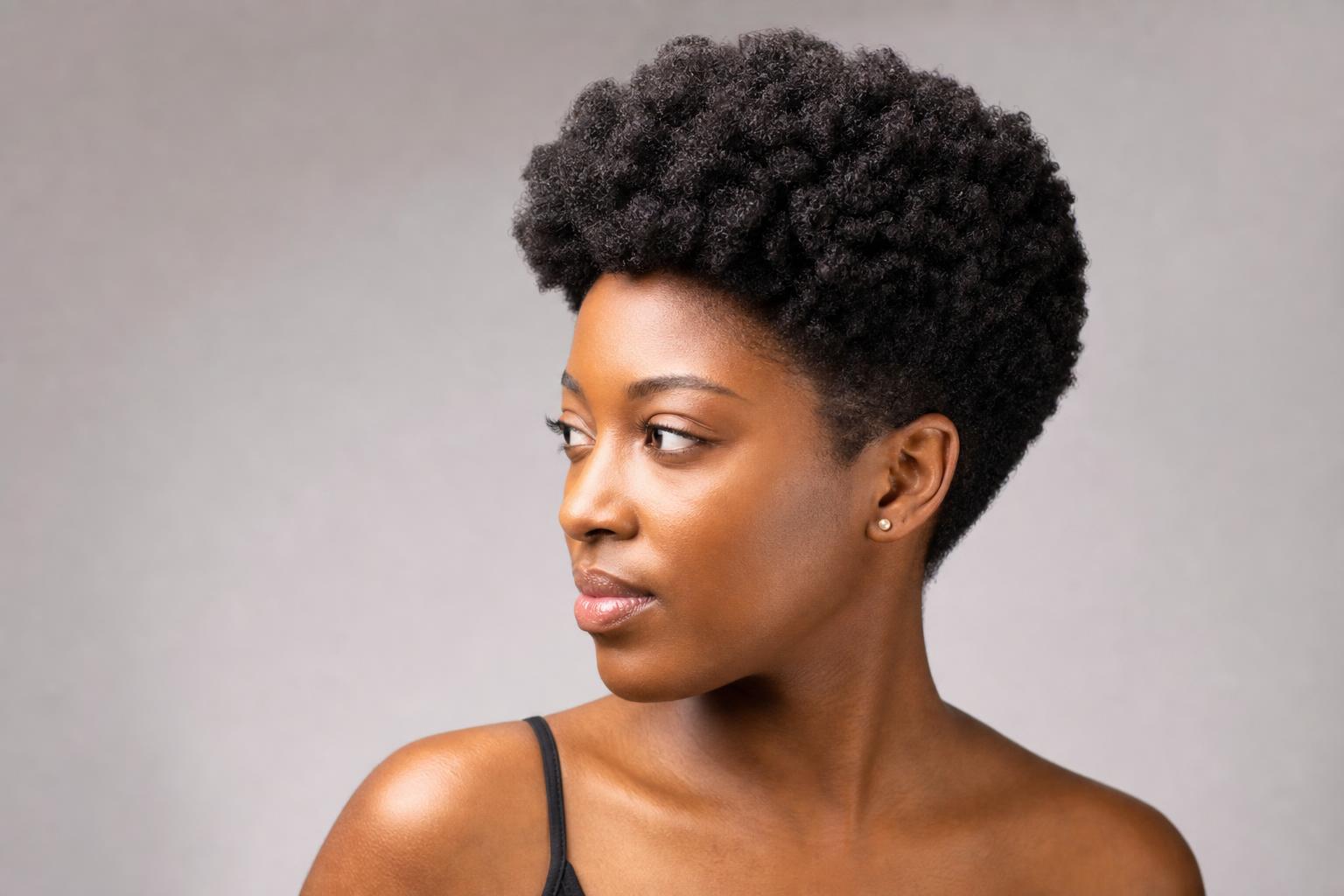
4B and 4C hair is cut as a sculpture, not as a set of layers, because there is no visible curl clump for a stylist to follow down the strand.
Haircuts for 4B and 4C hair are built from the outside in. A 4B strand bends in sharp Z angles instead of curling into an S, and 4C is tighter still, with shrinkage that can reach 75 to 80 percent, so what you see in the mirror is the outline of the whole head rather than individual coils. The 25 cuts below run from close-tapered crops through sculpted afro shapes to long stretched lengths, each with the structural reason it works.
One thing most guides never mention: 4B and 4C hair is often cut stretched rather than shrunken, which is the opposite of the advice given for looser curl patterns. That section comes after the gallery, along with a face shape table, consultation wording for both salons and barbershops, and an honest look at what goes wrong.
| Factor | Details |
|---|---|
| Best for | Z-pattern and zig-zag textures at any density, worn natural rather than under braids year round |
| Maintenance | Reshape every 6 to 10 weeks; tapered edges every 3 to 4 weeks if the cut has them |
| Works with | Scissor sculpting, clipper tapering, cutting on stretched or blown-out hair, banding |
| Avoid if | Your hair is mid-transition from a relaxer, or the stylist wants to razor the ends |
| Salon time | 45 minutes for a taper, up to 3 hours if a wash and blow-out come first |
Cropped and Tapered Cuts for 4B and 4C Hair
Short cuts are where tight coils have the biggest advantage, because the texture holds any shape it is given without product or heat. The whole craft lives in the transition from short to long and in the line around the hairline. Everything in this section is defined by those two things rather than by length.
1. Low Taper with a Softened Hairline
Ask for a low taper that starts just above the ear and say you want the hairline left soft rather than carved into a hard line. Barbers default to a crisp edge unless told otherwise, and a softened hairline grows out with no visible line of demarcation. Add the phrase “keep my natural hairline” if you want to protect the density at the temples.
2. Dense TWA for High-Density 4C
High-density 4C hair holds so much volume that a half-inch length already looks substantial and needs no interior work at all. Lower-density hair at the same length shows scalp through the crown and looks better slightly longer, closer to an inch and a half. Judge density by parting the hair in three places and seeing how much scalp shows.
3. Scissor-Sculpted Coily Crop
Working with shears rather than a guard lets the stylist follow the shape of the skull, taking a little more off above the ear and a little less at the occipital bone. The result is a rounded form instead of the uniform shell a clipper guard produces. It takes about three times as long, which is reflected in the price.
4. Tapered Sides with Visible Coil Length
Unlike a fade, which takes the hair to skin and creates a hard gradient, a taper leaves texture visible at its shortest point so the whole head still reads as hair rather than as two materials. The taper is more forgiving as it grows and needs a barber less often. A fade looks sharper on day one and messier by week three.
5. Grow-Out-Friendly Rounded Cut
Cut to one uniform length with a rounded outline and no tapering, this shape simply gets bigger rather than falling apart, which buys you ten to twelve weeks between appointments. Nothing needs touching up in between. If salon visits are hard to schedule, this is the cut that respects that.
6. Squared Crop for a Rounded Face
Squaring off the top and keeping the sides close introduces straight lines that counter the curves of a round face, while a rounded crop at the same length would emphasize them. The effect is strongest when the corners at the temple stay crisp. On an oblong face the same shape adds unwanted height, so soften the top instead.
7. Copper-Tipped Tapered Coils
Lightening only the tips of the crown on a tapered cut throws light at the top of the silhouette and makes the shape look taller without changing a single inch of the cut. Because only the ends are lifted, the damage stays in hair that will be trimmed off within a few months anyway. Warm copper reads best against a dark base and needs a color-depositing conditioner every few weeks.
8. Sponge-Twisted Short Cut
Work a curl sponge in small circles over damp, product-coated hair, moving in one consistent direction so the twists form evenly. Two to three inches of length gives the best result, since shorter hair will not catch in the sponge holes. Stop as soon as the pattern appears, because over-working the sponge tangles the coils at the root.
Sculpted Afro Shapes with Real Height
An afro is a haircut, not a default state, and the difference between a shaped one and an unshaped one is obvious from ten feet away. The stylist is cutting a three-dimensional form, which means working around the head and checking the silhouette from every angle rather than sectioning the way they would on straight hair. Length here is measured off the scalp, not down the strand.
9. Rounded Afro Sized to Your Frame
A rounded afro adds width at the temples, which balances an oblong or heart-shaped face, but the same shape on a round face doubles the width already there. The fix for a round face is height rather than width, achieved by keeping the sides closer and the crown taller. Scale matters too, since a very large afro on a small frame reads as top-heavy.
10. Blown-Out Afro Cut to a True Sphere
The stylist blows the hair out with a comb attachment first, then cuts around the head with the hair standing away from the scalp, checking the outline in a mirror from the front, side, and back. Cutting a sphere requires seeing it as a sphere, which is impossible when the hair is lying flat. This is the technique that produces the clean silhouettes in editorial photos.
11. Pick-Lifted Afro with a Defined Edge
Lift the hair with a wide-tooth pick from the roots outward in sections, working from the nape upward so the crown lands last and stays highest. Finish with a light oil sheen on the outer surface only. Picking from the ends inward flattens the shape you just built, which is the most common mistake with this style.
12. Compact Afro for Lower-Density Hair
Lower-density 4B hair looks fuller in a compact three-inch shape than in a large one, because a big afro spreads the same amount of hair over more surface area and lets light through. Denser hair can carry the height without going see-through. If you can see scalp when the hair is picked out, size the shape down rather than up.
13. Afro Shape Compared with a Frohawk
A frohawk narrows the sides and concentrates everything into a central strip, which reads sharper and more directional than a rounded afro. The rounded shape is more versatile and works in more settings, while the frohawk makes a stronger statement and needs more frequent side upkeep. Both start from the same length; only the outline differs.
14. Asking for an Afro in Inches, Not Guards
Say the height you want in inches off the scalp, since guard numbers describe clipper length on flat hair and mean very little on a shape that stands up. Bring a photo of the profile as well as the front, because the back of an afro is where most shaping errors happen. Some of this language carries over from barbering, and the distinctions in our guide to razor cutting versus scissor cutting are worth knowing before you ask for a specific tool.
Bobs and Mid-Length Cuts on Tight Coils
Bobs on 4B and 4C hair are almost always cut on stretched hair, because a shrunken zig-zag pattern gives the stylist no reliable line to follow. That means the cut is measured in blown-out inches and then springs up dramatically when it is washed, so the length you see at the salon is not the length you will live with. The shapes below are chosen for how they behave in both states.
15. Blunt Coily Bob Cut on Stretched Hair
A blunt line holds its shape for roughly eight weeks in a stretched state and considerably longer when worn shrunken, since a shrunken outline hides uneven growth. Plan appointments around how you mostly wear it. If you silk-press once a month, the trim schedule follows the pressed look rather than the natural one.
16. Auburn Bob on Blown-Out 4B
Auburn over a natural dark base warms the whole bob and shows up best on stretched hair, where the light travels along a straighter surface. On shrunken 4B the same color reads much deeper because the zig-zag pattern traps light rather than reflecting it. Ask for a semi-permanent formula if you want the color without any change to the texture.
17. Layered Bob Cut Section by Section
The stylist blow-dries the hair smooth, sections it into quadrants, and cuts each layer against the head with a fine comb for tension. The layers are graduated so that when the hair springs back it forms a rounded shape rather than a flat helmet. Consistent tension is the whole game here, since uneven tension produces layers that only reveal themselves after the first wash.
18. Stretched Lob That Holds Its Line
A lob cut on stretched hair keeps a visible perimeter for about ten weeks before the ends start to look uneven, mostly because of breakage rather than growth. Dusting the ends yourself every six weeks between salon visits extends the shape considerably. Keep a dedicated pair of hair shears and never use household scissors, which crush the strand instead of cutting it.
19. Caramel Ends on a Mid-Length Cut
Caramel placed only through the bottom three inches gives a mid-length cut a visible edge without lightening the fragile mid-shaft where 4C hair breaks most. It also means the lightened section grows off the head over time rather than staying permanently. Pair it with a monthly protein treatment, since lifted tight coils lose elasticity before they lose color.
20. Chin-Length Shape for a Long Face
Stopping the length at the chin creates a horizontal line across the widest part of the face, which visually shortens an oblong shape. Adding fullness at the sides rather than the top strengthens the effect. On a round face this same cut adds width where it is not wanted, so drop the length to the collarbone instead.
Long 4B and 4C Cuts Built for Stretched Wear
Long tight-coiled hair is a length-retention project as much as a haircut, since the challenge is breakage rather than growth. Cuts at this length are mostly about maintaining an even perimeter and removing damage before it travels. Most of these are worn stretched, either banded, braided out, or pressed.
21. Banded Length Cut on Damp Hair
Band the hair into sections with soft elastics placed every two inches down each ponytail, let it dry fully, then remove the bands to reveal stretched length with no heat involved. The stylist cuts against that stretched state. Banding gives roughly 70 percent of the elongation a blow-out does with none of the thermal risk.
22. Long Layers Compared with One Length
One length keeps the maximum amount of hair on the head and creates a heavy, dense outline, while long layers remove weight and give the shape movement when stretched. On tight coils, layers are much harder to see and much easier to get wrong. Choose one length if retention is your priority and layers only if you wear the hair stretched most of the time.
23. Asking for a Dusting, Not a Trim
Use the word dusting when you want a quarter inch off and nothing more, because trim means very different amounts to different stylists. Say the number out loud and hold up your fingers to show it. Anyone who has ended up with far more length gone than they asked for knows that a specific measurement is the only reliable defense.
24. Long Cut for Fine-Stranded 4C
Fine strands in a 4C pattern break far more readily than coarse ones, so the cut needs to stay blunt at the perimeter with nothing removed from inside. Coarse 4C hair carries interior weight removal at long lengths without any risk. Test by rolling a shed strand between your fingers, where fine hair is barely detectable and coarse hair feels like thread.
25. Silk-Pressed Length with Blunt Ends
Press in small sections with a low heat setting and a heat protectant, then cut the ends blunt while the hair is fully pressed and cooled. Cutting a press before it cools locks in an uneven line as the hair settles. Keep pressing to a few times a year at most, since repeated heat is how tight coils lose their pattern permanently.
Why 4B and 4C Hair Is Often Cut Stretched, Not Shrunken
The standard curly-hair advice is to always cut dry and shrunken, and for 3A through 4A that holds. Tight Z-pattern coils are the exception, because they do not form visible clumps for the stylist to follow, and a shrunken 4C head gives no usable guideline for a perimeter. Most experienced stylists stretch the hair first, cut against that, and then let it spring back.
| Cut You Want | Prep the Hair How | Why |
|---|---|---|
| Taper or fade | Dry and shrunken, freshly washed | The line is cut against the scalp, so stretching would distort it |
| Rounded afro shape | Blown out with a comb attachment | The silhouette can only be judged with the hair standing away from the head |
| Bob or lob | Blown out smooth or banded | A perimeter line needs an even, followable edge |
| Long one length | Banded or twisted out | Enough elongation to cut evenly without the heat of a press |
| Dusting the ends | Twisted, one twist at a time | Splits and knots poke out of a twist and can be removed individually |
Stylist tip: Ask how much the stylist expects the hair to spring back before any cutting starts, and get a number. If they say four inches, you know a shoulder-length blow-out will land near the chin. That single question prevents most of the shock that happens at the first wash after a cut.
How to Choose a 4B or 4C Cut for Your Face Shape
With tight coils the silhouette does all the work, and it can be moved almost anywhere: up, out, narrow, or squared. That flexibility is an advantage, but it means the face shape decision has to be made deliberately instead of falling out of the length you pick. Work out the effect you want first, then choose the outline that creates it.
| Face Shape | Outline That Flatters | Cut to Ask For | Avoid |
|---|---|---|---|
| Oval | Almost any outline | Rounded afro, taper, blunt bob | Nothing structural; only extreme scale mismatches |
| Round | Tall and narrow | Squared crop, frohawk, high taper with a full crown | Wide rounded afro level with the cheeks |
| Square | Curved, with softness at the jaw | Rounded afro, soft-edged crop, collarbone lob | Hard squared hairline plus a blunt jaw-length line |
| Heart | Fuller at the jaw than at the crown | Chin-length shape, compact rounded afro | Tall crown volume over very close sides |
| Oblong | Wide at the temples, low on top | Rounded afro, chin-length bob, dense TWA | Frohawk or any tall central shape |
| Diamond | Volume at forehead and jaw, less at the cheek | Stretched lob, mid-length shape with fullness low | Maximum width level with the cheekbones |
What to Tell Your Stylist or Barber
The first decision is where to book. Barbershops are usually better at tapers, fades, and hairline work, while natural hair salons are better at shaped afros, bobs, and anything involving a blow-out. Some cuts need both, and there is nothing wrong with getting a shape at a salon and the edges maintained at a barbershop between visits.
At the chair, describe the outline and the prep together: “I want a rounded shape about three inches off the scalp, blown out first so you can see the silhouette, with a low taper starting above the ear and my natural hairline left alone.” Then say how you wear it day to day, because a cut for someone who picks it out every morning is shaped differently from one for someone who wears it flat under a wrap. If you are growing out a shape you dislike, say that too, since a stylist can cut toward a target rather than just tidying, and the same logic applies to growing out a cut you regret with the fewest awkward months.
Stylist tip: Bring a photo of hair with a similar density and pattern to yours, not just a similar shape. A three-inch afro on low-density 4B and a three-inch afro on high-density 4C are two completely different silhouettes, and a photo that ignores that sets up an expectation nobody can meet.
Maintenance, Edges, and Grow-Out
The upkeep on a tight-coil cut splits in two: the shape, which lasts months, and the edges, which do not. Understanding that split is what stops people from booking full appointments they do not need. Moisture and protection at night do more for the cut than any salon visit in between.
| Cut | Full Reshape | Edge Upkeep | Grow-Out Behavior |
|---|---|---|---|
| Taper or fade | 8 weeks | Every 3 weeks | The gradient closes up and the head reads square |
| TWA | 6 to 8 weeks | Every 4 weeks if edged | Loses its round outline first |
| Rounded afro | 10 to 12 weeks | None needed | Enlarges evenly and stays wearable |
| Stretched bob | 8 to 10 weeks | None needed | Perimeter frays from breakage before it grows out |
| Long one length | 12 to 16 weeks | None needed | Ends knot and split before the shape changes |
Alternating a shaped cut with protective wear is a reasonable long-term plan, provided you give the hair a stretch of natural wear either side of the style. Low-tension options like butterfly locs put less strain on the hairline than tight braided styles, which matters if you are trying to keep the edges the cut relies on.
What Goes Wrong with 4B and 4C Haircuts
Four problems account for most bad outcomes, and all four are avoidable at the booking or consultation stage rather than in the chair.
- The hair was cut shrunken when it should have been stretched. The result looks uneven at the perimeter as soon as it is blown out, because there was never a followable line to cut against. Ask about prep before the appointment, not during it.
- The hairline was pushed back to create a cleaner shape-up. A millimeter each visit adds up over years, and the density does not come back. Say clearly that you want the natural hairline kept, even at the cost of a less perfect line.
- The stylist used thinning shears or a razor on tight coils. Both leave frayed, weakened ends that split and knot within weeks. Shears with a clean closing action are the only appropriate tool.
- The cut was shaped for hair that is mostly worn under braids or wigs. Tension at the perimeter distorts a shaped outline within a couple of installs, so a simple even length holds up better in that situation.
FAQ
Should 4C Hair Be Cut Wet or Dry?
Dry and stretched for anything with a perimeter, and dry and shrunken for tapers and fades. Cutting 4C soaking wet is the worst option, because wet coils clump into a length that has nothing to do with how they will sit once dry. If a stylist wants to wash, cut immediately, and let it dry after, ask them to blow it out first.
What Is the Difference Between 4B and 4C Hair?
4B bends in sharp Z angles with visible corners and holds a slightly looser pattern, while 4C is tighter and more compact, with a zig-zag so fine that the pattern is barely visible without definition. 4C also shrinks more, up to 80 percent against roughly 70 for 4B. In cutting terms they are treated the same way, which is why most stylists cover both with one approach.
Can 4B and 4C Hair Have Layers?
Yes, though layers only become visible when the hair is stretched or shaped into a form. On shrunken hair the eye reads the outline, so interior layers do their work by controlling bulk rather than by showing movement. Ask for weight removal from underneath if the shape feels too heavy, and skip layers altogether if you mostly wear the hair in its shrunken state.
How Often Should I Cut 4C Hair If I Am Growing It Out?
Every three to four months, taking a quarter inch or less. Growing out tight coils is limited by breakage rather than by growth rate, and split ends that are left in place travel up the strand and cost more length than a dusting ever would. Twist the hair into sections and dust each twist individually to remove only what needs to go.
Is a Fade Bad for My Hairline?
The fade itself is not the problem, but repeated aggressive shape-ups are. Each time the line is squared off slightly further back the hairline retreats, and after a few years the change is permanent. Ask for the natural hairline to be followed rather than corrected, and stretch the interval between edge-ups if you notice thinning at the temples.
Do 4A Cutting Rules Apply to 4B and 4C?
Only partly. 4A holds a defined coil that a stylist can follow, so the coil-by-coil approach described in our guide to cuts for 4A coils works well there and falls apart on a zig-zag pattern. The shared ground is silhouette-first thinking and dry cutting. The divergence is whether the hair is stretched first, and for 4B and 4C it usually is.
The best haircuts for 4B and 4C hair start with a clear silhouette and a clear answer about how the hair will be prepped, because those two decisions determine the outcome far more than the length you name. Pick a shape that suits your face and your realistic visit schedule, decide whether you mostly wear the hair shrunken or stretched, and say both things in the first minute of the consultation. Combining that with a broader read on how 4B hair behaves day to day puts you in a much stronger position at the chair.
Hair results vary based on your natural hair type, texture, density, and condition. Always consult with a licensed hairstylist before making significant changes, especially with chemical treatments or dramatic length changes. Photos may show styled results that require professional tools and products to replicate.


1 response