

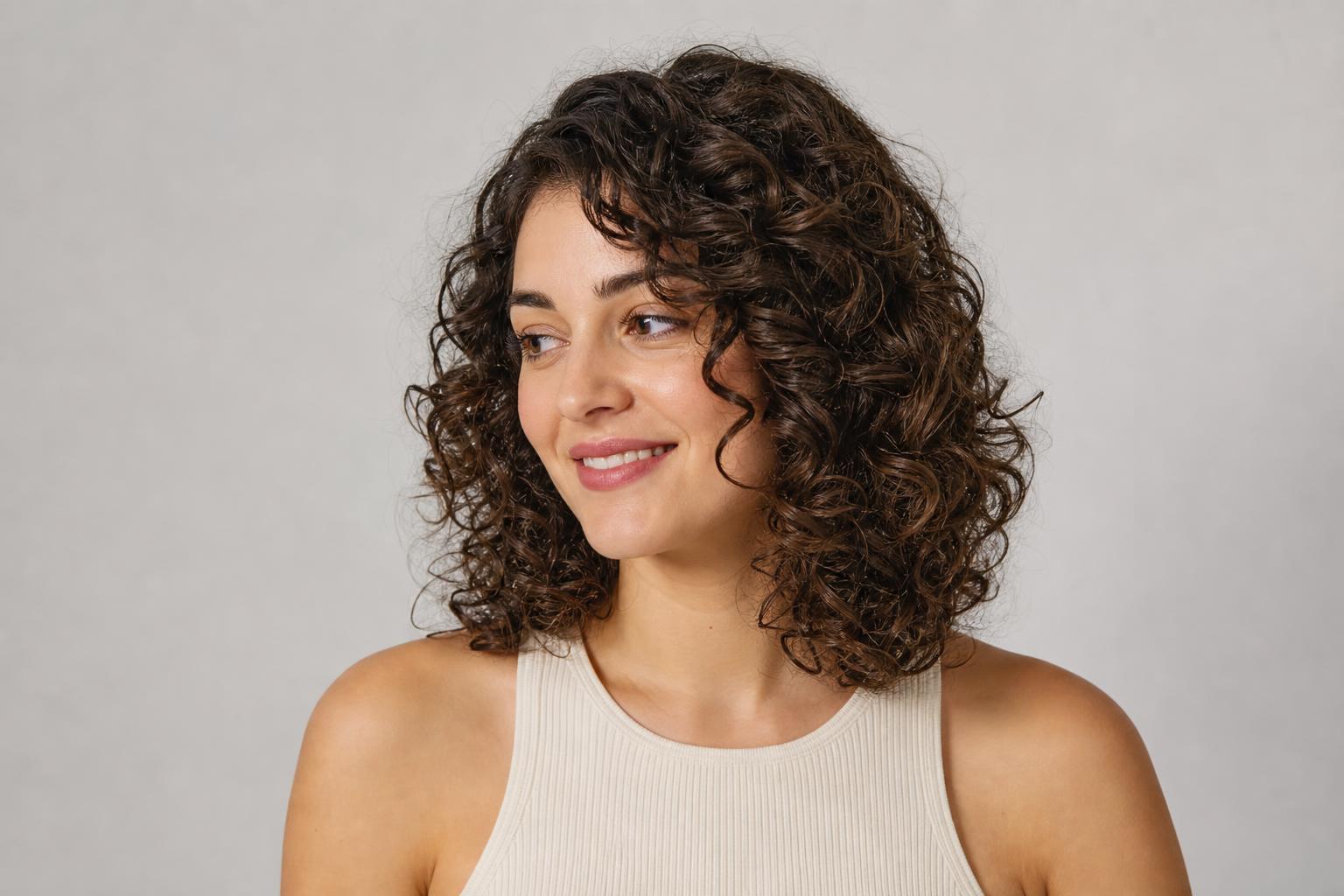
Your curl type is decided by one thing only: the shape a single clean, dry, product-free strand makes when nothing is holding it.
The curl type chart sorts hair into four families and three subtypes each, running from 1A through 4C. The number describes the shape (straight, wave, curl, coil) and the letter describes how tight that shape is within its family, so 3A is the loosest curl and 3C the tightest. It is a shape classification and nothing more, which is why two people with identical 3B curls can need completely different haircuts and completely different products.
This guide walks through the full chart with a physical reference for each type, a five-step method for identifying your own, the three measurements that matter more than curl type, and the myths that send people down the wrong product aisle. It also covers what your type actually changes once you are sitting in a salon chair.
What the Curl Type Chart Actually Measures
The system in common use came out of stylist Andre Walker’s work in the 1990s and was designed to describe curl shape for the purpose of choosing styling techniques. It measures the pattern a strand forms when it dries without manipulation. It does not measure how thick your individual strands are, how much hair you have on your head, or how readily your hair absorbs water, and those three things drive most day-to-day decisions.
Understanding that boundary saves a lot of frustration. Someone with 3B curls and fine, low-density hair needs a light gel and a cut that preserves weight, while someone with 3B curls and coarse, high-density hair needs a heavier cream and a cut that removes bulk. Same curl type, opposite routines.
Stylist tip: Look at the strand roughly halfway down its length rather than at the very end. The last inch is the oldest, most weathered part of the hair and often reads a full subtype looser than the rest of your head does.
The Full Curl Type Chart from 1A to 4C
Each row below gives the pattern, a real-world object of roughly the same diameter, and how much the hair shrinks when it dries. Shrinkage is the most practical number in the table, because it is the difference between the length you have and the length you see. Find the row that matches what your hair does with no product in it.
| Type | Pattern | Roughly the Size of | Shrinkage |
|---|---|---|---|
| 1A | Completely straight, very fine, no bend anywhere | A straight line | None |
| 1B | Straight with slightly more body and thicker strands | A straight line | None |
| 1C | Straight with a slight bend near the ends, coarse strands | A straight line | Under 5 percent |
| 2A | Loose, barely visible S wave close to the head | A shallow ripple | 5 to 10 percent |
| 2B | Defined S wave starting around eye level, flatter at the root | A beach wave | 10 to 15 percent |
| 2C | Deep S wave with the odd loose curl mixed in, starts at the root | A wide marker pen | 15 to 25 percent |
| 3A | Large, loose loops with a clear circular shape | A wine cork | 25 to 35 percent |
| 3B | Springy ringlets with visible bounce and more volume | A permanent marker | 35 to 45 percent |
| 3C | Tight corkscrews packed densely together | A pencil or a drinking straw | 40 to 60 percent |
| 4A | Small, defined S-shaped coils that spring back when pulled | A crochet needle | 65 to 75 percent |
| 4B | Sharp Z-shaped bends with visible angles rather than curves | A folded paper edge | 70 to 75 percent |
| 4C | Very tight zig-zag with almost no visible pattern until stretched | A thread | 75 to 80 percent |
Type 1 Hair Has No Curl Pattern at All
Type 1 hair falls in a straight line from root to end with no bend, and the three subtypes are separated by strand thickness and body rather than by shape. 1A is the finest and most resistant to holding any curl at all, 1B has enough body to take a blow-dry shape, and 1C is coarse enough to develop a slight bend by the ends. Nothing in a type 1 head shrinks when it dries, which is why length conversations are simple.
Type 2 Waves Form an S Shape Against the Head
Type 2 hair makes a horizontal S that lies flat rather than looping outward, and the subtype comes down to where the wave starts and how deep it is. 2A waves begin near the ends and can disappear entirely in humidity, 2B waves start around eye level and hold their shape, and 2C waves begin at the root and mix in the occasional full curl. Root flatness is the defining struggle across all three, which is why the cuts for deep 2C waves focus on lifting weight off the crown.
Type 3 Curls Form Loops You Can See Without Stretching
The jump from type 2 to type 3 is the point where the hair stops lying against the head and starts looping away from it. 3A curls are large and loose, 3B curls are springy ringlets with real volume, and 3C curls are tight corkscrews that pack together densely. Shrinkage becomes a serious factor here, moving from around a quarter of the length at 3A to more than half at 3C corkscrews.
Type 4 Coils Bend in Tight Springs or Sharp Angles
Type 4 hair is the most fragile of the four families because every bend in the strand is a potential break point, and the tighter the pattern the more bends there are per inch. 4A keeps a clearly defined coil that springs back when stretched, 4B bends at sharp angles rather than curving, and 4C is so tightly compressed that the pattern is barely visible until it is pulled straight. The practical consequence is that a stylist can follow a visible pattern on 4A hair, while 4B and 4C textures are usually shaped on stretched hair instead.
How to Identify Your Curl Type in Five Minutes
The test only works on hair that has nothing in it and has not been manipulated while drying. Any gel, cream, brush, or towel changes the pattern enough to shift the result by a full subtype. Work through the four steps below in order.
Step 1: Wash with a Clarifying Shampoo and Skip Everything Else
Silicone and product buildup weigh the pattern down and make hair read looser than it is. Wash with a clarifying shampoo, rinse thoroughly, and apply nothing afterward. This is the single step people skip most often, and it is the one that changes the answer most.
Step 2: Air-Dry Without Touching the Hair
Let the hair dry completely on its own, without a towel, a diffuser, or your fingers. Scrunching tightens the pattern and combing loosens it, so either one produces a false reading. Set aside a few hours and leave it alone.
Step 3: Look at One Strand, Not the Whole Head
Pull out a single dry strand and lay it flat on a light surface. What you are looking for is the shape it holds on its own, matched against the object column in the chart above. Judging by how the whole head looks confuses curl type with density, which is a different measurement entirely.
Step 4: Check the Nape and the Crown Separately
Most heads carry two or three patterns, with the nape usually tighter and the crown usually looser. Test both, note the difference, and treat the tighter one as your working type for product purposes. That is the section most likely to be under-moisturized if you buy for the looser pattern.
Why Most People Have More Than One Curl Type
Having a mix is the norm rather than the exception. Follicle shape varies across the scalp, which is why the hair at your nape can be a full family tighter than the hair at your temples, and hormonal changes, chemical services, and heat history all shift the pattern further. Pregnancy, thyroid changes, and chemotherapy regrowth commonly bring hair back at a completely different type.
A loose 3A crown over a tighter nape is one of the most common combinations, as is a mixed head of 4A coils and 4B sections. Practically, this means you should buy products for your tightest section and cut for your loosest one. Tighter hair needs more moisture and will suffer if you buy light, while a cut shaped around the tightest section will look uneven when the looser areas fall differently. Tell your stylist about the mix rather than naming a single number.
Curl Type Is the Least Useful of the Four Hair Measurements
This is the part that surprises people. Curl type tells you what your hair looks like, but porosity, density, and strand width tell you what your hair needs, and those three decide almost every product and cutting choice. A stylist who asks about your density before your type is asking the more useful question.
| Measurement | What It Describes | How to Test It | What It Decides |
|---|---|---|---|
| Curl type | The shape a dry strand holds | Air-dry with no product and compare one strand to the chart | Styling technique and which cuts are realistic |
| Porosity | How readily the cuticle takes in and holds water | Time how long dry hair takes to soak through in the shower | Product weight, protein needs, how well color takes |
| Density | How many strands are growing per square inch | Part the hair in three places and see how much scalp shows | Whether a cut needs bulk removed or weight kept |
| Strand width | How thick each individual hair is | Roll a shed strand between your fingertips | Breakage risk and how much heat or tension the hair tolerates |
Stylist tip: If you only have time to work out one of the four, make it density. It determines more about a haircut than curl type does, and knowing your haircut options by density narrows the realistic choices faster than any curl chart will.
Common Curl Type Myths
Three beliefs about the chart cause most of the confusion, and each one leads people to buy the wrong products or ask for the wrong cut.
Myth: A Higher Number Means Coarser, Thicker Hair
Reality: The number describes curl shape and says nothing about strand thickness. Plenty of people have 4C hair made up of very fine strands, and plenty have 2B waves made up of coarse ones. Fine 4C hair is among the most fragile combinations there is, precisely because it pairs the most bends with the least structural strength.
Myth: Your Curl Type Is Fixed for Life
Reality: Curl pattern shifts with hormones, medication, age, and damage history. Heat damage in particular loosens a pattern permanently, since the bonds that hold the shape do not reform once broken by high temperatures. If part of your head has gone from springy to limp and stays that way when wet, that is damage rather than a natural change.
Myth: You Need Products Labeled for Your Exact Type
Reality: Product formulation responds to porosity and density far more than to curl shape, and the type numbers on packaging are a marketing convention rather than a formulation standard. A cream labeled for 4C hair and one labeled for 3B hair may have nearly identical ingredient lists. Read the ingredients and match the weight of the product to how quickly your hair absorbs water.
What Your Curl Type Actually Changes at the Salon
Curl type earns its keep in exactly two conversations: whether the hair gets cut wet, dry, or stretched, and how much shrinkage the stylist should build into the length. That first question is where the chart does real work, since type 3 hair is almost always cut dry and shrunken while 4B and 4C cuts are usually shaped on stretched hair. Everything else in the consultation is better handled with density and strand width.
A workable script sounds like this: “My hair is mostly 3B with a tighter 3C section at the nape. It shrinks about 40 percent. I want the length to sit at my collarbone once it is dry, and I would like it cut dry so you can see where the curls land.” That gives the stylist the shape, the mix, the shrinkage, and the target in four sentences. It also flags the section that needs different handling, which matters most when the cut involves layers, since the rules for layering curly hair change with every step tighter on the chart.
FAQ
What Is My Curl Type If I Have Both Waves and Curls?
You are most likely 2C or 3A, the two types that sit either side of the line between waves and curls. The distinction is whether the pattern lies flat against your head or loops away from it. If you can see distinct circular loops when the hair is dry and untouched, you are in type 3; if the shape stays flat as an S, you are in type 2.
Can I Change My Curl Type?
Not permanently in the direction most people want. Chemical texturizers and relaxers loosen the pattern, and perms tighten it, but both alter the internal bonds and cannot be reversed. Removing buildup, cutting off heat-damaged length, and using less tension while drying often reveal a tighter pattern that was always there, which is a different thing from changing the type.
Why Does My Hair Look Different Every Time It Dries?
Humidity, product weight, and how much you touched it while drying all change how the same pattern presents. Your underlying type stays constant, but the definition varies a great deal day to day. Test on a clarified, air-dried, untouched wash to get your true baseline, then judge everything else against that.
Is 4C Hair Harder to Grow Long?
It is harder to retain, not harder to grow. All hair grows at roughly half an inch a month, but the tighter the pattern the more bend points there are per strand, and each bend is a place where the hair can snap. Length retention on tight coils comes down to moisture, low manipulation, and protecting the ends at night rather than to anything that speeds growth.
Does the Curl Type Chart Work for Men’s Hair?
Yes, the chart describes the strand rather than the wearer, so it applies identically. It matters less at very short lengths, where the shape of the cut dominates the look, and more once the hair is long enough to form visible pattern. Barbers rarely use the numbers, so describe the shape rather than naming a type.
Where Do I Look on My Head to Find My True Type?
Take the strand from the middle of the back of your head, roughly level with your ears. That area is least affected by friction from pillows, collars, and hair ties, so it holds the pattern most reliably. The hairline and the crown are the two worst places to judge from, since both are heavily influenced by daily wear.
The curl type chart is a shape reference and a starting point, not a diagnosis. Work out your pattern on clean, air-dried, untouched hair, note which sections differ, then spend your energy on porosity, density, and strand width, because those are the measurements that decide what your hair actually needs. Walk into your next appointment with your type, your mix, and your shrinkage percentage, and the conversation gets considerably shorter and more accurate.
Hair results vary based on your natural hair type, texture, density, and condition. Always consult with a licensed hairstylist before making significant changes, especially with chemical treatments or dramatic length changes. Photos may show styled results that require professional tools and products to replicate.


2 responses