

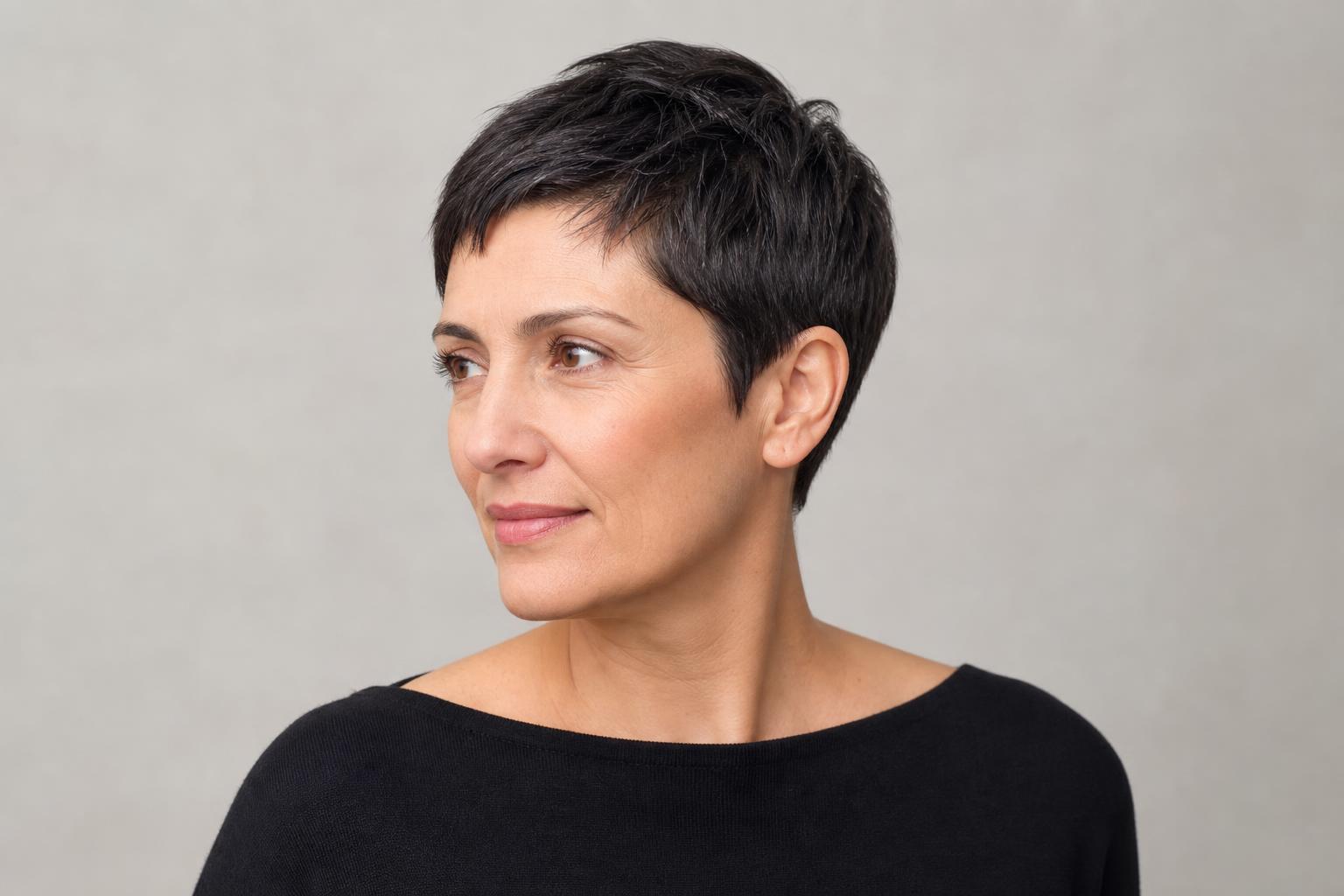
Low maintenance means two different things that pull in opposite directions, and short haircuts force you to pick one.
A pixie takes almost no time in the morning and needs a salon visit every four weeks. A soft chin-length bob takes ten minutes daily and holds its shape for three months. Both are called low maintenance and they solve opposite problems, so the first useful step is deciding which cost you actually want to cut: the minutes each morning, or the appointments each year. Below are 25 short cuts sorted by which of the two they save.
The gallery runs through cuts that need almost no daily styling, cuts that stretch the salon interval instead, the small group that manages both, and versions built for curly and coily texture. The cuts themselves overlap with the broader range of short cuts sorted by what suits real hair; what changes here is the ordering. After the entries there is an honest breakdown of the two costs, the structural features that actually make a cut forgiving, a stylist script, and a note on when a cut sold as low maintenance is nothing of the kind.
| Factor | Details |
|---|---|
| Two costs | Daily styling minutes, and weeks between salon visits |
| Shortest cuts | Near-zero daily time, 3 to 5 week salon cycle |
| Bob-length cuts | 5 to 12 minutes daily, 8 to 12 week salon cycle |
| What makes a cut forgiving | Soft edges, blended layers, a shape that follows your growth pattern |
| Avoid if you want low upkeep | Blunt fringes, hard undercut lines, anything needing daily heat |
Cuts That Need Almost No Daily Styling
These are the shapes you wash and leave, where the cut supplies the structure and nothing is arranged by hand. The trade is at the salon: the shorter the hair, the faster growth becomes visible, so these run on three to five week cycles. Choose from this group if your constraint is mornings rather than appointments.
1. Classic Tapered Pixie
Short through the nape and sides, graduating longer toward the crown, with enough on top to move without arranging. It reads as finished straight out of the shower. Ask for the front to reach at least the eyebrow so you keep some options when it grows.
2. Textured Crop with Piecey Ends
Point cutting through the top breaks the surface into separated pieces that fall apart on their own rather than sitting as a smooth cap. Thick and coarse hair carries it best. A pea of matte paste is optional rather than required.
3. Buzz Cut with a Shaped Hairline
A single uniform length with no styling at all, where the entire effect rests on the outline being cut deliberately. It suits balanced facial proportions and even scalp tone. The cycle is the shortest here at roughly three weeks, which is the honest cost.
4. Micro Bob Cut Blunt at the Jaw
One clean line just below the ear with no layering, so the weight of the hair holds its own shape as it dries. Straight and slightly wavy hair suits it; the line softens visibly by week six. Nothing needs doing beyond towel-drying.
5. Cropped Cut with a Deep Side Part
Moving the part well off-center makes the crown lift as the hair crosses over, producing root volume without product or a dryer. It takes two seconds and costs nothing. Alternate the side occasionally so the roots do not flatten permanently.
6. Short Shag with Built-In Movement
Soft layers cut so the hair separates as it dries, which means bedhead reads as the intended finish rather than as neglect. Wavy hair gets the most from it. This is the most forgiving cut in this section on grow-out, holding its look for six weeks rather than four.
7. Undercut Pixie with Hidden Sides
A section above the ears clipped short and covered by the length on top, removing bulk without changing the outline. Very thick hair sits considerably flatter and dries faster. The hidden section needs re-clipping every four weeks, which is what sets the cycle.
8. Bixie with Soft Layers
Longer than a pixie and shorter than a bob, layered so it falls into place without arranging. It is the compromise cut for anyone who wants near-zero styling but is not ready for a true pixie. Grow-out heads naturally toward a short bob with no awkward stage.
Cuts That Stretch the Salon Interval
These shapes hold for two to three months because nothing about them depends on a crisp line. They ask for five to twelve minutes each morning in return. Choose from this group if the appointment is the thing you are trying to avoid.
9. Soft Layered Bob at the Collarbone
Blended layers with no hard perimeter, so the shape simply lengthens rather than losing definition. Twelve weeks between appointments is realistic. A round brush for five minutes gives it polish, and skipping that reads as relaxed rather than unkempt.
10. Grown-Out Shag Cut to Look Grown Out
Layer spacing set deliberately wide so the cut looks correct three months after the appointment rather than three days after. Anyone who dislikes the sharp look of a fresh cut prefers this. It is the longest-interval shape in this article.
11. Chin-Length Bob with Point-Cut Ends
The perimeter is softened with vertical scissor work rather than cut as a hard line, which means regrowth blurs the edge instead of breaking it. Thick hair benefits most. Ten weeks between trims is comfortable.
12. A-Line Bob with a Gentle Angle
Shorter at the back, longer toward the front, with the angle soft enough that growth does not flatten it. The forward line keeps the shape reading as deliberate for months. Straight and wavy hair holds the angle; tight curls lose it to shrinkage.
13. Blunt Bob on Fine Hair
Nothing removed from the ends, so the full density sits at the perimeter where it reads as thickness. Fine hair gains the most apparent volume from this approach. The line does need resetting at eight weeks, which is the shorter end of this group.
14. Shoulder-Skimming Cut with Internal Layers
All the layering hidden inside the shape and none of it visible from outside, so movement exists without a perimeter that can go out of shape. Settling whether you want internal or visible layers before the appointment is what determines how forgiving the result is.
15. Lob with Long Face-Framing
The bulk stays one length while two front sections are cut to frame the face and move on their own. Nothing else is touched, so density is preserved everywhere. Growth simply lengthens the framing rather than ruining it.
16. Wavy Bob Left to Air-Dry
Cut to work with the wave rather than smooth it, with long layers giving the pattern room to clump. Wash, squeeze with a towel, walk away. Combing after washing is what separates the clumps and creates frizz, so the routine ends earlier than most people expect.
Cuts That Are Genuinely Low on Both Counts
A small group manages short daily time and a long salon interval at once, and they share a structural feature: soft edges combined with enough length that growth is not immediately visible. This is the section to look at if you want both, and it is deliberately short because the overlap is genuinely narrow.
17. Soft Bob with Blended Layers at the Jaw
Enough length to hold its own shape, layers soft enough that regrowth blends, and a perimeter with no crisp line to lose. Five minutes daily and ten to twelve weeks between appointments. This is the most broadly useful cut in the article.
18. Short Shag with Wide Layer Spacing
The shag structure supplies texture so nothing needs styling, while the wide spacing means the layers still look intentional two months later. Wavy and medium-density hair suits it. Texturizing spray on damp hair is the whole routine.
19. French Bob Worn Slightly Grown Out
Cut just above the chin and allowed to reach the chin before the next appointment, so the cut has a working range rather than a single correct length. Air-drying gives the tousled finish it was designed for. Skip the fringe version if upkeep is the priority.
20. Ear-Length Cut with a Soft Perimeter
Short enough to dry in minutes, softened enough at the edge that six weeks of growth reads as a slightly longer version of the same cut. It sits between a pixie and a bob without the salon cycle of the former.
21. Bixie with Wide-Spaced Layering
Longer than a pixie with layers cut far enough apart that growth blurs them rather than exposing them. Eight weeks between appointments is realistic, which is unusual at this length. Fine hair should keep the layering minimal.
Low-Maintenance Short Cuts for Curly and Coily Hair
Curl is the best low-maintenance asset there is, because the texture supplies volume and movement at no daily cost. The catch is that curly cuts fail differently: the problem is never a lost line, it is width building outward. Every cut here manages that.
22. Curly Pixie Cut Dry
Curls cut at their resting length so the shape is accurate the moment it dries, with no styling beyond a leave-in on wet hair. Wet cutting on curls lands inches shorter than intended, which is the one thing that turns this from low maintenance into a six-month wait.
23. Rounded Curly Bob with a Shaped Perimeter
The outline carries the shape and the interior density is left alone, which suits 3c and type 4 patterns where internal layering breaks the form. Twelve weeks between appointments is normal. A leave-in on soaking hair does more than any styling product applied later.
24. Short Wash-and-Go on 3a to 3b Curls
Cut with light layering so the curl clumps have room to form, then genuinely left alone from the moment product goes on. The single rule is hands off while it dries. Touching during drying is what produces the frizz people blame on the cut.
25. Tapered Coily Cut with Defined Edges
Sides tapered short with the top left full, shaped through the outline rather than layered internally. It needs moisturizing every day or two and nothing else. Night covering with a satin bonnet preserves the definition and removes most of the morning work.
The Two Costs, and Which One You Are Cutting
Almost every disappointing short haircut traces back to this. Someone asks for low maintenance, gets a pixie because that is what the phrase suggests, and then finds themselves at the salon every four weeks. The cut was low maintenance on one axis and high on the other, and nobody named which.
| Cut | Daily Styling | Salon Interval | Yearly Appointments |
|---|---|---|---|
| Buzz cut | None | 3 weeks | About 17 |
| Pixie | 2 to 5 minutes | 4 to 5 weeks | About 11 |
| Blunt bob | 10 to 15 minutes | 8 weeks | About 6 |
| Soft layered bob | 5 minutes | 10 to 12 weeks | About 5 |
| Grown-out shag | 3 to 5 minutes | 12 weeks | About 4 |
| Curly rounded bob | 5 minutes plus drying | 12 weeks | About 4 |
Read the last column rather than the first if time is genuinely your constraint. A buzz cut saves you roughly forty minutes a week of styling and costs you eleven extra salon visits a year, which for most people is the worse trade. The soft layered bob and the grown-out shag are the two cuts that come out ahead on total hours, which is why they appear in the section above rather than in either of the single-axis groups.
What Actually Makes a Short Cut Forgiving
Three structural features determine how a cut ages, and none of them is about length. The first is edge softness: a blunt perimeter has a line that can go out of shape, while a point-cut or textured edge simply blurs. The second is layer spacing, since layers cut close together expose every week of growth while widely spaced ones blend. The third is whether the shape follows your growth pattern, because a cut fighting a cowlick or a crown whorl needs restyling daily no matter how it was cut.
Stylist tip: ask your stylist to check your crown and hairline growth pattern before deciding the cut, not after. A double crown or a strong front cowlick rules out several of the shortest cuts in this article, because at pixie length the pattern wins every argument with product. Five minutes of looking at your dry hair saves months of fighting it.
Density matters differently than most people expect. Fine hair does better with blunt edges, which concentrate what density there is at the perimeter, while thick hair needs weight removed from underneath or it grows outward into a boxy shape. Cuts designed for thin hair at bob length take the blunt approach for exactly that reason, and applying the same logic to thick hair produces the opposite result.
What to Tell Your Stylist
Lead with the two numbers rather than the phrase. Saying low maintenance tells a stylist almost nothing; saying how many minutes and how many weeks tells them everything. A workable request sounds like this: “I want to spend under five minutes in the morning and come in every three months. I would rather have soft edges than a sharp line, and I air-dry.”
Stylist tip: say out loud that you air-dry, if you do. Almost every short cut photographed for a salon has been blow-dried, and a stylist who assumes you will do the same cuts a shape that depends on it. The same bob cut for air-drying and cut for a blowout are different cuts, and this single sentence is the most common thing left unsaid.
Be honest about the appointment cadence you will actually keep rather than the one you intend to. A cut that looks excellent for four weeks and poor for the next eight is a worse outcome than one that looks consistently decent for twelve, and stylists can design for either once they know. If you are still deciding on a length at all, the broader framework for working out which cut suits you comes before this question. General guidance on how often different lengths need cutting is a useful reality check before you commit.
When Low Maintenance Is a Trap
Several cuts are marketed as easy and are not, and a few situations undercut any short cut regardless of shape.
- Anything with a blunt fringe. A fringe reaches the lashes in three to four weeks and needs its own trim cycle, which is the highest-maintenance element available at any length.
- Hard undercuts and shaved sections. The hidden hair grows at the same rate as everything else and shows a hard line within a month.
- A pixie on hair with a strong crown whorl. The pattern lifts the crown daily and product will not hold it down at that length.
- Any cut needing daily heat to look correct. If the shape only exists after a blow-dry, it is a styling routine rather than a cut.
- Anything shorter than you can tie back on a bad day. Going up to a length covered in the medium range sorted by hair type keeps a ponytail available as a fallback, which is its own form of low maintenance.
- Very short cuts on hair that frizzes. Short hair has less weight holding the cuticle flat, so frizz shows more, and the routine that actually controls frizz adds minutes back into a morning you were trying to shorten.
FAQ
What Is the Lowest Maintenance Short Haircut for Women?
It depends which cost you are cutting. For daily time, a buzz cut or a tapered pixie needs almost nothing in the morning but a salon visit every three to five weeks. For total hours across a year, a soft layered bob wins, needing about five minutes daily and only four or five appointments annually. Most people who say low maintenance mean the second.
How Often Do Short Haircuts Need Trimming?
Roughly three weeks for a buzz cut, four to five for a pixie, eight for a blunt bob, and ten to twelve for a soft layered bob or shag. The pattern is that crisp lines need resetting and soft edges do not. A cut with a point-cut perimeter can go noticeably longer than the same length cut bluntly.
Is Short Hair Really Easier to Look After?
It is easier in the morning and harder at the salon, so whether it is genuinely easier depends on your constraint. Short hair dries faster, needs less product and tangles less, while also showing growth much sooner. Counting appointments across a year rather than minutes in a day often reverses people’s assumption.
Which Short Cut Grows Out Best?
A short shag or a bixie with widely spaced layers, because growth blends the layers rather than exposing them and the shape has no crisp line to lose. Blunt bobs grow out predictably but visibly, since the whole effect rests on the perimeter. Undercuts and shaved sections grow out worst of anything here.
Can Curly Hair Have a Low-Maintenance Short Cut?
Curly hair is well suited to it, because the texture supplies volume with no styling required. The requirement is cutting dry, since wet curls stretch and a wet cut lands inches shorter than intended. Shape the outline rather than layering internally on 3c and tighter patterns, and expect ten to twelve weeks between appointments.
What Should I Ask For If I Do Not Want to Style My Hair at All?
Ask for soft, textured edges rather than a blunt perimeter, widely spaced layers, and a shape that follows your natural growth pattern. Say explicitly that you air-dry and will not use a round brush. A stylist who knows those three things can build a cut that looks correct straight out of the shower rather than one that depends on a blow-dry.
Does a Bob or a Pixie Need Less Upkeep?
A pixie needs less daily time and roughly twice as many salon visits per year. A bob needs five to fifteen minutes each morning and holds its shape for two to three months. Neither is universally lower maintenance, and the right answer depends entirely on whether your mornings or your calendar is the tighter constraint.
Low maintenance short haircuts split cleanly into two groups, and picking well means naming which cost you are trying to cut before you sit down. Tell your stylist the number of minutes and the number of weeks rather than the phrase itself, mention that you air-dry if you do, and ask for soft edges over a sharp line. The soft layered bob and the grown-out shag are the two shapes that genuinely reduce both.
Hair results vary based on your natural hair type, texture, density, and condition. Always consult with a licensed hairstylist before making significant changes, especially with chemical treatments or dramatic length changes. Photos may show styled results that require professional tools and products to replicate.




1 response