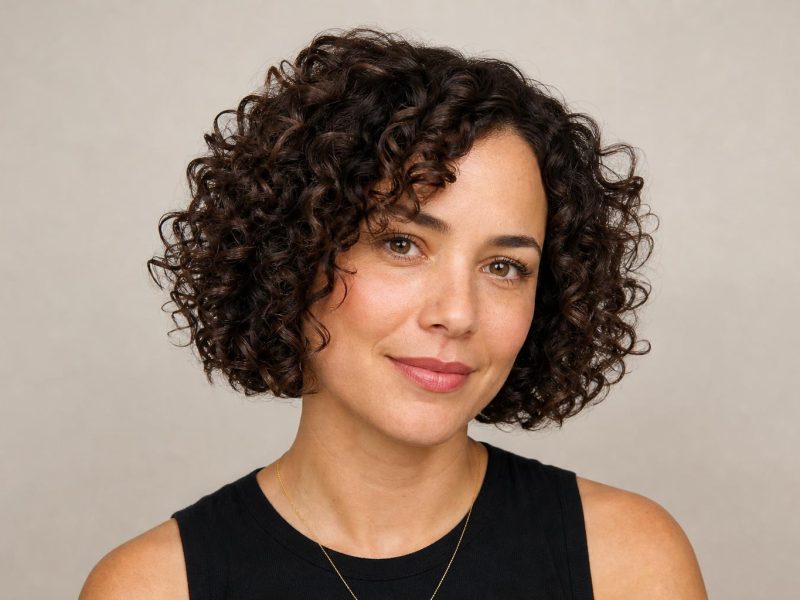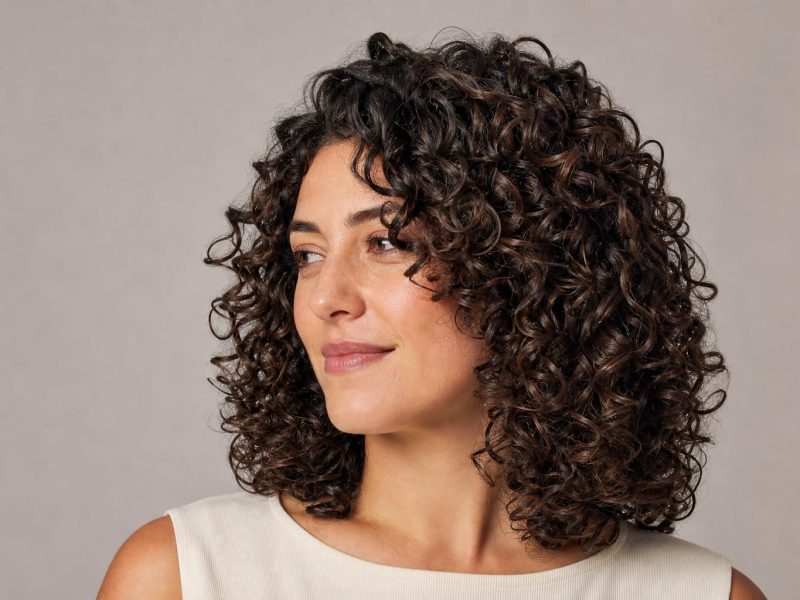

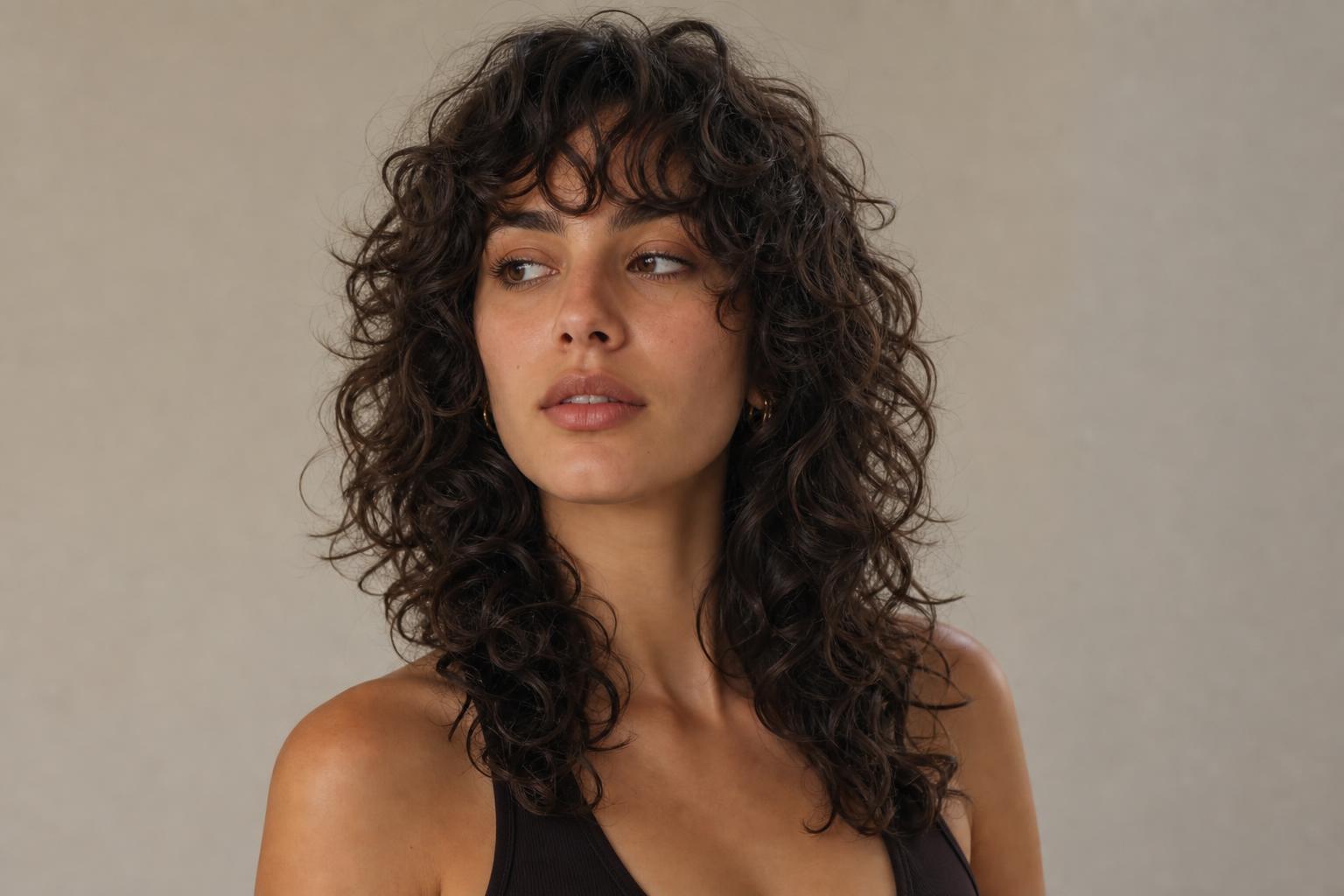
A wolf cut on curly hair needs a softer transition between the crown and the length than the same cut on straight hair, because curl already supplies the contrast the layers are meant to create.
The wolf cut is short, heavily layered at the crown with a long perimeter left underneath, borrowing the volume of a shag and the silhouette of a mullet. On straight hair the drama comes from a visible disconnection between those two sections. On curls the pattern itself already lifts and separates, so a stylist who cuts the same hard step produces a shape that sits away from the head like a triangle rather than falling into place. The curly version is the same idea executed with restraint.
This guide sets out how the wolf cut differs from the shag, butterfly and mullet it gets confused with, where the layers should start for each curl pattern, why the cut has to be done dry and by how much shrinkage moves the target, the wording to use at the consultation, a styling routine, and an honest account of who should skip it.
Wolf Cut, Shag, Butterfly and Mullet Are Four Different Things
All four are layered cuts with a longer perimeter, which is why the names get used interchangeably and why people end up with the wrong one. The difference is where the volume sits and how visible the step between layer lengths is. Getting the vocabulary right before the appointment is most of the work.
| Cut | Volume Sits | Layer Transition | Best Curl Range |
|---|---|---|---|
| Wolf cut | Concentrated at the crown | Sharp on straight hair, softened on curls | 2b to 3b |
| Shag | Spread evenly down the length | Blended throughout | 2a to 3c |
| Butterfly cut | At the front, around the face | Two distinct layer lengths, blended at the back | 2a to 3a |
| Mullet | Short through the sides and front | A hard stacked step at the back | Any, with dry cutting |
If you want volume that sits at the crown with length kept underneath, you want a wolf cut. If you want movement spread evenly with no obvious crown lift, you want a shag, which is the more forgiving of the two on tighter curl patterns. If the appeal is mostly face-framing, the butterfly cut and its two layer lengths gets you there with less commitment. The wolf cut is the one that changes the silhouette most, and the one hardest to undo.
Curl Pattern Decides Where the Layers Start
The single decision that makes or breaks this cut is the height of the shortest crown layer, which is really a question about how short and long layers behave differently. Too high and the curls stack outward into a pyramid; too low and there is no wolf cut at all, just a shag. Where that line should sit moves down the head as the curl pattern tightens, because tighter curls produce more volume from the same amount of hair.
Loose 2b to 2c Waves Take the Sharpest Version
Waves have the least natural volume, so they can carry crown layers cut as high as the top of the ear and still fall rather than stand. This is the curl range where a wolf cut looks closest to the versions you see on straight hair, with visible separation between the crown and the length. A texturizing spray on damp hair and air-drying is enough to make it read as deliberate.
3a to 3b Curls Need the Layers Dropped to Jaw Level
Spiral curls already lift at the root, so starting layers at ear level adds height to something that had plenty. Dropping the shortest layer to around the jaw keeps the crown volume in proportion while still giving the shape its lift. This is the sweet spot for the cut overall, and shapes built for 3b curls specifically follow the same weight logic.
3c Curls Need Weight Kept at the Perimeter
Tight corkscrews build width faster than length, and removing weight from the crown on 3c hair frequently produces the triangle it was meant to avoid. Keep the shortest layer at the collarbone and take the volume out of the sides instead. Anyone with this pattern should ask whether a shag serves them better, since the even distribution suits the texture more naturally, and the wider set of shapes built for 3c hair leans that way for the same reason.
Type 4 Coils Usually Want a Different Cut Entirely
Coily hair holds its shape through the outline rather than through internal layering, and a wolf cut is internal layering by definition. Cutting short crown layers into 4a to 4c hair removes the density that supports the shape and leaves the crown looking sparse rather than lifted. A shaped, rounded silhouette with the perimeter defined achieves the volume without the structural cost.
The Cut Has to Be Dry, and the Numbers Explain Why
Curls shrink as they dry, and the amount is larger than most people expect: roughly 20 to 30 percent on loose 3a curls and up to half the stretched length on tight 3c and type 4 patterns. A stylist cutting wet is choosing a length that will move upward by inches once the curl springs back, and they cannot see where it lands until it is too late to correct.
That matters more on a wolf cut than on any other curly shape, because this cut is defined by the shortest layer. Everything else forgives an inch of error; the crown layer does not. A crown section cut at the ear while wet can end up sitting above the ear once dry, which is the difference between lift and a shelf of hair standing away from the scalp. There is no styling fix for it and it grows back at half an inch a month.
Stylist tip: arrive with your hair washed, dry, and styled the way you normally wear it, with no updo and nothing clipped back. A stylist cutting a curly wolf cut is working curl by curl, judging where each spring sits at rest, and hair that arrives damp or stretched into a bun removes the only reference they have. Any salon that wants to wash and comb it straight before cutting is about to give you a shape you did not ask for.
What to Tell Your Stylist
Name four things: how high the shortest crown layer should sit, how visible you want the transition, where the perimeter should fall, and whether you want bangs. A workable request sounds like this: “Wolf cut, but softened for curls. Shortest layer at the jaw, blended into the length rather than disconnected, perimeter kept at the collarbone, and curtain bangs at the front. Please cut it dry.”
The phrase that does the most work is “blended, not disconnected.” Wolf cuts on straight hair are photographed with a visible step, and a stylist working from that visual reference will replicate it unless told otherwise. Saying the word blended once at the start saves the appointment.
Bring photos of the cut on hair with your curl pattern rather than a pattern you admire. A wolf cut on 2b waves and the same cut on 3c coils are different shapes with the same name, and a reference photo from the wrong pattern sets an expectation the cut cannot meet. Ask your stylist which parts of the photo are achievable on your texture before anything is cut, since the honest answer is usually most but not all of it.
Styling a Curly Wolf Cut
The cut does most of the work, which is the appeal, and the routine that keeps it looking intentional is short. Apply everything to soaking wet hair rather than damp, since product distributes evenly through wet curls and unevenly through damp ones. Leave-in conditioner first, then a curl cream or gel, raked through and then scrunched upward toward the scalp.
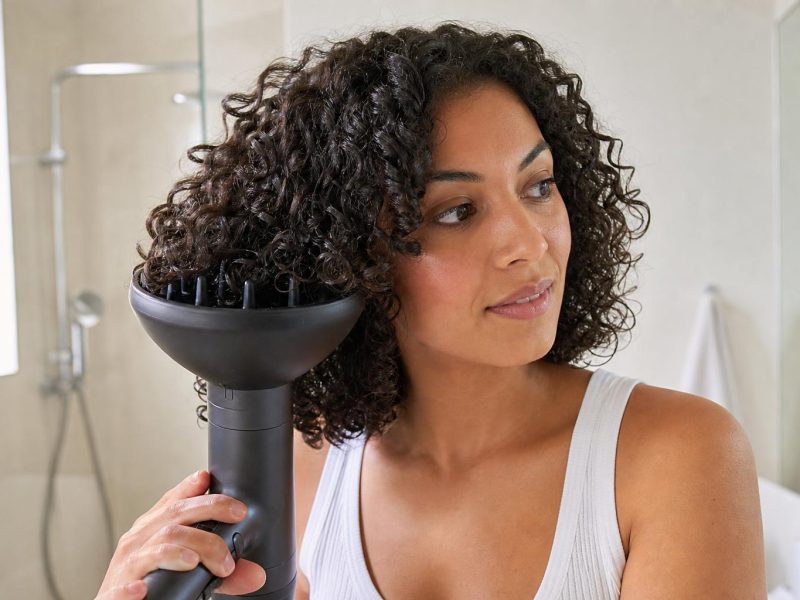
Drying is where curly wolf cuts most often go wrong. Diffuse on low airflow and medium heat, cupping sections against the scalp rather than moving the dryer around, and stop touching the hair once it is 80 percent dry. High airflow separates the curl clumps while the cuticle is still setting, which is what turns definition into frizz. If you air-dry instead, the same rule applies: hands off from the moment product goes on.
Stylist tip: scrunch the gel cast out only when the hair is completely dry, not while it is still slightly damp. The hard cast that forms as gel dries is protecting the curl shape underneath, and breaking it early collapses the clumps you were trying to set. Wait until it feels crunchy all the way through, then scrunch with a drop of oil on your palms.
Frizz at the crown is the most common complaint with this cut, because the short layers there have the least weight holding them down. Sealing damp hair with a light oil over the top of your cream slows how fast moisture moves through the cuticle, and the same sealing sequence that controls frizz generally applies to the crown section specifically.
Maintenance and Grow-Out
A curly wolf cut grows out more gracefully than the straight-haired version, since curl hides the layer spacing as it lengthens. What it loses first is the crown lift, because the short layers there gain weight fastest relative to their length. Most people notice the shape flattening at the crown around week eight while the rest of the cut still looks fine.
| Curl Pattern | Trim Interval | What Goes First | Daily Styling |
|---|---|---|---|
| 2b to 2c waves | 8 to 10 weeks | Crown lift flattens | 5 minutes, air-dry |
| 3a to 3b curls | 10 to 12 weeks | Layer spacing blurs | 10 minutes plus drying |
| 3c curls | 12 weeks | Width builds at the sides | 10 to 15 minutes plus drying |
One booking habit helps considerably: ask for a crown-only refresh at the midpoint rather than a full cut. Reshaping the short layers takes twenty minutes, costs less than a full appointment in most salons, and restores the lift without touching the length you are trying to keep. If the shape stops suiting you, the broader range of medium cuts sorted by hair type covers where a grown-out wolf cut can go next.
When a Curly Wolf Cut Is the Wrong Choice
This is one of the least reversible cuts available on curly hair, and several situations argue against it.
- Fine curly hair with low density. Removing weight at the crown on hair that has little to spare leaves the shape sparse rather than lifted, and there is no way back for six months.
- Type 4 coils. The cut works through internal layering, and coily hair holds its shape through the perimeter, so the two are structurally at odds.
- A stylist who will not cut dry. This is not a preference on this particular cut; it is the difference between the shape you asked for and a shelf at the crown.
- Anyone growing their hair out. Wolf cuts remove length at the crown by definition, and that section becomes the limiting factor on how long the whole cut can look even.
- Hair that is currently damaged through the mid-lengths. Heavy layering puts the damaged section on display at multiple levels rather than only at the ends.
Common Curly Wolf Cut Myths
Myth: A Wolf Cut Removes Bulk From Thick Curly Hair
Reality: it redistributes bulk upward rather than removing it. Short crown layers concentrate volume at the top of the head, which on already-dense curly hair produces height rather than the slimmer silhouette people are usually after. Weight removal from the interior of the sides is the request that actually reduces bulk.
Myth: The Wolf Cut Is Just a Trendy Name for a Shag
Reality: they differ in where the volume sits. A shag spreads layering evenly down the length with no concentration; a wolf cut deliberately stacks the shortest layers at the crown against a longer perimeter. On curly hair that difference is significant enough to suit different patterns, with shags generally working further down the curl scale.
Myth: Curly Hair Cannot Take Short Layers
Reality: curly hair takes short layers well when they are cut dry and placed correctly for the pattern. The failures people describe come from wet cutting, which lands the layer inches higher than intended, or from copying a layer height meant for a looser curl. Both are execution problems rather than a limit of the texture.
FAQ
What Is a Curly Wolf Cut?
A wolf cut is a heavily layered shape with the shortest layers concentrated at the crown and a longer perimeter left underneath, combining the volume of a shag with the silhouette of a mullet. The curly version softens the transition between those two sections, because curl already provides contrast that straight hair needs the cut to create. It is usually paired with curtain bangs or face-framing pieces.
Does a Wolf Cut Work on Curly Hair?
It works well on 2b through 3b patterns and becomes harder to execute as the curl tightens. Above 3c the internal layering starts removing the density that supports the shape, which is why a shag or a perimeter-shaped cut generally suits type 4 hair better. The key adjustment across all patterns is dropping the shortest crown layer lower than you would on straight hair.
Should a Curly Wolf Cut Be Cut Wet or Dry?
Dry, without exception. Curls shrink between 20 percent and half their stretched length as they dry, so a wet cut lands the crown layer inches above where the stylist intended. That matters more here than on any other curly cut, because the whole shape is defined by the height of that shortest layer and there is no styling correction for getting it wrong.
What Is the Difference Between a Wolf Cut and a Shag on Curly Hair?
A wolf cut concentrates volume at the crown with a distinctly longer perimeter; a shag spreads the layering evenly down the length with no single point of concentration. On curls, the shag is the more forgiving of the two and works across a wider range of patterns. Choose the wolf cut if you specifically want lift at the top of the head.
How Often Does a Curly Wolf Cut Need Trimming?
Every eight to twelve weeks depending on curl pattern, with looser waves needing it soonest. What fails first is the crown lift, since the short layers there gain proportional weight fastest, while the length still looks fine. Booking a crown-only refresh at the midpoint restores the shape in about twenty minutes without touching the length.
Will a Wolf Cut Make My Curly Hair Look Bigger?
At the crown, yes, which is the intended effect. If the layers are cut too high for your curl pattern the volume extends sideways as well and the silhouette turns triangular, which is the most common complaint about this cut. Dropping the shortest layer to jaw level on 3a to 3b hair, and to the collarbone on 3c, keeps the height without the width.
Can I Get a Curly Wolf Cut with Fine Hair?
Fine curly hair is the case to be most cautious about, because removing weight at the crown from hair with limited density leaves the top looking thin rather than lifted. If you want the shape, ask for a very restrained version with the shortest layer no higher than the collarbone and minimal texturizing. A shag or long layers deliver more visible fullness on fine curls.
A curly wolf cut succeeds on two decisions made before any hair is cut: how high the shortest crown layer sits, and whether the transition into the length is blended rather than stepped. Match the layer height to your curl pattern rather than to a photo, insist on a dry cut, and say the word blended out loud at the start of the appointment. Everything else about this shape is forgiving; those two things are not.
Hair results vary based on your natural hair type, texture, density, and condition. Always consult with a licensed hairstylist before making significant changes, especially with chemical treatments or dramatic length changes. Photos may show styled results that require professional tools and products to replicate.