

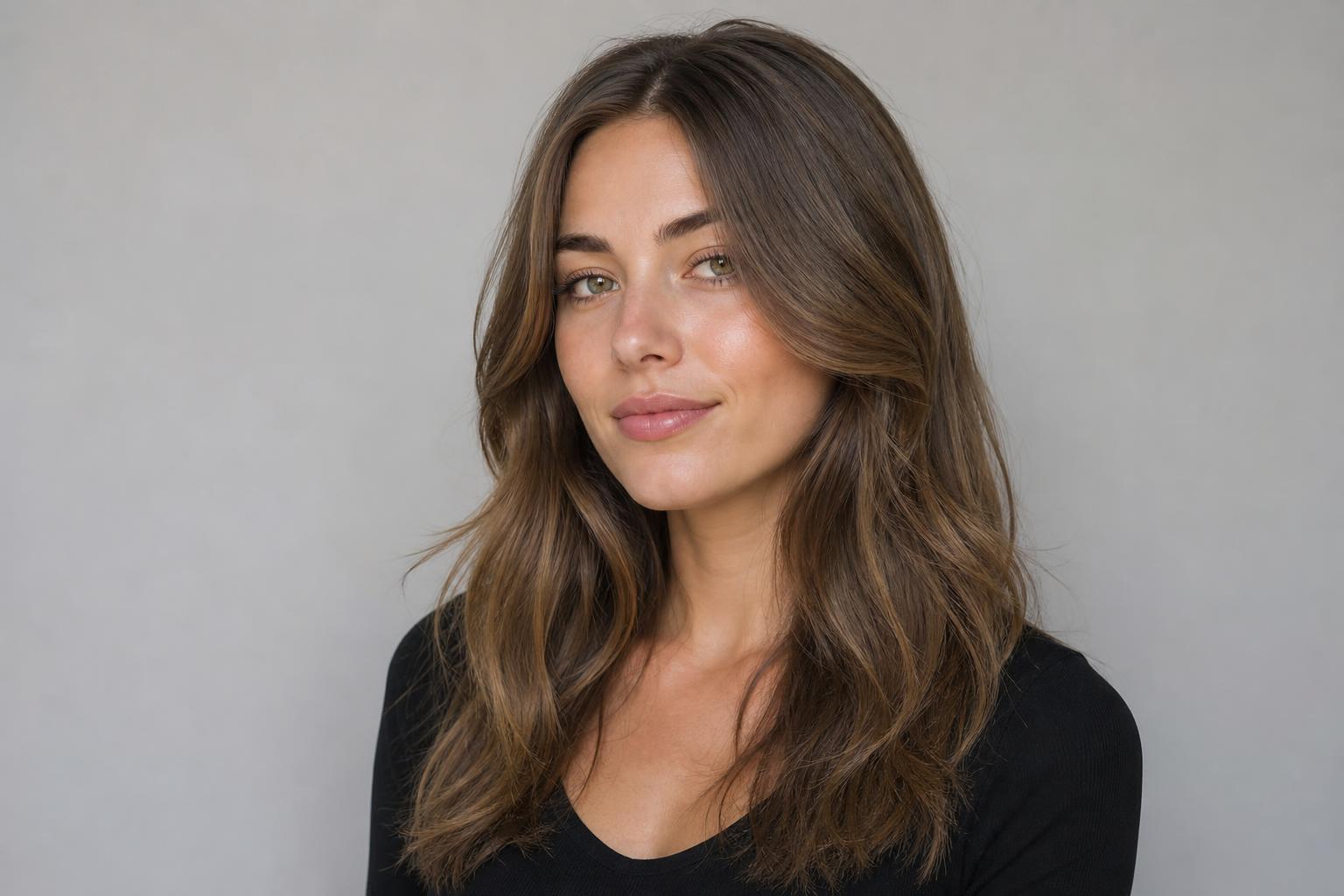
The butterfly haircut goes wrong in the chair for one reason, and it is almost never the stylist’s fault.
Ask for a butterfly haircut in a single sentence and you will get someone’s best guess. The wording that actually works names two lengths and protects one of them, something like this, “I want a butterfly cut. Keep my overall length exactly where it is now, add a shorter internal layer that finishes around my collarbone, and give me face-framing pieces that start at my cheekbones.” Those three clauses cover the only decisions your stylist has to make.
This guide gives you the full script broken into four parts, a say-this-not-that list of the phrases that cause the most damage, a face shape table for where the shortest layer should land, modifications for fine, thick, and curly hair, and the two checks to run before you leave the chair. It also covers the grow-out, which is the part nobody warns you about.
A Butterfly Cut Is Two Layer Lengths Living in One Haircut
The cut is built from two separate tiers. A short internal tier is cut somewhere between the chin and the collarbone and is what creates the lift and the winged shape around the face. A long tier keeps your existing length untouched below it. When the hair is worn down, the short tier folds over the long one and the two lengths blend into what looks like one soft, voluminous shape. Lift the top layer and you can see the two tiers clearly, which is why the cut looks so different in a ponytail than it does blown out.
That two-tier structure explains why the butterfly gets confused with its neighbors. An octopus cut stacks its short layers higher and tighter at the crown for a heavier top. A wolf cut adds choppy, disconnected texture all the way through. The butterfly keeps everything soft, blended, and long enough to tie back, which is precisely what most people want and rarely manage to say out loud.
Stylist tip: Use the word “tier” or “internal layer” instead of “layers” on its own. A stylist who hears “layers” with no length attached defaults to a standard long-layer graduation, which removes weight evenly down the whole length and gives you none of the winged shape you came in for.
The Script, Broken Into Four Sentences
Read these in order during the consultation, before the cape goes on. Each one answers a question your stylist would otherwise have to guess at, and together they take about 20 seconds to say. Adjust the measurements to your own hair, but keep the structure.
Sentence One Names the Cut and Protects Your Length
Say, “I would like a butterfly cut, and I do not want to lose any overall length. Please only dust the ends if they need it.” This is the sentence that prevents the single most common regret. The butterfly is a layering technique, not a length change, so your perimeter should end up within half an inch of where it started. Saying it first also sets the boundary before anyone picks up scissors.
Sentence Two Sets Where the Short Tier Finishes
Say, “The shortest internal layer should finish right around my collarbone.” Then touch the spot. Collarbone is the standard for shoulder-length and longer hair, though the short tier can finish anywhere from the chin to just below the shoulder depending on how much lift you want. Naming a body landmark beats naming inches, because your stylist can see a collarbone and cannot see the six inches you have in your head.
Sentence Three Handles the Face-Framing Pieces
Say, “I want face-framing pieces starting at my cheekbones, angled back away from my face, and I do not want a full fringe.” Or, if you do want the fringe, “I want a soft curtain fringe that splits in the middle and blends into the face-framing pieces.” The front of a butterfly cut is where the style is either made or lost, and vague wording here produces either a blunt curtain that fights the rest of the cut or nothing at all. The distinction between a curtain fringe and a butterfly fringe is worth settling before you sit down, since they are cut at different angles.
Sentence Four Asks for the Right Cutting Method
Say, “Please point cut the ends of the layers rather than cutting them blunt, and keep the transition between the two lengths soft.” Point cutting means the scissors go into the ends vertically instead of straight across, which softens the line where the short tier meets the long one. A blunt line there is what creates the shelf effect people complain about, where you can see exactly where the haircut changes lengths.
Phrases That Get You the Wrong Cut
Half of a good consultation is knowing which common phrases carry a different meaning inside a salon than they do outside one. These four cause the most trouble with this particular cut.
| Do Not Say | What Your Stylist Hears | Say Instead |
|---|---|---|
| “Just add some layers” | Standard long graduation from the eye line down | “A short internal tier finishing at my collarbone, with my length kept” |
| “Take off a little” | One to two inches from the perimeter | “Dust the ends only, no more than a quarter inch” |
| “Thin it out” | Thinning shears through the mid-lengths | “Remove weight with point cutting, not thinning shears” |
| “Something like Ariana” | A vibe with no measurable instruction in it | “This photo, but the shortest layer at my collarbone instead” |
Bring three photos rather than one, all showing hair close to your own texture and density. One photo leaves your stylist guessing which element you liked, while three of the same shape confirm the pattern. Photos of styled hair also mislead, so it helps to know how to use inspiration photos at the salon without setting up an expectation your natural texture cannot meet.
Where the Shortest Layer Should Finish for Your Face Shape
The short tier controls where the eye lands, so its finishing point does more for your face than the overall length does. Move it up and you add width and lift around the cheekbones. Drop it down and you keep the shape long and narrow. Use the table as your starting number, then let your stylist adjust for your height and neck length.
| Face Shape | Short Tier Finishes At | Face-Framing Starts At | Avoid |
|---|---|---|---|
| Oval | Collarbone | Cheekbone | Nothing structural, most placements work |
| Round | Below the collarbone | Jaw or lower | Chin-length short tier, which widens the cheeks |
| Square | Collarbone | Below the jaw, angled back | A blunt front piece landing level with the jaw corner |
| Heart | Collarbone | Chin, building width low | Heavy volume above the ears, which widens the forehead |
| Oblong | Chin to shoulder, higher than standard | Cheekbone, with a curtain fringe | All layers below the shoulder, which drags the face longer |
| Diamond | Just below the collarbone | Chin, softening the cheekbone | Short tier finishing level with the cheekbones |
Adjust the Ask for Your Hair Type
The same script produces three different haircuts on three different textures, so one clause needs swapping depending on what you are working with. Say the modification out loud rather than hoping it gets noticed, because density and curl pattern are easy to misjudge under salon lighting when the hair arrives already blown out.
Fine Hair Needs Fewer Tiers and a Higher Perimeter
Add, “My hair is fine, so please keep the internal tier minimal and leave the perimeter as dense as possible.” Fine hair carries a butterfly cut well only when the short tier is a light framing layer rather than a full second haircut. Too much removal and the ends go wispy while the crown collapses by lunchtime. Anyone whose hair thins toward the ends will get more out of the shaping ideas in our layered cuts for thin hair before committing to the full two-tier version.
Thick Hair Needs Weight Removed From Underneath
Add, “My hair is thick, so please remove weight from the interior rather than only from the surface layers.” Without that, a butterfly cut on dense hair puffs into a triangle by the second wash, because the short tier adds volume exactly where thick hair already has too much. Internal weight removal solves it while keeping the outline clean.
Curly and Wavy Hair Needs the Cut Done Dry
Add, “My hair is wavy, so I would like this cut dry or at least checked dry before we finish.” Shrinkage on a 2c to 3b pattern runs anywhere from one to four inches, which means a short tier measured wet at the collarbone can dry level with the chin. Confirming the layer placement on dry hair is the difference between the shape in the photo and a version that is two lengths shorter than you agreed to.
Two Checks Before You Leave the Chair
Run both of these while the cape is still on, when a correction takes two minutes rather than a second appointment. First, ask your stylist to gather the hair into a low ponytail. A well-cut butterfly still gathers cleanly, with the short tier lying softly around the face instead of sticking out in a shelf. Second, ask them to lift the top section straight up so you can see the two tiers. The transition should look like a slope, not a step.
Stylist tip: Ask to see the back with two mirrors before the blow-dry, not after. A round brush hides a lot, and a shape that only works styled will disappoint you on the first air-dry morning at home. If the two tiers are only visible after 20 minutes of blow-drying, the internal layer has been cut too subtly to matter.
When a Butterfly Cut Is Not the Right Ask
This cut has real limits, and walking in aware of them saves a difficult conversation later. Consider a different ask when any of these describe you.
- Your hair is shorter than shoulder length, since there is not enough length below the short tier to create the fold that makes the shape work.
- You have very fine, low-density hair and no interest in daily styling, because the cut relies on the short tier holding a bend that fine hair will not hold on its own.
- You wear your hair up almost every day, in which case the internal tier will escape the elastic and frame nothing.
- You are growing out a previous heavy layering job, where adding a second short tier stacks two grow-out phases on top of each other.
- You want a low-commitment change, since the short tier takes six to twelve months to blend back into one length.
If most of that list describes your situation but you still want movement, the softer route is a long-layer cut with face framing and no second tier. A wolf cut consultation heads the other direction, with shorter and choppier layers throughout, so it is worth knowing which side of the butterfly you are drifting toward before you book.
Maintenance and Grow-Out Reality
Plan on a trim every ten to fourteen weeks, which is longer than most layered cuts because the two tiers grow at the same rate and stay in proportion for a while. What you are maintaining is the face-framing, which loses its angle around week eight and can be reshaped on its own between full appointments. Daily styling runs about ten minutes with a round brush, or five with a diffuser if your natural texture does most of the work.
The grow-out is genuinely long. A collarbone-length short tier on hair that grows half an inch a month needs the better part of a year to reach the perimeter, and months four through seven are the awkward stretch where the tier hangs at an in-between length. Curling the ends of the short tier away from the face during that phase disguises it well. Once you are past it, the day-to-day styling routine for a butterfly cut is what keeps the two tiers blending into one shape.
FAQ
The questions that come up most often once people start planning the appointment.
Will a Butterfly Haircut Make My Hair Shorter?
Not if you say so explicitly at the start of the consultation. The butterfly is a layering technique applied inside your existing length, so the perimeter only changes if you ask for it to. Use the phrase “dust the ends only” rather than “just a trim,” because a trim means one to two inches to most stylists.
How Long Does My Hair Need to Be for a Butterfly Cut?
Shoulder length is the practical minimum, and the cut looks best from collarbone length down. Below shoulder length there is not enough hair under the short tier for the two lengths to fold together, and the result behaves like a shag instead. On very long hair the short tier can finish lower, around the bust line, and still create the same winged effect.
Is a Butterfly Haircut the Same as an Octopus Cut?
They are close relatives with a different balance of weight. An octopus cut concentrates its shorter layers higher, building a fuller, rounder crown with thin lengths trailing below, while a butterfly keeps the short tier lower and the whole shape softer and more blended. If you want visible drama at the crown, ask for the octopus by name.
Can I Get a Butterfly Cut Without Bangs?
Yes, and many stylists prefer it that way on clients with cowlicks or high foreheads. Ask for face-framing pieces starting at the cheekbone and angled back instead of a fringe, which gives you the same softness around the face without the daily commitment. You can always add the curtain fringe at a later appointment once the layers have settled.
How Much Should a Butterfly Haircut Cost?
It is priced as a standard women’s cut in most salons, since it takes the same chair time as any layered long cut. Expect to pay more only if your stylist adds a dry-cut finish or a full blow-dry lesson. Ask when you book whether the price includes a style, because the cut looks very different finished than it does air-dried.
What If My Stylist Has Never Heard of a Butterfly Cut?
Skip the name entirely and describe the structure instead, since the technique long predates the trend name. Say you want a short internal tier finishing at the collarbone over your existing length, with face-framing pieces from the cheekbone. Any experienced stylist can cut that, and knowing a handful of standard salon terms makes the conversation faster than any trend label does.
Can I Ask for a Butterfly Cut on Curly Hair?
Curly hair suits the cut well because the two tiers create separation that stops curls from stacking into a triangle. The one non-negotiable is a dry cut, or at minimum a dry check before the finish, so the layers land where your curls actually fall. Ask specifically whether your stylist cuts curls dry when you book rather than discovering the answer in the chair.
Knowing how to ask for the butterfly haircut comes down to naming two lengths, protecting the one you already have, and saying where the shortest layer finishes. Write the four sentences on your phone before the appointment and read them during the consultation rather than trusting yourself to remember under a hairdryer. Bring three photos, run the ponytail check before the cape comes off, and you will walk out with the cut you pictured.
Hair results vary based on your natural hair type, texture, density, and condition. Always consult with a licensed hairstylist before making significant changes, especially with chemical treatments or dramatic length changes. Photos may show styled results that require professional tools and products to replicate.
1 response