

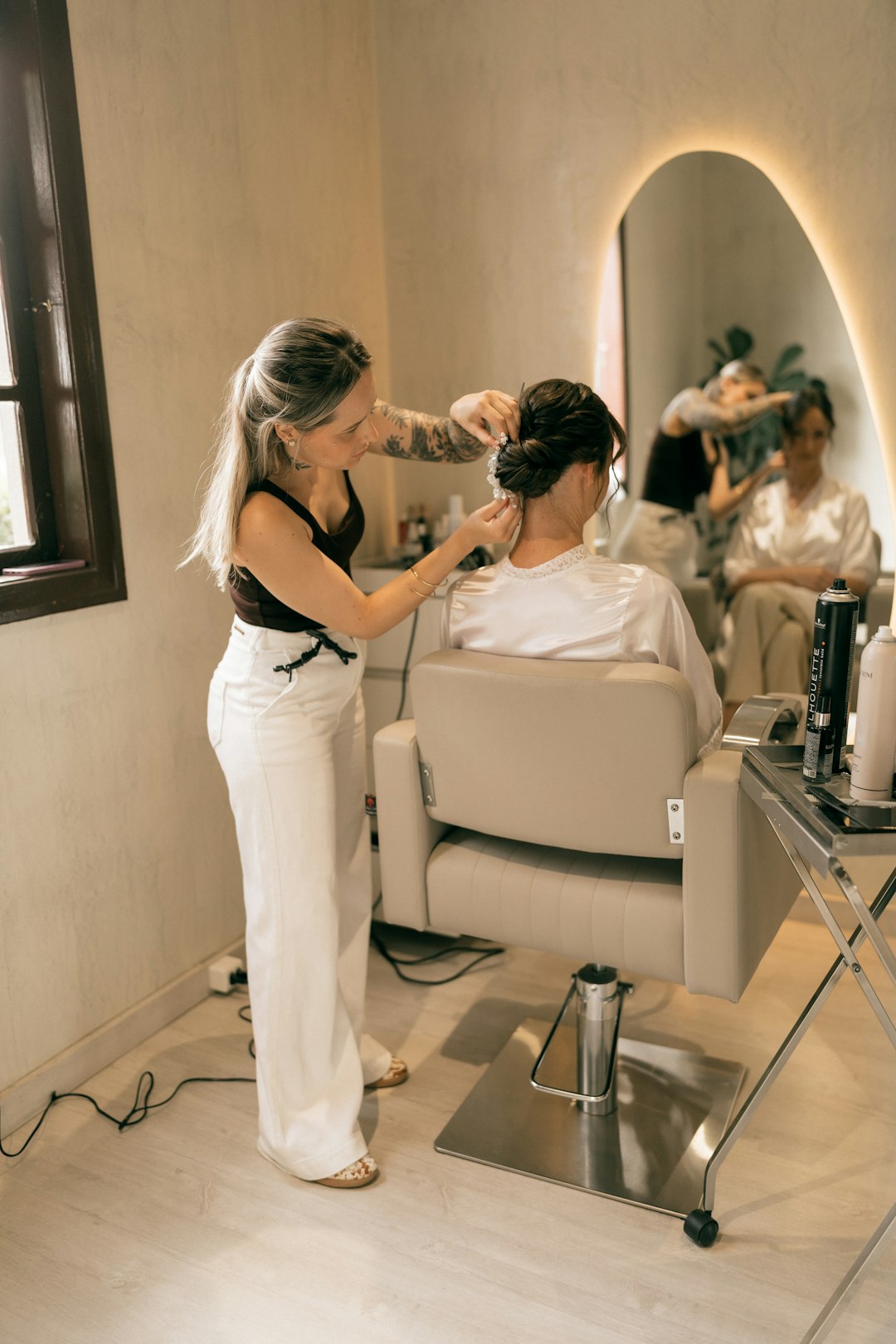

Knowing what your stylist is saying changes the outcome of every single appointment.
These 50 salon vocabulary terms cover the cutting techniques that shape your layers, the color service names that determine your treatment plan, and the consultation language that helps your stylist deliver exactly what you want. Walk in knowing the difference between balayage and foils, point cutting and texturizing, or a trim and a true cut, and you can ask for what you need with confidence instead of hoping the result matches your mental image.
This guide organizes all 50 terms into six categories, with a color service comparison table and exact phrasing you can use at your next consultation at the end.
How Your Haircut Is Built
These structural terms describe the shape, distribution, and silhouette of any haircut. Knowing them helps you ask for exactly what you want instead of pointing vaguely at your collarbone.
1. Blunt Cut
A blunt cut trims every strand to exactly the same length, creating a clean, defined edge with no graduation or layering. It works best on straight to medium-wavy hair with medium to thick density; on very fine hair, the single weight line tends to lie flat rather than swing.
2. Layers / Layering
Layers are sections cut at different lengths to add movement, volume, and texture. Specify whether you want internal layers (hidden underneath for lift) or surface layers (visible texture on the outside), since the two approaches look completely different in practice. The distinction plays out clearly in comparisons like layered bob versus choppy bob, two styles built from the same basic concept in very different ways.
3. Face-Framing Layers
Face-framing layers are shorter pieces around the front hairline that pull forward to frame your face. Starting point matters: cheekbone-level framing draws the eye downward and suits round faces; chin-level framing is more neutral across a wider range of shapes.
4. Graduation / Graduated Cut
A graduated cut is shorter at the back and progressively longer toward the front, stacking hair at an angle to build volume or shape. An inverted bob is the clearest example: the nape is shortest and the front sections lengthen past the jaw.
5. Weight Line
The weight line is the horizontal zone where most hair falls together, creating visible density or a defined edge. A strong weight line reads as sharp and architectural; breaking it up through point cutting or texturizing gives a softer, blended finish.
6. Perimeter
The perimeter is the outermost edge of a haircut: the ends visible when you look at the overall shape. A blunt perimeter is precise and architectural; a soft perimeter is point-cut or feathered for a less defined, more naturally moving finish.
7. Fringe / Bangs
Fringe and bangs describe the same thing, though stylists tend to say fringe while clients say bangs. The type varies widely: blunt fringe is a straight-across line at eyebrow level; curtain bangs are center-parted and swept to each side; wispy fringe is light and textured.
8. Bob
A bob is a cut where the length falls between the jaw and the chin with a defined edge, covering a wide range of styles from blunt and one-length to graduated and layered. Always bring a reference photo or specify the exact variation you want. Our guide on how to ask for a bob walks through the exact language to use at your consultation.
9. Lob (Long Bob)
A lob falls between the jaw and collarbone, giving the manageable shape of a bob with more length to work with. It covers a wide range from blunt to shaggy, including softer mid-length variants like the airy bob that show how much variation exists at a single length.
10. Undercut
An undercut clips a section very short underneath the longer top layer, usually at the nape or sides, to reduce bulk and add lightness to thick hair. It requires maintenance every 3–4 weeks because the clipped section grows back visibly under the longer hair.

Cutting Techniques Your Stylist Uses
These are the methods used to cut and texture your hair. Knowing them helps you ask for a specific finish and catch if a technique is about to be applied that does not suit your texture.
11. Point Cutting
Point cutting holds the scissors vertically and snips into the ends at an angle, producing a soft, textured edge rather than a blunt line. It is the preferred technique for fine hair because it removes bulk without making ends look thin.
Stylist tip: If your haircut always looks stiff or heavy at the ends, ask your stylist to point cut the perimeter on your next trim. This one technique change creates a noticeably lighter, more natural finish without removing any length.
12. Razor Cutting
A straight razor slices through hair at an angle to create an extremely soft, feathered edge with significant weight removal. One important caveat: razor work opens the cuticle unevenly and often causes frizz on curly or fine hair, so always confirm your texture can handle it before agreeing.
13. Slide Cutting
Slide cutting opens the scissors slightly and moves them down the shaft to taper and thin the ends from mid-shaft downward. It adds flowing movement to long or thick hair without a dramatic reduction in length, and it is gentler on the ends than razor cutting.
14. Blending
Blending connects two different lengths so the transition between them is seamless, with no visible line where one length ends and the next begins. When a cut looks choppy or disconnected, more blending in the transition zones is almost always the solution.
15. Thinning / Texturizing
Thinning uses notched-blade shears to remove bulk evenly; texturizing is a broader term covering point cutting, razor work, and slide cutting. Over-thinning on fine hair leaves ends looking sparse, so ask exactly which method your stylist plans to use before work begins.
16. Dusting
Dusting removes only the very tips of the hair, typically under a quarter inch, to clear split ends without any perceptible length change. It is the right request when you are growing your hair out and want healthy ends without losing progress on length.
17. Dry Cutting
Dry cutting works on hair that is completely dry in its natural state rather than wet. For curly and wavy hair it is strongly preferred because wet curls shrink 30–50% when dry, and cuts made on wet hair routinely remove more length than the client expected.
18. Chunking
Chunking removes large, defined pieces from specific sections to create visible gaps in the ends for a deliberately disconnected look. It is common in shag and wolf cuts where contrast between short and long sections is part of the style, and it is not suited to anyone wanting a polished, smooth finish.

Words for Describing Your Hair
These eight terms are how stylists assess hair during a consultation. Knowing them helps you give a more precise answer than “it’s kind of wavy.”
19. Hair Type (Curl Pattern)
Hair type describes your curl pattern on a scale from Type 1 (straight) through Type 2 (wavy), Type 3 (curly), and Type 4 (coily), with letter subdivisions a, b, and c indicating tightness within each category. Knowing whether you are a 2c or 3a gives your stylist a more precise starting point for both cutting technique and product choices.
20. Strand Thickness (Fine vs. Coarse)
Strand thickness describes the diameter of each individual hair strand, separate from how much hair you have overall. Fine strands lie flat easily and need lightweight products; coarse strands hold shape well but resist color penetration and often need more conditioning to feel soft.
21. Density
Density is how many strands grow per square inch of scalp, describing your overall hair volume rather than individual strand size. High-density hair looks full even when strands are fine; low-density hair appears sparse regardless of strand thickness. Our guide on choosing a haircut by hair density breaks down which cuts work best at each level.
22. Porosity
Porosity describes how easily your hair absorbs and holds moisture, determined by how open or closed the cuticle is. Low-porosity hair resists water and is slow to dry; high-porosity hair absorbs quickly but loses moisture just as fast, leading to dryness and frizz between washes.
23. Elasticity
Elasticity is your hair’s ability to stretch when wet and spring back without breaking. Poor elasticity signals damage or over-processing, and a stylist checks it before recommending bleach or a perm because low-elasticity hair may not survive the chemical process without significant breakage.
24. Virgin Hair
Virgin hair has never been chemically processed: no color, bleach, relaxer, or keratin treatment. It accepts color more predictably and lifts more evenly than hair with prior chemical history, so a colorist will plan a completely different formula when they know they are starting from virgin.
25. Cowlick / Growth Pattern
A cowlick is a section that grows in a circular or opposing direction, creating a patch that resists lying flat. Growth patterns more broadly describe the direction hair grows across the entire scalp, which affects how a fringe will fall and how the nape of any cut needs to be finished.
26. Shrinkage
Shrinkage is the difference in length between wet and dry curly or coily hair, which can be 30–50% for tight curl patterns. Always give your stylist a dry-length target so the cut accounts for how much the hair will spring up once it dries.

Hair Color Services Decoded
Color is where miscommunication is most costly. These 13 terms cover the services you will encounter most often and the distinctions that matter before you commit to any of them.
27. Highlights
Highlights are sections of hair lightened brighter than your natural base to add dimension and brightness. Specify partial (face frame, crown, or top layer only) or full (throughout the entire head), as the two differ significantly in time, cost, and result.
28. Lowlights
Lowlights are sections colored darker than your base to add depth and richness. They are often woven between highlights to prevent hair from looking over-brightened or one-dimensional, and can restore depth without requiring a full color service.
29. Balayage
Balayage is a freehand technique where the colorist paints lightener onto the hair without foils, creating a gradient with soft grow-out because there is no hard root line. Results vary widely by colorist skill, so always check a portfolio before booking.
30. Foils / Foiling
Foil highlights place lightener or color in aluminum packets for precise, controlled results that can achieve lighter tones than balayage on dark hair. Grow-out is more noticeable: the demarcation line between foiled color and natural root shows clearly around weeks 6–8.
31. Babylights
Babylights are extremely fine, closely placed highlights that mimic the natural, varied lightness children have in their hair before it darkens. The effect reads as a shimmer rather than distinct streaks, but the technique requires many more placements than standard highlights, adding significant chair time.
32. Money Piece
A money piece brightens the two front sections framing the face, often lifting them several shades lighter than the rest of the hair. It delivers high visual impact relative to the time involved and can be added as a standalone appointment or layered on top of existing color.
33. Ombre
Ombre transitions from a darker root to a lighter end with a relatively visible shift somewhere mid-shaft. The contrast between dark and light sections is the defining feature, making it more graphic than balayage rather than a seamless blend.
34. Color Melt
A color melt blends two or more colors through careful transitions at every boundary point so no single line is visible. Colorists use it to connect root regrowth into lightened lengths or to create a multi-toned gradient that flows without a distinct break between shades.
35. Root Shadow / Root Melt
A root shadow deepens and blurs the root area so the grow-out line between natural and lightened hair becomes barely visible. It is one of the most practical tools for extending time between full highlight appointments without the grow-out looking neglected.
36. Toner
A toner is a demi or semi-permanent color applied after lightening to neutralize unwanted warm tones and deposit the final desired shade. Toners fade over 4–8 weeks depending on your hair’s porosity, which is why many blonde clients return between full color appointments specifically for a refresh.
Stylist tip: If your blond looks right immediately after an appointment but turns golden or yellow within a few weeks, the issue is toner fade rather than the color formula. A purple or blue-toned shampoo used once or twice a week can extend the result significantly between salon visits.
37. Bleach / Lightener
Bleach and lightener are the same product: a mix of hydrogen peroxide and powder bleach that removes existing pigment. The developer volume (20, 30, or 40) controls speed and hair stress. Going from dark brown to platinum is a multi-session process spread across weeks or months, not a single appointment.
38. Brassy
Brassy describes the unwanted yellow, gold, or orange tones that appear in lightened hair when underlying warm pigment has not been fully neutralized. It is corrected with a cool-toned toner at the salon or managed between appointments with a purple shampoo.
39. Color Correction
Color correction reverses color that has gone wrong: box dye results, uneven lightening, or an unwanted tone. It is the most technically demanding color service, almost always requires multiple sessions, and demands a completely honest chemical history from the client. Our guide on what to do after haircut regret covers how to navigate that conversation constructively with your stylist.

Treatments and In-Chair Services
These seven services address hair health, manage texture, and restore condition. Most can be added to any appointment, though some require their own session.
40. Gloss / Glaze
A gloss or glaze is a quick, low-commitment color service that adds shine, adjusts tone slightly, or refreshes fading color without lifting pigment or altering hair structure. It is a popular add-on to any cut or color appointment because it leaves hair noticeably shinier with minimal processing time.
41. Keratin Treatment / Smoothing Treatment
A keratin treatment infuses a protein-based formula into the hair shaft and seals the cuticle smooth with heat, reducing frizz and softening texture for 2–6 months. Results vary widely by curl pattern and formula strength; stronger formulas require avoiding water and hair ties for 48–72 hours after the appointment.
42. Deep Conditioning
A deep conditioning treatment applies an intensive moisture or protein formula for 15–30 minutes, often under heat, to restore softness and elasticity from within the strand rather than simply coating the surface. It is recommended after color or bleach services and for high-porosity hair that loses moisture quickly.
43. Bond Treatment
Bond treatments rebuild the broken disulfide bonds inside the hair shaft that give hair its strength. They can be applied during a color service to reduce damage or used afterward as a stand-alone repair, and are most valuable before or during significant lightening. Olaplex is the most widely recognized brand, with several comparable alternatives now available.
44. Protein Treatment
Protein treatments fill gaps in the cuticle with hydrolyzed protein to restore rigidity and strength to hair that has become overly soft or limp from damage. Balance is key: too much protein without moisture causes brittleness, while too little leaves the hair weak and unable to hold a style.
45. Trim
A trim removes a specific amount of length to maintain an existing shape and clear split ends, without reshaping the overall style. Always state the exact amount you want removed rather than saying “just a trim,” which carries no measurable target for your stylist.
46. Refresh / Touch-Up
A refresh targets only the areas that have grown out or lost definition between full appointments: the roots for color, or the nape and bangs for a haircut. Knowing the difference helps you manage cost and scheduling.

Booking and Consultation Terms
These four terms prepare you for the first conversation before any service begins.
47. Consultation
A consultation is the conversation before any service where the stylist asks about your goals, assesses your hair, reviews your chemical history, and discusses what is realistic for your texture. If you are seeing a new stylist or requesting a significant change, ask about a standalone consultation so you can talk without time pressure.
48. Reference Photo / Inspo Photo
A reference photo is an actual image of the cut, color, or style you want, not just a celebrity you admire. The texture in the photo matters as much as the finished look: a balayage on thick, dark hair communicates something different from the same technique on fine, light hair. Our guide on how to show inspo photos at the salon covers how to select and present them effectively.
49. Maintenance Level
Maintenance level describes how much ongoing time and cost a service requires to keep looking right after the initial appointment. Before committing to anything new, ask your stylist: “What does this look like at week eight without a touch-up?” Our article on how to communicate your maintenance level to your stylist gives a full framework for that conversation.
50. Partial vs. Full Service
Partial covers a specific zone such as the face frame, crown, or top layer; full covers the entire head including the underneath sections. The distinction matters for cost and result: a partial can brighten your look effectively at lower cost, while a full service is necessary for even coverage throughout or a significant overall lightening.
Terms That Often Lead to Miscommunication
A handful of everyday phrases cause the majority of appointment disappointments — common words that mean something more specific in a salon context than in conversation.
“Just a Trim” Has No Measurable Target
Reality: Saying “just a trim” tells your stylist you want to keep the length but provides no measurement. Some interpret it as a quarter inch; others remove two inches to reach genuinely healthy ends. State the exact amount: “half an inch from the ends only, no shape changes.”
“Natural” Color Means Different Things to Different People
Reality: Clients requesting “natural” color often picture effortless, low-key tones; stylists may interpret it as a shade close to your base or as subtle highlights. Be specific: “natural-looking but with some brightness around the face” is actionable, while “natural” alone is not.
Texturizing Is Not Automatically the Same as Thinning
Reality: Some stylists use texturizing as a softer synonym for thinning shears. If you want movement but not reduced bulk, ask directly: “Are you planning thinning shears, or point cutting and slide cutting?” On fine hair, the distinction is especially critical because thinning shears on sparse ends creates a wispy result.
A Toner Is Not a Full Color Service
Reality: A toner deposits color without lifting pigment and adjusts tone temporarily. Asking for a toner to fix brassiness is an entirely different booking from requesting a color service to change your shade or cover gray, and the two are often scheduled for different amounts of time and cost.
Quick Reference: Color Service Comparison
Color terminology confuses even experienced salon clients because so many services sound similar. Use this table to compare the most common options before your next appointment.
| Service | What It Does | Touch-Up Frequency | Best For |
|---|---|---|---|
| Full Foil Highlights | Lifts throughout all sections with precision | Every 6–8 weeks | All-over brightness, even coverage |
| Balayage | Freehand painted lightening with soft grow-out | Every 12–16 weeks | Natural-looking brightness with less upkeep |
| Babylights | Fine, closely placed highlights for a shimmer effect | Every 8–10 weeks | Subtle, dimensional color with a natural finish |
| Toner / Gloss | Adjusts tone without lifting; adds shine | Every 4–8 weeks | Refreshing faded highlights, neutralizing brassiness |
| Root Shadow | Darkens and blurs the root area to soften grow-out | Extends time between full services | Clients stretching appointment intervals |
| Color Correction | Reverses or repairs unwanted color results | Multiple sessions required | Box dye mishaps, uneven lightening, damage repair |
What to Tell Your Stylist
These exact phrases give your stylist the information they need most, organized by service type.
For a haircut: “I want to keep the length but add movement. Can you point cut the perimeter and add internal layers starting at cheekbone level?” This covers the goal, the technique, and the placement in one clear sentence.
For color: “My hair is virgin, medium density, and I want balayage with a root shadow to blur the grow-out. About two levels lighter at the ends, warm-toned rather than ash.” This covers starting point, technique, maintenance plan, lightness target, and tone direction before the formula is mixed.
For maintenance: “I can realistically come in every ten to twelve weeks. What color service gives me the best-looking result on that schedule?” Letting your stylist work backward from your real schedule means the service will actually fit your life.
FAQ
What Is the Difference Between Balayage and Highlights?
Balayage is freehand painting that creates a soft, blended result with minimal grow-out; foil highlights deliver precise, uniform results with a more visible root line as the hair grows. Balayage typically extends time between touch-ups to 12–16 weeks versus 6–8 for full foils.
What Does Texturizing Mean at the Salon?
Texturizing is any technique that removes weight or adds movement without significantly changing length, including point cutting, razor work, slide cutting, or thinning shears. Ask which specific method your stylist plans to use before agreeing, since the tools produce different results on different hair types.
What Is a Toner, and Do I Need One After Color?
A toner is a deposit-only color applied after lightening to neutralize warm tones and deliver the final desired shade. Toners fade over 4–8 weeks, faster in high-porosity hair and with frequent washing, which is why many blonde clients return between full color appointments for a refresh.
What Does Dry Cutting Mean, and Should I Request It?
Dry cutting works on completely dry hair in its natural state, allowing the stylist to see exactly where curls or waves fall before making any cut. For 2b or curlier hair it is strongly recommended, since wet curls shrink significantly when dry and cuts made on wet hair routinely remove more length than the client expected.
What Is the Difference Between a Trim and a Haircut?
A trim removes a small amount to maintain an existing shape; a haircut reshapes the structure. Salons often charge by the service regardless of how much is removed, so state the exact amount rather than saying “just a trim.” “Half an inch from the ends only, no shape changes” is a complete instruction.
How Do I Know If My Hair Needs Protein or Moisture?
Test elasticity on a wet strand: if it stretches but does not return, the hair lacks protein; if it barely stretches and snaps, it needs moisture. Most damaged hair needs both in rotation, and your stylist can confirm the balance during a consultation.
What Does Low Maintenance Actually Mean for Hair Color?
Low maintenance means grow-out does not become noticeable quickly, not that the color needs no upkeep. Balayage and root shadows are genuinely lower maintenance because the color starts below the root and transitions gradually, but even these require appointments every 12–16 weeks to stay looking right.
Building fluency in salon vocabulary terms shifts every consultation from vague gestures and hopeful description to a clear exchange where both you and your stylist know exactly what you are working toward. Bring this guide to your next appointment, reference the color comparison table when choosing between services, and arrive with a reference photo and the vocabulary to describe it. Clear language and the right image together give your stylist everything they need.
Hair results vary based on your natural hair type, texture, density, and condition. Always consult with a licensed hairstylist before making significant changes, especially with chemical treatments or dramatic length changes. Photos may show styled results that require professional tools and products to replicate.



1 response