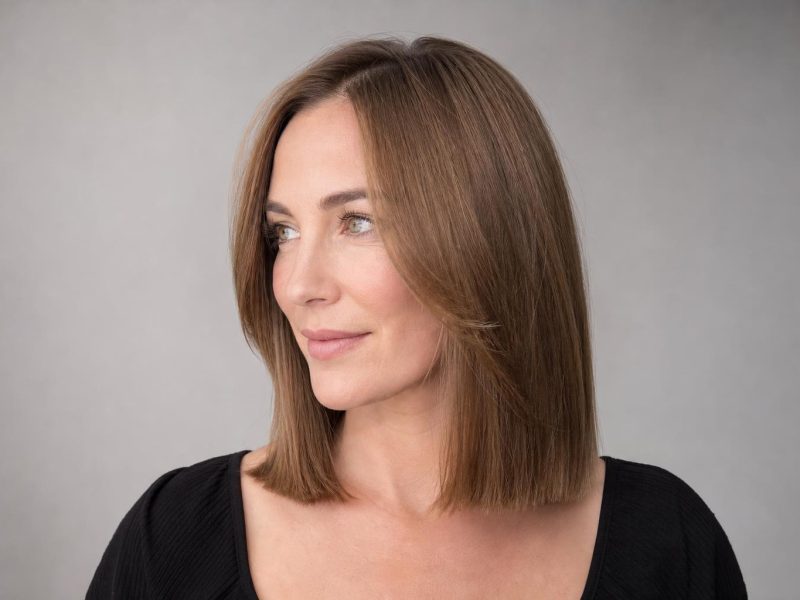

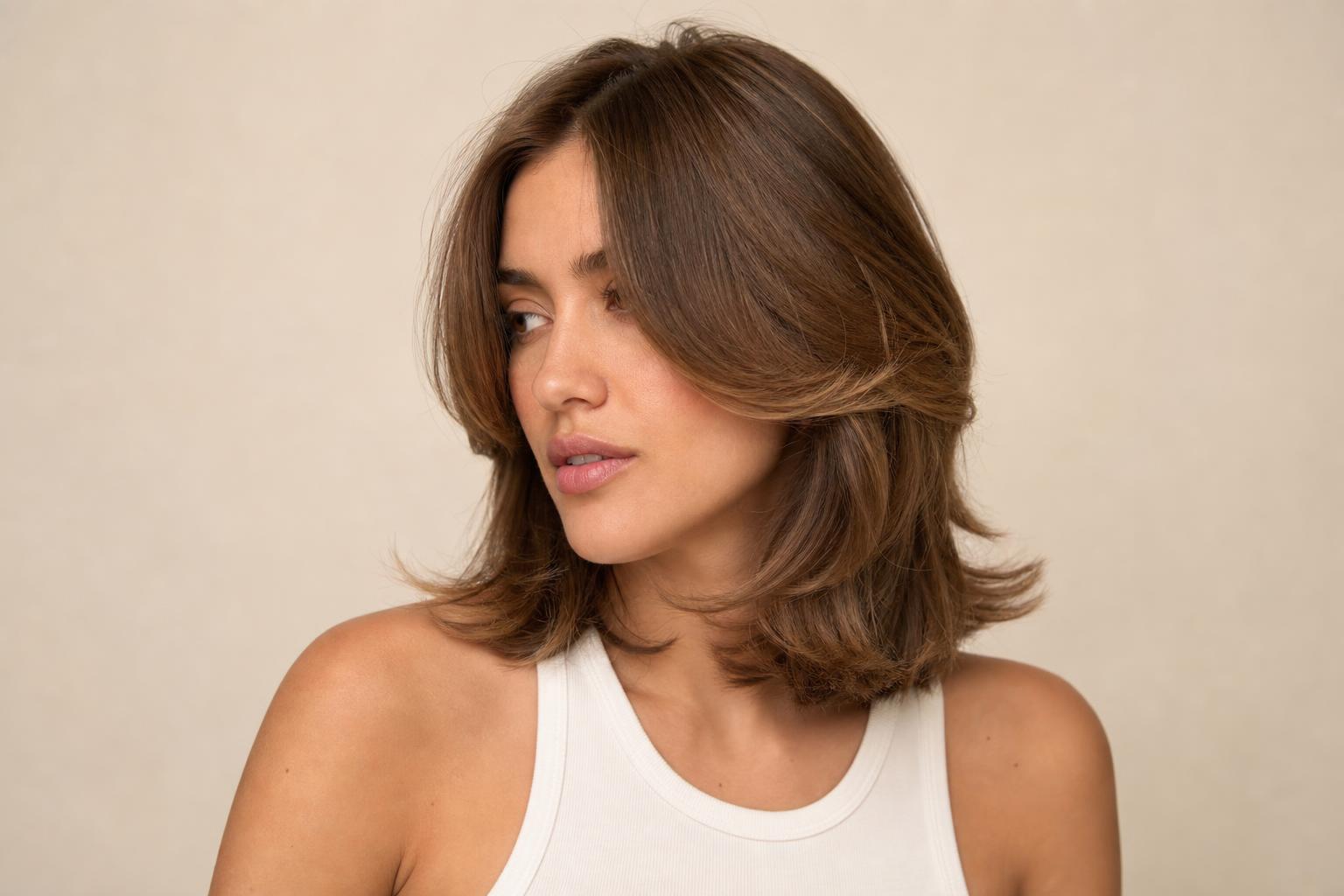
A short butterfly haircut works on the gap between two lengths rather than on the length itself, which is why the same cut can look striking at collarbone level and disappear entirely at the chin.
The butterfly shape comes from one short tier that stops near the cheekbone or chin and one long tier at the perimeter, with visible daylight between them. On long hair that gap happens almost by accident. On anything from chin to collarbone it has to be engineered, and roughly three inches of separation is the minimum before the shorter tier stops looking like ordinary layers.
Here are 22 short butterfly haircuts sorted by finished length, from chin-length bobs through collarbone cuts with bangs and versions built for specific textures. Below the gallery you will find the minimum length each variation needs, how a short butterfly differs from a shag and a wolf cut, which face shapes suit which wing height, and the exact wording to bring to a consultation.
Chin-Length and Bob-Length Butterfly Cuts
This is the hardest length to get right, because a chin-length perimeter leaves very little room below the shortest layer. Stylists build the effect by keeping the face-framing pieces high, at or just under the cheekbone, and by removing weight internally rather than cutting visible steps. Anyone whose hair falls dead straight should expect a blow-dry to be part of the deal at this length.
1. Chin-Length Butterfly Bob with Cheekbone Wings
Face-framing pieces start level with the top of the cheekbone and sweep back, while the perimeter holds a clean chin line. The three-inch difference between the two is just enough for the wing shape to show when the front is curved away with a round brush. Medium-density hair carries this best, since fine hair loses the perimeter weight the shape depends on.
2. Jaw-Length Butterfly with a Center Part
Splitting the front down the middle sends the short tier back symmetrically on both sides, which gives the most literal wing effect available at bob length. Oval and heart-shaped faces carry a center part comfortably here. Ask for the two front pieces to be cut a half-inch different in length so the sides do not look rigidly matched.
3. Blunt Bob with Internal Butterfly Layers
All of the layering happens underneath, leaving the outside line completely blunt so the bob keeps its weight. Thick hair gains the most, because internal weight removal takes out bulk without creating the pyramid shape heavy hair gets from surface layers. The butterfly effect only appears once the hair is styled with lift at the root.
4. Chin Bob with Curtain-Style Front Pieces
Rather than a separate fringe, the shortest pieces begin at the eyebrow and lengthen along the cheek, blending into the bob by the jaw. The soft entry point makes this the least severe short butterfly in the gallery and the easiest to grow out. For a fuller look at where those front pieces should land, our guide to asking for curtain bangs by face shape covers the same decision in detail.
5. Rounded Butterfly Bob with a Curved Perimeter
A perimeter cut slightly shorter at the back than the front gives the bob a natural inward curve, and the short tier then lifts away from it. Square jaws soften against that curve because there is no straight horizontal line at the jaw. Expect a trim every five to six weeks, since a curved perimeter loses its shape faster than a blunt one.
6. Angled Butterfly Bob Longer at the Front
The perimeter travels from a shorter nape to longer front pieces at the collarbone, which manufactures extra length for the long tier without growing the whole head out. Round faces benefit from the vertical line the angle creates down the front. Bring a photo of the back, because the degree of angle is where stylists differ most.
Shoulder-Length Short Butterfly Cuts
Shoulder length is where the butterfly cut starts behaving the way people expect from the photos. There is enough perimeter below the short tier for genuine separation, and the cut holds its shape through an air-dry on wavy hair. Most of the styles in this section need a trim every eight weeks rather than five, because the layers have room to grow into each other gracefully.
7. Shoulder-Length Butterfly with Chin-Level Wings
Short tier stops at the chin, perimeter lands on the shoulder, and the four-inch gap between them gives the cleanest short butterfly silhouette available. Anyone unsure about the trend should start with this ratio, since it works on the widest range of textures. Flicking the chin pieces back with a flat brush is the whole styling routine.
8. Soft Butterfly Layers on Straight Shoulder-Length Hair
Straight hair shows every cut line, so the layers here are point cut rather than sliced, which softens the step where the two tiers meet. The effect is quieter than a photo-perfect butterfly and considerably more wearable for anyone who does not blow-dry. A texturizing spray at the ends keeps the shorter tier from lying flat against the longer one.
9. Shoulder Butterfly with Invisible Internal Layers
Weight comes out from beneath the top section so the surface stays smooth and the movement happens underneath. This suits anyone who has been burned by visible layering in the past and wants shape without steps. Tell your stylist you want the weight removed with no visible line on the outside, which is the phrase that gets the right result.
10. Bouncy Butterfly Blowout at Shoulder Length
Built to be styled rather than air-dried, this version leans on a large round brush to curve the shorter tier back and the longer tier under. Fine to medium hair gets the most lift from the technique, and the shape holds a full day with a light hairspray at the root. Budget twenty minutes in the morning, which is honest rather than discouraging.
11. Shoulder Butterfly with Face-Framing Started at the Nose
Dropping the shortest point from the cheekbone to nose level makes a far gentler frame and suits anyone with a rounder face who does not want width at the cheeks. The lower start also means less regrowth awkwardness in month three. Grey-blending color placement works especially well along these lower front pieces.
12. Shoulder Butterfly with a Deep Side Part
Shifting the part well off-center throws more hair to one side, so one wing carries visibly more volume than the other. The asymmetry flatters long and oblong faces by adding width where the shape is narrowest. Keep the heavier side away from any part-line thinning, since a deep part exposes the scalp more than a center one.
13. Feathered Butterfly Ends at the Shoulder
Ends are feathered with a razor or deep point cutting so both tiers finish soft rather than blunt. Coarse, dense hair benefits because feathering releases some of the bulk that makes a shoulder-length cut turn outward at the ends. Avoid this finish if your hair is fine, where razored ends thin out the perimeter the cut needs.
Collarbone Butterfly Cuts with Bangs and Fringe
Collarbone is the longest length that still counts as short for this cut, and it is the most forgiving place to add a fringe. With a real fringe in play the short tier has something to blend into, so the step between the tiers can be cut more boldly without looking abrupt. Everything in this section needs a fringe trim every three to four weeks even when the rest of the cut can wait.
14. Collarbone Butterfly with Curtain Bangs
Curtain bangs part in the middle and lengthen into the short tier, which makes the transition between fringe and layers practically invisible. It is the most requested short butterfly variation and the one most stylists can execute without a reference photo. The pairing also grows out cleanly, since curtain bangs simply become face-framing pieces.
15. Collarbone Butterfly with a Wispy Fringe
A sparse, see-through fringe covers the forehead without the commitment of a solid one, and it keeps the eye at eye level rather than at the wings. Fine hair suits a wispy fringe better than a blunt one, which uses up too much of the available density. Our gallery of see-through fringe variations covers how thin is too thin for different textures.
16. Collarbone Butterfly with Birkin Bangs
Long, brow-skimming bangs with a slight center split give a seventies feel that pairs naturally with a tiered cut. Because they are cut long, they suit anyone nervous about a fringe, and they can be pinned back on days when they misbehave. Ask for them to be cut dry so the length is judged after any natural wave springs up.
17. Collarbone Butterfly with Side-Swept Bangs
Sweeping the fringe hard to one side creates a diagonal across the forehead that cuts against the horizontal line of the wings. Square and heart-shaped faces gain from the diagonal, which softens a strong brow or a wide forehead. A little cream on damp bangs and a cool blast from the dryer sets the direction for the day.
18. Collarbone Butterfly with a Full Blunt Fringe
A solid, eyebrow-length fringe is the boldest pairing here and the one that most clearly separates the style from a shag. Straight to slightly wavy hair holds a blunt fringe; anything curlier fights it within an hour. Commit to three-weekly fringe trims or the shape falls apart quickly.
Short Butterfly Cuts by Hair Texture
Texture changes the cut more than length does. The same tier ratio produces a crisp separation on straight hair, a soft billow on waves, and almost nothing at all on tight curls unless the stylist accounts for shrinkage before the first section is cut. These four are worth naming specifically at the consultation.
19. Short Butterfly on Fine Hair
Fine hair needs the perimeter kept blunt and the short tier kept shallow, because every layer removed from a thin perimeter costs density the shape relies on. Keeping the shortest piece at chin level rather than cheekbone preserves enough weight below it. A root-lifting mousse before blow-drying does more for the wing shape than any cutting technique.
20. Short Butterfly on Thick Coarse Hair
Thick hair can take a dramatic tier difference and needs internal weight removal to stop the longer tier from turning into a triangle. Expect the stylist to spend as much time thinning underneath as cutting the visible lines. The reward is a cut that dries into shape on its own, which fine hair rarely does at this length.
21. Short Butterfly on 2B Waves
Waves do half the work, separating the two tiers naturally as they dry and bend. Ask for the cut to be finished dry so the stylist can see where the wave falls before committing to the shortest length. Scrunching a light cream into damp hair and leaving it alone gives the best result.
22. Short Butterfly on 3A Curls
Curls shrink by a third or more, so a collarbone cut has to be planned from the dry length rather than the wet one. Cut curl by curl and the tiers create genuine volume at the crown with looser spirals at the perimeter. Anyone who has never had a dry curly cut should book a stylist who specializes in it, and our gallery of layered cuts built for curly hair shows how differently the same layering behaves on a curl pattern.
A Short Butterfly Needs a Length Gap, Not Just Layers
The most common disappointment with this cut at short lengths is walking out with a nice layered bob that nobody would call a butterfly. The shape depends on visible separation between the shortest tier and the perimeter, and below roughly three inches of difference the two tiers merge into a single graduated line. Use the table to check whether the length you want can carry the effect at all.
| Perimeter Length | Shortest Tier Lands At | Separation | How Clear the Effect Is |
|---|---|---|---|
| Ear length | Nowhere useful | Under 2 inches | Not achievable; ask for a textured crop instead |
| Chin | Top of the cheekbone | About 3 inches | Subtle; needs a blow-dry to show |
| Jaw to shoulder | Cheekbone to chin | 3 to 4 inches | Clear on straight and wavy hair |
| Collarbone | Chin or lower lip | 4 to 6 inches | Obvious on every texture |
| Collarbone on 3A curls | Chin when dry, lower when wet | Plan from dry length | Strong, but only with a dry cut |
Short Butterfly, Shag and Wolf Cut Are Three Different Shapes
All three are layered, all three are having a moment, and stylists use the words loosely enough that a booking note is worth more than a style name. The difference is in where the layers begin and how blended the transition is, which changes both the silhouette and how often you need a trim.
| Feature | Short Butterfly | Shag | Wolf Cut |
|---|---|---|---|
| Number of visible tiers | Two, deliberately separated | Many, blended through | Two, with a heavy crown |
| Where volume lands | Mid-length, around the cheeks | Spread from crown to ends | High at the crown |
| Perimeter | Kept heavy and fairly blunt | Textured and broken up | Thin and wispy |
| Finish it needs | Smooth, usually blow-dried | Undone, air-dried with product | Rough-dried with texture spray |
| Trim interval | 6 to 8 weeks | 8 to 12 weeks | 6 to 8 weeks |
If the undone version appeals more than the polished one, the full range of blended layering is laid out in our gallery of modern shag haircuts by hair type, and the two shapes are put head to head in our shag versus layered haircut comparison.
Choosing Your Wing Height by Face Shape
Where the shortest tier lands is the single decision that changes how the cut flatters you, because that point draws the eye and adds width exactly where it falls. Perimeter length matters far less by comparison.
| Face Shape | Shortest Tier Should Land | Best Perimeter | Avoid |
|---|---|---|---|
| Oval | Cheekbone or chin, either works | Chin to collarbone | Nothing structural |
| Round | Chin or below, never the cheek | Collarbone | Cheekbone wings, which widen the face |
| Square | Just under the cheekbone | Shoulder to collarbone | A blunt perimeter level with the jaw |
| Heart | Chin to lower lip | Collarbone | High wings that widen an already wide brow |
| Oblong or long | Cheekbone, paired with a fringe | Chin to shoulder | Long flat perimeter with no fringe |
| Diamond | Chin, to build width at the jaw | Shoulder | Anything that adds volume at the cheekbone |
What to Tell Your Stylist
Ask for the cut in inches and landmarks rather than by name, because butterfly means something slightly different in every salon. Name three things, which are where the perimeter finishes, where the shortest piece lands on your face, and whether you want the step between them visible or blended.
A consultation line that gets the right cut sounds like this. Keep the perimeter at the collarbone and blunt, cut the shortest face-framing piece to land at my chin, and leave a clear gap between the two rather than blending them together. Add one more sentence about styling, since a stylist who knows you air-dry will cut a softer step than one who assumes a round brush.
Stylist tip: Bring two photos rather than one. A front view shows the wing height you want and a back view shows how much perimeter weight you expect to keep, and the back is where most butterfly cuts go wrong.
If you would rather have the layers cut entirely inside so nothing shows from the outside, say that plainly at the start. It is a genuinely different cut from a stepped butterfly, and the full consultation script is broken down in our guide to asking for a butterfly haircut.
When a Short Butterfly Cut Is Not the Right Choice
The cut asks for two things at once, which are enough length for separation and enough density to keep the perimeter heavy. When either is missing the result tends to disappoint, and these are the situations where a different shape serves better.
- Your hair is shorter than chin length, where there is no room below the short tier and a textured pixie or bixie delivers the movement you are after.
- Your hair is fine and already thin at the ends, since removing weight from a sparse perimeter leaves the longer tier looking wispy rather than deliberate.
- You have a very tight curl pattern, where shrinkage hides the separation and a shape cut for volume will serve better than one cut for tiers.
- You genuinely never style your hair, because the chin-length and bob-length versions in this gallery need a round brush to show at all.
- You are growing out a previous heavy layer, in which case waiting two or three months gives the stylist enough length to place the tiers where you want them.
- You want a cut that grows out invisibly, since a visible step needs a trim every six to eight weeks to keep the two tiers from merging.
Styling and Maintenance
Most short butterfly cuts take ten to fifteen minutes with a round brush, curving the shorter tier away from the face and the longer tier slightly under. The direction matters more than the tool. Dragging both tiers the same way flattens the separation the cut was built for, so brush the front pieces back and the perimeter down.
Trim every six to eight weeks at bob and shoulder lengths, and every eight to ten at collarbone. Grow-out is gentler than most layered cuts because the two tiers move toward each other rather than apart, though anything with a fringe still needs its own three-week appointment.
Stylist tip: Use a lightweight mousse at the root and nothing heavier than a serum on the ends. Cream products weigh the shorter tier down against the longer one, which erases the gap in a single wash day.
Color placement can reinforce the shape for free. Lightening the front pieces a shade or two makes the short tier visible even on a day it has not been styled, which is why balayage placed high at the face is so often paired with this cut, and why the pairing works just as well on the longer versions in our full butterfly haircut gallery.
FAQ
How Short Can a Butterfly Haircut Go?
Chin length is the practical floor, and even there the effect is subtle and depends on a blow-dry. Below the chin there is not enough perimeter under the shortest tier for any separation to show, so a textured crop or a bixie gives more movement for the same length. If you want the shape to be obvious rather than suggested, start at shoulder length.
Is a Short Butterfly Haircut the Same as a Shag?
No, although the two get confused constantly. A butterfly has two deliberate tiers with a visible gap and a heavy, fairly blunt perimeter, while a shag runs many blended layers through the whole head and keeps the ends broken up. The finish separates them as clearly as the cut does, since a butterfly is styled smooth and a shag is styled undone.
Will a Short Butterfly Cut Work on Fine Hair?
It can, with two adjustments. Keep the shortest tier at chin level rather than cheekbone so less weight comes out of the front, and keep the perimeter blunt so the bottom line holds its density. Fine hair also needs a root-lifting product to show any separation at all, since the tiers fall flat against each other without it.
How Often Does a Short Butterfly Need Trimming?
Every six to eight weeks at bob or shoulder length, stretching to ten weeks at collarbone. The tiers grow toward each other rather than apart, so the shape softens gradually rather than falling apart suddenly. Any version with a fringe needs a separate three to four week fringe trim regardless of when the rest is cut.
Does a Short Butterfly Cut Work on Curly Hair?
Loose curls up to about 3A carry it well, provided the cut is done dry so the stylist can place the tiers where the curl actually falls. Tighter patterns shrink too much for the separation to show, and the cut turns into general volume rather than two readable tiers. Book a stylist who cuts curl by curl rather than sectioning wet hair.
Can I Get a Short Butterfly Cut Without Losing Length?
Yes, because the whole effect can be built from the face-framing pieces without touching the perimeter. Ask for the shortest tier to be cut into the front only and the back left exactly as it is. The separation is less dramatic from behind, but nothing comes off your overall length.
A short butterfly haircut delivers on its reputation when the two tiers are placed deliberately and disappoints when it is treated as a name rather than a structure. Decide your perimeter length first, pick the wing height that suits your face rather than the one in the photo, and tell the stylist plainly whether you want the step visible or hidden.
Hairstyle results vary with hair texture, density, growth pattern and the skill of the individual stylist. Treat the lengths and intervals here as starting points for a consultation rather than guarantees.