

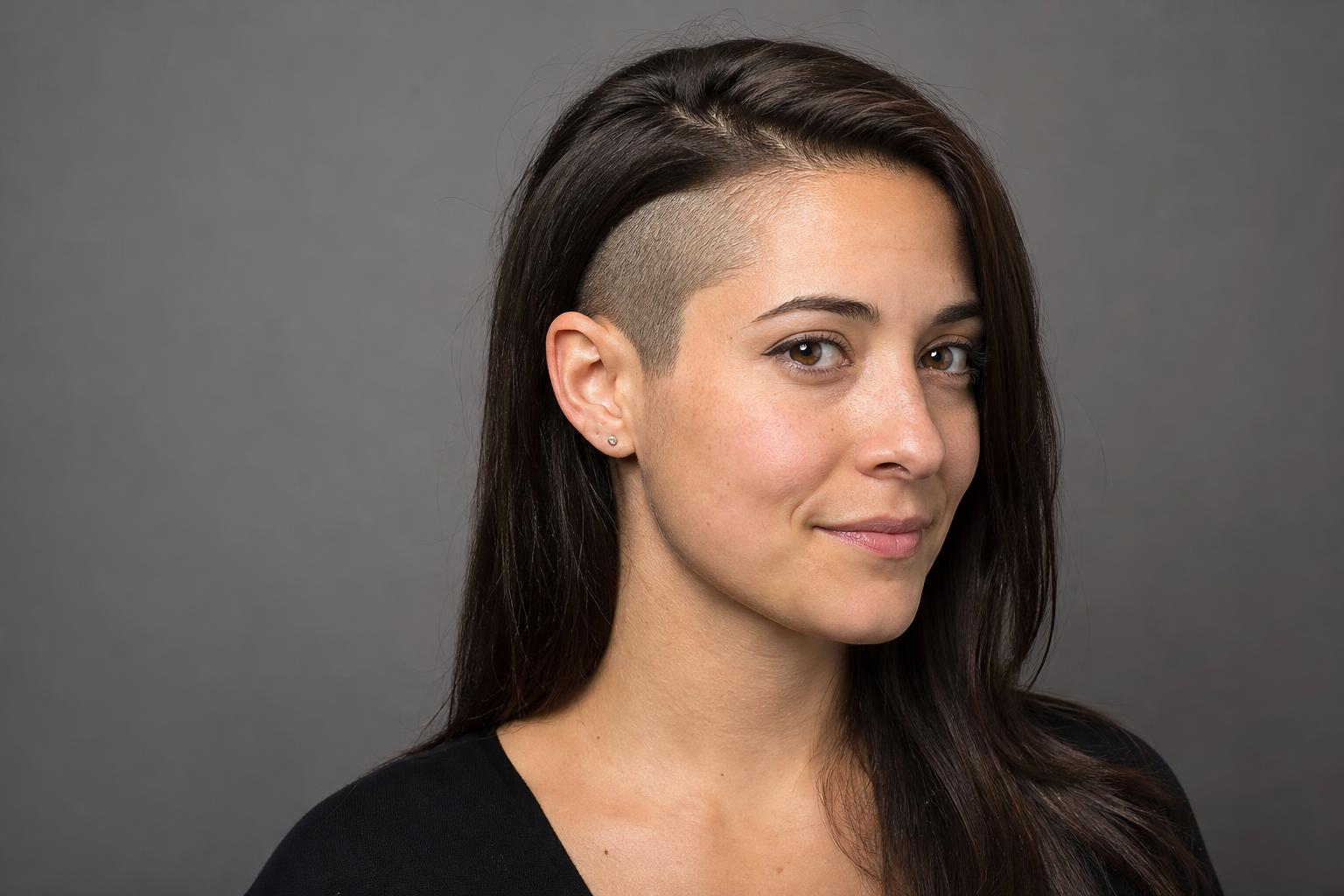
Two choices define a side shave: where the panel goes and what guard number takes it down, and only one of those can be undone quickly.
An undercut side shave removes hair from a defined panel above or behind the ear and leaves the length on top to fall over it. A panel placed low, behind the ear and toward the nape, stays invisible with your hair down and shows only when you tie it up. A panel that starts at the temple is visible from the front every day, whatever you do with the length. Same haircut, same clipper, completely different commitment, and the difference is roughly two inches of placement.
This guide maps the four standard placements and what each one commits you to, explains what guard number to ask for and how quickly it grows back, covers how thick, fine, and curly hair each behave under a shaved panel, and lays out the twelve-month grow-out timeline nobody mentions before the clippers come out.
| Factor | Details |
|---|---|
| Best for | Thick or coarse hair below the shoulders that feels heavy or hot |
| Salon time | 15 to 25 minutes as an add-on, 45 minutes with a full cut |
| Maintenance | Re-shave every 2 to 4 weeks depending on guard length |
| Full grow-out | 10 to 18 months to blend back into shoulder-length hair |
| Avoid if | Your hair is fine and low density, or you have a receding temple hairline |
Four Placements, Four Different Commitments
Every side shave is one of four panels, and choosing between them is the part of the consultation worth spending real time on. Placement controls visibility, how much weight comes out, and how awkward the regrowth will be if you change your mind. A nape panel disappears under a ponytail; a temple panel changes your face every morning. Neither is more valid, but they are not interchangeable decisions.
| Placement | Where the Panel Runs | Visible When | Weight Removed |
|---|---|---|---|
| Nape only | The hairline at the back of the neck, up 1 to 2 inches | Only in a high ponytail or an updo | Small, but it stops the collar-line bulk |
| Hidden side panel | Behind the ear, from the earlobe back, roughly palm-sized | Tucked hair behind the ear, or hair pulled up | Moderate, and the most useful for thick hair |
| Single visible side | From the temple back to behind the ear, one side only | Every day unless you part your hair over it | Significant on one side, which unbalances the fall |
| Both sides | Matching panels above both ears | Always | The most, and the fastest daily routine of the four |
A useful test before committing: pin the hair you want removed flat against your head with clips and wear it that way for a full day. It approximates the silhouette without the clippers, and it exposes the practical problems, such as hair that refuses to lie over the panel or a parting that will not hold on the shaved side. Shorter lengths use the same nape panel for a different job, tightening the back of an undercut stacked bob so the graduation holds its shape between trims.
Stylist tip: Ask for the top edge of the panel to be cut in a curve rather than a straight line. A straight edge shows a hard demarcation as soon as it grows a quarter inch, while a curved edge softens as it fills in and gives you a far easier grow-out.
Guard Number Controls Both Visibility and Upkeep
The clipper guard is the second decision, and it changes the appointment schedule more than the placement does. A shorter guard gives sharper contrast against the length on top and needs re-cutting sooner, because a quarter inch of stubble on a skin-close panel looks unfinished within two weeks. A longer guard blurs the contrast slightly and buys you twice as long between visits.
| Guard | Length Left | Look | Re-Shave Interval |
|---|---|---|---|
| No guard | Under 1/16 inch | Skin visible, hardest contrast, shows scalp tone | 10 to 14 days |
| Number 1 | 1/8 inch | Dense velvet texture, no scalp showing on most people | 2 to 3 weeks |
| Number 2 | 1/4 inch | Soft, forgiving, the common starting point | 3 to 4 weeks |
| Number 3 or 4 | 3/8 to 1/2 inch | Weight removal with barely any visual contrast | 5 to 7 weeks |
A number 2 is where most first-time side shaves land, and there is a practical reason beyond appearance. Going shorter than a number 1 on a first attempt means that if you dislike it, you spend six to eight weeks at a length where nothing can be done to disguise it. Starting at a 2 or 3 leaves room to go shorter next time, and the sensation of the shaved panel takes a few weeks to stop feeling strange regardless of length.
The Real Benefit on Thick Hair Is Weight, Not the Look
Most coverage treats a side shave as purely a style choice, which undersells what it does for anyone with genuinely heavy hair. Removing a palm-sized panel behind each ear takes measurable bulk out of the interior without touching a single visible length. Hair dries faster, holds a ponytail without slipping, and stops pushing outward at the ears, which is the usual reason thick hair widens into a triangle at the jaw.
This makes the hidden panel a direct alternative to heavy internal thinning. Thinning shears remove weight but leave short broken pieces that stick up along the parting for months. A shaved panel removes the same bulk from one contained area and regrows evenly, with a clean edge instead of scattered stubble across the top of the head. Anyone weighing this against a layering approach can compare it with the weight-removal methods in our guide to layered haircuts built for thick hair.
Hair Type Changes What the Panel Actually Looks Like
Density matters more than texture here. Fine, low-density hair gives the worst results from a visible side shave, because the length left on top is not thick enough to cover the panel and the whole head starts to look sparse rather than deliberate. If your parting already shows scalp, a shaved panel makes that look stronger, not weaker.
Curly and coily hair takes a shaved panel well and gains the most from it in terms of comfort, though the contrast is stronger than expected: a number 2 on a 4a texture looks far closer to the scalp than the same guard on straight hair, because the coil pattern compresses. Go up one guard number from whatever you planned. Straight, thick hair gives the cleanest, sharpest panel edge and holds a shaved design longest before it blurs. Anyone whose hair is already short enough that the panel would dominate should look instead at how the shaved section works inside a pixie cut with a built-in undercut, where the proportions are designed around it.
Stylist tip: Have your stylist check your hairline at the temple before agreeing to a visible side panel. If the hairline recedes slightly at the corners, which is common and usually unnoticed under length, shaving to the temple exposes it and there is no styling fix short of growing the panel back.
When a Side Shave Is the Wrong Call
The undercut is a low-risk haircut compared with a big length change, since nothing you can see gets shorter. It still goes wrong in specific circumstances, and the grow-out is long enough that these are worth checking honestly before booking.
- Your hair is fine with low density. There is not enough weight on top to cover the panel, and the effect is thinner-looking hair rather than a defined shape.
- You are growing out a previous short cut. Adding a shaved panel resets part of that progress and creates a second demarcation line to manage.
- Your workplace or family setting makes visible shaved hair a problem you would rather avoid. Choose the behind-the-ear panel instead, which stays hidden with hair down.
- You have a scalp condition such as psoriasis or seborrheic dermatitis in that area. Clipper work on affected skin can aggravate it, and the shaved panel leaves it exposed.
- You want the weight gone but not the commitment. Internal layering or a tunnel-style debulk removes bulk with no visible edge and no re-shave schedule.
What to Tell Your Stylist
Describe the panel by its boundaries, not by a photo alone. Photos rarely show where the shaved area stops at the top, which is the measurement that decides whether the length covers it. Something like this covers everything: “A hidden undercut behind both ears, starting level with the top of my ear and no higher, curved along the top edge, taken with a number 2. Leave the hairline at the nape natural rather than squared off.”
Ask two follow-up questions in the chair. First, whether the top edge will disappear when your hair is down, checked with your hair actually let down rather than clipped up. Second, what it will look like at six weeks, since that is the state you will be in for most of the time between appointments. If you are also changing the length on top, our overview of choosing a short cut around your growth pattern covers how the two decisions interact.
What the Next Twelve Months Look Like
Growing out a side shave is slower than growing out a fringe and faster than growing out a pixie, and the reason people describe it as difficult is the demarcation line rather than the length itself. Hair grows about half an inch a month, so the panel passes through several distinct stages, each with its own workaround. Knowing the sequence in advance makes the middle stretch far less frustrating.
| Stage | Panel Length | What It Does | How to Handle It |
|---|---|---|---|
| Months 1 to 2 | Up to 1 inch | Lies flat, still looks like a deliberate undercut | Nothing needed; this is the easiest stretch |
| Months 3 to 5 | 1.5 to 2.5 inches | Sticks out sideways above the ear, the hardest phase | Tuck behind the ear, or have the top edge softened with point cutting |
| Months 6 to 8 | 3 to 4 inches | Long enough to lie down, still visibly shorter | Ask for the length above it to be layered to meet it |
| Months 9 to 12 | 4.5 to 6 inches | Looks like a short layer rather than regrowth | Normal trims, no special handling |
| Beyond 12 months | 6 inches and up | Blends fully into shoulder-length hair | Done, unless your length is past mid-back |
The counter-intuitive part is that trimming the length on top during months three to five shortens the grow-out considerably. Bringing the surrounding hair closer to the panel length means the two meet sooner, and a stylist can layer the gap into something wearable instead of waiting for the panel to catch up on its own.
FAQ
Does an Undercut Damage Your Hair or Change How It Grows Back?
No. Clipping hair at the surface does not affect the follicle, so the panel grows back at the same rate and the same texture it had before. What does change is the feel of the regrowth, which is blunt at the tip rather than tapered, so it stands up more than the rest of your hair for the first few months. That is a cutting effect, not a change to the hair itself.
How Much Hair Actually Gets Removed in a Side Shave?
A hidden panel behind one ear takes roughly the area of your palm, which is a small share of total coverage but a noticeable share of the weight at the sides. Both sides together typically remove enough bulk that thick hair dries five to ten minutes faster. The visible temple-to-ear version removes considerably more and changes how the remaining length falls, since there is no longer hair underneath supporting it.
Can You Do an Undercut at Home?
The nape panel is realistic at home with a second mirror and a steady hand, since the shape is simple and mistakes are hidden. The behind-the-ear and temple panels are not, because you cannot see the top edge you are cutting and that edge is the part everyone sees. A first undercut is worth having done professionally so you have a clean template to maintain yourself afterward.
Will a Side Shave Work with Curly Hair?
Yes, and curly hair is one of the best candidates because the volume removal is felt immediately. Ask for one guard longer than you would choose on straight hair, since coils compress against the scalp and a number 1 on 3c or 4a hair looks close to shaved. Keep the top edge curved so the surrounding curl clumps fall over it naturally instead of splitting around a hard line.
How Do You Hide an Undercut for Work or an Event?
Move your parting toward the shaved side so more length falls over the panel, and use a light texture spray at the roots to stop the hair separating. A behind-the-ear panel disappears entirely with hair down and a low ponytail. A temple panel is far harder to conceal, which is the main practical argument for choosing the lower placement if concealment ever matters to you.
Is an Undercut the Same as a Buzz Cut on the Sides?
They use the same tool but serve different purposes. An undercut keeps full length on top and removes a defined panel underneath it, so the shaved area is optional to display. A buzzed side is part of an overall short cut where the contrast is the point and there is no length to cover it. If the appeal is mostly the shorter, cooler feel rather than the contrast, our guide to buzz cut lengths and what each guard looks like covers the fully short route.
An undercut side shave is a smaller decision than it appears, provided you choose the placement for how you actually live rather than for the photo that inspired it. Start with the behind-the-ear panel at a number 2, see how the first six weeks feel, and go shorter or higher at the next appointment if you want more. Bring a picture, but describe the boundaries out loud, because the top edge of the panel is what you will be living with long after the novelty of the clippers wears off.
Hair results vary based on your natural hair type, texture, density, and condition. Always consult with a licensed hairstylist before making significant changes, especially with chemical treatments or dramatic length changes. Photos may show styled results that require professional tools and products to replicate.