

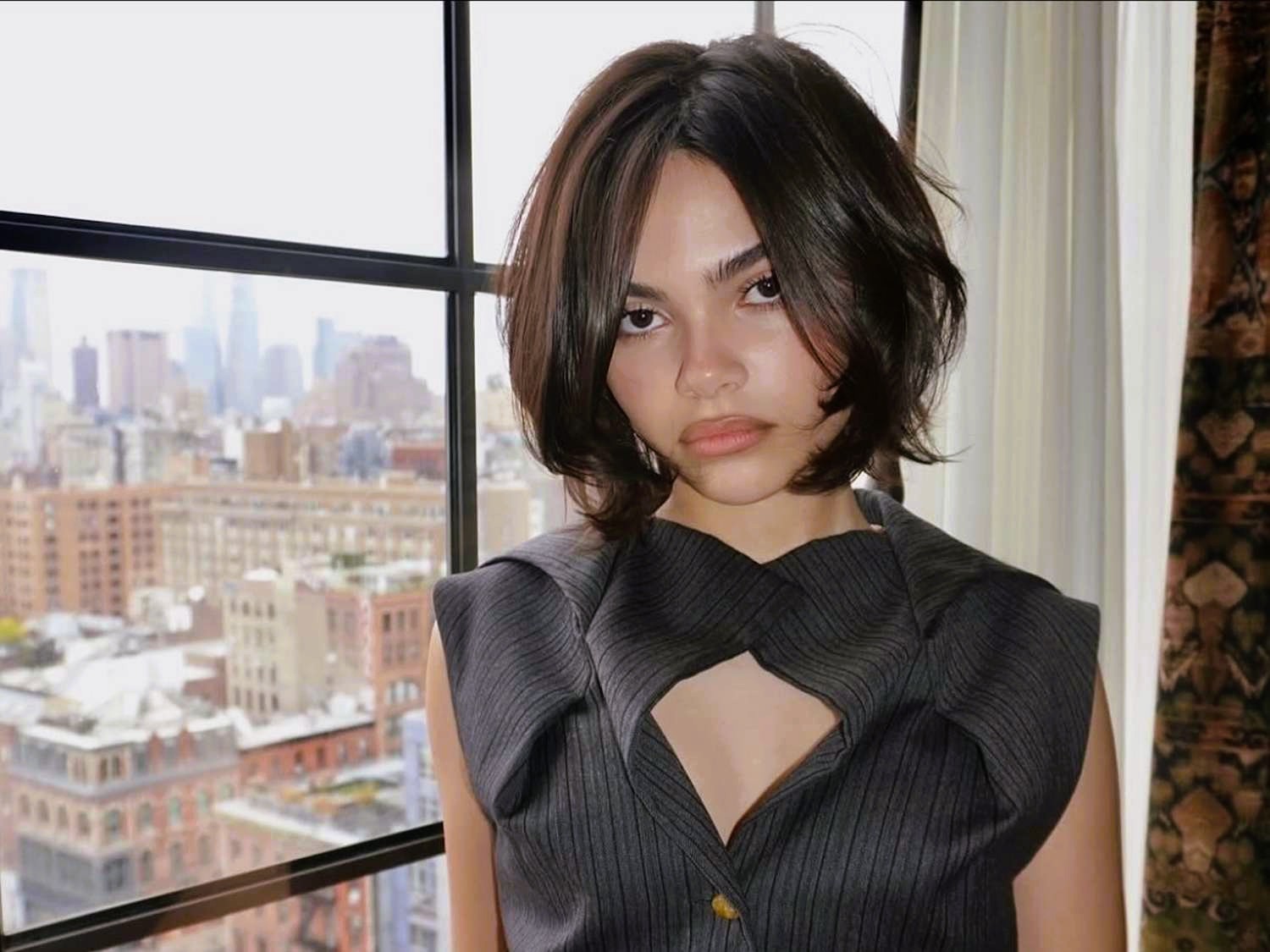
Volume-building bob variations for fine hair, organized by cutting technique — with face shape guidance and salon tips
Fine hair and bobs are one of the smartest pairings in the salon chair — a shorter length removes the weight that drags fine strands flat, while the right cutting technique redistributes visual density exactly where you need it. These 35 bob haircuts are selected specifically for fine hair, from blunt cuts that create a solid weight line to textured variations that fake fullness through strategic layering.
The gallery is grouped by technique — blunt and one-length cuts, textured and point-cut bobs, stacked and graduated shapes, angled A-lines, and bobs with bangs — so you can find the approach that matches your hair’s needs. Below the gallery, you’ll find a blunt-vs-layered comparison, face shape recommendations, a styling and product guide, and the exact language to use at your next salon appointment.
| Bob Type | Best For | Volume Effect | Maintenance |
|---|---|---|---|
| Blunt bob | Very fine, thin density | Creates solid weight line — maximum perceived thickness | Trim every 5–6 weeks |
| Textured / point-cut bob | Fine hair with some density | Adds movement without sacrificing bulk at the ends | Trim every 6–8 weeks |
| Stacked / graduated bob | Fine hair that falls flat at the back | Builds lift and roundness at the nape and crown | Trim every 5–6 weeks |
| Angled / A-line bob | Fine hair that needs face framing | Front length adds visual weight near the face; back stays lifted | Trim every 6–7 weeks |
| Bob with bangs | Fine hair with a high forehead or narrow face | Bangs redistribute hair from the sides forward, creating density at the front | Bang trim every 3–4 weeks; overall trim every 6–8 weeks |
Blunt and One-Length Bobs for Fine Hair
When every strand ends at the same point, the overall perimeter looks thicker and more defined — that’s the fundamental reason blunt bobs work so well on fine hair. There’s no tapering to thin out already-sparse ends. The trade-off is that blunt cuts show damage quickly, so staying on top of trims matters more than with layered styles.
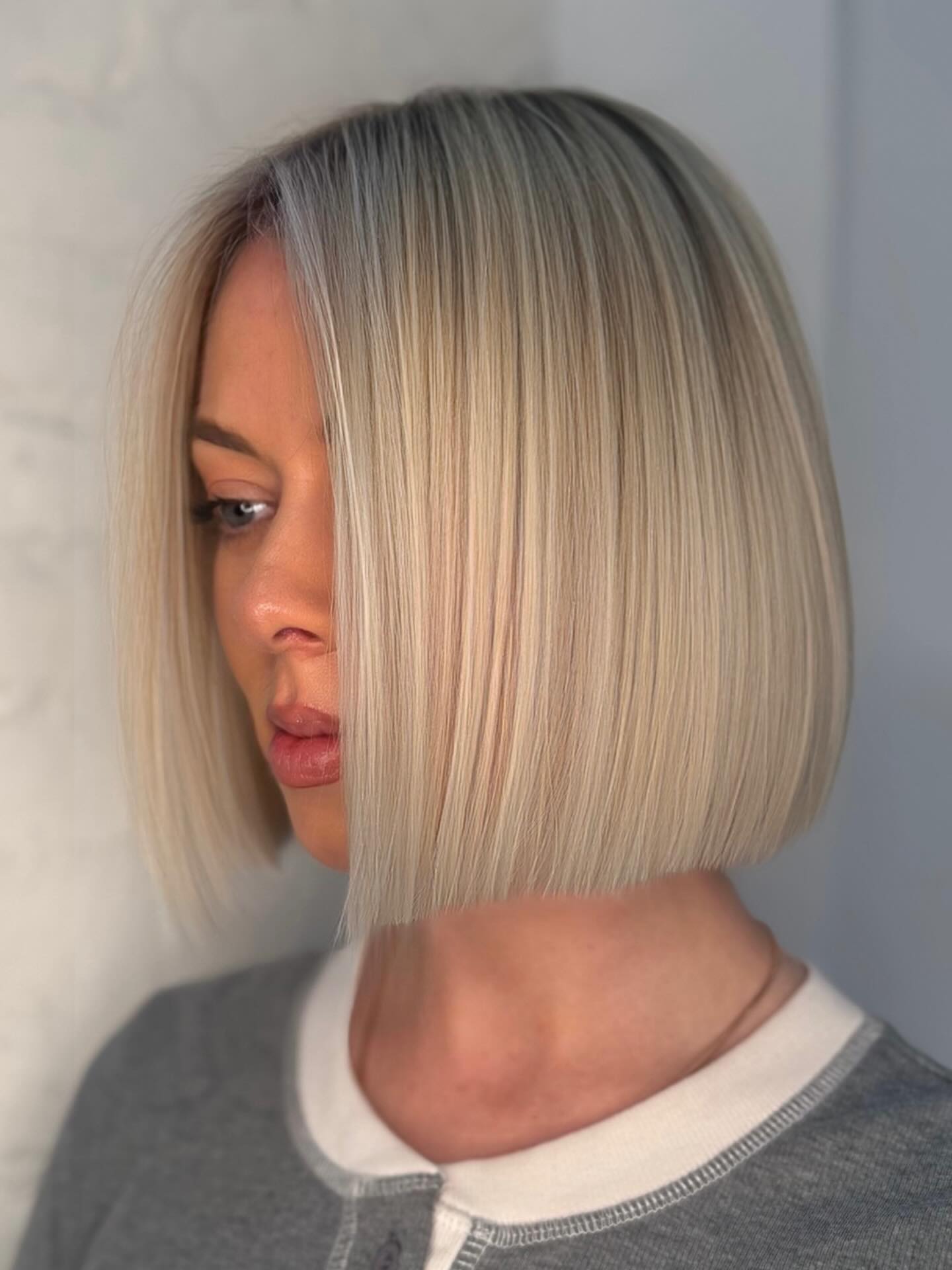
1. Chin-Length Blunt Bob
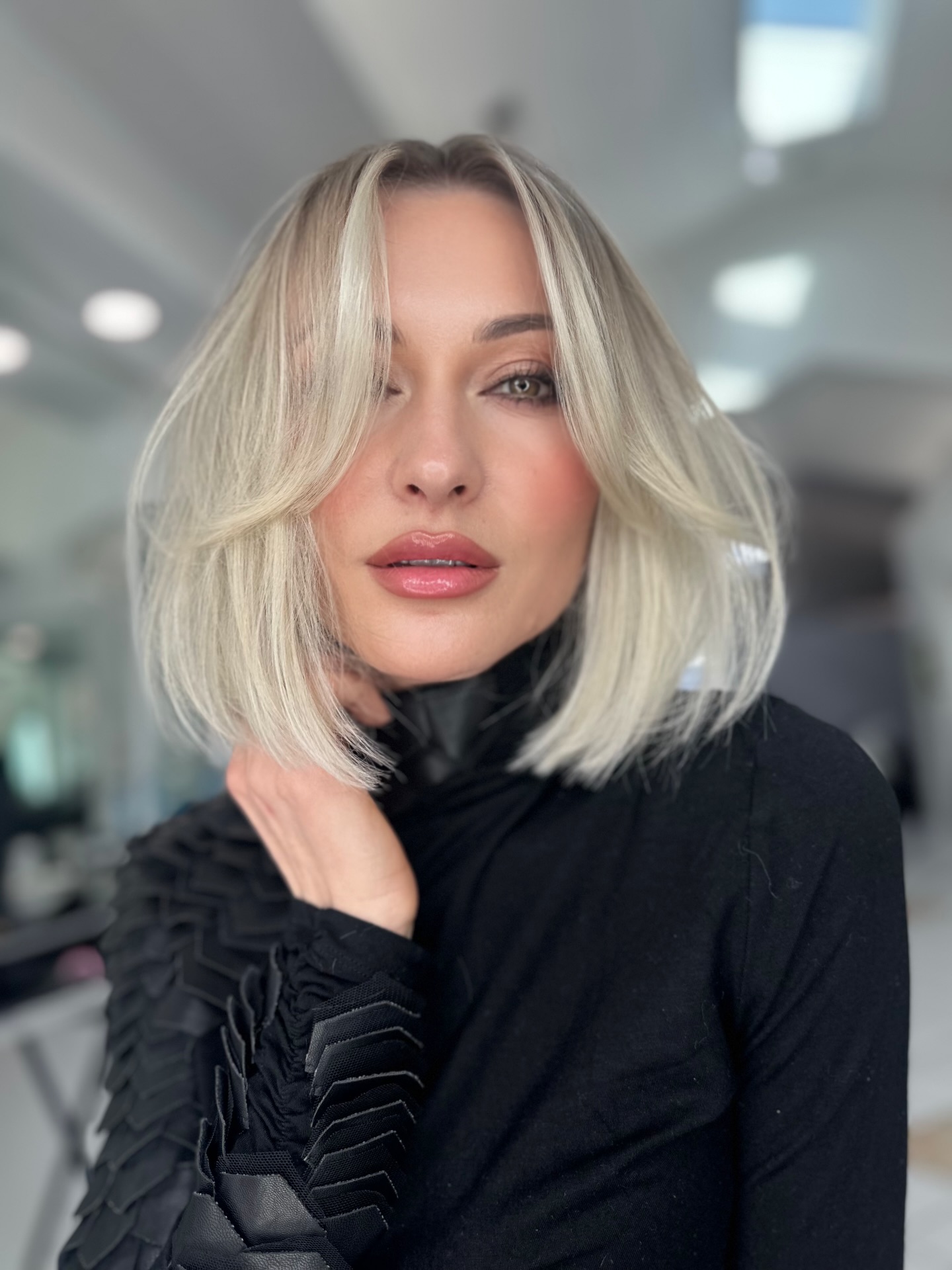
A single-length cut at chin level creates the strongest possible weight line for fine hair — every strand terminates at the same point, so the ends look dense rather than wispy. This length sits just above where fine hair tends to start separating, keeping the silhouette compact. Oval and heart-shaped faces wear this length particularly well, since the chin emphasis balances a narrower jaw.
2. Jaw-Grazing Blunt Bob with Deep Side Part
Shifting the part to a deep side creates instant root lift on the heavier side while the shorter side gains a subtle ear-tuck effect that looks intentional rather than flat. The jaw-grazing length keeps weight near the face, which gives fine hair more visual presence than a shorter crop would. If your hair tends to go limp by midday, a deep side part extends the volume longer than a center part.
3. Collarbone Blunt Lob
The longest version of a blunt bob that still works for fine hair — anything past the collarbone starts pulling fine strands down under their own weight. A clean, even hemline at collarbone level is long enough for a low ponytail but short enough to hold body after a round-brush blowout. This is the safest entry point if you’re cutting from longer hair and aren’t ready for a chin-length commitment.
4. Ear-Length Blunt Mini Bob
Cutting above the jaw line concentrates all of your hair’s density into a smaller area, which is why very fine hair can look surprisingly thick at this length. The ear-length mini bob is having a moment in 2026 — think French bob territory but without the rounded bangs. It does expose more of your neck and jawline, so square and oval face shapes get the most balanced result.
5. One-Length Bob with Center Part
A center part distributes hair evenly on both sides, which can either enhance or work against fine hair depending on your density. If you have average density but fine strand width, the symmetry looks clean and editorial. If your hair is both fine and thin (low density), a center part risks exposing the scalp at the part line — in that case, a slight off-center part gives the same structured effect without the gap.
6. Glass Bob
The glass bob — named for its mirror-like, ultra-smooth finish — relies on a precise blunt cut and a flat iron to create light reflection that makes fine hair appear thicker than it is. The shine itself does the heavy lifting here: a polished surface reflects light uniformly, which reads as density. Achieving the glass effect at home requires a smoothing serum applied to damp hair before blow-drying, followed by a single flat iron pass on each section.
7. Blunt Bob with Subtle Undercut
An undercut beneath the occipital bone removes bulk at the nape without changing the visible silhouette — on fine hair, this creates the illusion that your remaining hair is denser because the weight-to-volume ratio shifts. The undercut also encourages the outer layer to push outward slightly, adding a rounded shape at the back. Grows out cleanly and only needs maintenance every 6–8 weeks.
Textured and Point-Cut Bobs for Fine Hair
Texture on fine hair is a balancing act — too much layering thins out already-sparse ends, but the right amount of point cutting or internal texturizing adds movement that makes hair look like it has more going on. The bobs in this section use restrained texture techniques that preserve the weight line while creating separation and airiness at specific points.
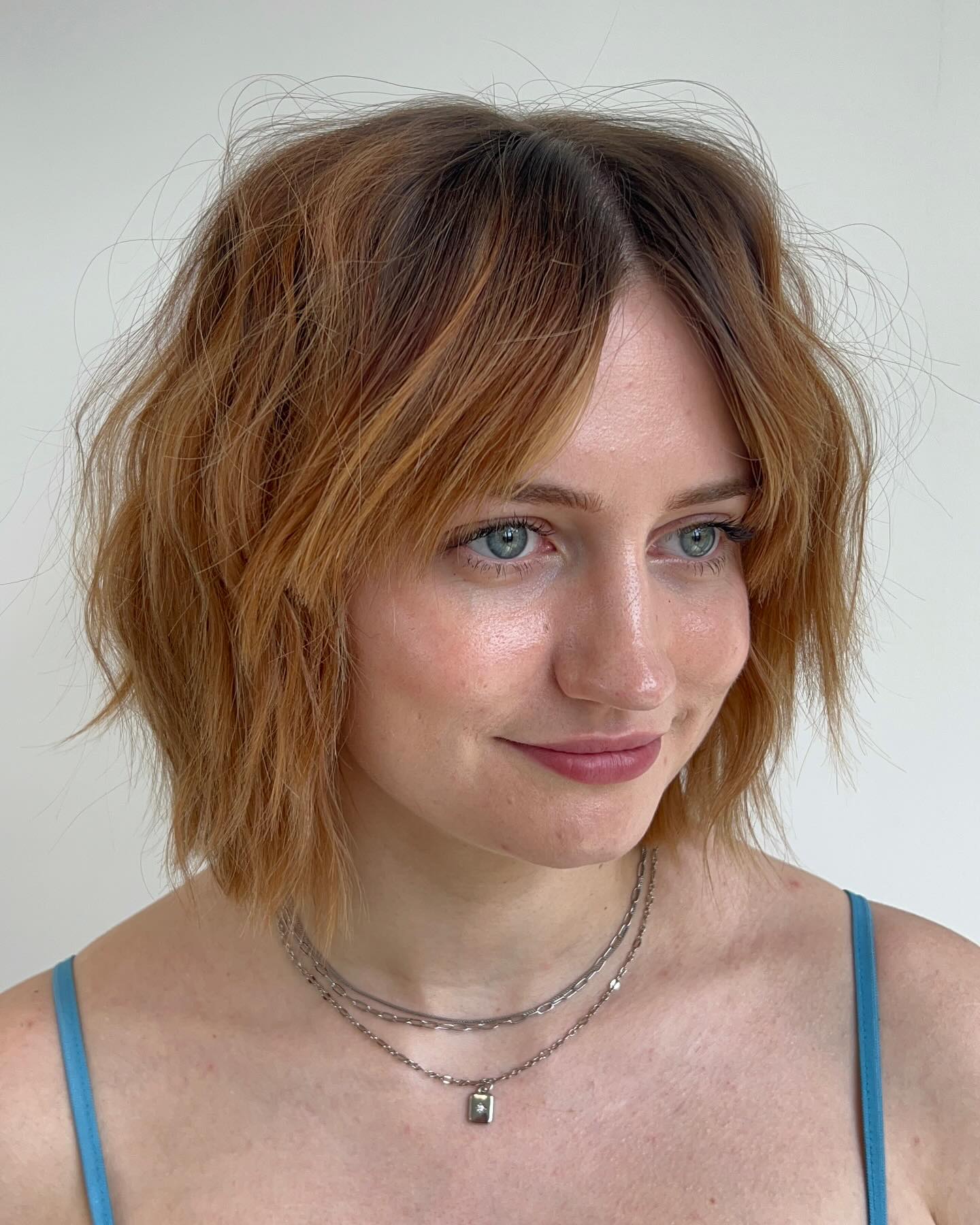
8. Point-Cut Bob with Piece-y Ends
Point cutting removes tiny notches from the ends at an angle rather than cutting straight across, which creates natural-looking separation without removing bulk the way thinning shears would. On fine hair, this gives the perimeter just enough irregularity to suggest movement. Tell your stylist you want point cutting at the ends only — not through the interior, where it would thin out the mid-shaft density you need to keep.
9. Textured Lob with Soft Bend
A lob with light texture through the lower third lands in the sweet spot between “structured enough to hold shape” and “relaxed enough to look effortless.” The soft bend — achieved with a large-barrel curling iron held for just a few seconds per section — adds horizontal width that makes fine hair appear fuller. Round and square face shapes benefit from the lob length because it elongates without adding width at the jaw.
10. Lived-In Textured Bob
A “lived-in” finish relies on air-dried or diffused texture rather than a smooth blowout, which actually suits fine hair well — the imperfection hides thinness at the ends. Your stylist achieves this by cutting with a razor or texturizing shears through the last inch of hair, then you maintain it at home with a sea salt spray scrunched into damp hair. The look intentionally avoids a clean perimeter, so grow-out between trims is more forgiving than a blunt bob.
11. Razor-Cut Bob
A razor creates softer, more tapered ends than scissors, which translates to wispy, feathered tips that suggest movement. On fine hair, razor cutting works best when used sparingly — just the last half-inch of the ends. Overuse of a razor on fine strands removes too much material and creates see-through tips. Bring a reference photo showing the level of razoring you want, because the difference between “slightly feathered” and “severely thinned” is a matter of technique, not terminology.
12. Choppy Bob with Internal Layers
Internal layers sit underneath the top layer of hair, adding movement through the interior without disrupting the perimeter weight line. On fine hair, this approach gives you the texture benefits of layering without the thinned-out ends that visible surface layers create. The choppiness comes from how the layers interact when the hair moves, not from aggressive cutting at the surface.
13. French Bob with Textured Tips
The French bob — typically cheekbone to chin length with a slightly rounded shape — pairs well with fine hair when the tips are point-cut for softness rather than left perfectly blunt. The shorter length means fine hair holds its shape under its own weight all day, and the rounded silhouette creates a fuller-looking profile view. A pea-sized amount of lightweight mousse scrunched into damp hair is enough product for styling — anything heavier weighs fine strands down.
14. Shaggy Bob with Face-Framing Wisps
Face-framing wisps that start at cheekbone height draw attention forward and away from any thinness at the crown or sides. The shag element — disconnected layers with more movement than a classic bob — gives fine hair a textured, intentional look that reads as “I styled it this way” rather than “my hair won’t hold volume.” The wispy framing pieces need to be long enough to blend into the main length by the jawline, otherwise they can look sparse on fine hair.
Stacked and Graduated Bobs for Fine Hair
Stacking and graduation build volume where fine hair is flattest — the back of the head. Graduated layers at the nape create a rounded, lifted profile without requiring product or heat tools to hold the shape. The trade-off: stacked bobs need consistent trims because the precision layering at the back grows out faster than a one-length cut.
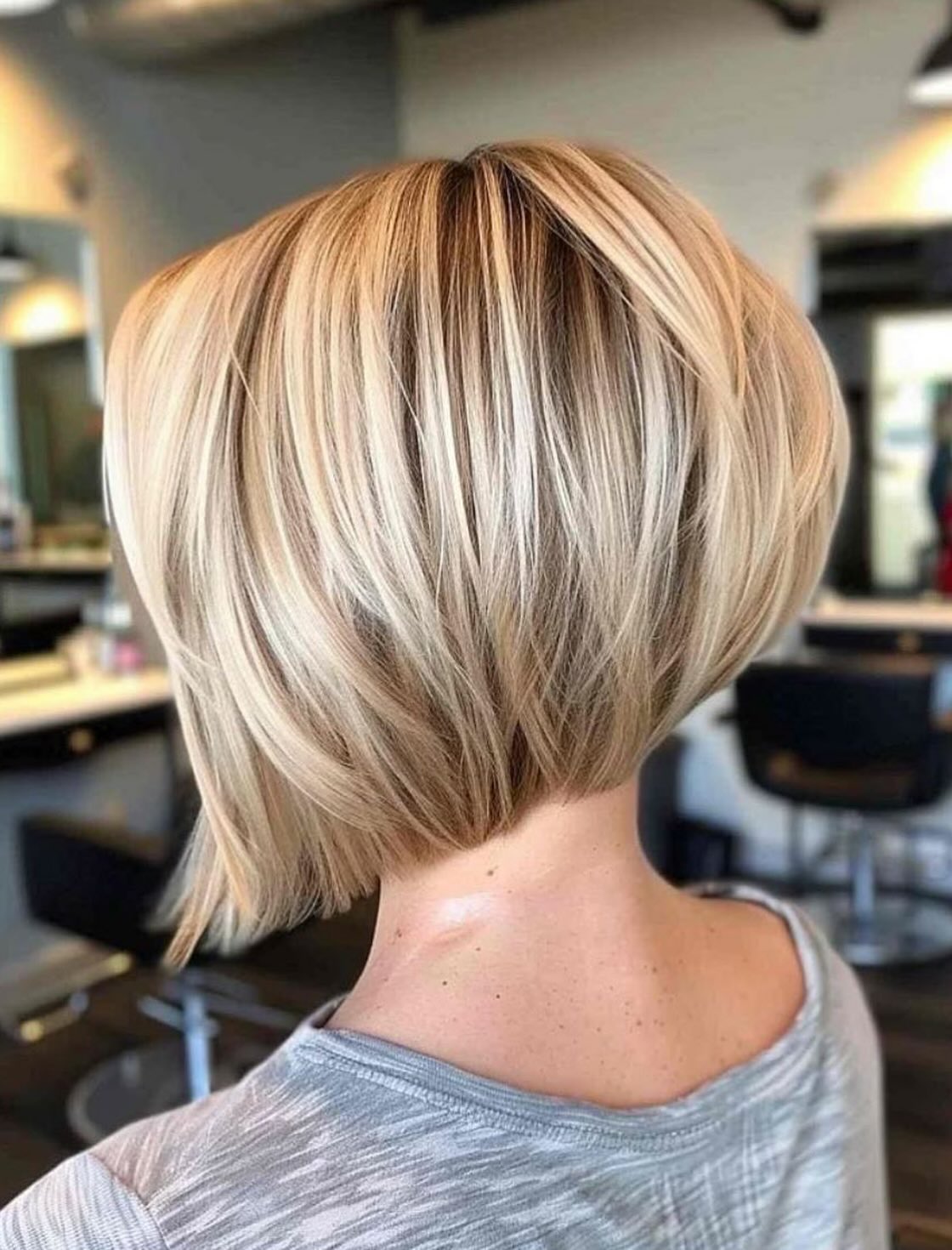
15. Classic Stacked Bob
Graduated layers at the nape build a rounded, lifted shape exactly where fine hair falls flattest. The front stays longer — usually chin length or slightly below — while the back is shorter and pushes outward from the stacking. If your hair tends to cling to your neck at the back, a stacked bob physically redirects it. Trim every 5–6 weeks to keep the graduation crisp.
16. Soft Graduated Bob
A less dramatic version of the stacked bob, the soft graduated cut uses longer graduation so the transition from back to front is seamless rather than sharply angled. Fine hair benefits from the gentler approach because extreme stacking can expose thin spots at the nape. The rounded back still adds volume, but it blends into the sides without a visible shelf or line.
17. Stacked Bob with Volume at the Crown
Adding shorter layers at the crown — not just the nape — creates lift at the top of the head, where fine hair often looks flattest in photos. Ask your stylist for graduation that extends from the nape up to the crown, with the top layers sitting about two inches shorter than the front length. This layering approach essentially builds an internal scaffolding that props up the surface hair.
18. Inverted Bob for Fine Hair
The inverted shape — shorter at the back, longer at the front — uses the same volume-building graduation as a stacked bob but emphasizes the front-to-back angle more dramatically. For fine hair, keep the angle moderate (no more than two inches of length difference between front and back) to avoid exposing thinness at the nape. The longer front pieces also add visual weight near the face, which compensates for any density you lack at the sides.
19. Short Stacked Bob with Nape Taper
Tapering the nape — gradually fading the hair shorter toward the hairline — gives a short stacked bob a clean, defined finish at the back while the stacking above it creates volume. On fine hair, the contrast between the tapered nape and the fuller graduation above makes the crown look denser by comparison. This is one of the more structured bobs in the collection and works best on straight to slightly wavy textures, where the lines stay visible.
20. Graduated Bob with Side-Swept Styling
Sweeping a graduated bob to one side shifts all the volume asymmetrically, which creates a fuller look than centering it. The graduation handles the lift at the back, while the side-swept direction handles the front. When styling, flip the hair to the opposite side of your natural part while blow-drying — once you flip it back to your usual side, the roots hold more lift from being dried in the wrong direction.
Angled and A-Line Bobs for Fine Hair
Angled bobs create visual weight through geometry — the longer front panels frame the face with density while the shorter back avoids the flat, lifeless look that longer fine hair develops at the nape. A-line variations are among the most forgiving bobs for fine hair because the structural angle does the work that products normally have to do.
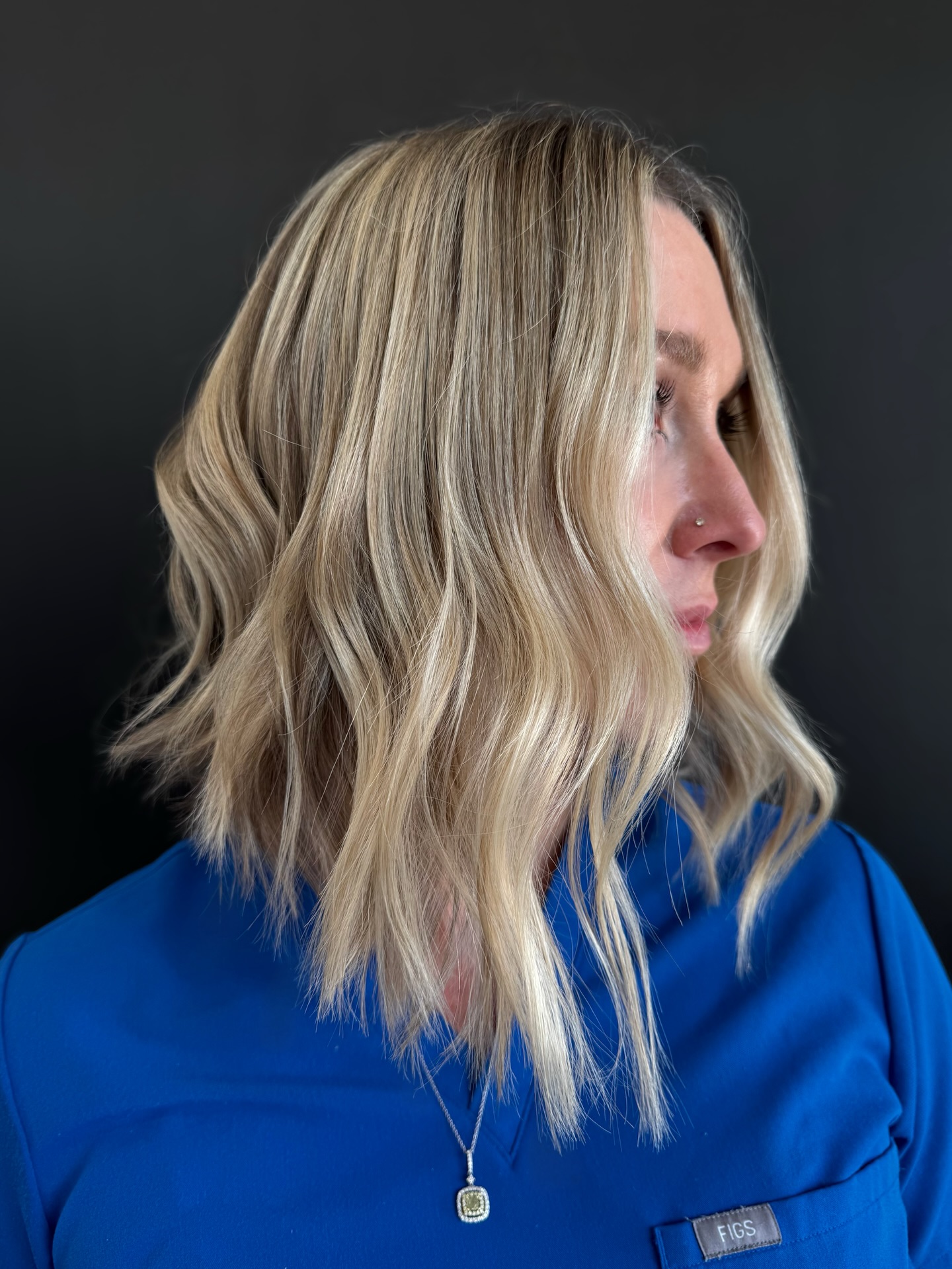
21. Classic A-Line Bob
The A-line is a consistently reliable shape for fine hair because the angled perimeter naturally creates the illusion of movement even when the hair is completely straight and unstyled. Longer front pieces frame the jawline with density, while the shorter back keeps the overall silhouette lifted. Start with a modest angle — about an inch to an inch and a half difference between front and back — and adjust from there if you want more drama.
22. Long A-Line Bob (Lob)
Extending the A-line angle into lob territory gives you front pieces that brush the collarbone while the back sits just below the chin. Fine hair holds this length better than a one-length lob because the angle builds in structure that resists going flat. Heart-shaped and long face shapes benefit most — the length at the front softens a pointed chin, while the back avoids adding visual weight to the crown.
23. Angled Bob with Blunt Perimeter
Combining the angle of an A-line with a blunt (not textured) perimeter gives fine hair the density benefits of both approaches — the geometric line creates structure, and the uniform ends prevent any wispiness at the tips. This is one of the sharpest-looking bobs in the collection, but the precision means you’ll see the shape start to soften within five to six weeks as the hair grows unevenly.
24. Asymmetrical Bob
An asymmetrical bob takes the A-line concept further by making one side noticeably longer than the other — typically a two-to-three-inch difference. On fine hair, the longer side concentrates density near the face, and the visual imbalance tricks the eye into seeing more volume overall because it’s reading the thicker side first. Square and round faces get extra benefit from the diagonal line, which elongates the face instead of mirroring its width.
25. Angled Bob with Hidden Layers
If you want the structural benefits of an A-line but find the flat shape too severe, ask for internal layers that sit beneath the surface. The top layer stays one-length for maximum perimeter density, while the underlayers add enough movement to prevent the bob from looking like a helmet. On fine hair, limit hidden layers to the back half of the head — the front needs every strand at the same length to look full.
26. Micro A-Line Bob
A micro bob — roughly ear-to-chin length — with a subtle A-line angle offers the volume concentration of a very short cut with just enough angle to avoid looking like a blunt helmet. Fine hair appears densest at shorter lengths because less length means less weight pulling strands flat. The micro A-line works particularly well after a grow-out from a pixie cut, since the graduated lengths blend into the existing layers.
Bobs with Bangs for Fine Hair
Bangs redistribute hair from the sides and crown forward, which makes the front of a bob look denser — useful if your fine hair is also thin in density. The catch: bangs on fine hair need to be cut with restraint. Too thick and they steal volume from the rest of the bob; too thin and they separate and show forehead through the gaps. The bobs in this section pair specific bang styles with cuts that keep the balance right.
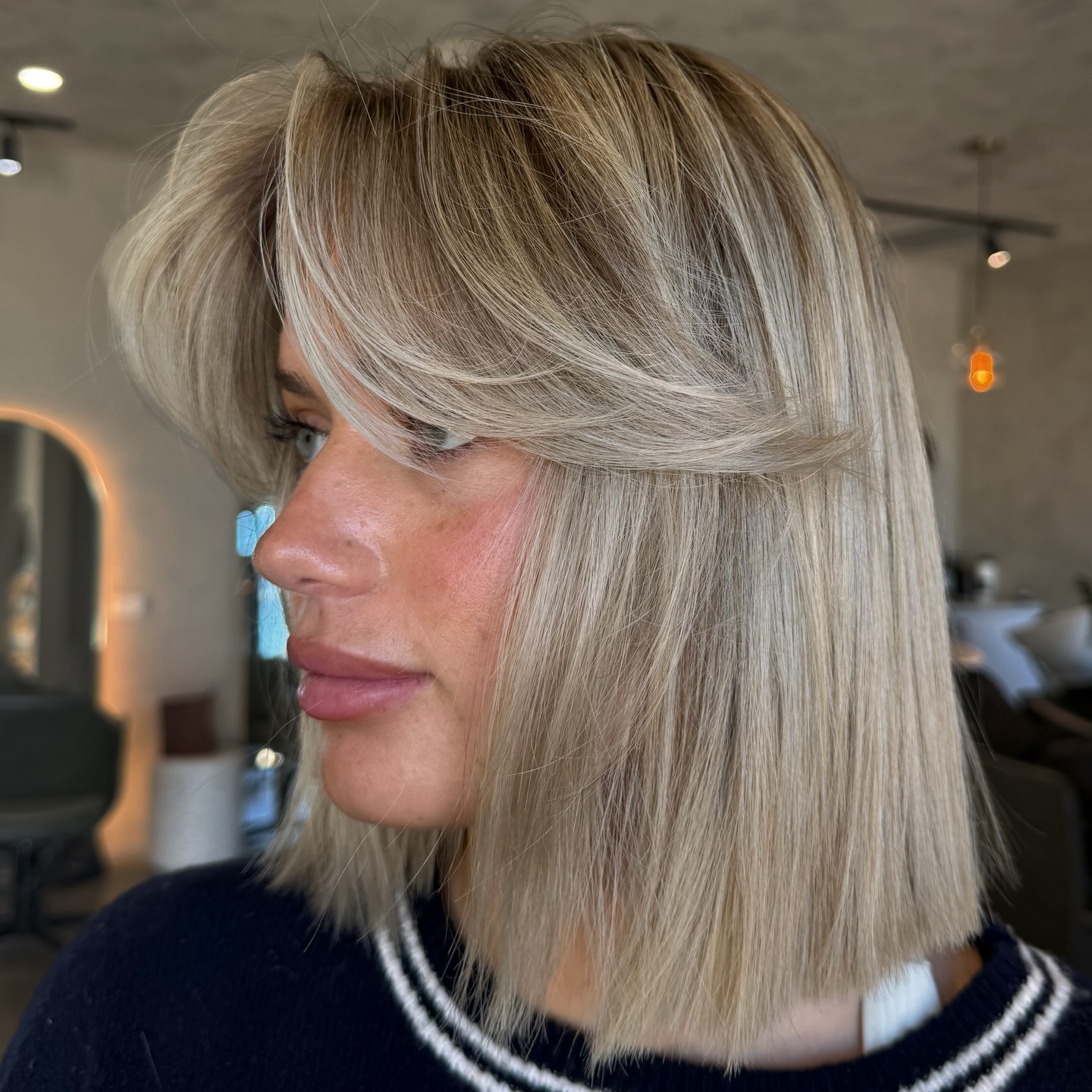
27. Blunt Bob with Wispy Curtain Bangs
Curtain bangs split at the center and sweep to the sides, which adds face-framing density without committing a large section of hair to bang territory. For fine hair, keep the curtain fringe wispy — no more than a half-inch-deep section taken from the hairline. The parted shape integrates into the rest of the bob as it grows, so the grow-out phase is seamless rather than awkward.
28. French Bob with Rounded Bangs
Full, rounded bangs paired with a French bob at cheekbone-to-chin length is one of the few fine-hair styles that deliberately uses bangs as the focal point rather than the length. The bangs create a strong horizontal line across the forehead that reads as density, while the short bob behind them keeps the overall weight light enough for fine strands to hold shape. Be aware that this look requires the most frequent maintenance in this gallery — bang trims every three to four weeks to keep them above the eyes.
29. Side-Swept Bangs with Layered Bob
Side-swept bangs direct a sweep of hair diagonally across the forehead, which builds density on one side without requiring a thick section of hair. Combined with a layered bob, the bangs blend into the face-framing layers for a cohesive look. This pairing is particularly useful if your part line has widened over time — the sweep covers the thinnest area while still looking styled rather than strategic.
30. Textured Bob with Micro Bangs
Micro bangs — cut an inch or more above the eyebrows — only require a very thin section of hair (about a quarter inch), which means they barely impact the volume of the rest of your bob. On fine hair, the short length keeps the bangs from separating under their own weight the way longer bangs do. Micro bangs pair best with textured bobs rather than blunt ones, because the contrast between the precise short fringe and the piece-y bob creates visual interest.
31. Lob with Bottleneck Bangs
Bottleneck bangs — short at the center of the forehead and gradually lengthening toward the temples — blend seamlessly into a lob without a visible line where the bangs end and the face-framing layers begin. For fine hair, this gradual transition means you’re never committing a large chunk of hair to one area. The cheekbone-length side pieces also double as face-framing layers, so you get two effects from the same cut.
32. Angled Bob with Baby Bangs
Baby bangs (roughly eyebrow-length, slightly longer than micro bangs) sit well on fine hair because they’re heavy enough to lay flat without separating but light enough not to steal volume from the crown. Pairing them with an angled bob creates a geometric look — the horizontal line of the bangs intersects with the diagonal angle of the bob for a structured, sharp silhouette. This works especially well on straight fine hair that holds clean lines without much effort.
33. Bob with Feathered Side Bangs
Feathered side bangs use point cutting or razor work to soften the bang edge, creating a wispy, face-framing effect that blends into the bob’s length. On fine hair, feathered bangs avoid the blunt heaviness that can make the rest of the bob look thin by comparison. They’re also the lowest-maintenance bang option here — as they grow out, the feathered edges simply merge into the side layers.
34. Wavy Bob with Bardot Bangs
Bardot bangs — center-parted, cheekbone-length, with a slight curtain sweep — work on fine hair when the bob underneath has some wave or bend to match the movement. On straight fine hair, the bangs can separate and look stringy, but on hair with natural wave or a quick pass with a curling iron, the Bardot fringe adds a frame that makes the whole style look intentionally full. A volumizing mousse worked through damp hair before air-drying is usually enough to get the wave and the bang to cooperate.
35. Blunt Bob with Clip-In Bangs for Testing
If you’re drawn to bangs but nervous about committing fine hair to them, clip-in bangs let you test the look before cutting. A good set matches your exact hair color and sits flat against the hairline — the blunt bob underneath provides a clean baseline that the clip-in integrates into naturally. Test the look for a few weeks to see whether you like bangs on fine hair before asking your stylist to cut them in permanently.
Blunt vs. Layered: Which Approach Actually Works Better for Fine Hair?
This is the most common question in the fine-hair conversation, and the honest answer is that both approaches work — they just solve different problems. Blunt cuts maximize perceived thickness at the perimeter by keeping all strands at the same length. Layered cuts add movement and interior volume by creating shorter pieces that push the surface hair upward. The mistake is applying the wrong approach to the wrong issue.
| If Your Issue Is… | Best Approach | Why |
|---|---|---|
| Thin, see-through ends | Blunt cut | Uniform endpoints create a solid hemline that looks thicker |
| Flat crown and no lift | Graduated or stacked layers | Shorter layers underneath push the surface hair upward |
| Limp, lifeless shape | Internal layers (hidden beneath one-length surface) | Movement in the interior without sacrificing the solid perimeter |
| Frizzy and flyaway fine hair | Blunt or minimal texturing | Fewer layer transitions mean fewer places for flyaways to spring out |
| Fine hair but decent density | Point-cut texture at the ends | Enough hair to afford removing a little for movement; not enough for heavy layering |
Stylist tip: Ask your stylist to assess your hair’s density (how many strands per square inch) separately from its texture (the width of each strand). You can have fine-textured hair that’s also high-density, in which case layers work beautifully. Or you can have fine-textured, low-density hair, where a blunt cut protects every strand you have. These are two different hair situations that require opposite approaches — knowing which one you have is the single most useful piece of information for choosing the right bob.
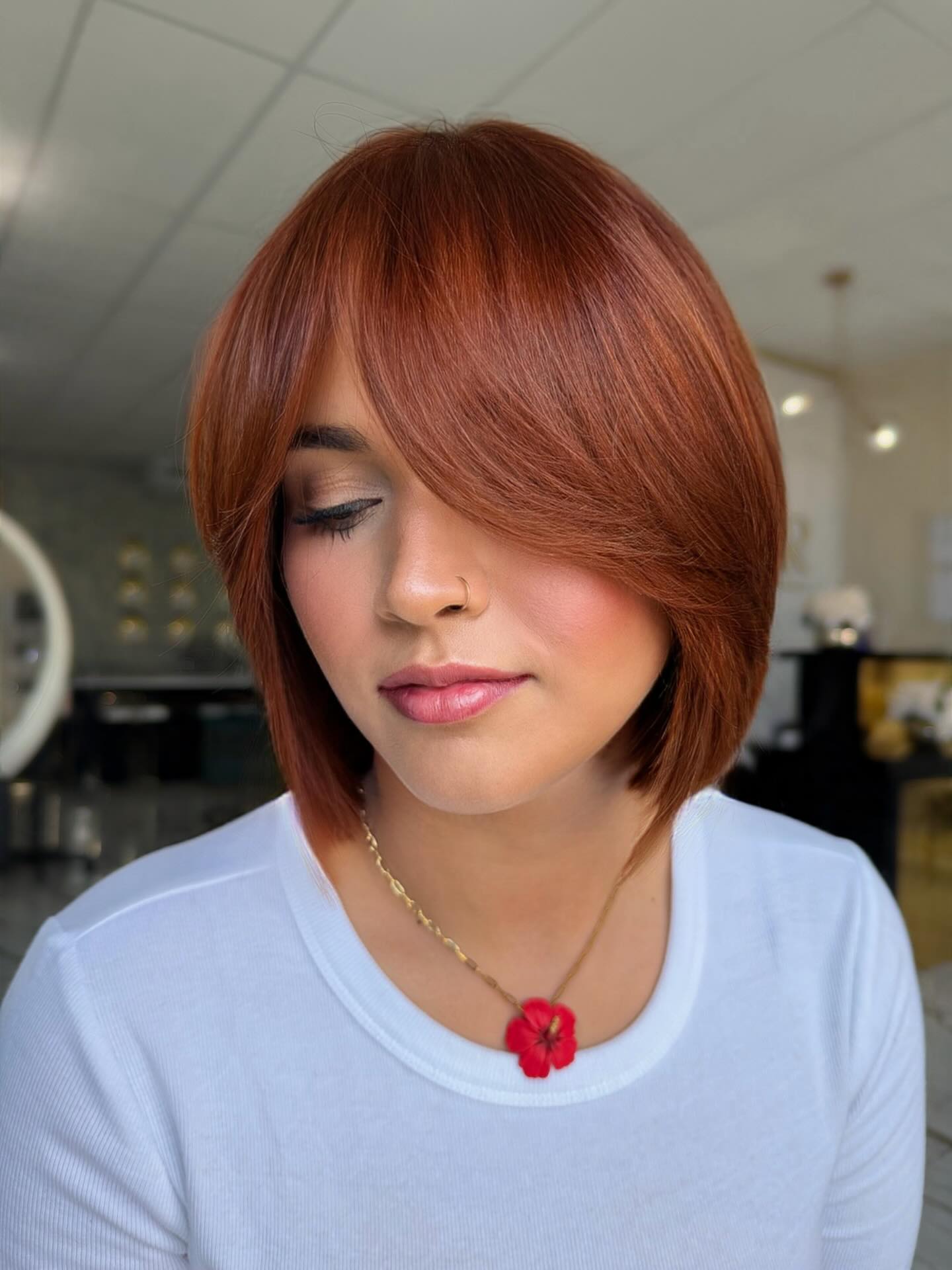
How to Choose a Bob by Face Shape When You Have Fine Hair
Face shape matters for any bob, but fine hair adds an extra variable: you need a cut that flatters your proportions and compensates for reduced volume at the same time. The right bob variation does both.
| Face Shape | Best Bob Variation | Why It Works | Avoid |
|---|---|---|---|
| Oval | Almost any bob — chin-length blunt, textured lob, French bob | Balanced proportions work with any length | Very short bobs that expose too much of the balanced features, making fine hair the focal point instead |
| Round | Angled bob or A-line past the jaw, with a side part | The diagonal angle elongates; length past the jaw avoids adding width | Chin-length blunt bobs that hit at the widest point of the face, full rounded bangs |
| Square | Textured bob at or below the jaw, soft layers at the face | Texture softens the jawline; length below the jaw draws the eye down | Blunt chin-length bobs that emphasize the angular jaw, heavy straight-across bangs |
| Heart | Chin-length bob with volume near the chin, curtain bangs | Width at the chin balances a wider forehead; curtain bangs soften the hairline | Very short stacked bobs that add crown volume without chin-level width |
| Oblong / Long | Chin-length blunt bob with bangs or a French bob | The horizontal bang line breaks up vertical length; chin-level cut avoids elongating further | Long A-line lobs that add vertical length, center parts without bangs |
| Diamond | Textured lob with side-swept bangs, or chin-length bob with curtain fringe | Width at the forehead and chin balances narrow areas; bangs soften angular cheekbones | Slicked-back styles that expose the narrowest points of the face |
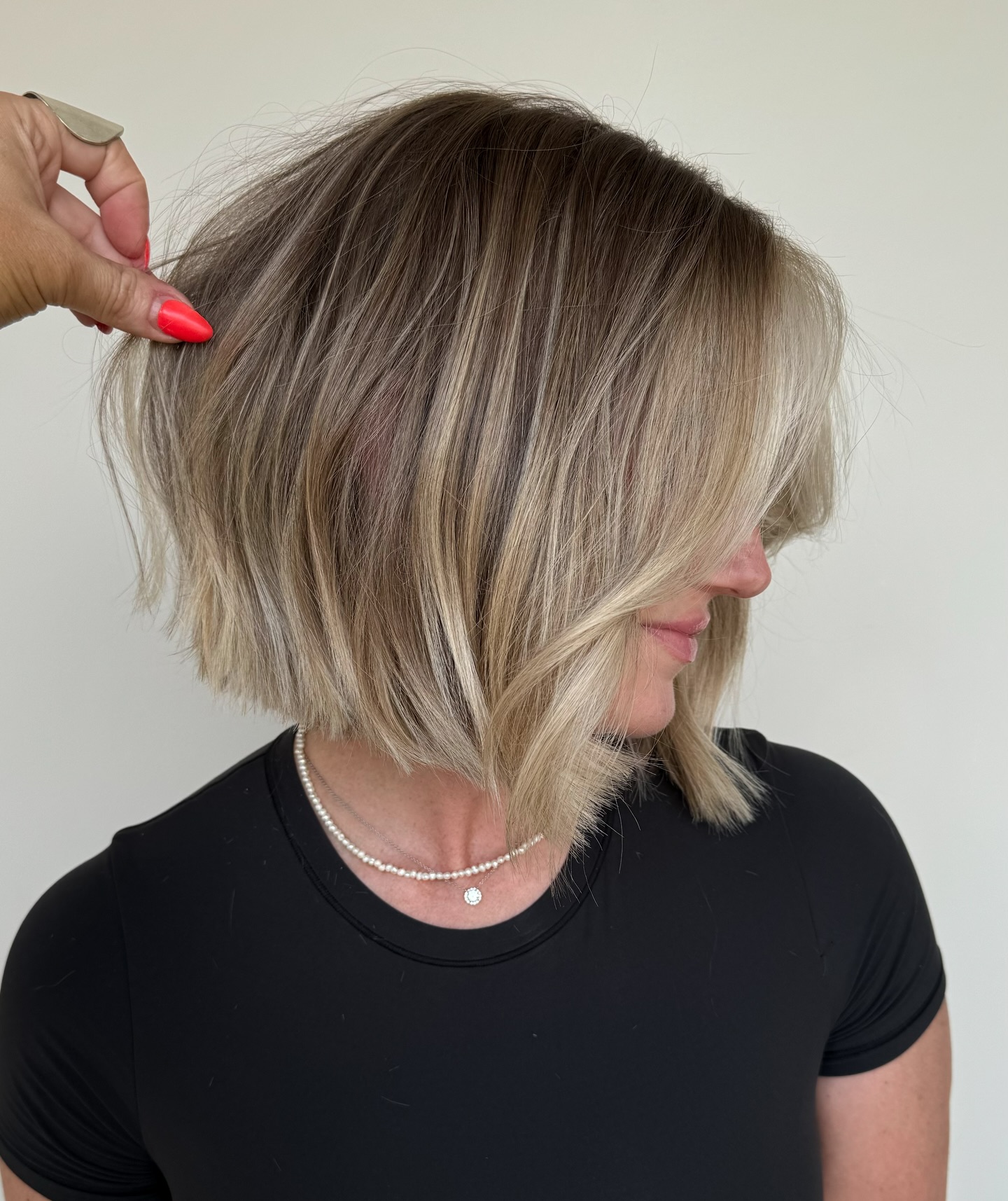
What to Tell Your Stylist
Walking into the salon with the right vocabulary makes the difference between a bob that’s technically correct and one that’s optimized for your specific fine hair. Most of the volume-building techniques in this gallery are invisible to someone looking at a photo — they happen in how the cut is structured, not what it looks like from the outside.
Start with the specific bob variation you want (bring a reference photo), then communicate these fine-hair-specific details:
“I want to keep the weight line solid.” This tells your stylist you don’t want thinning shears or heavy layering at the ends — the most common mistake on fine hair. If you want texture, specify point cutting at the tips only.
“Can you check my density before we decide on layering?” Density (how many hairs per square inch) is different from texture (the width of each strand), and the answer determines whether your fine hair can support layers. A stylist can assess this by pulling a section taut and evaluating how much scalp shows through.
“I’d like the graduation to stay below the occipital bone.” If you’re getting a stacked or graduated bob, this instruction keeps the volume-building layers in the back half of your head, where fine hair needs the most help, rather than extending them to the sides where they could thin out your profile.
Stylist tip: Avoid asking for “lots of layers for volume” — on fine hair, this often has the opposite effect. Instead, describe the problem you’re trying to solve: “My hair goes flat at the back by noon” or “The ends look see-through.” Your stylist can choose the technique that addresses the specific issue rather than defaulting to a generic layered approach.
Maintenance and Styling for Fine-Hair Bobs
Fine-hair bobs are generally lower-maintenance than their thick-hair counterparts, but they do have specific upkeep requirements that affect how long your cut holds its shape.
Trim schedule: Blunt bobs show split ends and unevenness faster than textured cuts — plan for a trim every five to six weeks. Textured and graduated bobs are more forgiving, lasting six to eight weeks between appointments. Bangs, regardless of the bob style, need a separate trim every three to four weeks.
Styling products by category: Fine hair gets weighed down by heavy creams, oils, and serums applied generously. Stick to lightweight formulas applied sparingly. A volumizing mousse (golf-ball-sized amount, worked through damp roots before blow-drying) builds body without residue. A dry texture spray adds grip and separation to second-day hair. If you need smoothing, apply a dime-sized amount of lightweight serum to ends only — never roots.
Blow-drying technique for maximum volume: Flip your head upside down and blow-dry the roots to about 80% dry. Flip back up, then use a medium-barrel round brush to dry section by section, lifting each section away from the scalp. Finish with a blast of cool air to lock the shape. This takes about 10 minutes on a bob and adds noticeably more volume than air-drying alone.
Wash frequency: Fine hair shows oil faster than coarse hair, so most people with fine bobs wash every one to two days. Extending to day three usually requires dry shampoo at the roots — apply it before bed rather than in the morning so the powder absorbs overnight and doesn’t leave a visible white cast.
FAQ
Is a Blunt or Layered Bob Better for Fine Hair?
It depends on whether your primary concern is thin ends or flat volume. A blunt bob creates the strongest perimeter density because every strand ends at the same point, which is ideal for fine hair with low density that looks see-through at the tips. A layered or graduated bob adds interior movement and lift, which is better for fine hair that has adequate density but falls flat against the head. Many stylists recommend a hybrid — blunt perimeter with internal layers underneath — to get both effects.
What Length Bob Is Best for Fine Hair?
Chin to jaw length is the sweet spot for most fine hair types. This length is short enough that the hair’s weight doesn’t drag it flat, but long enough to show shape and movement. You can go shorter (ear-length or above) if you want maximum density concentration, or longer to collarbone length if your hair has enough density to support it. Anything past the collarbone typically requires thicker hair to hold body.
Should I Avoid Thinning Shears on Fine Hair?
In most cases, yes. Thinning shears remove volume from the interior of a section, which is the opposite of what fine hair needs. They’re designed for thick hair that has excess bulk. On fine hair, thinning shears create patchy spots and stringy ends. If your stylist reaches for them, ask for point cutting instead — it creates texture at the tips without removing interior density.
Can I Get a Bob If My Hair Is Very Thin and Fine?
A bob is one of the best options for very thin, fine hair. The shorter length concentrates whatever density you have into a smaller area, making the overall shape look fuller. Stick to a blunt or minimally textured variation rather than a heavily layered one — you want to preserve every strand rather than thin them out further. A chin-length blunt bob or a soft graduated bob are the two most reliable choices for very thin hair.
How Do I Add Volume to a Fine-Hair Bob Without Heat Tools?
Three approaches work without heat. First, change your part — a deep side part or zigzag part lifts the roots simply by redirecting the hair. Second, apply a lightweight volumizing mousse to damp roots and scrunch while air-drying. Third, use Velcro rollers at the crown on damp hair for 20 minutes while you do your makeup — they set root lift without any heat damage. A dry texture spray on day-two hair also adds grip and separation that mimics volume.
Does Hair Color Help Fine Hair Look Thicker?
Strategic color adds visual dimension that makes fine hair appear denser. Highlights and lowlights placed throughout the bob create contrast between light and dark strands, which tricks the eye into seeing more texture and depth. Avoid single-process all-over color, which makes every strand the same shade and can actually flatten the appearance. A subtle balayage or babylight technique adds dimension without the maintenance of full foils.
How Often Should I Wash a Fine-Hair Bob?
Most fine hair needs washing every one to two days because the scalp’s natural oils travel down fine strands faster than thick ones, making hair look greasy sooner. Overwashing can trigger more oil production, so try extending to every other day using dry shampoo at the roots. Apply it before bed — not in the morning — so the powder absorbs overnight without leaving a visible residue.
Hair results vary based on your natural hair type, texture, density, and condition. Always consult with a licensed hairstylist before making significant changes, especially with chemical treatments or dramatic length changes. Photos may show styled results that require professional tools and products to replicate.

2 responses