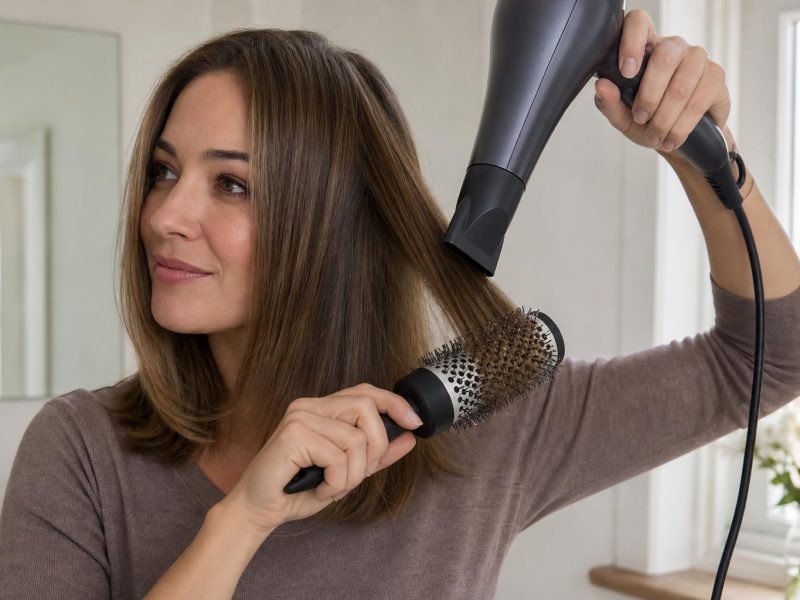


Your follicles produce about half an inch a month whatever you do, so the length you end up with is decided at the ends rather than at the roots.
Hair grows roughly half an inch per month, or about six inches a year, and that rate is set by genetics, age, and general health rather than by anything you buy. Going from a chin-length bob to mid-back length is therefore a two-and-a-half to three-year project, not a six-month one. The variable you can actually influence is retention, which is how much of that growth survives to stay on your head instead of breaking off somewhere along the way.
This guide covers the real timeline for common length goals, why trims cannot speed growth but skipping them costs you length anyway, what terminal length means for your ceiling, the handful of habits that genuinely help, an honest read on supplements, and the point at which slow growth becomes a medical question rather than a haircare one.
What Growth Actually Looks Like on a Calendar
The single most useful thing you can do before starting a grow-out is convert your goal into months, because the number is usually larger than people expect and the surprise is what makes them quit at month seven. Measure from your current length to your target in inches, then divide by half an inch. The table below does that for the common starting points.
| Starting Length | Target Length | Inches to Grow | Realistic Timeline |
|---|---|---|---|
| Pixie | Chin-length bob | 4 to 5 | 8 to 10 months |
| Chin-length bob | Collarbone lob | 4 to 6 | 8 to 12 months |
| Collarbone | Mid-back | 8 to 10 | 16 to 20 months |
| Mid-back | Waist | 6 to 8 | 12 to 16 months |
| Shoulder | Waist | 14 to 16 | 2.5 to 3 years |
Those timelines assume you keep essentially all of what you grow, which almost nobody does. Add three to six months to any of them for the trims you will need along the way, and add more if your hair is colored or heat-styled regularly. Growth rate also slows somewhat with age and varies by texture, with tightly coiled hair often growing at the same rate but appearing to grow slower because of shrinkage.
Growth Happens at the Follicle, Retention Happens Everywhere Else
Hair is produced by living cells inside the follicle and is dead from the moment it clears the scalp. Nothing you apply to the length can influence what the follicle does, because the two are not connected in any way that matters. Products that claim to speed growth are either working on the scalp, where the argument is at least plausible, or they are marketing.
Retention is the other half, and it is where the real difference between two people with identical growth rates comes from. Every strand on your head is exposed to friction, heat, chemical processing, brushing, and weather for the entire time it exists. Hair at your waist has been on your head for roughly three years and has survived around a thousand washes. The ends are the oldest and most damaged part of any long hair, which is why the perimeter thins out before the length stops increasing.
Stylist tip: Photograph your hair against the same wall, in the same light, on the first of every month with your hair dry and pulled straight. Length gain is invisible day to day and obvious across six photos, and having proof you are making progress is what gets most people past the awkward middle stretch.
Trims Do Not Speed Growth, and Skipping Them Still Costs You Length
Cutting the ends has no effect whatsoever on the follicle, so the widespread belief that frequent trims make hair grow faster is simply wrong. Growth rate is unchanged whether you visit a salon every six weeks or never. That part of the myth deserves to die.
The reason trims still matter is different and less intuitive. A split end does not stay where it is: the split travels upward along the shaft, and the strand eventually snaps well above the original damage. Removing a quarter inch before that happens protects the two inches above it. That is why people who avoid the salon entirely to preserve length often end up shorter after a year than people who trimmed twice, since they lost more to breakage than they would have lost to scissors.
The practical compromise during a grow-out is a dusting rather than a trim, meaning a quarter inch or less, every three to four months. Ask for exactly that, in inches, and say you are growing it out. Understanding what a split actually is helps here, and our guide to managing split ends between trims covers what you can and cannot do at home between appointments.
Terminal Length Sets a Ceiling You Cannot Argue With
Each follicle runs a growth cycle with an active phase that lasts somewhere between two and seven years depending on your genetics. When that phase ends, the hair sheds and the follicle starts over. Terminal length is simply how long a hair can get before its clock runs out, and it is why some people reach their waist without much effort while others cannot get past their shoulder blades no matter what they do.
You cannot extend your active growth phase. What you can do is stop mistaking breakage for a genetic ceiling, which is the far more common situation. The tell is straightforward: if your ends are thin, wispy, and see-through while the hair higher up is dense, you are losing length to damage. If the ends stay reasonably thick and the length simply stops increasing, you have probably met your terminal length.
There is a middle case worth naming. Hair that seems stuck often has a blunt perimeter that is being trimmed at the same rate it grows, which feels like a plateau and is really a scheduling problem. Stretching your appointments from every eight weeks to every fourteen, with a smaller cut each time, usually breaks that stalemate within six months.
What Actually Moves the Needle
The list of things that genuinely help is short, unglamorous, and mostly free. In rough order of how much difference each makes for the average person:
- Cut the heat. Sustained high heat is the fastest route to mid-length breakage. Drop your tools to medium, air-dry when you can, and use an overnight heatless set instead of an iron for texture.
- Protect the ends mechanically. Sleep on satin or in a loose braid, use a wide-tooth comb on wet hair, and stop tying your hair in the same spot every day, which wears a weak point into the same inch of every strand.
- Balance protein and moisture. Hair that snaps needs structure; hair that feels rough and tangly needs water. Getting the protein and moisture balance right prevents most everyday breakage.
- Space out chemical services. Every lightening session costs retention. If you are growing out and coloring, stretch to root touch-ups and leave the ends alone, or use a bond treatment alongside processing to limit the damage.
- Use heat protectant properly. On damp hair, before layering anything else, every single time you use a hot tool. The application sequence matters more than the brand.
- Eat enough protein and iron. Genuine undernutrition does slow growth and increase shedding, and low ferritin is a common and easily missed cause. This is about correcting a deficit, not about supplementing above normal.
Stylist tip: Long layers are your friend during a grow-out and a blunt perimeter is not. A blunt line at the ends means the whole cut has to be trimmed to the shortest damaged strand, whereas long layers let a stylist remove damage selectively and keep the overall length. Ask for the damage taken out of the layers rather than off the bottom.
What the Evidence Does Not Support
Myth: A Biotin Supplement Will Make Your Hair Grow
Reality: A review in the Journal of Clinical and Aesthetic Dermatology concluded that marketing biotin for hair loss in healthy people is unsubstantiated, and that the best-quality trial found no significant difference against placebo. Biotin genuinely helps people who are biotin-deficient, and that deficiency is rare outside specific inherited conditions and a few medications. Excess biotin can also interfere with certain lab tests, including thyroid and cardiac panels, so mention it to your doctor if you take it.
Myth: Scalp Massage Adds Meaningful Length
Reality: The evidence for scalp massage is thin and mostly comes from small studies on hair thickness rather than growth rate. It feels good, it costs nothing, and it does no harm, so there is no reason to stop. Just do not expect it to change your half inch a month, and do not let it displace the retention habits that actually work.
Myth: Cutting on a Schedule Set by the Moon Helps
Reality: No mechanism exists for lunar phases to influence follicle activity, and no study supports it. If following a calendar gets you into the salon regularly, the regularity is doing the work rather than the moon.
Myth: If It Is Not Growing, You Need a Stronger Product
Reality: Stalled length is almost always breakage, terminal length, or a trim schedule that outpaces growth, and none of the three responds to a new bottle. Diagnose which one you have before spending anything. The AAD’s guidance on keeping hair healthy is a good baseline, and it is notable for how little it involves buying things.
A Realistic Twelve-Month Grow-Out Plan
Grow-outs fail in the middle, when the hair is too long to look deliberate and too short to do anything with. Planning the awkward stage rather than enduring it is the difference between reaching your goal and cutting it all off at month eight in frustration.
| Stage | What Is Happening | Salon Plan | Getting Through It |
|---|---|---|---|
| Months 1 to 3 | About 1.5 inches gained, shape still holds | No cut, or a dusting only if ends are already split | Fix the heat and mechanical habits now, before the damage exists |
| Months 4 to 7 | The awkward stage, shape collapses and length looks shapeless | Face-framing layers only, nothing off the bottom | Half-up styles, headbands, and a good part change buy you months |
| Months 8 to 10 | 4 to 5 inches gained, ends starting to show wear | Quarter-inch dusting, damage removed from layers | Add a weekly mask, since the oldest inch is now genuinely old |
| Months 11 to 12 | Roughly 6 inches gained, a new length is possible | A real shape cut into the length you now have | Bring photos and reset the goal for year two if you are continuing |
When Slow Growth Is a Medical Question
Most stalled grow-outs are breakage. A minority are not, and the distinction matters because the medical causes respond to treatment while breakage responds to habits. See a doctor rather than adjusting your routine if any of the following describes you.
- You are shedding noticeably more than usual from the root. Hairs that come out with a small white bulb are shedding, not breaking, and a sustained increase points to telogen effluvium, thyroid issues, or low iron.
- The hair is getting finer overall, not just at the ends. Miniaturization of individual strands is a pattern hair loss signal and is worth catching early, when treatment works best.
- You have visible scalp where you did not before. Widening at the part deserves a professional opinion rather than a volumizing product. There are cuts that work well with thinning hair, but they manage the appearance rather than the cause.
- Shedding started two to four months after a major event. Illness, surgery, childbirth, crash dieting, and severe stress all trigger delayed shedding, which usually resolves but is worth confirming.
- You have patchy loss, scalp pain, or scarring. These need a dermatologist promptly, because some causes permanently destroy follicles if untreated.
What to Tell Your Stylist
Say the words “I am growing it out” at the start of the appointment, not after the cut. Then be specific about the amount: “Take a quarter inch, no more, and remove any damage from the layers rather than the perimeter.” Stylists cut to the shortest damaged strand by default because that is what produces a clean result, and they will happily work differently if they know your priority is length over polish.
Ask them to show you the length between their fingers before they cut, which takes ten seconds and prevents the classic misunderstanding where a quarter inch becomes an inch and a half. It is a normal request and no reasonable stylist minds.
Also ask what they see in your ends. A stylist has your hair in their hands and can tell you within seconds whether you are dealing with breakage or a genuine plateau, which is the single most useful piece of information in the whole project and costs you nothing to obtain.
FAQ
Does Hair Grow Faster in Summer?
Slightly, for many people, though the effect is small enough that you will not notice it on a ruler. Circulation and seasonal shedding patterns both shift with temperature and daylight. It is not a reason to plan a grow-out around the calendar.
How Often Should I Trim While Growing My Hair Out?
Every three to four months, taking a quarter inch or less, is the usual sweet spot for hair in reasonable condition. Bleached or heat-styled hair may need every ten weeks to stay ahead of splitting. Going a full year with no trim at all almost always ends with a bigger cut than the trims would have cost you.
Will Skipping Washes Help My Hair Grow?
It has no effect on growth rate, though it can help retention by reducing handling, heat, and mechanical stress. Whether it suits you depends on your scalp, since oil buildup causes its own problems. Wash on the schedule that keeps your scalp comfortable and manage retention through the other habits instead.
Can I Grow Long Hair If It Is Fine?
Yes, though fine hair reaches a visual limit before it reaches a length limit, since the ends look sparse as the density thins toward the perimeter. Long layers and a slightly shorter target usually look fuller than maximum length does. Anyone whose fine hair looks thin below the shoulders often gets a better result from a long bob with a strong perimeter than from another six months of growing.
Do Hair Growth Serums Work?
Topical minoxidil has genuine evidence behind it for pattern hair loss, and it works on density rather than on the speed of growth. Most other scalp serums are unproven for growth in people without a diagnosed condition. If you are considering minoxidil, talk to a doctor first, because stopping it reverses the gains.
Why Does My Hair Stop at the Same Length Every Time?
Either you have reached terminal length or you are trimming at the same rate you grow, and the two are easy to confuse. Check whether your ends are thin and see-through, which points to breakage, or still dense, which points to a genuine ceiling. Tracking your trims in a note on your phone for a year usually answers it definitively.
Does Coloring My Hair Stop It Growing?
Color does not affect the follicle, so growth continues at the same rate. What it affects is retention, since lightening breaks internal bonds and makes the hair more fragile at exactly the ends you are trying to keep. Staying within two shades of your natural color, or restricting lightening to the top layers, costs you far less length.
Learning how to grow long hair is mostly a matter of accepting the growth rate you have and getting serious about keeping what it produces. Convert your goal into months so the timeline stops being a surprise, cut the heat and the mechanical wear, and trim small amounts on a schedule rather than avoiding the salon entirely. The rest of the long hair question is patience, and the photographs are what prove it is working.
Hair results vary based on your natural hair type, texture, density, and condition. Always consult with a licensed hairstylist before making significant changes, especially with chemical treatments or dramatic length changes. Photos may show styled results that require professional tools and products to replicate.