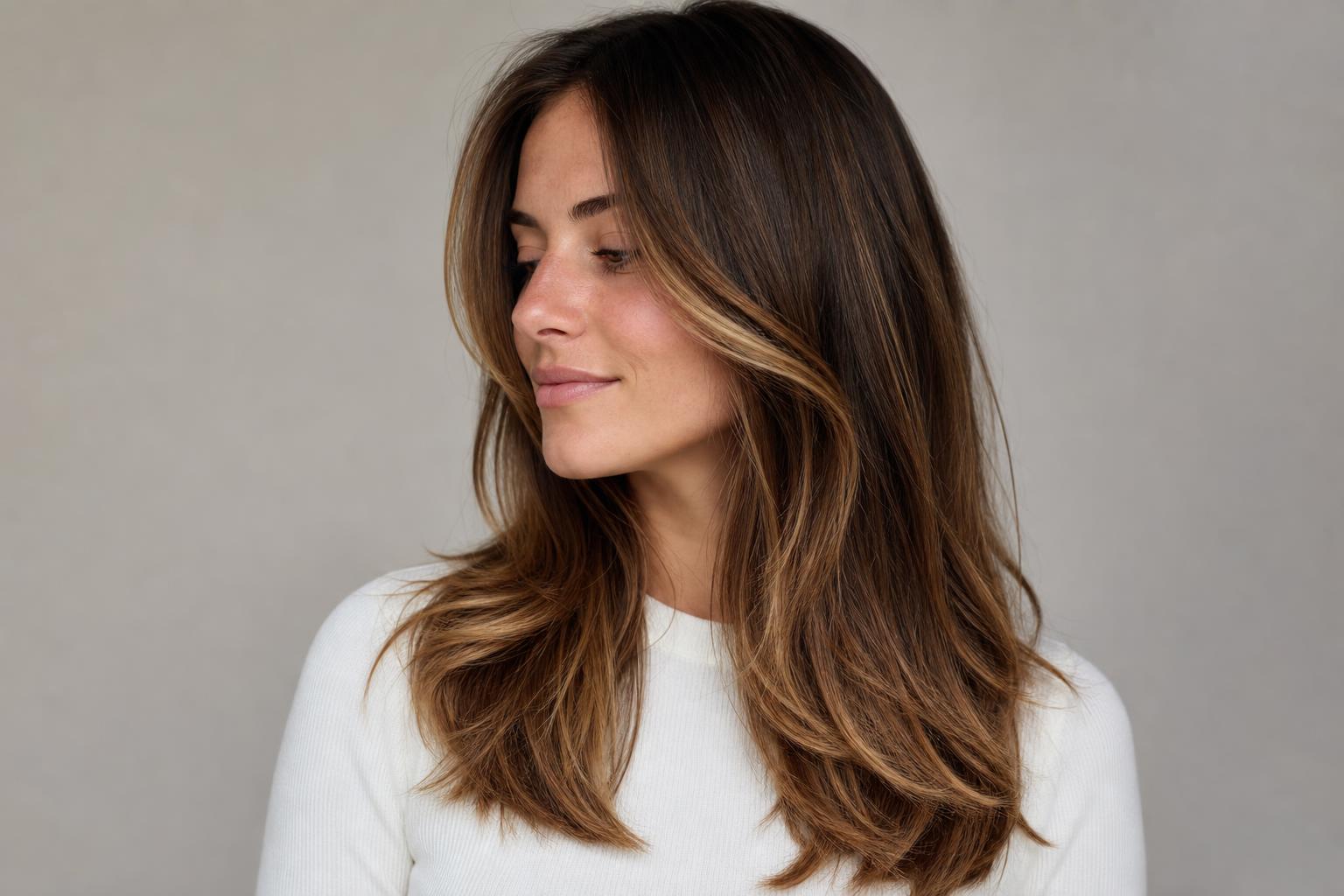
Brown hair does not lift straight to blonde; it travels through red and then orange first, and how far along that path your colorist stops decides everything about the result.
Every dark strand contains warm pigment underneath the brown, and lightener removes color in a fixed order: brown gives way to red, red to orange, orange to yellow, yellow to pale yellow. A highlight that looks brassy has simply been stopped at orange rather than taken to yellow and then toned. This is why the same technique produces a clean beige result on one head and a copper streak on another, and it is the single most useful thing to understand before booking.
This guide covers the level system and the underlying pigment behind it, the four techniques and the contrast each produces, how light brown hair can realistically go in one appointment, what toner actually does, the wording to use at the consultation, and a realistic maintenance schedule once the highlights are in.
Brown Hair Lifts Through Red and Orange Before It Reaches Blonde
Colorists describe depth on a scale of 1 to 10, where 1 is black and 10 is the lightest blonde. Most brown hair sits between level 3 and level 6. Lightener works by dissolving the natural pigment in stages, and because warm pigment is the most stubborn, it is what remains at every intermediate step. That exposed warmth is not a mistake or a sign of a bad product; it is the predictable middle of the process.
| Level | Depth | Underlying Pigment Exposed | What It Looks Like Untoned |
|---|---|---|---|
| 3 to 4 | Dark brown | Red | Warm auburn cast in the lightened pieces |
| 5 to 6 | Medium brown | Red-orange to orange | The classic brassy stage most people complain about |
| 7 | Dark blonde | Orange-yellow | Golden but still warm; tones easily to caramel |
| 8 | Medium blonde | Yellow | The realistic target for most brunettes in one session |
| 9 to 10 | Light to lightest blonde | Pale yellow | Where cool and beige tones become possible; needs the most lift |
Two practical conclusions follow. First, a cool or ashy blonde highlight is only achievable once the hair has reached pale yellow, which means it takes more lift on dark brown hair than on light brown. Second, an inspiration photo showing an icy highlight on someone who started at level 6 is not a realistic target for someone starting at level 3, at least not in one appointment. Level, not shade, is what makes a reference photo useful.
Four Techniques and the Contrast Each Produces
The technique controls where the lightener goes and how visible the line is between highlighted and natural hair. All four can produce blonde on brown; they differ in contrast, regrowth behavior and how much time the appointment takes.
| Technique | How It Is Applied | Contrast | Regrowth |
|---|---|---|---|
| Babylights | Very fine sections in foil, starting at the root | Lowest; reads as natural sun lightening | Soft, but visible at the root in 8 to 10 weeks |
| Traditional foils | Wider sections in foil, root to end | High; distinct blonde ribbons | A clear line at the root by week 8 |
| Balayage | Painted freehand, heavier toward the ends | Medium, graduated from root to tip | Almost invisible; 12 to 16 weeks between visits |
| Foilyage | Painted freehand, then wrapped in foil | High brightness with a soft root line | Soft, similar to balayage |
On dark brown hair specifically, foilyage tends to be the most useful of the four. Freehand balayage relies on air to develop the lightener, which limits how much lift it achieves, and dark hair frequently needs more lift than open-air painting delivers. Wrapping the painted sections in foil traps heat and pushes them further up the level scale while keeping the soft, grown-out root that balayage is chosen for in the first place.
How Light You Can Realistically Go in One Session
A safe appointment lifts the highlighted sections by about three to four levels. Starting at level 5 medium brown, that lands the highlights around level 8, which tones to a warm beige or caramel and looks natural against the remaining brown. Starting at level 3, the same single session reaches level 6 or 7, which is a golden brown rather than a blonde.
Pushing further in one appointment is possible and carries a real cost. Lightener works by opening the cuticle and dissolving pigment, and the longer it processes the more structural protein it removes. Hair that has been overprocessed feels gummy when wet, stretches without springing back, and breaks at the mid-shaft. Reaching genuinely pale blonde from dark brown is typically a two or three appointment project spaced six to eight weeks apart, and a colorist who tells you that is protecting your hair rather than upselling you.
Stylist tip: ask your colorist for a strand test at the consultation rather than on the day of the full service. A small section processed under the exact formula shows how your hair lifts, how fast, and whether it holds together, which is information no photograph can give. It costs fifteen minutes and it is the only reliable way to know whether your target is one session away or three.
Previous color complicates the arithmetic considerably. Box dye, particularly dark box dye, deposits pigment that sits unevenly along the length and resists lifting, so a colorist working over it cannot predict the result the way they can on virgin hair. Say so at the consultation even if it was years ago, because a colorist who does not know will formulate for virgin hair and be surprised alongside you.
Toner Does the Last Third of the Work
Lightener removes pigment; toner puts a small amount back. Once the hair has reached yellow, a toner in the opposite position on the color wheel neutralizes the remaining warmth, which is how a yellow base becomes beige, ash or a soft champagne. Violet cancels yellow and blue cancels orange, which is the entire logic behind both salon toners and the purple shampoos sold for home use.
Toner is not permanent. It fades over roughly four to eight weeks, which is why highlights that looked perfect on the day drift warm after a month or two. That drift is normal and is corrected with a gloss rather than with more lightening, and a gloss appointment is faster, cheaper and does no structural damage. Booking one halfway between highlight appointments is the standard way to keep the tone stable.
At home, a purple shampoo used sparingly rather than constantly holds the tone between salon visits. Used too often it deposits enough violet to leave a visible cast, especially on the most porous sections, so once a week is a reasonable starting point. Washing with a gentler sulfate-free formula the rest of the time slows how fast the toner washes out in the first place.
What to Tell Your Colorist
Name four things: how much contrast you want, where you want the lightest pieces to sit, how often you are willing to come back, and your full color history. A useful opening is: “I want soft blonde through the mid-lengths and ends, nothing bright at the root, and I would rather come in every three months than every six weeks. My hair has never been colored except a box dye about four years ago.”
Bring photos of people whose starting depth resembles yours, not just an end result you like. The gap between a photo of level 9 highlights on naturally light brown hair and the same photo interpreted onto level 3 hair is where most disappointment lives, and the way you present reference images at the salon changes the conversation more than the images themselves. Bringing one photo of what you want and one of what you want to avoid is more useful than five of the former.
Stylist tip: say the word “dimension” if you want the result to still read as brunette, and “brightness” if you want it to read as blonde. Colorists use those two words to mean genuinely different services, and picking the wrong one produces a result that technically matches your description while being nothing like what you pictured. It is the fastest way to align on the outcome before anyone mixes a bowl.
Maintenance, Regrowth and Condition
The upkeep depends far more on the technique than on the shade, because what needs redoing is the line where new growth meets lightened hair. Root-based techniques create that line; painted ones largely avoid it.
| Technique | Salon Interval | Appointment Length | Between Visits |
|---|---|---|---|
| Babylights | 8 to 10 weeks | 2 to 3 hours | Gloss at the midpoint |
| Traditional foils | 6 to 8 weeks | 2 to 3 hours | Purple shampoo weekly; gloss if it drifts |
| Balayage | 12 to 16 weeks | 2.5 to 4 hours | Gloss every 8 weeks keeps the tone |
| Foilyage | 12 to 14 weeks | 3 to 4 hours | Weekly bond treatment on the lightened sections |
Condition needs active management once any part of the hair has been lightened. Lifted sections are more porous, absorb and lose water faster, and tangle more readily than the surrounding brown. A weekly bond-building treatment addresses the internal structure rather than coating the surface, and it is the one product genuinely worth the money after highlighting. Porosity is also why highlighted brunettes often notice frizz they never had before, and the same sealing routine that controls frizz generally applies to the lightened pieces specifically.
When Blonde Highlights Are the Wrong Choice
Lightening is the most structurally demanding thing you can do to hair, and several situations argue against it.
- Hair that already feels gummy when wet or stretches without springing back. That is compromised protein structure, and lightening it further risks breakage rather than a color change.
- A recent keratin treatment or relaxer. Both alter the internal structure, and stacking chemical services within a few months compounds the damage in ways that are hard to reverse.
- Very dark box-dyed hair with an unknown history. The result cannot be predicted reliably, and removing box color is a separate service before any highlighting begins.
- An unwillingness to return every three months. Highlights do not simply grow out neutrally; foil-based ones develop a visible line, and untoned ones drift warm.
- Wanting an icy or platinum result from level 3 or 4 in a single appointment. It is achievable over several sessions and not in one, and pushing for it in one is where most severe damage happens.
Common Blonde Highlight Myths
Myth: Balayage Is Always Lower Maintenance Than Foils
Reality: balayage has a softer regrowth line, which is genuinely lower maintenance for the root. The tone still fades on the same schedule as any other lightening, so a balayage left untoned for six months drifts just as warm as foils would. The saving is in root appointments, not in glossing.
Myth: Brassiness Means Your Colorist Made a Mistake
Reality: warmth is the predictable middle stage of lifting brown hair, and it appears in every lightening process. It becomes a problem only when the hair was not taken far enough before toning, or when the toner has since faded. A gloss corrects it in under an hour without any further lightening.
Myth: You Can Match a Salon Result with a Home Highlighting Kit
Reality: home kits use a fixed developer strength with no ability to adjust for your starting level, your porosity or how the hair is behaving as it processes. On brown hair, which needs the most lift and passes through the most warmth, that lack of control is exactly where the process goes wrong. Correcting a home highlight typically costs more than the original salon service would have.
FAQ
Will Blonde Highlights Work on Dark Brown Hair?
They work, and the realistic target in one session is a warm beige or caramel around level 7 or 8 rather than a cool blonde. Dark brown sits at level 3 to 4 and lifts about three to four levels safely in a single appointment, passing through red and orange on the way. Reaching genuinely light blonde is usually a two or three appointment project spaced six to eight weeks apart.
Why Do My Blonde Highlights Look Orange?
Orange is the underlying pigment exposed when medium brown hair is lifted partway, so highlights that look orange were stopped before reaching yellow, or the toner that neutralized them has faded. A gloss appointment corrects it in under an hour with no additional lightening. If it happened immediately after the service, the lift was insufficient rather than the toner being wrong.
Is Balayage or Are Foils Better for Brown Hair?
Foilyage, which is balayage painted freehand and then wrapped in foil, tends to suit dark brown best because it delivers the lift foils give while keeping the soft regrowth of balayage. Open-air balayage often cannot lift dark hair far enough on its own. Traditional foils give the brightest, highest-contrast result and the most visible root line.
How Often Do Blonde Highlights on Brown Hair Need Redoing?
Six to eight weeks for traditional foils, eight to ten for babylights, and twelve to sixteen for balayage or foilyage. Those figures cover the regrowth line only; the tone fades separately over four to eight weeks and is refreshed with a gloss. Booking a gloss between highlight appointments is what keeps the color from drifting warm.
Do Blonde Highlights Damage Brown Hair?
Any lightening removes structural protein and raises the cuticle, so highlighted sections become more porous and more fragile than the surrounding hair. The extent depends on how many levels were lifted and how many times. A weekly bond-building treatment and spacing sessions six to eight weeks apart keeps the damage manageable, while pushing for maximum lift in one appointment is where breakage happens.
Can I Get Highlights Over Box-Dyed Brown Hair?
It is possible and considerably less predictable, since box dye deposits pigment unevenly along the length and resists lifting in patches. Tell your colorist about it even if it was years ago, because they will formulate differently and may recommend a color removal service first. A strand test matters more here than on virgin hair.
What Is the Difference Between Babylights and Highlights?
Babylights use much finer sections than traditional highlights, which produces a subtler result that reads as natural lightening rather than as distinct ribbons. Both are applied in foil starting at the root. Babylights take longer to apply because of the number of sections, and they grow out more softly, though they still develop a root line by around week eight.
Blonde highlights on brown hair come down to understanding one process: your hair passes through red and orange before it reaches the yellow that can be toned to a clean blonde. Decide how much contrast you actually want, bring a photo of someone whose natural depth matches yours, and ask for a strand test at the consultation. If your target needs more than four levels of lift, plan for two or three appointments rather than pushing one too far.
Hair results vary based on your natural hair type, texture, density, and condition. Always consult with a licensed hairstylist before making significant changes, especially with chemical treatments or dramatic length changes. Photos may show styled results that require professional tools and products to replicate.