

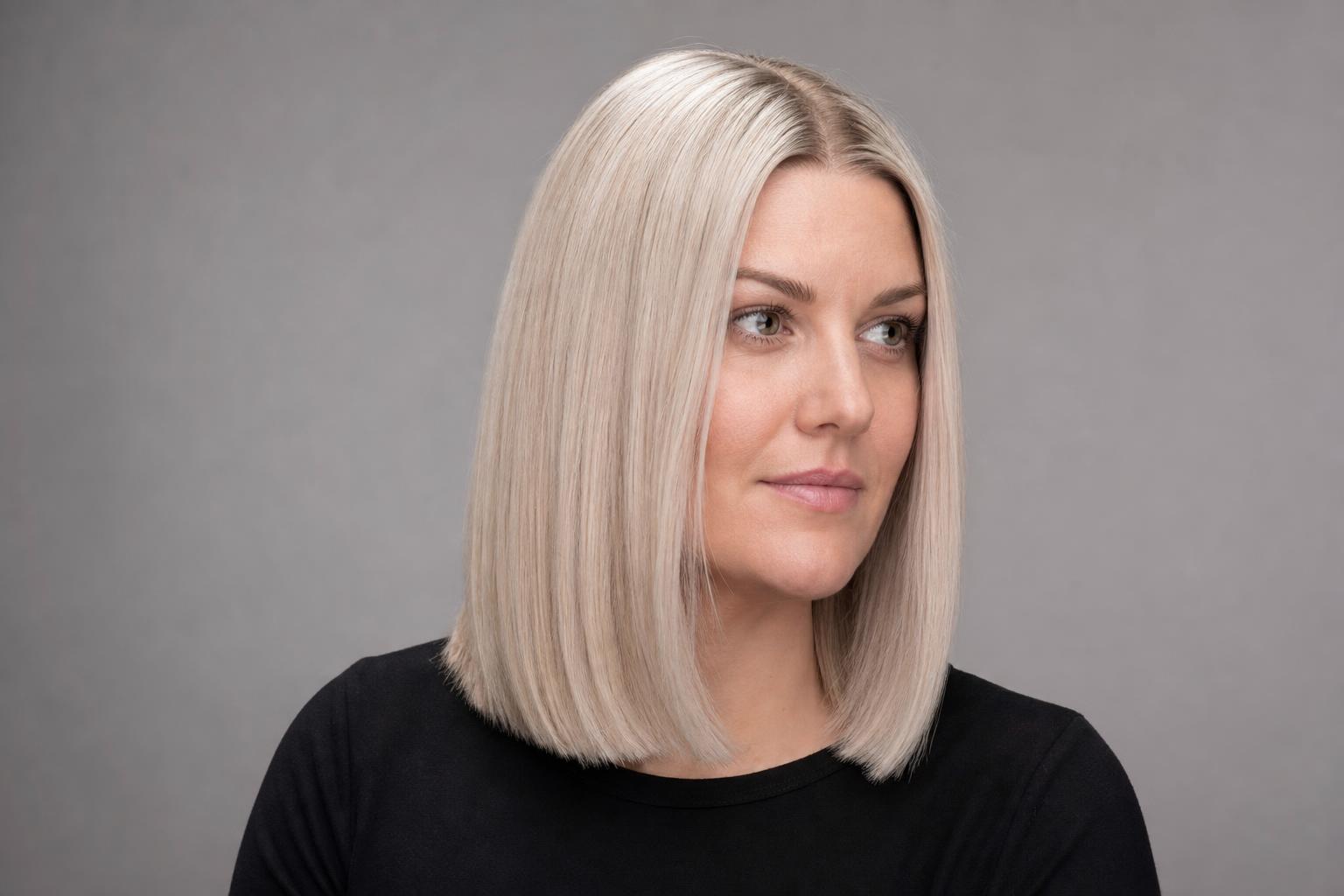
Purple shampoo cancels yellow, and nothing else, which is why it does so little for the orange brass most people are actually fighting.
Leave purple shampoo on for one to two minutes on platinum or high-porosity hair, three to five on darker blonde or grey, and use it once or twice a week rather than every wash. That timing is the whole technique. The bigger question is whether purple is even the right pigment for your brass: violet neutralizes yellow, so it works on blonde at levels 8 through 10, while the orange that shows up at levels 5 through 7 needs a blue-pigmented product instead.
This guide matches the right toning pigment to the warmth you actually have, sets timing and frequency by porosity, explains why hair goes lilac and how to strip that cast out, and draws the line where a purple shampoo stops being enough and a salon toner takes over.
What Purple Shampoo Actually Does
Purple shampoo is a cleanser carrying a small amount of direct violet dye. It does not lighten, it does not lift, and it does not change your underlying color. Every wash leaves a sheer film of violet pigment on the outside of the hair shaft, and because violet and yellow are opposites on the color wheel, that film visually cancels yellow warmth. The effect is optical and temporary, and it rinses away over the following few washes, which is why the routine has to be repeated rather than done once.
Because the pigment deposits on the surface, porosity controls almost everything about the result. Bleached, high-porosity hair has a raised cuticle that grabs dye fast and holds it, so the same three-minute wash that barely registers on healthy virgin blonde can leave visible violet on damaged ends. That single variable explains most complaints in both directions: the person who says purple shampoo does nothing and the person whose hair turned lavender are usually running identical timings on completely different hair.
Stylist tip: Apply purple shampoo to the mid-lengths and ends first, then work whatever is left through the roots for the final 30 seconds. Roots are newer, less porous, and generally less brassy than the ends, so treating the whole head for the same duration over-tones the parts that need it least.
Purple Cancels Yellow, Blue Cancels Orange
When bleach or lightener removes natural pigment, it does not strip it evenly. Warm tones sit underneath the cool ones and get revealed in a predictable order as hair lightens, which is why brass is not one problem but several. Matching the toning pigment to the exact warmth you have is the difference between a product that works in one wash and one that seems inert no matter how long you leave it on. Our breakdown of hair color levels from 1 to 10 covers the numbering in detail, and the practical version is below.
Levels 8 to 10 Turn Yellow, Which Is Purple’s Job
Light blonde, platinum, highlighted blonde, and most grey or silver hair land in this range, and the warmth that creeps in is yellow or pale yellow. This is exactly what violet pigment neutralizes, so purple shampoo performs well here and often visibly cools the tone after a single correctly timed wash. Grey and silver hair belongs in this category too, since the yellowing comes from environmental buildup, minerals, and product residue rather than from lightening.
Levels 5 to 7 Turn Orange, Which Needs Blue
Medium to dark blonde and light brown reveal orange rather than yellow. Violet has no useful effect on orange, and putting purple shampoo on genuinely orange hair either does nothing or leaves a slightly muddy, greyed-down version of the same warmth. Blue is the complement of orange on the color wheel, so a blue-pigmented shampoo is the correct tool. Anyone whose brown balayage has gone coppery is in this group, and a targeted approach to brassiness in brown hair works better than reaching for the purple bottle out of habit.
Most Brunette Balayage Needs Blue, Not Purple
This is the single most common mismatch in home toning. Brunettes buy purple shampoo because it is what the shelf is full of, then conclude their hair is beyond help when nothing changes. If your lightened pieces read orange, copper, or peachy rather than yellow, switch pigments before you change anything else about your routine. Hair carrying both tones, which is normal on blonde balayage over a brown base, does best alternating a blue product on the mid-lengths with a purple one on the lightest ends.
| Hair Level | Underlying Pigment | What You See in the Mirror | Toning Pigment That Works |
|---|---|---|---|
| Level 10, lightest blonde | Pale yellow | A faint buttery or champagne cast | Violet, short contact time |
| Levels 8 to 9, light blonde | Yellow | Clear golden or straw warmth | Violet, standard contact time |
| Level 7, dark blonde | Yellow-orange | Warm gold tipping into copper | Blue-violet, or alternate blue and violet |
| Levels 5 to 6, light brown | Orange | Coppery or peachy lightened pieces | Blue; violet will not touch it |
| Level 4 and darker | Red | Reddish glow in sunlight | Green-based product, salon territory |
| Grey and silver | None; yellowing is external | Dull yellow film, worst at the front | Violet, plus a clarifying wash first |
How Long to Leave Purple Shampoo On
Timing is set by porosity and by how much pigment your hair already holds, not by how brassy you feel it looks. The instinct to leave it on longer for a stronger result is what produces the lilac disasters, because deposit accumulates faster than it fades on damaged hair. Start at the short end of the range for your hair, rinse, dry, and judge the result before extending anything. If you have never tested your hair porosity, that ten-minute check tells you more about the right timing than any instruction on the bottle.
| Hair Type | Contact Time | Frequency | What to Watch For |
|---|---|---|---|
| Platinum or bleached, high porosity | 1 to 2 minutes | Once a week at most | Ends greying out before the roots change at all |
| Highlighted blonde, medium porosity | 2 to 3 minutes | Once or twice a week | Uneven pickup where highlights overlap |
| Dark or natural blonde, low porosity | 3 to 5 minutes | Twice a week | Very little change, which may mean you need blue |
| Grey or silver | 3 to 5 minutes | Once a week | Coarse grey resists, fine grey stains quickly |
| Blonde extensions or wefts | 1 minute, diluted | Every third wash | Processed hair stains permanently and cannot recover |
Stylist tip: Dilute the shampoo in a bottle with a few parts water before your first attempt on new hair. A weaker mix over four minutes deposits far more evenly than full strength over one, and evenness is what separates a professional-looking result from a patchy one on hair with mixed porosity.
Why Hair Turns Lilac, and How to Undo It
A violet cast means the hair took on more direct dye than it could carry invisibly. It happens fastest on bleached ends, on fine hair, and on anyone using purple shampoo daily as a regular cleanser. The good news is that direct dyes rest on the surface rather than binding into the cortex, so this is one of the few color problems that genuinely reverses at home without a salon visit.
Step 1: Stop and Clarify
What you need: A clarifying shampoo, used once or twice.
How: Wash with clarifying shampoo, leave it on for two minutes, rinse thoroughly, and repeat if the cast is still visible after drying.
Why: Clarifying formulas lift surface deposit, which is exactly where the violet is. Most cases clear within one or two washes, and the same trick works when grey hair has been over-toned.
Step 2: Add Heat and a Deep Conditioner
What you need: A rich conditioning mask and warm water.
How: Apply the mask generously, leave it for 15 to 20 minutes, and rinse with water slightly warmer than usual.
Common mistake: Reaching for dish soap or a clarifying wash three or four times in a row. That strips the toner you paid for along with the violet and leaves you brassier than where you started.
Step 3: Rebuild the Routine at Half Strength
Once the cast has gone, restart at half the contact time and half the frequency you were using, and alternate the purple shampoo with a gentle everyday cleanser. Pairing it with a gentler daily shampoo also stretches the life of whatever toner is underneath, since strong detergents pull toner out faster than they pull violet in.
When You Need a Toner or Gloss Instead
Purple shampoo is a maintenance product, not a correction product. It handles the mild warmth that returns between salon appointments, and it fails at anything structural: uneven bands, patchy lightening, visible orange, or a tone that was wrong the day you left the salon. Those need pigment that penetrates rather than coats.
| Factor | Purple Shampoo | Salon Toner | Gloss or Glaze |
|---|---|---|---|
| How it works | Surface deposit of direct violet dye | Demi-permanent color with developer, enters the cuticle | Sheer semi-permanent pigment plus shine |
| How long it lasts | 2 to 4 washes | 4 to 8 weeks | 3 to 6 weeks |
| Fixes uneven tone | No; often makes patchiness more obvious | Yes, this is its main purpose | Partly; evens mild variation |
| Handles orange brass | No | Yes, with a blue or ash base | Mildly, in the right shade |
| Best use | Weekly upkeep between appointments | Resetting tone after lightening or a bad fade | Refreshing shine and softening warmth mid-cycle |
When Purple Shampoo Is the Wrong Product
Reaching for the violet bottle by reflex causes as many problems as it solves. Skip it entirely in these situations.
- Your brass is orange, not yellow. Violet cannot neutralize orange, and repeated attempts dull the tone without cooling it. Use a blue-pigmented shampoo instead.
- Your hair is freshly toned. Give a new toner at least two weeks before adding violet on top, or you will push the tone past where your colorist placed it.
- You have blonde extensions or a wig. Processed hair has no way to shed deposit, so the violet becomes permanent. Dilute heavily or leave it alone.
- Your hair is severely damaged or mid-repair. Very high porosity grabs pigment unpredictably and patchily. Rebuild condition with a bond-building treatment first and tone once the hair holds product evenly.
- The yellow is actually mineral buildup. Well water and swimming pools deposit iron and copper that look like brass but do not respond to any toning pigment. A chelating shampoo removes them; violet just sits on top.
What to Tell Your Colorist
The most useful thing you can bring to an appointment is an accurate account of what you have been doing at home, because home toning changes what the colorist sees in the chair. Violet deposit can mask the true underlying tone, which leads to a formula built on the wrong starting point.
Say: “I use purple shampoo about twice a week, roughly three minutes each time, and the warmth still comes back at the ends by week three.” That gives your colorist frequency, duration, and where the problem lives. Then ask directly: “Is my brass yellow or orange, and should I be using a blue product instead?” Colorists can identify the underlying pigment in seconds and most are glad to say so. If you want a lower-maintenance result overall, ask whether a shadow root or root melt would reduce how visible the regrowth line becomes, since a softer grow-out means less pressure on the toning routine between visits. And skip purple shampoo for a week before any color appointment so the true tone is visible.
FAQ
How Often Should I Use Purple Shampoo?
Once or twice a week for most blonde and grey hair, and no more than once a week on platinum or heavily bleached hair. Using it as your only shampoo is the fastest route to a violet cast and to dryness, since toning formulas are not built for daily cleansing. Alternate it with a regular gentle shampoo and treat it as a weekly treatment rather than a staple.
Why Did My Hair Turn Purple or Grey?
Too much contact time on hair porous enough to grab the pigment fast, usually bleached ends or fine strands. Wash once or twice with a clarifying shampoo and the cast lifts, because direct dyes rest on the cuticle rather than binding inside the hair. Restart at half the contact time afterward, and dilute the product with water so it deposits more evenly.
Does Purple Shampoo Work on Orange Brass?
No. Violet neutralizes yellow, and orange requires blue, which is its opposite on the color wheel. Orange typically appears on hair lightened to levels 5 through 7, so brunettes and dark blondes are the ones most often using the wrong pigment. A blue shampoo, or a salon toner with an ash base, is the correct tool for that warmth.
Can I Use Purple Shampoo on Natural Grey Hair?
Yes, and it is one of the best uses for it, since the dull yellowing on grey hair comes from mineral and product buildup that violet cools effectively. Clarify first so the pigment lands on clean hair rather than on the film causing the discoloration. Coarse grey resists deposit and can take the full five minutes, while fine grey stains quickly and should start at two.
Should I Use Purple Shampoo on Wet or Dry Hair?
Wet, in the shower, as a normal shampoo step. Applying it to dry hair concentrates pigment on whatever it touches first and produces blotchy results, particularly around the hairline. Squeeze excess water out before applying so the product is not diluted unevenly by whatever is left in the hair.
Will Purple Shampoo Damage My Hair?
The pigment itself does not damage hair, but many purple formulas are drying because they need enough detergent to distribute the dye evenly. Follow every use with a conditioner or mask, and pay attention to whether the ends feel rougher after a few weeks. Dryness from over-frequent toning gets misread as damage from the color service itself surprisingly often.
How Soon After Bleaching Can I Use Purple Shampoo?
Wait about two weeks if your stylist toned you at the appointment, so you are maintaining that tone rather than pushing past it. If you left the salon with visible yellow and no toner, you can start within a few days at short contact times. Freshly bleached hair is at its most porous, so halve whatever timing you would normally use for the first month.
Getting a purple shampoo routine right comes down to two decisions made before the bottle ever reaches your hair: whether your warmth is yellow or orange, and how fast your hair takes on pigment. Match the tone, start at the shortest contact time your hair type allows, and treat it as weekly maintenance for the tone your colorist created rather than a substitute for one. If the brass keeps returning within days of every wash, that is a signal to book a toner, not to leave the shampoo on longer.
Hair results vary based on your natural hair type, texture, density, and condition. Always consult with a licensed hairstylist before making significant changes, especially with chemical treatments or dramatic length changes. Photos may show styled results that require professional tools and products to replicate.
1 response