


Measure your dryer’s nozzle before you look at a single diffuser, because fit decides more about the result than any feature on the box.
A diffuser that sits loose on the barrel wobbles, leaks air out of the join, and blows a jet of unfiltered wind straight into your curls, which is exactly what a diffuser exists to prevent. Most nozzles measure between 1.5 and 2.5 inches across, and most universal diffusers claim to cover that range while actually fitting well at one end of it. Get the fit right and a modestly priced diffuser outperforms an expensive one that rattles.
This guide covers how to check fit, how bowl depth and prong length should match your hair rather than your curl type, why airflow hole size matters more than most buyers realize, the four diffuser types and who each suits, which features are genuinely useful against which are marketing, and when buying one is not worth it at all.
Measure the Nozzle Before Anything Else
Take a ruler or a tape measure across the widest point of your dryer’s barrel where an attachment would clip on, and write the number down. That single measurement rules out most of the market immediately and saves you from the most common complaint about diffusers, which is that they fall off mid-dry.
You then have two routes. A brand-specific diffuser made for your exact dryer model will always fit better, seal tighter, and stay put, and it is the right choice if one exists for your dryer. A universal diffuser uses a flexible or adjustable collar to grip a range of barrel sizes, which is the answer when your dryer has no matching attachment, when you travel, or when the household has several dryers. The trade is that universal fittings work loose over time and need occasional re-seating.
Stylist tip: if a universal diffuser sits slightly loose on your dryer, wrap one turn of plumber’s tape or a thin strip of silicone tape around the barrel before pushing it on. It costs almost nothing, grips without adhesive residue, and fixes the wobble that otherwise sends unfiltered air into your curls. This is the single cheapest improvement available to anyone already owning a diffuser that nearly fits.
Bowl Depth and Prong Length Match Your Hair, Not Your Curl Type
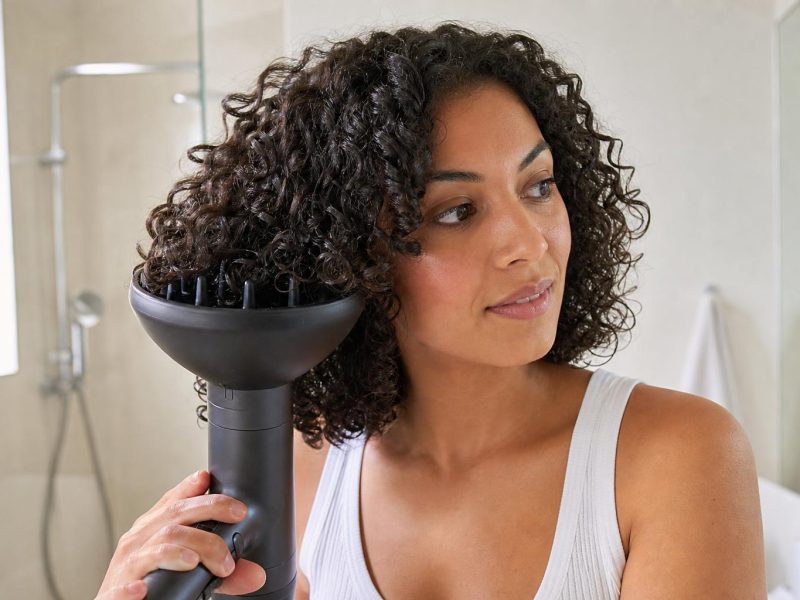
The most common mistake is choosing a diffuser by curl pattern when the relevant variables are length and density. A deep bowl holds more hair, which speeds up drying on long or thick hair and swallows short hair entirely. Long prongs reach the scalp to lift roots; short prongs sit gently against the surface and disturb less.
| Your Hair | Bowl | Prongs | Why |
|---|---|---|---|
| Long and thick | Large and deep | Long | Holds bigger sections, cutting total drying time substantially |
| Long and fine | Medium depth | Medium | Enough capacity without airflow strong enough to separate clumps |
| Short or fine | Shallow and compact | Short | More control; a deep bowl loses short hair and blows it around |
| Very dense coils | Large and deep | Long and widely spaced | Prongs need room to reach through density to the scalp |
| Wavy, needs root lift | Medium | Long | Prong length does the lifting; waves flatten at the root first |
Curl pattern still influences one thing: prong spacing. Tighter coils need prongs set further apart so they can pass through the density rather than dragging on it, while looser waves do better with closely spaced prongs that support the clump. If you are choosing between two otherwise similar diffusers, spacing is the tiebreaker. Cuts shaped for a specific pattern, such as those built for 3b curls, tend to come with the same advice about working through density rather than dragging on it.
Airflow Hole Size Is the Detail Nobody Checks
The entire point of a diffuser is to take a concentrated jet of air and spread it into something gentle enough not to disturb a curl while it dries. That job is done by the holes in the bowl, and their size and distribution vary considerably between products that otherwise look identical.
Small holes distributed evenly across the whole bowl produce soft, dispersed airflow. Large holes, or holes concentrated in one area, let a stronger stream through and reintroduce exactly the turbulence you were trying to eliminate. Turn a diffuser over in the shop and look at the inside surface: many holes of modest size is what you want, and a handful of big openings is a warning sign no marketing copy will mention.
This matters because frizz during diffusing comes from airflow rather than heat. Air moving across a curl while the cuticle is still setting pushes strands out of their clumps, and no amount of product compensates afterward. The physical relationship between moving air, a drying cuticle and why frizz forms in the first place is what makes hole size a functional specification rather than a detail.
The Four Types and Who Each Suits
Nearly every diffuser on the market falls into one of four designs. They are not ranked; each solves a different problem, and the right one depends on your hair, your dryer and whether you travel.
| Type | Design | Best For | Drawback |
|---|---|---|---|
| Bowl and prong | Rigid plastic bowl with finger-like prongs | Most people; the default choice | Bulky to store and to travel with |
| Collapsible silicone | Soft bowl that folds flat | Travel and small bathrooms | Less structure; can deform under heat over time |
| Hand or sock style | A fabric or mesh sleeve over the barrel | Very fine or fragile hair needing minimal airflow | Slow; poor root access on dense hair |
| Brand-integrated | Made for one dryer model, often magnetic | Anyone whose dryer has a matching attachment | Tied to that dryer; useless if you replace it |
For most people with curly hair the bowl-and-prong design in the right size is the correct answer, and the other three exist for specific constraints. A collapsible silicone version is worth owning as a second diffuser rather than a first, since it solves travel rather than daily use.
What Matters and What Is Marketing
Diffuser packaging leans heavily on the same vocabulary as dryer packaging, and most of it describes the dryer rather than the attachment. A diffuser is a passive plastic shell; it does not generate ions, emit infrared, or condition anything. Those claims belong to the dryer behind it, and even there the effect is smaller than the labelling suggests, which is covered in more depth in the breakdown of what ionic, ceramic and tourmaline actually mean.
Worth paying for: a genuine fit for your dryer, appropriate bowl depth for your length, prong length matched to whether you need root lift, many small evenly spaced holes, and heat-resistant material that will not warp. Not worth paying for: ion claims on the attachment itself, decorative finishes, and any suggestion that a particular diffuser defines curls better than another of the same geometry. Two diffusers with the same bowl, prongs and hole pattern perform the same regardless of price.
Stylist tip: check that the diffuser is rated for the heat your dryer produces, particularly with a high-wattage professional dryer and a cheap universal attachment. Thin plastic softens and warps at the collar, which turns a snug fit into a loose one within a few months and occasionally melts onto the barrel. A slightly heavier, more rigid attachment lasts years rather than a season.
Matching the Diffuser to Your Dryer’s Power
A powerful dryer paired with a small, shallow diffuser forces a high volume of air through a limited number of holes, which produces exactly the concentrated stream you were trying to avoid. If your dryer runs at high wattage, choose a larger bowl with more hole area so the air has somewhere to disperse, and use the lowest speed setting available.
The reverse also matters. A weak travel dryer behind a deep bowl and long prongs may not move enough air to dry dense hair in reasonable time, which leads to holding the diffuser in one place for too long and overheating a single section. Match the scale of the attachment to the output of the dryer rather than buying the largest available.
Once the hardware is right, technique carries the rest, and the settings matter more than most people assume: low speed, medium heat, and hands off the hair once it is 80 percent dry. The full sequence is covered in the guide to using a diffuser without causing frizz, which is worth reading alongside any new purchase.
When a Diffuser Is Not Worth Buying
A diffuser is genuinely useful for most curly and wavy hair, and there are cases where it adds nothing.
- You air-dry and are happy with the result. A diffuser speeds drying and adds root volume; if neither is a problem you are trying to solve, it will sit in a cupboard.
- Your hair is very short. Below about three inches there is not enough length for prongs to engage with, and a low speed setting on the bare dryer does the same job.
- Your dryer has only one speed and it is high. Diffusing on high airflow undoes the purpose, and no attachment fully compensates for a dryer with no gentle setting.
- Your dryer’s barrel does not match anything available. A rattling diffuser is worse than none at all, since the leaking air is both unfiltered and unpredictable.
- Your hair is chemically damaged and currently fragile. Reducing heat exposure altogether serves better than a gentler way of applying it, at least until condition improves, and a heat protectant used properly matters more than the attachment in that situation.
FAQ
What Should I Look for in a Diffuser for Curly Hair?
Fit first: measure your dryer’s barrel and confirm the diffuser matches, because a loose attachment leaks unfiltered air into your curls. After that, match bowl depth to your hair length and density, choose long prongs if you want root lift, and check the inside for many small evenly spaced holes rather than a few large ones. Ion and infrared claims on an attachment are marketing, since a diffuser is a passive shell.
Are Universal Diffusers Any Good?
They work well when the fit is genuinely snug and poorly when it is approximate, which is the main variable. A brand-specific attachment made for your dryer model will always seal better and stay put longer. If you buy universal, check the stated nozzle range against your measurement, and use a turn of silicone tape on the barrel if it sits even slightly loose.
Do I Need Long or Short Prongs?
Long prongs reach the scalp and lift roots, which suits anyone whose hair flattens at the crown, particularly wavy textures. Short prongs sit against the surface and disturb the curl less, which suits fine or short hair. Prong spacing matters separately: widely spaced prongs pass through dense coils more easily, while closer spacing supports looser wave clumps.
Does an Expensive Diffuser Work Better?
Not by virtue of price. Two diffusers with the same bowl depth, prong length and hole pattern perform the same, so what you get at higher prices is usually better material quality and a more precise fit rather than better drying. Heat-resistant, rigid material is worth paying for, since thin plastic warps at the collar and loosens over a few months.
Can I Use a Diffuser on Wavy Rather Than Curly Hair?
Waves benefit as much as curls, and often more, because type 2 hair tends to flatten at the root where a diffuser with long prongs adds lift. Use a medium-depth bowl and the lowest speed setting, and stop touching the hair once it is mostly dry. Wavy clumps separate more easily than curls, so airflow control matters even more.
Why Does My Hair Frizz When I Diffuse?
Almost always airflow rather than heat. Air moving across the hair while the cuticle is still setting pushes strands out of their clumps, so high speed settings, large airflow holes and a loose-fitting attachment all produce frizz. Drop to the lowest speed, check the diffuser is seated tightly, and stop handling the hair once it reaches roughly 80 percent dry.
Should I Buy a Collapsible Silicone Diffuser?
As a travel option, yes; as your only diffuser, usually not. Collapsible designs fold flat and adapt to unfamiliar hotel dryers, which is genuinely useful, but the soft bowl gives less structure and can deform with repeated heat exposure. Most people are better served by a rigid bowl-and-prong diffuser at home and a collapsible one in the suitcase.
Choosing the best diffuser for curly hair starts with a tape measure rather than a product list: get the fit right, then match bowl depth to your length, prong length to whether you need root lift, and prong spacing to your curl pattern. Look inside the bowl for many small holes before you look at the price, and ignore any ion or infrared claim printed on a piece of plastic that does nothing but redirect air.
Hair results vary based on your natural hair type, texture, density, and condition. Always consult with a licensed hairstylist before making significant changes, especially with chemical treatments or dramatic length changes. Photos may show styled results that require professional tools and products to replicate.



1 response