
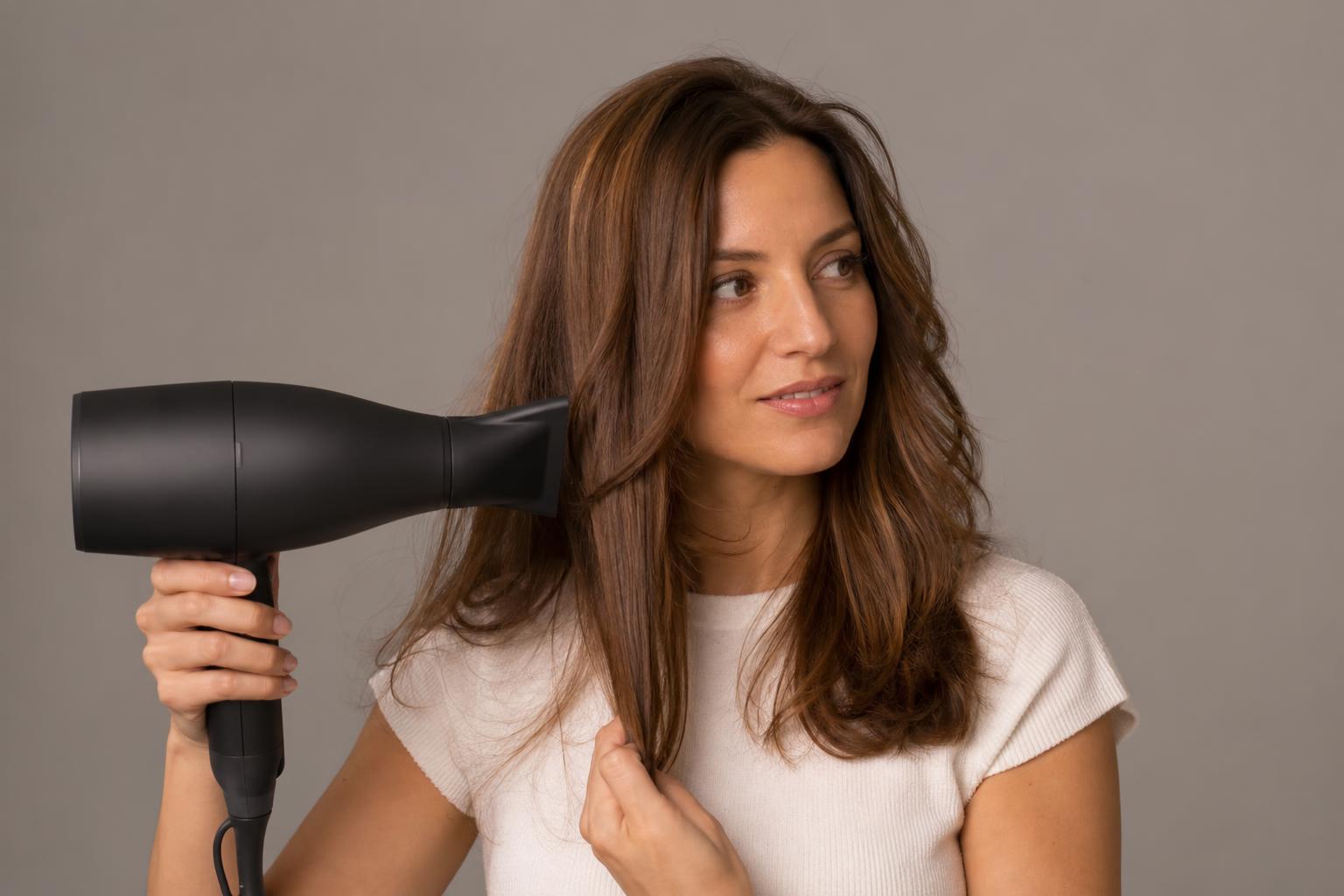
A blow dryer does two separate jobs, and only one of them is drying your hair.
Moving air removes water from hair. Heat only makes that air able to hold more moisture, so it speeds the process up rather than doing it. That single distinction decides which dryer you should buy: a model that moves a lot of air at moderate heat dries faster and leaves hair in better condition than one that moves little air very hot, even when both draw the same 1875 watts from the wall.
This guide explains what airflow actually is and why wattage does not measure it, how AC, DC and brushless motors differ in practice, which specs are worth checking before you pay, how long a full dry realistically takes at your hair density, what each attachment changes, and when a new dryer is not the thing standing between you and a better result.
Airflow Dries Hair and Heat Only Speeds It Up
Drying is evaporation. Water leaves the hair surface when moving air carries it away, and the faster the air moves, the more water it carries per second. Heating that air raises how much moisture it can absorb before it saturates, which is why hot air feels dramatically more effective than cold. But the air volume is doing the work, and a strong stream of warm air beats a weak stream of scorching air on every measure that matters, including how long you stand there.
Airflow is measured in cubic feet per minute, and professional-grade dryers typically move somewhere in the range of 50 to 75 CFM. Most consumer boxes never print the number, which is exactly why people fall back on wattage. When a brand does publish airflow, treat it as the single most useful figure on the page, because it predicts drying time more reliably than anything else listed.
Stylist tip: Turn the heat down one setting and the speed up one setting on the dryer you already own. Most people run the reverse combination, and the swap usually cuts total drying time while lowering the temperature the hair ever sees.
Wattage Is Power Draw, Not Drying Power
Wattage is the biggest number on the box and the least informative. It describes total electricity consumed, split between the heating element and the motor, and nothing on the label tells you how that split falls. A 1875-watt dryer that spends most of its budget on the heating coil will run hot and blow gently. Another 1875-watt dryer with an efficient motor and a modest coil will blow hard and run warm, and it will finish the job first.
The motor is what determines that split, and there are three kinds in circulation. The differences show up in weight, noise, lifespan and how much air actually comes out of the nozzle.
| Motor Type | Typical Speed | Strengths | Trade-Offs |
|---|---|---|---|
| AC | Roughly 20,000 to 25,000 rpm | Strong sustained airflow, long service life, the salon standard for decades | Heavy in the hand and loud; wrist fatigue on long hair is real |
| DC | Similar to AC, with finer speed control | Lighter, quieter, cheaper; fine for most home use | Brushes wear out, so lifespan is shorter under daily use |
| Brushless digital | Roughly 90,000 to 110,000 rpm | High airflow from a small, light body; quiet; very long life | The most expensive tier by a wide margin |
A brushless dryer is the genuine upgrade if you dry thick hair often, because the airflow arrives without the weight and the noise. If your hair dries in ten minutes anyway, the same money buys nothing you will notice, and a well-built DC model does the job. The marketing terms stacked around the motor claim, meanwhile, deserve the same scrutiny you would give any tool, and our breakdown of what the ionic, ceramic and tourmaline labels really mean sorts which of them change the result.
The Specs Worth Checking Before You Buy
Six things predict how a dryer performs and how long you will tolerate holding it. Everything else on the box is secondary, and several of the loudest claims fall into the last two rows below.
| Spec | What to Look For | Why It Matters |
|---|---|---|
| Airflow | A published CFM figure at all, ideally 50 or above | The number that actually sets drying time; brands that publish it usually have something to show |
| Separate heat and speed controls | Three heat settings and two speeds as a minimum | Combined dials force you to take more heat to get more air, which is the wrong trade |
| Cool shot | A button you can hold with your thumb mid-stroke | Cool air sets the shape you just created; without it a blow-dry drops within the hour |
| Weight and balance | Under about 1.2 pounds if you dry long hair daily | Arm fatigue is why most home blow-dries get abandoned at 80 percent dry |
| Removable filter | A rear cap that twists off without tools | A clogged filter is the most common cause of a dryer that has quietly lost its power |
| Cord length and type | Eight feet or more, with a hanging loop | Short cords pull the dryer toward the outlet and force awkward angles at the back of the head |
| Wattage above 1875 | Treat with suspicion | Standard household circuits cap near there, so bigger claims usually measure peak draw, not steady output |
| Infrared or far-infrared | Ignore | Every hot element emits infrared; the phrase adds price without adding airflow |
Match Airflow and Weight to Your Hair Density
Density decides how much water there is to remove, so it is the variable that should drive the purchase. Length matters less than people expect, because a long, fine head of hair holds less water than a short, very dense one. Use the table as a planning tool: if your real drying time is far above the range for your density, either the dryer is underpowered, the filter is blocked, or you are skipping the towel and rough-dry stages.
| Hair Density and Length | Airflow Priority | Realistic Full Dry | What to Prioritize |
|---|---|---|---|
| Fine, short to mid | Low | 5 to 10 minutes | A low heat setting and a genuine cool shot; power is not your bottleneck |
| Fine to medium, long | Medium | 12 to 20 minutes | Light weight and a long cord, since you are holding it above shoulder height throughout |
| Thick, mid to long | High | 20 to 35 minutes | Maximum published airflow and a narrow concentrator; this is where a brushless motor earns its price |
| Curly or coily, any length | High, delivered gently | 25 to 45 minutes diffused | A deep bowl diffuser and enough airflow to work through it without cranking heat |
Every one of those times assumes you squeezed the hair out in a microfiber towel or cotton T-shirt first and let it sit for a few minutes. Skipping that step adds roughly a third to the total, and it is free.
Attachments Change the Result More Than the Dryer Does
A concentrator narrows the stream so the air arrives in a flat, directed band instead of scattering. That is what lets you smooth a section against a brush without blasting the surrounding hair into frizz, and it is the difference between a home dry that looks styled and one that looks merely dry. If your dryer came with a concentrator sitting unused in a drawer, that single change will do more than a new machine.
A diffuser does the opposite, spreading the air over a wide bowl so curls dry in the shape they formed rather than being blown apart. Curl pattern determines which bowl depth and prong length suit you, and the practical technique of cupping, holding and moving is covered in our guide to diffusing without disturbing the curl, with attachment-by-curl-type recommendations in the diffuser comparison for curly hair. A pik attachment, the wide-toothed comb head, is the third option and belongs to stretching type 4 hair rather than smoothing it.
Stylist tip: Keep the concentrator nozzle pointed down the hair shaft, from root toward ends, at all times. Air blown up the shaft lifts every cuticle scale it passes, and that is what produces the fuzzy halo people blame on humidity.
Blow-Drying Is Not Automatically Worse Than Air-Drying
The received wisdom that air-drying is the gentle option is only half right. A study in the Annals of Dermatology compared natural drying against dryer use at several temperatures and distances, and found that a dryer held about 15 centimeters away and kept moving caused less overall damage than letting hair dry on its own. Surface damage rose steadily with temperature, with the worst results at the highest setting tested, but prolonged soaking damaged the cell membrane complex that holds the inner structure together.
The practical reading is not that heat is harmless. It is that sitting wet for an hour has its own cost, and that the safe zone is a moderate temperature, six inches of distance, and constant movement rather than a stationary blast. Where possible, rough dry to about 80 percent with the dryer at arm’s length before any styling begins, then bring it closer only for the finishing work. If flat ironing or curling follows, a heat protectant applied before drying covers both passes rather than just the second.
Blow Dryer Myths That Cost Money
Myth: Higher Wattage Means Faster Drying
Reality: wattage is the electricity going in, not the air coming out. Two dryers at the same wattage can differ by half in airflow depending on how the power is divided between the motor and the heating element. Compare published airflow if you can find it, and compare weight and motor type when you cannot.
Myth: A Salon Dryer Will Give You a Salon Blowout
Reality: the tool is maybe a quarter of the result. Sectioning, brush size, tension and finishing with cool air account for far more, which is why stylists get better results from a borrowed drugstore dryer than most people get from a professional one. The technique that closes that gap is laid out in our walkthrough of getting a salon blowout at home with a round brush.
Myth: Cold Air Does Nothing Useful
Reality: cool air is what makes the shape last. Hot air makes hair pliable, and the shape locks in as it cools, so a two-second cool blast while the section is still wrapped around the brush is what holds the bend. Skip it and the same blow-dry falls flat by lunchtime, no matter how expensive the dryer was.
When a New Dryer Will Not Fix the Problem
Several complaints that send people shopping have nothing to do with the machine. Check this list before you replace a dryer that may be working fine.
- Your dryer has gotten weaker over a year or two. This is almost always a clogged rear filter, not a dying motor. Twist the cap off and clear the lint mat behind it, and full power usually returns in two minutes.
- Hair frizzes no matter what you do. Nozzle direction and section size cause more frizz than air temperature. Fit the concentrator, point it downward, and work in sections you can see through.
- The blow-dry drops within two hours. That is a cool-shot and cooling-time problem. Let each section cool fully on the brush before releasing it, and do the whole head before touching any of it.
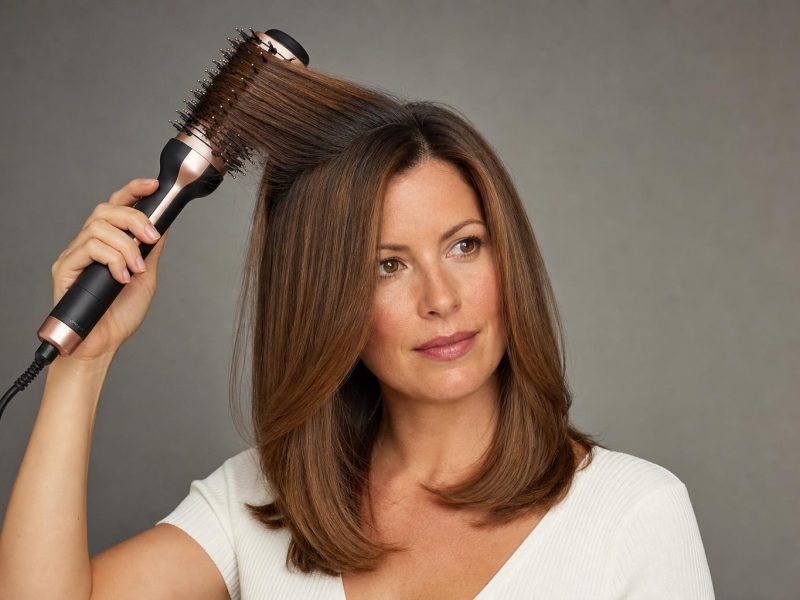
- You want smooth hair without arm work. A dryer will not deliver that in one tool. A hot-air brush that combines the dryer and the round brush is the honest answer for bendy, smooth finishes, with limits of its own.
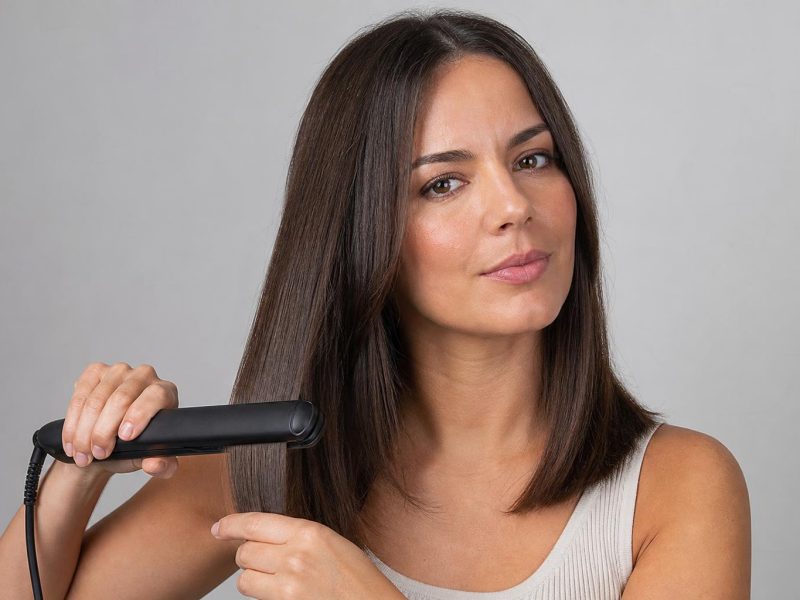
- You want poker-straight hair from the dryer alone. Wavy and curly textures need a flat iron to finish, and the choice there turns on plate width and temperature control rather than airflow, as our guide to picking a flat iron by spec sets out.
Cleaning the Filter Is the Maintenance Nobody Does
Air enters through the back of the dryer and passes through a filter that traps lint, dust and shed hair. That mat builds up invisibly, and as it thickens the motor has to pull harder for less air, which raises the internal temperature and shortens the motor’s life while making your drying time longer. It is the single most common reason a dryer feels like it has lost power.
Twist or slide the rear cap off once a month, peel the lint layer away with your fingers or an old toothbrush, and rinse the mesh if it detaches fully, drying it completely before it goes back on. Also check the cord where it enters the handle a few times a year, since that flex point is where cords fail, and a cord you have to hold at an angle to keep the dryer running is a fire risk, not a quirk. Beyond that there is little to service, and the same monthly habit is worth applying across the rest of the tools in the hair tools and products library.
FAQ
How Many Watts Should a Good Blow Dryer Have?
Anywhere from 1600 to 1875 watts covers essentially every home need, and going higher on the label buys nothing real. Standard household circuits limit what a dryer can continuously draw, so claims well above that range are usually measuring a momentary peak. Spend the attention on motor type and published airflow instead, since two dryers at identical wattage can differ enormously in how much air they move.
Is It Bad to Blow-Dry Your Hair Every Day?
Daily drying is manageable if the temperature is moderate, the dryer keeps moving, and you stay about six inches away. Damage accumulates from high heat held in one spot, not from frequency alone, and hair that sits wet for hours has its own structural cost. If you dry daily, use the lowest heat that finishes the job in a reasonable time and finish every section with cool air.
What Does the Cool Shot Button Actually Do?
It cuts the heating element and blows room-temperature air, which sets the shape while the hair cools. Hydrogen bonds in the hair reform as the strand drops back to room temperature, so whatever position the hair holds at that moment becomes the shape it keeps. Two to three seconds per section while it is still wrapped on the brush is enough, and it is the cheapest way to make a home blow-dry last longer.
Should I Buy an Ionic Blow Dryer?
Ionic output helps if your hair is frizz-prone or static-prone, and does very little if it is coarse and already dry-feeling. Negative ions break up water droplets and help the cuticle lie flat, which reads as less flyaway and more shine. It is a finishing benefit rather than a drying-speed benefit, so never trade away airflow to get it.
How Far Should I Hold a Hair Dryer From My Head?
About six inches, roughly 15 centimeters, and always moving. That distance came out of controlled testing as the point where drying is efficient without concentrating heat on one patch of cuticle. Closer than that and you are essentially pressing hot air into a fixed spot, which is where scalp discomfort and surface damage begin.
Why Does My Hair Look Frizzy After Blow-Drying?
The nozzle is almost certainly pointing the wrong way. Air blown from the ends toward the roots lifts every cuticle scale in its path, and the raised scales scatter light and catch on each other. Fit the concentrator, aim it down the length of the section, and keep the section thin enough that the air reaches the middle rather than only the surface.
Do Expensive Blow Dryers Last Longer?
Usually, and the reason is the motor rather than the shell. Brushless digital motors have no wearing brush contacts, so they outlast both AC and DC designs under heavy use, and AC motors outlast DC ones. A well-maintained mid-range dryer with a clean filter can still run for years, so the durability gap narrows a lot for anyone who dries two or three times a week rather than daily.
The right blow dryer is the one whose airflow matches your hair’s density and whose weight you can hold for the length of a full dry. Look for published airflow, separate heat and speed controls, a real cool shot and a filter you can open, then judge the wattage number last. Clean that filter monthly, keep the nozzle pointing down the hair shaft, and most people find the dryer they already own performs like a better one.
Hair results vary based on your natural hair type, texture, density, and condition. Always consult with a licensed hairstylist before making significant changes, especially with chemical treatments or dramatic length changes. Photos may show styled results that require professional tools and products to replicate.