
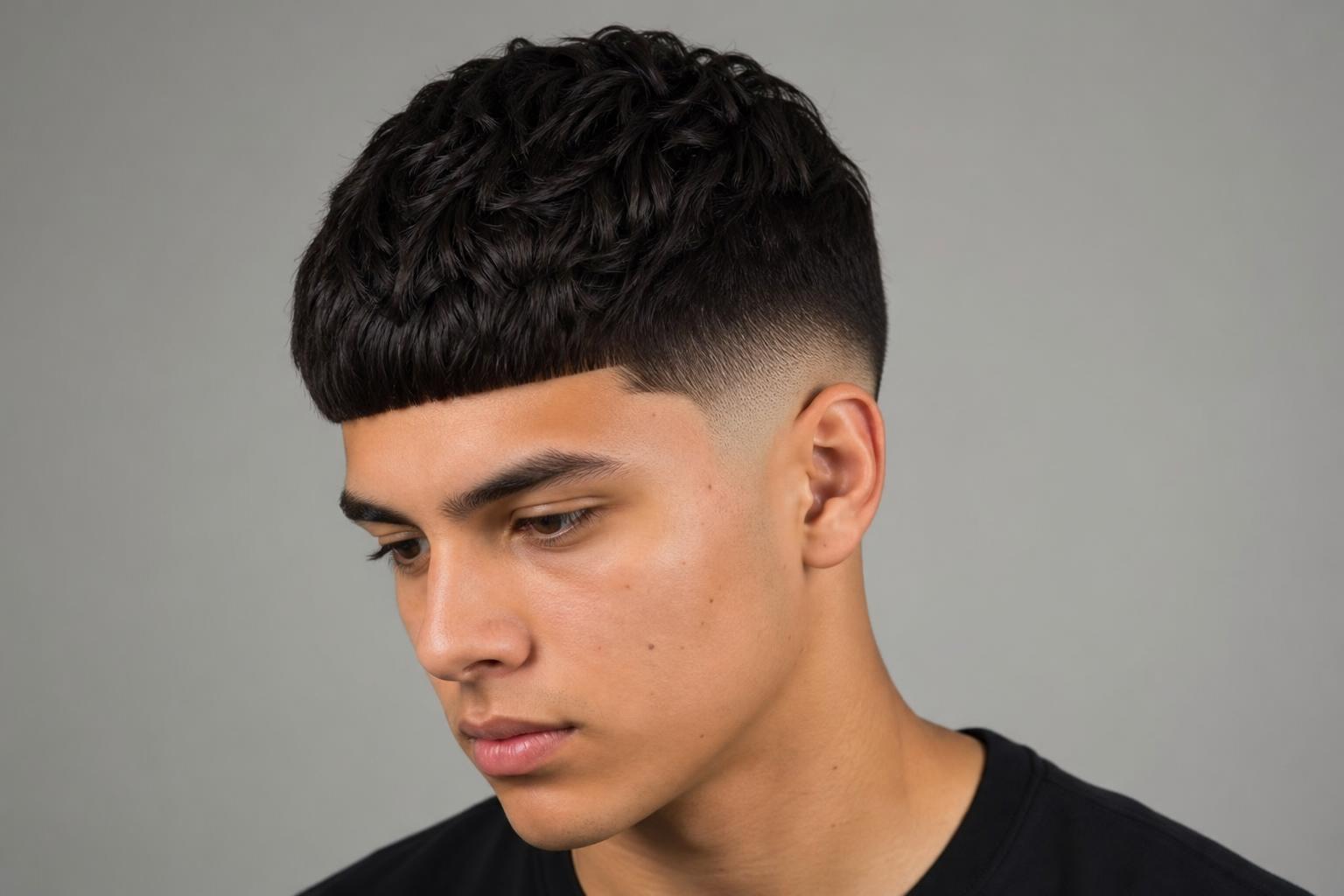
The Edgar cut has one defining feature that makes it immediately recognizable: a horizontal, blunt fringe cut straight across the forehead — not swept to the side, not tapered into layers, just a clean line that hits somewhere between mid-forehead and the brow.
Everything else about the cut — how high the fade goes, how much volume sits on top, whether the texture is crisp or fluffy — is a variation on that one signature element. That blunt fringe is why the Edgar looks sharper and more intentional than a standard crop, and it’s why getting the fringe line right in the barber’s chair is the most important 30 seconds of the appointment. These 30 Edgar cut styles cover the full range: from the classic low-taper version to the voluminous fluffy Edgar, the curly-textured take, the low taper edgar, and the hybrid combinations that have turned it into one of the most-searched men’s haircuts on the internet.
The gallery is organized by what’s happening structurally — classic and clean fades first, then textured and fluffy versions, curly adaptations, longer and hybrid combinations, and finally styling variations for different hair types. Each entry covers the technique, who it suits, and what to tell your barber.
| Factor | Details |
|---|---|
| Defining feature | Horizontal blunt fringe cut straight across the forehead — not swept, not layered |
| Best for | Oval, oblong, diamond, and square face shapes; works on most hair types |
| Maintenance | Trim every 2–4 weeks; fringe grows out noticeably fast and softens the line |
| Works with | Straight, wavy, curly (2a–4c); thick hair gets the most impact |
| Avoid if | Very round or wide forehead where a straight horizontal fringe adds width |
| Salon time | 30–45 minutes standard; 45–60 minutes for fluffy/curly textured versions |
Classic Edgar Cuts: The Foundational Styles
The classic Edgar is built on two decisions: how high the fade goes on the sides, and where the fringe line lands on the forehead. Mid-forehead fringes give a more dramatic, bold look; fringes closer to the brow read softer and more wearable in professional settings. Every variation below shares the blunt horizontal fringe — what changes is the fade level, the fringe length, and the treatment of the top.
1. Classic Edgar with High Skin Fade
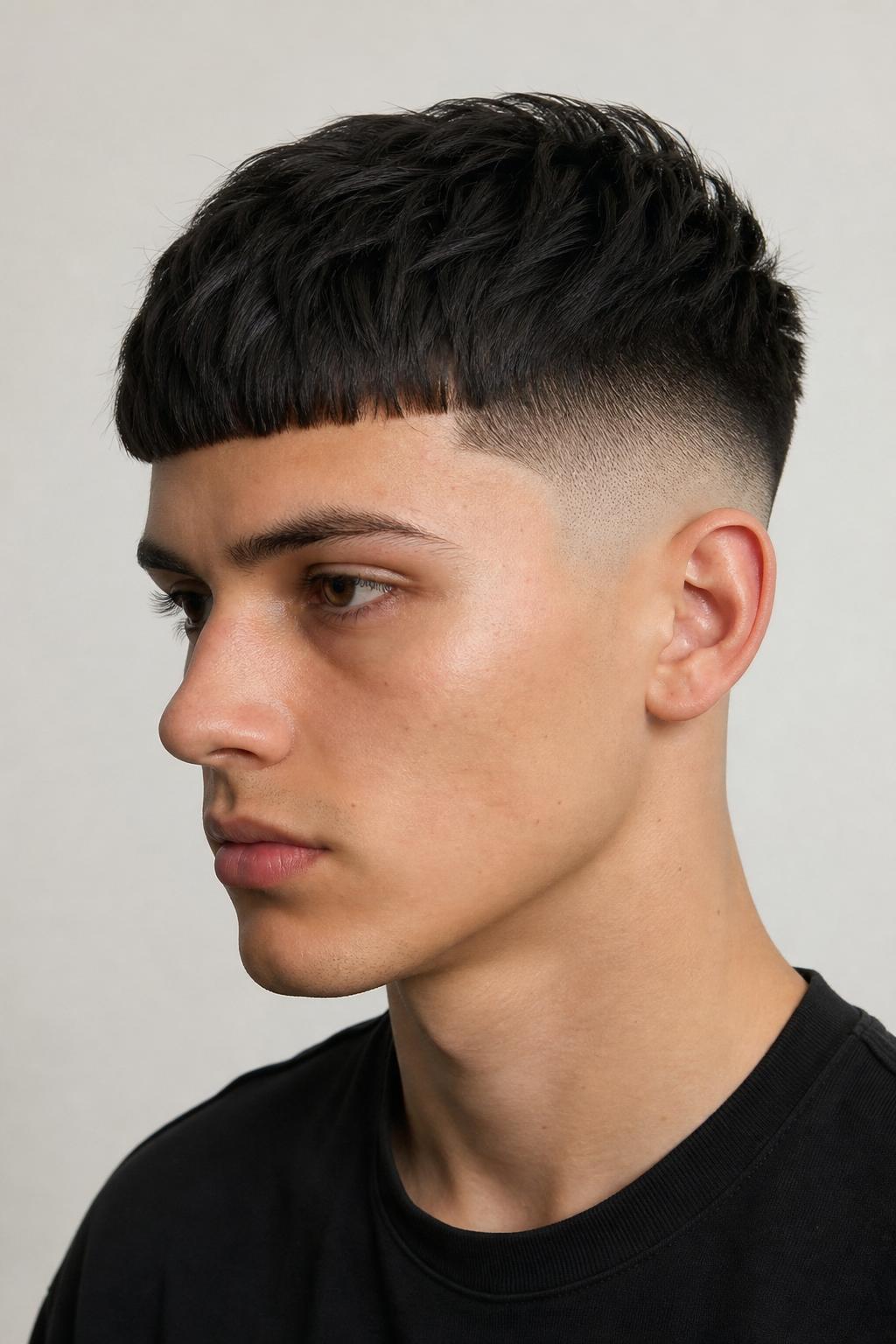
The most-referenced Edgar: a high skin fade starting at or above the temples, sides taken all the way to skin at the lowest point, and a blunt fringe cut straight across the mid-forehead. The contrast between the bare skin at the sides and the fringe above it is deliberately aggressive — this is a statement cut, not a conservative one. It works best on thick, straight-to-slightly-wavy hair where the top has enough density to hold its shape against the skin below. Ask your barber for a “high bald fade with a blunt horizontal fringe, no tapering on the front line.”
2. Low Taper Edgar
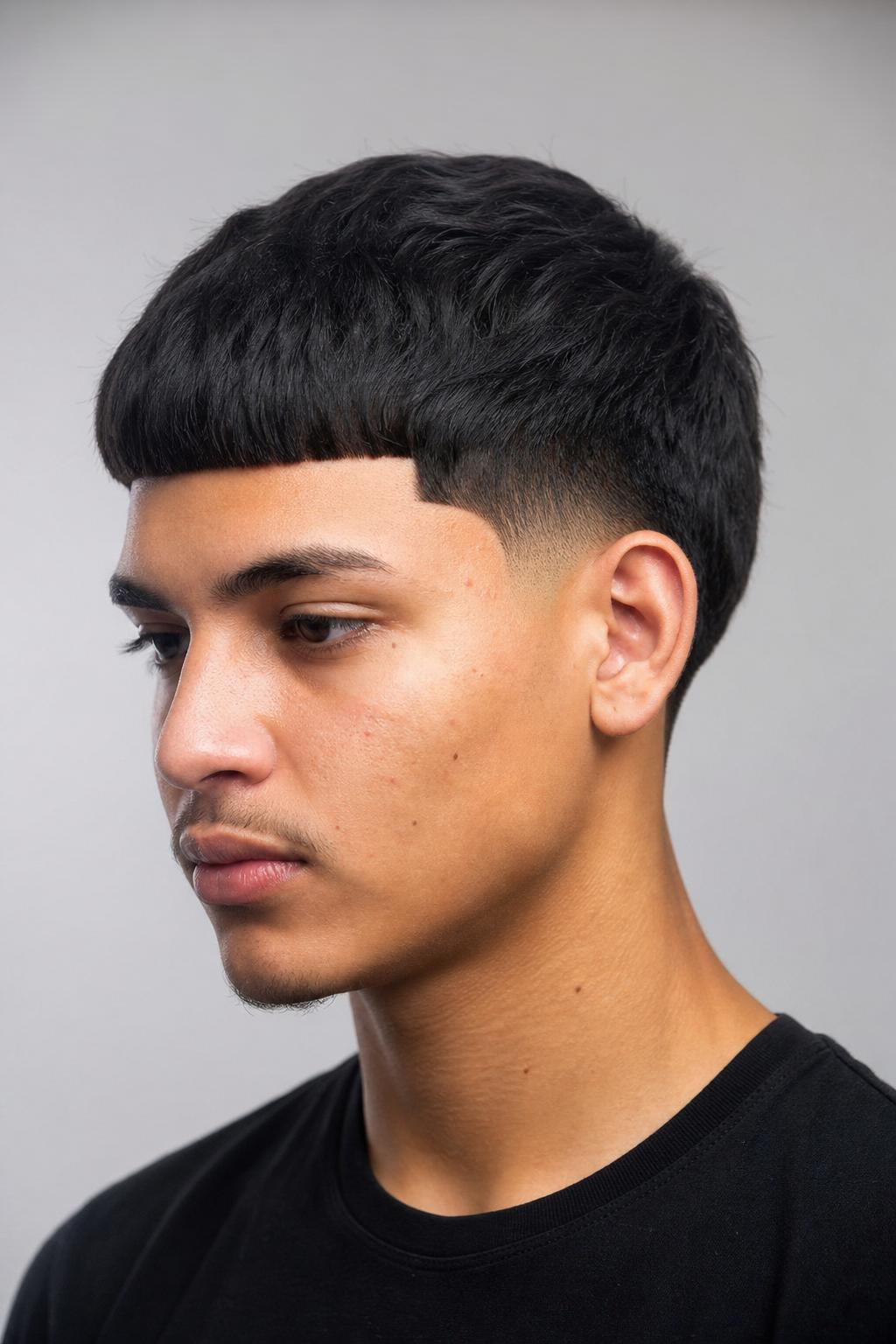
The low taper edgar brings the fade’s start point down to just above the ear — the transition from longer to shorter happens only in the lowest section of the sides, leaving more hair visible from the profile. The overall look is significantly less aggressive than the high skin version, which makes it the most wearable Edgar in office and professional environments. A low taper sits lower and blends more gradually than a mid taper, giving the fringe’s blunt line a less severe surrounding context. This is the entry-point Edgar for anyone new to the cut.
3. Mid Taper Edgar
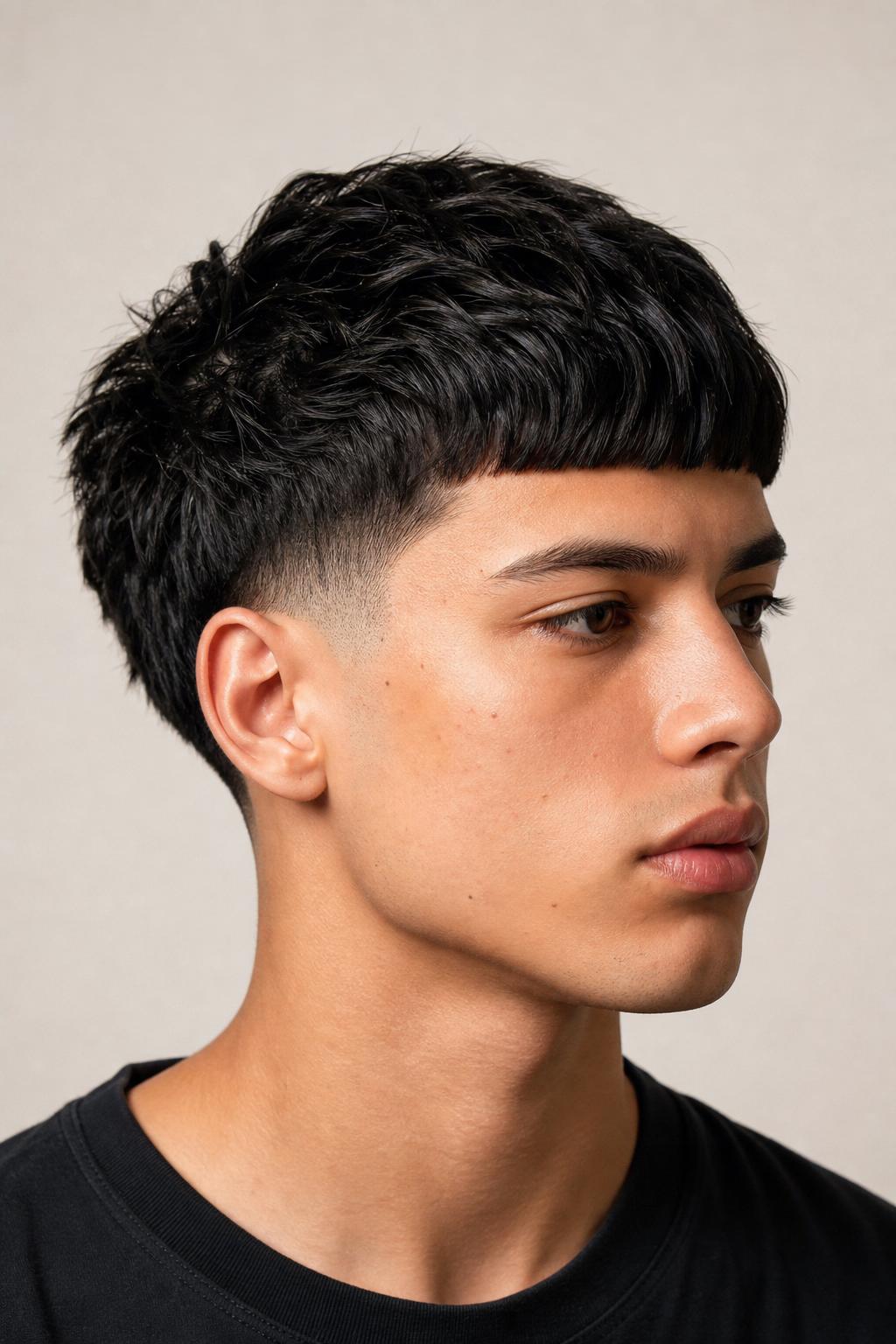
The mid taper version starts the taper at ear level, reaching the same blunt fringe on top but with a more visible fade visible from the side. It’s the middle-ground Edgar — sharper than a low taper but not as extreme as a skin fade from the temples. Mid taper fades are the most commonly requested in barbershops, and the Edgar fringe is one of the most popular top styles paired with them. On square and diamond face shapes, the mid taper level is particularly balanced — it defines the silhouette without amplifying angular features the way a high skin fade sometimes does.
4. Edgar with Hard Part
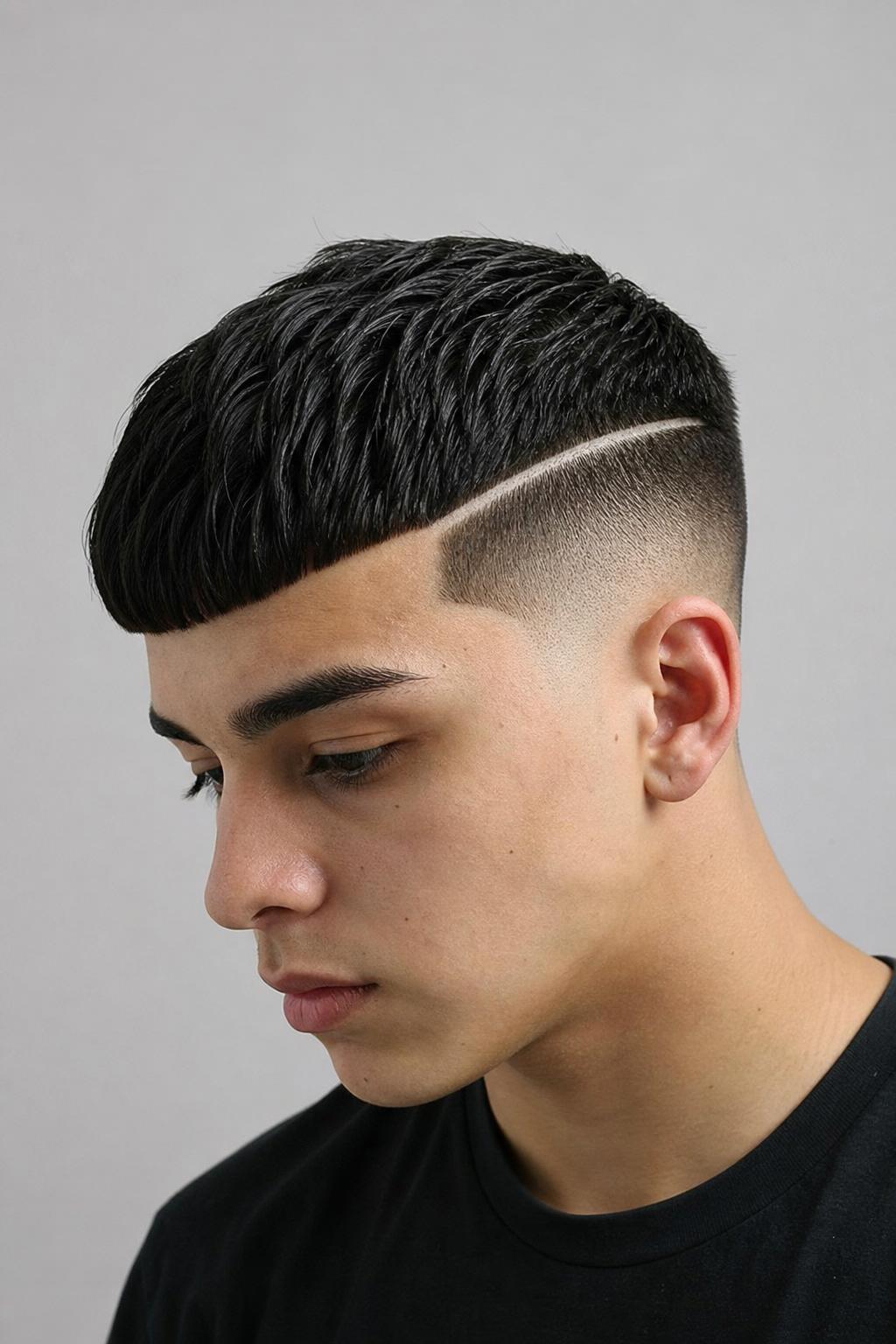
A clipper line carved through one side of the top creates a crisp separation between the front section of the Edgar and the longer hair behind it. The hard part and the blunt fringe together produce a geometric, almost architectural structure that reads as very deliberate — two precise lines meeting at a right angle. On dark, dense hair where the clipper line shows maximum contrast, this combination is particularly striking. Ask your barber to place the part at your natural growth direction rather than forcing a geometric line that fights against your hair’s pattern.
5. Edgar with Shape-Up
A shape-up (also called a line-up or edge-up) straightens and defines the natural hairline at the temples, sideburns, and forehead corners. When added to an Edgar, the shape-up turns the already-clean fringe into an even more deliberate geometric border — every edge of the hairline is precise. This combination is deeply rooted in Black and Latino barbering culture, where clean lines are a mark of craft. The shape-up requires refreshing every 7–10 days as the hairline grows; the fade can go a bit longer before needing a full touch-up.
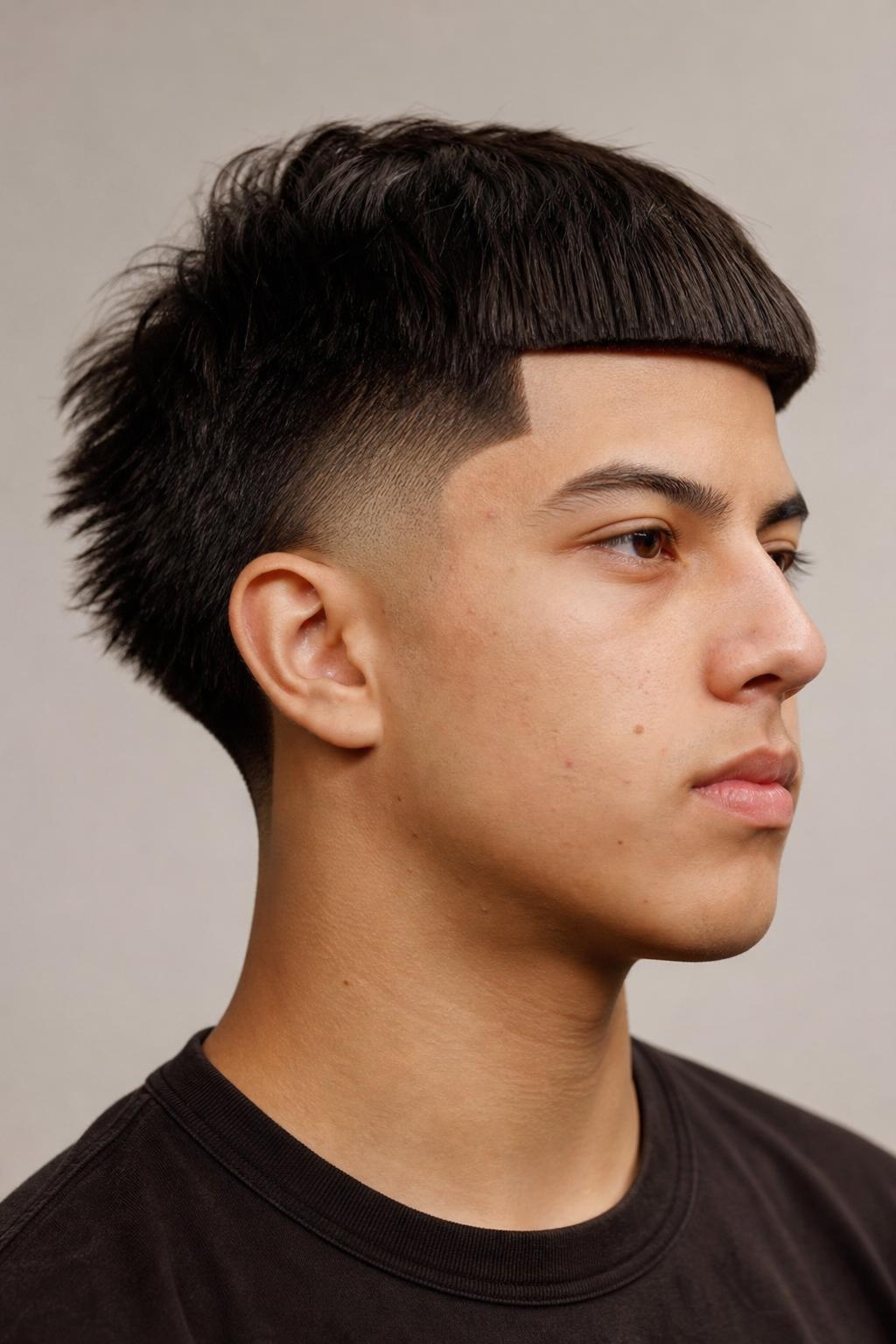
6. Mexican Edgar (Takuache Edgar)
The Mexican Edgar — sometimes called the Takuache cut — is the original form that gave the style its name and cultural identity. It typically features a mid-to-high skin fade, a blunt fringe cut straight across the mid-forehead, and a slightly longer top that can be styled forward or upward. The Takuache version often includes especially crisp temple lines and a defined neckline, reflecting the high standards of Latino barbering culture. The fringe in this variation tends to sit slightly higher on the forehead than the softer European or Korean interpretations of the Edgar.
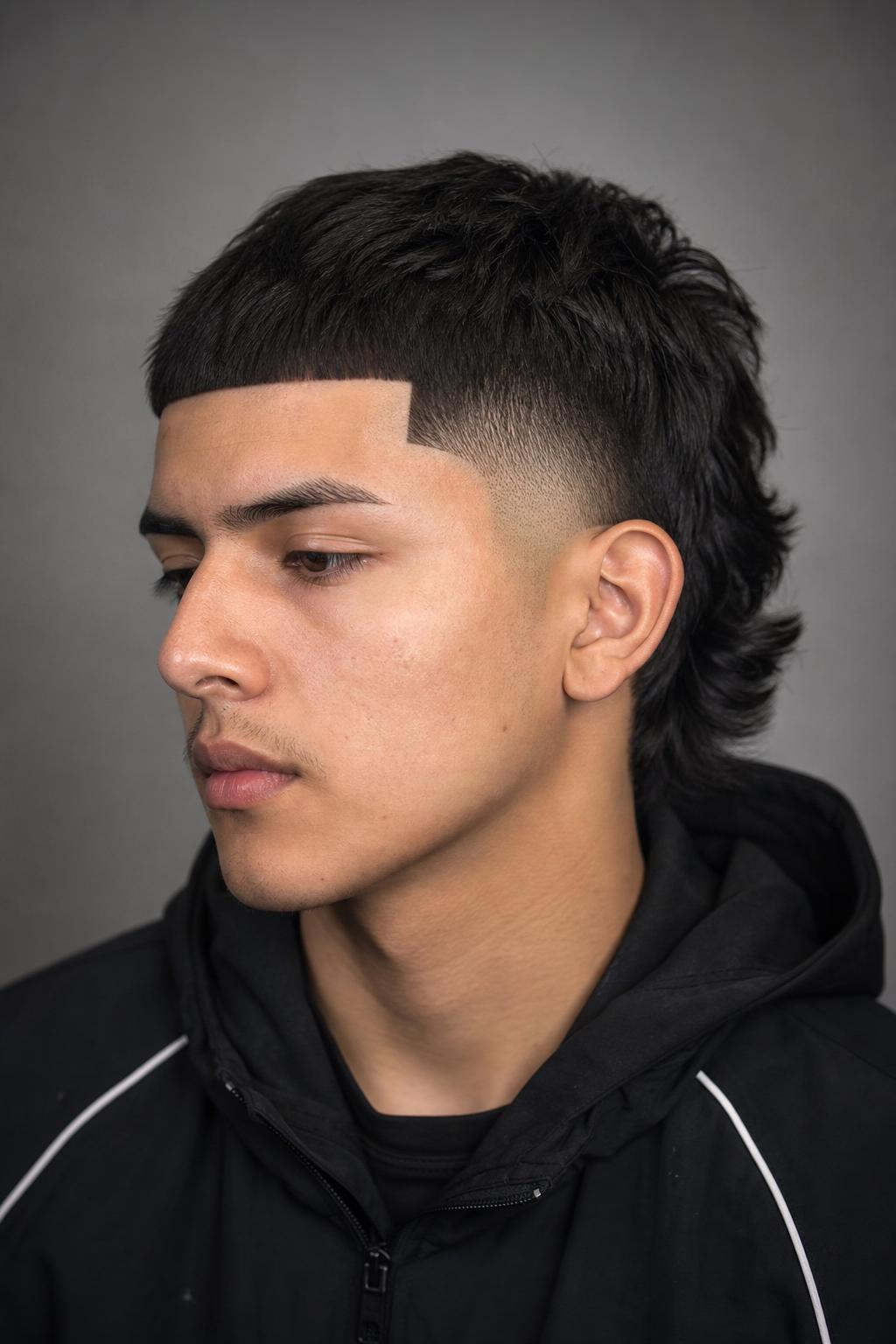
Fluffy Edgar Cuts: Volume and Texture on Top
The fluffy Edgar is the most-searched variation of the cut right now — it takes the blunt fringe and adds significant volume on top, usually achieved by blow-drying the top section upward while the hair is damp, or by using thinning shears to create internal movement without removing weight. The result looks fuller and more relaxed than the flat-topped classic Edgar, while keeping the signature horizontal fringe line at the front. Thick hair excels here; fine hair needs volumizing mousse at the roots before blow-drying to achieve a comparable result.
7. Fluffy Edgar Low Taper
Voluminous, lifted top with a low taper on the sides is the most common fluffy Edgar combination — the soft, airy texture on top contrasts with the clean taper below without the aggressive side-exposure of a skin fade. Apply a volumizing mousse on towel-dried hair, then blow-dry upward and slightly forward using a round brush or fingers. The fringe should look substantial and full — if the fringe falls flat, the defining feature of the cut disappears. This version suits oval and oblong face shapes particularly well because the volume adds proportional height without widening.
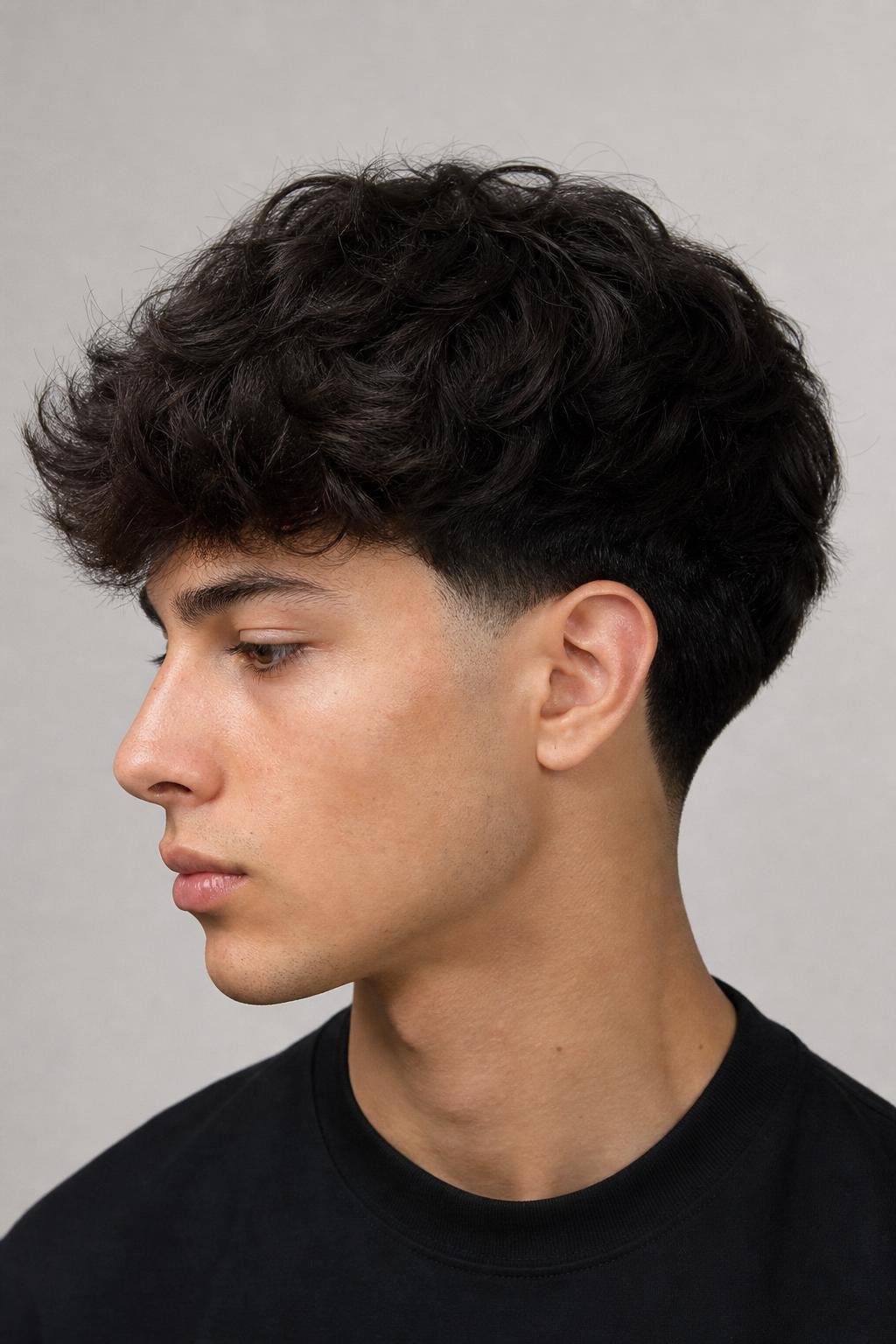
8. Fluffy Edgar with Mid Skin Fade
Moving the fade up to mid-ear level while keeping a voluminous top creates a contrast between the crisp, skin-level sides and the soft, textured top that reads as deliberately composed rather than effortless. The key to keeping the fluffy top looking intentional is to blow-dry in sections — lift the crown first, then the sides of the top, then direct the front section forward and slightly downward to shape the fringe. Without structure from the blow-dry, the top falls flat and the cut looks like an overgrown crop.
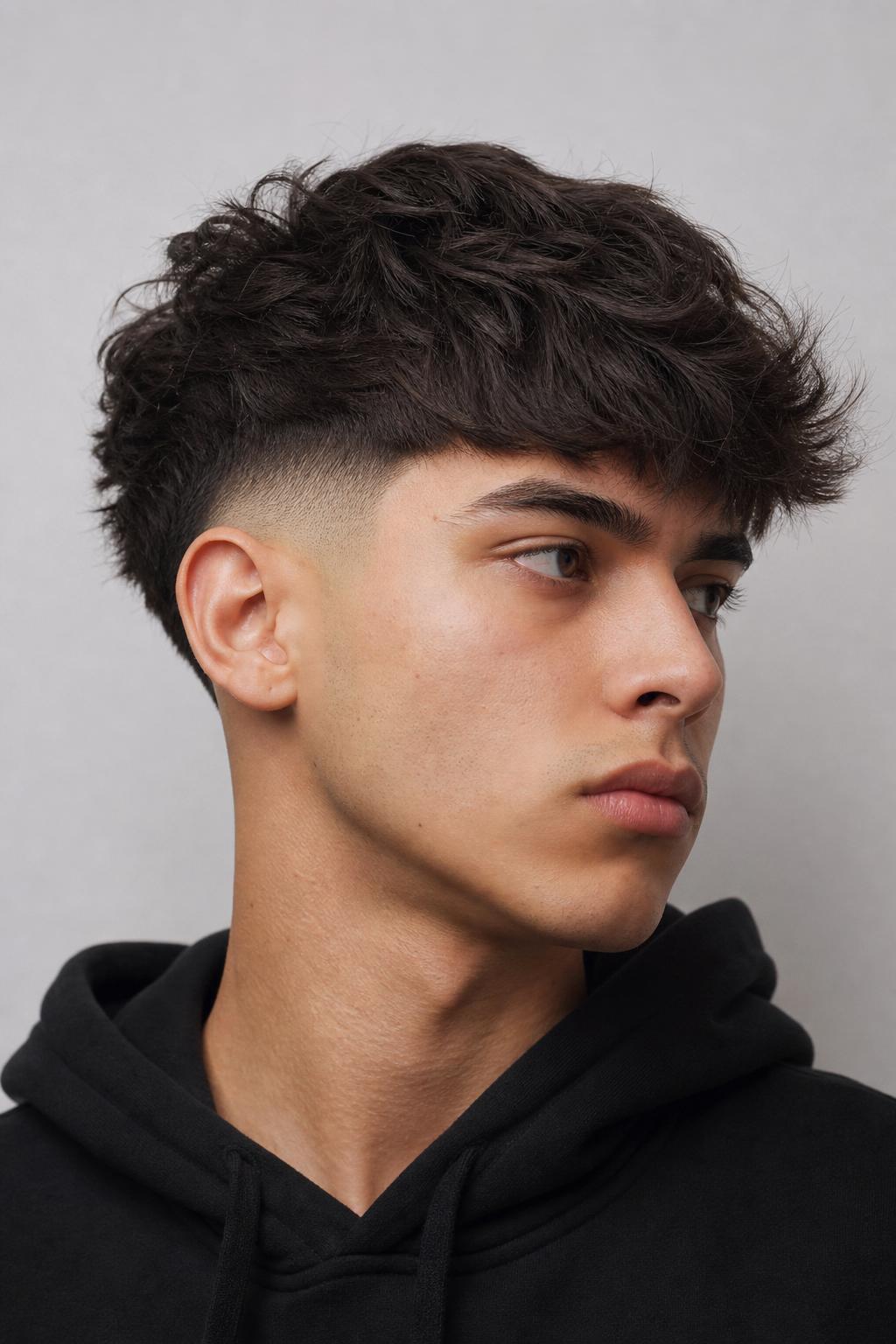
9. Fluffy Edgar with Waves
Naturally wavy or lightly permed hair gives the fluffy Edgar its best organic volume — the wave pattern creates movement that a straight-hair blow-dry has to work hard to replicate. Let wavy hair air-dry after washing, diffuse on low heat, then use a light sea-salt spray to define the texture without stiffening the fringe. The fringe on this version is naturally slightly imprecise — the wave at the front softens the hard horizontal line into something that reads more relaxed. This suits men who want an Edgar’s structure without its sharpest edge.
10. Fluffy Edgar with High Fade
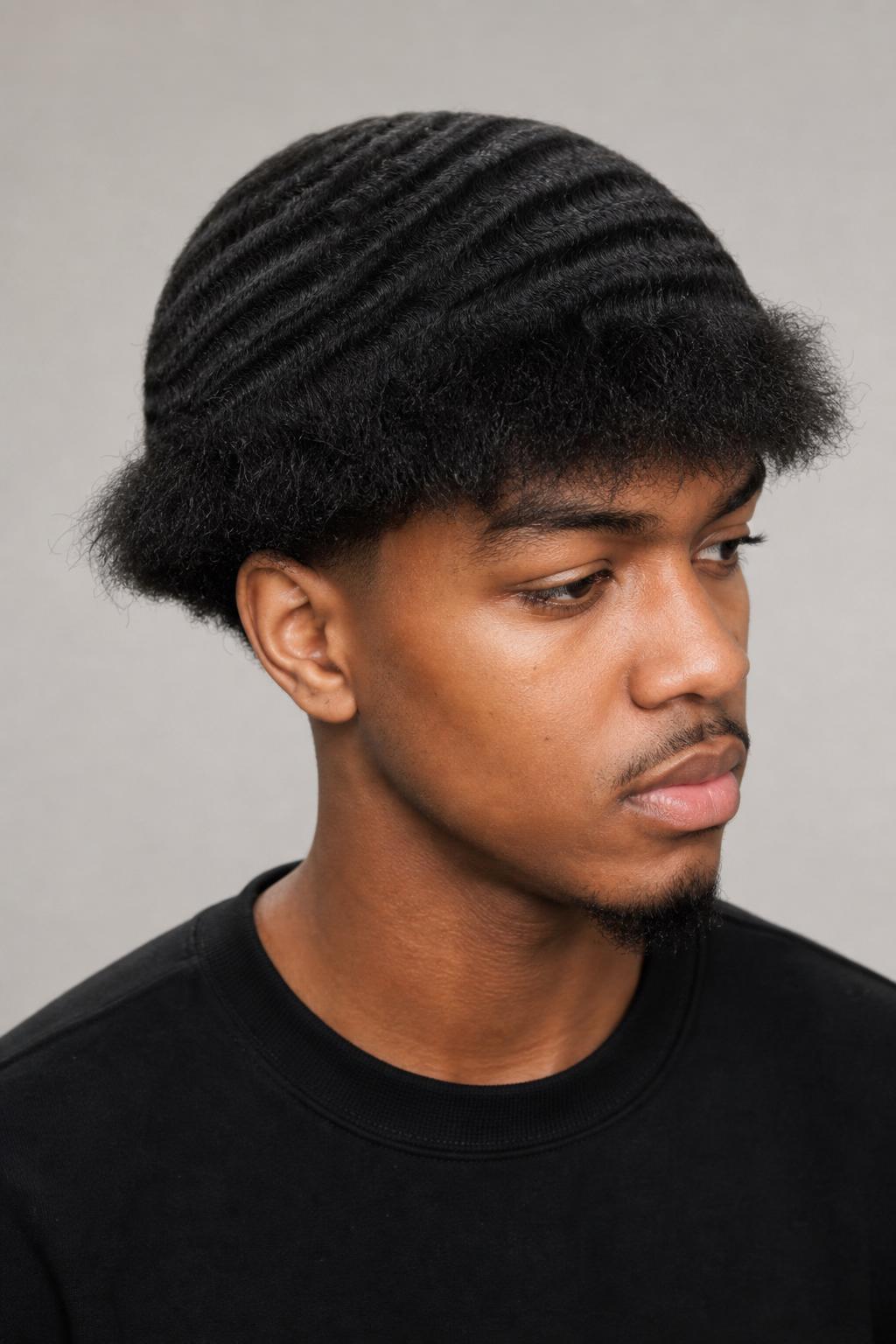
The maximum-contrast fluffy Edgar: skin or near-skin fade from the temples, voluminous lifted top. The distance between the bare skin below and the full, airy top above is significant — this reads as a style choice that required actual effort, which it does. Budget 10–15 minutes for daily styling: volumizing mousse on damp hair, blow-dry upward, shape the fringe last. Maintenance visits every 2–3 weeks are non-negotiable here — the skin fade shows grow-in within 7–10 days, and the fluffy top loses its shape as the sides start blending into it.
11. Layered Fluffy Edgar
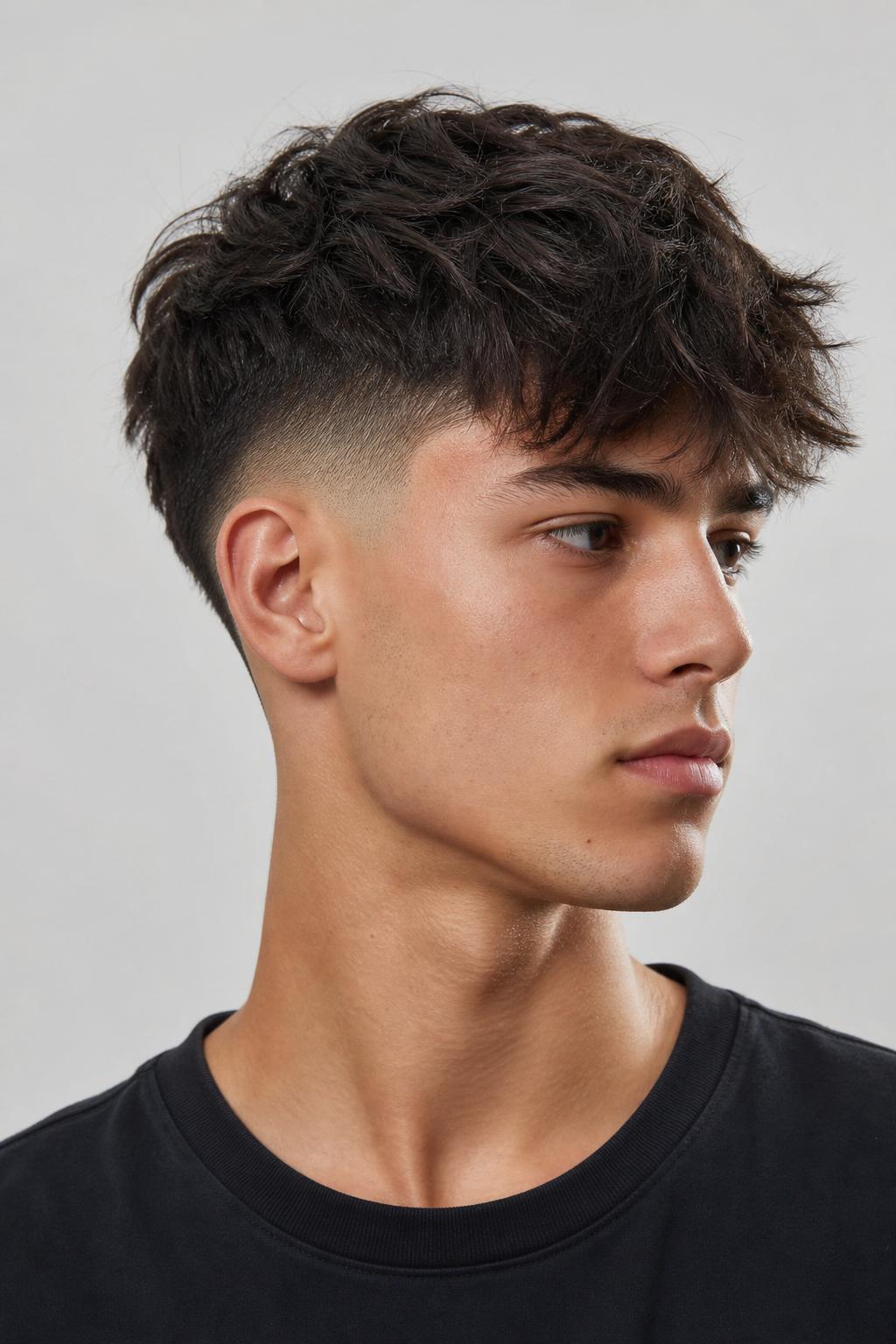
Instead of using blow-drying alone to create volume, the layered fluffy Edgar uses internal layers cut into the top section — shorter layers underneath push up the surface layers, creating lift that holds throughout the day without constant restyling. Ask your barber to use thinning shears or point cutting to add internal layers while keeping the top length and the blunt fringe intact. This technique works especially well on medium-density hair that doesn’t hold a blow-dry volume for a full day.
12. Textured Fluffy Edgar
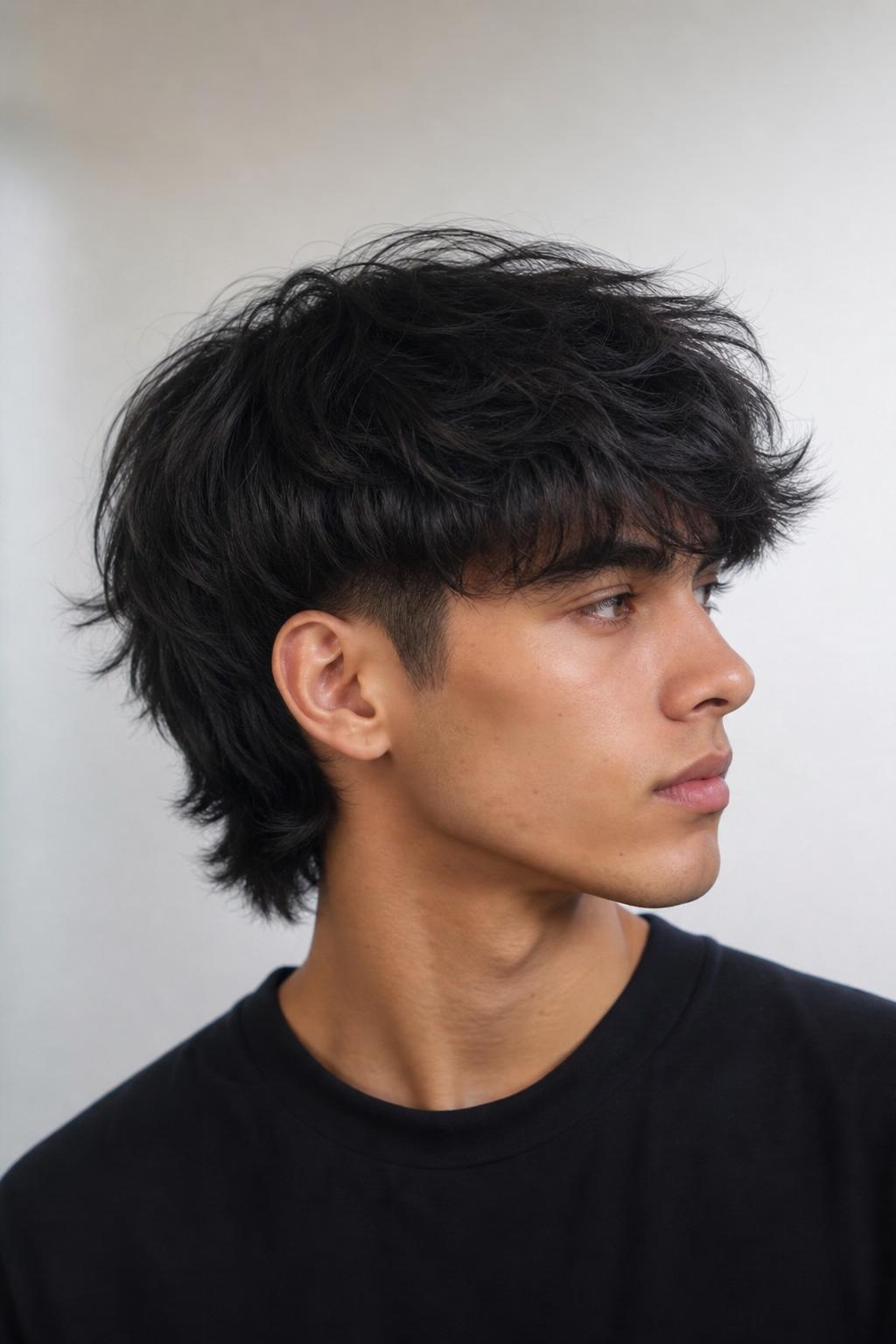
The textured fluffy Edgar breaks up the top into separated, piece-y sections rather than a uniform lifted mass. The difference in execution: use a matte clay or fiber paste through towel-dried hair, work it through with fingers to separate sections, then blow-dry loosely without pressing the top into a single unified shape. The fringe on this version is slightly broken-up at the ends rather than rigidly blunt — individual strands fall at slightly different lengths, giving the horizontal line a choppy, lived-in edge that reads as less formal than the strict classic.
Curly and Wavy Edgar Cuts
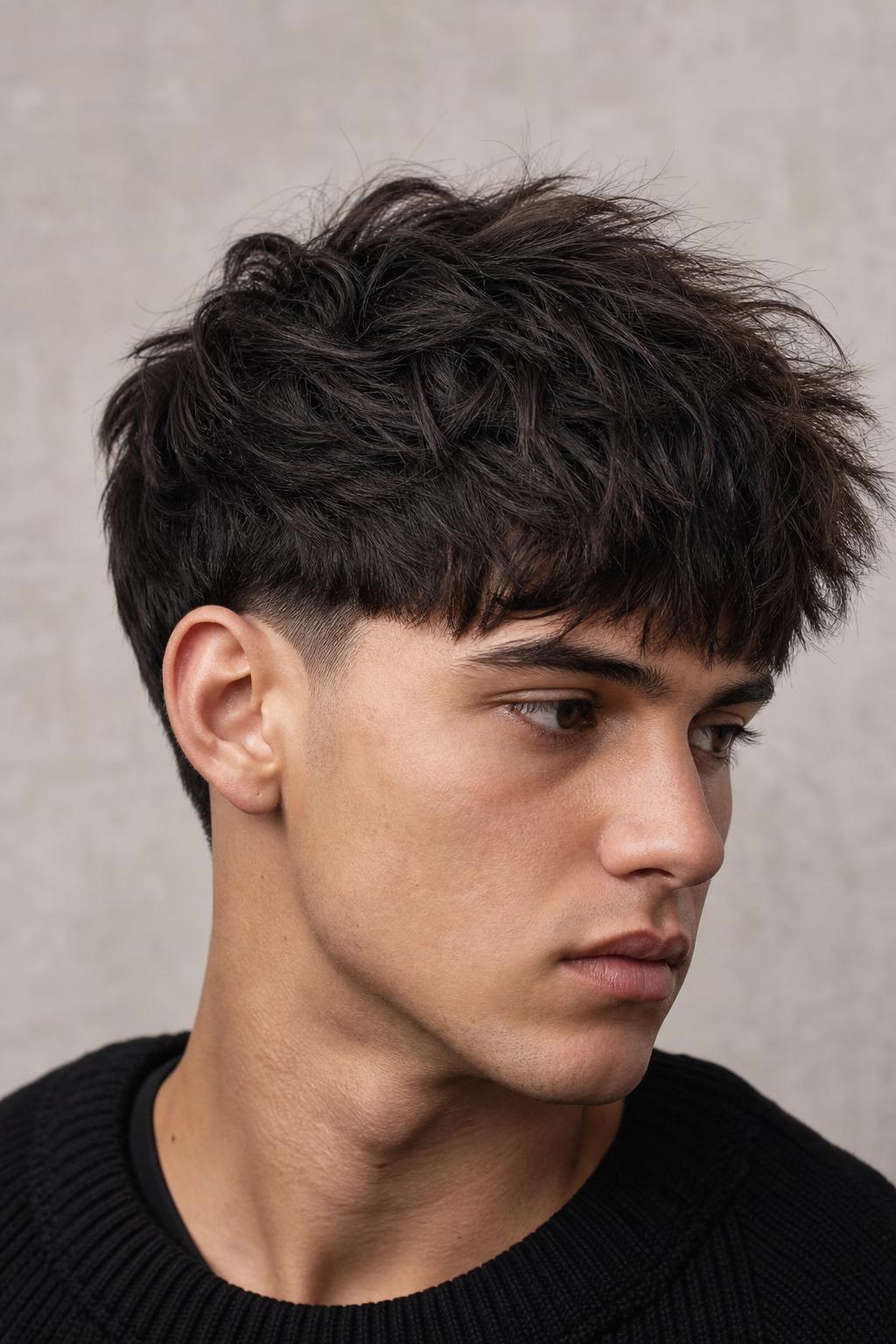
The curly Edgar is technically more demanding than the straight-hair version because the blunt fringe that defines the cut needs to be cut dry, not wet — curly hair shrinks significantly when it dries, meaning a fringe cut wet will end up considerably shorter than intended. Any barber who insists on cutting curly hair wet is going to produce a fringe that sits too high on the forehead once the hair dries. This is the single most important thing to get right when booking a curly Edgar.
13. Curly Edgar with Mid Fade
Naturally curly hair (2c–3b) with a mid fade on the sides produces one of the most dynamic Edgar variations — the coils on top create volume and contrast against the clean fade below, and the blunt fringe sits at a natural horizontal line formed by the curl pattern itself. Use a curl cream on damp hair, scrunch upward, and let air-dry or diffuse on low heat. The fringe should be allowed to spring to its natural dried length before the barber trims it — never while wet.
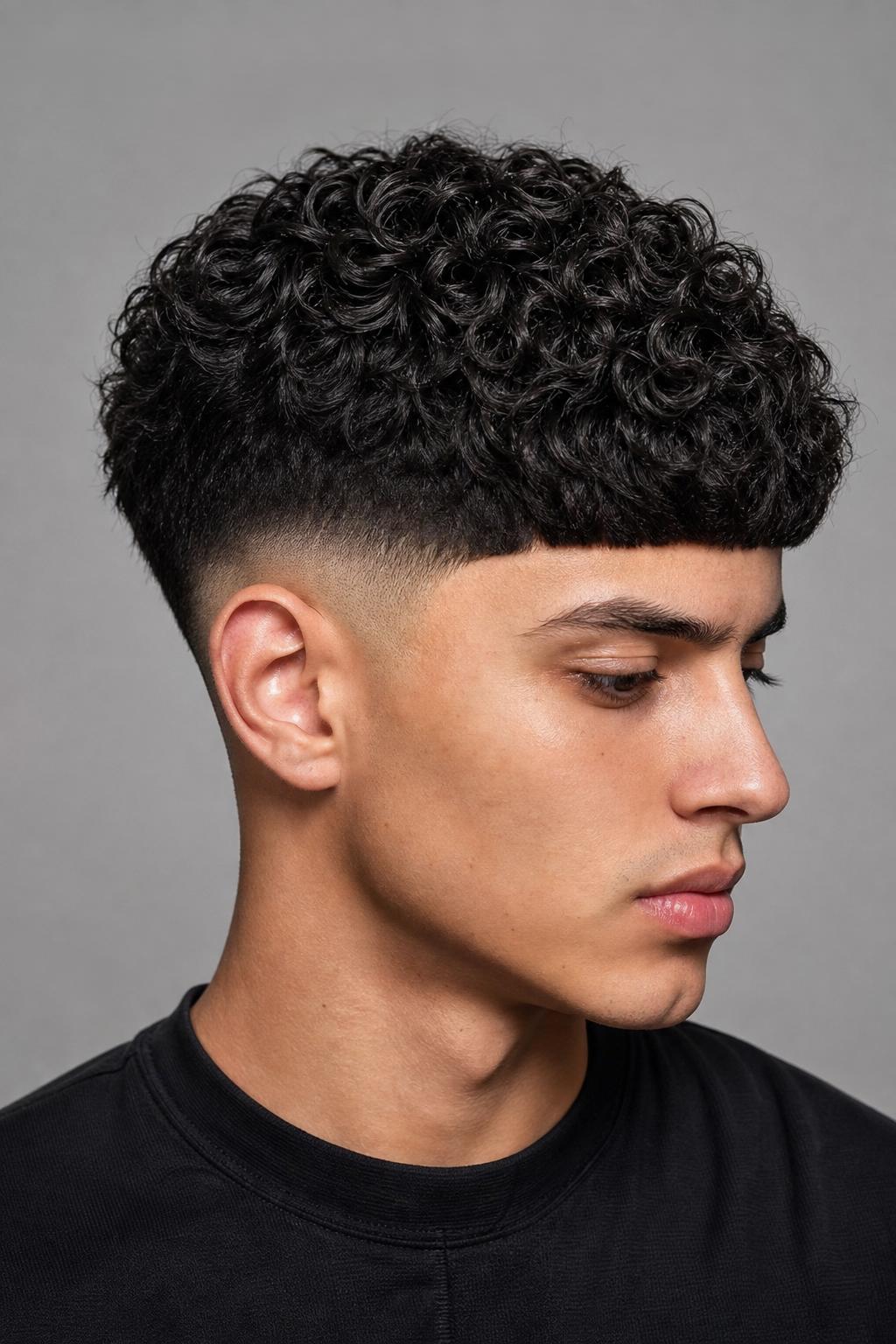
14. Curly Edgar with High Skin Fade
Tighter curls (3a–3c) against a skin fade create a striking silhouette where the coils appear to float above the bare skin on the sides. The shape-up at the forehead and temples is particularly important in this version — without defined edges, the curly top can look undefined from the front rather than intentionally structured. Curl cream or a light gel gives the coils their definition; avoid heavy pomades that flatten the curl pattern and cause the fringe to lose its dimensional edge.
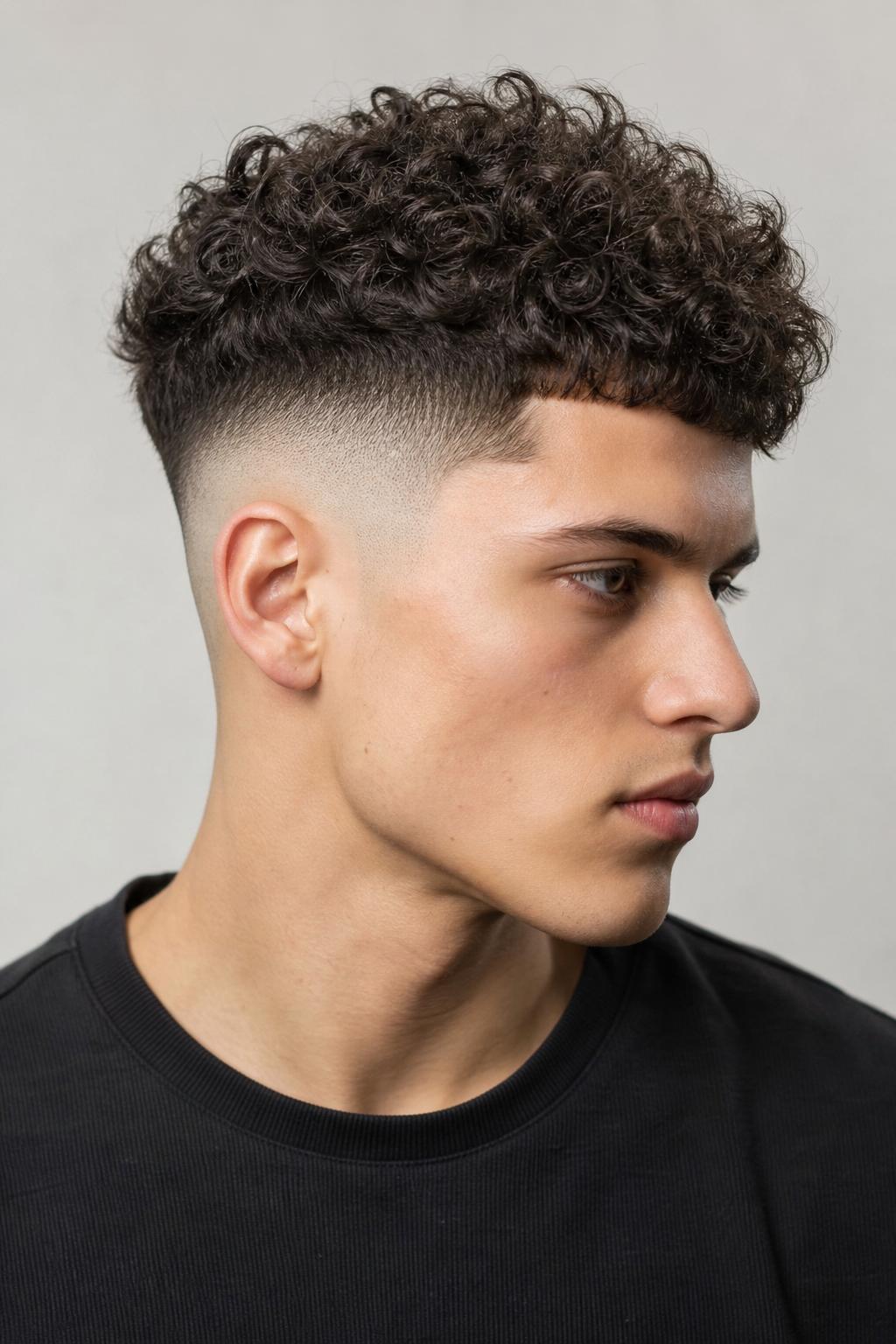
15. Tight Coil Edgar (4a–4c)
On 4a–4c textures, the blunt fringe becomes a natural architectural feature — the coil pattern creates its own horizontal density line at the front. The barber needs to shape the front into an even, defined edge by dry-cutting along the coil’s natural resting length, accounting for up to 75% shrinkage. A shape-up at the hairline is particularly useful here, as the tight coil pattern benefits from a crisp edge at the forehead corners and temples. Pick or afro comb the top after styling to maximize the height-to-width ratio of the overall shape.
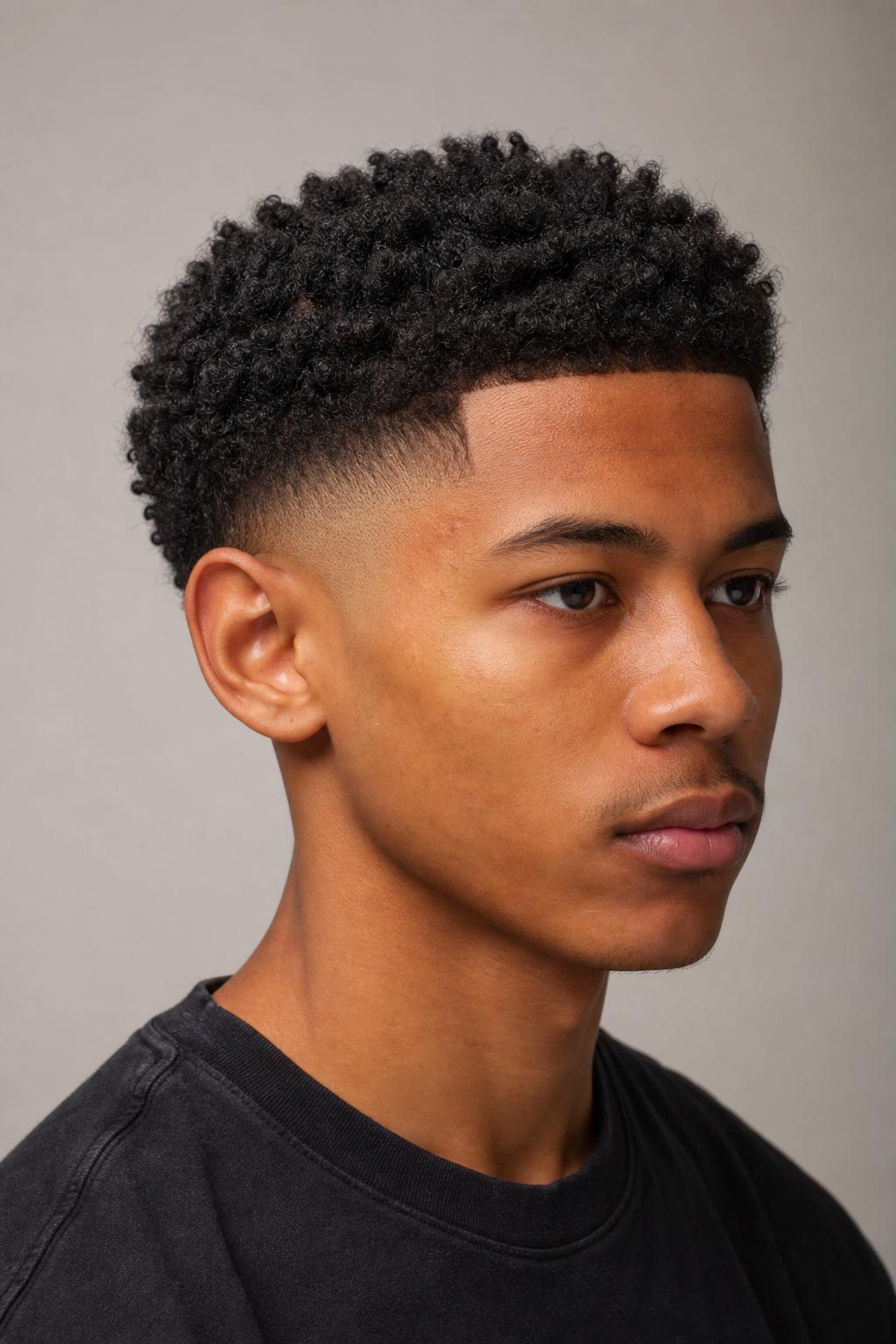
16. Wavy Edgar with Low Taper
Loose to medium waves (2a–2b) with a low taper give the Edgar its most relaxed, low-key interpretation. The wave pattern prevents the fringe from sitting rigidly straight — it has a slight natural movement that softens the horizontal line into something approachable. This version doesn’t need much daily styling: a small amount of sea-salt spray or texturizing cream, scrunch forward, and air-dry. It’s the Edgar for men who want the structured silhouette without the precision-grooming maintenance commitment.
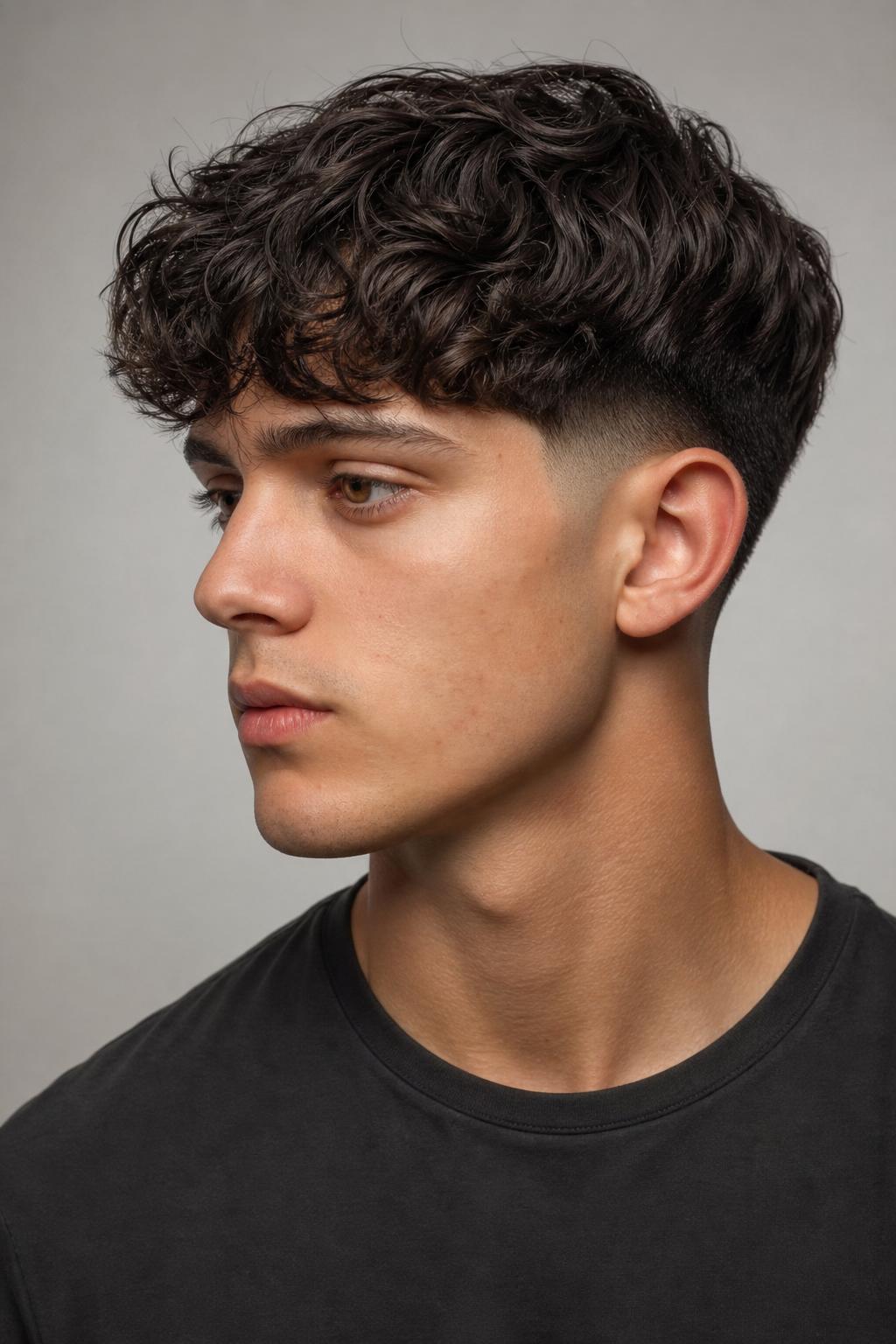
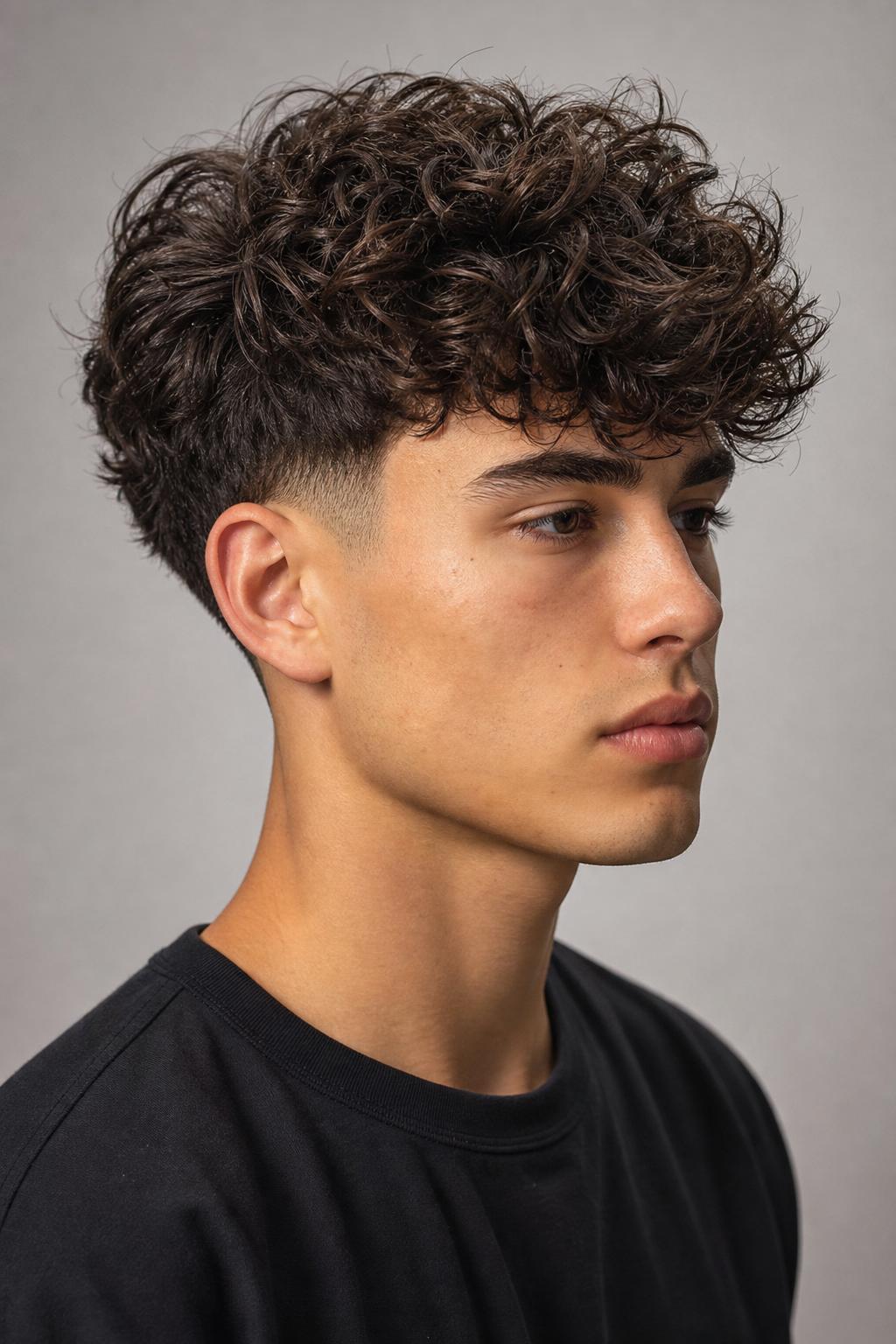
17. Curly Fluffy Edgar
The curly fluffy Edgar is exactly what it sounds like — natural curl pattern amplified by a blow-out or diffuse dry for maximum volume, then faded sides keeping the shape defined. The top should look full and rounded rather than flat; the front edge should be a clear horizontal line formed by the curl pattern. Apply curl cream on damp hair, diffuse on low heat while lifting the roots upward, then let it finish air-drying without disturbing the curl pattern. Avoid touching the fringe while wet — handling wet curls while the hair is setting causes frizz that disrupts the clean horizontal line.
Hybrid Edgar Combinations
Once you understand what makes an Edgar an Edgar — that blunt horizontal fringe — you can pair it with almost any side or back treatment. The hybrid combinations below take the Edgar fringe and combine it with structural elements from other cuts, creating results that look complex but are built on straightforward barbering principles.
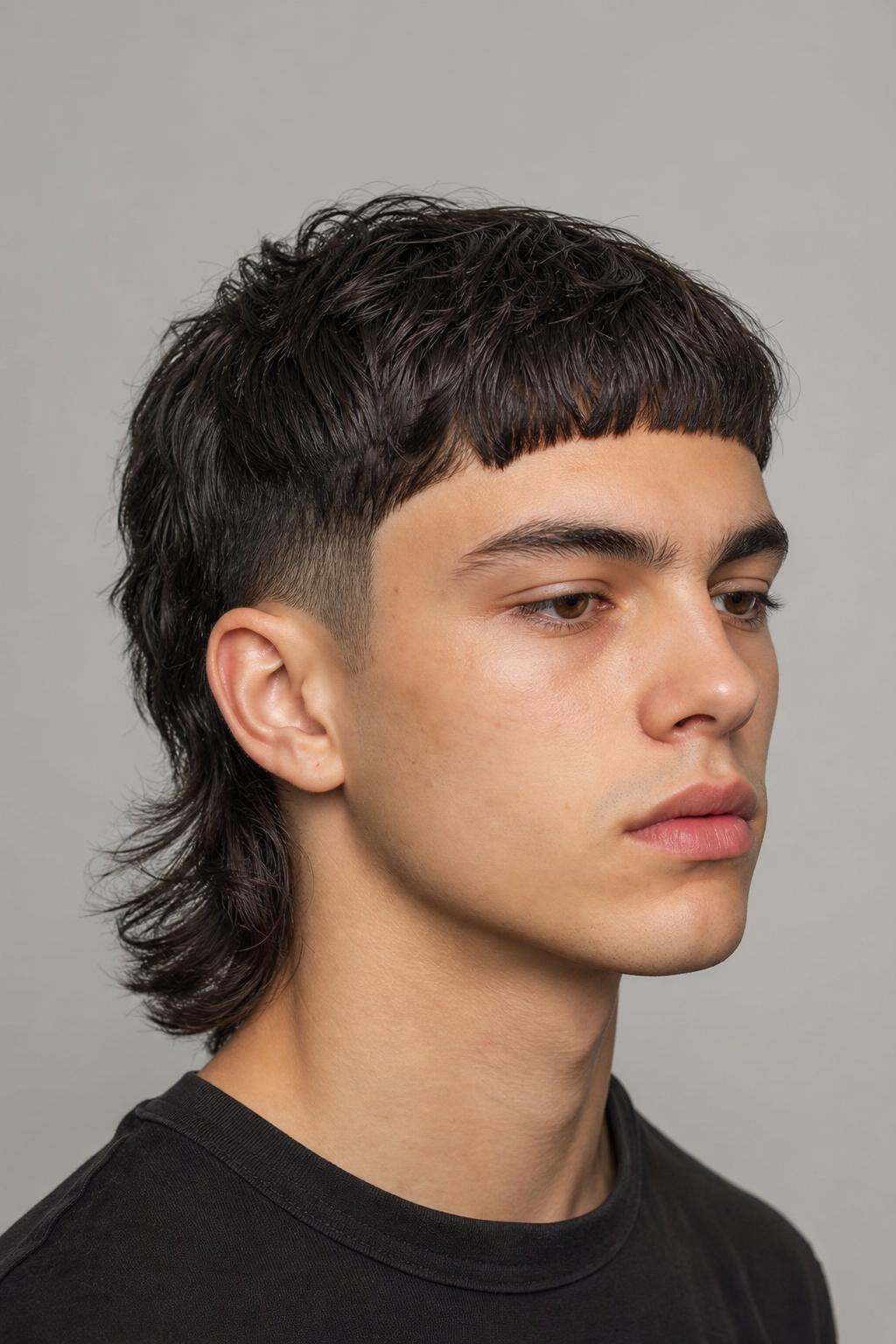
18. Edgar with Mullet
The back section is left significantly longer than the rest of the cut — the same back-to-front contrast that defines a mullet, but with an Edgar’s blunt fringe at the front rather than a rounded crop. The result is two defined horizontal lines: one at the front fringe, one at the back tail. This reads as an overtly fashion-forward choice — it’s the cut for someone who wants maximum visual impact and doesn’t need to worry about conservative dress codes. The back tail needs trimming every 4–6 weeks to maintain proportionality as the rest of the cut grows in.
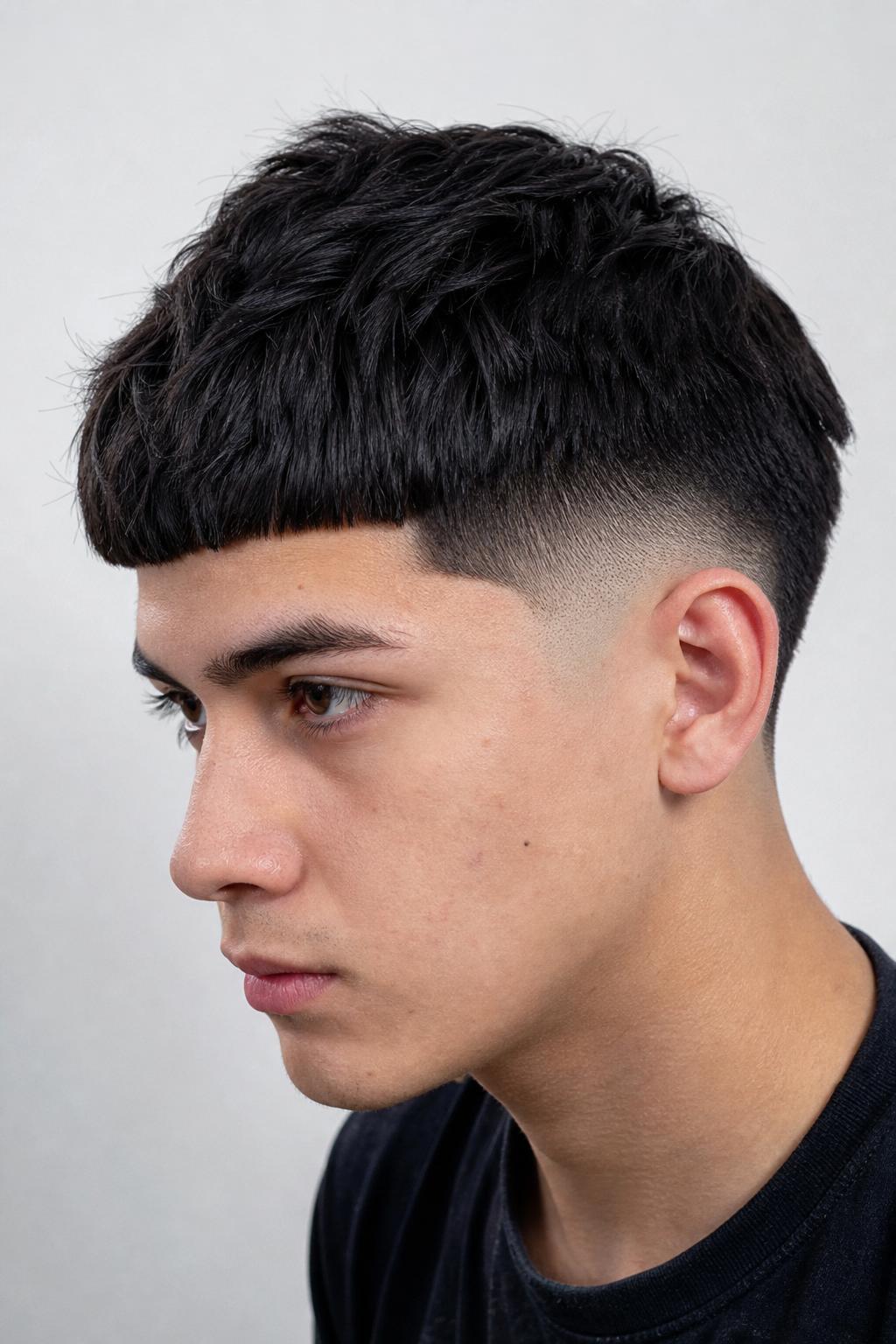
19. Edgar with Burst Fade
A burst fade curves around the ear in a semicircle rather than dropping straight down the side — it creates a rounded halo effect that makes the head’s silhouette appear wider and more rounded at the sides. Combined with the straight horizontal Edgar fringe, the burst fade produces a graphic contrast between the curved side silhouette and the straight front line. This works particularly well on oval and diamond face shapes where the rounded fade adds width at a flattering point. The burst fade requires a barber skilled in curved line work — not all fades are the same technical challenge.
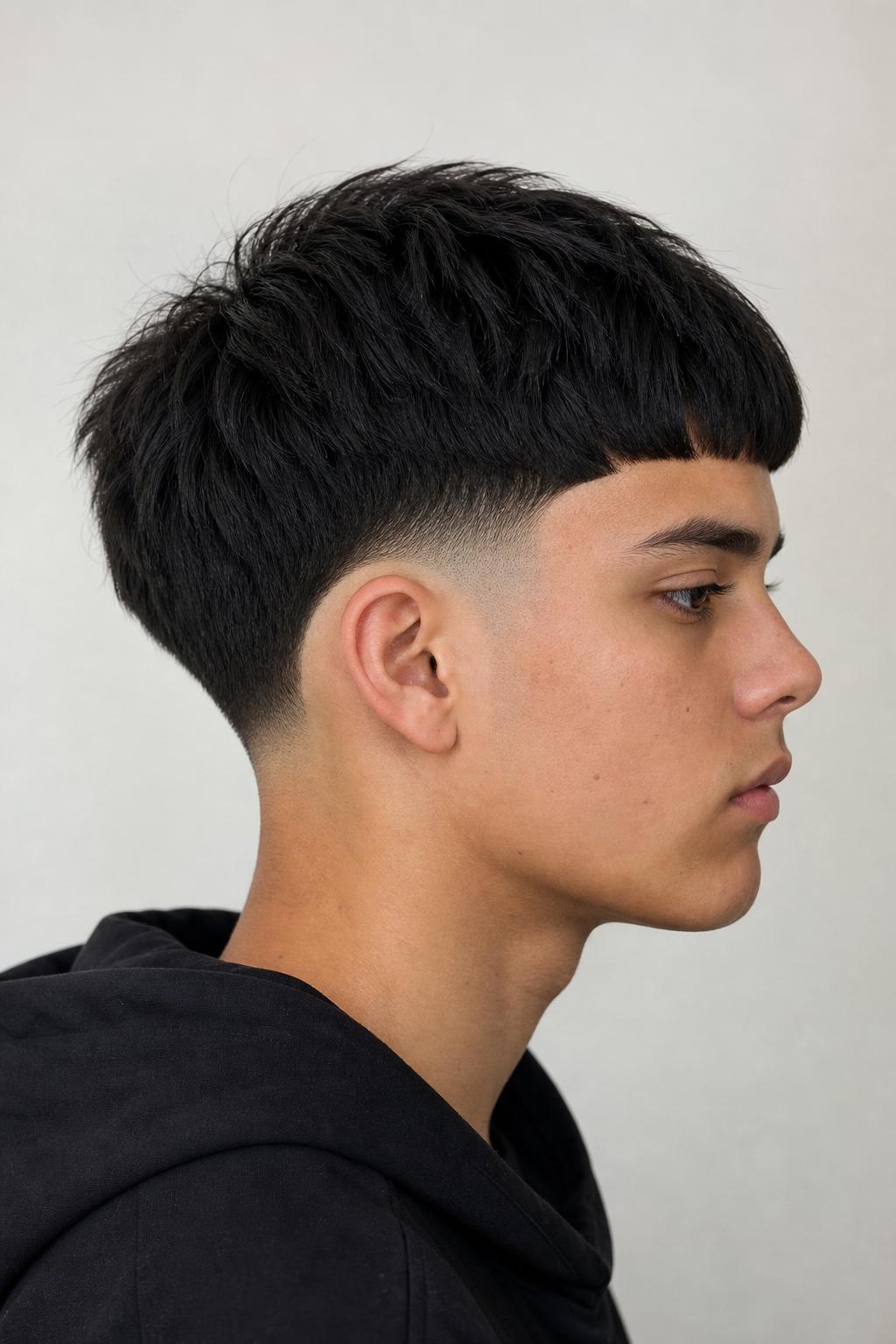
20. Edgar with Drop Fade
A drop fade curves down behind the ear, following the ear’s natural contour rather than running in a straight horizontal line from temple to nape. The drop gives the overall silhouette a softer, rounder back profile, which makes the Edgar’s sharp fringe look more intentionally contrasted against it. On square and round face shapes, the drop fade’s curved back is more flattering than a straight-line fade, which can emphasize width. Ask your barber: “I want an Edgar fringe with a drop fade that curves down behind the ear.”
21. Edgar with Disconnected Undercut
The sides below a defined horizontal line are cut very short or buzzed, but without the blending gradient of a fade — there’s a visible, hard line where the top length ends and the short sides begin. Combined with the Edgar fringe at the front, the disconnected undercut creates two structural contrasts: the fade-less sides and the blunt front fringe. On thick, straight hair this is one of the most dramatic-looking combinations in men’s haircuts — the contrast between top length and side shortness is stark and unmistakable.
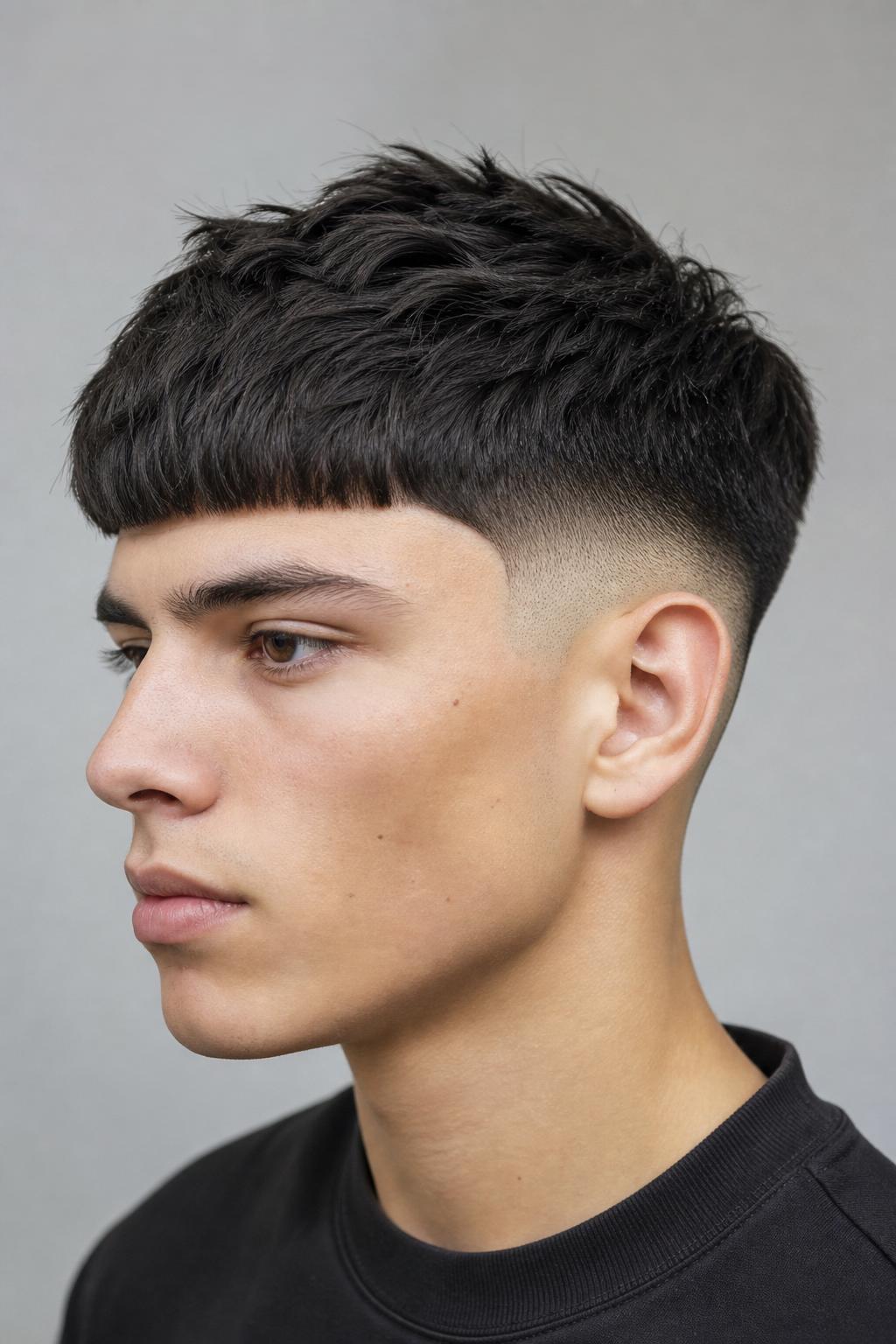
22. Edgar with Skin Fade and Line Design
Razor-carved geometric lines — a single slash at the temple, a chevron above the ear, or a double-line part — added to the fade zone of an Edgar cut turn the haircut into wearable art. The lines work best in the transition zone between the skin fade and the natural hair, where the contrast between the razor line and the surrounding gradient is highest. Design work is an additional barbershop service — expect to add $20–$40 to the base price — and needs refreshing every 1–2 weeks as the hair grows in and softens the lines.
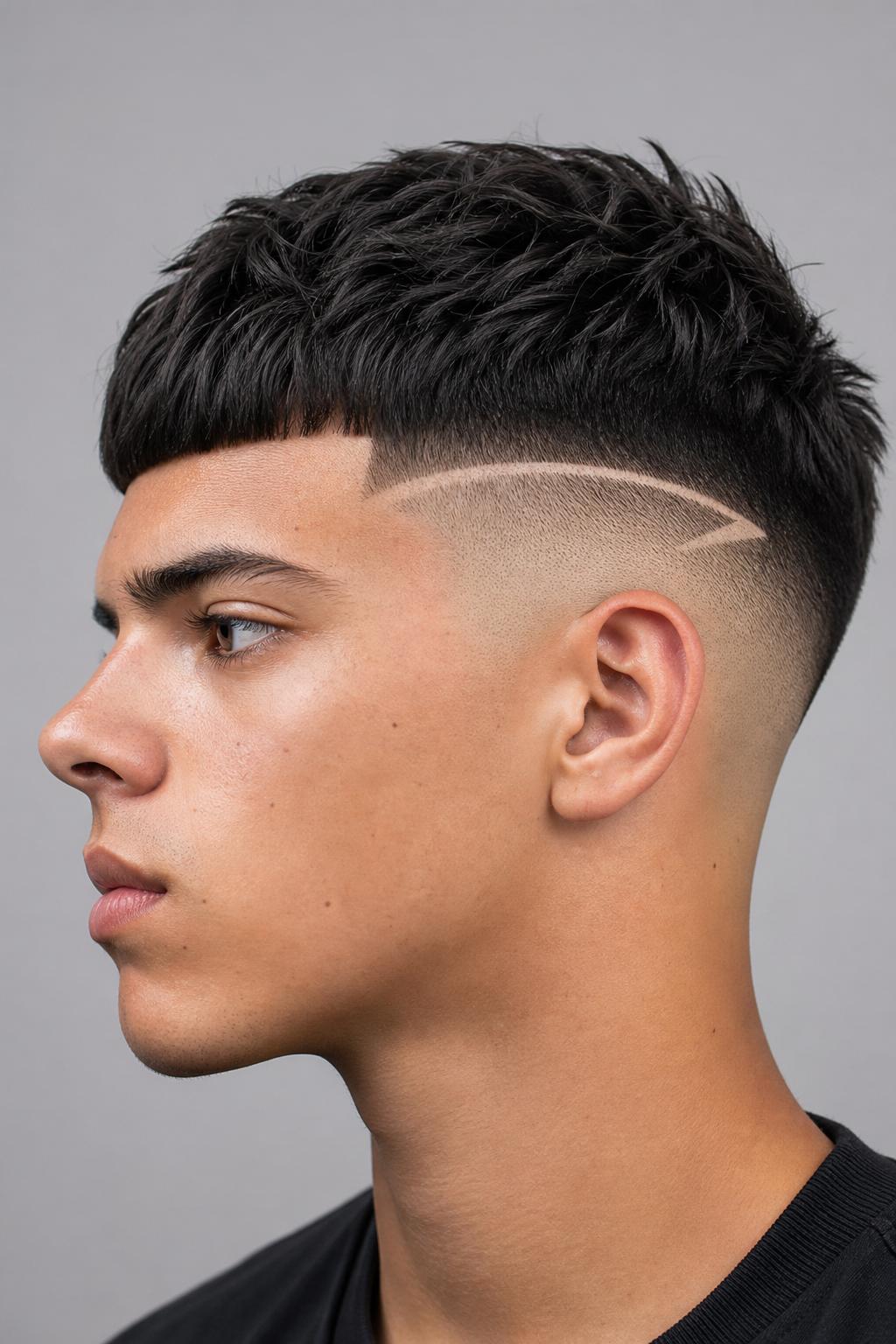
23. Edgar with Beard Fade
When the skin fade at the sides is blended seamlessly into a beard or heavy stubble, the result is a unified frame around the face where the hair on top, the fade on the sides, and the facial hair below all read as one continuous groomed shape. The Edgar fringe at the top and the beard at the bottom create two horizontal definition points that bracket the face vertically. On square and diamond face shapes, a fuller beard at the jaw adds width that can balance the face’s angular structure. This requires a barber skilled in both hair fading and beard work — not always the same person.
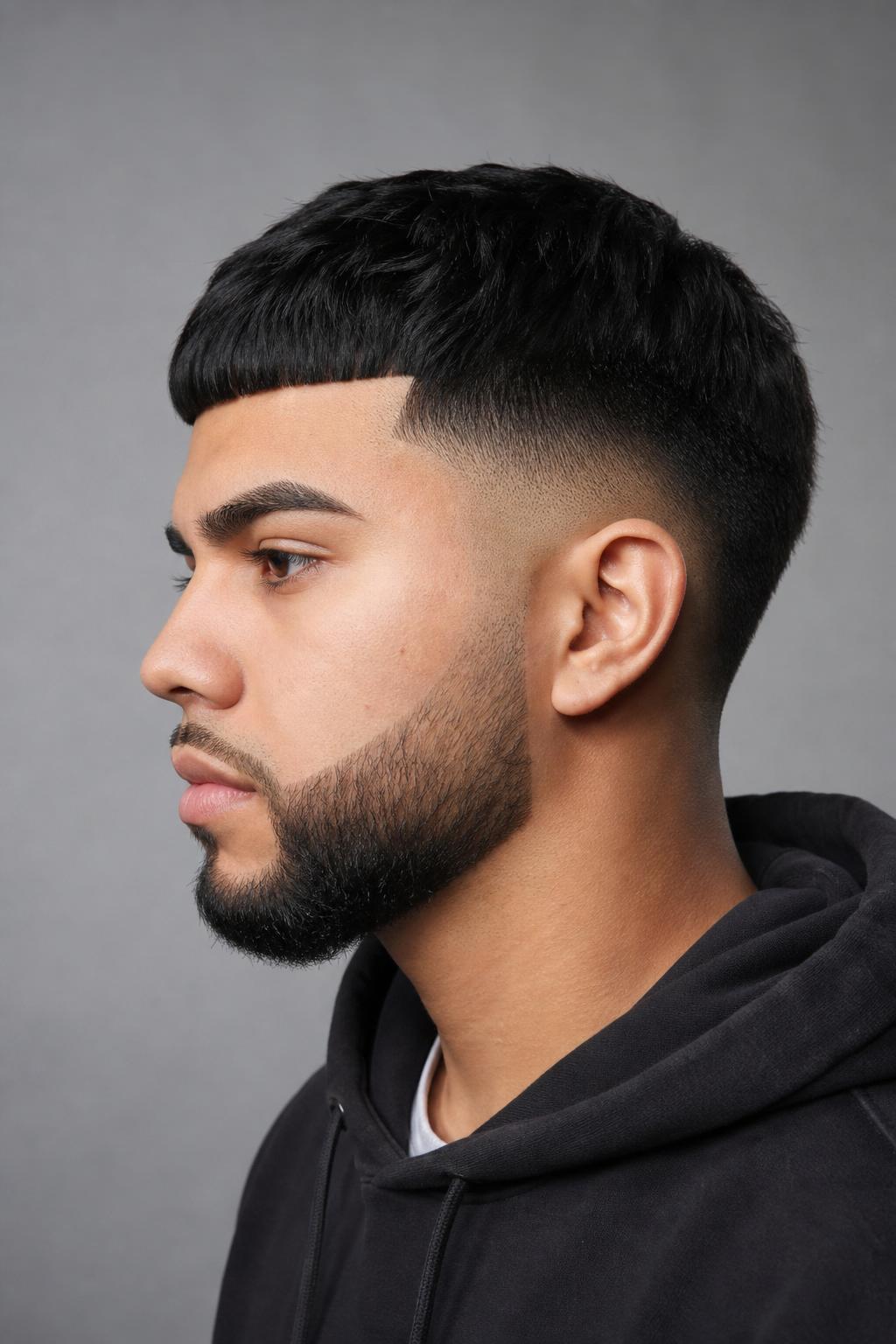
Longer Edgar Variations
The standard Edgar fringe sits at mid-forehead or above. But the blunt horizontal fringe principle can be applied at longer lengths — a longer fringe still reads as an Edgar if it’s cut straight across rather than swept or layered. These longer variations suit men who want the Edgar’s structural identity without going as short on top as the classic version requires.
24. Long Fringe Edgar
The fringe extends down to near-brow or eyebrow level — longer than a classic Edgar’s mid-forehead placement, but still cut straight across horizontally. The longer fringe changes the proportional impact: at mid-forehead the fringe looks bold and square; at brow level it looks more like a sharp French fringe or a heavily blunted curtain bang. This version is significantly more versatile for professional environments — the fringe is still structured but not as immediately striking. It also grows out more gracefully than a shorter Edgar fringe, giving a longer window between barber visits.
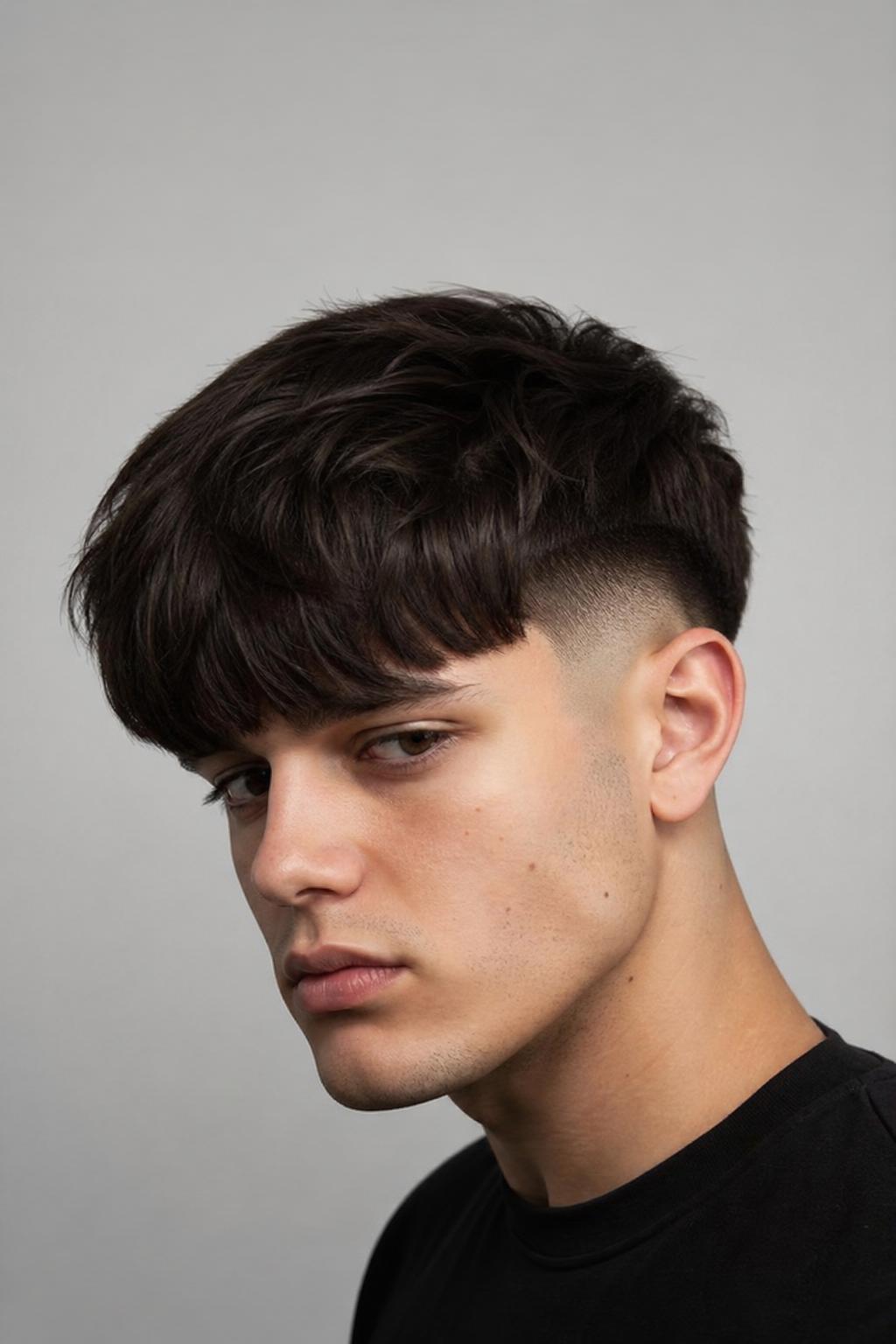
25. Edgar Lob (Longer on Top)
Top length extended to 3–4 inches rather than the standard 1.5–2 inches of the classic Edgar, with the blunt fringe still present at the front but naturally longer and slightly softer-looking. The additional length on top allows for more styling range: the top can be pushed forward for a pronounced fringe effect, swept slightly to one side for a more relaxed day look, or lifted at the crown for a quiff-adjacent volume. This version is the bridge between the Edgar and longer men’s hairstyles — it works for men transitioning to or from the classic Edgar length.
26. Slicked Edgar
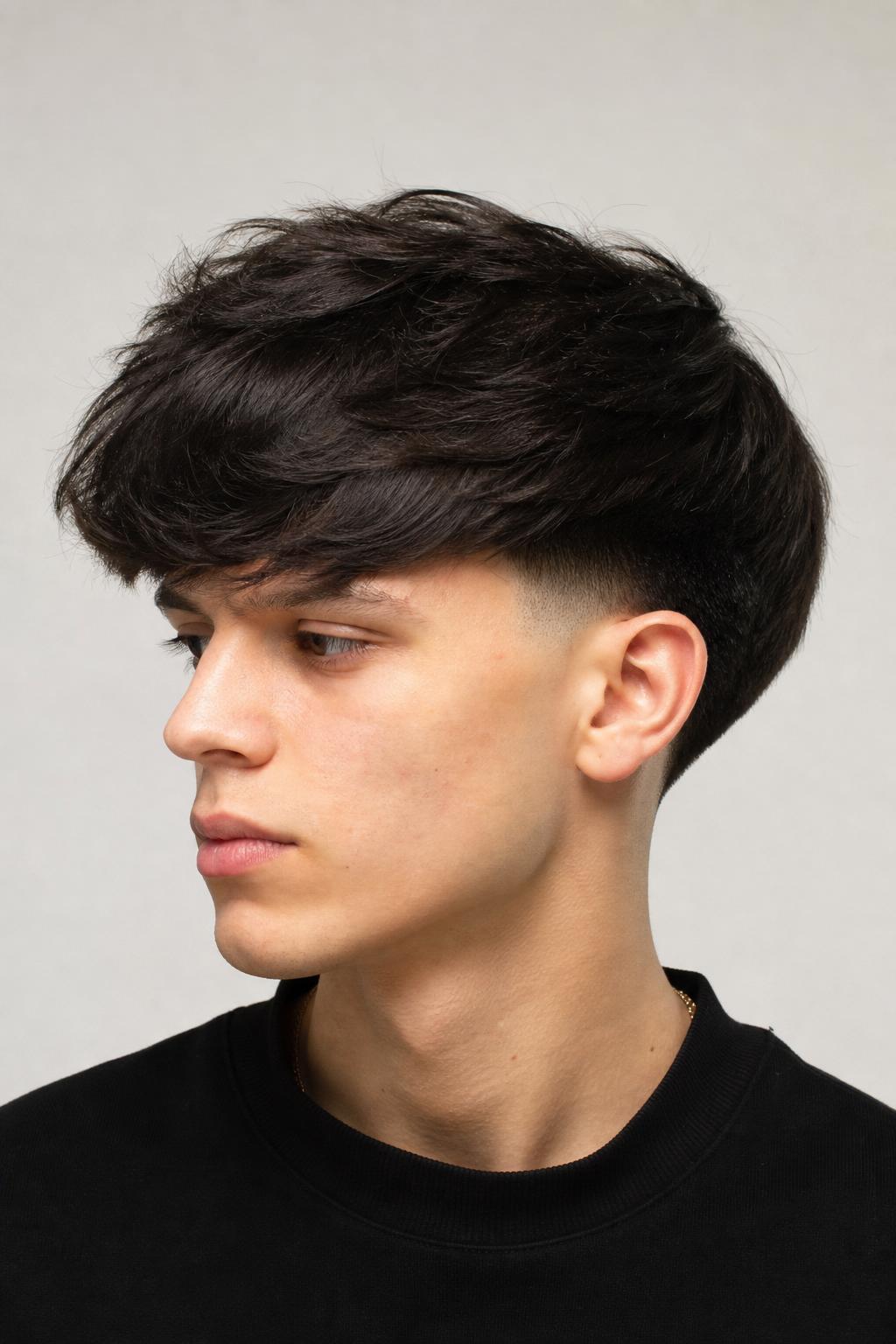
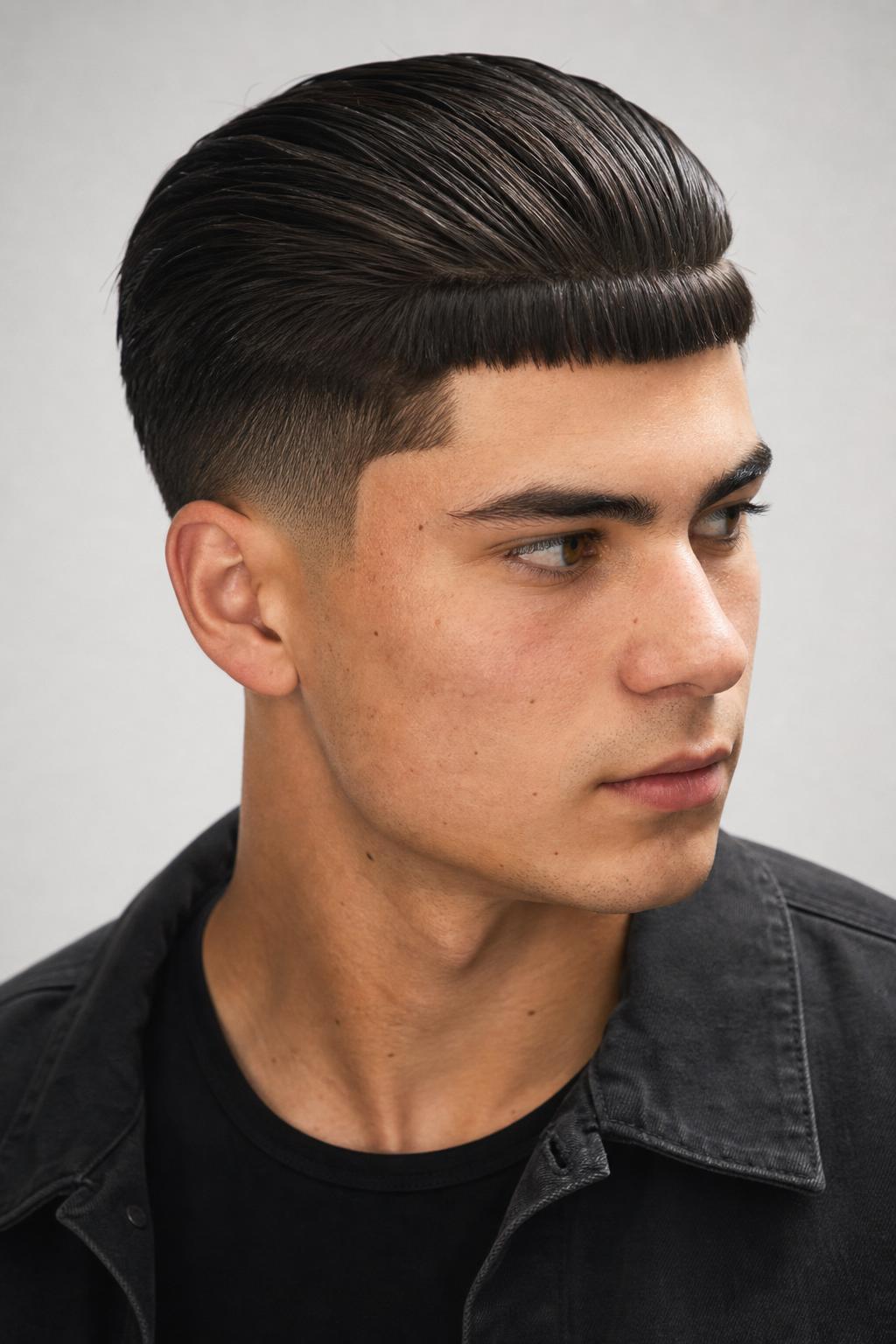
The top is styled backward and downward with a medium-hold pomade rather than forward and upward as in most Edgar interpretations. The fringe is still blunt at the front, but the styling direction creates a sleeker, more polished silhouette — the hair lies flatter against the head. This works particularly well for men with thick, straight hair who find the fluffy or lifted variations too high-maintenance; the slicked styling holds for a full work day without constant restyling. The contrast between the slicked flat top and the precise skin fade below is sharp and very intentional-looking.
Edgar Cuts by Hair Type
The Edgar’s defining feature — that blunt horizontal fringe — behaves differently depending on hair texture, density, and curl pattern. These entries address the most common hair-type questions barbers get about this cut, including the ones competitors gloss over.
27. Edgar for Thick, Straight Hair
Thick straight hair is the easiest texture to work with for an Edgar — the density holds the fringe line naturally, the sides are heavy enough to show the fade gradient clearly, and the top can be styled in almost any direction without losing its shape. The main risk is the fringe sitting too heavy and falling into the eyes if the length goes past mid-forehead. Ask your barber to point cut the underside of the fringe slightly to reduce weight without changing the external blunt line — it helps the fringe lift slightly and avoids the flat, pasted-to-forehead look that thick heavy fringes sometimes produce.
28. Edgar for Fine or Thin Hair
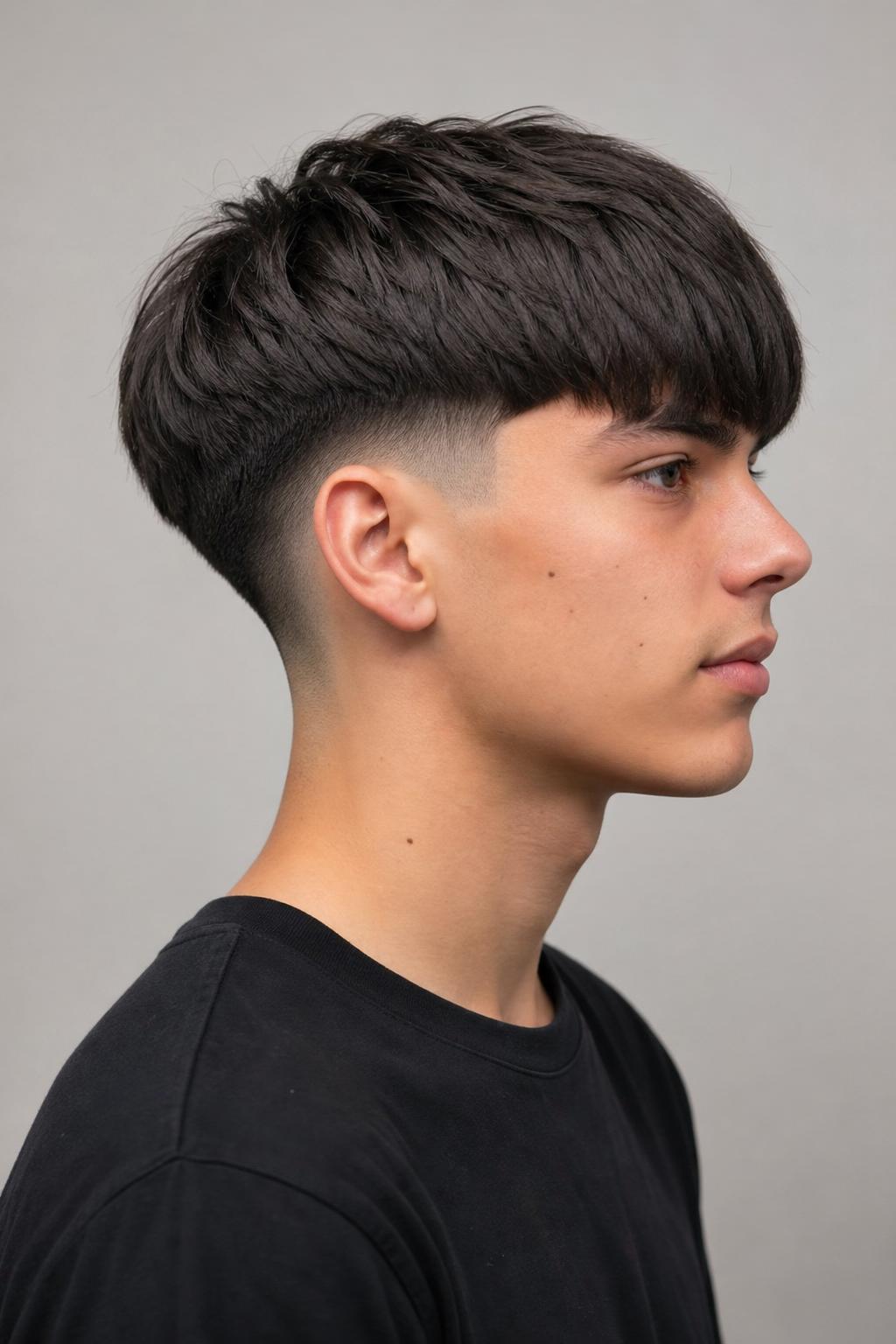
Fine hair is the most challenging texture for an Edgar because the blunt fringe relies on density for its impact — a thin fringe looks sparse rather than bold. The fluffy variation is more forgiving on fine hair than the classic flat-topped version, because the blow-dry volume compensates for the lack of natural density. Volumizing mousse at the roots, blow-dried upward, makes a significant difference. Avoid heavy pomades entirely on fine hair; they weigh the fringe down and make individual strands visible through the fringe. Keep the fringe shorter (higher on the forehead) where the hair is thickest.
29. Edgar for Naturally Wavy or Coily Hair
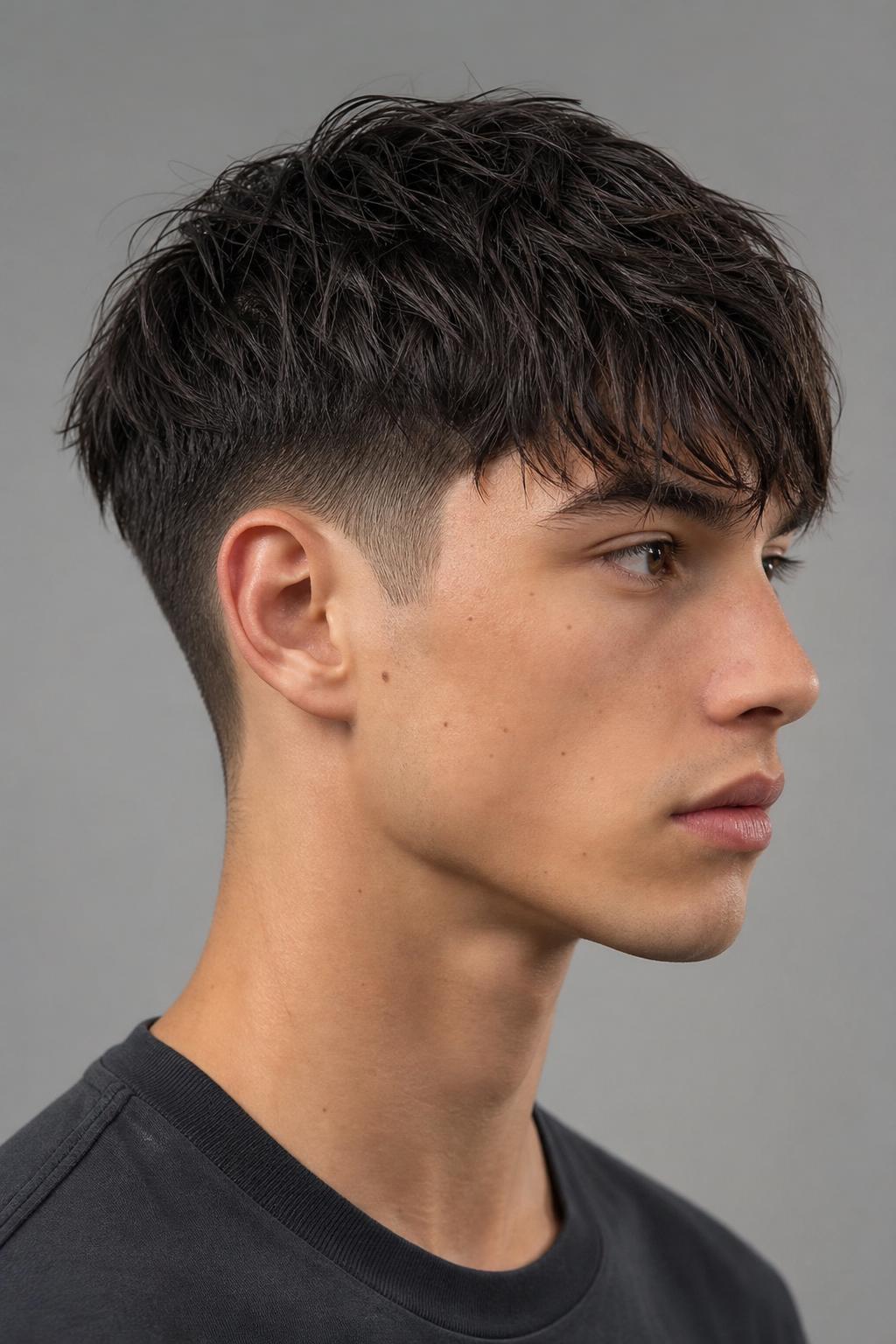
The blunt fringe on wavy or coily hair has a natural energy that straight-hair Edgars have to create with products — the texture at the fringe front creates visual depth and movement that makes the horizontal line look three-dimensional rather than flat. The key technical point: the barber must cut the fringe dry, in the hair’s natural resting state. Wet cutting on wavy or coily hair produces a fringe that sits 30–75% higher than intended once the hair dries and contracts. Show your barber the exact length you want on dry hair, and request that the final fringe trim be done dry.
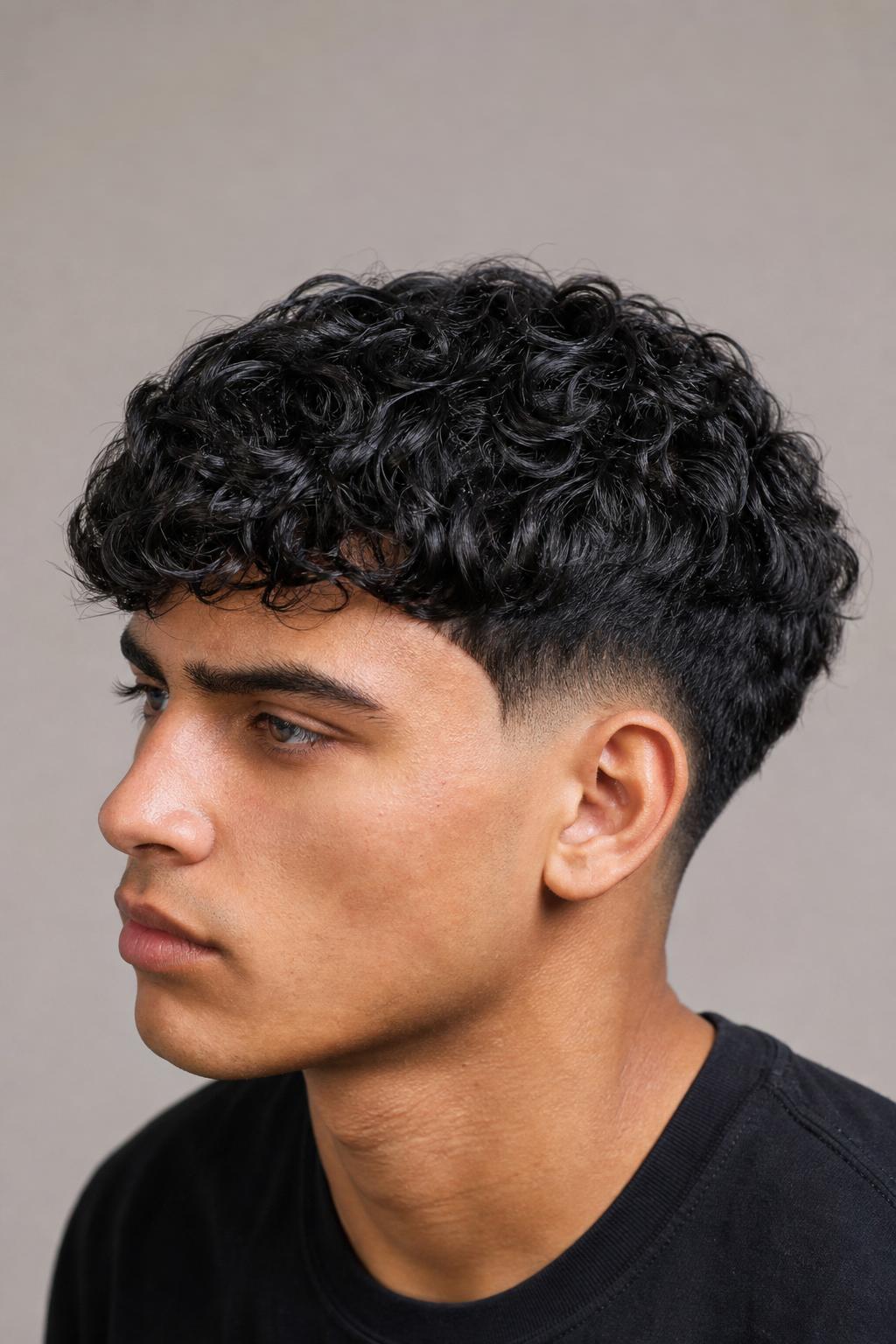
30. Edgar for Mixed or Bi-Racial Hair Textures
Mixed or bi-racial hair textures — where the hair might have straight sections at the nape but coily sections at the crown, or where texture changes noticeably between wet and dry states — require a barber with experience in multi-texture cutting. The fade can be executed similarly to any other Edgar, but the fringe length needs to account for the specific behavior of the front hairline section, which may have a different curl pattern than the crown. If the front section is straighter than the rest of the hair, the fringe will behave more like a straight-hair Edgar; if it’s the coiliest section, it will spring up more after cutting. Ask your barber to assess the front section specifically before committing to a fringe length.
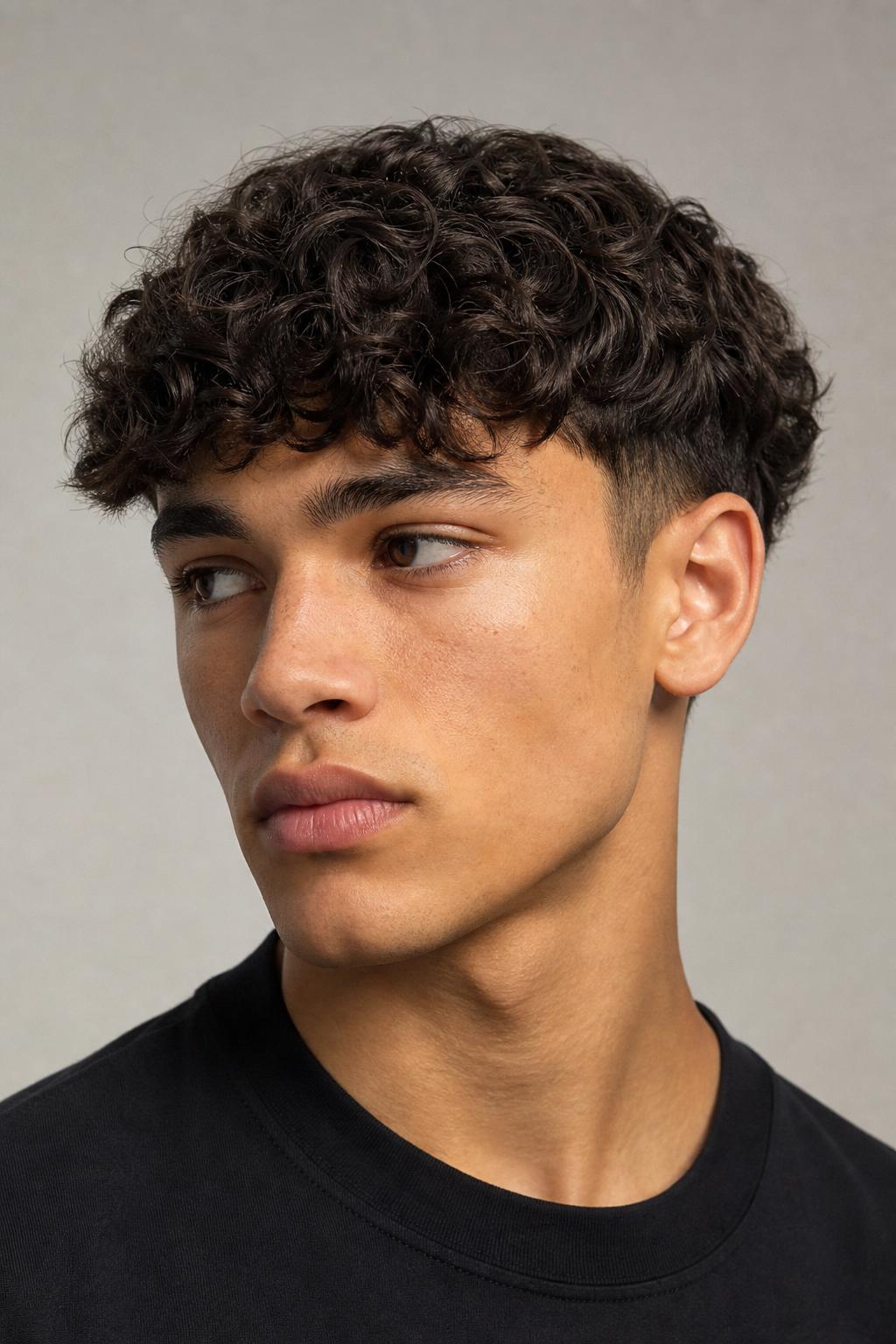
How the Edgar Cut Differs from Similar Styles
The Edgar is frequently confused with the French crop and the Caesar cut, and occasionally with the bowl cut. The differences are meaningful — knowing them helps you explain what you actually want to your barber.
| Feature | Edgar Cut | French Crop | Caesar Cut |
|---|---|---|---|
| Fringe line | Hard horizontal blunt line — very defined | Blunt but corners slightly shorter — softer | Short horizontal fringe, slightly softer |
| Fringe length | Mid-forehead or higher — bold placement | Mid-forehead, slightly longer corners | Similar to French crop but stiffer |
| Sides | High skin fade most common; any fade level | Typically mid or low taper; less aggressive | Usually mid fade or taper |
| Top texture | Fluffy/voluminous in trending versions | Textured, slightly brushed forward | Flat, uniform crop — minimal texture |
| Cultural association | Latin American / Mexican; Gen Z / TikTok | European / British barbering | General men’s barbering, no specific origin |
| Overall vibe | Bold, intentional, statement-making | Clean, modern, understated | Classic, conservative, low-key |
The most common confusion is between the Edgar and the French crop. The French crop corners are slightly shorter, softening the line at the edges; the Edgar’s fringe is completely horizontal across the full width. The French crop looks intentional but not aggressive; the Edgar looks deliberate and sharp. If you bring a French crop photo to a barber and ask for an “Edgar,” you’ll get the correct cultural reference but possibly the wrong fringe shape — always clarify whether you want the full-width horizontal line or a slightly softer perimeter.
Edgar Cut Face Shape Guide
The Edgar’s horizontal fringe adds a visual width line across the forehead. That’s an advantage for some face shapes and a complication for others. Choosing the right fringe length and fade level can compensate for most face shape challenges.
| Face Shape | Best Edgar Variation | Avoid |
|---|---|---|
| Oval | Any — classic high fade, fluffy, curly, or hybrid all work well | Nothing to avoid; oval face shapes are most versatile |
| Oblong/Long | Classic or fluffy Edgar — the horizontal fringe shortens perceived face length | Tall volume on top (quiff-style Edgar) further elongates the face |
| Square | Fluffy Edgar with mid or low taper; beard fade to soften jaw lines | High skin fade + hard fringe line — amplifies angular jaw contrast |
| Round | Fluffy or volumized Edgar to add height; longer fringe near brow to break width | Short fringe high on forehead — adds width and emphasizes roundness |
| Diamond | Edgar with beard fade to add jaw width; mid or low taper to preserve side balance | High skin fade — makes cheekbones (the widest point) look disproportionate |
What to Tell Your Barber
The Edgar is one of the cuts most prone to miscommunication because “Edgar” means different things to different barbers depending on their cultural background and training. A barber trained primarily in European barbering may execute it more like a French crop; a barber from a Latino or East LA background may automatically go to a high skin fade with a blunt mid-forehead fringe. Showing a reference photo is non-negotiable with this cut — the word alone is not enough information.
Barber tip: Bring two reference photos — one showing the fringe length and line you want, and one showing the fade level and height you want on the sides. The fringe and the fade are two separate decisions, and most reference photos online show only one or the other clearly.
The five pieces of information your barber needs:
- Fringe length: Where on the forehead do you want the fringe to end? Mid-forehead is classic; closer to brow is softer. Physical point to the spot or use a reference photo.
- Fringe texture: Hard and blunt (one straight horizontal line, all strands the same length) or slightly choppy and textured at the ends?
- Fade level: Low taper (above the ear), mid fade (mid-ear), or high skin fade (above the temples)? Point to the spot on your own head.
- Top treatment: Fluffy and voluminous, flat and sleek, or somewhere between? Describe the styling direction — forward, upward, backward?
- Neckline finish: Squared, tapered, or rounded? The neckline impacts how the cut reads from the back.
If you have curly or coily hair, add explicitly: “Please cut the fringe dry — I need it trimmed after it’s dried naturally, not while it’s wet.” Most barbers understand this, but it’s worth confirming before the appointment begins rather than after the fringe is already too short.
Edgar Cut Maintenance
The Edgar is not a low-maintenance cut — the blunt fringe is its defining feature, and that fringe loses its clean horizontal line within 2–3 weeks as the hair grows. Unlike a fade alone, which can look intentional for up to 3–4 weeks before it clearly needs a refresh, the fringe’s grow-out immediately softens the hard line that makes the Edgar recognizable.
| Task | Frequency | Notes |
|---|---|---|
| Full cut refresh (fringe + fade) | Every 2–4 weeks | High skin fade: 2 weeks max. Low taper: can stretch to 4 weeks |
| Fringe trim only | Between full cuts if needed | Some barbers will do a quick fringe trim for $5–$10 between full appointments |
| Shape-up / edge refresh | Every 7–10 days | Especially important if you have a shape-up as part of the cut |
| Razor design refresh | Every 1–2 weeks | Design lines soften fast; schedule accordingly |
| Daily styling | 5–15 minutes | Classic Edgar: 5 min. Fluffy Edgar: 10–15 min with blow-dry |
Styling Products for the Edgar Cut
Product choice changes the character of the cut more than with most men’s hairstyles — the same Edgar can read sharp and precise with pomade or soft and casual with mousse. These are the categories that work, matched to the variation they suit best.
- Matte clay or fiber paste (textured fluffy Edgar, curly Edgar): worked through towel-dried hair with fingers, gives separation and texture without shine. Best for the messy, piece-y fluffy variations where you don’t want a polished look.
- Volumizing mousse (fluffy Edgar, fine hair Edgar): apply to damp roots, blow-dry upward. The best tool for adding lift that holds without stiffness. Essential for fine hair that won’t hold a blow-dry volume on its own.
- Water-based pomade (slicked Edgar, hard part Edgar): medium hold, natural-to-medium shine. Easier to wash out than oil-based pomades. Good for the sleeker Edgar variations where you want the fringe to lie flat and intentional rather than lifted.
- Curl cream or light gel (curly and wavy Edgar): applied on damp hair, scrunched, and air-dried or diffused. Gives curl definition without the crunch of heavy gel. Avoid heavy gel on the Edgar fringe — it creates a rigid, flat fringe that loses the dimensional quality of the curl pattern.
- Sea-salt or texturizing spray (wavy Edgar, textured fluffy Edgar): sprayed on dry or lightly damp hair, scrunch or finger-tousle, done. The lowest-effort finishing product for wavy Edgar variations.
FAQ
What Exactly Is an Edgar Haircut?
An Edgar cut is a men’s hairstyle defined by a blunt horizontal fringe cut straight across the forehead, combined with faded or tapered sides. The fringe is the non-negotiable element — if the front isn’t cut in a clean horizontal line, it’s not technically an Edgar. Everything else (fade height, top texture, fringe length) is a variation. The cut originated in Mexican and Latino street culture, sometimes called the Takuache cut, before spreading globally through barbershop culture and social media platforms like TikTok and Instagram.
Does the Edgar Haircut Suit All Face Shapes?
With adjustments, yes — but the classic high-fade version with a short mid-forehead fringe is not universally flattering. On oblong and oval faces, the horizontal fringe shortens the face’s perceived length, which is a genuine advantage. On round faces, the same fringe can add unwanted width; a fluffy Edgar with extra volume on top compensates for this by adding height instead. On square faces, a softer low taper Edgar (rather than a high skin fade) reduces the harshness. The fringe itself is a forehead-widening element, so face shapes with wide foreheads should consider a longer fringe that sits closer to the brow.
How Often Does the Edgar Cut Need a Trim?
More often than most cuts — every 2–4 weeks for most versions. The blunt fringe is unforgiving to grow-out because even a small amount of growth softens the hard horizontal line that defines the cut. A high skin fade Edgar needs the shortest interval (2 weeks) because both the skin fade and the fringe show grow-in quickly. A low taper Edgar with a longer fringe near the brow can go up to 4 weeks before looking visibly overgrown. Some men book a quick fringe-trim-only appointment between full cuts to keep the front line sharp.
Can I Get an Edgar Cut with Curly Hair?
Yes — and curly Edgars are increasingly popular because the texture on top adds dimension that straight-hair versions have to create with products. The critical requirement is dry cutting for the fringe. Wet cutting curly hair produces a fringe that sits far higher on the forehead than intended once the hair dries and contracts — sometimes 30–75% shorter than the wet length. Always confirm with your barber that they cut curly hair dry before booking, especially if the fringe length matters to you. A curly Edgar with a mid fade and a clean horizontal fringe dry-cut to mid-forehead is one of the sharpest versions of the cut.
What Is a Fluffy Edgar and How Is It Different from a Classic Edgar?
A fluffy Edgar has the same blunt horizontal fringe as the classic version but with significantly more volume on top — the top is blown out upward or diffused for lift, often with internal layers or thinning to support the volume. The classic Edgar lies flatter on top, emphasizing the contrast between the short sides and the top length; the fluffy Edgar emphasizes texture and fullness. The fluffy version requires more daily styling time (10–15 minutes vs 5 minutes for the classic) but looks more three-dimensional and modern. Both have the same defining fringe — the difference is entirely in the top treatment.
What’s the Difference Between an Edgar Cut and a French Crop?
The fringe is the key difference: an Edgar fringe is completely horizontal across the full width of the forehead, with no softening at the corners. A French crop fringe has slightly shorter corners, softening the line from a hard geometric cut to something more organic. The French crop also typically has a less aggressive fade — it’s a European barbering style, while the Edgar has roots in Latin American barbering culture. If you show a French crop photo and ask for an “Edgar,” a knowledgeable barber will usually ask which you specifically want — they’re close enough to cause confusion but distinct enough to look different when side by side.
Is the Edgar Haircut Appropriate for Work or Professional Settings?
It depends on the variation and the workplace. A classic high skin fade Edgar with a sharp mid-forehead fringe is the most fashion-forward version of the cut and can read as aggressive or informal in conservative environments (finance, law, corporate banking). A low taper Edgar with a longer fringe near the brow is substantially softer and reads as a clean, modern crop in most professional contexts. The fluffy Edgar is somewhere between — more volume than the classic but not as sharp-edged. Avoid razor designs or very high skin fades if your workplace has formal grooming standards; the blunt fringe itself is generally fine in most settings.
The Edgar cut’s defining feature — that straight horizontal fringe — is both its most distinctive quality and the reason it needs more frequent barber visits than most men’s cuts. Bring a reference photo that clearly shows the fringe length and fade level you want, confirm with your barber before they start cutting whether they’re planning to trim the fringe dry or wet, and book your next appointment before you leave the chair. A well-maintained Edgar cut looks sharp for exactly as long as the fringe line stays clean.
Hair results vary based on natural hair type, texture, density, and curl pattern. Always consult with a licensed barber before making significant changes, especially with fade level or fringe placement. Photos may reflect styled results that require professional tools and products to replicate.