


Clipper guard numbers are eighths of an inch, so a #2 leaves a quarter inch of hair and a #4 leaves half an inch, and knowing that one fact lets you ask for any length with confidence.
Hair clipper sizes run from #0 to #8 on a standard guard set. Each number up adds roughly one eighth of an inch: #1 leaves 1/8 inch (3mm), #2 leaves 1/4 inch (6mm), #4 leaves 1/2 inch (13mm), and #8 leaves a full inch (25mm). A #0 guard leaves about 1/16 inch, close enough to stubble that most people call it a shadow rather than a length.
This guide covers the full guard chart in inches and millimeters, why the same number cuts differently on Wahl, Andis, and Oster clippers, how the taper lever gives you half sizes for free, which guard produces which haircut, and the exact wording to use so a barber cuts what you actually pictured.
| Guard | Inches | Millimeters | What It Looks Like |
|---|---|---|---|
| No guard (bare blade) | About 1/32 in | 0.8 to 1.2 mm | Scalp visible through the hair, the base of a skin fade |
| #0 | 1/16 in | 1.5 mm | Heavy stubble, scalp shows on light hair |
| #1 | 1/8 in | 3 mm | Short buzz, holds color, no scalp shine on dark hair |
| #2 | 1/4 in | 6 mm | The default fade mid-point, dense and even |
| #3 | 3/8 in | 10 mm | Short back and sides with visible hair texture |
| #4 | 1/2 in | 13 mm | Classic crew cut length, the most forgiving all-over buzz |
| #5 | 5/8 in | 16 mm | Long enough to comb, still uniform |
| #6 | 3/4 in | 19 mm | Top-section length for a clipper cut with a scissor finish |
| #7 | 7/8 in | 22 mm | Bulk removal on the top, rarely used on the sides |
| #8 | 1 in | 25 mm | Longest standard guard, keeps enough length to style |
Every Guard Number Up Adds One Eighth of an Inch
The whole system is built on eighths. Multiply the guard number by 1/8 of an inch and you have the cutting length, which is why a #4 is exactly half an inch and a #8 is exactly one inch. That arithmetic is worth memorizing because it works in the chair without a chart: if a #3 came out shorter than you wanted last time, a #4 adds an eighth of an inch, which is a small but genuinely visible difference on the sides.
Millimeters are the more precise way to talk about it, and most modern clipper sets print both. A #1 at 3mm and a #2 at 6mm are double each other, which sounds trivial until you see it on a head. The jump from #1 to #2 is the most noticeable single-step change in the whole range, because at #1 the scalp starts to show through and at #2 it stops.
Wahl, Andis, and Oster Do Not Number Guards Identically
The eighths rule holds for most consumer guard combs, and it is not a standard anyone is required to follow. Andis and Oster sets sometimes label the same physical length with a different number than Wahl does, and cordless travel kits often ship with a shortened range that skips sizes entirely. Detachable blades add another layer, since a blade marked #000 or #0000 cuts far shorter than any guard comb and is what a barber reaches for at the base of a skin fade.
The practical fix is simple: talk in millimeters or inches when it matters. Saying “about 6mm on the sides” travels across every brand and every country, while saying “a two” assumes your barber’s guards are numbered the same as your clipper at home. If you are cutting your own hair, measure a guard once with a ruler and write the real number on it with a paint pen.
Barber tip: Keep a photo on your phone of the back of your head taken a week after a cut you liked, not the day of. The day-of photo shows the barber’s blow-dry and product, while the week-later photo shows what the guard length actually looks like on you once it has grown a few millimeters and settled.
The Taper Lever Gives You Half Sizes Without Extra Guards
The small lever on the side of a clipper adjusts the blade position, and most people never touch it. Closed, the blade cuts at its shortest setting. Open, it cuts roughly twice that length, which effectively places a half size between every guard you own. A #2 with the lever open lands somewhere between a #2 and a #3, and that in-between length is exactly what a fade needs to blend without a visible step.
This is how a barber creates a smooth gradient with only four or five guards. They run a #1 with the lever closed, then a #1 with the lever open, then a #2 closed, then a #2 open, working up the head and flicking the clipper outward at the end of each pass. Understanding the lever is also the single biggest upgrade for anyone cutting at home, since it turns a set of blunt steps into something that actually blends. It is the difference between a buzz cut with a proper taper and a buzz cut with a line around the head.
Which Guard Produces Which Haircut
Guard numbers describe length, and haircuts describe where those lengths go on the head. The table below maps common requests to the guards a barber typically reaches for, though every barber has their own preferences and any of these can shift a number in either direction depending on your hair density.
| Haircut | Sides and Back | Top | Upkeep |
|---|---|---|---|
| Induction buzz | #0 or #1 all over | Same guard, no change | Every 2 weeks |
| Standard buzz cut | #2 or #3, tapered at the neck | #3 or #4 | Every 3 weeks |
| Crew cut | #1 to #2 blended upward | #4 to #6, scissor finished | Every 3 to 4 weeks |
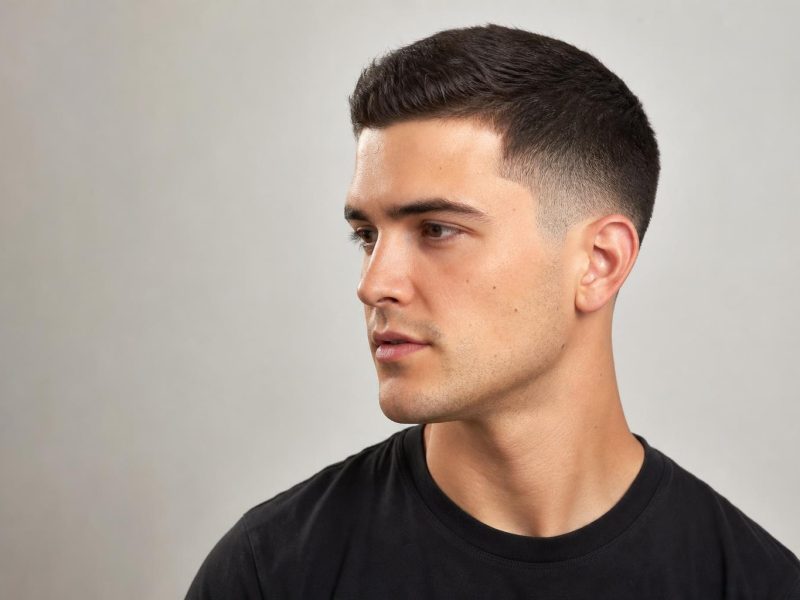
| Low fade | Bare blade at the base up to #2 by the temple | Left to scissor length | Every 2 to 3 weeks |
| Mid fade | Bare blade or #0 rising to #3 at the parietal ridge | Left long, styled separately | Every 2 to 3 weeks |
| Taper only | #2 or #3 overall, shorter only at the neckline and sideburns | Unchanged | Every 4 to 6 weeks |
| Grown-out clipper cut | #4 or #5 | #7 or #8 | Every 6 to 8 weeks |
A fade is defined by where the shortest length stops climbing, not by which guard starts it. That is the practical difference between a low fade that stays just above the ear and a mid fade that reaches the temple, and it is why asking for “a two fade” leaves the most important decision unmade.
Hair Density and Texture Change What a Guard Number Delivers
The same guard produces noticeably different results on different heads, which is the part the charts never mention. Coarse, dense hair at a #1 stands upright and holds a solid block of color with no scalp visible. Fine or sparse hair at the same #1 lets light straight through to the skin, so it appears two shades lighter and considerably shorter than expected. If your hair is fine, go one guard longer than the chart suggests for your first attempt.
Curly and coily hair behaves differently again, because the clipper cuts the curl at its compressed height rather than its stretched length. A #3 on tight curls produces a shape with real presence, where the same guard on straight hair lies flat against the head. That is why a taper fade on curly hair usually needs longer guards on top than a straight-haired version of the same cut.
A thinning crown deserves a separate note. Short guards make thinning more obvious, not less, because they remove the length that was providing coverage and reveal the density difference between the crown and the sides. Going shorter overall is still often the better answer, since it removes the contrast, and the honest version of that conversation belongs with your barber before the clipper starts. Our guide to cuts built around a thinning crown covers where the trade-offs actually land.
How to Ask a Barber for a Specific Length
A complete request has four parts: the guard on the sides, where the guard changes, what happens on top, and what you want at the neckline. Leave any one out and the barber fills the gap with a default that may not match your picture. A workable script: “Number two on the sides and back, fade it up to about the temple, leave the top at four fingers and point cut it, and give me a tapered neckline rather than a blocked one.”
Three specific words are worth learning because they change the outcome more than the guard number does. A blocked neckline is cut in a straight horizontal line, which looks sharp for two weeks and grows out visibly. A tapered neckline follows your natural hairline down and grows out cleanly. A line-up or edge-up squares off the front hairline and temples, and it is a separate request from the fade itself.
Barber tip: Ask your barber to write your guard numbers and fade height on your file or a card, including whether the lever was open or closed for each pass. Six weeks later that note is more reliable than either of your memories, and it makes a new barber able to repeat the cut on the first visit.
When a Guard Number Is the Wrong Way to Ask
Guard numbers describe uniform clipper work, and several common requests are not that. Skip the number and describe the outcome in these cases:
- Anything on top longer than about an inch. Above a #8 you have left clipper territory entirely, and the top should be cut with scissors or clipper-over-comb. Ask in finger-widths or inches instead.
- A skin fade or bald fade. The shortest part uses a bare blade or a foil shaver, not a guard, so asking for “a zero fade” is close but imprecise. Say skin fade and point to where you want the skin to stop.
- Textured or choppy tops. Guards produce a flat, even surface by design. If you want movement, ask for point cutting or thinning through the top after the clipper work is finished.
- Very curly hair where shrinkage is unpredictable. Ask the barber to cut a small test section at the guard you have in mind and check it before committing to the whole head.
- Your first appointment with a new barber. Start one guard longer than your usual and adjust down in the chair. Adding length back is the one thing nobody can do.
Common Clipper Size Mistakes at Home
Mistake: Cutting Wet Hair With Clippers
Clippers are built for dry hair, and wet hair clumps, drags, and pulls through the blade unevenly. Wet hair also hangs longer than it will when dry, so the length you leave looks correct in the mirror and turns out shorter once it dries and lifts. Wash the night before, dry fully, and comb through before the first pass.
Mistake: Working Against the Grain on the First Pass
Go with the growth direction first to remove the bulk evenly, then make a second pass against the grain only if you want it shorter than the guard nominally delivers. Cutting against the grain immediately removes more than the guard number suggests, which is how a planned #2 ends up looking like a #1. On the crown, where growth patterns swirl, work in several directions and keep the clipper flat against the head.
Mistake: Buying a Guard Set and Skipping the Lever
Most home cuts have a visible step where two guards meet, and the reason is almost always an unused taper lever. Run each guard twice, once with the lever closed and once open, and use the open pass to soften the boundary above it. That single habit does more for a home haircut than an expensive clipper does, and it is what makes a simple all-over buzz look barbered rather than shorn.
FAQ
What Length Is a Number 2 Clipper Guard?
A #2 leaves a quarter inch of hair, or 6mm. It is the most requested guard for the sides of a fade because it is short enough to be tidy and long enough that no scalp shows through on most hair colors. On very fine or light-colored hair a #2 can still show scalp, so a #3 is a safer first choice in that case.
What Is the Difference Between a Number 1 and a Number 2?
One eighth of an inch, or about 3mm, and it is the most visually significant single step in the range. At a #1 you are at 3mm and the scalp begins to show through, especially at the crown and temples. At a #2 you are at 6mm and the hair covers the skin as a solid block. If you are deciding between them for a first buzz cut, start at #2.
Which Clipper Guard Is Best for a Buzz Cut?
A #3 or #4 is the most forgiving choice for a first buzz cut, since half an inch of hair hides an uneven scalp, old scars, and any density differences. Military-style induction cuts use a #0 or #1, which shows everything underneath. Most people who go straight to a #1 wish they had started at #3 and worked down over two or three cuts, which is a genuinely reversible way to find your length.
Do All Clipper Brands Use the Same Guard Sizes?
Most consumer guard combs follow the eighths-of-an-inch pattern, and the numbering is not a formal standard. Andis, Oster, and Wahl sets can differ, travel kits often skip sizes, and detachable blades use an entirely separate numbering system where #000 and #0000 cut far shorter than any comb. Quote millimeters when precision matters, since that number means the same thing on every machine.
How Often Do I Need to Recut a Clipper Cut?
Hair grows about half an inch a month, so a #1 doubles its length in roughly two weeks and a #4 takes closer to four. Fades need the most frequent attention because the whole effect depends on the gradient staying tight, and a fade looks noticeably grown out around week three. A simple taper on a #3 or #4 holds its shape for five or six weeks.
Can I Use Clipper Guards on My Own Hair at the Back?
You can manage the back at a single uniform guard, and blending two guards back there without seeing what you are doing is where most home cuts go wrong. Use two mirrors, work in overlapping passes, and keep the clipper flat rather than tilting it. For a graduated result rather than one length, it is worth paying a barber for the shape once and maintaining it yourself between visits.
What Guard Should I Use on the Top of My Head?
Anything from a #4 upward, depending on how much length you want to style, and a #6 to #8 if you want to comb it. Below a #4 on top you are into buzz cut territory where the top and sides look like one length. If you want any texture or movement up there, finish with scissors after the clipper pass rather than trying to build it with guards. Our roundup of very short cuts for men shows where each of those top lengths lands.
Understanding hair clipper sizes turns a guessing game into a specific request: pick your millimeters, decide where the fade stops climbing, name the neckline you want, and say what happens on top. Note the numbers that worked after your next cut, take a photo a week later, and you will never have to rely on a barber’s interpretation of “short on the sides” again.
Hair results vary based on your natural hair type, texture, density, and condition. Always consult with a licensed hairstylist before making significant changes, especially with chemical treatments or dramatic length changes. Photos may show styled results that require professional tools and products to replicate.



4 responses