

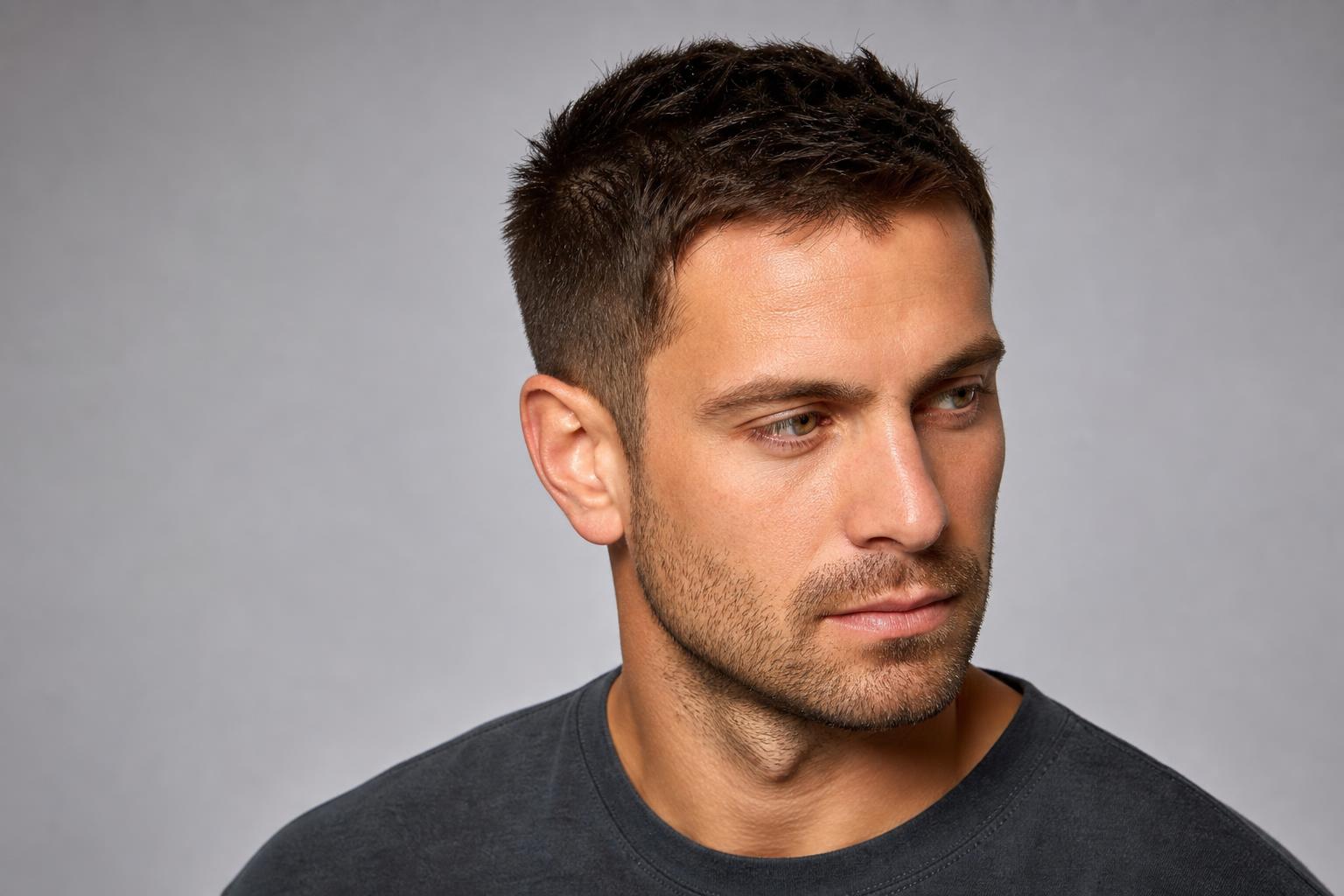
Very short means anything from bare clipper stubble to about two inches, and the guard number you pick matters more than the name of the cut.
Very short haircuts for men run from a guard zero, which leaves bare stubble, up to roughly two inches on top, which is the point where a cut starts needing product to hold a shape. Everything in that range shares one thing: the shape of your head does more work than the haircut does, because there is no length left to disguise anything. Below are 28 cuts arranged by how much hair they leave, starting with clipper-only styles and finishing with the versions built for thinning and grey hair.
The guidance sections after the photos cover the guard number ladder in millimeters, which head and face shapes each length flatters, and the honest visit frequency for each. If you want the fade underneath kept conservative rather than taken high, the low fade haircut gallery covers that blend in detail.
| Guard | Length Left | Scalp Visibility | Best For |
|---|---|---|---|
| 0, no guard | Under 1 mm | Fully visible | Even scalp tone, a well-shaped skull |
| 1 | About 3 mm | Clearly visible | Hot climates, high contrast against the skin |
| 2 | About 6 mm | Slightly visible | The default all-over buzz, most forgiving of the short end |
| 3 | About 10 mm | Mostly covered | Thinning hair that still needs some coverage |
| 4 | About 13 mm | Covered | Enough length for texture to read as a cut, not a clip |
| 5 to 6 | 16 to 19 mm | Covered | A crop with an actual shape rather than a buzz |
Clipper-Only Cuts
These are cut entirely with clippers and a guard, with no scissor work on top. They are the fastest cuts in any barbershop, usually ten to fifteen minutes, and the only decision you make is the number. What separates a good one from a bad one is the neckline and the hairline, because with nothing on top, the edges are the only place a barber can show skill.
1. Guard Zero Induction Cut
The clippers run over the whole head with no guard fitted, leaving hair at roughly the length of a day-old shave. Nothing is blended and nothing is shaped, which is what separates this from a shaved head done with a razor. Scalp sunscreen becomes a real requirement at this length, because there is no hair left to filter anything.

2. Guard One Buzz Cut
Three millimeters is short enough that your skull shape shows through completely, which rewards an even, rounded head and punishes a flat back or a prominent occipital bone. Oval and square faces carry it most easily, since both already have proportions that do not need help from hair.

3. Guard Two Buzz Cut
Six millimeters is the length where hair color starts to register again instead of reading as shadow, so this is where a buzz stops looking severe. Coarse, dense hair holds an even surface at this length, while very fine hair can still look patchy where density drops off. It is the most requested buzz length in most barbershops for exactly that reason.

4. Guard Three Buzz Cut with a Taper
Run a damp towel over the top after clipping to knock down the static that a fresh buzz always carries, then leave it alone. The top goes to a guard three while the sides step down to a two around the ears, which gives the head a slightly narrower outline. There is no product step, which is the entire appeal of a buzz cut with a tapered edge.

5. Guard Four Buzz Cut
At thirteen millimeters there is enough hair that regrowth blends instead of appearing as a change in color, which stretches the gap between visits to four or five weeks. That makes this the cheapest very short cut to run over a year despite leaving the most hair, and it is where the guard four buzz earns its following.

6. Salt and Pepper Buzz Cut
Mixed grey and dark hair gains contrast at very short lengths, because the white strands catch light against the scalp while the dark ones disappear into it. A guard two or three shows that mix most clearly; anything shorter flattens both into the same grey tone.
7. Buzz Cut with a Shaped Hairline
Ask for a buzz at your chosen guard plus a line up at the front and temples, and say whether you want the corners squared off or left following your natural growth. Squared corners look sharper for about ten days and then grow out as a visible step. The shaped lines and patterns barbers razor in all start from this same edge work.

Very Short Cuts with a Cut-In Shape
Once scissors get involved on top, a very short cut starts having a front, a crown, and a direction. These sit between one and two inches, which is enough for a barber to build a fringe or a slight lift without the hair needing daily work. Most take under three minutes to style and a small amount of matte product.
8. Butch Cut with a Blunt Front
Unlike a buzz, which runs one guard over the whole head, the butch keeps the top at a uniform half inch and squares the front hairline off flat rather than following its natural curve. That flat front is the difference, and it gives the cut a deliberate edge a plain buzz cannot produce. Thick, straight hair holds the squared shape best.

9. Classic Crew Cut
The crew is graduated: about an inch and a half at the front hairline, tapering down to a quarter inch by the crown, so the top slopes backward. That slope is cut with scissors over comb rather than clippers, which is why a good crew costs more and lasts longer than a buzz.

10. Ivy League Cut
An Ivy League is a crew cut with enough length left at the front to take a side part, roughly two inches, which draws a diagonal line across the forehead. Square and round faces both benefit, because that diagonal breaks up the horizontal width they carry. Long, narrow faces should keep the part shallow so the sides do not flatten further.

11. French Crop
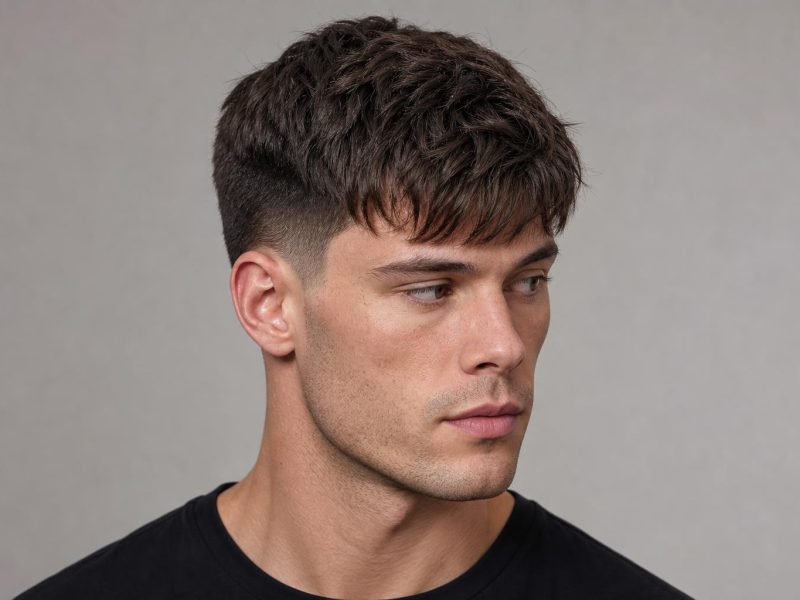
Fine and thinning hair does well here because the fringe is cut blunt and pushed forward over the hairline, which puts the densest hair you have at the most visible point. The top runs about an inch and a half and the back and sides go to a guard one or two. Thick, coarse hair needs internal thinning first or the fringe forms a solid block.

12. Textured Crop with a Choppy Fringe
Towel-dry, then work a fingertip of matte clay through the top from back to front, pushing the fringe forward and breaking it into pieces with your fingertips. The cut itself is point cut heavily so the ends separate rather than falling as one edge. Two minutes in the morning is the whole routine.

13. Caesar Cut with a Straight Fringe
The Caesar keeps everything at one length, about an inch, combed forward into a straight line across the forehead, which means grow-out happens evenly with no shape to lose. Trims every five weeks keep the fringe from creeping into the eyebrows, and that is the only upkeep it asks for.
14. Platinum Bleached Crop
Bleaching is far kinder at very short lengths, because the hair being lifted is only a few weeks old and has never seen heat or friction. A crop at an inch and a half takes platinum in a single session on most dark hair, where the same lift on long hair would need two or three. Regrowth shows at three weeks, so budget for a root touch-up on the same visit as the cut.
Very Short Cuts for Curly, Coily, and Wavy Hair
Curly and coily hair shrinks when it dries, so two inches of curl hangs like about three quarters of an inch, which changes every length judgment in this article. Cutting dry is not optional here, because a barber working on wet curls is guessing at where the hair will finish. The versions below keep enough length for the pattern to show while staying inside the very short range.
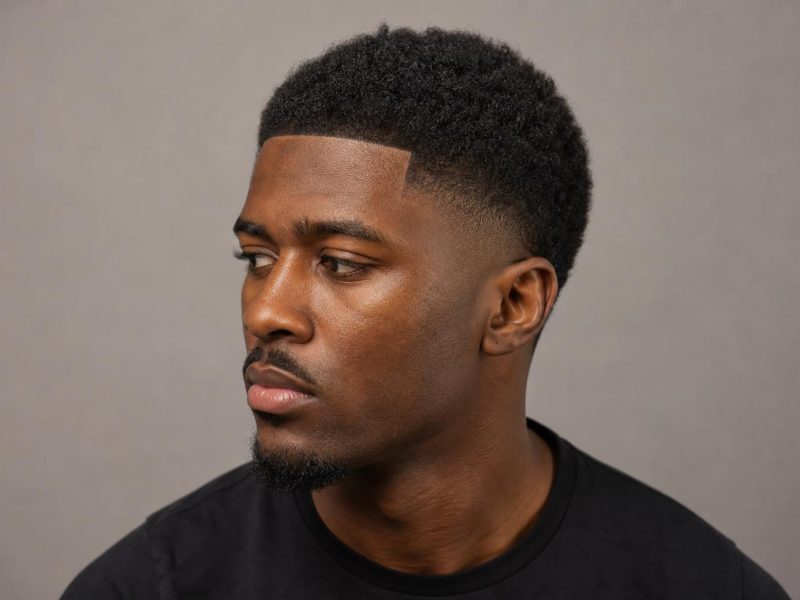
15. Short Curly Crop with a Line Up
Ask for the top left at about two inches unstretched, cut dry, with a line up across the front and a taper at the sides rather than a hard fade. The words that matter are cut it dry and do not stretch my curls, because stretching while cutting is how men end up an inch shorter than they wanted.

16. Cropped Curls with a Taper
A taper leaves the sides soft and gradual where a fade takes them to a hard line, and on curls the softer edge keeps the head from looking like two separate textures stacked on each other. The top stays around an inch and a half of curl. Choose the fade version only if you want the curl pattern to end abruptly rather than thin out.

17. Twist-Out Cut Kept Short
The hair is twisted in small sections while damp, left to dry, then unraveled to leave defined coils about an inch and a half long. Cutting happens after the twist-out is unraveled, so the barber shapes the curls at their finished volume rather than guessing.

18. Short Afro Under Two Inches
A rounded afro kept under two inches adds a small amount of height without width, which suits long and rectangular faces better than the wider versions do. Round faces get more from a flat-topped shape that builds a vertical line instead.

19. Waves Cut to a Guard Two
Wave patterns need coarse, tightly coiled hair to form at all, and six millimeters is roughly the shortest length that still shows a defined ripple. Straight or loosely wavy hair will not produce this pattern at any guard length, no matter how much brushing goes in.

20. Short Wavy Crop Left Loose
Scrunch a curl cream into damp hair with your palm, then leave it to air-dry without touching it again, since handling wavy hair while it dries is what turns waves into frizz. The crop is cut to about two inches so the wave has room to form one full bend.

21. Cropped Coils with a Shaped Neckline
A shaped neckline holds its line for about two weeks on coily hair before regrowth softens it, which is the real clock on this cut rather than the length on top. Ask for a rounded neckline instead of a blocked one if you want to stretch that to three or four weeks, because a rounded edge blurs as it grows while a squared one breaks.

Very Short Cuts for Thinning Hair and Grey
Very short cuts are the standard answer to thinning because they remove the contrast between dense areas and sparse ones, and contrast is what makes thinning visible rather than the thinning itself. The trick is picking a length short enough to flatten that difference but long enough to keep some coverage. Guard three or four is usually that window, and there are cuts shaped specifically around a thinning crown worth comparing before committing.
22. Silver Crop Grown to an Inch
Fully silver hair looks denser at an inch than at a guard two, because white hair against a pale scalp gives almost no contrast and needs length to register as hair at all. Keep the top at an inch and the sides at a guard two so the outline stays defined.

23. Short Cut for a Receding Hairline
Tell your barber to follow your natural hairline rather than cutting a straight line across it, because a squared line up on a receding hairline draws a hard border around exactly the area you want to be less obvious. Ask for the front left slightly longer than the crown so there is something to comb forward.

24. Buzz Cut for a Thinning Crown
Where a crop tries to cover a thinning crown and usually fails, a uniform buzz stops competing with it entirely, and the sparse patch reads as part of an even surface rather than a gap. A guard two or three does this best, since a guard one exposes the scalp everywhere and cancels the effect.

25. Shaved Head with a Defined Edge
This one uses a foil shaver over the whole scalp rather than clippers, taking the hair fully to skin, then the barber cleans the sideburn and neck edges with a straight razor. Those two edges are what separates a deliberate shaved head from simply not having hair.

26. Short Cut for a Diamond Face Shape
A diamond face is widest at the cheekbones and narrow at both the forehead and the chin, so the goal is width at the top rather than height. Keep about an inch and a half on top with a soft forward fringe, which broadens the forehead, and avoid taking the sides to skin. The same balancing logic applies to triangle and diamond face shapes more generally.

27. Short Cut for Fine Straight Hair
Fine hair looks thickest when it is cut blunt and kept short enough that its own weight cannot flatten it, which lands at about an inch to an inch and a half. Avoid any thinning or texturizing on fine hair at this length, because removing weight from strands that are already thin leaves visible gaps.

28. Cropped Top Styled Forward for Density
Dry the top forward from the crown with a hairdryer on low, aiming the air against the growth direction, then press a small amount of matte powder into the roots. Styling hair forward makes it overlap rather than lie flat, which puts more strands over the same patch of scalp. This takes about ninety seconds and does more for apparent density than any product claim.

How to Match a Very Short Cut to Your Head and Face Shape
At these lengths there is almost no hair left to correct proportions with, so the shape of your skull becomes part of the haircut whether you planned for it or not. The one lever you still have is where the small amount of remaining length goes: forward for a wider forehead, up at the front for a longer face, flat for a narrower outline.
| Face Shape | Best Very Short Cut | Length on Top | Avoid |
|---|---|---|---|
| Oval | Almost anything, buzz through crop | Guard 1 to 2 inches | Nothing structural |
| Round | Crew cut or Ivy League with front height | 1.5 to 2 inches | A uniform guard 1 or 2, which removes every vertical line |
| Square | French crop or textured crop | 1 to 1.5 inches | A guard 0 plus a squared line up, doubling the angles |
| Heart | Textured crop with a forward fringe | 1.5 to 2 inches | Shaved sides with nothing left on top |
| Oblong or long | Caesar with a blunt fringe | 1 to 1.5 inches | Height at the front over very tight sides |
| Diamond | Crop with a soft forward fringe | 1.5 inches | Sides taken to skin, narrowing the head further |
Stylist tip: Run your hand over the back of your head before booking a guard one or shorter. A pronounced occipital bone or a flat back of the skull is invisible under an inch of hair and obvious under three millimeters, and it is the single most common reason men regret going shorter than a guard two.
What to Tell Your Barber
Give a number, not an adjective. Short means something different to every barber, while guard two on the sides, an inch on top, and a rounded neckline means one thing only. A complete request reads: “Guard two on the back and sides, scissor cut to about an inch on top, rounded neckline, and follow my natural hairline at the front.”
The neckline is worth deciding in advance because it outlasts everything else about the cut. A blocked neckline is squared straight across and looks sharpest for the first week, a tapered one fades gradually into the neck and stays tidy longest, and a rounded one sits between them. If you go more than three weeks between visits, ask for tapered every time.
Stylist tip: Ask for a guard one number longer than you think you want on the first visit. Clippers can always take more off in the chair, and the two minutes it costs to go shorter is nothing against the six weeks it takes to undo a cut that went too far.
Maintenance and Real Visit Frequency
Here is the part that surprises most men who switch to a buzz: a very short cut is not the cheapest option over a year. A guard one needs the barber every two weeks, which is roughly 26 visits, while a two-inch crop trimmed every six weeks needs about nine. The shorter the cut, the more visible a millimeter of regrowth becomes, and the clock speeds up accordingly.
| Cut | Barber Visit | Daily Styling | Products | Grow-Out |
|---|---|---|---|---|
| Guard 0 to 1 | 1 to 2 weeks | None | Scalp SPF, light moisturizer | Loses its edge within days |
| Guard 2 to 3 | 2 to 3 weeks | None | None needed | Blends evenly, no awkward stage |
| Crew or Ivy League | 3 to 4 weeks | 1 to 2 minutes | Matte paste | The graduated slope flattens first |
| French or textured crop | 4 to 5 weeks | 2 to 4 minutes | Matte clay, sea salt spray | The fringe reaches the eyebrows by week five |
| Short curls or afro | 3 to 4 weeks | 3 to 8 minutes | Curl cream, wide pick, satin bonnet | The outline softens before the length matters |
When a Very Short Cut Is the Wrong Call
Four situations where going this short works against you, each with what to do instead.
- You have scars, moles, or uneven pigment on the scalp. Anything under a guard two puts them on display. A guard three or four covers most surface marks while still counting as very short.
- Your head is flat at the back or has a pronounced occipital bone. Very short cuts trace the skull exactly. Keep one to two inches on top and let a slight lift at the crown fill the outline instead.
- You have a round face and want it to look narrower. A uniform buzz removes the only vertical line available to you. A crew cut with front height does the opposite job for the same amount of maintenance.
- You have curly or coily hair and want a defined shape. Under about an inch, the curl pattern stops registering and the cut becomes texture without form. Keep an inch and a half minimum, or look at longer cuts built around curly texture.
FAQ
What Is the Shortest Haircut a Barber Can Give?
A full razor shave to bare skin is the shortest, followed by a guard zero clipper cut, which leaves about a millimeter of stubble. The practical difference is upkeep: a razor shave needs redoing every two or three days, while a guard zero holds for about a week. Most men who want the shaved look use clippers with no guard rather than a blade, because the maintenance is manageable.
Does a Very Short Haircut Make Thinning Hair Look Worse?
Usually the opposite, as long as you stop at a guard two or three rather than going to skin. Thinning is visible because of the contrast between dense and sparse areas, and cutting everything to one short length removes most of that difference. Going all the way to a guard one or zero undoes the benefit, because the scalp then shows everywhere and the sparse patches become visible again.
Which Guard Number Should I Ask For?
Guard two, about six millimeters, is the safest first choice for anyone who has not had a very short cut before. It is short enough to count as a buzz but long enough that hair color still shows and the scalp stays mostly covered. From there you can go to a one next time if you want more contrast, or up to a three or four if you found it too exposing.
Do Very Short Haircuts Work on Curly Hair?
Yes, though the length rules shift because curls shrink as they dry. Two inches of curl hangs at roughly three quarters of an inch, so what looks very short on curly hair is longer in measured terms than the same look on straight hair. Ask for the cut to be done on dry, unstretched hair so the barber shapes what you will actually walk out with.
How Often Do I Need a Very Short Haircut Trimmed?
Every one to two weeks at a guard zero or one, two to three weeks at a guard two or three, and four to five weeks for a crop with scissor work on top. Hair grows about half an inch a month, so the shorter the starting point, the larger the proportional change each week brings. A guard one grows into a guard three in six weeks, which is a completely different haircut.
Will a Buzz Cut Suit My Head Shape?
A buzz suits an evenly rounded skull with no flat spots and looks least flattering on a head that is flat at the back or angular at the crown. Feel the back of your head with your palm before booking, because that area is the one you never see and the one a buzz exposes most. If you find a pronounced ridge or a flat plane, keep an inch on top instead.
Does Hair Grow Back Thicker After a Buzz Cut?
No, cutting hair has no effect on how it grows, since growth happens at the follicle well below the skin. What changes is the shape of the end: a hair that has never been cut tapers to a fine point, and clipping it leaves a blunt end that feels coarser to the touch. That blunt end is also stiffer, so short hair stands up rather than lying down, which adds to the impression of density.
Choosing among very short haircuts for men comes down to two numbers rather than a style name: the guard on the sides and the inches left on top. Decide those before you get in the chair, feel the back of your head first, and start one guard longer than you think you want. You can always go shorter in the same appointment, and that is not true in reverse.
Hair results vary based on your natural hair type, texture, density, and condition. Always consult with a licensed hairstylist before making significant changes, especially with chemical treatments or dramatic length changes. Photos may show styled results that require professional tools and products to replicate.


2 responses