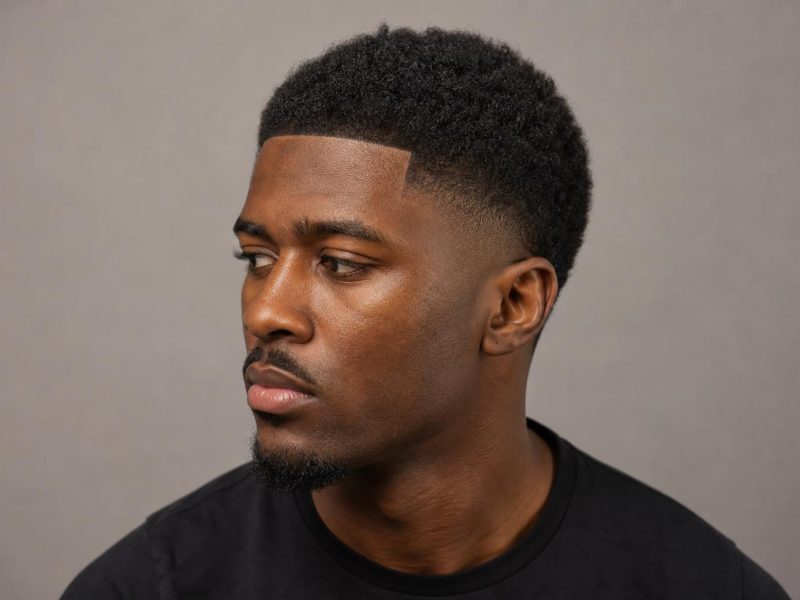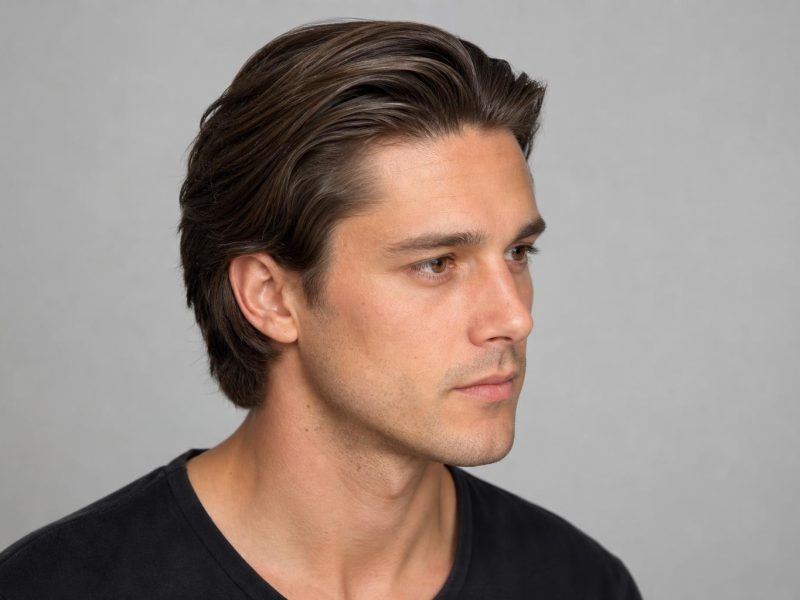

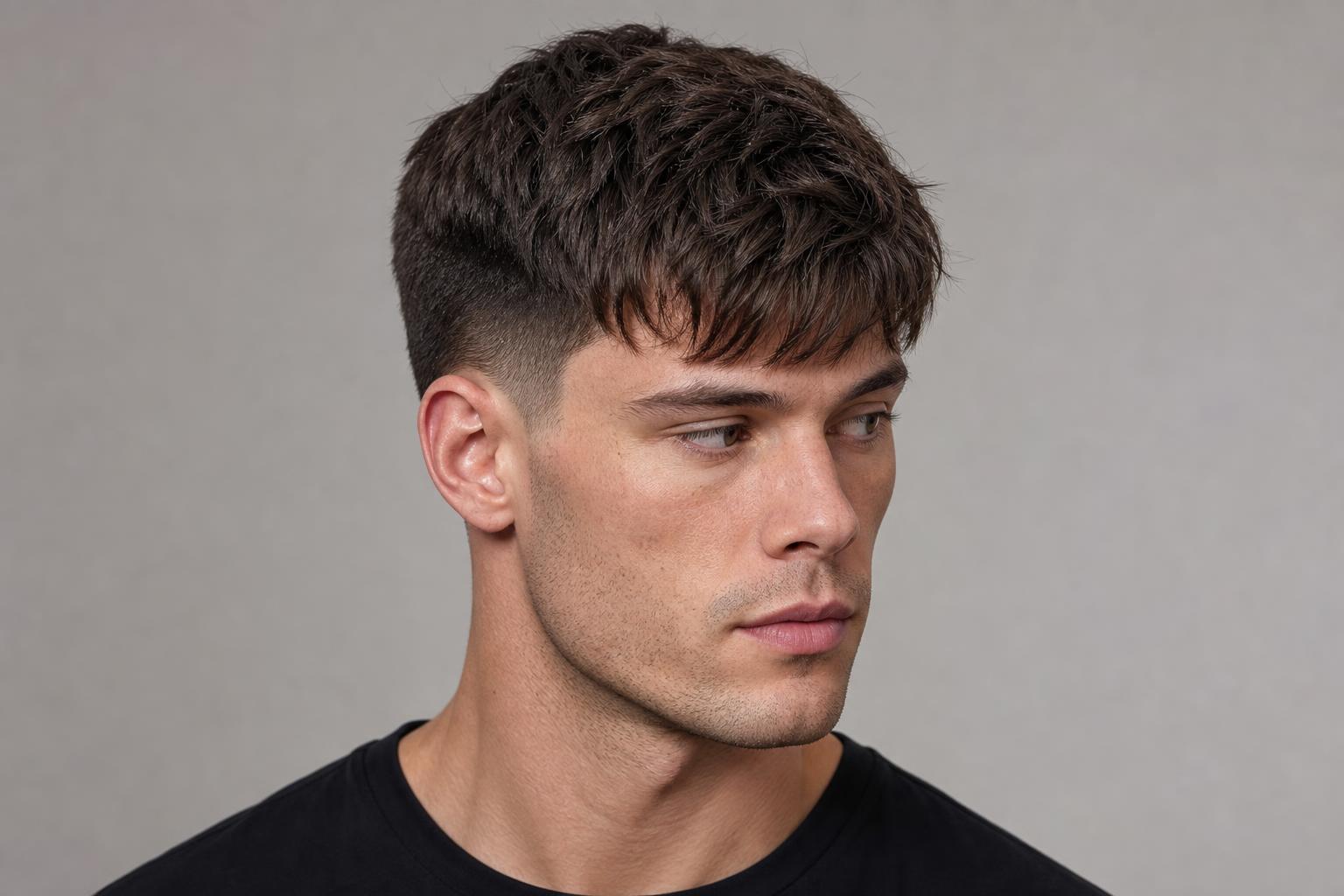
A textured crop is a short back and sides with 1.5 to 3 inches left on top, cut with point-cut separation and worn forward into a broken fringe.
The cut works because the weight sits forward instead of on top, so it holds shape on fine hair and stops thick hair from mushrooming out at the sides. Two decisions define every version: how high the fade climbs, and how long the fringe falls. Get those two right at the consultation and the rest is finishing product. Below are 25 variations sorted by fade height and fringe length, each with the detail that separates it from the one before.
After the gallery there is a face shape breakdown, a comparison against the French crop and the Caesar it gets confused with, exact wording for the barber’s chair, realistic upkeep numbers, and an honest list of the hair types this cut fights against.
| Factor | Details |
|---|---|
| Best for | Straight to wavy hair of any density; oval, oblong, and square faces |
| Length on top | 1.5 to 2 inches short, 2.5 to 3.5 inches for a heavier fringe |
| Maintenance | Barber every 3 to 5 weeks with a skin fade, 6 to 8 weeks with a taper |
| Daily styling | 2 to 5 minutes; matte clay or paste on damp hair, no blow-dryer needed |
| Avoid if | You have a strong front cowlick, a very round face, or tight 4b to 4c coils |
| Barber time | 30 to 45 minutes including the fade and fringe detailing |
Short Crops with Skin and High Fades
Taking the sides down to skin or a zero guard puts maximum contrast between the sides and the top, which makes even a modest 1.5-inch fringe read as substantial. This group suits men with strong jawlines and anyone whose hair grows thick at the sides, because the tight sides stop the shape widening. All of these need a barber visit every three to four weeks to stay sharp.
1. Skin Fade Crop with a Blunt Micro Fringe
Barbers build this by taking the sides to bare skin at the temple and leaving a hair over an inch on top, then cutting the front edge straight across about two fingers above the brow. The near-total contrast between skin and fringe is what carries the cut, so it needs a fresh fade to look deliberate rather than grown out.
2. High Fade Crop with Point-Cut Separation
Point cutting into the ends removes bulk without shortening the fringe, which is how the top splits into visible pieces instead of sitting as one solid block. Thick straight hair benefits most here, since the technique takes out the density that would otherwise make the top look helmet-like. Ask for the texture through the interior, not just the perimeter.
3. Cropped Fringe for Oblong Faces
A long face gains balance from a fringe worn low and flat rather than pushed up, because the horizontal line across the forehead visually shortens the shape. Keep the top at roughly two inches and the sides high and tight so the width stays in the upper third of the head. This is a small adjustment that changes the proportion considerably.
4. Skin Fade with a Razored Top
Razor work slices the ends at an angle instead of blunting them, giving a softer, wispier finish than shears produce. It suits medium-density straight hair; on fine hair the razor removes too much and leaves the fringe see-through. Bring it up specifically, because most barbers default to shears unless asked.
5. High Fade Crop with a Hard Part
A shaved line carved from the temple back gives the cut a defined structural break that photographs well and holds its clarity for about ten days. It works best when the fade is high enough for the line to sit on genuinely short hair. Expect to book a line touch-up between full cuts if you want it crisp year-round.
6. Textured Crop with a Burst Fade
Instead of running straight around the head, the fade arcs around the ear and leaves weight at the nape. The result reads softer at the back while keeping the sides tight, and it pairs well with a fringe that sits just off the brow. A burst fade shape is also more forgiving through grow-out than a straight high fade.
7. Crop with a Disconnected Top
Nothing blends here. The sides stop at one length, the top starts at another, and the hard step between them is the whole point. Fine hair looks denser under a disconnection because the eye reads the line as a boundary rather than a gradient, though the grow-out at week five is noticeably awkward.
Mid and Low Fade Crops for a Softer Line
Dropping the fade to mid or low height keeps some weight above the ear, which softens the whole silhouette and suits offices where a skin fade reads as too severe. These variations also stretch the gap between appointments, because a lower fade blurs as it grows rather than developing a visible line. Most men find this the more practical group.
8. Mid Fade Crop with a Forward Fringe
The mid fade starts around the temple and gives the most balanced version of this cut, with enough contrast to look modern and enough length at the sides to avoid scalp shine. Two and a half inches on top falls forward naturally with no product beyond a light clay. This is the version to ask for if you are unsure which fade height suits you.
9. Low Taper Crop for Fine Hair
Fine hair loses the illusion of density under a high fade, since the exposed scalp above the ear reads as thinner than it is. Keeping a low taper that only tightens at the very bottom preserves the visual bulk. Pair it with blunt rather than heavily texturized ends on top.
10. Crop with a Curtain-Split Fringe
Growing the fringe to three inches and splitting it slightly off-center gives a softer front line that sits between a crop and a curtain cut. Wavy hair falls into the split without help. On straight hair you need to dry it forward and then part it with your fingers while it cools.
11. Matte Crop for Oily Hair
Scalp oil kills the separation this cut depends on, flattening the pieces into strands by lunchtime. A clay-based product with a high kaolin content absorbs oil through the day rather than adding to it. Skip anything labeled pomade or cream if your hair goes greasy fast.
12. Crop with a Blocked Neckline
A squared-off nape gives a cleaner, more formal finish than the tapered neckline most barbers default to, though it grows out with a visible line within two weeks. Men with a straight natural hairline at the back get the most out of it. Say “blocked” specifically, because tapered is the standard.
13. Textured Crop with a Drop Fade
The fade line curves down behind the ear following the skull’s natural shape, which flatters heads that are flat at the back. Combined with a short crop it gives a rounder, more finished profile from the side. A drop fade also hides an uneven occipital bone better than a straight line does.
14. Grown-Out Crop with Soft Edges
Not every version needs a fade at all. Scissor-cut sides tapered by hand give a lived-in shape that passes for deliberate at any point in the grow-out cycle, and it stretches appointments to eight or nine weeks. The trade-off is that it never looks as sharp on day one.
Longer Crops with a Heavier Fringe
Past about three inches the top stops behaving like a crop and starts behaving like a fringe cut, which changes the styling demands. These need more product and usually a rough blow-dry, but they cover more forehead and give the most flexibility day to day. Anyone with a receding hairline should look here first.
15. Heavy Fringe Crop Covering a High Hairline
Three and a half inches of forward-directed length reaches the brow and disguises a receding front line better than any shorter cut can. The weight has to be kept in the fringe itself, so the crown gets cut shorter to stop the whole shape looking top-heavy. Barbers call this over-directing, and it is worth naming.
16. Choppy Crop with Visible Layers
Cutting the top in distinct steps rather than one graduated line creates deliberate unevenness where shorter pieces sit above longer ones. Coarse hair holds these steps without product; fine hair needs a texture powder at the roots to keep them apart. The look is closer to a textured fringe than to a classic crop.
17. Side-Swept Crop for Square Jaws
Angling the fringe across the forehead instead of straight down breaks up the horizontal lines that a strong square jaw already provides. The diagonal softens the face without losing the cut’s structure. Ask for the fringe to be cut on a slight bias so it falls that way on its own.
18. Crop with a Faded Fringe Edge
Barbers graduate the fringe so it is shortest at the outer corners and longest in the center, which creates a subtle arc across the forehead rather than a flat line. It is a small detail that stops a heavy fringe looking like a bowl cut. Photographs of the front are the easiest way to communicate it.
19. Messy Crop with Sea Salt Texture
Sea salt spray on damp hair, rough-dried with fingers, gives the gritty separation this shape wants without the weight of a wax. Wavy hair takes it best. The finish is deliberately imperfect, which also means it survives wind and a hat far better than a sculpted version.
20. Long Crop with a Faded Beard Connection
Blending the sideburn into the beard line turns the crop and the beard into one continuous shape, which lengthens a round face and balances a heavy fringe. It only works if the beard is dense enough at the cheek to hold a fade. Book the beard and the cut together so one barber controls the transition.
Textured Crops for Curly, Coarse, and Thinning Hair
The standard textured crop is cut for straight to slightly wavy hair, and applying the same technique to curls or a thinning crown produces a shape nobody wants. These five variations adjust the cutting method rather than the name, and they are worth asking for by their differences rather than trusting a barber to adapt on the fly.
21. Curly Crop Cut Dry at Natural Length
Curls need to be cut dry so the barber can see where each one actually sits, since wet curly hair can spring up two inches once it dries. On 2c to 3b patterns the crop shape reads as a rounded, full top rather than a flat fringe. Barbers who specialize in cutting men’s curly hair will do this without being asked; others need to be told.
22. Coarse Hair Crop with Interior Thinning
Wiry, dense hair pushes outward and turns a crop into a triangle unless weight comes out from underneath. Thinning shears used in the interior, kept well away from the perimeter and the fringe edge, remove bulk while leaving the outline intact. Overdone thinning near the ends creates frizzy spikes that never lie flat.
23. Crop for a Thinning Crown
Keeping the top short and the fringe forward draws the eye to the front and away from the crown, which is the single most useful thing a cut can do for early thinning. Longer styles do the opposite by exposing scalp when hair separates. The same logic drives most cuts built around a thinning crown.
24. Wavy Crop Air-Dried with No Product
Natural wave supplies the separation that everyone else builds with clay, so the cut can be left alone. Ask for slightly more length than you think you need, because wave shortens the apparent fall by roughly half an inch. Towel-dry, push it forward, and leave it.
25. Cropped Cut with a Line-Up and Tight Corners
Squaring the front hairline with a trimmer creates a defined frame that sharpens the whole shape, and it suits hairlines that grow in unevenly at the temples. The edge stays crisp for about a week and a half before stubble blurs it. This finish is common on Black hair textures where the natural line is dense enough to hold a clean edge.
How to Choose a Textured Crop for Your Face Shape
Fade height and fringe length are the two levers, and they work in opposite directions. A higher fade adds vertical emphasis and narrows the face; a longer fringe adds a horizontal line and shortens it. Match the combination to the proportion you want to change.
| Face Shape | Best Version | Fringe Length | Avoid |
|---|---|---|---|
| Oval | Mid fade with point-cut separation | Any, 1.5 to 3.5 inches | Nothing structural; most versions work |
| Round | High or skin fade with height kept on top | Short, worn slightly lifted | Low fades and flat heavy fringes, which widen the face |
| Square | Mid fade with a side-swept fringe | 2 to 3 inches, cut on a bias | Blunt straight fringes that double the jaw’s hard lines |
| Oblong | High fade with a low flat fringe | 2 to 2.5 inches, worn forward and down | Any style with height on top, which lengthens further |
| Heart | Low taper with a softer fringe edge | 2.5 to 3 inches, texturized at the tips | Very tight sides, which exaggerate a narrow chin |
| Diamond | Mid fade with a wider fringe across the forehead | 3 inches, spread rather than pushed together | Narrow center-weighted fringes above wide cheekbones |
Textured Crop, French Crop, and Caesar Are Three Different Cuts
These names get used interchangeably in barbershops and they should not be. All three are short on the sides with the top worn forward, but the fringe treatment differs enough that asking for the wrong one gets you a cut you did not want.
| Feature | Textured Crop | French Crop | Caesar |
|---|---|---|---|
| Fringe edge | Broken and piece-y | Blunt straight line | Short, even, close to the brow |
| Top length | 1.5 to 3.5 inches | 1.5 to 2.5 inches | 1 to 2 inches, uniform |
| Cutting method | Point cutting for separation | Blunt scissor cut on the fringe | Cut to one length across the top |
| Daily product | Matte clay or texture powder | Light cream, or none | None required |
| Best hair type | Straight to wavy, any density | Straight, medium to thick | Straight and dense; poor on fine hair |
In practice the French crop is the tidier, more formal relative, and the textured version is what you ask for when you want the same silhouette to look undone. If a barber says the names mean the same thing, describe the fringe edge instead of arguing about the label.
What to Tell Your Barber
Names get interpreted differently shop to shop. Numbers and techniques do not. Give the barber four specifics and the cut comes out the same wherever you go.
- Fade height and guard: “Mid fade, number one at the bottom blending to a two above the temple.”
- Top length in inches: “Leave about two and a half inches on top, measured at the front.”
- Texture method: “Point cut through the interior for separation, and keep the fringe edge soft rather than blunt.”
- Fringe position: “I want it falling to about two fingers above my eyebrows.”
Stylist tip: Ask the barber to cut the fringe with your head upright and your hair dry at the end of the service, not wet at the start. Wet hair sits half an inch lower than dry, and a fringe cut wet almost always ends up shorter than you asked for once it dries and lifts.
If you are switching from a longer style, book a slightly longer fringe than the photo you brought. You can take another quarter inch off at the next appointment; you cannot put it back. Barbers expect this request and most will suggest it themselves on a first visit.
Styling and Maintenance
This is one of the few modern men’s cuts that genuinely styles in under three minutes, provided the product is right. Everything below assumes towel-dried hair rather than soaking wet or fully dry.
| Hair Type | Product | Method | Barber Interval |
|---|---|---|---|
| Fine and straight | Texture powder at the roots, then a pea of matte clay | Rough-dry forward, then break up with fingertips | 4 to 5 weeks |
| Medium and wavy | Sea salt spray, light paste to finish | Spray damp, air-dry, scrunch forward once dry | 5 to 6 weeks |
| Thick and coarse | Heavier matte clay, no pre-styler needed | Warm between palms, press down and forward | 3 to 4 weeks to control bulk |
| Curly | Curl cream, then a light hold gel | Apply to soaking hair, scrunch, leave to dry | 4 to 6 weeks |
| Thinning on top | Volumizing powder only; skip creams and oils | Work into the roots, tousle forward, no combing | 4 weeks |
Stylist tip: The most common mistake is loading product onto the fringe first. Start at the crown with whatever is left on your fingertips after working the product through your palms, and let the fringe get the last of it. Product-heavy fringes separate into strings and hang flat instead of holding their broken edge.
Grow-out behavior depends almost entirely on the fade. A skin fade goes fuzzy at the edge by week three and looks unkempt by week five. A taper fade softens gradually and passes as deliberate for two months. The top itself grows more forgiving as it gets longer, since extra length falls into the fringe rather than sticking up.
When a Textured Crop Is Not the Right Cut
This cut suits a broad range of men, which is exactly why it gets recommended to people it will fight against. Four situations are worth flagging honestly.
- A strong front cowlick will push the fringe up and sideways no matter how it is cut, and no product overrides a growth pattern. A shorter, brushed-up style works with that hairline instead of against it.
- Very round faces get wider under a low flat fringe, since the horizontal line across the forehead adds to the width already there. A high fade with lift on top is the better direction.
- Tight 4b to 4c coils do not fall forward into a fringe, so the shape reads as a rounded afro with faded sides rather than a crop. That can look excellent, but it is a different cut and should be discussed as one.
- Anyone who genuinely will not use product should expect a flat top by mid-morning on straight fine hair. A tapered buzz cut gives the same low-effort tidiness with none of the daily styling.
FAQ
How Long Does Hair Need to Be for a Textured Crop?
About 1.5 inches on top is the practical minimum, since point cutting needs enough length to create visible separation. Coming from a buzz cut, expect roughly three months of growth before the shape is achievable. The sides can be cut at any point in that period without affecting the timeline.
Does a Textured Crop Work on Thin or Receding Hair?
It is one of the better options for both. Directing the weight forward covers a receding hairline, and the piece-y finish disguises low density far better than a smooth combed style, which separates and shows scalp. Keep the fringe on the longer side and skip any product that adds shine.
How Often Do I Need to Get It Cut?
Every three to four weeks with a skin or high fade, and six to eight with a taper or scissor-cut sides. The top can usually stretch to eight weeks regardless, so many men book a sides-only tidy between full cuts. Ask your barber whether they offer that shorter service, since it typically costs half the price.
What Product Gives the Most Texture Without Looking Greasy?
A matte clay is the reliable answer for most hair types, applied to damp rather than dry hair. Texture powder is stronger for fine hair but goes chalky if you use more than a light dusting. Avoid pomades and anything described as high shine, since gloss flattens the separation this cut is built on.
Can I Cut a Textured Crop at Home?
You can maintain the sides with clippers and a guard, but the top is difficult to point cut on yourself because you cannot see the interior sections you are working through. Most men who try end up with an uneven fringe cut too short. Trimming your own neckline between barber visits is a more realistic goal.
Is a Textured Crop Professional Enough for an Office?
A mid or low fade with a two-inch top reads as tidy in almost any workplace. Skin fades, hard parts, and disconnected tops push it toward the fashion end. If you are unsure, ask for a taper rather than a fade and keep the fringe edge softly cut rather than blunt.
Choosing among these textured crop hairstyle variations comes down to two numbers you can decide before you sit down: how high you want the fade and how far the fringe should fall. Save two photos from opposite ends of this gallery, show your barber both, and let them tell you which one your growth pattern will actually hold. That conversation takes a minute and saves a bad six weeks.
Hair results vary based on your natural hair type, texture, density, and condition. Always consult with a licensed hairstylist before making significant changes, especially with chemical treatments or dramatic length changes. Photos may show styled results that require professional tools and products to replicate.