

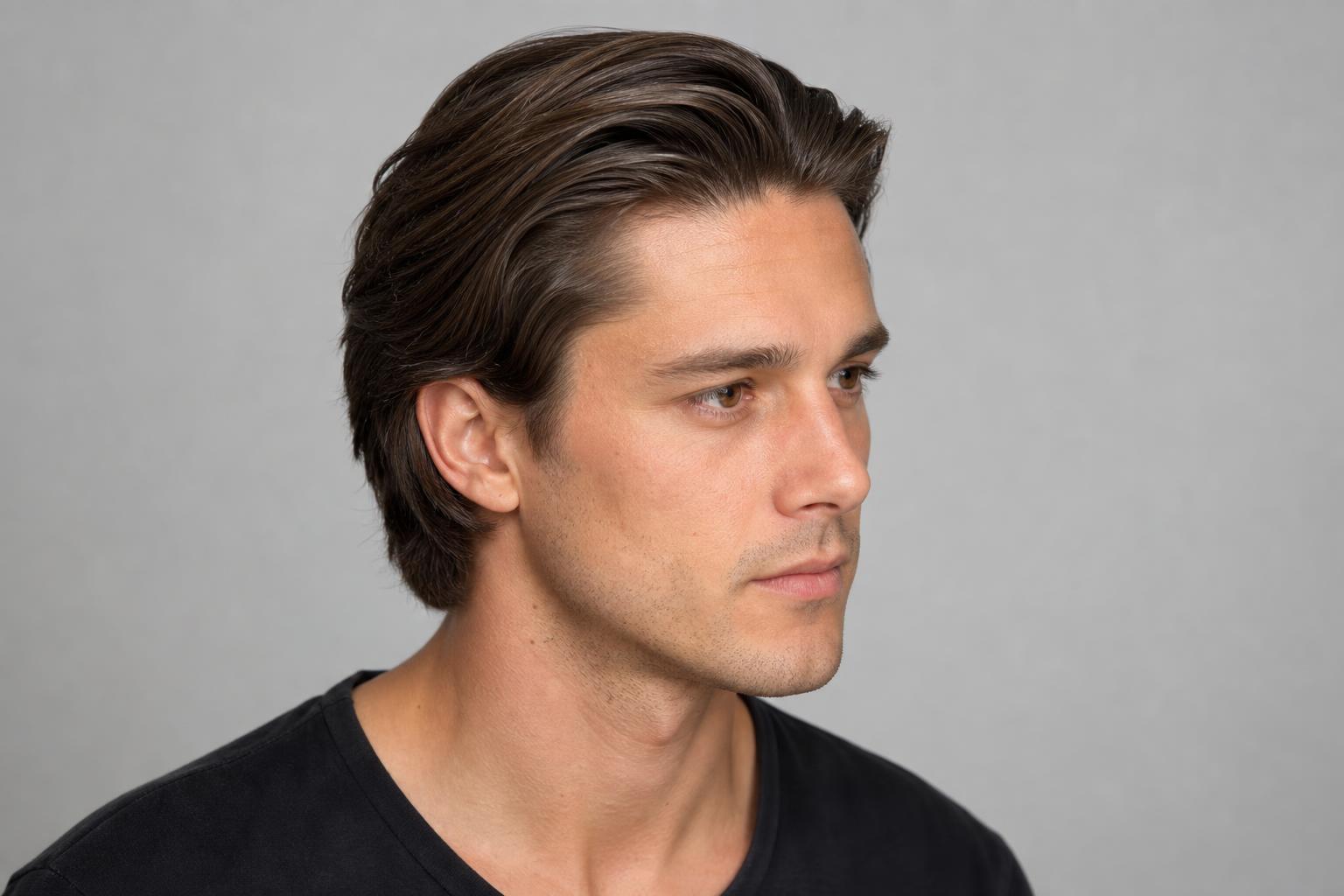
Medium length for men means roughly 3 to 6 inches on top, which is the shortest length that can actually hold a direction you choose rather than falling where it wants.
Below 3 inches the cut decides everything and you have almost no styling range. Past 6 inches the weight takes over and the hair starts behaving like long hair, which is a different set of problems. In between sits the range where a quiff, a flow, a middle part and a swept-back shape are all available from the same cut, changed by nothing more than how you dry it. Below are 30 medium-length shapes grouped by how the sides are cut and what the top does.
The gallery runs from medium tops over faded and tapered sides, through grown-out flow shapes, into volume-led quiffs and pompadours, then curtains and fringes, and finishes with versions for curly and wavy texture. After the entries you will find a growing-out timeline, the barber script that gets you this length without losing it, a realistic styling and maintenance table, and an honest note on when medium is not worth the trouble.
| Factor | Details |
|---|---|
| Length on top | 3 to 6 inches, measured at the front |
| Length at the sides | Anything from a skin fade to 2 inches, depending on the shape |
| Time to grow | 6 to 12 months from a buzz, at about half an inch per month |
| Daily styling | 2 to 8 minutes, usually involving a dryer |
| Barber cycle | 4 to 8 weeks depending on whether the sides are faded |
| Avoid if | Your hair is fine and flat, or you want a zero-product routine |
Medium Tops Over Faded and Tapered Sides
Keeping the sides short while the top runs long is the most common way to wear medium hair, because the contrast keeps the shape defined without the head widening. The choice within this group is fade height and how hard the transition is. A blended fade reads modern and needs frequent upkeep; a scissor taper reads classic and stretches the cycle considerably.
1. Four-Inch Top Over a Mid Fade
Enough length to sweep in any direction with the sides taken cleanly to a blend at the temple. It is the default medium men’s cut and suits most face shapes because the contrast adds height without a hard line. Pairing it with a mid fade cut properly through the temple is what keeps the sides from swelling as the top grows.
2. Medium Top with a Scissor Taper
No clippers anywhere, with the sides cut to about an inch and a half over a comb. Grow-out is invisible, so eight weeks between appointments is realistic instead of four. Anyone in a workplace where a fade reads too sharp lands here, and the cut still holds every medium styling option.
3. Disconnected Medium Top
The top stays long and the sides drop straight to a short guard with a deliberate step at the temple. Thick, dense hair carries this well because the mass on top balances the hard break. Fine hair produces a thin floating shape under the same cut and does better with a blend.
4. Medium Length with a Drop Fade
The fade line arcs down behind the ear rather than running straight across, which follows the skull and softens the outline. Wavy hair suits it because the curve echoes the movement in the top. Barbers who work mostly with clippers will know it immediately; scissor-led shops may call it a drop taper.
5. Grown-Out Undercut in Transition
If you are growing out an undercut, the awkward stage passes faster when the sides are left alone and only the perimeter is tidied. The visible step softens once the sides reach about an inch. Guys further along this path often end up at a longer top over a maintained undercut, which is the same idea taken past six inches.
6. Medium Top with a Hard Part
A razored line above the temple splits the top into two masses and holds the part in place through the day without product. Round and square faces both benefit from the asymmetry it introduces. Regrowth shows within about ten days, so it fits best alongside a fade you are already maintaining.
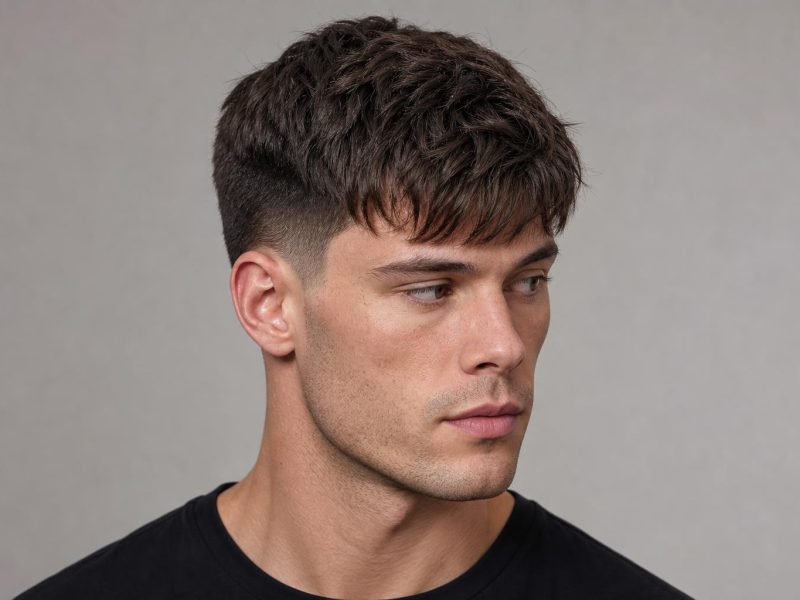
7. Textured Medium Crop with Faded Sides
Three inches on top cut with heavy point cutting so the ends separate rather than sitting as a block, over a clean fade. Straight hair needs the texturizing built in by the barber; wavy hair gets it for free. Ask for the weight taken out of the interior rather than off the surface, which keeps the shape while removing bulk.
8. Medium Length with a Burst Fade
Fading in an arc around the ear leaves weight at the back and nape, which balances a heavy top instead of stacking all the mass at the front. It suits curly and wavy texture particularly well. Keep the top under five inches or the back starts to look disconnected from the sides.
Flow and Grown-Out Shapes
Flow means no fade at all: the sides are left long enough to tuck behind the ears and the whole shape is pushed back off the face. It is the lowest-maintenance branch of medium length, since there is no clipper line to grow out and appointments stretch to two months. The requirement is hair with some natural body, because dead-straight fine hair falls forward and stays there.
9. Classic Flow Pushed Straight Back
Four to five inches all over, no fade, worn back off the forehead with the sides tucked. A sea salt spray on damp hair and thirty seconds of rough-drying is the entire routine. Wavy hair holds the backward direction on its own; straight hair usually needs the dryer to set it.
10. Flow with Weight Removed Underneath
Thick hair at this length swells sideways by week four unless bulk is taken from underneath the top section. The surface stays the same length while the interior thins, which keeps the silhouette narrow. Say “take weight out from underneath, leave the surface length” and most barbers know exactly what you mean.
11. Tucked Behind the Ears with a Longer Back
Leaving the back slightly longer than the sides gives the shape somewhere to go and stops it from looking like a bowl as it grows. It is a useful holding pattern if you are heading toward genuinely long hair. The nape can still be tapered so the outline stays deliberate at the collar.
12. Medium Shag with Visible Layers
Layers cut short at the crown against a longer perimeter, borrowed from women’s shag cutting and increasingly requested by men. Medium-density wavy hair holds the contrast best. Expect trims every six weeks, because the crown layers flatten before the length does.
13. Modern Mullet at Medium Length
Short and tight through the sides and front with the back left noticeably longer, softened so the transition is gradual rather than a step. The shape extends backward instead of sideways, which flatters round faces. Ask for the transition blended, since a hard line at the crown is what dates the cut.
14. Wavy Medium Cut Left to Air-Dry
Cut to encourage the wave rather than fight it, with no fade and light layering through the length. Wash, squeeze with a towel, and leave it alone. Combing after washing is what separates the wave clumps and produces frizz, and skipping that step is most of the routine.
15. Medium Length with a Center Break
The hair falls away from its natural parting point with no product forcing the split. Find yours by pushing damp hair straight back and letting it drop, then have the cut built around that line. Fighting a natural break means restyling every morning and losing by lunchtime.
Quiffs, Pompadours and Volume-Led Styles
These shapes build height at the front rather than sweeping it back flat, which is what gives medium hair its most formal register. All of them need a blow-dryer, and none of them work without it. The current versions are matte and broken up rather than polished, which makes them more forgiving than the equivalent styles a decade ago.
16. Textured Quiff with a Matte Finish
The front lifts and sweeps back but the surface stays separated and dull rather than smooth. It is the most-requested medium style at the moment and the least demanding of the volume shapes. Anyone unfamiliar with the terminology should read the wording that actually gets you a quiff before booking.
17. Classic Pompadour with a Rounded Front
Five inches at the front swept up and back over a defined curve, finished with shine. It gives the strongest vertical line available at medium length and takes five to eight minutes daily. Thick straight hair holds it; fine hair collapses by afternoon without a volumizing product underneath.
18. Brushed-Up Medium Top
Rather than a shaped pompadour, the whole top is dried upward at the root and left to stand in separate pieces. Coarse hair does this with clay alone and no dryer. It is the informal daily version of the same silhouette and takes about half the time.
19. Side Part with Volume at the Crown
A deep part placed on the natural break, with the bulk swept across and lifted at the root. It reads as the most conventional style in this section and works in any professional setting. Blow-dry against the part direction first, then comb it across, which is what creates the lift.
20. Slicked Back Without the Shine
All the length pushed straight back with a matte paste rather than a pomade, so the shape is there but the finish is dry. It suits hair that is thick enough to stay put once directed. Anyone with fine hair should skip this one, since flat-back styling shows scalp more than any other medium shape.
21. Medium Faux Hawk
The center section is left longer and pushed toward a soft ridge, with the sides kept short but not shaved. It narrows the head visually and adds height at the same time. Clay and thirty seconds of finger work is enough, which makes it the easiest volume style here.
Curtains, Fringes and Middle Parts
Forward-falling medium shapes cover the forehead rather than exposing it, which changes the proportions of the face and suits anyone with a high hairline. They are also the most forgiving group for men who dislike product, since the hair is doing what gravity already wants.
22. Full Curtain Cut with a Center Split
Five inches at the front split down the middle so the two halves frame the face. Wavy hair splits more convincingly than straight, which usually needs a dryer to hold the parting. The full range of curtain shapes varies mainly in how much length sits behind the split.
23. Short Curtains Over a Taper
A restrained version with the curtain kept to three inches and the sides tapered rather than left long. It is easier to wear in a formal setting than a full curtain and grows into one if you want it. Style by drying the front outward with your fingers before anything else.
24. Medium Length with an Eyebrow-Grazing Fringe
The front is cut to sit at the brow and pushed forward as a single piece rather than split. It covers a receding hairline better than any other medium shape. A point-cut textured fringe keeps it light enough to avoid the solid helmet look.
25. Angled Fringe Swept to One Side
Cut on a diagonal so the front runs across the forehead rather than straight down, which introduces an angle a round face lacks. Dry it sideways with your fingers before any product goes in. It is also the easiest fringe to grow out, since it merges into the length with no awkward stage.
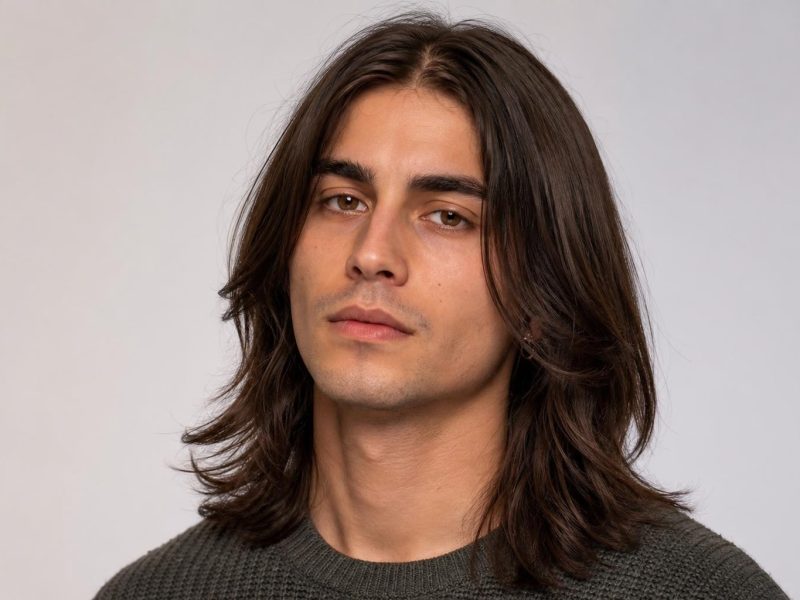
26. Middle Part with Length Behind the Ears
The part runs from the hairline back to the crown and the sides are long enough to tuck. It reads as deliberate rather than grown-out, and it needs almost no daily work once the length is right. Check that your natural growth allows a center part before committing, since a forced middle part drifts within hours.
Medium Cuts for Curly and Wavy Texture
Curl adds volume without any styling, which is an advantage at short length and a liability at medium, where the same volume can turn into width. Every cut here manages the width while keeping the length, and none of them relies on a dryer.
27. Curly Medium Top with Tapered Sides
Three to four inches of curl on top with the sides tapered rather than faded, so a small amount of texture remains around the ear. It stops the head reading as a curly cap on bare skin. Cut the curls dry so the barber can see their resting length, since wet curls stretch and come out shorter than intended.
28. Curly Flow with the Weight Taken Out
Dense curly hair at five inches builds outward fast, and removing weight from underneath is what keeps the silhouette from turning into a triangle. Leave-in conditioner on soaking hair does more for definition than any product applied later. Wider shapes built around a curl pattern use the same approach at other lengths.
29. Wavy Medium Cut with Long Layers
Long layers give 2b to 2c waves room to clump instead of frizzing into a halo. Short layers do the opposite and are the most common mistake at this length. A light sea salt spray on damp hair, then air-drying without touching it, is the whole routine.
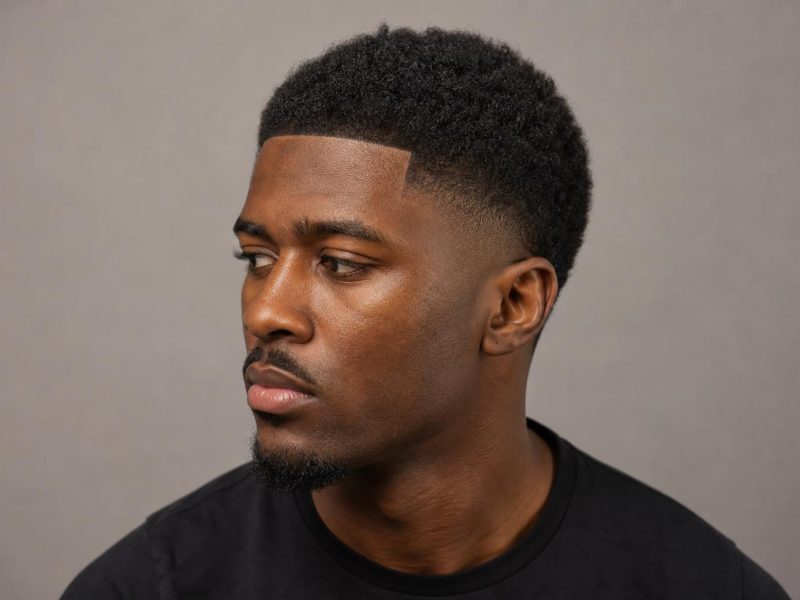
30. Coily Medium Shape with a Defined Perimeter
Tighter 3c to 4a texture holds a medium shape through its outline rather than through internal layering, so the barber shapes the edge and leaves the density alone. Judge the length stretched rather than shrunken when discussing it. Night covering with a satin bonnet or durag preserves the definition between wash days.
What Counts as Medium and When You Reach It
Hair grows at roughly half an inch a month, which makes the journey from short to medium considerably longer than most men expect. The awkward stage is real and lands between about weeks eight and twenty, when the top is too long to sit flat and too short to be directed anywhere. Knowing where you are in that window makes it easier to hold the line rather than cutting it all off in frustration.
| Stage | Length on Top | What Works |
|---|---|---|
| Months 1 to 2 | 1 to 2 inches | Textured crop; keep the sides tight so it stays deliberate |
| Months 3 to 5 | 2 to 3 inches | The awkward stage; a forward fringe hides it best |
| Months 6 to 9 | 3 to 5 inches | Full medium range opens up: quiff, curtains, swept back |
| Months 10 to 12 | 5 to 6 inches | Flow shapes; weight removal becomes necessary |
| Past 12 months | 6 inches and up | Behaves as long hair; different cutting and care rules apply |
Stylist tip: keep booking appointments while you grow it out, and ask for the sides and the perimeter only. The instinct is to stop going to the barber entirely, which is exactly what makes the middle months look unintentional. Shaping the outline every six weeks while the top gains length is the difference between growing hair out and simply not cutting it.
What to Tell Your Barber
The risk at this length is losing more than you meant to, since a barber with no instruction will default to tidying and tidying means shorter. Name four things: how much length to leave at the front in inches, what the sides should be, whether the top should be texturized, and explicitly what not to cut. A workable request sounds like this: “Leave four inches at the front, taper the sides to about an inch, take weight out from underneath but keep the surface length, and please do not cut the top.”
The phrase worth memorizing is “take weight out, do not take length off.” Thick hair at medium length needs bulk removed regularly or the shape widens, but that is a different instruction from a trim, and conflating the two is why men come out of appointments shorter than they wanted. Say the two halves separately.
Stylist tip: arrive with your hair styled the way you actually wear it, not freshly washed and flat. At medium length the shape depends entirely on how the hair falls once dried and directed, and a barber who only sees it wet and combed straight down is cutting blind. This matters far more here than it does on a short cut, where the clipper length settles everything.
Styling and Maintenance
Medium length is where a blow-dryer stops being optional for most of these shapes. The dryer sets the direction at the root, and product holds what the dryer created; doing it the other way round produces hair that looks heavy and falls flat within hours. Thirty seconds of rough-drying at the root is enough for most of the gallery above.
| Shape | Barber Cycle | Daily Styling | Product |
|---|---|---|---|
| Medium top over a fade | 3 to 4 weeks | 3 to 5 minutes | Matte clay or paste |
| Medium top with a taper | 6 to 8 weeks | 3 minutes | Clay, occasionally a cream |
| Flow, no fade | 8 weeks | 2 minutes | Sea salt spray |
| Quiff or pompadour | 4 to 5 weeks | 5 to 8 minutes | Volume cream plus a fiber or paste |
| Curtains or fringe | 5 to 6 weeks | 2 to 4 minutes | Light paste or nothing |
| Curly medium | 6 to 8 weeks | 3 minutes plus drying time | Leave-in conditioner on wet hair |
Washing frequency matters more here than at short length. Daily shampooing strips the natural oil that gives medium hair grip and body, which leaves it slippery and harder to direct. Every two or three days suits most men, with a water rinse in between. The general question of how often different lengths need cutting also shifts at medium, since the sides and the top now run on separate clocks.
When Medium Length Is Not Worth It
This length asks more of you than short hair does, and there are cases where the trade is bad.
- Fine, flat hair with no natural body. Medium length on fine hair lies against the scalp and shows more scalp than a short cut would, and no product creates lasting volume at this weight.
- Thinning at the crown. Longer hair separates over a sparse area and shows it; short uniform lengths hide the density difference much better.
- A genuine unwillingness to use a dryer. Most shapes in the quiff and volume section simply do not work air-dried, and pretending otherwise leads to disappointment.
- A strong double crown. At three to five inches the two whorls fight each other and the crown separates, which needs either more length or considerably less.
- Hard hats, helmets or headwear for most of the day. Medium hair takes the shape of whatever compresses it, and a full restyle at lunchtime is not realistic for most people. The shapes sorted by daily styling minutes flag which cuts survive this and which do not.
FAQ
What Counts as Medium Length Hair for Men?
Roughly 3 to 6 inches on top, measured at the front where the hair is longest. Below 3 inches you have little styling range and the cut dictates the shape; past 6 inches the weight takes over and the hair behaves like long hair. The sides can be anything from a skin fade to two inches without changing that classification.
How Long Does It Take to Grow Medium Length Hair?
About six to twelve months from a short cut, since hair grows at roughly half an inch per month. The difficult stretch is months three to five, when the top is too long to sit flat and too short to direct. Keep booking appointments through that period and ask for the sides and perimeter only, which is what stops the growing-out phase from looking unintentional.
What Should I Ask a Barber for at Medium Length?
Give the length to leave at the front in inches, the length for the sides, whether you want the top texturized, and an explicit instruction not to cut the top if you are still growing. The most useful phrase is “take weight out, do not take length off,” since thick medium hair needs bulk removed regularly and that is a different request from a trim. Arrive with your hair styled as you normally wear it rather than freshly washed.
Does Medium Length Hair Suit a Round Face?
It works well when the volume sits on top rather than at the sides, so a quiff, a brushed-up top or a faux hawk over short sides all suit a round face. Avoid shapes that leave bulk around the ears, since that adds width where the face is already widest. A modern mullet also works, because the length extends backward rather than sideways.
Do I Need a Blow-Dryer for Medium Length Hair?
For any shape with height at the front, yes, because volume at this length comes from setting the root direction while the hair dries rather than from product. Flow, curtains and curly shapes are the exceptions and genuinely air-dry. Thirty seconds of rough-drying at the root covers most of what the other styles need.
How Often Should Medium Length Hair Be Cut?
Every three to four weeks if the sides are faded, and six to eight weeks if they are tapered or left long. The top and the sides run on separate schedules at this length, so many men book a sides-only tidy in between full cuts. If you are still growing the length, ask for the perimeter shaped and the top left alone entirely.
Can Curly Hair Work at Medium Length?
Curly hair suits medium length well, provided weight is removed from underneath so the shape does not widen into a triangle as it grows. Cut the curls dry, because wet curls stretch and a cut judged wet comes out noticeably shorter once it dries. Taper the sides rather than skin-fading them, which keeps some texture around the ear and grows out more evenly.
Medium length hairstyles for men all draw on the same 3 to 6 inches; what separates them is the sides and how you dry the top. Decide first whether you want a fade you maintain every three weeks or a taper you can leave for two months, because that single choice narrows the gallery above by half. Then tell your barber to take weight out rather than length off, and keep the appointments going while you grow it.
Hair results vary based on your natural hair type, texture, density, and condition. Always consult with a licensed hairstylist before making significant changes, especially with chemical treatments or dramatic length changes. Photos may show styled results that require professional tools and products to replicate.

2 responses