

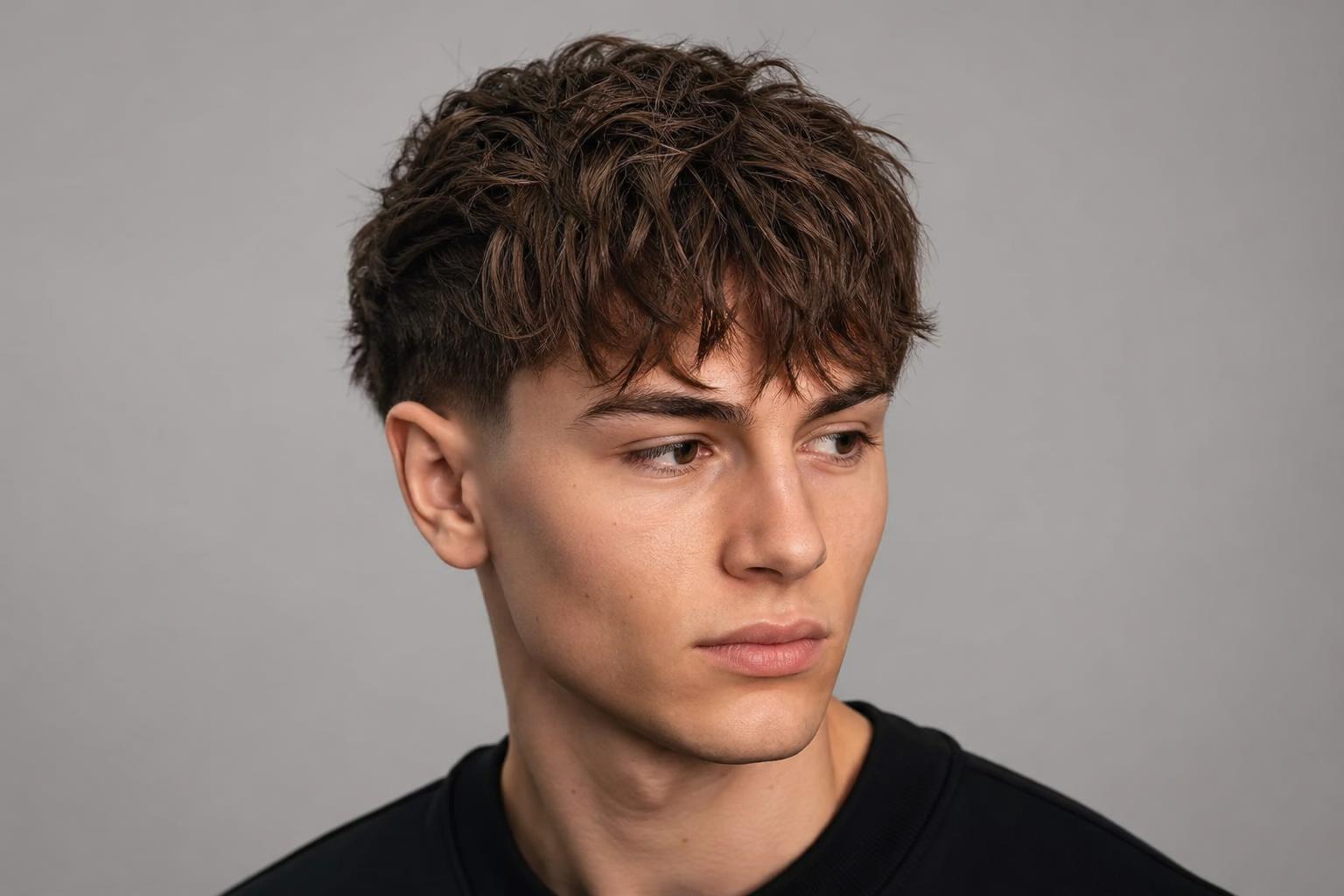
A textured fringe is a short-to-medium front section cut with point-cut, separated ends so it falls forward in pieces instead of one solid block.
A textured fringe haircut leaves roughly 2 to 4 inches of length at the front, cut with the scissor tips rather than straight across, so the hair breaks into visible strands when it dries. It suits straight, wavy and loosely curly hair, and it is one of the few front-heavy shapes that still works on a high forehead or a slightly receding hairline. Below are 30 variations, grouped by length and hair type, with the exact wording to use at the barber chair.
The gallery moves from short fringes paired with fades, through mid-length and longer versions, into curly and wavy adaptations, and finishes with shapes built around thinning or uneven hairlines. After the entries you will find a face shape table, a barber script with the phrases that actually get you the cut, a realistic maintenance schedule, and an honest list of situations where this shape is the wrong call.
| Factor | Details |
|---|---|
| Best for | Straight to wavy hair of medium or thick density; oval, oblong and square faces |
| Fringe length | 2 to 4 inches at the front, sitting between mid-forehead and eyebrow |
| Maintenance | Barber visit every 3 to 5 weeks; 2 to 5 minutes of styling daily |
| Product | Matte clay or paste, roughly a pea-sized amount on dry hair |
| Avoid if | Your hair is very fine and sparse at the front, or tightly coiled 4b to 4c |
| Barber time | 30 to 45 minutes for a first cut, 20 to 25 for a maintenance visit |
Short Textured Fringes Paired with Fades
Pairing a textured fringe with a fade puts all the visual weight at the front and keeps the sides clean, which is why this combination dominates barbershop request photos. The shorter the sides, the more the fringe reads as a deliberate shape rather than hair that needs cutting. These eight versions differ mainly in fade height and how much length stays behind the fringe.
1. Short Textured Fringe with a Low Fade
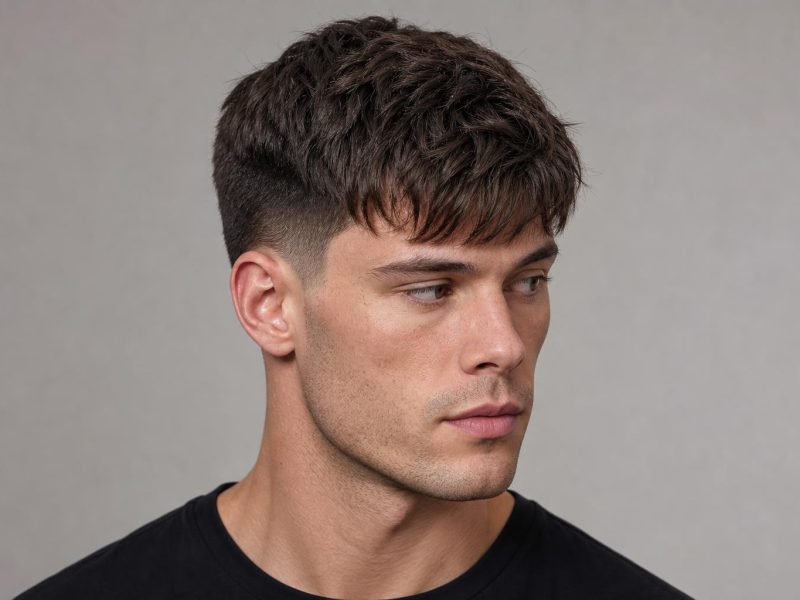
The sides drop to skin just above the ear and the top keeps about 3 inches at the front, point cut so the ends separate. Because a low fade sits below the temple, the shape stays conservative enough for most offices while the fringe still does the work. Ask your barber to leave the corners at the temples slightly soft rather than squared off.
2. Mid Fade Crop with a Piecey Front
Oblong and long faces gain the most here, because the horizontal line of the fringe visually shortens the forehead while the mid fade removes width at the sides. Keep the fringe just above the eyebrow so it interrupts the vertical run of the face rather than extending it. Longer faces should skip the very short 2-inch versions, which reopen the forehead.
3. Skin Fade with a Blunt-Cut Then Texturized Fringe
Thick, coarse hair holds this shape better than anything else because the density supports a heavy front without collapsing. The barber cuts a straight baseline first, then goes back in with the scissor tips to break up the last half inch. That two-step method is the difference between a fringe that looks cut and one that looks grown out.
4. Textured Fringe with a Taper Instead of a Fade
A taper leaves more hair on the sides than a fade, tightening only the neckline and around the ears. Grow-out is far kinder as a result, and you can stretch appointments to six weeks without the sides looking shelf-like. Say the words “taper the sides, no clipper above the ear” so the barber does not default to a fade.
5. Cropped Fringe with a Hard Part
A shaved line above the temple gives an otherwise soft cut a defined edge, and it holds the fringe forward by breaking the natural growth direction. Keep the line short, roughly an inch and a half, so it does not compete with the fringe for attention.
6. Burst Fade with a Forward Fringe
The burst fade arcs around the ear and leaves weight at the back, which balances the forward mass of the fringe instead of stacking everything at the front. Curly and wavy textures suit it best because the curl fills the rounded shape behind the ear. Barbers often call this a burst taper, so use both terms if the first one draws a blank.
7. Short Textured Fringe on Fine Hair
Fine hair needs a shorter fringe, closer to 2 inches, because longer pieces have nothing to hold them up and lie flat against the forehead. Blow-dry the front upward for 20 seconds before pushing it forward, and the roots hold a small amount of lift all day. Skip cream and use a matte clay, which grips fine strands without adding weight.
8. Textured Fringe with a Disconnected Top
Nothing blends here. The top stays one length and the sides drop straight to a short guard, creating a hard step at the temple. It suits square jaws and works badly on soft, round faces, so this one genuinely depends on your bone structure.
Mid-Length and Longer Textured Fringes
Once the fringe passes the eyebrow, the cut stops being a crop and starts behaving like a grown-out shape that needs daily direction. Longer fringes give more styling range, since the same cut can be pushed forward, split in the middle, or swept sideways. They also demand more product and more honest self-assessment about how much time you will spend on your hair each morning.
9. Eyebrow-Grazing Fringe with Scissor-Cut Sides
Skipping clippers entirely gives a softer perimeter that grows out without a visible line. The fringe sits right at the brow and the sides stay around 2 inches, scissor cut over the comb. Expect a longer appointment, because scissor work on the sides takes roughly twice as long as a clipper pass.
10. Split Fringe with Center Separation
Ask for a fringe long enough to fall past the brow, then part it slightly off-center so the two halves fall apart naturally. This is close to a curtain shape but cut shorter, which keeps it from looking like a deliberate 1990s reference. Wavy hair splits more convincingly than straight hair, which tends to need a blow-dryer to hold the parting.
11. Angled Fringe Swept to One Side
Cutting the fringe on a diagonal, longer on one side than the other, creates a line that runs across the forehead rather than straight down. Round faces benefit because the diagonal breaks up the width. Style it by drying the hair sideways with your fingers before any product goes in.
12. Messy Mid-Length Fringe with Choppy Ends
Heavier point cutting through the last inch produces deliberately uneven ends that never quite sit flat. Coarse hair carries the roughness well; fine hair looks patchy under the same technique. Two seconds of finger-raking after applying paste is all the styling this needs.
13. Textured Fringe with a Longer Back
Keeping length through the crown and nape balances a heavy front and stops the head from looking front-loaded in profile. It is a useful compromise if you are growing hair out but want the front to look finished in the meantime. The nape can still be tapered so the shape does not turn shaggy at the collar.
14. Brushed-Up Fringe with Texture at the Root
Rather than falling forward, this version is dried upward and back at the root, then broken apart at the tips so it stands in separated pieces. It borrows the height of a quiff without the smooth finish. Thick straight hair holds it with clay alone; wavy hair usually needs a blast of cool air to set the direction.
15. Long Textured Fringe with Faded Sides
The contrast between 4 inches at the front and skin at the sides is the entire point of this cut, and it needs a barber who fades cleanly. Book every three weeks or the fade grows into the fringe and the contrast disappears. Anyone unwilling to commit to that schedule should choose a taper instead.
16. Mid-Length Fringe with a Soft Baseline
Instead of texturizing aggressively, the barber removes only a small amount of weight, leaving the fringe nearly solid with slightly softened ends. Straight, glossy hair suits this restrained version, since heavy texturizing on smooth hair can look frayed. Say “just take the hard edge off the front, do not thin it” to get this result.
Textured Fringes for Curly and Wavy Hair
Curl does half of the texturizing work before a scissor touches the hair, which changes what the barber should do. Over-texturizing curly hair removes the weight that holds the curl pattern in place and produces frizz rather than separation. These seven versions rely on shaping and length choice instead of thinning.
17. Curly Textured Fringe Cut Dry
Curls need to be cut at their resting length, because a wet curl can sit two inches lower than the same curl dry. A dry cut lets the barber see exactly where each piece lands before removing anything. This single request prevents the most common curly fringe complaint, which is a front that ends up far shorter than intended.
18. Wavy Fringe with Natural Separation
Loose 2a to 2b waves separate on their own once the length passes about 3 inches, so the barber only needs to remove bulk from underneath. Apply a light sea-salt spray to damp hair and let it air-dry rather than reaching for a dryer. Blow-drying wavy hair straight and then trying to force texture back in with product rarely works.
19. Coily Fringe with a Shaped Perimeter
Tighter 3c to 4a coils hold a fringe shape through the outline rather than through internal layering. The barber shapes the front edge and leaves the interior alone, which keeps density where it is needed. Sponge coiling on damp hair defines the front pieces without the frizz that combing creates.
20. Curly Crop with Tapered Sides
Tapering rather than fading keeps a small amount of curl at the sides, which stops the head from looking like a curly cap sitting on bare skin. Roughly a half-inch guard behind the ear is enough. This shape also grows out more gracefully than a skin fade, which starts to look uneven on curly hair by week three.
21. Wavy Fringe with a Middle Break
Waves naturally fall away from a central point on many heads, and this cut works with that pattern instead of against it. Find your natural break by pushing damp hair straight back and letting it fall. Where it splits is where the cut should sit, and fighting that spot means restyling every morning.
22. Curly Fringe Kept Above the Brow
Shrinkage means a curly fringe cut at the eyebrow will sit an inch higher once dry, so barbers experienced with curls cut long and check twice. Anyone with 3b or tighter curls should ask for the front to be left longer than looks right during the cut. It will rise into place as it dries.
23. Textured Fringe on Coarse, Thick Curls
Very dense curly hair can turn into a triangle if the sides are left too full while the top is short. Removing weight from the sides and keeping length at the front rebalances the silhouette. A leave-in conditioner applied to soaking-wet hair does more for definition here than any styling product applied later.
Textured Fringes That Work Around Hairline and Density Issues
A forward-falling fringe is the most useful shape available to men dealing with a receding hairline or thinning at the temples, because it covers the recession without looking like it is trying to. The trick is keeping the fringe light enough that scalp does not show through it. These seven versions all prioritize coverage that holds up in daylight.
24. Short Forward Fringe for a Receding Hairline
Cutting the front short and pushing it forward covers the temple corners without the thin, stringy look that longer hair creates when it is drawn over a recession. Two to three inches is the working range. There are more shapes built for a receding hairline if the recession has moved past the mid-scalp.
25. Caesar-Style Fringe Cut Straight Across
The Caesar is the ancestor of every modern crop and remains the most direct way to hide a high hairline. Modern versions add texturizing so the line does not look severe, which is the main difference from the blunter French crop shape. Keep it high on the forehead rather than low, which ages the cut.
26. Textured Fringe with a Faded Temple
Fading tightly at the temple removes the sparse patch that draws the eye, so the density that remains at the front looks intentional. It works best when the recession is still limited to the corners. Once the temples and crown connect, a shorter overall cut usually looks better than any fringe.
27. Light Fringe on Fine, Thinning Hair
Fine thinning hair needs the fringe cut in a single soft layer, not stacked, so nothing has to lie on top of anything else. Density looks best when every strand is visible against the forehead rather than the scalp. A dry texture spray at the root beats any clay, which drags fine hair flat.
28. Textured Fringe with a Crown Cowlick Worked In
Cowlicks at the crown push hair forward, which for once is helpful, so leaving the crown slightly longer lets the growth pattern feed the fringe. Point out the cowlick during the consultation, since barbers who miss it tend to cut the crown short and create a spike that never lies down.
29. Uneven Hairline Softened with a Piecey Front
An irregular hairline with one corner higher than the other becomes almost invisible under a fringe with varied end lengths, because there is no straight line for the eye to compare it against. Ask for the front cut with the scissor tips held vertically. Blunt horizontal cutting does the opposite and highlights the asymmetry.
30. Grown-Out Textured Fringe as a Transition Cut
If you are moving from a very short cut to something longer, a textured fringe gives the awkward middle stage a defined front while the rest catches up. The sides can stay tight through the first two months, then be left alone. Guys coming from a buzz or one of the shortest men’s cuts usually reach a workable fringe length around week ten.
How to Choose a Textured Fringe for Your Face Shape
Fringe length and direction change the apparent proportions of the face more than the sides do, which is why two men with the same cut can look completely different. The rule that holds across every shape is simple: a fringe adds a horizontal line, and horizontal lines make a face look shorter and wider. Use that to your advantage or work around it, depending on what you are starting with. If you are unsure which category you fall into, measuring your face shape properly takes about two minutes with a tape measure.
| Face Shape | Best Fringe Version | Fringe Length | Avoid |
|---|---|---|---|
| Oval | Almost any version, including blunt-then-textured | 2 to 4 inches | Very heavy fringes that hide balanced proportions |
| Round | Angled or side-swept fringe with height at the root | 3 to 4 inches, cut on a diagonal | Flat straight-across fringes, which widen the face further |
| Square | Softly textured forward fringe with rounded corners | 2 to 3 inches | Hard disconnection, which doubles the angularity |
| Oblong | Fuller fringe sitting low on the forehead | 3 to 4 inches, brow level | Brushed-up or high fringes, which lengthen the face |
| Heart | Light, piecey fringe with minimal width at the temple | 2 to 3 inches | Wide, dense fringes that broaden an already wide forehead |
| Diamond | Forward fringe with a small amount of side volume | 3 inches | Tight skin fades at the temple, which narrow the forehead more |
What to Tell Your Barber
The phrase “textured fringe” alone means different things in different shops, so name the four variables instead: fringe length, cutting technique, side length, and how much texture you want. A workable script sounds like this: “Leave about three inches at the front, point cut so it separates, low fade on the sides starting just above the ear, and keep the corners at the temples soft.” That gives a barber every decision they need to make. Bring a photo as well, because the words and the picture together are far more reliable than either alone.
Stylist tip: Ask your barber to cut the fringe with your head upright and your hair dry at the end of the appointment, not wet at the start. Hair sits differently under its own weight than it does pulled straight down with a comb, and the last half inch is where every fringe succeeds or fails.
If your barber reaches for thinning shears, say something. Thinning shears remove weight in a straight line across the hair shaft and leave a fuzzy regrowth halo weeks later. Point cutting with regular scissors produces the same separation without that side effect, and most barbers will switch happily if asked.
Styling and Maintenance
Daily styling on a textured fringe takes two to five minutes and depends entirely on product choice. Matte clay gives grip and separation with no shine, paste is softer and easier to restyle mid-day, and cream is usually too heavy unless your hair is very coarse. Use roughly a pea-sized amount, warm it between your palms until it disappears, and work it in at the root before touching the ends.
| Version | Barber Visit | Daily Styling | Grow-Out Behavior |
|---|---|---|---|
| Fringe with skin fade | 3 weeks | 3 to 5 minutes | Contrast fades by week 3; looks unkempt by week 5 |
| Fringe with taper | 5 to 6 weeks | 2 to 4 minutes | Softens gradually with no hard line |
| Scissor-cut sides | 6 to 8 weeks | 2 to 3 minutes | Most forgiving; simply reads as longer hair |
| Curly fringe | 6 to 8 weeks | 4 to 6 minutes plus drying | Volume builds outward; needs weight removed, not length |
| Fringe on fine hair | 4 weeks | 3 to 5 minutes with a dryer | Loses lift quickly once past 4 inches |
Stylist tip: Rough-dry the front on medium heat for 20 seconds with your fingers pushing the roots backward, then let the hair fall forward before applying any product. That single step builds the root lift that separates a fringe with movement from one lying flat on the forehead, and it costs less time than most men spend choosing a product.
Between appointments, the fringe is the only part worth touching. Trimming your own sides ends badly, but lifting the front section and taking a few millimeters off the longest pieces with the scissor tips held vertically buys an extra week. Knowing which clipper guard corresponds to which length also helps you describe the sides accurately when you switch barbers.
When a Textured Fringe Is Not the Right Choice
This cut has real limits, and the men who end up disappointed usually fall into one of the categories below.
- Very fine, sparse hair at the front. A fringe needs enough strands to look solid against the forehead; below a certain density the scalp shows through and the shape looks thinner than a simple short cut would. A tight crop with the front left slightly longer serves better.
- Tightly coiled 4b to 4c hair. The shrinkage is too severe for a forward fringe to hold a predictable line, and forcing one usually means chemical straightening. A shaped sponge twist or a low-profile taper is a better use of that texture.
- A hairline that has receded past the mid-scalp. Once the temples and crown meet, a fringe has nothing to anchor to and starts to look like a comb-forward. Going shorter overall reads as a decision rather than a concealment.
- Anyone who dislikes hair on their forehead. This sounds obvious, and it is still the most common reason men grow the cut out. If you push your hair back reflexively during the day, the fringe will annoy you within a week.
- A schedule that cannot absorb a barber visit every three weeks. Fringe cuts paired with skin fades go from sharp to shapeless faster than almost any other men’s shape.
FAQ
How Long Does Hair Need to Be for a Textured Fringe?
You need at least 2 inches at the front, and 3 to 4 inches gives more styling range. Measured from a buzz cut, that is roughly ten to fourteen weeks of growth at the average rate of half an inch per month. The sides can be cut into shape at any point during that wait, so the growing-out phase does not have to look untidy.
Is a Textured Fringe the Same as a French Crop?
No. A French crop has a blunter, heavier front cut in a defined horizontal line, while a textured fringe is broken up with point cutting so the ends separate into visible pieces. The two share the same silhouette and the same fade options, which is why barbers often use the names interchangeably. Specify “point cut, not blunt” if you want the softer version.
Can I Get a Textured Fringe with Curly Hair?
Yes, and curly hair often needs less work from the barber because the curl provides the separation on its own. The critical requirement is a dry cut, since wet curls stretch and a fringe cut wet will sit far shorter once it dries. Avoid thinning shears entirely on curls, as removing internal weight causes the curl pattern to break up into frizz.
What Product Works Best on a Textured Fringe?
Matte clay is the default for straight and wavy hair because it grips without shine, and a pea-sized amount is enough for most heads. Fine hair does better with a dry texture spray at the root, since clay weighs it down. Curly hair should use a leave-in conditioner applied to wet hair rather than any styling product applied dry.
Will a Textured Fringe Hide a Receding Hairline?
A short forward fringe covers receding temple corners effectively as long as the recession has not passed the mid-scalp. Keep the fringe between 2 and 3 inches, because longer hair drawn over a recession separates and shows scalp. A tight fade at the temple also helps by removing the sparse patch that draws attention.
How Often Does a Textured Fringe Need Cutting?
Every three weeks with a skin fade, five to six with a taper, and six to eight with scissor-cut sides. The fringe itself grows roughly half an inch a month and starts sitting in your eyes around week five. Many men book the sides on a longer cycle and get the front trimmed alone in between, which most shops charge a reduced rate for.
Does a Textured Fringe Work on Straight, Flat Hair?
It works, but the separation has to be built in by the barber rather than by your hair texture. Ask for deeper point cutting through the last inch and keep the fringe shorter, closer to 2 to 3 inches, so it does not lie flat under its own weight. Rough-drying the roots before styling matters more on straight hair than on any other texture.
A textured fringe haircut succeeds or fails on two decisions: the length you leave at the front and whether the ends are point cut rather than blunt. Take a photo of a fringe you like to your next appointment, name the four variables from the barber script above, and be specific about how much time you are willing to spend styling it each morning. The cut itself is straightforward; the communication is the part most men get wrong.
Hair results vary based on your natural hair type, texture, density, and condition. Always consult with a licensed hairstylist before making significant changes, especially with chemical treatments or dramatic length changes. Photos may show styled results that require professional tools and products to replicate.


1 response