
Four tape-measure numbers tell you your face shape in about three minutes, and they beat every “hold a lipstick up to the mirror” trick you have been told to try.
Your face shape is decided by two things: which of your three face widths is largest, and how your face length compares to those widths. Measure your forehead, cheekbones, jaw, and face length, find the widest of the first three, then divide your length by the average of the widths. A ratio under about 1.45 with cheekbones widest reads as oval; 1.5 or higher reads as oblong or rectangle. Everything else falls out from where your widest point sits.
This guide walks through the four measurements and exactly where to place the tape, gives you a decision table that converts your numbers into a shape name, defines all eight shapes by measurement rather than by vague description, and explains what to do when your numbers land between two shapes. It also covers the part most face shape guides skip: how much your face shape actually changes about your haircut, and what matters more.
The Four Measurements That Decide Your Face Shape
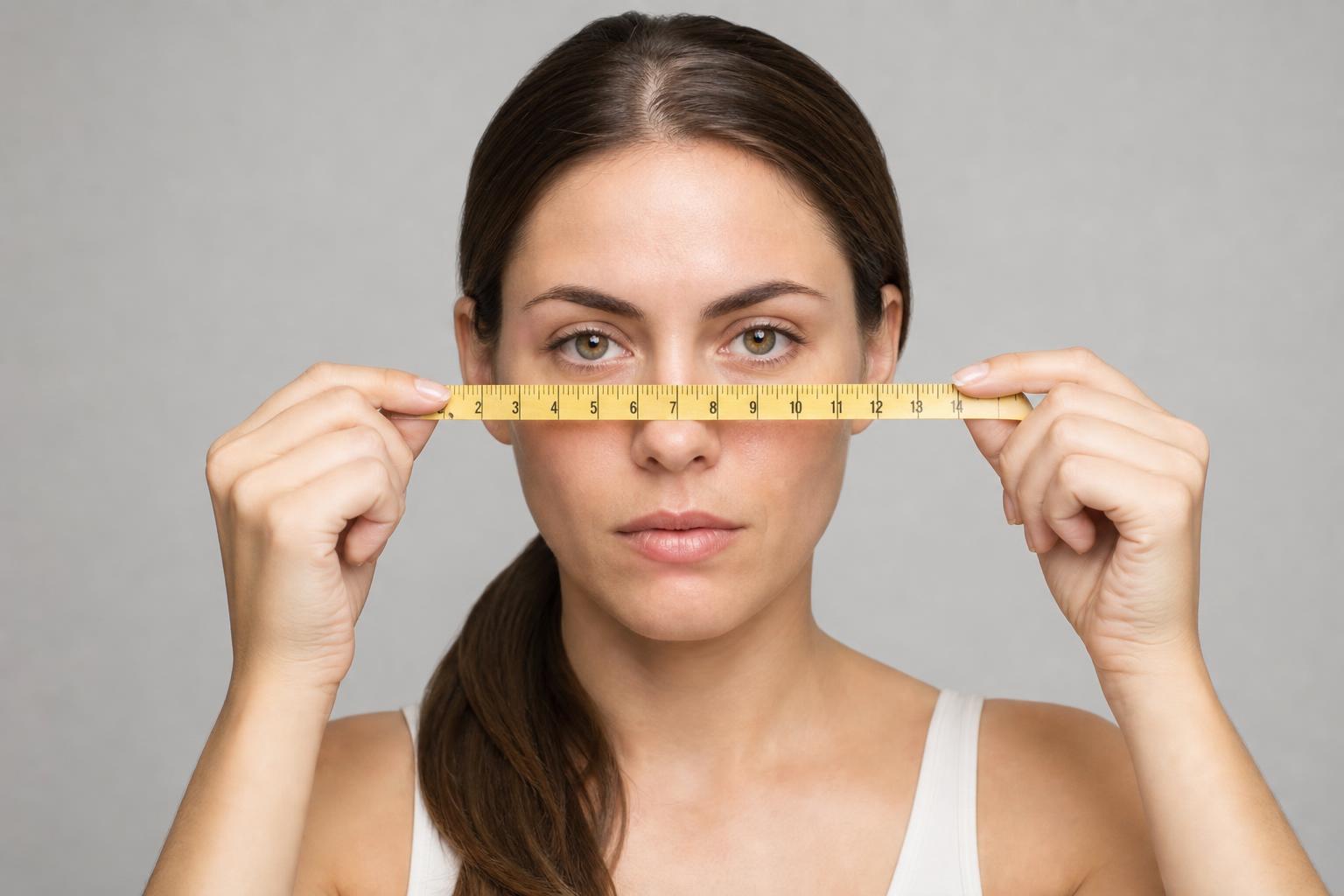
You need a soft fabric tape measure, the kind used for sewing, not a rigid metal builder’s tape. Pull all of your hair back into a low ponytail or a headband first. Hair sitting against your cheeks or forehead is the single most common reason people misidentify their own face shape, because loose hair adds width exactly where you are trying to measure. Stand square to a mirror in even light and keep your chin level for every measurement.
Take these four numbers in order and write them down. Use the same unit throughout, inches or centimeters, since the shape comes from the relationship between the numbers rather than their absolute size.
- Forehead width: measure straight across the widest part of your forehead, which usually sits about halfway between your eyebrows and your hairline.
- Cheekbone width: measure from the outer corner of one eye, across the top of your cheekbones, to the outer corner of the other. On most faces this is the same line as the top of your ears.
- Jaw width: run your fingers back along your jawbone until you feel the corner where it turns up toward your ear. Measure from that corner on one side straight across to the other, not along the curve of your chin.
- Face length: measure from the center of your hairline straight down to the bottom of your chin.
Now do one piece of arithmetic. Add the three widths together and divide by three to get your average width. Then divide your face length by that average. That number is your length-to-width ratio, and it is what separates the shapes that share the same widest point.
Stylist tip: Measure jaw width from the bony corner, not from the softest-looking part of your lower face. People with fuller cheeks routinely measure too low and record a jaw number that belongs to their cheek tissue, which turns a square face into a false round reading and sends them toward layers they do not need.
Your Widest Point and Your Ratio Name the Shape
Face shape naming works on two questions in sequence. First, which of your three widths is the biggest? That narrows you to a family. Second, what is your length-to-width ratio and how angular is your jaw? That picks the specific shape inside the family. Read the table left to right using your own numbers.
| Widest Measurement | Length-to-Width Ratio | Jawline | Your Shape |
|---|---|---|---|
| Cheekbones | 1.25 to 1.45 | Softly curved, narrower than cheekbones | Oval |
| Cheekbones | 1.45 or higher | Narrow, often pointed chin | Diamond |
| All three within about half an inch | 1.0 to 1.25 | Soft, rounded, no visible corner | Round |
| All three within about half an inch | 1.0 to 1.25 | Straight sides, defined corner at the ear | Square |
| All three within about half an inch | 1.5 or higher | Soft, rounded | Oblong |
| All three within about half an inch | 1.5 or higher | Straight sides, angular corner | Rectangle |
| Forehead | Any | Clearly the narrowest, chin tapers to a point | Heart |
| Jaw | Any | Widest point of the whole face | Triangle (also called pear) |
Those ratio thresholds are a working convention rather than a medical standard. They come from the face shape calculators that have become the default reference online, and stylists use them because they are consistent, not because a research body set them. Treat a number that lands within a tenth of a boundary as genuinely ambiguous rather than as a verdict.
Every Face Shape, Defined by Measurement
The descriptions below name the measurement pattern behind each shape rather than the usual comparisons to eggs, hearts, and playing cards. Match yours against the numbers you wrote down, not against a mental picture of a celebrity, because celebrity face shape labels in magazines are frequently wrong.
Oval Faces Have Cheekbones as the Widest Point and a Ratio Under 1.45
Your forehead is slightly narrower than your cheekbones, your jaw is narrower again, and the whole face tapers gently at both ends. The ratio sits in the 1.25 to 1.45 band, so the face is noticeably longer than wide without looking stretched. This is the shape most haircut charts treat as the baseline, which is why oval-face readers get so little specific advice.
Round Faces Measure Nearly as Wide as They Are Long with No Jaw Corner
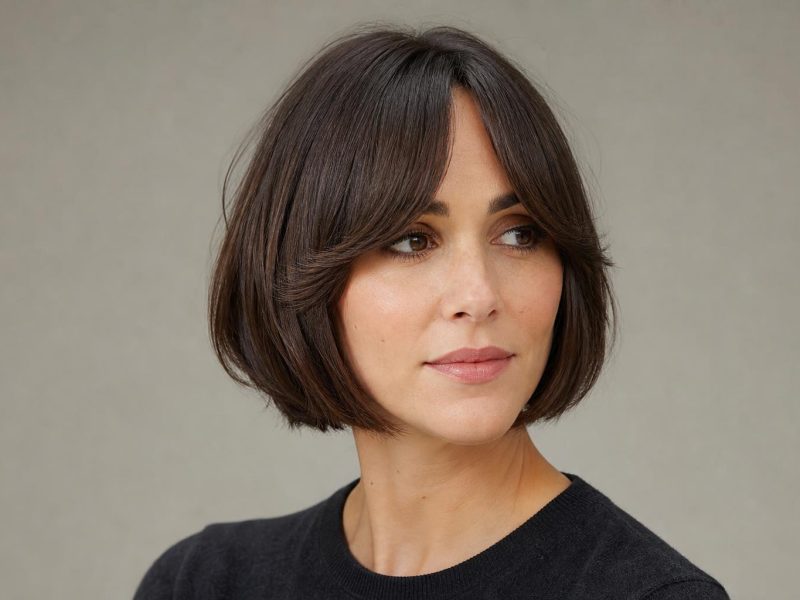
All three widths land close together and the ratio is low, usually between 1.0 and 1.25. The giveaway is the jaw: run your fingers along it and you will not find a distinct corner, just a continuous curve from chin to ear. Fullness through the cheeks is common and is what most people are actually noticing when they call their face round. A bob cut specifically for round faces is usually the first thing worth trying, since length past the jaw does most of the work.
Square Faces Share Round Proportions but Have a Straight, Angular Jaw
The measurements look almost identical to a round face, with all three widths close and a low ratio. The difference is entirely structural. Your jaw runs in a straight line from chin to a defined corner near your ear, and your hairline often runs straight across too. If you have measured a round result but keep being told you have a strong jaw, measure the corner again, because you are probably square. Softening options are covered in more depth in our guide to pixie cuts for square faces.
Oblong Faces Run 1.5 Times Longer Than They Are Wide with Soft Corners
Your three widths are similar, but the ratio crosses 1.5, so the face reads as long rather than balanced. The sides run close to parallel with very little taper at the forehead or jaw. This is the shape most often mistaken for oval, and the ratio is the only reliable way to separate them. Our breakdown of cuts for oblong faces goes into which lengths add the horizontal weight this shape benefits from.
Rectangle Faces Have Oblong Proportions with a Squared Jaw
Same 1.5-plus ratio, same near-parallel sides, but the jaw corner is defined rather than rounded and the forehead tends to be broad and flat. Rectangle and oblong are often collapsed into one category by beauty guides, which is a mistake, because the styling goals differ. Oblong needs width; rectangle needs width plus softened angles. The rectangle face shape guide covers that distinction properly.
Heart Faces Are Widest at the Forehead and Narrowest at the Chin
Your forehead measurement is the largest of the three and your jaw is clearly the smallest, with the chin tapering to a point. The ratio can be almost anything, because the defining feature is the top-heavy distribution rather than the length. A widow’s peak often accompanies this shape and makes the forehead read even wider, which is covered in our styles for a broader forehead. Chin-length shapes and pixie variations cut for heart-shaped faces both work by putting weight where the face narrows.
Diamond Faces Peak at the Cheekbones with a Narrow Forehead and Chin
Cheekbones are the widest measurement, as with an oval, but here both the forehead and the jaw are noticeably narrower rather than just slightly. The ratio usually runs 1.45 or above, giving a face that is long through the center and pinched at both ends. It is the least common of the eight and the most frequently misdiagnosed as oval. Options that add width at the forehead and jaw are collected in our diamond face shape haircut guide.
Triangle Faces Are Widest at the Jaw, Regardless of Length
Also called a pear shape, this is the inverse of heart: your jaw is the largest of the three widths and your forehead is the smallest. Volume at the crown and through the upper sides balances the lower half. Because the pattern is defined by distribution rather than proportion, the same styling logic holds whether your ratio is 1.1 or 1.6.
When Your Measurements Land Between Two Shapes
Most people do not measure cleanly into one shape, and that is normal rather than a sign you measured wrong. Faces are not geometric, and an eight-category system applied to every human face is going to produce a lot of borderline cases. Here is how to resolve the common overlaps.
- Oval versus oblong: the ratio decides it. Recalculate carefully, and if you land between 1.45 and 1.5, style for oblong. Adding a little horizontal width never hurts an oval face, while an oblong face styled as an oval looks longer.
- Round versus square: ignore the tape and use your fingers. A findable corner where the jaw turns upward means square. A continuous curve means round.
- Heart versus diamond: compare forehead to cheekbone directly. If the forehead is wider, you are heart. If the cheekbone is wider, you are diamond.
- Square versus rectangle: only the ratio separates them. Under 1.25 is square, over 1.5 is rectangle, and in between you can borrow from both.
If two shapes remain genuinely tied after all of that, style for the one you want to counterbalance more. Someone sitting between round and square who dislikes the width will get a better result following round-face guidance, because both sets of recommendations lengthen rather than widen.
Common Face Shape Myths That Send People to the Wrong Haircut
Myth: You Can Tell Your Face Shape by Tracing It on a Mirror
Reality: the lipstick-on-the-mirror trick produces a distorted outline because your reflection scales with how far your head sits from the glass, and the trace captures your hairline rather than your skull. It reliably makes almost everyone look oval. Use the tape.
Myth: Your Face Shape Is Fixed for Life
Reality: the underlying bone structure is stable in adulthood, but the measurements you take are of soft tissue over bone. Weight change, fluid retention, and the gradual loss of midface volume with age all move the cheekbone and jaw numbers. It is worth remeasuring if it has been several years and your usual cut has stopped working.
Myth: A Face Shape Category Tells You What Haircut to Get
Reality: it tells you what visual goal to aim at, which is a much smaller claim. Whether a specific cut achieves that goal on your head depends on your hair’s texture, density, growth pattern, and how much time you will spend styling it. The chart narrows the field; it does not pick the cut.
What Your Face Shape Actually Changes About Your Haircut
Face shape sets one variable: where you want visual weight and where you want to remove it. That is genuinely useful, and it is also the entire extent of what the category does. The table below converts each shape into that single goal plus a concrete thing to ask for, which is more actionable than a list of approved haircut names.
| Shape | Visual Goal | Ask For | Be Cautious With |
|---|---|---|---|
| Oval | Keep existing balance | Almost any length; choose by texture instead | Heavy full bangs that hide the proportions |
| Round | Add vertical length | Length past the jaw, deep side part, height at the crown | Chin-length blunt cuts with a center part |
| Square | Soften the jaw corner | Movement starting at the cheekbone, side-swept fringe | A blunt line landing exactly at the jaw corner |
| Oblong | Add horizontal width | Volume at the sides, a fringe to shorten the forehead | Long flat styles with a center part |
| Rectangle | Add width and soften angles | Curved or wispy fringe, waves through the mid-lengths | Very short sides plus a blunt heavy fringe |
| Heart | Add weight at the jaw | Fullness from cheekbone down, chin-length or longer | Heavy volume at the crown with nothing below |
| Diamond | Widen forehead and jaw | Fringe or forehead coverage plus fullness at the jaw | Slicked-back styles that expose both narrow points |
| Triangle | Add volume above the cheekbones | Crown height, layers starting above the jaw | Heavy weight sitting at jaw level |
Notice that every row is a direction, not a haircut. Two people with identical square measurements, one with fine straight hair and one with 3b curls, need completely different cuts to reach the same goal of softening the jaw. Texture decides the cut; face shape only decides what the cut should be trying to do.
Stylist tip: If you have to choose between following your face shape chart and following your hair’s natural growth pattern, follow the growth pattern. A cowlick at the front hairline or a strong wave that only goes one direction will override any face-shape logic within a week of your appointment, and you will spend every morning fighting it.
What to Tell Your Stylist
Do not walk in and announce your face shape as if it settles the matter. Stylists assess proportion visually within a few seconds of you sitting down, and hearing a category name mostly tells them what you have read online. Give them the goal and your constraints instead, and let them pick the shape that gets there.
Useful phrasing sounds like this: “My face measures long and fairly narrow, so I would like something that adds width around the cheekbones without adding bulk at the top.” Or: “My jaw is the widest part of my face and I would like the weight moved higher.” If you have a specific worry, name the feature rather than the category, for example “I would rather not draw a line straight across my jaw.” That is a request a stylist can act on immediately, and it is the same language used in our guide to asking for face-framing layers by face shape.
Bring two reference photos, and pick people whose hair texture resembles yours rather than people whose faces resemble yours. A photo of straight, dense hair handed over by someone with fine wavy hair is the most common source of disappointment in the chair, and no amount of face-shape matching fixes it.
FAQ
What Is the Most Common Face Shape?
Oval is the most commonly reported, though that partly reflects measurement error rather than true distribution. The mirror-tracing method and self-assessment both bias heavily toward oval, and many people who identify as oval measure into oblong once they calculate the ratio properly. Round and square are the next most frequently measured.
Can I Determine My Face Shape from a Photo?
Yes, with care. Use a straight-on selfie taken at arm’s length or further with your hair pulled back, your chin level, and no smile, since smiling widens the cheek measurement. Phone cameras held close distort proportions by enlarging whatever is nearest the lens, so a photo taken at very close range will exaggerate your forehead or nose. Measuring with a tape on your actual face remains more reliable.
Do Face Shape Apps and Calculators Actually Work?
They apply the same ratio rules described above to landmark points detected in your photo, so they are only as good as the photo and the landmark detection. They tend to be consistent, which is useful, but they are not measuring anything you cannot measure yourself in three minutes. Where they fail most often is on faces sitting near a boundary, where a couple of millimeters of detection error flips the answer.
Does My Face Shape Change If I Lose Weight?
The measurements can change noticeably, particularly at the cheeks and lower face where fat is lost early. Bone structure does not change, so a square jaw stays square, but a face that measured round at a higher weight may measure oval afterward as cheek width drops relative to length. Remeasure rather than assuming your old category still applies.
Which Face Shape Suits Bangs Best?
Oblong, rectangle, and diamond faces benefit most, because a fringe shortens the visible forehead and cuts the vertical line these shapes have too much of. Round faces are the trickiest, since a blunt straight-across fringe adds a horizontal line where the face is already wide, though a long curtain or side-swept fringe works. Heart faces do well with a wispy fringe that breaks up a broad forehead without adding weight.
Is Face Shape More Important Than Hair Texture When Choosing a Cut?
Texture matters more in practice. Face shape tells you the goal, but texture determines whether a given cut can reach it and whether it will hold that shape between washes. A cut that suits your face shape on paper and fights your curl pattern daily is the wrong cut, every time.
How Do I Measure My Face Shape If I Have a Receding or Uneven Hairline?
Measure face length from where your hairline sits now, not from where it used to sit or from an imagined midpoint. For an uneven or asymmetric hairline, take the length measurement from the center point and take the forehead width at the widest visible span. A receding hairline lengthens the face measurement genuinely, which is why many men measure oblong or rectangle in their forties after measuring oval in their twenties.
Working out how to determine your face shape takes a tape measure, four numbers, and one division, and it gives you a starting direction rather than a rule you have to obey. Keep your measurements somewhere you will find them again, bring the visual goal to your next appointment instead of the category name, and let your stylist match that goal to what your hair will actually do. The chart is a tool for the conversation, not a replacement for it.
Hair results vary based on your natural hair type, texture, density, and condition. Always consult with a licensed hairstylist before making significant changes, especially with chemical treatments or dramatic length changes. Photos may show styled results that require professional tools and products to replicate.