

30 stylist-approved bob variations for round faces — sorted by cut type, with a compatibility table, maintenance tips, and salon-ready language
Round faces benefit from bobs that create vertical lines and visual length, but not every bob does this — a chin-length blunt cut with a center part will do the opposite. These 30 bob haircuts are organized by sub-type (angled, layered, graduated, shaggy, bangs-inclusive, and asymmetrical), each with a note on why the specific variation works for round face proportions and what to ask your stylist to recreate it. If you’re not sure whether your face is round, oval, or heart-shaped, our guide to determining your face shape breaks it down with photo comparisons.
Below the gallery, you’ll find a quick-reference compatibility table, a “what to avoid” section covering the three most common round-face bob mistakes, trim schedules by bob category, and exact salon phrases for the most popular variations.
| Bob Type | Round Face Compatibility | Best Length | Part Direction | Maintenance |
|---|---|---|---|---|
| Angled / A-Line | Excellent — diagonal line elongates | Front pieces 1–2″ past jaw | Deep side part | Trim every 6 weeks |
| Layered | Very good — movement breaks up width | Chin to shoulder | Side part preferred | Trim every 6–8 weeks |
| Graduated / Stacked | Very good — crown volume adds height | Jaw-length front, short nape | Side part | Trim every 4–6 weeks |
| Shaggy / Textured | Good — texture breaks symmetry | Chin to shoulder | Either works | Trim every 8–10 weeks |
| With Bangs | Depends on bang type (see below) | Varies by bob style | Side part with side bangs | Bang trim every 3–4 weeks |
| Asymmetrical | Excellent — asymmetry counteracts roundness | Varies (1–2″ difference between sides) | Side part | Trim every 5–7 weeks |
| Blunt (center part) | Risky — emphasizes width at jaw | Must fall past jaw if attempted | Side part essential | Trim every 5–6 weeks |
Angled and A-Line Bobs for Round Faces
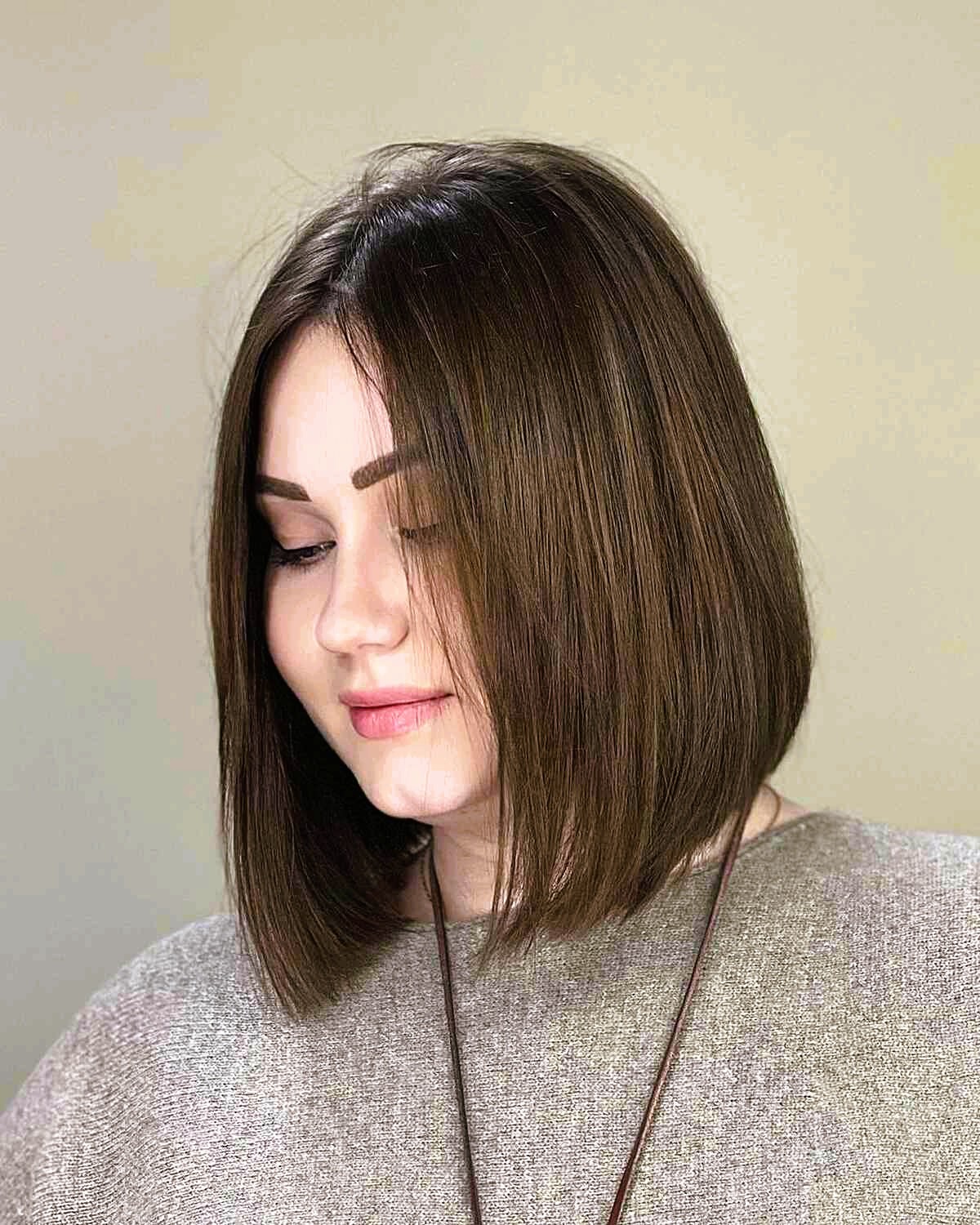
The angled bob is the safest starting point for round faces because the diagonal perimeter — shorter in back, longer in front — creates a line that draws the eye downward and visually narrows the lower face. The steeper the angle, the more dramatic the slimming effect. For most round faces, the front pieces should fall at least 1 inch below the jawline.
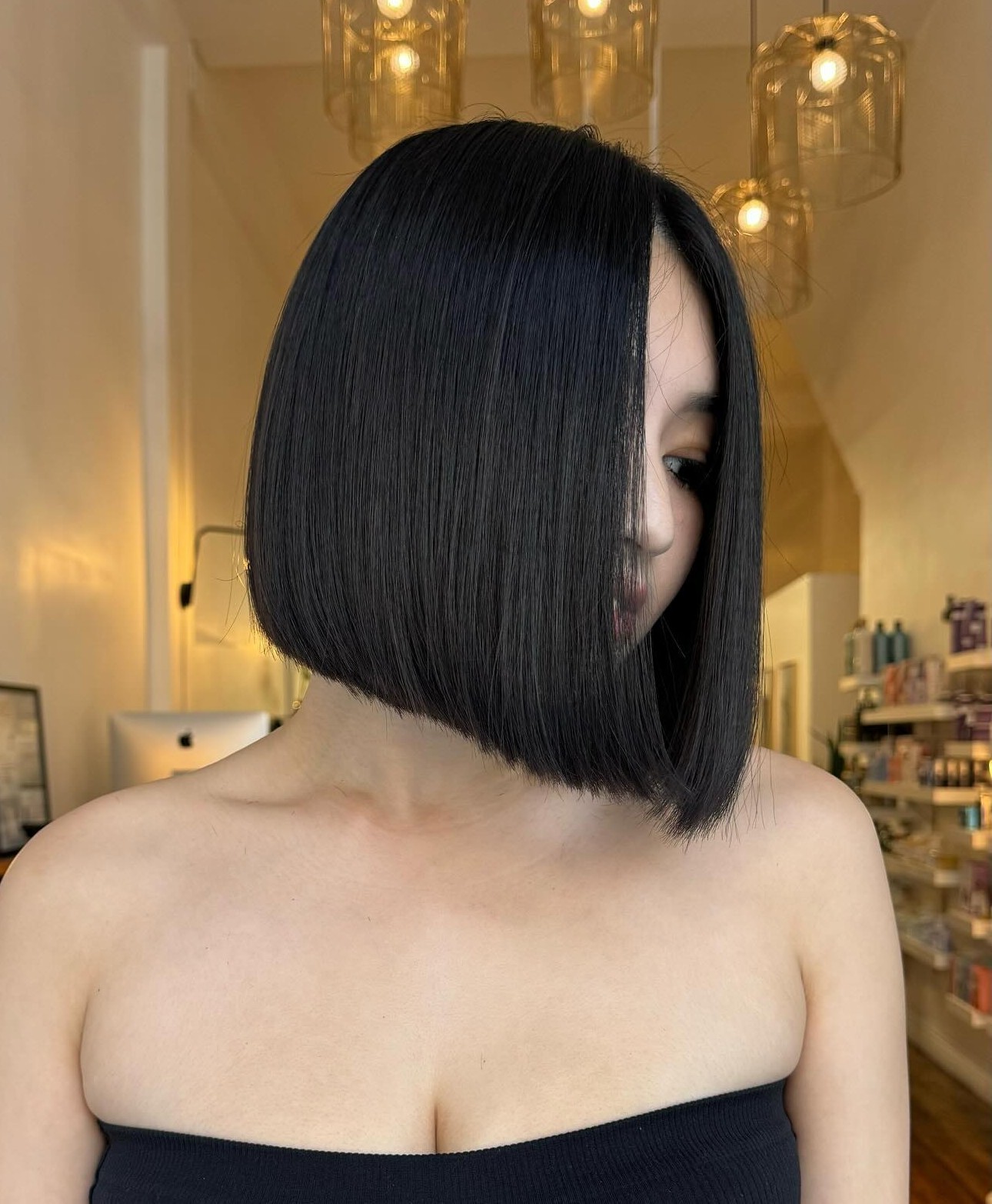
Image source: @beautybylexietg
1. Classic A-Line Bob with Deep Side Part
The graduated perimeter on this A-line creates a clean diagonal from the nape to just below the chin, which is exactly the kind of vertical line round faces benefit from. The deep side part at roughly a 70/30 ratio adds asymmetry without looking dramatically uneven. Ask your stylist for the front pieces to hit 1–2 inches below your jawline and the back to sit at the nape — the angle between those two points is what does the work.
2. Long Angled Lob with Face-Framing Layers
If you want one bob variation that works on nearly every round face, this is it. The shoulder-grazing length extends well past the jaw — the widest point of a round face — while face-framing layers starting at cheekbone level direct the eye downward rather than outward. This lob also has the advantage of growing out gracefully, so you’re not locked into a strict trim schedule. For more length options in this family, see our lob haircuts collection.
3. Textured A-Line with Lived-In Waves
Achieve this look by wrapping 1-inch sections around a curling iron, alternating direction with each section, then shaking the curls out and finishing with a texturizing spray. The waves add dimension that a sleek A-line doesn’t provide, and for round faces, that extra dimension breaks up the smooth, symmetrical surface that tends to emphasize width. A dime-sized amount of texturizing spray is enough — over-applying makes fine-to-medium hair look crunchy rather than tousled.
4. Sharp Angled Bob with Stacked Nape
Unlike a standard A-line where the angle is subtle, this version has a dramatic drop from a cropped, stacked back to front pieces that reach past the chin. The effect is bolder and more architectural, but the tradeoff is higher maintenance — the stacked nape needs shaping every 4–5 weeks to stay crisp. The steep angle makes it one of the most effective bobs for visually narrowing a round face, especially when paired with a side part.
5. Soft Angled Bob for Fine Hair
Fine hair needs the elongating angle but can’t support heavy layering — too many layers make already-sparse ends look wispy and transparent. This variation uses internal layers and point-cut ends instead, which add movement inside the shape without thinning the visible perimeter. Keep the angle moderate (2–3 inches of length difference between back and front) so the shorter back doesn’t expose the scalp where fine hair is thinnest.
6. Angled Lob with Curtain Bangs
Tell your stylist: “I want an angled lob with curtain bangs starting at cheekbone level, with the front pieces falling past my jawline.” Curtain bangs add a soft arch across the forehead that creates vertical interest without the width-adding effect of full blunt bangs. The key detail for round faces is the starting length of the bangs — at or below the cheekbone, not higher. Bangs that hit above the cheekbone on a round face can emphasize the widest point.
Layered Bobs That Slim Round Faces
Layers add movement and break up the solid weight line that can sit right at the jaw and emphasize roundness. The placement matters: layers should start at or below cheekbone level. Layers above the cheekbone create volume at the widest part of a round face, which adds width instead of reducing it. For a broader look at what layering can do across all face shapes, our layered bob haircuts gallery covers 60 variations by hair type and texture.
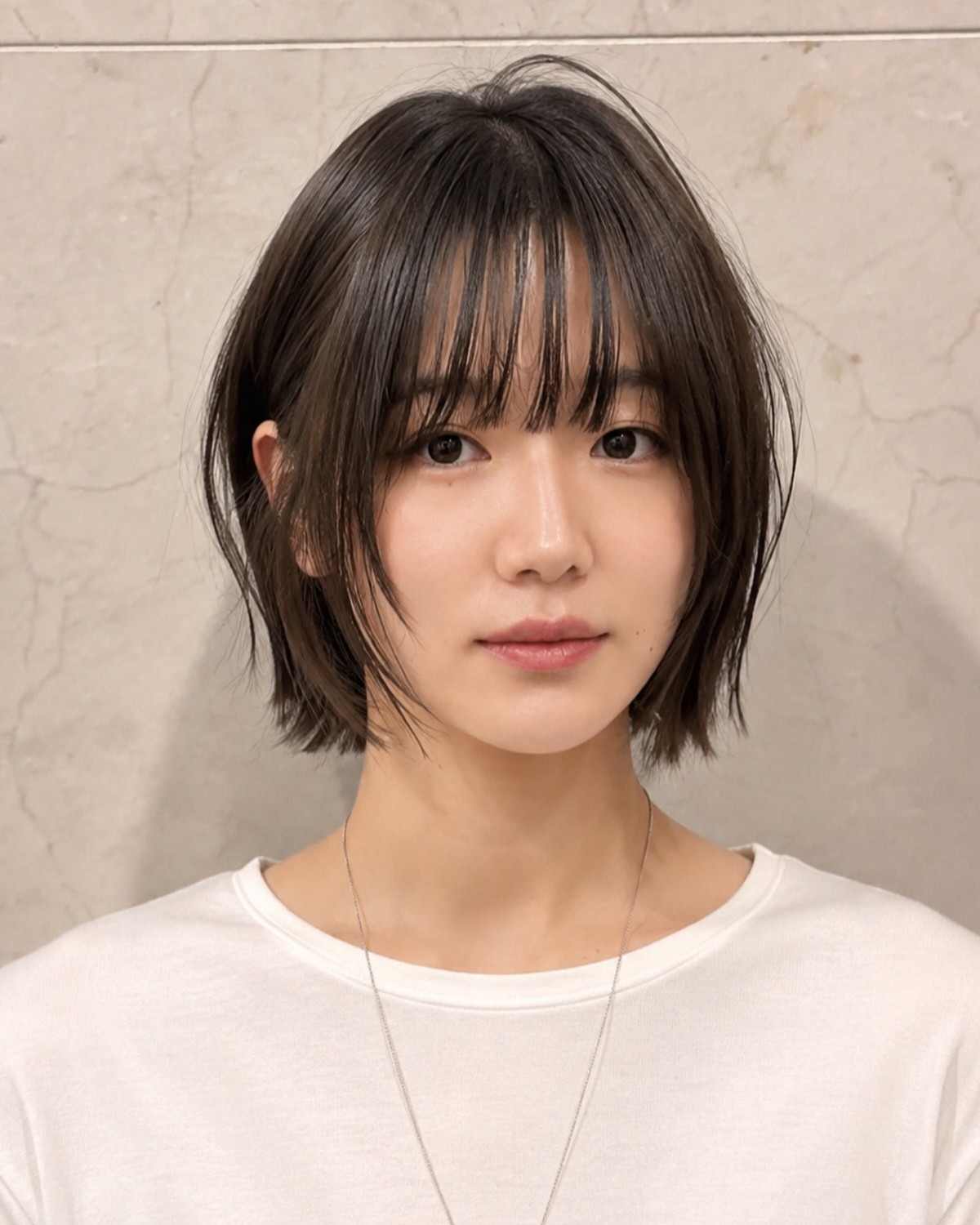
Image source: @zi_win_
7. Medium Layered Bob with Side-Swept Bangs
Side-swept bangs create a diagonal line from the hairline to the jawline, adding exactly the kind of asymmetry round faces need. This works particularly well for round faces with a prominent forehead — the sweep draws attention across the forehead rather than down to the widest point. Keep the bangs long enough to tuck behind the ear for versatility on days when you want them out of the way.
8. Long Layered Bob (Lob) with Movement
This is the most forgiving bob variation for round faces in terms of grow-out. The shoulder-grazing length means you can stretch trims to 7–8 weeks without the shape looking noticeably overgrown. The layers add gentle movement that prevents the lob from looking like a blunt, one-length cut (which would be less flattering for round proportions). Air-dry with a lightweight mousse for a natural, undone finish, or blow-dry with a medium round brush for a polished look.
9. Heavily Layered Bob for Thick Hair
Thick hair without sufficient layering creates a “triangle” effect — narrow at the crown and wide at the jaw — which is the last thing a round face needs. This bob uses aggressive interior layering through point cutting and slide cutting to remove bulk from the mid-shaft while keeping weight at the perimeter. The result is a shape that moves instead of sitting like a helmet. If your hair is naturally thick and dense, make sure your stylist thins the interior, not just the ends.
10. Feathered Bob with Wispy Ends
Razor-cut or point-cut ends create feathered tips that soften the perimeter at the jaw — instead of a hard line sitting at the widest part of the face, the ends taper gently. One honest caveat: this technique doesn’t work well on very fine hair, where the feathered ends can look transparent and stringy. Medium-to-thick hair gets the best result because there’s enough density for the tapered ends to still look substantial.
11. Layered Bob with Face-Framing Highlights
Strategically placed highlights on the front face-framing pieces draw the eye toward the center of the face and away from the width at the cheekbones. Balayage or a money-piece placement (two light strips framing the part line) works best for this effect. The highlights also create the illusion of depth — lighter pieces appear to recede while darker sections underneath add shadow, which gives a naturally narrowing effect that doesn’t depend on the cut alone.
12. Choppy Layered Bob with Texture
This isn’t a wash-and-go cut. Unlike a smooth layered bob that falls into place with a round brush, a choppy bob needs a texturizing spray worked through the mid-lengths daily to look intentional rather than neglected. The payoff is that the uneven, piece-y ends break up the smooth surface of a round face more effectively than any other layering approach. Think of it as the difference between drawing a clean line around a circle versus an irregular one — the irregular line makes the circle look less round.
Graduated and Stacked Bobs for Round Faces
Graduated bobs place volume at the crown — exactly where round faces need it — while angling the weight away from the jawline. The stacked layers at the nape build lift at the back of the head, which adds vertical height and makes the face appear longer in proportion. These work best on straight to wavy hair; very curly textures can make the stacking puff outward rather than stacking neatly. One realistic note: graduated bobs need the most frequent trims of any bob category (every 4–6 weeks) because the short layers at the nape are the first to lose their shape.
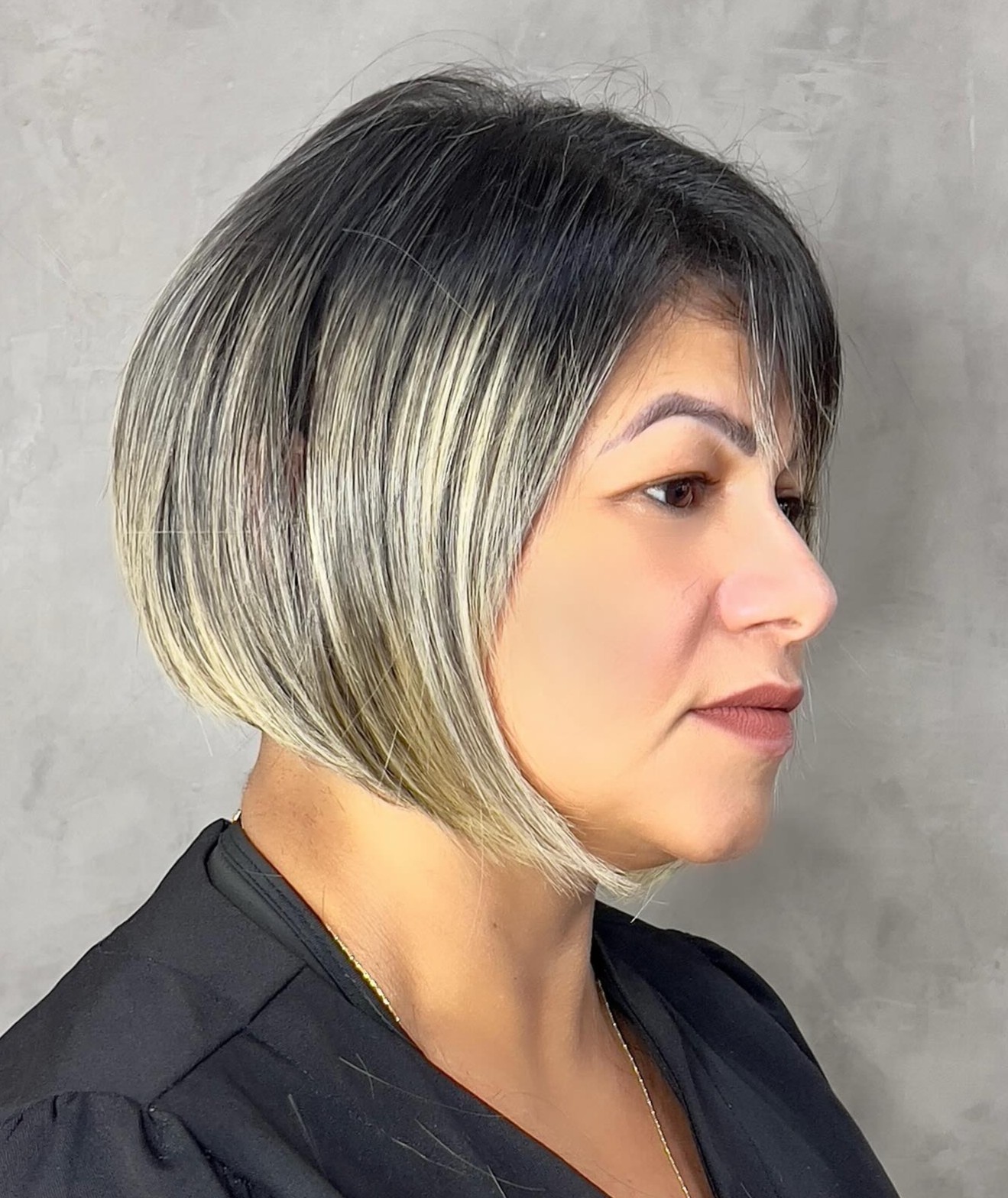
Image source: @daniel.hairstylist
13. Classic Graduated Bob with Crown Volume
The stacked layers at the nape create a rounded, lifted shape at the back of the head. For round faces, this crown volume is valuable because it adds vertical height — the eye reads the overall silhouette as taller and narrower rather than circular. Blow-dry the crown section upward and away from the scalp with a medium round brush to maximize the lift. Flat-drying defeats the purpose of the graduated cut.
14. Stacked Bob with Side Part
Bring a photo and tell your stylist: “I want a stacked bob with graduation at the nape, a side part, and the front pieces hitting about an inch below my jawline.” The specificity matters — “stacked bob” without length guidance can result in front pieces that hit at chin level, which is less flattering for round faces. Make sure you discuss where the front length will fall before any cutting starts.
15. Inverted Bob with Soft Graduation
The inverted shape — dramatically shorter in back, significantly longer in front — is one of the most effective silhouettes for visually narrowing a round face. The extreme angle creates a strong diagonal that overrides the face’s circular outline. This version softens the drama with gentle graduation rather than a blunt weight line, which makes it more wearable for daily life. It reads as modern and structured without veering into severe territory.
16. Graduated Bob on Wavy Hair
Natural wave adds texture to the stacking that straight hair doesn’t provide, reducing the “helmet” look that can happen when a graduated bob is blow-dried too smoothly. Let it air-dry with a curl cream (a quarter-sized amount scrunched into damp hair), and the wave creates organic movement through the graduated layers. If your waves are looser than 2A, you may want to scrunch with a diffuser on low heat to encourage them.
17. Stacked Pixie-Bob Hybrid
This is the shortest option in the gallery and the highest-maintenance — the cropped nape needs shaping every 4–5 weeks, and the longer top pieces need styling direction daily. The payoff is dramatic: the extreme vertical lift at the crown and the short, close-fitting sides create a silhouette that’s the opposite of round. Commit to this only if you’re comfortable with a regular trim schedule. If you’re curious about going even shorter, our pixie cuts for round faces gallery explores that territory.
Shaggy and Textured Bobs for Round Faces
Shaggy bobs use disconnected layers and textured ends to create movement that naturally breaks up roundness. They’re less structured than angled or graduated bobs, which makes them more forgiving on grow-out (8–10 weeks between trims is realistic) but more product-dependent day to day. The lived-in, imperfect finish works in your favor with a round face — precision and symmetry are what emphasize roundness, and a shag is the opposite of both.
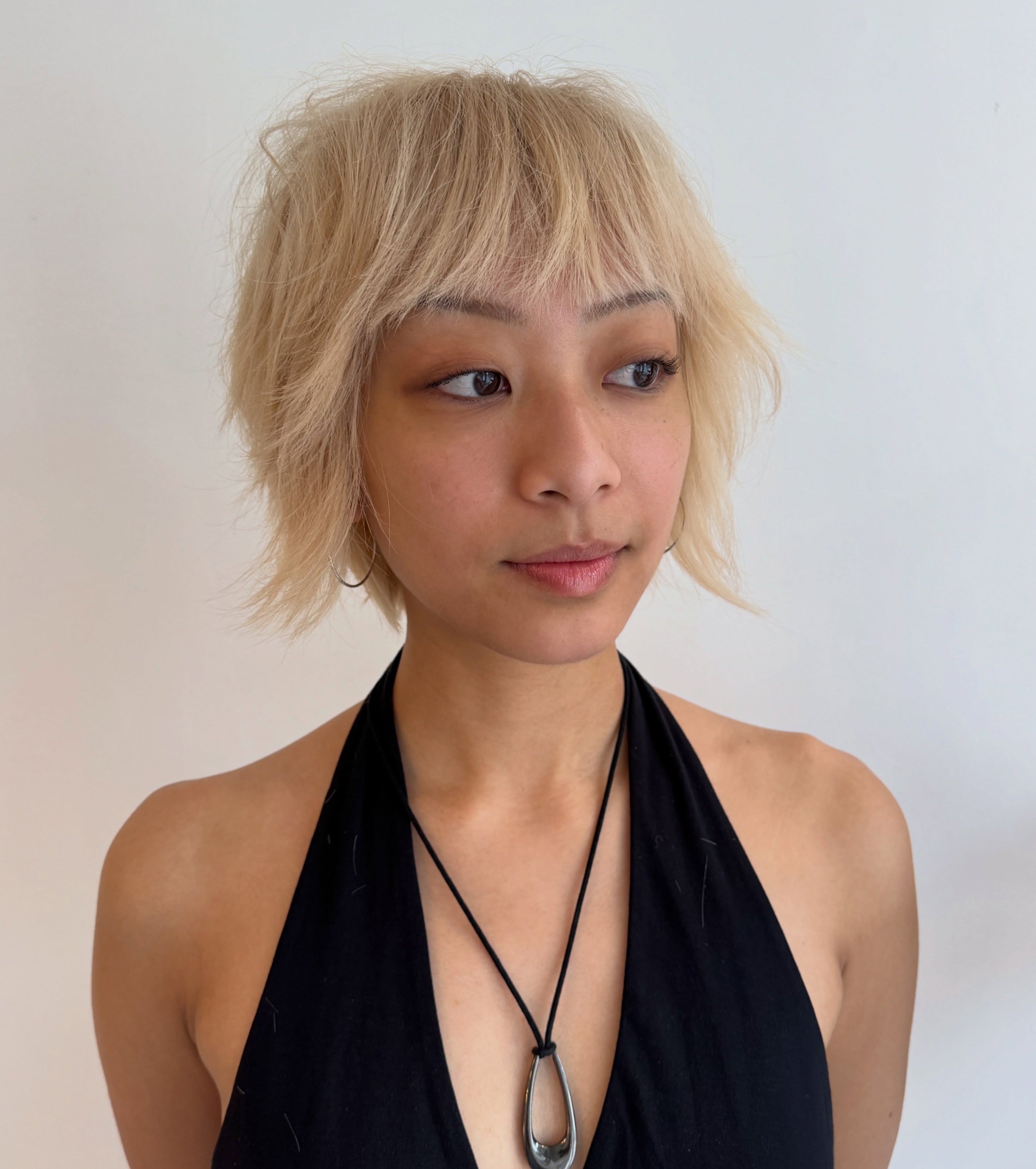
Image source: @anti.dote_studio
18. Modern Shag Bob with Curtain Fringe
Scrunch a curl enhancer through damp hair, diffuse on medium heat until 80% dry, then let it air-dry the rest of the way. Total styling time: about 5 minutes. The tousled, imprecise texture is the point — and for round faces, that deliberate messiness breaks up the smooth, symmetrical surface that makes a face read as circular. Curtain fringe adds a soft arch across the forehead, directing the eye along a curved vertical line rather than a horizontal one.
19. Razor-Cut Shag Bob
Razor cutting creates softer, more organic layers than scissor cutting — the ends taper to a fine point instead of a blunt edge, which gives the bob a natural, effortless movement. One important note: razor cutting removes a lot of weight, which is ideal for medium-to-thick hair but risky on fine hair. If your hair is fine, ask your stylist for point cutting instead, which gives similar texture with less weight removal.
20. French Bob with Tousled Texture
A French bob — chin-length, usually blunt, often with bangs — isn’t the first recommendation for round faces because the short length can hit right at the widest point. This version works around that by adding tousled texture and a slightly off-center part, both of which break up the symmetry that a classic French bob emphasizes. Be honest with yourself: this variation flatters oval-leaning round faces (slightly more length than width) better than very round faces with prominent cheeks.
21. Textured Lob with Piece-y Ends
Dimensional color — babylights, a shadow root, or subtle ribbon highlights — enhances the textured look by creating depth where the lighter pieces catch light and darker sections recede. For round faces, this depth adds a visual slimming effect that goes beyond what the cut alone provides. Think of it as contouring with color: the lighter front pieces draw the eye inward while the darker sections at the sides minimize perceived width.
22. Messy Undone Bob for Thick Wavy Hair
Thick wavy hair is the ideal canvas for a messy bob because the natural texture does most of the styling work — you’re not fighting your hair into a shape, you’re letting it do what it already wants to do. Apply an anti-frizz serum to damp hair (a pea-sized amount, concentrated on the mid-lengths and ends), scrunch, and let it air-dry. The volume and movement that thick waves create naturally break up the roundness without any heat tools or structured blow-drying.
Bobs with Bangs for Round Faces
Bangs can either help or hurt a round face — it depends entirely on the type and length. Side-swept bangs and curtain bangs create diagonal or arched lines across the forehead that add visual length. Full blunt bangs cut straight across create a horizontal line that shortens the face and can emphasize width. The entries in this section show which bang-and-bob combinations work and why.

Image source: @yukistylist
23. Layered Bob with Long Side-Swept Bangs
Long side-swept bangs that graze past the eyebrow create a diagonal line from the hairline to the jawline — one of the strongest asymmetry tools for round faces. Keep the bangs long enough to blend into the front layers when you want them out of the way, which gives you two distinct looks from the same cut. This works for round faces with a wider forehead especially well, since the sweep covers the broader area and narrows the perceived proportion.
24. Lob with Parted Curtain Bangs
Blow-dry curtain bangs with a medium round brush, rolling the ends away from the face to create the signature flip. For round faces, the critical detail is where the shortest point of the bangs falls — aim for cheekbone level or below. Bangs that hit above the cheekbone on a round face add volume at the widest point, which works against the elongating effect you’re going for. Practice the round-brush technique a few times before deciding the bangs aren’t working — the first week of curtain bangs always has a learning curve.
25. Angled Bob with Wispy Bangs
Tell your stylist: “I want wispy, piecey bangs — not blunt or thick. They should be thin enough that I can see my forehead through them.” Wispy bangs soften the forehead without creating the dense horizontal line that full bangs add. Paired with an angled bob, the wispy fringe and the diagonal perimeter work together — the bangs handle the top of the face while the angle handles the jaw, and the round shape gets interrupted at both points.
26. Shaggy Bob with Bardot Bangs
Bardot bangs — long, center-parted, sweeping past the cheekbones — need trimming every 3–4 weeks to stay at the right length. That’s a higher maintenance commitment than the bob itself, which is worth knowing before you commit. The upside for round faces is significant: the bangs create two curtains of hair that narrow the face on both sides while the shaggy bob adds textured movement below. Budget for the extra bang trims when deciding whether this cut fits your schedule.
27. Wavy Bob with Long Curtain Fringe
Wavy hair has a natural advantage with curtain bangs: the wave pattern makes the fringe fall into a soft, face-framing arc without the round-brush work that straight hair requires. If your hair has a natural 2A–2B wave, you can let the bangs air-dry and they’ll split at the part and sweep back on their own. Straight hair needs 3–5 minutes of round-brush direction every morning to get the same effect, which is a daily commitment worth factoring into the decision.
Asymmetrical Bobs for Round Faces
Asymmetry is inherently flattering for round faces because round faces are almost perfectly symmetrical — and any cut that disrupts that symmetry makes the face read as less circular. The stronger the asymmetry, the more dramatic the slimming effect. Even a subtle 1-inch difference between sides creates enough imbalance to change the overall appearance.
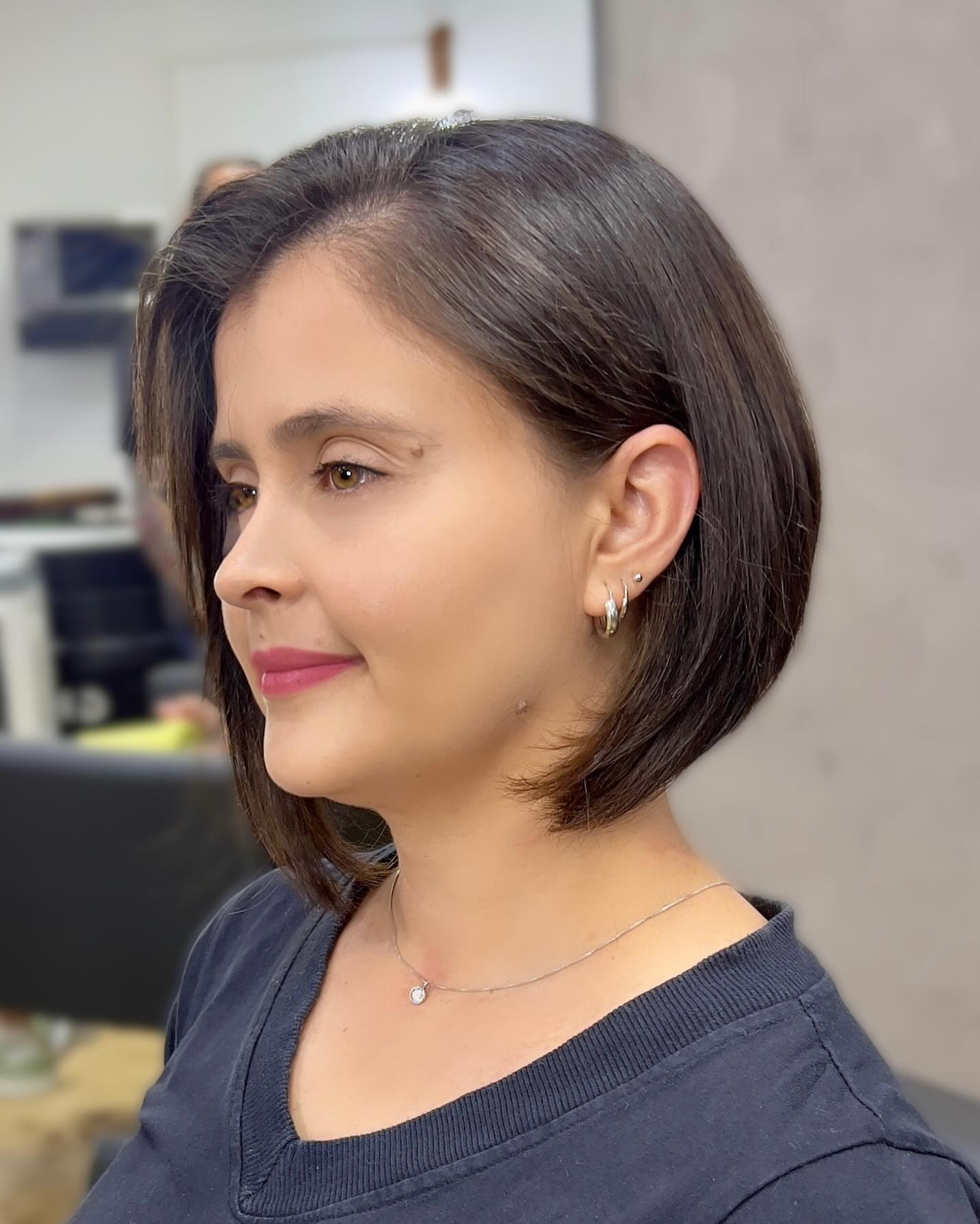
Image source: @daniel.hairstylist
28. Classic Asymmetrical Bob
One side falls 1–2 inches longer than the other, with the longer side framing the fuller cheek. The weight line sits at different heights on each side of the face, which prevents the eye from drawing a horizontal line across the jaw — the line that emphasizes roundness most. A side part on the shorter side adds to the asymmetry. This is a controlled, wearable version of asymmetry that works in professional settings without looking edgy.
29. Subtle Asymmetrical Lob
More wearable than a sharp asymmetrical bob because the length difference is gentler — just enough to break the symmetry without being immediately obvious. This version also grows out more gracefully, with an 8-week trim cycle that’s manageable for most schedules. It’s a good option if you want the slimming benefit of asymmetry but prefer a look that doesn’t announce itself as deliberately uneven.
30. Asymmetrical Bob with Undercut Detail
This is the boldest choice in the gallery and the highest-maintenance — the undercut side needs buzzing every 2–3 weeks to stay clean. The effect on a round face is dramatic: one side is fully exposed (shortening the visual width on that side to zero) while the other side has volume and movement. It’s not for everyone, and that’s worth acknowledging. But if you’re drawn to it, the contrast between the cropped side and the full-length side creates the strongest possible asymmetry for narrowing a round face.
Bob Styles That Round Faces Should Approach with Caution
Three bob variations consistently work against round face proportions — not because they’re bad cuts, but because their geometry emphasizes width rather than length.
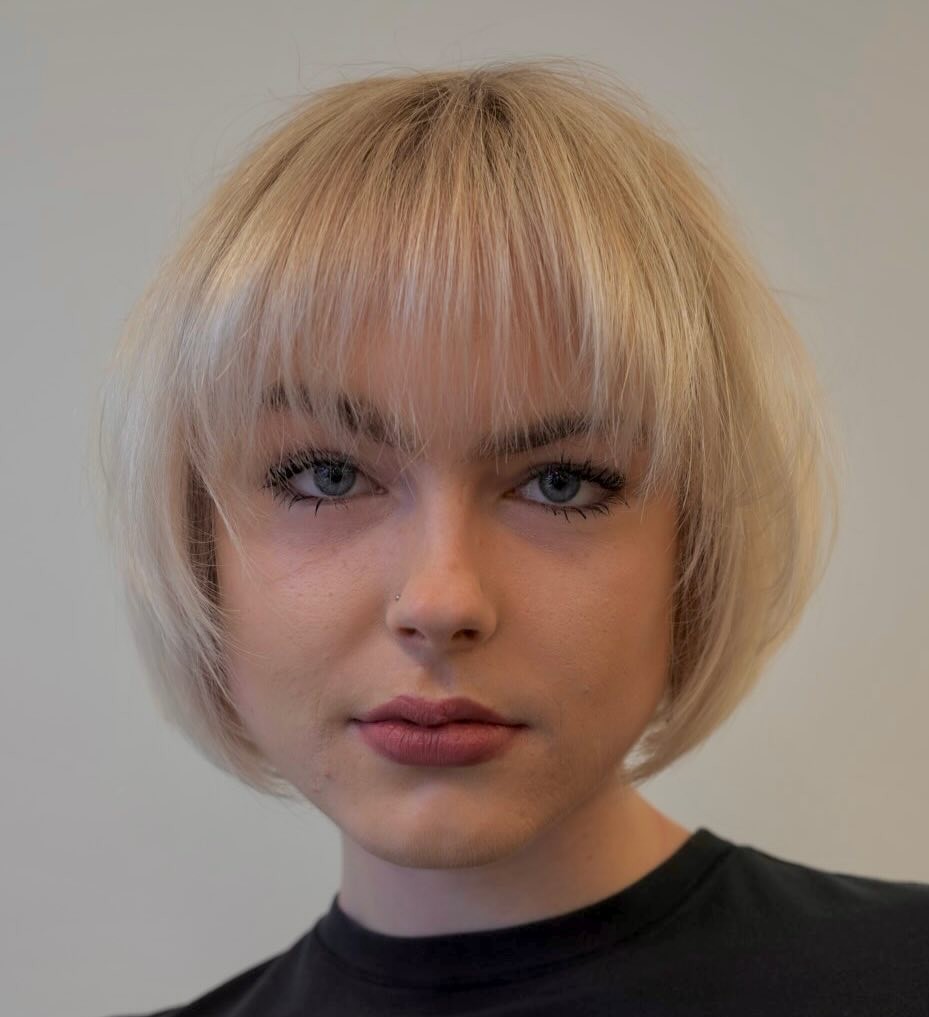
Image source: @valteribeironl
Chin-length blunt bob with a center part is the most common mistake. The blunt perimeter creates a hard horizontal line at the widest point of the face, and the center part divides the face into two symmetrical halves — symmetry is exactly what makes a round face look rounder. If you’re set on a chin-length bob, offset it with a deep side part and face-framing layers that break up the perimeter line.
One-length bob without any layering places all the hair’s weight at a single horizontal line around the jaw. On round faces, this reads as a frame that traces the circular outline rather than interrupting it. Even subtle internal layers or point-cut ends add enough movement to prevent this effect.
Very short bob with full blunt bangs shortens the face vertically (the dense bang line cuts the forehead out of the picture) and adds width horizontally (the short length stops at the widest point). Together, these two forces compress the face into a shape that reads as wider and shorter than it is. If you want both a short bob and bangs, choose wispy or side-swept bangs instead of blunt, and make sure the bob has a side part.
What to Tell Your Stylist
Walking into a salon with specific language makes the difference between getting the bob you wanted and getting a generic interpretation. Here’s what to say for the three most popular round-face-friendly variations:
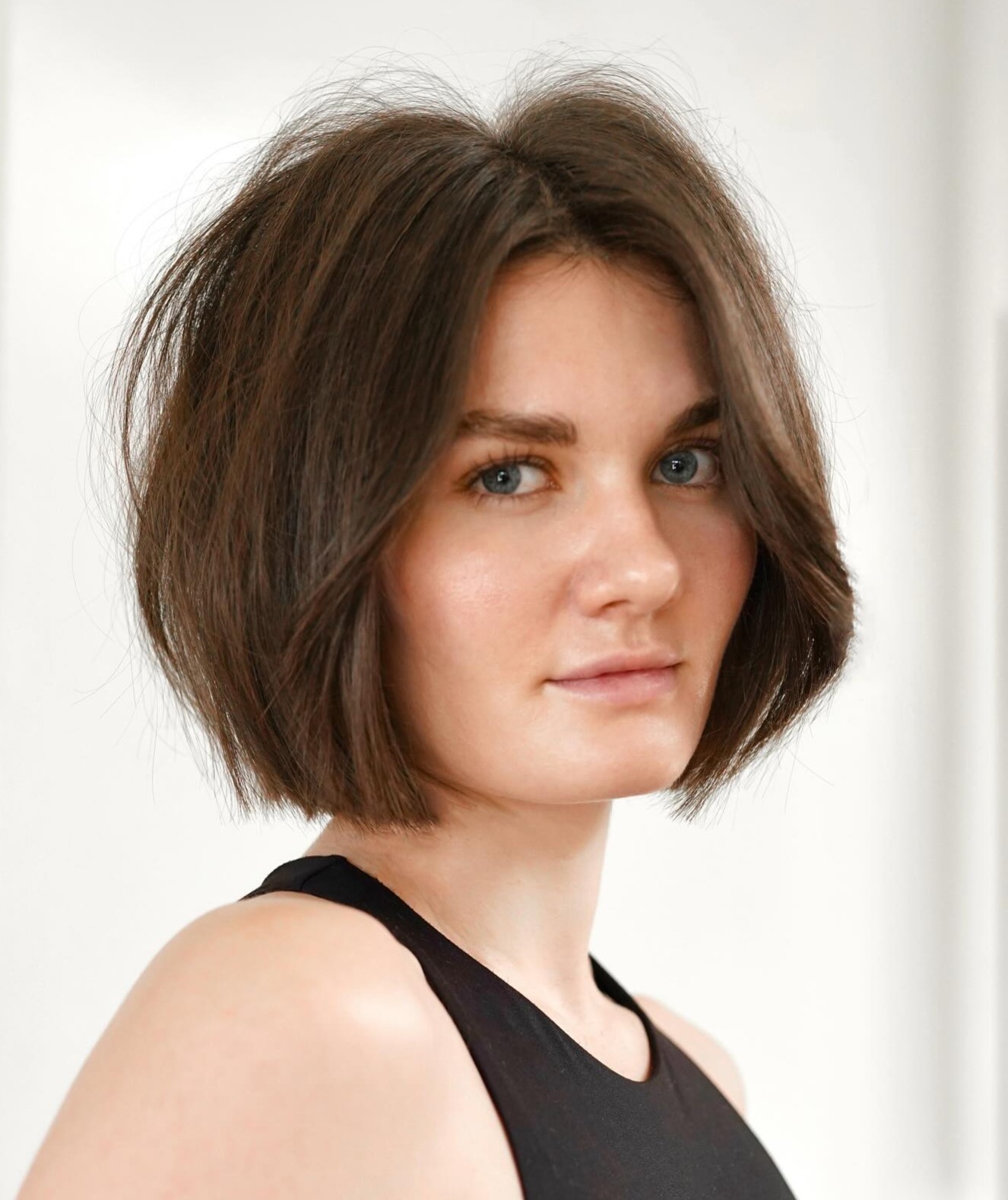
Image source: @yukistylist
For an angled lob: “I want an angled lob with the front pieces hitting 1–2 inches below my jawline, shorter in the back at the nape, with a deep side part. I’d like the angle to be visible but not extreme.”
For a layered bob: “I need layers starting at cheekbone level or below — no layers above the cheekbone, they’ll add width on my face shape. I’d like point-cut ends rather than blunt ends.”
For a graduated bob: “I’d like a stacked bob with graduation at the nape for crown volume, with the front pieces falling past my jawline. I want the back to have lift, not just be short.”
Stylist tip: Bring 2–3 reference photos showing the specific variation you want, not just the general idea. Ask for a dry consultation before any cutting starts — seeing the cut’s likely shape on your dry hair is more accurate than visualizing from wet hair, especially for round faces where the relationship between length and jawline matters.
Maintenance and Styling by Bob Type
Angled and A-line bobs need a trim every 6 weeks to maintain the angle — as the hair grows, the front-to-back length difference shrinks and the elongating effect diminishes. Daily styling takes about 10 minutes with a round brush and dryer. Products: heat protectant spray, a lightweight smoothing cream for the ends.
Layered bobs are more flexible — you can stretch to 6–8 weeks between trims before the layers lose definition. Styling takes 5–10 minutes depending on whether you air-dry (faster, more casual) or blow-dry (more polished). Products: a golf-ball-sized amount of volumizing mousse on towel-dried roots, heat protectant if blow-drying.
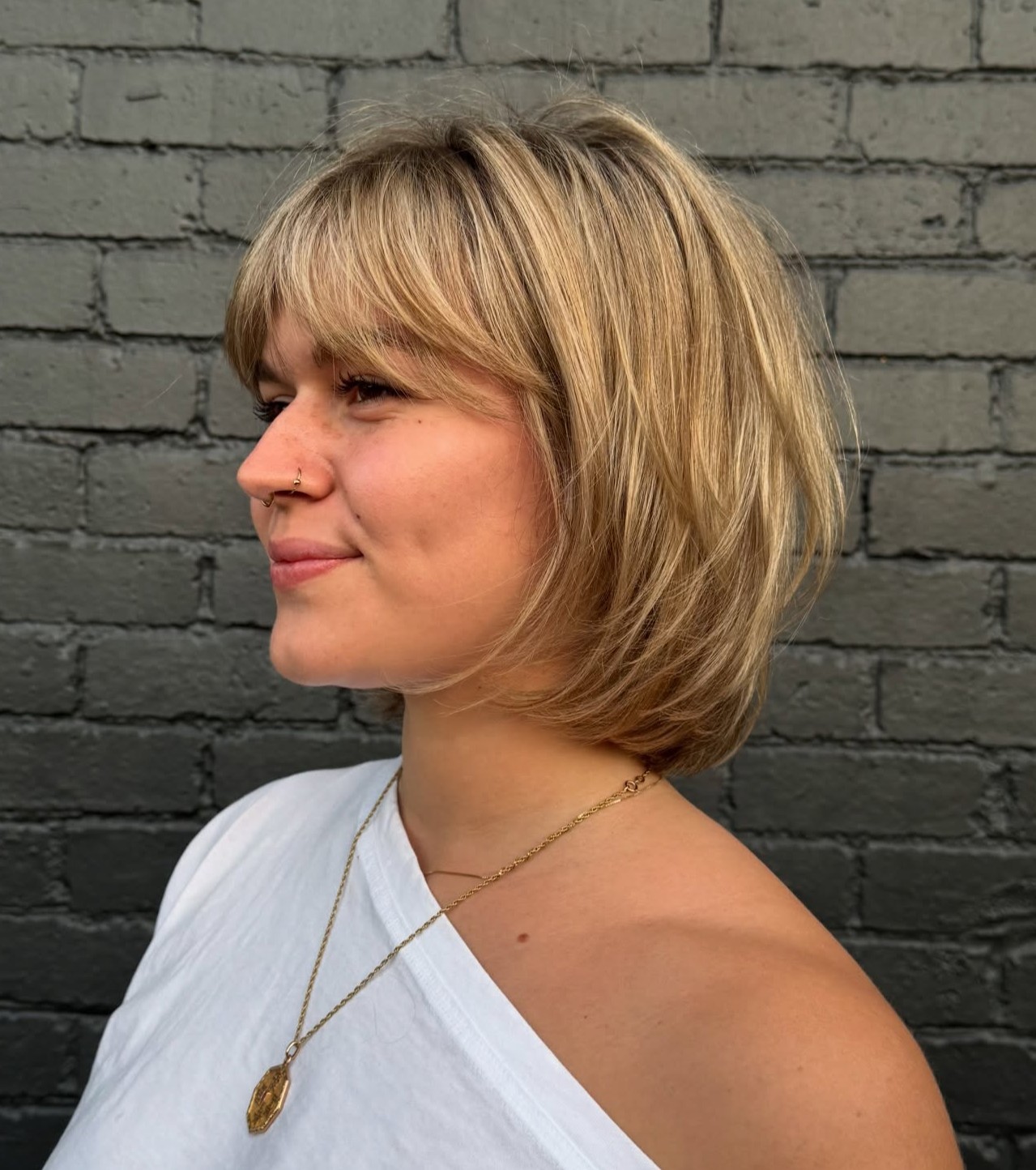
Image source: @pennyandpeach
Graduated and stacked bobs have the shortest trim cycle at 4–6 weeks. The stacked layers at the nape are the first to grow out and lose their shape. Styling takes 10–15 minutes because the crown needs round-brush lift to look intentional. Products: volumizing mousse, medium-hold hairspray at the crown.
Shaggy bobs grow out the most gracefully — 8–10 weeks between trims is realistic because the lived-in look is part of the style. Daily styling is minimal (5 minutes), but a texturizing spray is non-negotiable. Without it, the shag looks unfinished rather than intentionally undone.
FAQ
What Length Bob Is Most Flattering for a Round Face?
A bob that falls 1–2 inches past the jawline is the most universally flattering for round faces — it extends the visual line below the widest point of the face, creating the illusion of length. Chin-length bobs can work but need a deep side part and face-framing layers to offset the width. The key is avoiding a perimeter line that stops exactly at the widest part of your cheeks, which emphasizes roundness rather than elongating it.
Can I Get a Short Bob If I Have a Round Face?
Yes, but the cut needs compensating elements to prevent it from emphasizing width. A short bob for a round face should include a side part (not center), visible layering or texture, and ideally some stacking at the back for crown height. The one combination to avoid is a chin-length blunt bob with a center part and no layering. For more short bob inspiration, our short bob haircuts gallery covers 50 variations across face shapes and hair types.
Should I Get Bangs with a Bob If I Have a Round Face?
Side-swept and curtain bangs are excellent for round faces because they create diagonal or arched lines across the forehead that add visual length. The type to avoid is full, blunt, straight-across bangs — they add a dense horizontal line that shortens the face. Wispy bangs are a safer bet than thick ones if you’re unsure, because you can see the forehead through them and they don’t create a hard edge.
Does a Center Part Work for Round Faces?
A center part emphasizes facial symmetry, and round faces already have strong symmetry — highlighting it makes the face look rounder. A side part at a 70/30 or 80/20 ratio adds asymmetry that visually narrows the face. If you strongly prefer a center part, offset it with face-framing layers, waves, or curtain bangs to introduce irregularity. A center part with a one-length blunt bob is the specific combination that’s least flattering.
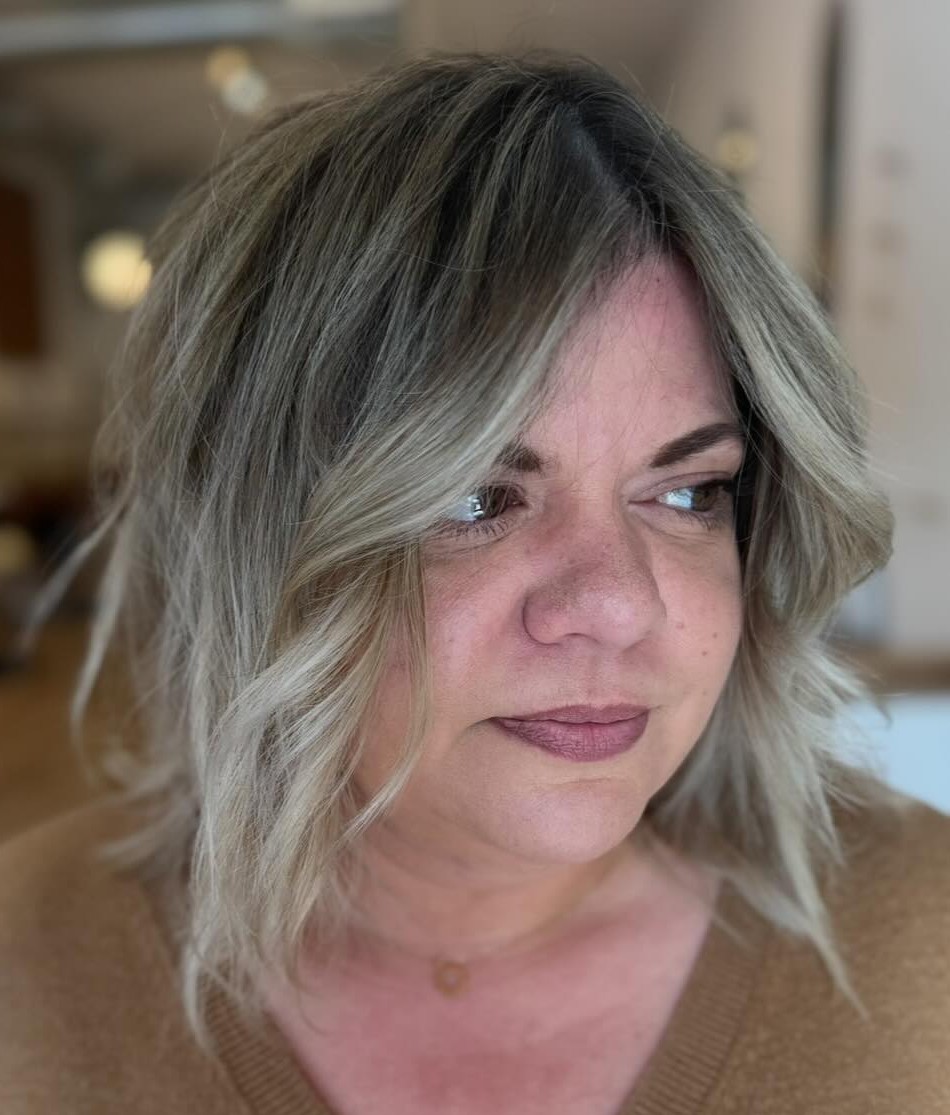
Image source: @feverfewhair
How Do I Know If I Have a Round Face?
Round faces have roughly equal width and length, with the widest point at the cheekbones and a softly curved jawline without strong angles. The forehead and jaw are approximately the same width, and the overall outline resembles a circle more than an oval or rectangle. Compare to an oval face (noticeably longer than wide) or a square face (strong, angular jawline). Our face shape determination guide walks through each shape with photo comparisons to help you identify yours.
Will a Bob Make My Round Face Look Wider?
Only if the cut is the wrong variation. Chin-length bobs with center parts and blunt cuts without layering are the two combinations that risk adding width. Any bob with a side part, face-framing layers, or an angled perimeter creates vertical lines that elongate rather than widen. The bob is actually one of the best cut families for round faces — the key is choosing the right sub-type and part direction, which is why this guide exists.
Hair results vary based on your natural hair type, texture, density, and condition. Always consult with a licensed hairstylist before making significant changes, especially with chemical treatments or dramatic length changes. Photos may show styled results that require professional tools and products to replicate.


1 response