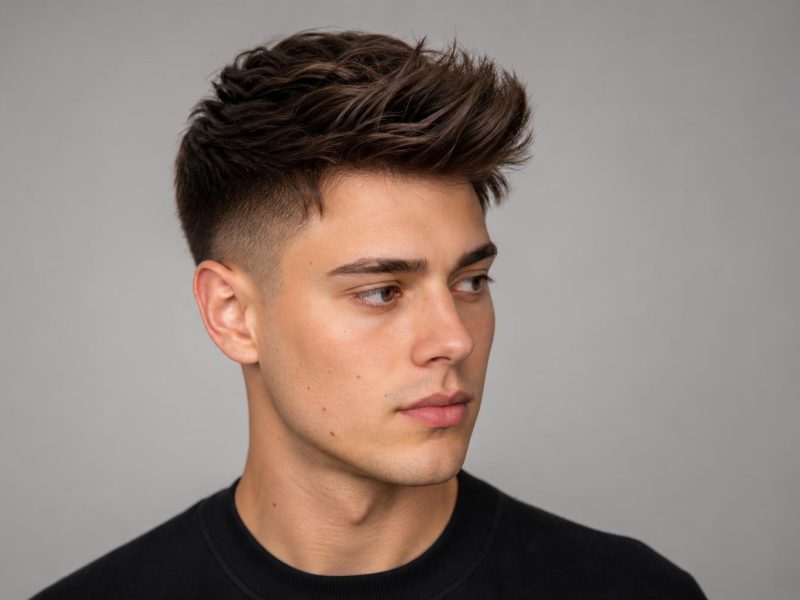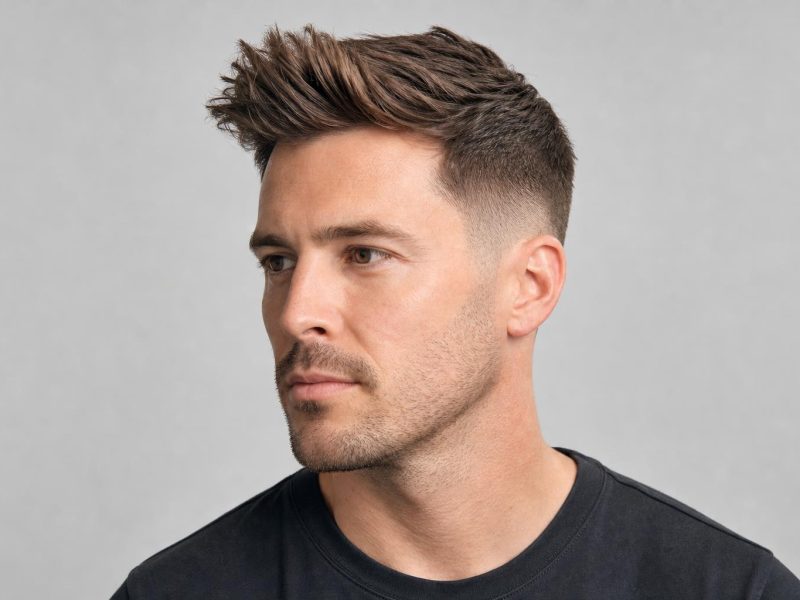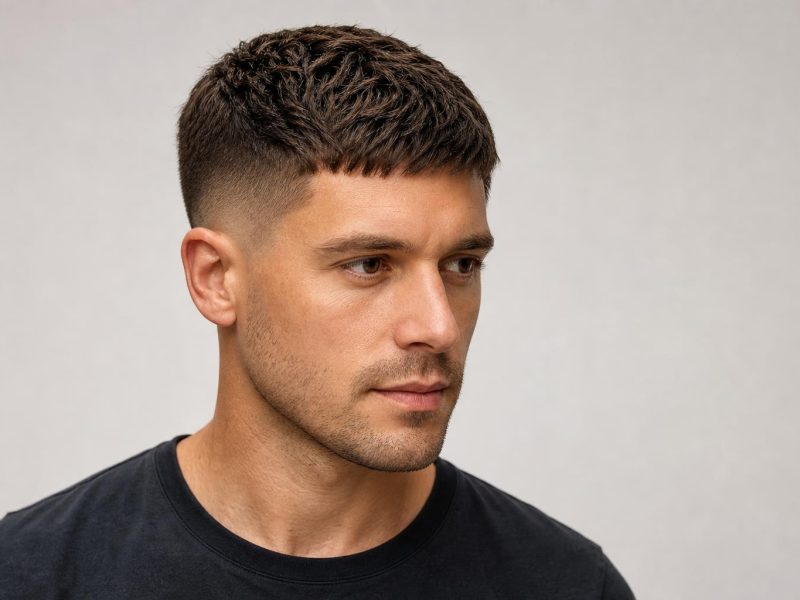

The bowl cut became a punchline in the 90s, but the modern version built on texture, fades, and a sharp perimeter has almost nothing in common with the kitchen-scissors original — except the name.
A modern bowl cut creates a blunt-edged rounded perimeter around the top section while the sides taper, fade, or disconnect cleanly below it. That structural combination looks architectural rather than accidental, which is the single thing that separates a contemporary bowl from a dated one. Here are 25 variations covering straight hair, wavy hair, curly textures, and the longer mushroom-adjacent styles getting the most attention right now.
The gallery runs through four categories: classic and textured bowl cuts on straight and wavy hair, undercut and faded high-contrast versions, curly and wavy natural-texture styles, and longer ear-grazing mushroom variations. Guidance sections follow on face shape compatibility, the bowl cut vs mushroom cut vs bull cut distinction, exact barber language, and the conditions where this cut works against you.
| Factor | Details |
|---|---|
| Best for | Oval, heart, and square faces; medium to thick hair of any texture |
| Maintenance | Faded versions every 2–3 weeks; taper and mushroom versions every 4–6 weeks |
| Works with | Straight, wavy, curly (2c–3b); medium to thick density; all coil types |
| Avoid if | Very round face; fine low-density hair; receding front hairline |
| Salon time | 30–45 minutes for cut; 15 min extra for fade or color integration |
Classic and Textured Bowl Cuts
The foundation of the modern bowl cut is the blunt perimeter line — a clean horizontal boundary where the top section ends and the sides begin. Straight to slightly wavy hair shows this line most crisply; texture on top keeps it from reading as a helmet. These seven entries use the perimeter as the structural constant while varying what happens above and below it.
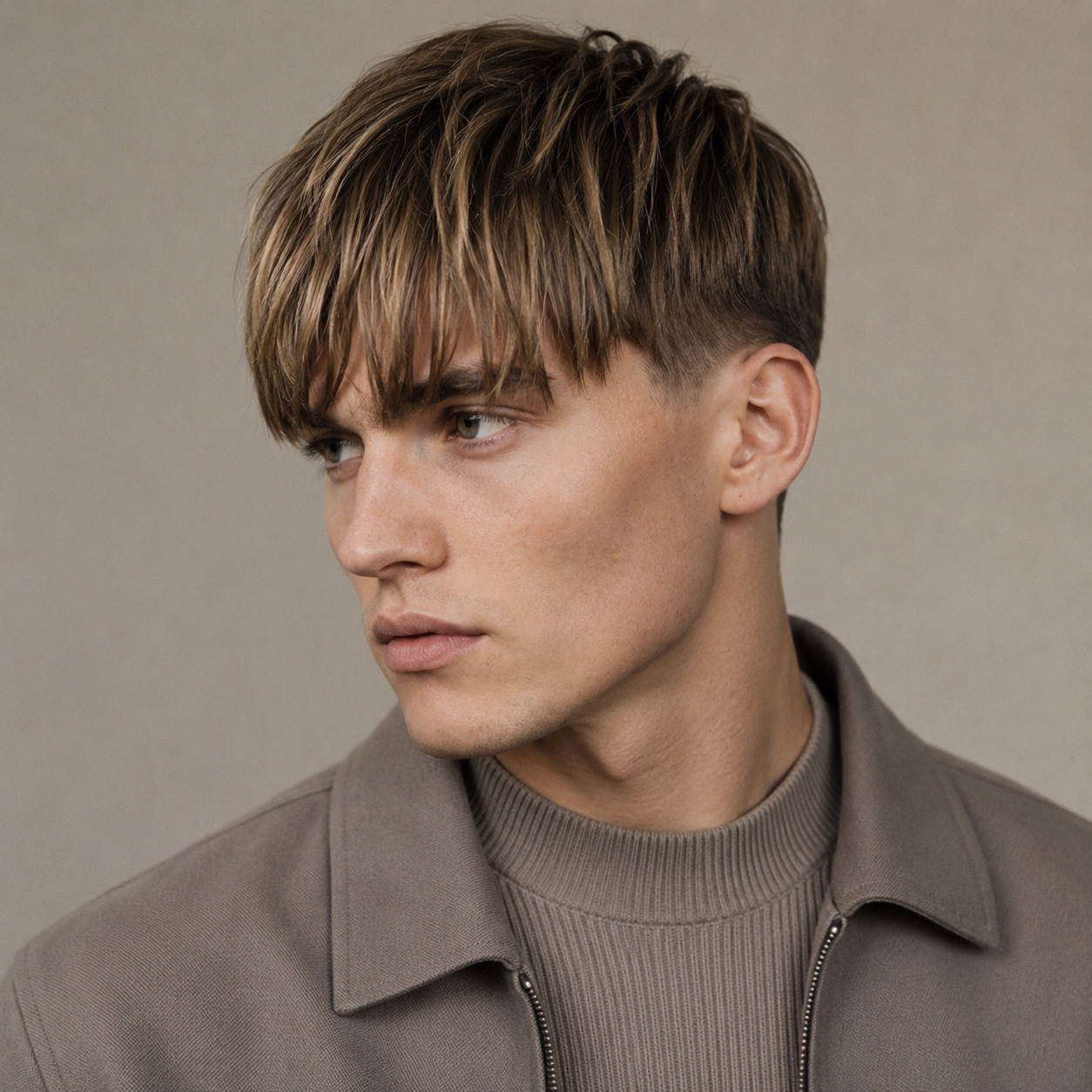
1. Textured French Crop Bowl
Scissor-over-comb work through the top 2–3 inches creates a choppy surface texture that sits within the bowl’s rounded perimeter rather than spilling past it. This technique prevents the flat, pressed-down appearance that made 90s bowl cuts look dated — the texture breaks the surface while the perimeter line stays clean. Medium-density straight hair gets the most definition; fine hair loses the texture by midday without a light clay to hold it.
2. Blunt Perimeter Bowl with Side Part
Oval and oblong faces benefit most from a hard side part that breaks the bowl’s circular silhouette into asymmetric halves, adding horizontal movement to a shape that otherwise produces a static cap from the front. The perimeter falls at mid-ear and is cut parallel to the floor all the way around, which creates the cut’s signature clean line. On straight hair with enough density to hold that horizontal, this version is the most precise in the bowl family and the one barbers find easiest to execute consistently.
3. Bowl Cut on Thick Wavy Hair
Thick wavy hair has enough natural body to fill out the bowl shape without product, and the waves create surface texture that prevents the top from going flat. The adjustment: the perimeter in the back should be cut slightly shorter than the sides because density at the nape can push the rear section outward and break the rounded silhouette. On 2a–2b wave patterns, leaving the top at 2.5–3 inches gives enough length for the wave to move within the bowl’s boundary.
4. Choppy Tousled Bowl
Blow-drying the top section forward and down, then working a matte paste through it with fingers against the direction of growth, creates lift and forward movement that tousles the surface without product residue. The bowl’s perimeter keeps the tousled look from reading as overgrown — the clean edge signals the style as deliberate rather than neglected. This approach takes 3–5 minutes daily and is the easiest version to recreate at home once the cut is correct.
5. Low-Maintenance Soft Bowl
At four to five weeks past the last cut, the perimeter of a taper-sided bowl softens from a hard line into a graduation, and the overall shape reads more as a longer textured crop than a defined bowl. For men who prefer fewer barber visits, this version’s grow-out is more forgiving than a faded bowl — the perimeter blurs gradually rather than abruptly. Schedule visits every 4–6 weeks and accept that weeks four and five look more like a soft crop than a clean bowl.
6. Two-Tone Bowl with Bleached Top Surface
Bleaching the top surface of the bowl 1–2 shades lighter while leaving the sides and undersection at the natural base creates a gradient that emphasizes the cut’s geometry — the lighter top and darker perimeter amplify the bowl’s silhouette visually. This combination works best on medium-brown to dark-brown bases; going lighter than level 8 on top starts to look very high-contrast rather than tonal in most lighting. Budget for a color refresh every 6–8 weeks as the bleached section shows new growth and the gradient loses definition.
7. Taper Bowl with Low Fade
Tell your barber: “bowl cut on top with a low taper starting at the ear — keep the perimeter line clean and sharp, no graduation above it.” The key word is “taper” rather than “fade” — a taper blends gradually from top to short at the natural hairline, while a fade goes to skin, and the difference in outcome is significant. This is the least visually dramatic bowl variation and the right starting point for men who want the shape but are hesitant about strong contrast at the sides.
Undercut and Faded Bowl Cuts
The biggest change in the bowl cut’s contemporary revival is the integration of fades and undercuts below the perimeter line. Where the 90s version blended the sides gradually or left them at uniform length, the faded bowl creates hard contrast between the full top section and the shorter sides — that tension makes the perimeter look deliberate. These seven entries cover the range from low fade to bald taper.
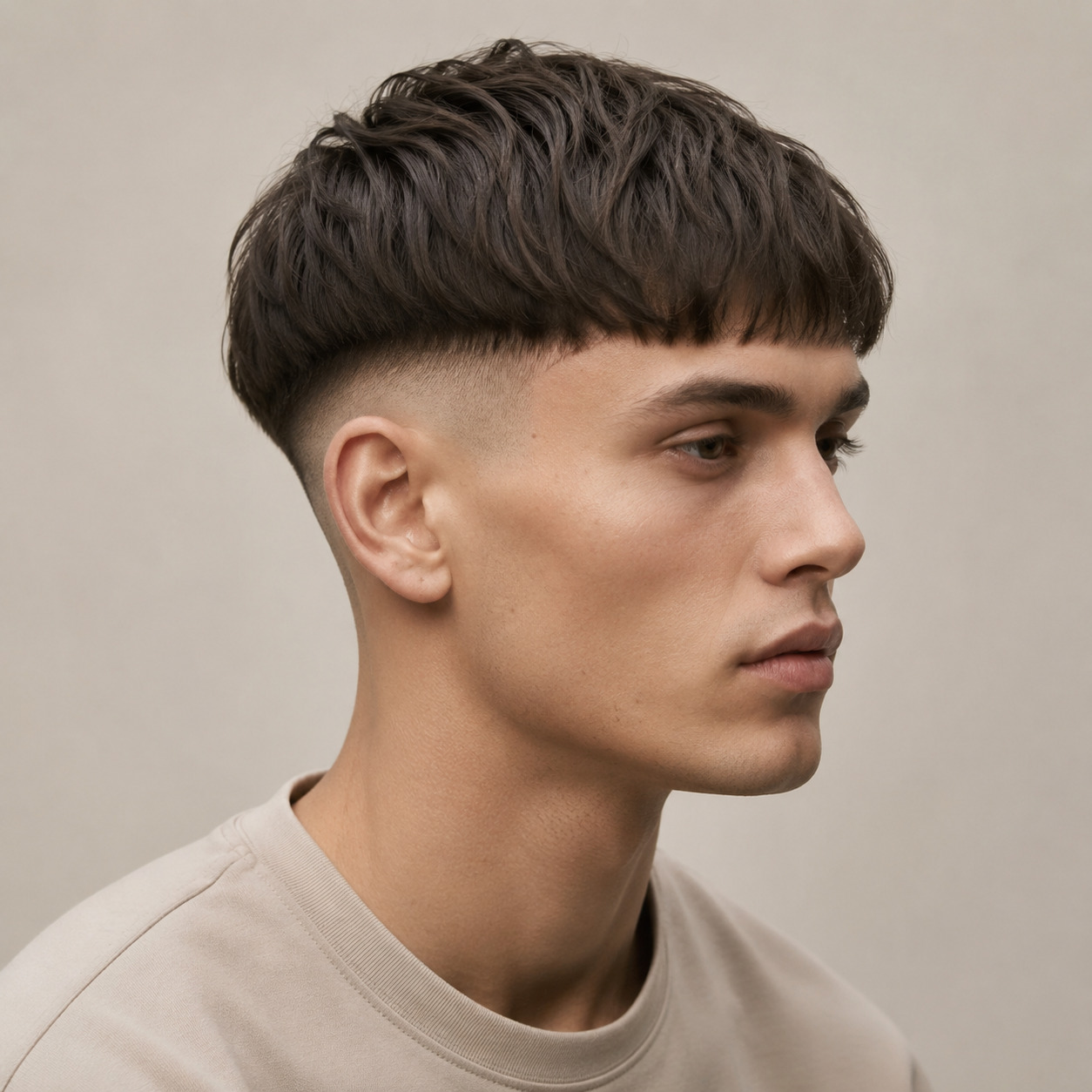
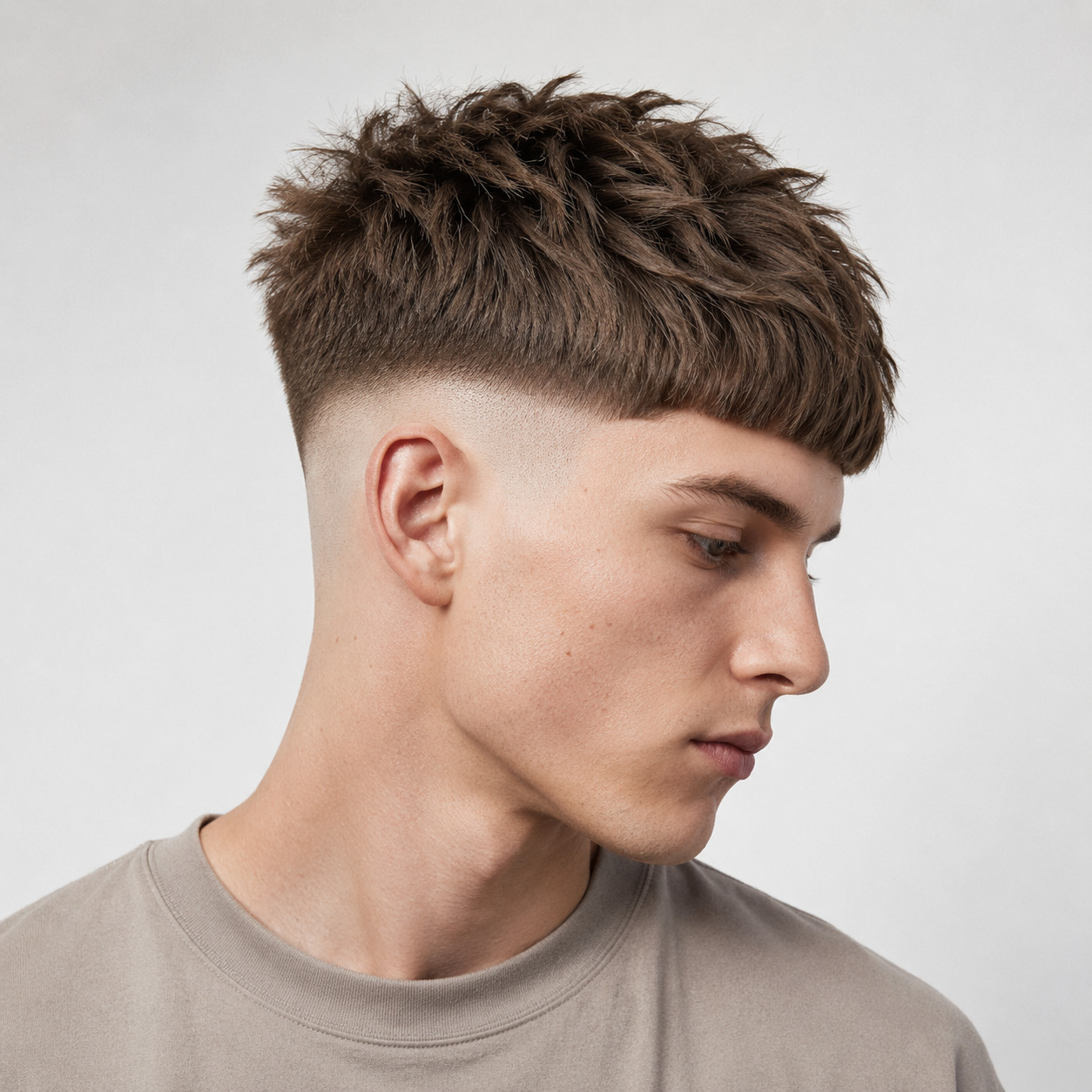
8. Bowl Cut with Disconnected Skin Fade
Where a taper blends gradually, this version disconnects the top section completely — the perimeter line is the hard boundary between full-length top and skin-faded sides, with no blending across the transition zone. Oval and heart face shapes carry this best; square faces should avoid a very high fade that makes the jaw the widest visible point. Among all bowl cut variations, the disconnected version tends to generate the most questions from other people — the hard divide is unexpected on what looks like a bowl from above.
9. Bowl with High Taper Fade
The fade starts at the temple zone and works down to zero at the natural hairline, covering more of the sides than a low fade while keeping the bowl’s top intact. Barbers establish the perimeter line with scissors first, then fade below it using progressively shorter guards toward skin at the ear. The result combines the structural logic of the high taper fade with the bowl’s blunt perimeter rather than a comb-over or textured crop, which makes it the most modern-looking variation on straight medium-density hair.
10. Mid Fade Bowl
A mid fade paired with the bowl’s blunt perimeter is the single most requested combination in shops where the bowl cut has returned to the menu, especially for oval and round faces who want to add apparent height through the top section while narrowing the sides. The mid fade begins just above the ear, and the bowl’s perimeter sits 2–3 centimeters above the fade’s starting point. The mid taper fade provides the same proportional logic but without the bowl’s blunt perimeter as the defining top element.
11. Bowl Cut on Fine Straight Hair with Undercut
Fine straight hair shows the bowl’s perimeter line more crisply than medium or thick hair — lighter strands have less volume pushing the line out of alignment. The challenge: fine hair on top of an undercut has no support from below, and the top section can flatten against the scalp by early afternoon without intervention. A salt spray worked into towel-dried hair before air-drying is the lightest product intervention that creates surface texture and prevents the bowl’s top from going flat.
12. Hard Part Bowl with Drop Fade
Blow-drying the top section toward one side of a razor-scored hard part creates directional movement within the bowl’s circular shape, which prevents the static front-on look that even well-executed bowl cuts can produce. The hard part is placed at the temple, precisely where the bowl meets the faded sides, so the parting becomes part of the perimeter’s design rather than just a styling choice. The hard part needs re-shaving every 7–10 days as temple hair grows fastest.
13. Bald Taper Bowl for Type 4 Coily Hair
A bald taper below coily 4a–4c hair produces sharper contrast than the same fade on any other texture — the coil pattern makes the top section visually dense in a way that straight hair at the same length cannot replicate. This version is among the less maintenance-intensive faded bowls: the top section needs shaping but not a full cut between visits, and the bald taper is quickly re-touched rather than fully redone. Use a detail trimmer to define the perimeter edge precisely — a sloppy perimeter on a bald taper bowl is visible from across a room.
14. Color-Block Fade Bowl
The bowl cut’s blunt perimeter naturally creates a visual boundary; adding a lighter color to the top section and a darker or natural base beneath turns the cut into a graphic color block. The color contrast amplifies the perimeter line strongly enough that even a low-contrast taper below reads as a hard disconnection. This approach was most visible in Korean barbering and K-pop influenced men’s styles before crossing into broader western men’s cutting trends — unlike most trend-borrowed cuts, the color block genuinely serves the bowl’s structural logic rather than just decorating it.
Bowl Cuts for Curly and Wavy Natural Textures
Curly and wavy hair creates the bowl’s surface texture naturally — no product or technique required to prevent the flat helmet look that trips up fine straight hair. The one condition across all curly bowl cuts: your barber needs to see the curls at their natural resting length before any scissors come out. Wet cutting curly hair is how you end up two inches shorter than planned, because curls can lose 20–40% of their visible length when saturated.
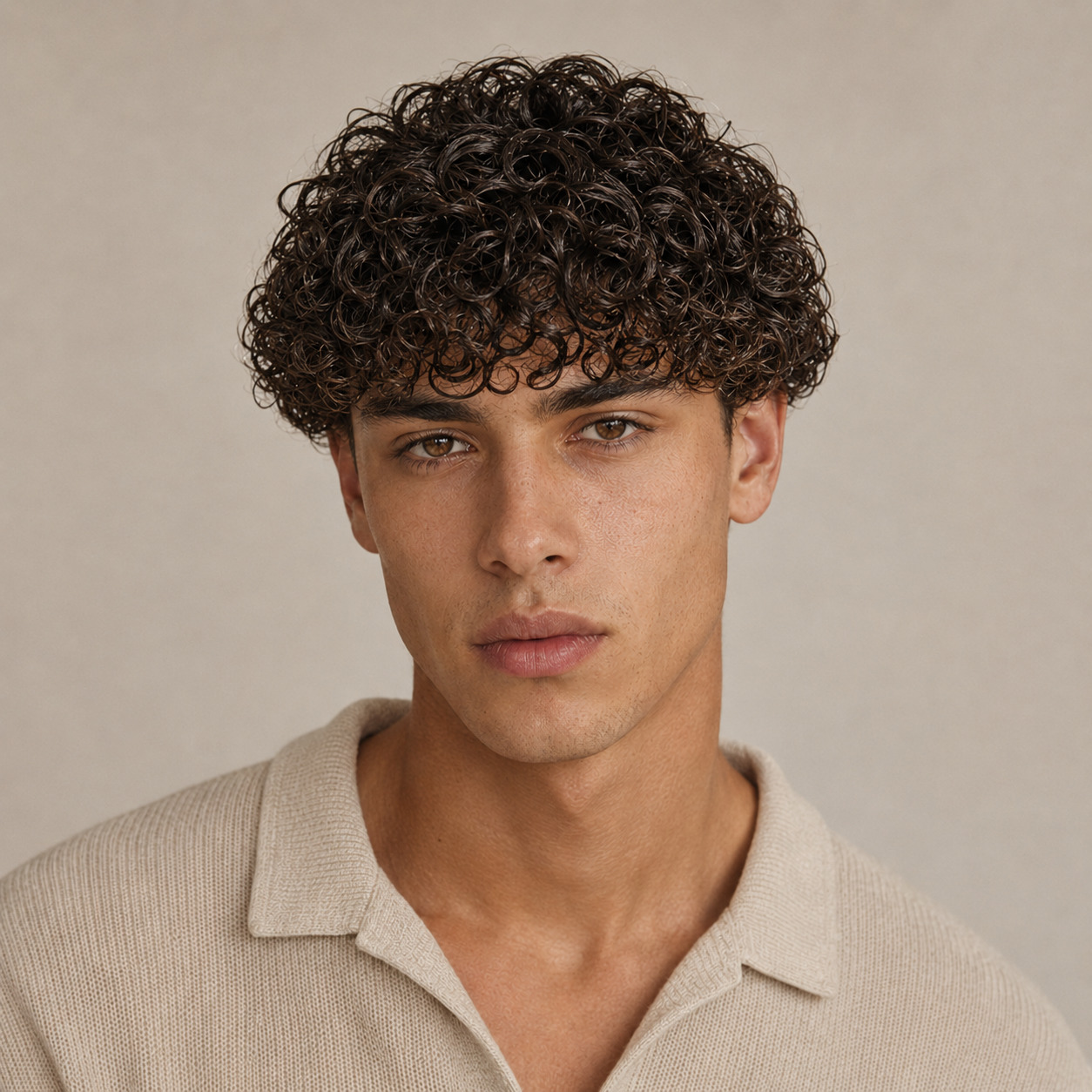
15. Wavy Bowl — Using the Wave to Set the Perimeter Shape
Tell your barber: “bowl cut, but use the natural wave to inform the perimeter shape rather than a rigid mechanical line — I want movement in the perimeter, not a helmet.” This consultation detail gets missed when clients show a straight-hair reference photo and expect the same result on their 2b wave; the wave needs its own perimeter approach. A sea salt spray on damp hair before air-drying is the only product most 2a–2b wave patterns need to activate enough texture for the bowl’s surface to look full.
16. Curly Undercut Bowl
The undercut beneath curly hair produces a different result than beneath straight hair — the curl pattern creates a defined cap of natural texture above the disconnection line rather than a smooth, flat surface. Where most undercut bowls use clipper-fade blending, this version uses a scissors-over-comb cut at the disconnection, which makes the transition from full curls to short sides more architectural than blended. Men with 2c–3a curls and enough density to hold the top section’s shape without collapsing are the best candidates; low-density curly textures risk the top lying flat against the sides.
17. Tight-Curl Bowl with Scissor-Cut Perimeter
Scissor-cutting a bowl shape on 3b–3c curls requires working on dry texture — the barber establishes the perimeter by identifying where each curl naturally settles, not by pulling it straight and cutting a geometric line. The curls create a visually clean boundary when the length is consistent; the perimeter doesn’t need to be mechanically precise because the curl pattern enforces it. A water-based curl activator applied after the cut sets the shape and keeps it reproducible between visits.
18. Coily Bowl on Type 4 Hair with Shaped Lineup
Round and square faces get the most from a coily bowl cut when the barber edges the front hairline into a clean arc from temple to temple — this detail transforms a natural growth boundary into a deliberate frame that anchors the cut’s shape. Without the lineup, a coily bowl can look like an unshaped natural rather than a considered cut. Maintain the hairline edge with a detail trimmer every 7–10 days; the shaped arc is what gives the bowl structure on type 4 hair, and losing it loses half the cut’s visual impact.
19. Loose Wave Bowl on Medium Density Hair
2a–2b wave patterns on medium density create a semi-structured bowl without bulk removal or heavy texturizing — the waves prevent the top surface from going flat while remaining light enough to move. Men with thin-density wavy hair should ask the barber to thin the underneath of the top section slightly so the bowl shape holds its rounded silhouette without collapsing at the center. A light mousse or sea salt spray is all most men with this texture will need in the morning.
20. Bowl Cut with Fringe Sweep on Thick Wavy Hair
Thick wavy hair at 3 or more inches on top, swept forward as a fringe and cut at mid-forehead, creates a mushroom-adjacent bowl with enough natural body to hold its shape all day without much product. The wave is what stops this version from reading as dated — a flat, product-smoothed fringe on the same cut gives you the 90s mushroom; a natural-moving wave gives you the contemporary one. Avoid using a flat iron on the fringe here, as straightening removes the body that makes the shape work.
Longer and Mushroom-Adjacent Bowl Cuts
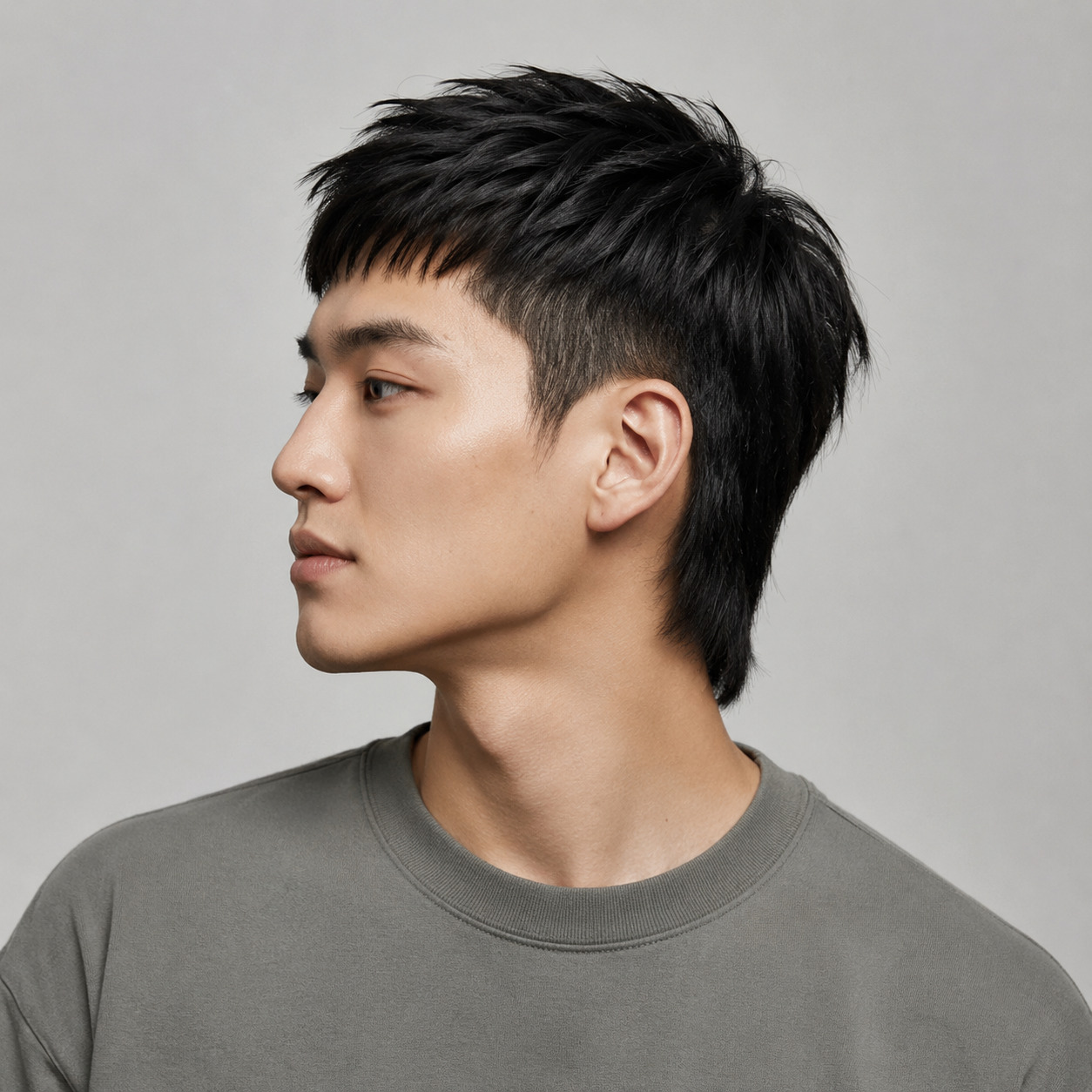
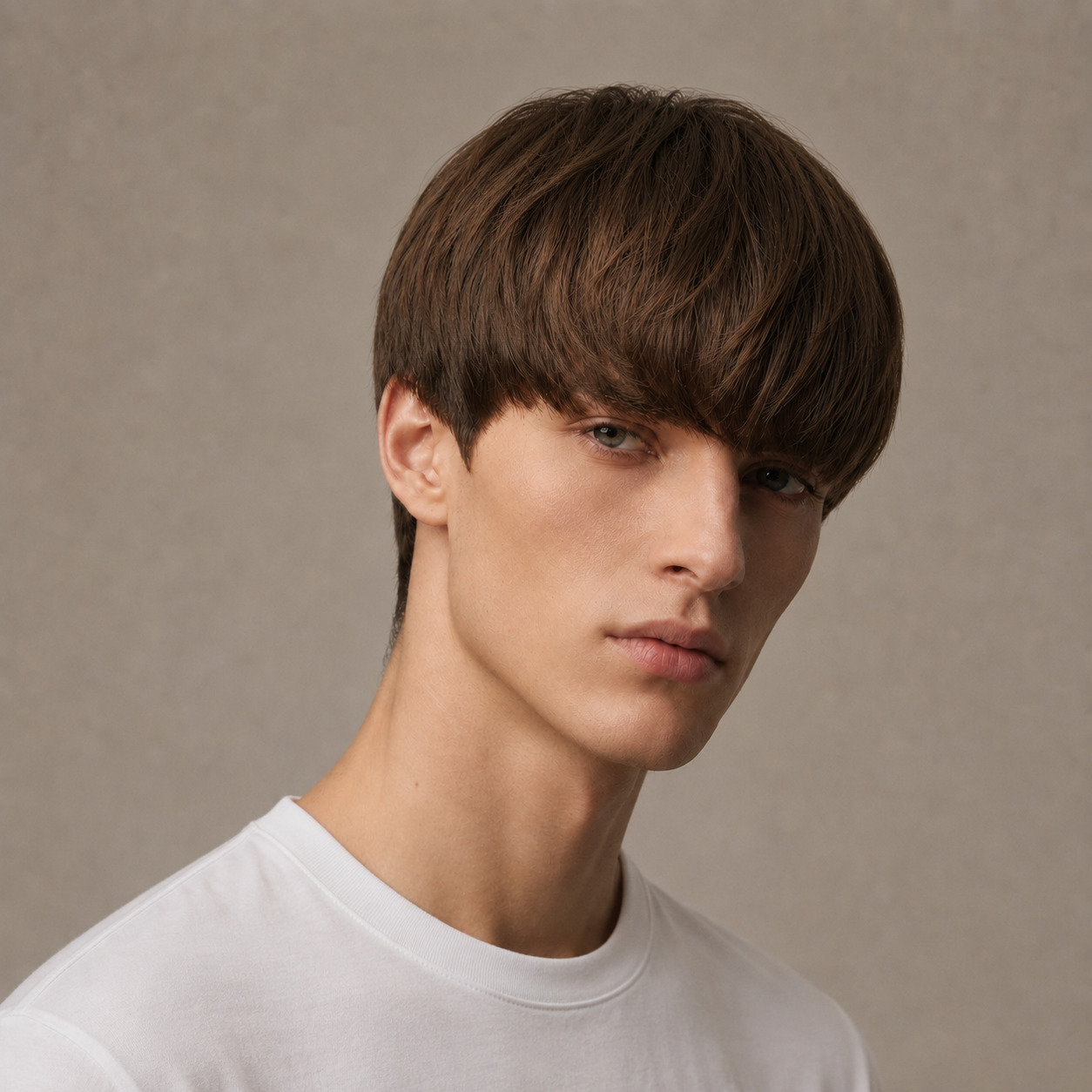
The longer bowl cut, where the perimeter grazes or falls just past the ears with a top section of 3–4 inches, is the variation most commonly called a mushroom cut. In current usage the distinction is mostly about perimeter height: bowl cut describes shorter, higher-perimeter versions, while mushroom cut describes the ear-length-or-below silhouette with a rounder, lower cap shape. These five entries cover the mushroom-adjacent range.
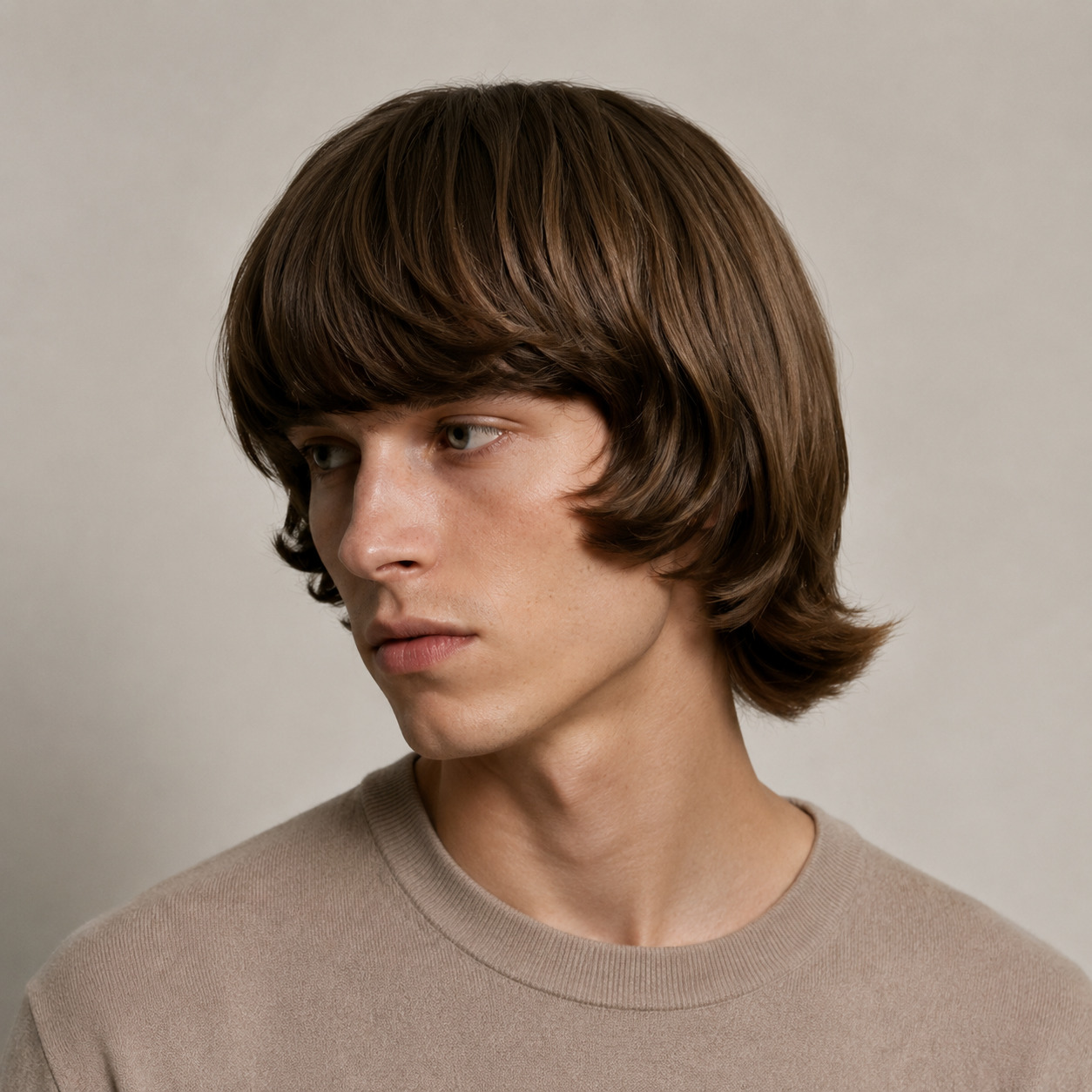
21. Ear-Grazing Bowl at Mushroom Length
Growing the bowl’s perimeter to the top of the ear adds 3–4 weeks to the cycle between cuts, making this the most forgiving bowl variation on grow-out — the line softens gradually rather than suddenly looking too long. The top section needs at least 3 inches to fill out the rounded cap shape at this length; less than that and the proportions tip toward a standard short bowl rather than the fuller mushroom silhouette. A wide-tooth comb and a light styling cream keep the top weight forward and cohesive rather than separating into pieces.
22. Mushroom Cut with Tonal Gloss Color
A single-process gloss that matches the natural base tone but enriches its depth — deepening existing brunette or adding warmth to a medium brown — enhances the mushroom cut’s silhouette without making the color do work the cut doesn’t support. High-contrast color on a longer mushroom cut draws attention to grow-out faster than the cut itself ages. A gloss refresh at the same frequency as a trim appointment keeps color and cut aligned without compounding the upkeep schedule.
23. Center-Part Mushroom with Eyebrow-Grazing Fringe
Tell your barber: “mushroom cut length, center part, fringe sitting at the eyebrows — keep the perimeter uniform all the way around and leave the top at 3.5 inches minimum.” The center part works especially well for oblong and heart face shapes, where balanced framing from both sides distributes visual weight evenly and reduces emphasis on a prominent forehead or chin. This is the longest, most committed version of the bowl cut family — growing past mushroom length means accepting several weeks of awkward in-between length before it resolves into something new.
24. Shaggy Bowl with Softened Perimeter
Where the standard bowl cut’s perimeter is a hard edge, the shaggy bowl uses point cutting at the boundary to soften it into a graduation — the fringe and sides are texturized rather than blunt-cut, producing a looser, more lived-in shape. This version is more forgiving for men who can’t sustain a 3–4 week barber schedule, since a blurred perimeter shows grow-out more slowly than a clean geometric line. Thick wavy and curly textures suit it best; fine straight hair loses the perimeter’s architectural quality when texturized rather than blunt.
25. Curtain Fringe Bowl
A center parting through the bowl’s top section lets the fringe fall on both sides of the face, creating a hybrid of bowl geometry and curtain framing — the perimeter shape is informed by the fringe’s natural fall rather than a mechanical cut line. Straight to lightly wavy hair holds the curtain fall without daily resetting; curlier textures need a light cream to direct both sides forward before the style locks in as the hair dries. Compared to a standard bowl, this version makes the fringe the defining element rather than the perimeter line.
What a Modern Bowl Cut Actually Is
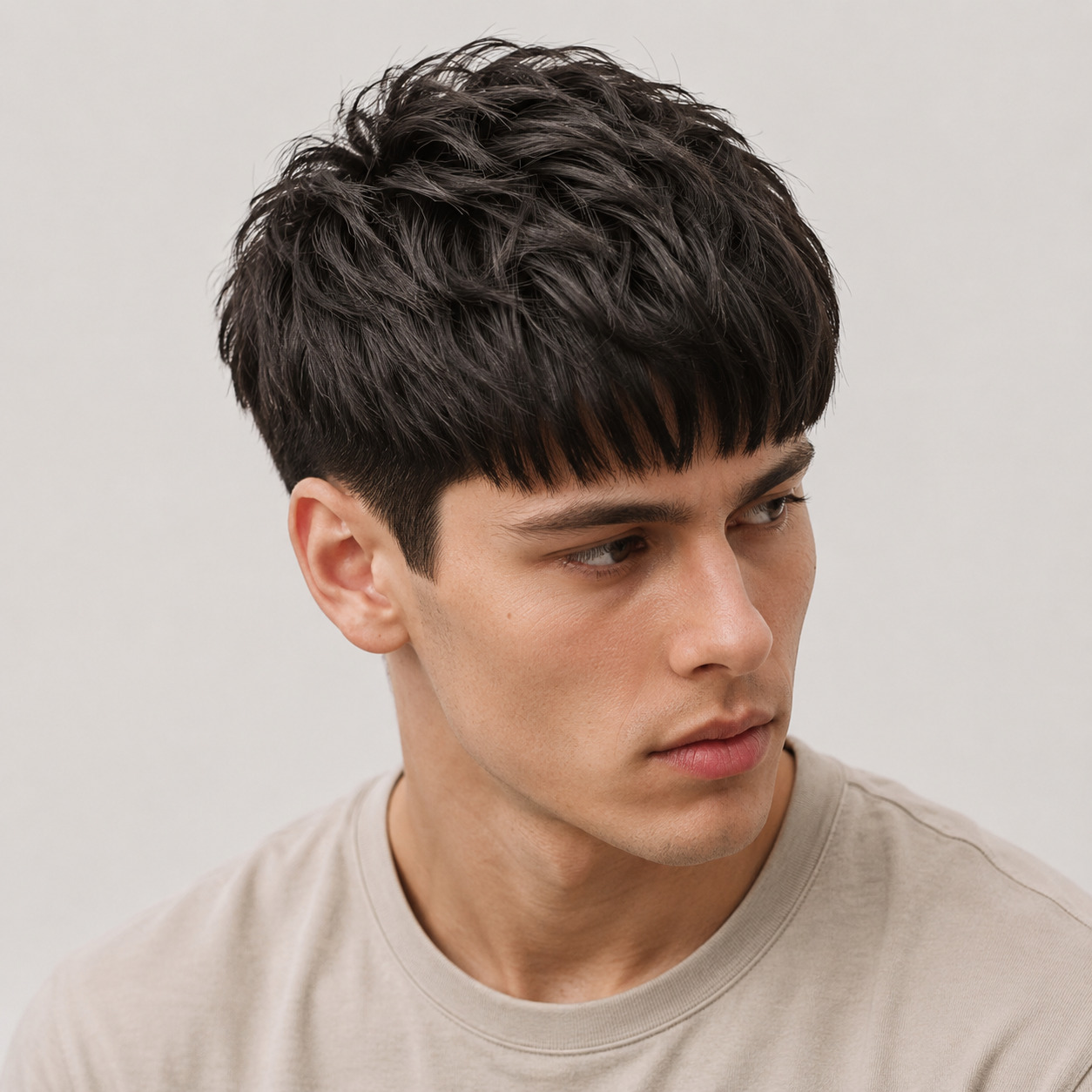
A bowl cut is a men’s haircut where the top section is cut into a rounded, blunt-edged cap shape — the perimeter follows a consistent length all the way around the head at roughly ear level, and the sides are shorter, faded, or disconnected below it. The defining structural feature is the perimeter line itself: a clean boundary that separates the full top section from the shorter sides.
The style’s lasting punchline status comes from its 90s execution: long on top, blunt-cut to a perimeter at mid-ear with the sides left at uniform shorter length and no blending, achievable at home with kitchen scissors and a literal pot. The modern bowl cut keeps the perimeter concept and replaces everything else — fades or undercuts below the line, texture or natural movement on top, and perimeter height calibrated to face shape rather than applied at a fixed mid-ear point regardless of the person wearing it.
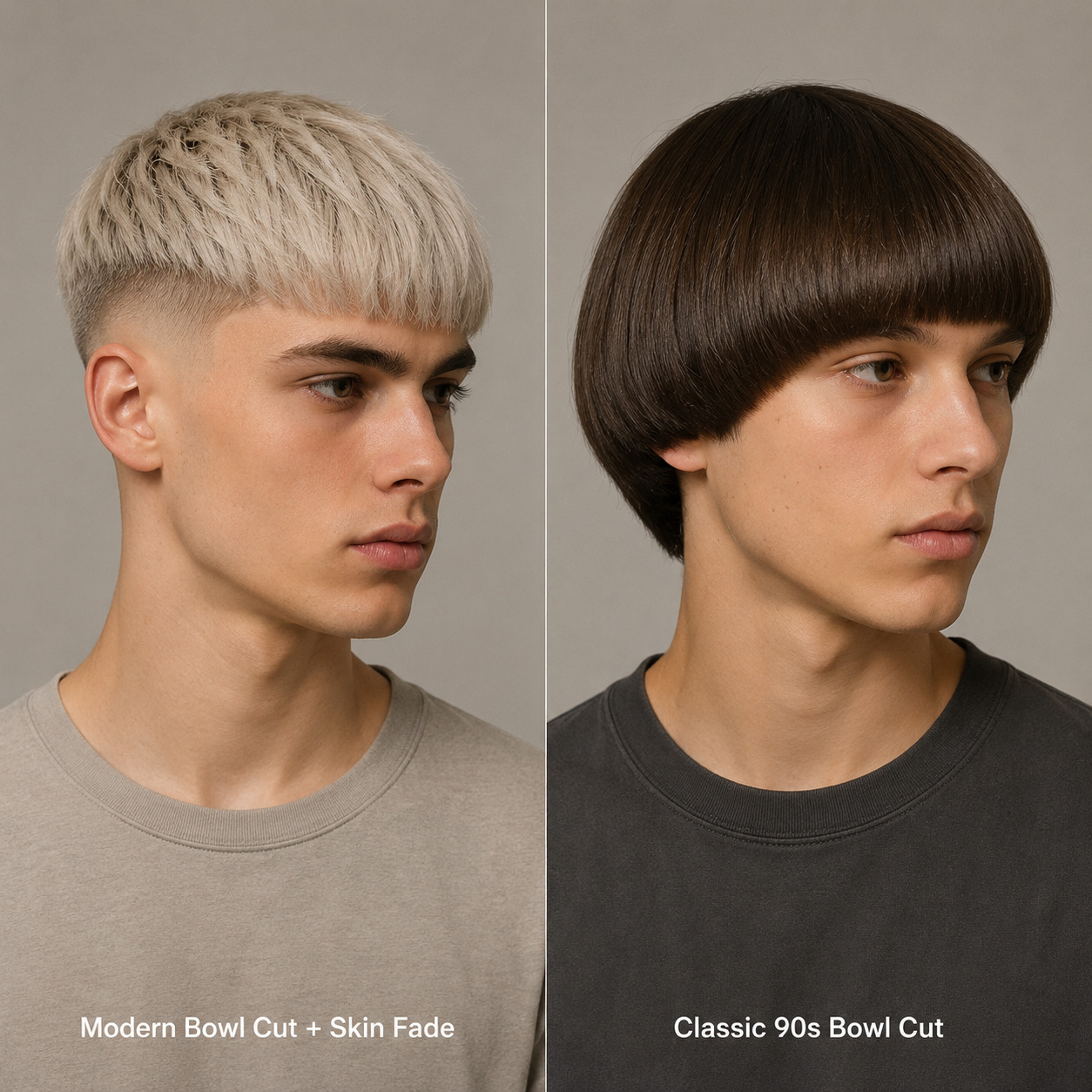
Stylist tip: “The single biggest difference between a modern bowl cut and a dated one is what happens below the perimeter line. Faded or tapered sides make the perimeter look architectural. Scissors-cut sides at uniform length make it look like a bowl was actually involved,” says Ryan Whitfield, THP contributor and licensed barber.
Bowl Cut vs Mushroom Cut vs Bull Cut
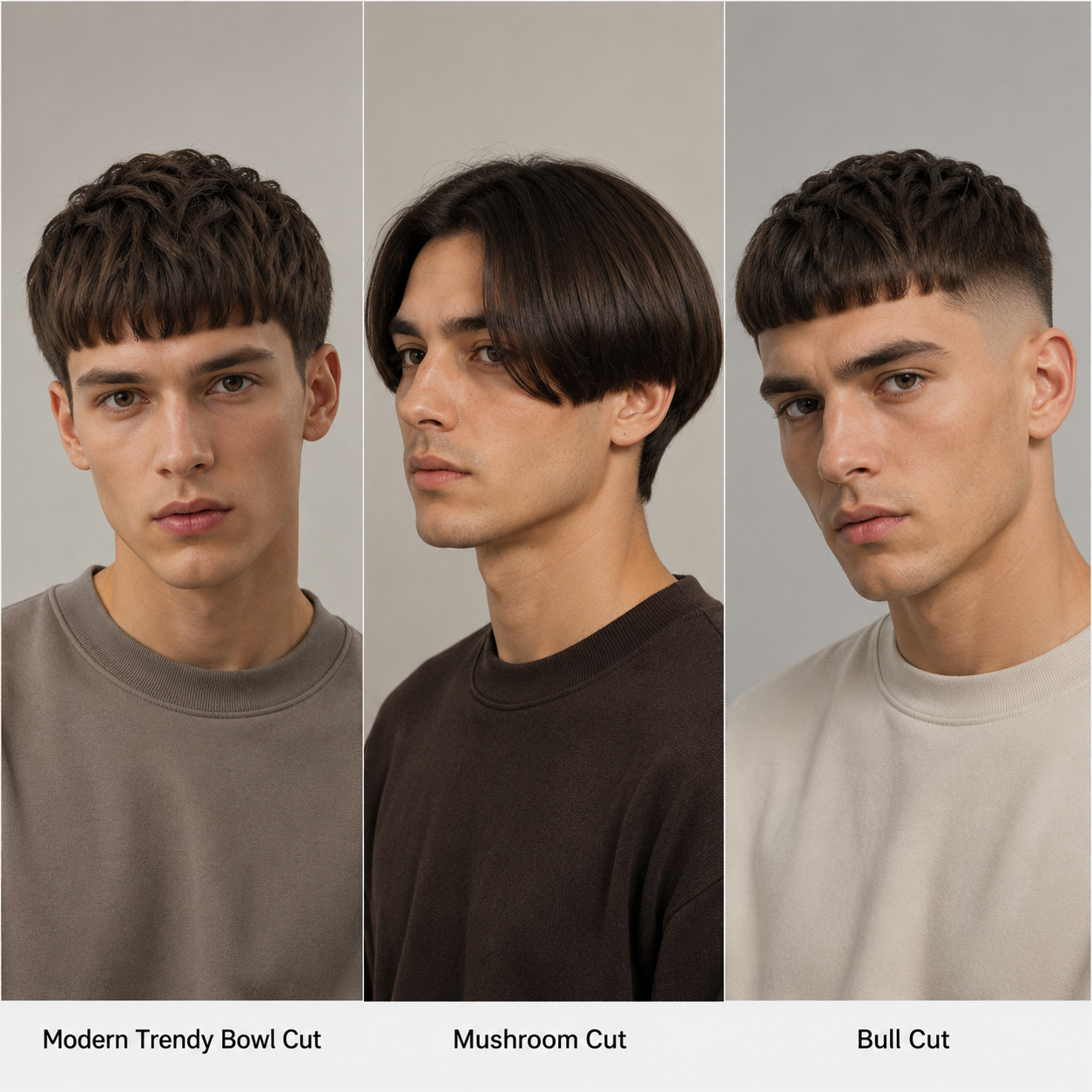
These three names describe variations of the same structural family, and the distinction matters when searching for reference photos or telling your barber what you want. Using the right name communicates the perimeter height and top length — the two details that change the cut most significantly.
A Bowl Cut Uses a Blunt Perimeter at or Just Above Ear Level
“Bowl cut” is the broadest term and applies to any version of the perimeter-top family at any length. The perimeter sits at or just above the ear, the sides are shorter by whatever method, and the top section rounds over the perimeter cleanly. A mid taper paired with a bowl top section is the most common contemporary interpretation in western barbershops.
A Mushroom Cut Refers to the Longer, Lower-Perimeter Version
The mushroom cut’s perimeter falls at or below the ear, the top section is 3–4 inches, and the overall silhouette is rounder and larger than a short bowl. The name references the mushroom cap’s flared lower edge over a narrower stem. “Mushroom cut” is the 90s frame of reference — the modern version updates the sides with texture and a fade but keeps the lower, rounder perimeter that distinguishes it from a short bowl.
A Bull Cut Uses a Higher Perimeter with a Shorter Top Section
The bull cut (sometimes called a bull fade) sits at or above the temple rather than at ear level — the perimeter is higher on the head, the top section is shorter, and the sides are closely faded or cropped. It shares the bowl’s perimeter logic but the shorter top and higher line produce a result closer to a textured crop with a defined edge. If you want something in the bowl family that reads as less obviously retro, the bull cut’s higher perimeter is the direction to explore alongside the edgar cut, which uses a similarly blunt horizontal boundary at the fringe.
Which Face Shapes Work Best with a Bowl Cut
The bowl cut’s perimeter adds horizontal visual emphasis at ear level and creates a cap-like silhouette that widens the head at the perimeter zone. That combination helps specific face shapes and works against others. Knowing which category you fall into before choosing a variation saves a disappointing barber appointment.
| Face Shape | Best Variation | Avoid | Why |
|---|---|---|---|
| Oval | Any variation | Nothing significant | Balanced proportions handle the bowl’s perimeter line from any angle |
| Round | Asymmetric bowl; version with height on top and narrower perimeter | Standard uniform bowl with wide perimeter | The horizontal perimeter adds width, which a round face doesn’t need |
| Square | Textured or tousled bowl top; soft taper sides | Hard disconnected undercut bowl | Texture softens the angular jaw that high-contrast sides expose |
| Heart | Fringe at eyebrow level; center-part mushroom | Very short fringe above the eyebrows | Fringe width at the forehead balances a wider brow against a narrower chin |
| Oblong | Side-parted bowl; fringe that adds horizontal weight at mid-forehead | Very tall bowl top with minimal fringe | Horizontal fringe weight counteracts the vertical length of a long face |
| Diamond | Textured bowl with moderate fringe width | Very tight, narrow top section | Some top volume at the forehead balances the narrow points at chin and brow |
What to Tell Your Barber
The most important detail to specify is what happens to the sides, since “bowl cut” communicates the top shape but nothing below the perimeter line. Two barbers can both execute a correct “bowl cut” and produce completely different results because they chose different side treatments without instruction.
“Bowl cut on top. Fringe length: [eyebrow level / mid-forehead / just above the brows]. Side treatment: [low taper from the ear, blended gradually / mid fade / high fade to skin / hard disconnected undercut at the perimeter]. Perimeter line sharp and clean all the way around — no graduation above it. Top texture: [point-cut for texture / leave blunt / soften the perimeter slightly for a mushroom feel].”
Knowing where the bowl cut sits relative to its neighbors helps the consultation too: the blowout taper adds volume through the top section while keeping the sides graduated, and some men who think they want a bowl are actually describing the blowout taper’s fuller, more voluminous top rather than the bowl’s rounded perimeter shape.
Stylist tip: Bring a side-profile photo alongside any front-on reference image. The bowl’s perimeter height and side treatment are most visible in profile — a front photo alone often hides whether the sides are faded, tapered, or blended, which is precisely the information your barber needs most to execute the right variation.
Maintenance and Styling
How often you need a barber depends almost entirely on how the sides are treated. A skin fade or hard undercut bowl needs re-edging every 2–3 weeks before the perimeter’s disconnection starts blurring; a soft taper or mushroom-length version holds shape for 4–6 weeks. The top section is more forgiving — the rounded perimeter softens gradually rather than suddenly looking grown-out, which gives taper and mushroom versions genuine flexibility between appointments.
| Variation | Trim Frequency | Daily Styling | Key Product | Grow-Out Behavior |
|---|---|---|---|---|
| Faded or undercut bowl | 2–3 weeks | 3–5 min | Matte clay or paste | Perimeter blurs noticeably by week 3; sides grow in fast |
| Taper bowl | 4–5 weeks | 3–5 min | Light clay or mousse | Shape softens rather than breaks; very forgiving |
| Mushroom or ear-length bowl | 5–6 weeks | 5–8 min | Styling cream or light wax | Perimeter softens slowly; most forgiving grow-out |
| Curly or wavy bowl | 4–6 weeks | 2–3 min product and air dry | Salt spray or curl cream | Curls maintain the perimeter shape naturally between visits |
When a Bowl Cut Is Not the Right Choice
The bowl cut’s perimeter line adds horizontal visual emphasis at ear level and produces a cap-like silhouette. That combination benefits specific face shapes and works against others. Several specific conditions where the cut works against you rather than for you:
- Very round faces: The perimeter adds horizontal width at the level that a round face is already widest. A standard uniform bowl cut with a wide, level perimeter is among the worst choices for this face shape. An asymmetric version with more height on top and a narrower perimeter can work, but the standard version will not.
- Receding front hairline: The bowl cut’s fringe frames the front hairline directly. A recession above the temple places the perimeter line in proximity to the receding area, drawing a contrast that emphasizes the recession rather than softening it. A textured crop without a defined perimeter boundary handles early-stage temple recession more gracefully.
- Fine, low-density hair: The bowl’s top section needs enough density to hold its rounded shape without collapsing flat onto the scalp. Fine low-density hair under the bowl’s weight tends to flatten rather than fill out the cap shape, making the perimeter look deflated rather than clean. The bull cut’s shorter top section and higher perimeter works better on fine hair.
- Very strong square jaws with a high-contrast bowl: A tight bowl at a high perimeter can double the horizontal emphasis from a strong jaw — the jaw’s prominent line mirrors the cut’s perimeter line, and both are fully exposed by a high skin fade. A textured bowl top or a softer taper rather than a hard undercut is more flattering on prominent square jawlines.
FAQ
Is the bowl cut coming back in style in 2026?
Yes — but the version gaining ground is the textured, faded iteration, not the 90s mushroom. The modern bowl cut with an undercut or fade and texture on top has been a staple in barbershops specializing in East Asian men’s cuts for over a decade, and it has since crossed into broader western men’s cutting trends. The reference photos now circulating look nothing like the home-cut version the word “bowl cut” conjures for most people over 30, and the style appears regularly in the broader men’s haircuts conversation alongside other perimeter-focused cuts that have gained ground in the same period.
What face shape suits a bowl cut best?
Oval, heart, and square faces handle the bowl cut best. Oval faces work with nearly any variation; heart faces benefit from the fringe’s width at forehead level, which narrows the visual difference between a wider brow and a narrower chin; square faces work well with textured or tousled versions that soften the angular jaw the faded sides expose. Round faces are the most challenging fit — the bowl’s horizontal perimeter is the opposite of what a round face needs, though asymmetric versions can work.
How long does hair need to be to get a bowl cut?
The top section needs at least 2.5–3 inches to hold the rounded cap shape. The sides can be at almost any length — the cut’s structure comes from the contrast between the longer top section and shorter sides, not from overall length. If you’re growing into a bowl cut from shorter hair, the top section’s length is the only limiting factor; the sides can keep growing until the top reaches the right length, then everything gets cut into the shape together.
What is the difference between a bowl cut and a mushroom cut?
Both names describe the same structural family from different eras. “Bowl cut” generally describes shorter, higher-perimeter versions where the top section is relatively close to the head and the perimeter sits at or just above the ear. “Mushroom cut” describes the longer, ear-length-or-below version with a rounder, lower silhouette. In most barbershops the terms are used interchangeably — specifying fringe length and perimeter height communicates more than agreeing on the name.
Can I get a bowl cut on curly hair?
Yes — curly hair suits the bowl cut particularly well because the natural texture fills out the cap shape without product and prevents the flat, pressed-down look that troubles fine straight hair in this cut. The technique condition: your barber needs to cut the top section on dry hair. Wet cutting curly hair is how you end up two inches shorter than planned — curls lose a significant portion of their resting length when saturated, and cutting wet gives an inaccurate picture of where the length actually lands.
How do you style a bowl cut at home?
The main daily task is maintaining surface texture rather than letting the top section flatten. For straight and wavy textures, work a small amount of matte clay or paste into slightly damp hair and direct it forward with fingers to reinforce the bowl’s cap shape. For curly and wavy textures, a light salt spray or curl cream through dry hair typically handles the work on its own. Avoid high-shine pomades in any texture — gloss flattens the surface and removes the texture that makes the modern bowl look current rather than retro.
Will a bowl cut work with glasses?
It depends on the frame shape. Round frames paired with a standard bowl cut can create a face full of circular shapes — both the frames and the cut’s silhouette are round, which tends to look uncoordinated rather than coordinated. Rectangular or geometric frames pair better, providing contrast to the bowl’s rounded perimeter. From a practical standpoint, the bowl’s fringe should sit below the top of the frame rather than competing with it for horizontal emphasis at the forehead.
The bowl cut has more working variations now than at any other point in its history — from the tight bull cut at the temple to the longer ear-grazing mushroom, from textured crops with perimeter lines to curly natural-texture versions that fill the shape effortlessly. Whether you’re drawn to the high-contrast faded version or a softer mushroom-length style, what separates a bowl cut that looks sharp from one that looks dated is mostly what happens to the sides and whether the top section has texture. Bring a side-profile reference photo to your barber and confirm the specific perimeter height and side treatment before any scissors come out.
Hair results vary based on your natural hair type, texture, density, and condition. Always consult with a licensed barber or hairstylist before making significant changes. Photos may show styled results that require professional tools and products to replicate.