

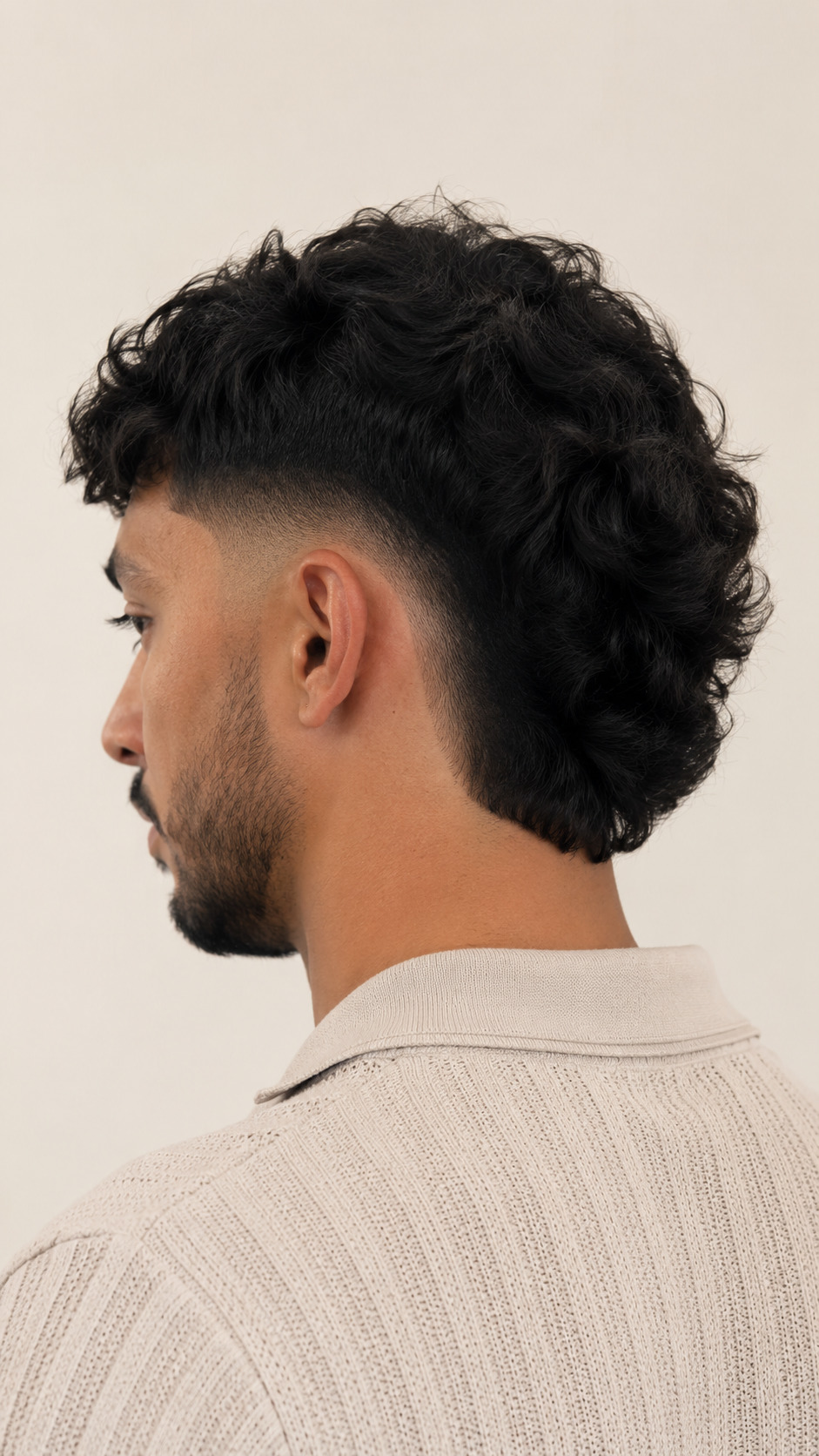
A burst fade mullet works because the curved semicircular arc around the ear solves what every old-school mullet couldn’t — the transition from short sides to long back looks designed rather than forgotten.
The burst fade mullet combines a semicircular fade that arcs around the ear with a mullet’s longer back section — the arc’s curve is what separates this cut from a taper fade mullet or a drop fade mullet, and it’s what makes the longer back look like a deliberate design choice. Here are 30 variations covering low-burst versions that work in most settings, mid and high burst styles with stronger contrast, curly and wavy texture builds, and modern mullet hybrids with color and design work.
The gallery runs through four categories. Guidance sections follow on how the burst arc differs structurally from taper and drop fade versions, face shape compatibility, exact barber language, maintenance by variation, and the conditions where the cut is a mistake rather than a statement.
| Factor | Details |
|---|---|
| Best for | Oval, diamond, and heart faces; medium to thick hair of any texture |
| Maintenance | Fade re-edge every 2–3 weeks; back section shape every 5–8 weeks |
| Works with | Straight, wavy, curly (2a–4c); medium to thick density performs best |
| Avoid if | Round face with wide cheekbones; fine low-density hair; strict workplace appearance codes |
| Salon time | 40–55 minutes for cut and fade; 15 min extra for design work or color |
Low Burst Fade Mullet
A low burst keeps the arc close to the natural hairline, wrapping just around the ear at roughly ear-level height. The transition from faded sides to longer back is subtle enough that the style looks clean rather than statement-making from the front — it’s the easiest version to wear in most settings without the cut becoming the defining thing about your appearance. These eight entries cover skin-faded to guard-based low burst variations.
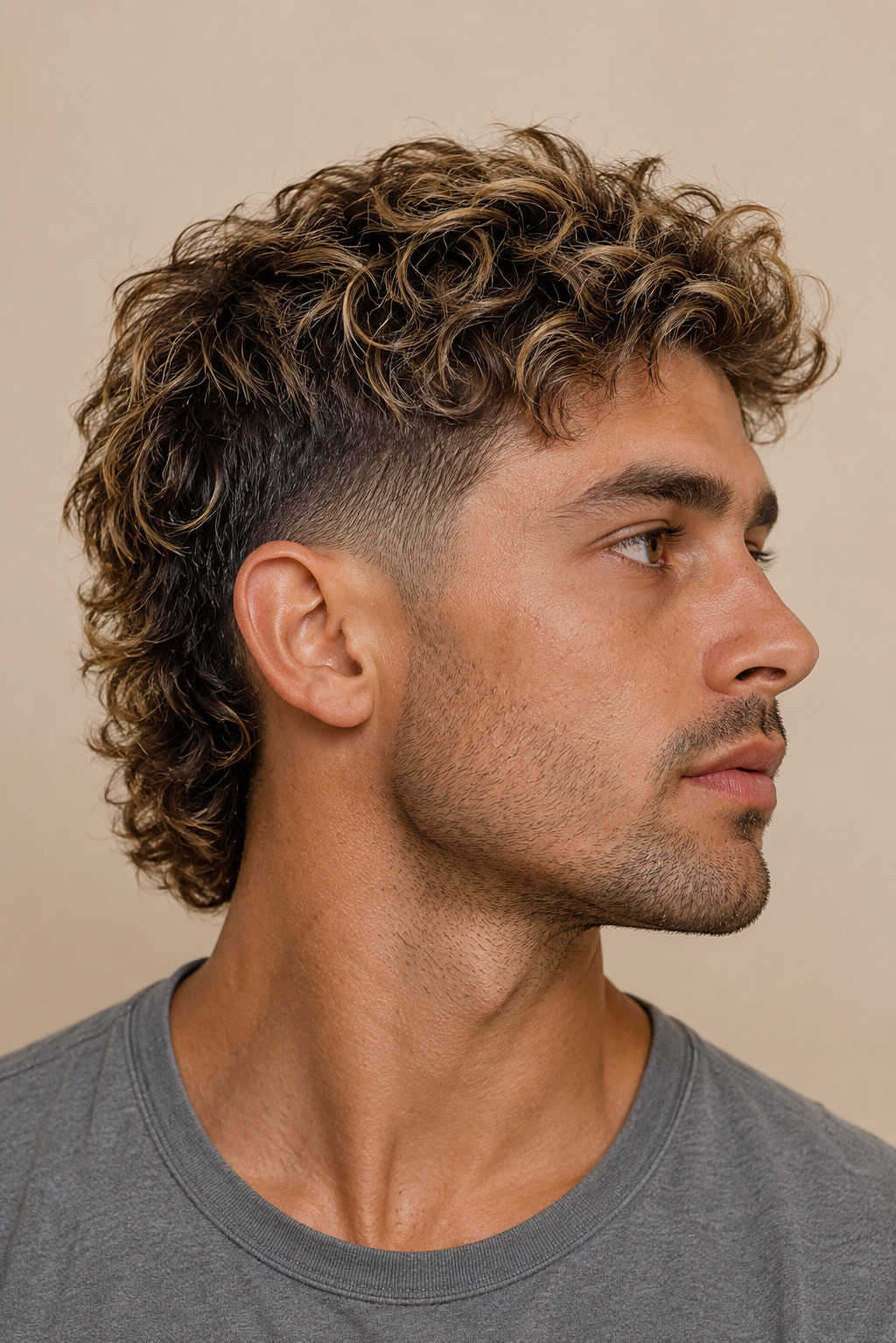
1. Skin Fade Low Burst with Disconnected Back
The barber starts the skin fade below the ear, follows the natural curve of the ear with the burst arc, and blends upward to a short guard on the sides and crown — the back stays deliberately disconnected from the fade at the nape, creating a clean ledge where the mullet’s length begins. That disconnection separates a burst fade mullet from a tapered version: the arc cuts away to skin before the longer back section starts, rather than blending gradually into it. On medium-density straight or wavy hair, the disconnected back holds its shape for about two weeks before the fade starts blurring the boundary.
2. Low Burst Mullet for Oval Faces
Oval face shapes get the most flexibility with the burst fade mullet because the combination of a burst arc at the temples and longer back length doesn’t emphasize any problematic proportions. The arc frames the ear cleanly on both sides, and the back section can extend anywhere from collar-grazing to mid-neck without distorting the face’s natural balance. Men with oval faces who want to try the combination for the first time typically start here — it’s the lowest-commitment version and the one closest to a standard tapered haircut from the front.
3. Low Burst on Fine Straight Hair
Fine straight hair makes the burst arc’s precision visible more clearly than any other texture — there’s no wave or curl to soften the transition between faded sides and the longer back, so every detail of the barber’s clipper work is exposed. At medium-low density, keep the back section no longer than collar length or the weight of straight hair will pull it flat rather than letting it hold any shape. A lightweight volumizing spray worked through the back section on damp hair before air-drying is the minimum product commitment for fine-haired burst fade mullets.
4. Styled-Back Low Burst Mullet
Blow-drying the top section backward while leaving the back loose and air-dried creates two different textures playing off each other — a smooth, swept-back crown against a more natural, slightly unstructured back. Apply a light pomade to the top section only and finger-style the back dry with a sea salt spray. On 2a–2c wavy hair, the difference between the polished top and natural back adds a contrast that suits the burst fade mullet’s structural logic, where the faded sides and styled crown lead into a less controlled back section.
5. Low-Frequency Low Burst Fade
A low burst with a soft taper rather than a skin fade lasts 4–5 weeks before grow-out becomes obvious — the arc softens rather than disappearing, and the back section adds only a small amount of visible length per week. Skin-faded low bursts need a tidy-up at 2–3 weeks when the arc’s precision starts breaking down. Men who want this cut but can’t commit to frequent barber visits should request a mid-guard number at the lowest point of the arc rather than a true bald fade — the grow-out is significantly more controlled and the line stays legible at week 3 rather than looking overgrown.
6. Low Burst Mullet with Bleached Back Section
Bleaching the back section 2–3 levels lighter than the natural base while leaving the sides and top at natural depth gives the burst arc a color boundary — the shade change reinforces where the cut’s design begins. On medium-brown bases, a back-section bleach to level 8 or 9 creates enough contrast to look purposeful without going fully blonde. Budget for a toner refresh every 6–8 weeks alongside the fade maintenance if you want the contrast to hold rather than shifting warm and fading into the base tone.
7. Low Burst Mullet — Barber-Friendly Version
Use this language at your next appointment: “Low burst fade mullet — the arc wraps around the ear, fades to skin just below it, taper on the sides blending up to about a guard 2 or 3, back section left long with a soft taper at the neckline rather than a hard block tail.” The “soft taper at the neckline rather than a hard block” detail prevents a squared tail that makes the back section look like a leftover rather than a continuation of the cut. Showing a side-profile photo alongside a front-facing reference covers both the burst height and the back length simultaneously, which saves a consultation round.
8. Low Burst vs Low Drop Fade Mullet
A low drop fade mullet descends below the natural ear level to create a U-shaped line at the nape, while the burst arc wraps around the ear rather than descending past it — the distinction changes how the back section visually connects to the sides. Where the burst arc leads the eye smoothly from the ear into the longer back, the drop fade creates a more pronounced descent at the sides and a sharper separation at the nape. Side by side on the same face shape, the burst tends to look more integrated; the drop produces a more structural boundary line between sides and back.
Mid and High Burst Fade Mullet
A mid or high burst arc starts the fade noticeably above the ear, which increases the contrast between faded sides and the longer back. The higher the burst, the more visible the arc is from the front — rather than hiding close to the natural hairline, it becomes part of the cut’s front-on silhouette. These eight entries cover mid-burst blended versions through bald high-burst executions.
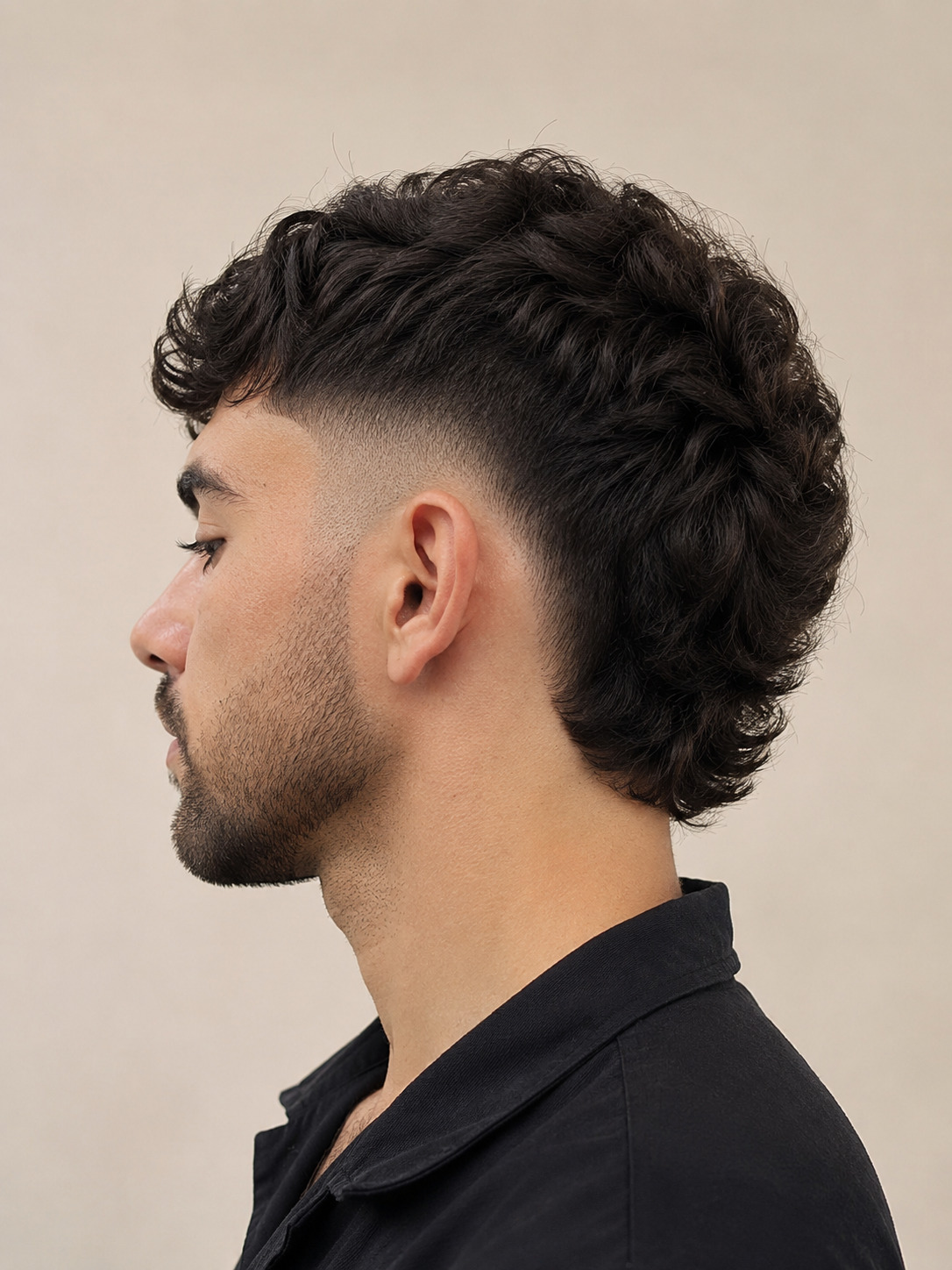
9. Mid Burst Fade with Blended Crown
At mid-burst height, the arc starts level with the middle of the ear and curves forward toward the temple and backward into the nape — blending the crown into the mid-length top section with scissor work rather than a hard clipper line keeps the cut cohesive. The technique distinction matters here: a hard clipper-over-comb boundary at the crown and a soft scissor blend produce very different results on the same arc height. For men new to the mid burst, requesting the scissor blend at the crown keeps the transition subtle and gives future appointments room to adjust.
10. High Burst for Diamond Face Shapes
Diamond face shapes — widest at the cheekbones with narrower forehead and jaw — get the most from a high burst that adds visual width at the temple zone while keeping the sides closely faded. The arc’s sweep from temple to behind the ear adds horizontal emphasis just above the cheekbones’ widest point, and the longer back section draws the eye downward. Diamond faces should avoid very short mullet back sections because removing the length eliminates the downward counterbalance to prominent cheekbone width.
11. Wavy Hair Mid Burst Mullet
Medium-density wavy hair at mid-burst height creates visible wave movement in the back section that straight hair at the same length simply cannot match — the waves fill out the mullet’s length naturally and add texture that makes the back look full without product. On 2b–2c wave patterns, ask the barber to taper the neckline softly rather than blocking it, which controls the shape without cutting the waves shorter at the perimeter. Wavy hair also ages the grow-out more gracefully than straight hair between trims — the texture softens the precision loss as the burst arc starts to blur.
12. Textured Top Mid Burst Mullet
Working a medium-hold matte clay through the top section with fingers rather than a comb creates a piece-y, textured surface that suits the burst fade mullet’s contrast-forward aesthetic better than a smoothed finish. Leave the back section un-styled or apply a light sea salt spray while damp and let it air dry — the rougher back plays against the slightly more deliberate top. On straight to lightly wavy medium-density hair, this routine takes about 4 minutes and reproduces reliably once the cut is shaped correctly.
13. High Burst Skin Fade — Maintenance Realities
A high burst with a skin fade is the most demanding version in this family — the arc starts high enough that new growth at the temple zone is visible within 7–10 days, and the contrast between skin and surrounding hair is unforgiving when it blurs. Expect barber visits every 2–3 weeks to keep the skin zone clean. Men who find that schedule impractical should request a shadow fade (guard 1 or 1.5 at the lowest point rather than skin) — the cut looks comparable from across a room and the grow-out window extends to 3–4 weeks without looking unkempt.
14. High Burst Mullet with Fade Design at the Arc
A razor design etched at the burst arc’s highest point uses the cut’s own structure as a frame — a curved line following the arc, geometric shapes at the temple, or a part line extending from the fade all reinforce the arc as a deliberate element. A high burst gives a razor design more real estate than a low burst because the faded surface is higher on the head, offering more area for the barber to work with. Razor designs need re-etching every 2–3 weeks since hair at the temple grows faster than most other scalp areas.
15. High Burst Fade Mullet — Exact Barber Language
When requesting this version, specify all four variables: “High burst fade mullet — arc starts above the ear, curves around to zero below it, fade to skin. Top section about 2 to 3 inches, natural texture. Back section at collar level, soft taper at the neckline, no squared tail. Sideburns cleaned up to match the arc line.” That instruction leaves nothing to interpretation and prevents the barber from choosing between a high burst and a high taper based on their own preference — both are valid cuts, but the burst arc is the specific element that defines this combination.
16. Burst Fade Mullet vs Mohawk Mullet
A mohawk mullet removes hair from most of the sides and leaves a strip running front-to-back, while the burst fade mullet maintains a full top section and uses the curved arc as the structural boundary. From the front, the burst fade looks closer to a standard haircut — the full top section and faded sides don’t signal mullet until you see the back or a side angle. The mohawk mullet’s side removal is immediately visible from every angle. Men who want the mullet’s back length without it dominating the front-on look consistently choose the burst fade combination; men who want maximum visual impact from every angle lean toward the mohawk variation.
Burst Fade Mullet on Curly and Wavy Hair
Curly and wavy hair builds the mullet’s back section with natural volume that straight hair can’t match — the curl pattern fills out the length and adds movement that makes the back look full even without product. The main technical condition: the barber needs to assess the back section at its natural dry length before cutting, because curls contract significantly when they relax after a wash and won’t hold the length they appear to have when wet. These seven entries cover 2c wavy through 4c coily textures.
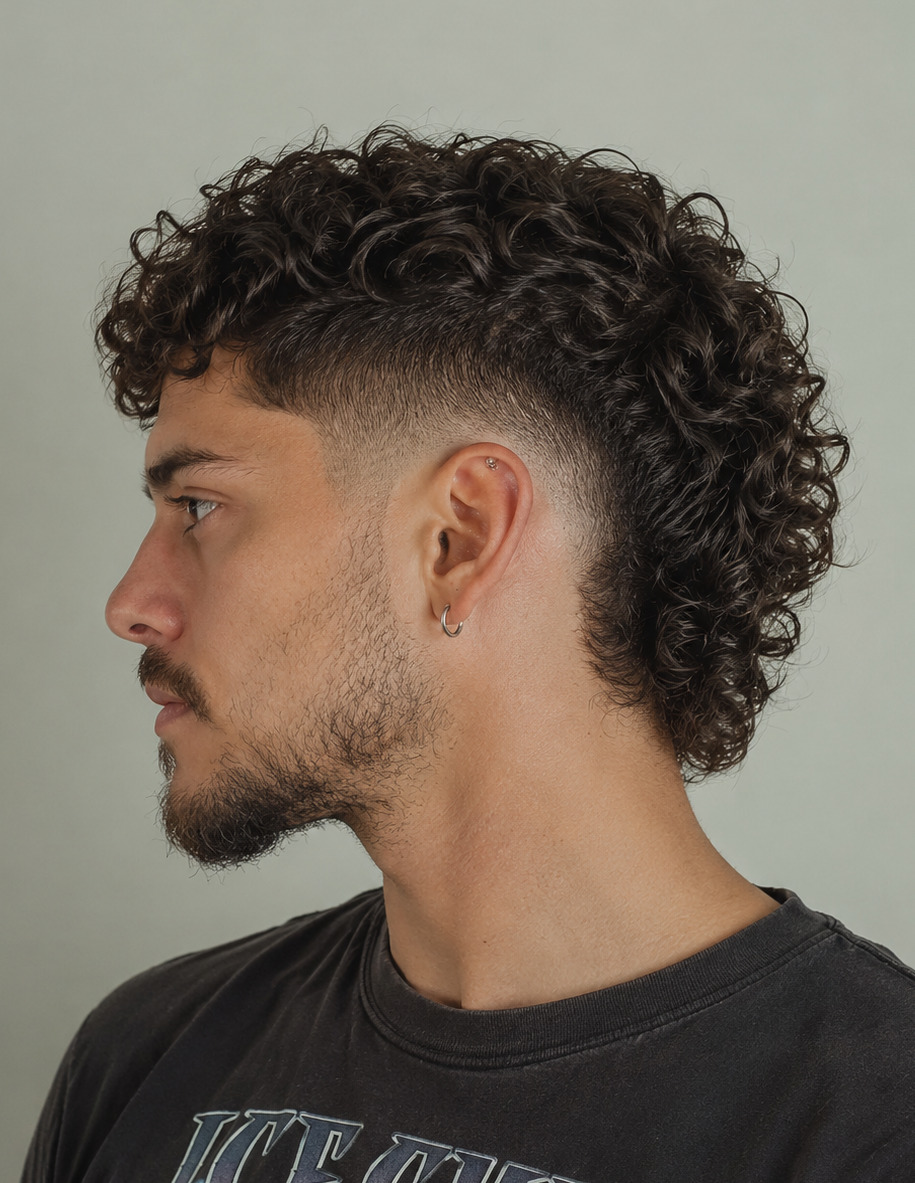
17. Burst Fade on 3a–3b Loose Curls
Scissor work through the back section on 3a–3b curls, with the barber assessing each curl’s natural resting point before cutting, produces a back section that holds its length because the curl’s contraction is accounted for rather than ignored. The burst arc is executed the same way regardless of texture — clipper work is not affected by curl pattern. The critical detail on curly hair is the transition zone just above the arc: asking the barber to blend into the curl with scissors rather than clippers prevents a hard line between the faded sides and the naturally textured top.
18. Low Burst Curly Mullet for Heart-Shaped Faces
Heart-shaped faces have a wider forehead and narrower chin — a low burst keeps the fade from adding visual width too high on the head, while curly volume in the back section adds presence at the lower portion of the silhouette by drawing the eye downward and back. The combination naturally counterbalances the heart face’s proportions better than a high burst, which would add width at the already-wider upper section of the face. A low burst with a rounded, full curly back is the most proportionally balanced version of this cut on heart face shapes.
19. 2c Wavy Hair Burst Fade Mullet
2c waves have enough definition to look deliberately textured in the back section without styling product — the wave pattern is looser than a true curl but dense enough to hold its shape through a full day. The challenge specific to 2c hair is the crown zone: where the wavy top section meets the burst arc, the wave can push outward at the sides if the crown is left too long. Keeping the top section at 2.5 inches or under prevents the sides from widening past the intended silhouette.
20. Air-Dry Curly Burst Fade Mullet
Applying a curl-defining cream to the back section while damp and air-drying without disturbing the curl until it’s completely dry preserves the curl pattern without adding frizz. The faded sides need no product — curl cream applied to a skin-faded area flattens what should be clean and smooth. On 3a–3c curl types, this 2-minute application routine in the morning produces a back section that holds its definition for most of the day; heavier gels last longer but leave a crunchy texture most men prefer to avoid.
21. Curly Burst Fade Mullet Grow-Out
Curly hair grows the burst arc out more gracefully than straight hair because the curl pattern absorbs the precision loss between trims — the arc softens into the texture rather than blurring into obvious stubble. The back section benefits from the same effect: curls add volume as they grow rather than just getting longer and heavier. Men with 3a–3c curl patterns can typically extend between fade appointments to 3–4 weeks before the arc’s definition becomes noticeably soft; the back section can go 6–8 weeks between shape trims.
22. Curly Burst Mullet with Bleached Curl Tips
Bleaching the tips of the mullet’s back section on 3a–3c curls creates a gradient that follows each curl’s natural coil shape — the bleached ends appear lighter as the curl springs back, looking sun-faded rather than processed. On dark natural bases (level 2–3), tip bleaching to level 7–8 produces a strong visible gradient; going lighter risks brassiness without regular toning. The contrast between the skin-faded arc, the natural curl density at the crown, and the lighter ends at the back creates a three-zone visual from the side that uses the cut’s structure as an effective color canvas.
23. Curly Burst Fade Mullet — Barber Consultation
The most effective way to specify this cut on curly hair: “Burst fade mullet on curly hair. Keep the curl in the back intact — shape it, don’t thin it. Cut the back dry so I don’t lose more length than I want. Arc starts at mid-ear, goes to zero below it. Top section about 2 inches. Soft taper at the neckline.” The phrase “cut it dry” tells the barber that you understand how curls behave under scissors when wet — it communicates a specific technical request rather than a vague preference, and barbers with curl experience will act on it accordingly.
Modern Mullet Variations with Burst Fade
The burst arc works as a structural constant across a wide range of mullet variations — the arc defines the sides while everything above and behind it can change significantly. These final seven entries use different top section treatments, back section lengths, color approaches, and design work to show how far the base combination can be stretched.
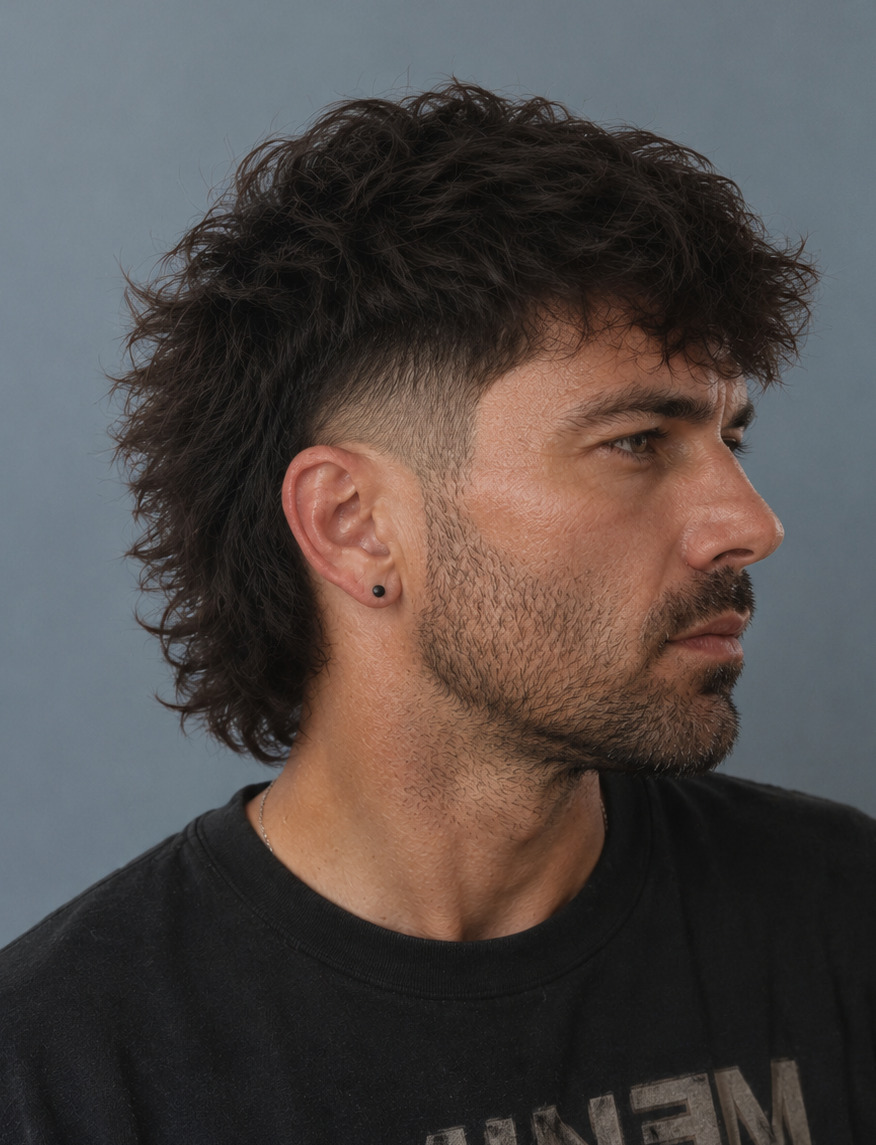
24. Burst Fade Mullet vs Blowout Mullet Hybrid
Inflating the top section with blow-dry volume before the arc transitions to the longer back — the same principle the blowout taper uses for a standard haircut — creates a voluminous, textured crown above the burst arc that’s a different silhouette than the flatter-topped standard burst fade mullet. The burst arc becomes the boundary between a full crown and the longer, looser back section. On thick medium-density hair, the blowout-mullet hybrid gives the front-on silhouette much more height and makes the arc appear sharper because there’s more material above it to contrast against.
25. Shaggy Burst Fade Mullet
Point-cutting the back section into choppy, uneven layers rather than a clean perimeter creates a shaggy mullet back that moves with natural texture rather than holding a defined endpoint. The technique difference: blunt-cutting the back creates a clean line at the perimeter; point-cutting texturizes it and removes the hard boundary, producing a more relaxed silhouette. On medium to thick wavy hair, a point-cut shaggy back against the crisp burst arc creates a contrast between precision at the sides and looseness at the back — one of the most wearable executions for men who find the standard burst mullet too structured.
26. Square Face Burst Fade Mullet
Square face shapes have strong, wide jawlines that high-contrast fades can emphasize by exposing the jaw’s horizontal line against closely faded sides. A mid burst rather than a high burst keeps the fade from adding too much width at the upper portion of the face, and leaving some length at the crown softens the angular transition from the jaw upward. The mullet’s back section genuinely helps on square faces — the length draws the eye toward the back-and-down rather than leaving the jaw as the dominant visual element from a front-on view.
27. Coily Type 4 Burst Fade Mullet
Type 4 coily hair in the mullet’s back section creates a dense cap of natural coils that fills out the silhouette with significantly more volume than any other texture at the same length — 2 inches of 4c coil at the back is considerably more substantial than 2 inches of straight hair. The burst arc on type 4 hair benefits from a detail trimmer pass at the arc’s edge, as the coil pattern can make the fade’s boundary less crisp without a cleanup pass. Men going for a subtle back length on type 4 should start shorter than they expect to need, since the coil volume makes the section look much longer than its actual measurement.
28. Sleek Top with Textured Mullet Back
Blow-drying the top section with a flat brush and applying a light shine cream creates a smooth, polished crown while leaving the back section’s natural texture completely untouched — the contrast between a sleek top and a natural back is one of the most recognizable aesthetic choices in the burst fade mullet family. The burst arc is the visual transition point between the two textures; a clean, precise arc line makes that contrast look purposeful rather than inconsistent. On straight to 2a hair, a few drops of cream on the top section and finger-drying the back produces this look in about 5 minutes.
29. Long Back Section Burst Fade Mullet
Extending the back section past the shoulders commits to a style where the burst fade’s maintenance schedule drives all barber visits — the back’s length needs minimal trimming at 6–8 week intervals, but the fade needs re-edging every 2–3 weeks regardless of what the back is doing. On wavy and curly hair, a back section at 5 or more inches produces natural wave movement and volume that straight hair at the same length cannot match without heat or product. Men with straight hair going for a long burst mullet back should use a sea salt spray to add texture that prevents the section from lying flat and heavy.
30. High-Contrast Color Block Burst Fade Mullet
Bleaching the entire top and crown section while leaving the sides faded and the back at natural depth creates a color block that uses the burst arc as the boundary between the bleached top and the darker, longer back — the arc functions as a color transition line as much as a fade line. On dark natural bases (level 2–4), the contrast between a heavily lightened crown and the natural mullet back is high; on mid-tone bases (level 5–7), the result is more wearable across more settings. The top section bleach needs refreshing every 6–8 weeks as the natural base grows through the lightened crown.
What a Burst Fade Mullet Actually Is
A burst fade mullet is built from two structural elements. The first is a burst fade — a semicircular fade that arcs around the ear in a curved line rather than following a straight horizontal path. The second is a mullet — a back section that extends noticeably longer than the sides and top. The arc is what gives this combination its distinctive side profile: the curve naturally guides the eye from the faded sides into the longer back rather than creating a blunt step-down.
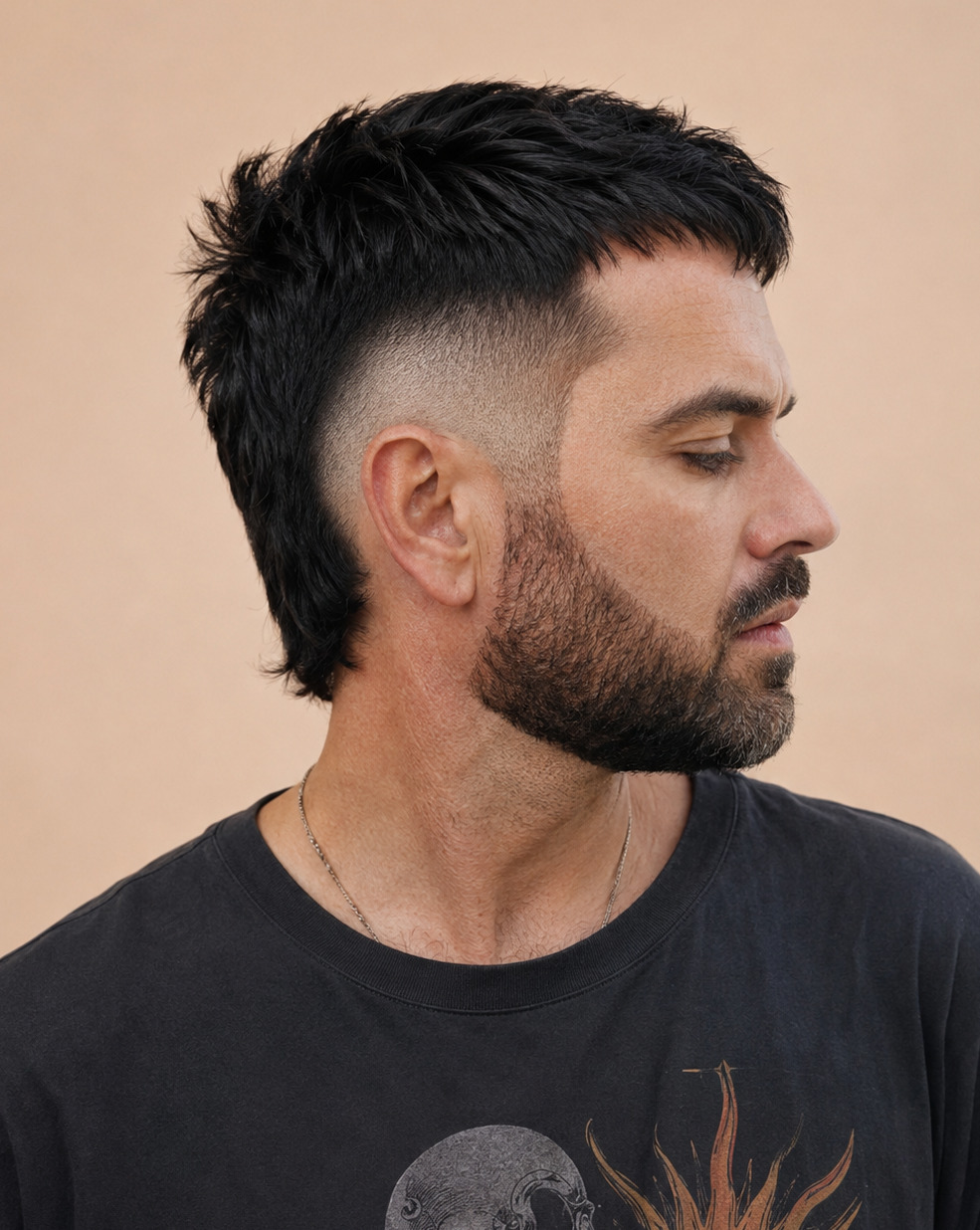
From the front, a low burst fade mullet looks close to a standard short haircut — faded sides and a longer top section don’t signal mullet until you see the back or a side angle. Mid and high burst versions are more visible from the front because the arc sits higher on the head, but the full silhouette only becomes clear from the side or back view. This is the cut that most accurately earns the “business front, party back” description, because at low burst height the front genuinely looks like a conventional haircut.
Stylist tip: “The most common error I see when men request this cut is describing the fade height without specifying the arc’s shape — ‘high fade’ and ‘high burst’ are not the same thing. A high taper fade blends straight across the sides; the burst wraps around the ear in a curve. Showing a side-profile photo makes the arc shape unambiguous,” says Ryan Whitfield, THP contributor and licensed barber.
Burst Fade vs Taper Fade Mullet vs Drop Fade Mullet
These three names describe the same base combination — shorter faded sides and a longer mullet back — with different fade types executing the side treatment. The fade type changes the silhouette from every angle and the visual character of the cut significantly.
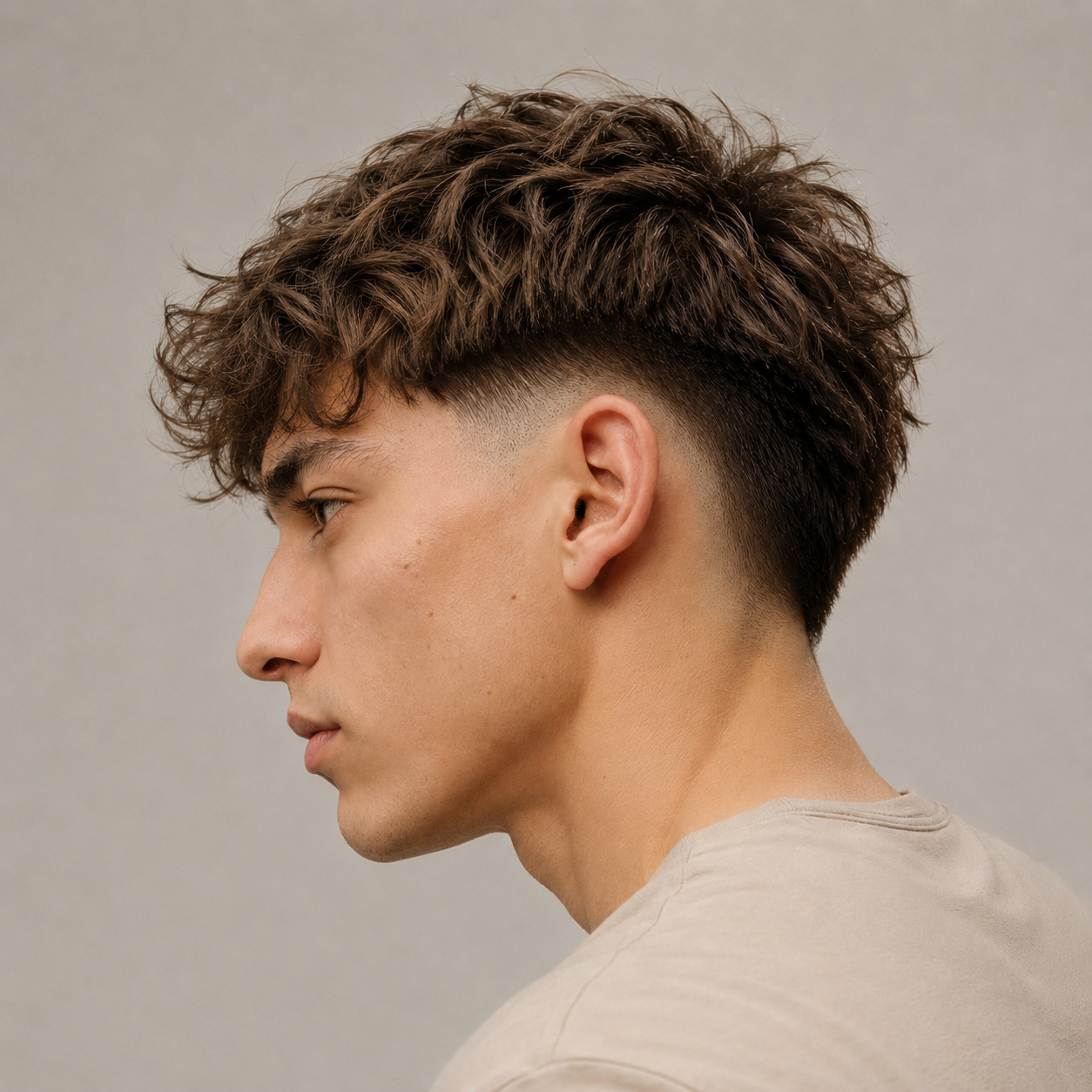
A Burst Fade Mullet Uses a Semicircular Arc That Wraps the Ear
The burst fade creates a curved, semicircular line that arcs around the ear rather than following a straight horizontal or diagonal path. The arc follows the ear’s natural contour, which means the transition from faded sides to the longer back flows along the head’s actual shape. This is the fade type most specifically suited to the mullet combination because the arc guides the short-to-long transition in a way that looks like it belongs. The mid taper and similar gradual fade types blend in a straight line from hairline to crown, producing a different front-and-side profile on the same mullet back section.
A Taper Fade Mullet Creates a Softer, Gradual Transition
The mid taper fade and its variants blend from the natural hairline upward in a more or less horizontal progression rather than an arc. On a mullet, the taper creates a softer, more gradual transition from short sides to longer back — the contrast is lower than the burst and the grow-out is more forgiving. Men who want the mullet’s back length without the burst arc’s visible curve typically prefer a low or mid taper because the cut looks less deliberately edgy from a front-on view.
A Drop Fade Mullet Descends Below the Natural Ear Level
A drop fade follows a curved path that descends behind the ear toward the nape — lower than the burst arc, which wraps around the ear rather than descending past it. Drop fade mullets create a lower, rounded neckline silhouette with a more pronounced U-shape at the back. Compared to the burst, the drop creates a sharper separation at the nape; the burst typically flows more smoothly from the arc into the longer back section. The edgar cut uses a similarly deliberate perimeter line at the fringe, but the drop fade’s emphasis is at the nape rather than the front.
Which Face Shapes Work Best with a Burst Fade Mullet
The burst arc adds visual width at the ear-level zone; the mullet’s back section adds length to the overall silhouette. That combination benefits faces that can absorb horizontal emphasis at the middle of the head and vertical length at the back — and works against faces that already have too much width at the sides.
| Face Shape | Best Variation | Avoid | Why |
|---|---|---|---|
| Oval | Any variation — low, mid, or high burst | Nothing significant | Balanced proportions handle any arc height and back length |
| Round | High burst with long back section | Low or mid burst with a short back | Long back adds vertical length; high burst starts above the widest point of a round face rather than at it |
| Square | Mid burst; some crown length; textured or shaggy back | High burst skin fade with a very short back | Mid burst softens the upward transition from a wide jaw; back length draws the eye away from the jaw’s horizontal emphasis |
| Heart | Low burst; full curly or wavy back section | High burst that adds width at the temples | Low burst avoids adding width to the already-wider upper face; full back adds volume at the lower portion of the silhouette to balance the narrower chin |
| Oblong | Low to mid burst; textured top; moderate back length | Very long back section with no width added at the top | The burst arc adds horizontal width at the sides; avoiding a very long back prevents adding more vertical length to a face that already has plenty |
| Diamond | High burst; moderate top length; back section at collar or longer | Very short back section | High burst adds width above the cheekbones’ widest point; back length draws the eye downward and counterbalances prominent cheekbones |
What to Tell Your Barber
Four variables define this cut completely: arc height (low, mid, high), fade depth (skin, shadow, guard-based), top section length, and back section length plus neckline style. “Burst fade mullet” tells a competent barber the general structure; the four variables prevent them from defaulting to their own interpretation of each detail.
A complete specification: “Burst fade mullet. Arc height [low/mid/high]. Fade to [skin/shadow/guard 1] at the bottom of the arc. Top at about [X] inches. Back section at [collar/mid-neck/shoulder], soft neckline taper — not a squared tail. Blend the crown into the top with scissors.” The “not a squared tail” detail is the one most men forget, and a squared neckline is the single element that pushes a burst fade mullet back toward its dated predecessor. A soft neckline taper makes the back section look like a continuation of the cut rather than something the barber left unfinished.
Stylist tip: Always bring a side-profile reference photo alongside any front-facing one. A front photo communicates almost nothing about the arc height or the back section’s length — precisely the two details that matter most. Most disagreements between client and barber on this cut come from working from a front-only reference, says Ryan Whitfield, THP contributor and licensed barber.
Maintenance and Styling
The fade’s maintenance schedule is the binding constraint — the mullet’s back section can go 5–8 weeks between trims, but the burst arc needs attention every 2–3 weeks regardless of fade height. The grow-out window extends slightly on curly and wavy hair where the arc softens gradually into the texture rather than producing obvious stubble. For the broader modern mullet fade family, taper-based versions grow out a little more forgiving than the burst arc because the arc’s precision is harder to recover once it blurs past a certain point.
| Variation | Fade Re-Edge | Back Section Trim | Daily Styling | Key Product |
|---|---|---|---|---|
| Low burst skin fade | 2–3 weeks | 5–6 weeks | 3–5 min | Matte clay or salt spray |
| Low burst soft taper | 4–5 weeks | 6–8 weeks | 3–5 min | Light pomade or styling cream |
| High burst skin fade | 2 weeks | 5–6 weeks | 3–5 min | Matte clay (top); salt spray (back) |
| Curly burst fade mullet | 3–4 weeks | 6–8 weeks | 2–3 min product only | Curl cream or light gel |
When a Burst Fade Mullet Is Not the Right Choice
The cut’s combination of a visible arc and longer back section works well in specific contexts and works against you in others. Several conditions where it’s the wrong choice:
- Round faces with standard proportions: A mid-height burst arc at the widest part of a round face adds horizontal emphasis where the face is already widest. A round face can wear a high burst with a long back, but the standard low-to-mid version tends to widen the silhouette further rather than add vertical length.
- Fine low-density hair: The back section needs enough density to hold its shape. Fine straight hair under 2 inches of back length tends to lie flat rather than showing movement or structure — the mullet portion looks like an unfortunate grow-out rather than a deliberate length. Wavy and curly textures handle low density better than straight hair on this cut.
- Strict workplace appearance codes: Low burst versions are more neutral in most professional environments, but mid and high burst mullets are unambiguously a statement cut. Assess your specific workplace before committing — the arc-to-mullet combination is one of the most recognizable silhouettes in contemporary men’s cutting and rarely goes unnoticed in formal environments.
- Men with no existing back length: Getting a burst fade applied when there’s no back section length requires growing out the back separately before the mullet portion is visible. If the back isn’t already past collar length, grow it before booking this cut — the burst fade alone without the back length is simply a burst fade, not a burst fade mullet.
FAQ
Is the burst fade mullet still popular in 2026?
Yes — the burst fade mullet is among the most-requested combination cuts at barbershops that have updated their menus beyond traditional fades and tapers. The combination picked up momentum after several years of mullet resurgence colliding with the fade trend, and the burst arc proved a better structural fit for the longer back section than a standard taper. The cut appears regularly across the broader men’s haircuts conversation alongside other fade-combination styles, and its visibility on social platforms continues to bring new clients into shops requesting it by name.
What is the difference between a burst fade and a regular fade mullet?
A burst fade uses a semicircular arc around the ear, while a regular or taper fade blends in a more or less straight horizontal line. On a mullet, the burst arc guides the eye from the faded sides into the longer back along a curve that follows the head’s contour. A regular taper produces a more gradual, less arc-shaped transition. From the side, the burst is more visually distinctive — the arc creates a pronounced curve that functions as a design element; the taper looks more like a haircut that happens to have a longer back.
How long does hair need to be to get a burst fade mullet?
The back section needs to be at least collar length for the mullet to be visible — anything shorter just looks like a standard haircut with uneven length. The sides can be at almost any length since they’ll be faded. On wavy or curly hair, “collar length” can mean 2–3 inches of actual hair because the texture adds volume; on straight fine hair, 3–4 inches is usually the minimum before the back looks like a mullet rather than a slightly long neck.
Can I get a burst fade mullet on curly hair?
Curly hair is among the best textures for this cut — the natural volume fills out the back section and adds movement without product. The key consultation detail is asking the barber to cut the back section dry. A barber assessing curl length on wet hair doesn’t see the actual resting length, and the back ends up shorter than planned once the curl contracts. This dry-cutting condition applies across the broader curly mullet family in any fade variation, not just the burst arc version.
What is the hardest part of maintaining a burst fade mullet?
The fade’s grow-out, not the back section’s length. Most men underestimate how quickly a skin-faded burst arc blurs — a high-contrast skin fade starts losing its definition at 7–10 days. The back section is forgiving by comparison; length grows slowly and curly or wavy textures absorb grow-out naturally. If the maintenance frequency is a concern, requesting a shadow fade (guard 1–1.5 at the arc’s lowest point rather than skin) extends the clean window by about a week without meaningfully changing the cut’s appearance from normal conversation distance.
Does a burst fade mullet work on all hair types?
It works across most hair types with texture-specific adjustments. Straight medium to thick hair handles the combination cleanly at any back length. Fine straight hair needs the back kept at moderate length and a lightweight product to prevent it lying flat. Wavy hair produces a naturally textured back that fills out well. Curly hair from 2c loose waves to 4c tight coils creates a visually fuller, more dramatic back section than any straight texture can produce without heat. The type requiring the most extra thought is fine straight hair, where the back section’s appearance depends heavily on maintaining the right length and adding product consistently.
The burst fade mullet’s staying power in 2026 comes from the arc — it’s the structural detail that makes the longer back section look like a considered choice rather than an unfinished haircut, and it’s what separates the contemporary version from the mullets that gave the style its punchline reputation. Whether you want a low-contrast version appropriate for most settings or a high burst skin fade with design work, specifying all four variables — arc height, fade depth, top length, back length plus neckline style — and bringing a side-profile reference photo is how you walk out with the right version of this cut.
Hair results vary based on your natural hair type, texture, density, and condition. Always consult with a licensed barber or hairstylist before making significant changes. Photos may show styled results that require professional tools and products to replicate.

1 response