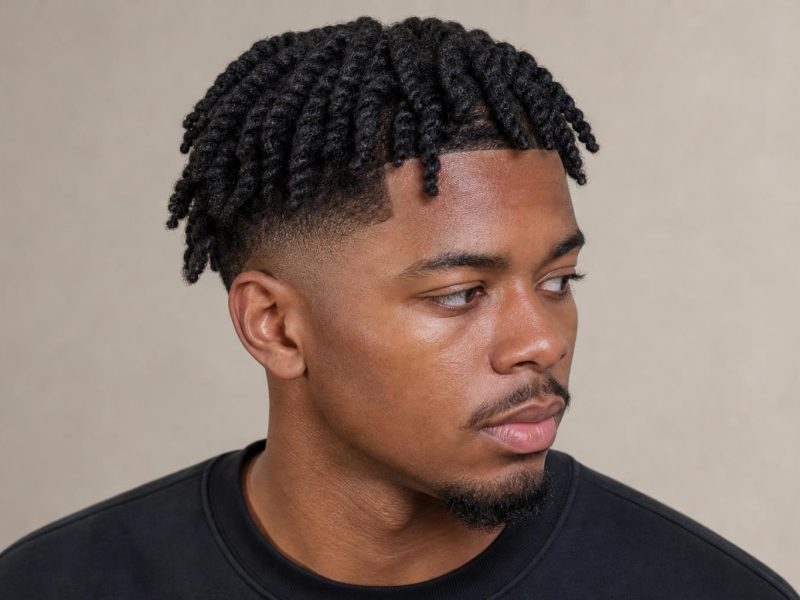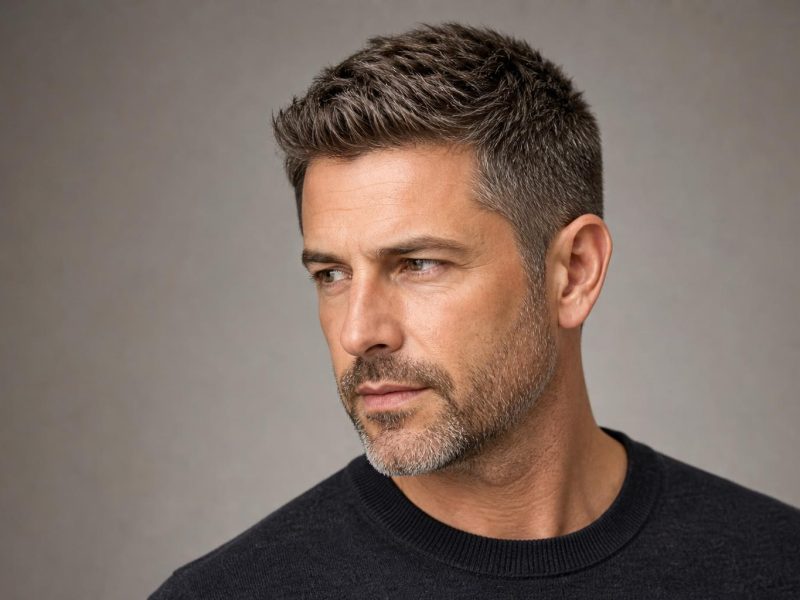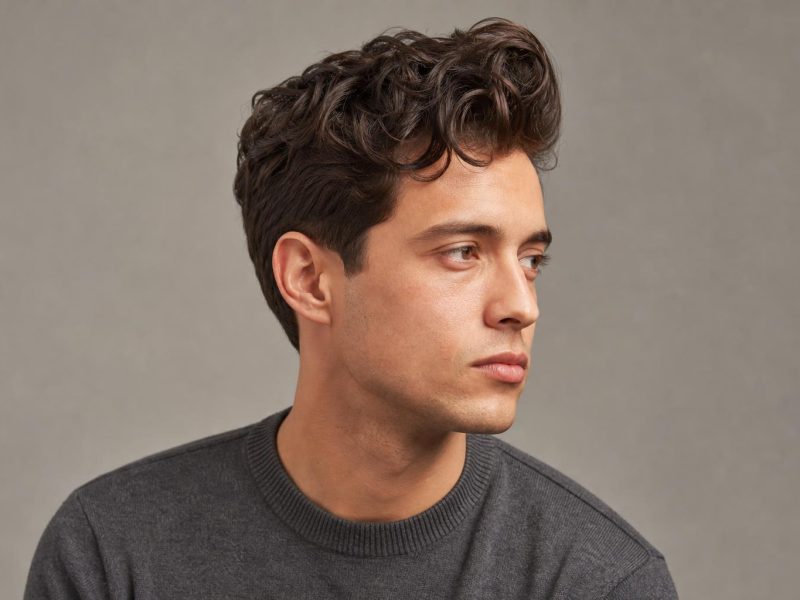

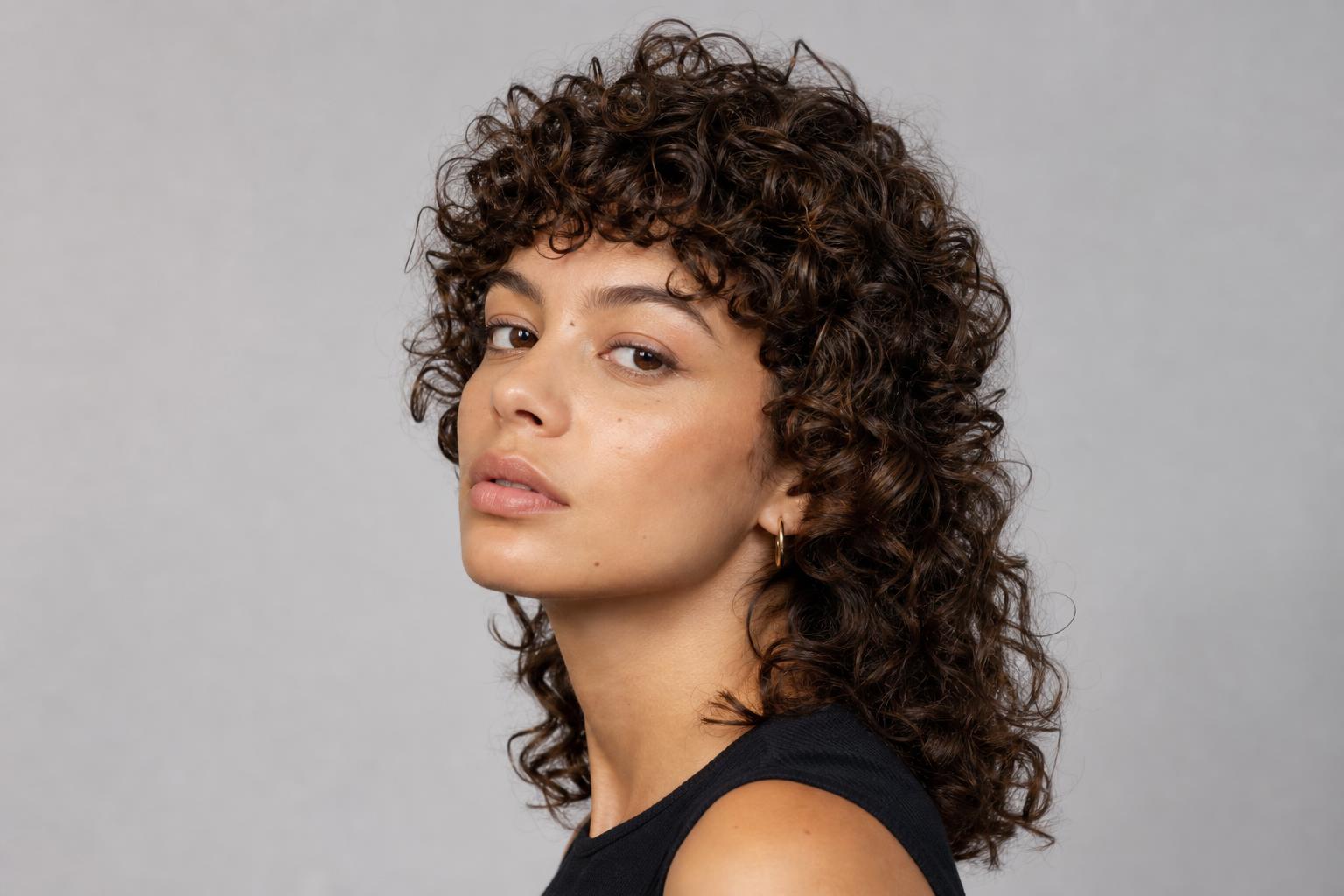
The curly mullet uses natural curl or wave texture to do the structural work that a straight mullet achieves through product: the front and sides are cut short, the back is left long, and the curl pattern generates the volume and movement that defines the silhouette from behind.
On curly hair, the mullet is one of the few cuts designed to work with natural texture rather than against it. The shrinkage from tight ringlets controls length with precision a flat cut cannot match, the bounce at the crown creates volume without a blow dryer, and the curl at the back fills the silhouette naturally. These 30 styles cover the full range from loose 2b waves to tight 3c ringlets, for men and women, across lengths from collar to shoulder blade, with a face shape table, a barber communication script, and a maintenance schedule.
Classic Curly Mullet Styles
The classic curly mullet holds close to the cut’s original structure: front and top cut to a short or medium length, sides kept tighter with a fade or scissor taper, and the back left significantly longer to display natural curl at its full length and volume. Unlike the shaggy or wolf cut version, the classic maintains a clear front-to-back contrast rather than blending lengths through heavy layering throughout.
1. Short Front, Long Curly Back
The foundational version of the curly mullet sets the front at 1-2 inches and leaves the crown with enough length for the curl to form naturally, while the back falls at 4-6 inches or longer. On 3a-3b curls, the back will appear shorter than its cut length because shrinkage pulls the hair upward; target 6 inches at the back to achieve a visually 4-inch result. Ask your barber to cut the back dry so they can assess the actual curl length rather than wet-stretched length before setting the finished shape.
2. Curly Mullet with Low Fade
A low fade starting below the ear and blending upward to the natural curl creates a clean side profile that separates the modern curly mullet from the original untapered version. The fade should begin below the temple so the transition from skin to curl rises gradually, preserving enough hair at the sides to balance the volume at the back. A low fade suits those who want the mullet silhouette with the clean barbershop finish of a skin-to-curl boundary. For related fade structures, the burst fade mullet offers a curved perimeter variation worth comparing.
3. Classic Curly Mullet on Oval Faces
Oval face shapes carry the curly mullet most easily because the balanced forehead and jawline do not require visual correction from the cut’s structure. The contrast between the short top and long back creates a vertical emphasis that plays naturally with oval proportions without exaggerating any dimension. On an oval face, the curly mullet can be worn at any front-to-back length ratio, from a subtle contrast to a dramatic extended back.
4. Wavy Mullet on 2b Hair
Loose wave patterns in the 2a-2b range produce a softer, more diffused mullet where the back section moves in waves rather than defined ringlets. This version is commonly called a “modern mullet” because the wave gives the back a flowing, undone quality rather than the bouncy curl of tighter patterns. On 2b wavy hair, the mullet back grows out particularly gracefully because the wave adds length-extending volume without the significant shrinkage that tighter curls produce.
5. Curly Mullet with Curtain Fringe
A center-parted curtain fringe on the curly mullet creates a face-framing front that softens the contrast with the longer back. On curly hair, curtain fringe naturally spirals away from the center part rather than falling in a straight sheet, giving the front section a softer, less architectural character. This version is popular in alternative and fashion-forward style communities because the soft, spiraling front fringe creates a deliberate contrast with the volume-forward back.
6. Curly Mullet vs. Shaggy Mullet: What Is the Difference
The shaggy mullet applies heavy layering throughout the full length of the hair, distributing movement from root to tip with no sharp front-to-back contrast. A curly mullet maintains a clear structural contrast between short front and long back without uniform layering throughout. On curly hair, the distinction blurs because the curl itself creates movement that can make a shaggy version appear like a classic mullet from certain angles. The clearest test: if the front is deliberately shorter than the back with a visible length ratio, it is a mullet; if the lengths are close with movement coming from interior layers, it is shaggy. See the full comparison in the shaggy mullet guide.
Curly Mullet for Men
Men’s curly mullets in 2026 tend to incorporate more fade architecture on the sides than women’s versions, creating a clean profile that contrasts with the natural texture at the crown and back. The most popular men’s versions pair a mid or high fade with a textured, natural curl at the top and a full-curl back section left to grow without clippers.
7. High Taper Curly Mullet
A high taper on the sides and back perimeter creates a sharp, structured border that makes the natural curl at the crown and back appear more defined by contrast. The taper begins close to the temple and blends down to a short length at the ear, while the crown curls remain full and unshaped by clippers. This version is among the most popular men’s curly mullet styles because it combines the clean barbershop finish of a fade-based cut with the low-maintenance, unstraightened quality of natural curl. The high taper fade gives additional context on how the elevation line affects the overall silhouette.
8. Curly Mullet with Mid Fade
A mid fade starting at the temple provides a visible transition line separating the faded sides from the curly crown and longer back. On men with dense 3b-3c curls, the mid fade creates a strong perimeter that frames the natural volume without letting the sides blend uncontrolled into the back section. The fade should be blended carefully at the transition to avoid a hard line where the fade boundary cuts through the natural curl pattern.
9. Afro-Textured Curly Mullet
On 4a-4c hair, the curly mullet works with the natural shrinkage pattern to create a compact crown with a longer, more extended back section. Some men with type 4 hair achieve the mullet contrast through targeted twist-out or pick-out techniques at the back rather than through front-to-back length difference alone. The back section is often left looser, with less product, so it maintains more relative length while the tightly coiled crown stays compact. Work with a barber who specializes in natural Black hair textures, as clipper techniques designed for straight hair can undercut the shrinkage pattern incorrectly on type 4 coils.
10. Short Curly Mullet for Men
A short curly mullet keeps the back section at 2-3 inches before shrinkage rather than the longer versions that fall past the collar. On tighter curls, this produces a compact, dense back with visible ringlets rather than a trailing length. The short version is one of the lower-maintenance options because the back section requires less product and styling time to look deliberate, and it serves as a useful first mullet for anyone uncertain about committing to a longer back section.
11. Curly Mullet with Defined Part
A hard side part cut into the fade adds a deliberate architectural detail that separates the faded area from the natural curl at the crown. On a curly mullet, the part line introduces a classic barbershop element that contrasts with the more relaxed, natural curl above it. The part must be reinforced with a thin comb and a light pomade at each appointment, as the curl pattern will grow over the part quickly without regular maintenance.
12. Permed Curly Mullet
Men with naturally straight or only slightly wavy hair can achieve a curly mullet through a perm, a chemical treatment that restructures the hair bond to hold a curl pattern permanently until grown out. A perm on mullet-length hair gives the back section defined, bouncy curls that behave like natural 3a-3b ringlets. On straight hair, the perm requires 6-8 weeks of recovery between appointments, and the curl loosens gradually with each wash cycle. Ask the barber to cut the mullet shape before the perm so the curl can be assessed at the correct length rather than trying to shape a fully permed head afterward.
13. Curly Mullet for Round Faces
Round faces benefit from height at the crown and a back section that adds vertical length rather than width. On a curly mullet, this means allowing the crown curls to stand up naturally rather than pushing them flat, adding visual height above the forehead. Keep the sides tight with a taper or fade to control width, and ensure the back section falls straight down rather than flaring outward, which adds length without widening the silhouette at the jawline.
14. What to Tell Your Barber
Bring a reference photo and say: “I want a curly mullet, short at the front, [fade / taper / scissor-cut] on the sides, and long at the back. Please cut the back dry so you can see the actual curl length after shrinkage.” Then specify the back: “I want the back to fall to roughly [ear / collar / shoulder blade] level after the curl springs up.” Naming the back length and the side finish prevents the two most common misinterpretations that produce an unintended result. Barbers who specialize in curly hair will understand the shrinkage consideration immediately.
Curly Mullet for Women
Women’s curly mullets in 2026 tend toward softer transitions between lengths, with more layering throughout the back section and less fade architecture on the sides. The front-to-back contrast remains the defining element, but the execution tends toward a more blended, movement-forward silhouette rather than the sharp barbershop perimeter of men’s versions.
15. Women’s Curly Mullet with Long Back
A long back falling to the shoulder blades or mid-back creates a dramatic contrast with a cropped or medium-length front. On 3a curls, a long back has natural volume and movement that makes the mullet silhouette highly visible from behind. The front can be cut to chin length or shorter to create the face-framing element that distinguishes the mullet from a layered long cut. Long curly mullets benefit from a light curl cream applied section by section through the back to keep the ringlets defined rather than frizzing at length.
16. Short Curly Mullet for Women
A short women’s curly mullet keeps the front at a chin-length bob and the back at collar length or slightly longer, creating a subtle contrast that is not immediately visible as a mullet from the front. From behind, the longer back section and natural curl movement give the style its character. This version transitions more easily across contexts and is often described as a “curly bob with length in the back” rather than a mullet by clients who want the silhouette without the label.
17. Curly Mullet for Square Faces
Square faces benefit from the natural curl volume at the temples, which softens angular jawlines by adding rounded fullness at the sides of the head rather than at the jaw itself. Keeping the front at cheekbone length rather than chin length prevents the front section from landing directly at the jaw and emphasizing its width. The back section’s natural length draws the eye downward, which visually elongates the face and counterbalances the square jaw without requiring any additional styling.
18. Curly Mullet with Curtain Bangs
Curtain bangs on a curly mullet create a soft, face-framing front that spirals naturally to either side of the center part on curly hair, producing a feathered effect without heat styling. The combination of curtain bangs, a shorter front section, and a long curly back is one of the most common curly mullet iterations appearing in fashion editorial imagery in 2026. Ask your stylist to cut the bangs dry and leave them slightly longer than you think necessary, since curl shrinkage will bring them shorter after the appointment than they appear wet.
19. Curly Mullet with Color
Adding a lighter tone to the back section emphasizes the front-to-back contrast: the darker front and lighter back create a depth variation that makes the back’s length and curl more visually prominent from behind. On natural brunette curls, a balayage lightened specifically on the back panel creates this effect without coloring the front section. A bold fashion color applied only to the back panel, such as copper, rose, or ash blonde, turns the mullet’s back emphasis into a deliberate color statement visible from behind while the front remains natural. For related color inspiration, see strawberry blonde as a warm option for the back panel.
20. Voluminous Curly Mullet for Thick Hair
Thick, dense curly hair produces the most dramatic curly mullets because the back section’s volume is substantial without any styling product. On high-density 3b-3c curls, the mullet back can fill the entire frame on its own. The tradeoff is weight: very thick curly hair at mullet length can drag the curl downward, reducing visible curl definition at the back. A stylist should remove weight from the interior of the back section through a thinning technique without altering the exterior shape, allowing the surface curl to remain defined without the density pulling it flat. For more on managing layered cuts on thick hair, that guide covers weight removal techniques in detail.
21. Curly Mullet Grow-Out Behavior
The curly mullet grows out more gracefully than most precision cuts because the natural curl pattern continues to define the overall shape even as individual sections increase in length. After 6-8 weeks, the front begins to blend into the sides, reducing the front-to-back contrast, but the back retains its curl volume and length emphasis. Trimming only the front and side lengths every 8-10 weeks, without touching the back, can extend the curly mullet’s shape significantly between full appointments.
Curly Mullet by Curl Type
Curl type is the most important variable in how a curly mullet looks and behaves. The same cut applied to a 2c wave and a 3c tight ringlet produces two different results in terms of volume, shrinkage, and back section definition. Understanding what your curl pattern contributes to the mullet shape helps you communicate the correct target length to your barber.
22. Wavy Mullet (2a-2b)
Loose wave patterns produce a soft, flowing mullet back that moves rather than bouncing with curl definition. The 2a-2b back section often reaches longer visible lengths than tighter curl types because minimal shrinkage allows the cut length to appear close to the actual length. On 2b waves, light diffuser drying with a curl-enhancing cream produces the best back definition; air drying while sitting against a chair back can flatten the wave against the body and reduce the volume the style depends on.
23. Defined Ringlet Mullet (3a-3b)
The 3a-3b range produces the most classically recognizable curly mullet: individual ringlets at the back that bounce and move, creating clear contrast with the shorter, more controlled front. On these curl types, the mullet back benefits from a leave-in conditioner plus a defining gel or cream applied section by section to prevent the ringlets from frizzing or clumping unevenly. Plopping or diffusing from below after product application sets the ringlets upward and maximizes the volume and bounce of the back section.
24. Tight Curl Mullet (3c)
3c curls shrink 40-50%, which means the mullet back must be cut considerably longer than the intended visible length to account for the coil pulling upward. A 3c back that appears 4 inches long when dry may measure 7-8 inches at the stretched length. On 3c hair, the back of the mullet appears as a compact, densely curled panel rather than loosely falling ringlets, which creates a distinctly different shape from looser curl types. Deep conditioning is essential on this curl type to maintain elasticity throughout the length.
25. Curly Mullet on Transitioning Hair
Hair transitioning from chemically relaxed to natural carries two textures along the length: a straighter previously processed section and new natural curl at the root. A mullet can support this transition by keeping the shorter front and crown sections where the natural curl is growing in, while the longer back displays the mixed texture during the grow-out phase. This allows the transition to appear deliberate rather than unfinished, since the length contrast of the mullet gives structure to the two-texture situation rather than leaving it shapeless.
26. Curly Mullet on Fine Curly Hair
Fine curly hair (small strand diameter with natural curl) can wear the curly mullet, but the back section must be managed carefully to prevent the weight of length from pulling the curl flat. A layered back with interior weight removal allows the surface curl to maintain its pattern without the dense interior weighing down the strands. A lightweight curl cream rather than a heavy gel preserves the bounce that makes the back section animated without causing individual fine strands to clump or flatten.
27. Diffuse-Dried Curly Mullet
Diffuse drying is the most reliable method for consistent curl definition at the back section. Cupping the diffuser around the curl from below on low heat encourages ringlets to set upward rather than flat, which maximizes the volume and bounce that defines the mullet silhouette. Air drying a curly mullet while sitting or lying with the back in contact with a surface can press the curl flat against the body, producing a less voluminous result than the cut would otherwise allow. The diffuser adds 5-10 minutes to the morning routine but meaningfully improves the back section’s three-dimensionality.
Curly Mullet Variations
Beyond curl type, the curly mullet adapts through fade depth, back section length, and the degree of front-section layering. These final three entries cover the most popular modifications for specific aesthetic preferences or lifestyle needs.
28. Boosie Fade Curly Mullet
The boosie fade curves around the head at a consistent high elevation, creating a pronounced skin-to-curl contrast that frames the natural curl volume at the crown and back. On a curly mullet, the boosie fade leaves only the crown and back length sections with natural curl sitting above a sharp, curved perimeter. The tradeoff is maintenance frequency: the high elevation line grows in visibly within 2-3 weeks, requiring more barber visits than a low taper version.
29. Shaggy Curly Mullet
The shaggy version reduces the contrast between front and back by adding layers throughout both sections, creating a more continuous look where front and back blend through graduated length rather than a hard boundary. On curly hair, the shaggy approach distributes curl volume more evenly from front to back, giving the cut a cloud-like overall shape rather than the directional gradient of a classic mullet. This version overlaps with the wolf cut in structure; the shaggy mullet guide breaks down where the distinctions fall across different hair types.
30. Low-Maintenance Curly Mullet
The most sustainable everyday curly mullet keeps the front and sides short enough to stay out of the face without daily styling and the back long enough to show the curl without needing product every morning. On most curl types, this means a front at 1-1.5 inches, a low scissor taper on the sides, and a back cut with enough layering that the natural curl springs up cleanly after sleep with only a brief wet-and-scrunch routine. Skipping daily product is more feasible on 3a-3b curls than on looser waves, which tend to need a small amount of curl cream to prevent the back section from losing definition throughout the day.
Which Curly Mullet Suits Your Face Shape
The curly mullet’s flexibility across front length, back length, and side depth allows it to be adjusted for a wider range of face shapes than most precision cuts. The key variables are the front length relative to the jawline and how much side volume the curl pattern naturally contributes.
| Face Shape | Best Version | Front Length | What to Avoid |
|---|---|---|---|
| Oval | Any version; most versatile base shape | Any length | Nothing specific |
| Round | Tall crown volume, tight sides (fade or taper) | Short; above jawline | Wide bushy sides; long front that emphasizes face width |
| Square | Curl volume at temples to soften corners; layered back | At or above cheekbone | Very short squared-off front that mirrors the angular jaw |
| Heart | Medium front, side volume to balance narrow chin | Chin to cheekbone | Very short front with all volume at back; emphasizes wide forehead |
| Oblong | Fuller sides; moderate crown height | At or below cheekbone | Very tall crown curl that extends face length; very short sides with no volume |
Maintaining the Curly Mullet
The curly mullet is more manageable than a straight mullet because the curl pattern maintains the shape without heat styling or heavy product. The main maintenance needs are keeping the front and sides trimmed at the correct length and maintaining curl health in the longer back section.
| Task | Frequency | Notes |
|---|---|---|
| Front and side trim | Every 4-6 weeks | Front grows quickly and blends into back; trimming keeps the contrast visible |
| Back section trim | Every 8-12 weeks | Trim only to remove split ends; the back is meant to grow |
| Deep conditioning | Every 1-2 weeks | Back section needs more moisture at length; essential for 3c-4a curl types |
| Daily curl refresh | Morning | Dampen back section lightly and scrunch with a small amount of curl cream |
| Satin pillowcase | Nightly | Reduces friction against back section during sleep; minimizes morning frizz |
Stylist tip: Sleep on a satin or silk pillowcase if you carry any length at the back. Cotton creates friction against the curl as you move during sleep, which disrupts the curl pattern and produces frizz that requires a full re-scrunch routine in the morning. A satin pillowcase reduces that friction enough that the back section typically needs only a quick dampen-and-scrunch refresh rather than product reapplication from scratch.
Stylist tip: Ask your barber to cut the back section dry at every appointment, not just the first one. Cutting dry allows the barber to see exactly how the curl falls at its natural length after shrinkage, so each trim removes only what needs to go rather than overcutting wet-stretched hair that springs up shorter than intended after it dries.
When the Curly Mullet Is Not the Right Choice
The curly mullet suits a wide range of curl types and face shapes, but there are specific situations where the cut produces results that do not match the inspiration photos most people bring to their appointments.
- Straight hair without a perm: Straight hair can be cut into the mullet shape, but without natural curl volume at the back, the long straight back section falls flat against the neck without the full, dramatic shape that defines the curly version. Straight-haired clients should look at a traditional straight mullet or commit to a perm rather than attempting to create the curly volume through daily heat styling, which causes cumulative damage to the back section’s length over time.
- Very low-density or thinning hair: The curly mullet depends on volume at the back for its silhouette. On hair that is thinning significantly at the crown or back, the longer back section may appear limp and reveal the scalp rather than forming the full, rounded curl shape. A shorter, more compact styling approach that works with limited density provides better coverage and a more flattering result than the mullet’s extended back section on very low-density hair.
- Professional environments with length restrictions: Some workplaces, military branches, or athletic programs restrict hair length at the nape or back in ways that would prevent a curly mullet’s back section from being worn without modification. Knowing these restrictions before starting the grow-out process avoids having to cut off months of growth to comply with a policy. A shorter curly mullet with a collar-length back is more likely to fall within most professional guidelines than longer versions.
FAQ
What Is a Curly Mullet?
A curly mullet is a haircut where the front and sides are cut shorter than the back, and the back length is left long to display natural curl or wave texture. The curl pattern at the back creates the volume and movement that define the style’s silhouette, and the contrast between the shorter front and the longer, naturally voluminous back is the cut’s defining characteristic. It differs from a straight mullet in that the curl does structural work the cut alone cannot do on straight hair.
What Curl Type Works Best for a Curly Mullet?
The 3a-3b curl range produces the most defined curly mullet because the ringlets at the back create visible, bouncy curls clearly distinct from the shorter front. Looser waves (2b-2c) produce a softer, more flowing version. Tighter curls (3c-4a) produce a compact, densely curled back with significant shrinkage that requires cutting longer than the target visible length. Curl types from 2b through 4a can all wear the curly mullet effectively when the back length target accounts for the specific shrinkage pattern.
How Do You Ask a Barber for a Curly Mullet?
Bring a reference photo and say: “I want a curly mullet, short at the front, [fade / taper / scissor-cut] on the sides, and long at the back. Please cut the back dry so you can see the curl length after shrinkage.” Then specify the back: “I want the back to fall to about [ear / collar / shoulder blade] after the curl springs up.” Naming the back length and the side technique removes most of the ambiguity, as “curly mullet” means different things to different barbers.
How Often Does a Curly Mullet Need Trimming?
The front and sides need trimming every 4-6 weeks to maintain the contrast that defines the mullet shape. The back only needs trimming every 8-12 weeks, primarily to remove split ends rather than to shape the length. Men with a fade on the sides require touch-up visits every 2-3 weeks because curly hair growing over a faded side becomes visibly uneven faster than straight hair at the same length.
Can Women Get a Curly Mullet?
Yes, and the women’s curly mullet is among the more popular fashion haircuts of 2026. Women’s versions typically feature softer length transitions, less fade architecture, and more layering throughout the back section compared to men’s versions. The front-short, back-long principle is the same; the execution tends toward a more blended, layered silhouette. Any curl type from 2b waves to 3c ringlets can work in a women’s curly mullet, with the style’s character adjusting based on the curl pattern.
Is the Curly Mullet High Maintenance?
The curly mullet is lower maintenance than a straight mullet because the curl pattern provides natural volume and shape without heat styling. Day-to-day styling typically involves dampening the back section and scrunching with a small amount of curl cream, which takes 2-3 minutes. Front and sides need trimming every 4-6 weeks. Men with faded sides need more frequent barber visits. Deep conditioning the back section every 1-2 weeks is important for curl health at length, especially on tighter curl patterns. Overall, the cut is more manageable than its visual impact suggests.
The curly mullet is one of the few cuts built around working with natural texture rather than overriding it. The curl does the shaping that a straight cut would require significant daily effort to simulate. The 30 styles above cover the full range from barely-there wave contrast to full-ringlet backs, for men and women, across curl types from 2b to 3c. Work with a barber who cuts curly hair dry, set the back length target based on your specific shrinkage pattern, and keep the front and sides trimmed on schedule to preserve the contrast that makes the curly mullet its own distinct style.
Hair results vary based on natural curl pattern, density, and hair health. Always consult with a licensed stylist familiar with curly hair before making significant length changes. Photos and descriptions may show results that require professional technique to replicate accurately.