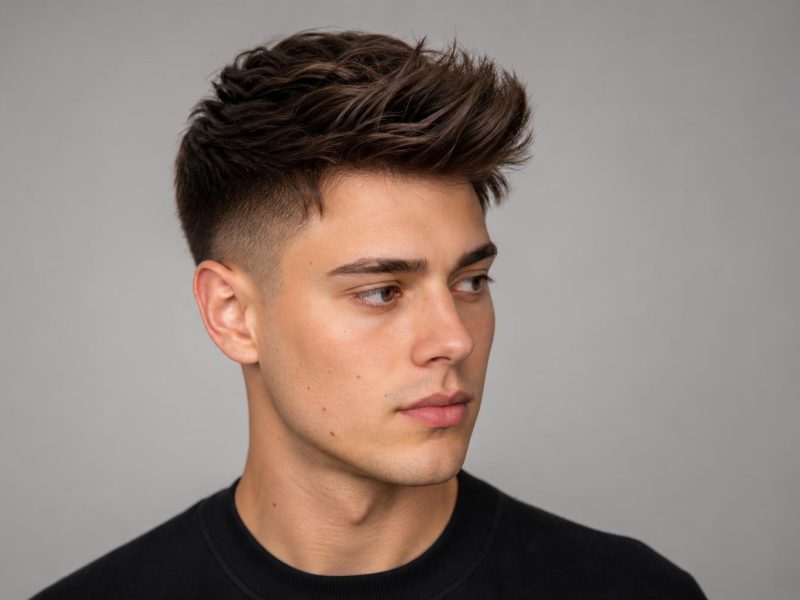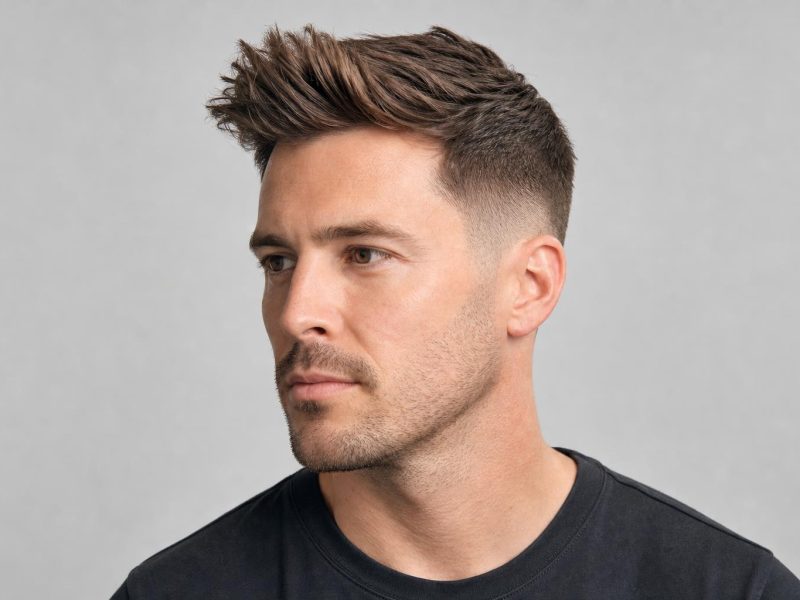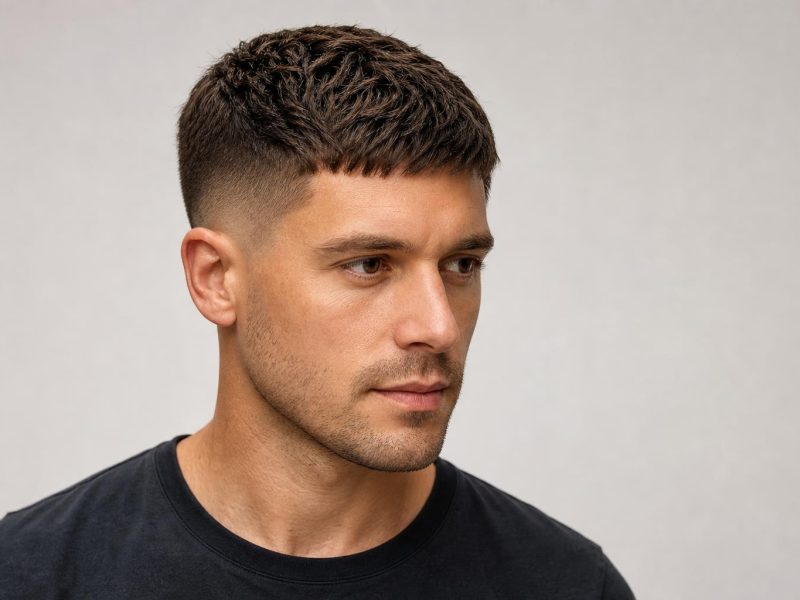


The mohawk fade is not one haircut but a format: a strip of length down the center, faded sides, and as many variables in between as there are hair types and face shapes to fit.

These 25 mohawk fade styles are organized by variation type — from the classic mid fade mohawk and burst fade versions through curly mohawk variations, short and low interpretations, and kid-appropriate cuts that work on toddlers and school-age boys. Each entry includes the specific fade level, the top length that makes the variation work, and the hair types it suits. Barber communication tips and face shape guidance follow the gallery.
The mohawk fade differs from the faux hawk in one structural detail: a true mohawk fades the sides to skin or very low, leaving a visible line between the strip and the fade; a faux hawk blends the top into the sides with length graduation rather than a defined edge. Both are covered here because barbers and clients use the terms interchangeably, but the guidance sections clarify what to ask for when the distinction matters.
| Variation | Fade Level | Top Length | Best Hair Type |
|---|---|---|---|
| Classic mid fade mohawk | Mid (above ear) | 2-4 inches | Straight, wavy |
| Burst fade mohawk | Burst (behind ear, semicircle) | 2-5 inches | All types |
| Skin fade mohawk | Skin/bald (zero guard) | 2-6 inches | All types |
| Curly mohawk | Low to mid | 3-5 inches (stretched) | Curly, coily, 3a-4c |
| Short mohawk fade | Mid to high | 0.5-1.5 inches | Straight, fine |
| Kids mohawk fade | Low to mid (age-appropriate) | 1-3 inches | All types |
Classic Mohawk Fade
The classic mohawk fade uses a mid or high taper on the sides to expose the scalp at the temple and above the ear while leaving a defined strip of length running from the hairline to the nape. The strip width varies by personal preference and face shape, typically 2-4 fingers wide at the crown, and the top length determines whether the look skews bold (longer, styled high) or modern and wearable (shorter, textured flat). This foundation applies to every variation in the gallery, making it the best starting point for clients getting their first mohawk fade.
1. Mid Fade Mohawk with Textured Strip
A mid fade that starts at the upper temple and graduates to skin by the time it reaches the ear leaves a clearly defined, bold strip down the center that contrasts sharply with the faded sides. The barber leaves 2-3 inches of length on the strip and uses shears to add texture and remove bulk, preventing a flat, helmet-like appearance in the top section. Ask for a “mid fade starting at the upper temple, dropping to skin or a zero by the sideburn, with 2-inch textured length on the strip” for a classic result that suits most face shapes.
2. High Taper Mohawk on Thick Straight Hair
Thick, straight hair holds a mohawk strip well because the weight of the hair maintains the shape through the day without heavy product. A high taper that starts at the crown, fading aggressively down to skin by the temple, creates the maximum contrast between the strip and the sides. For thick straight hair, the barber should point-cut the strip to remove interior bulk while leaving the surface flat. A blunt-cut strip on thick hair looks blocky and heavy compared to the same length on fine hair.
3. Mohawk Fade Touch-Up Schedule
A mohawk fade begins losing its sharpness around week 2-3 as the faded sides grow in and the hard edge between the strip and the zero dissolves. Most clients with a classic mohawk fade schedule a touch-up every 3-4 weeks, with a full recut every 6-8 weeks when the strip itself needs length adjustment. Between barber visits, the sides can be maintained with a home trimmer on a zero or half guard, but the blend near the strip requires a professional hand to avoid a visible line difference between the home-trimmed section and the professionally faded section.
4. Mohawk Strip Width for Diamond and Triangle Face Shapes
Diamond face shapes have narrow foreheads and chins with wide cheekbones, and a wide mohawk strip (3-4 fingers) adds emphasis at the top that broadens the perceived forehead. Triangle face shapes have a wider jaw than forehead, and a narrow strip (1-2 fingers) with height adds vertical emphasis that draws the eye upward from the jaw. For both shapes, discussing strip width at the consultation before the cut rather than after the fade is important, because once the sides are faded short the strip width cannot be increased without growing the sides back out.
5. Styling the Mohawk Strip with High-Hold Pomade
High-hold pomade or wax applied to a damp strip gives the mohawk its classic shaped, defined look. Work a quarter-sized amount of high-hold product through the strip from root to tip, then use a comb or fingers to direct the hair straight up or slightly forward. For a more textured, lived-in look, work a clay product into dry hair instead. Clay gives a matte, separated finish rather than the sleek, directional hold of pomade. Set the style with a light mist of flexible hairspray if the look needs to hold through a full day.
Burst Fade Mohawk
The burst fade mohawk is the most popular current variation of the cut because the semicircular fade pattern behind the ear creates a sculptural shape that enhances the mohawk strip from behind. Instead of a straight fade line running from the temple to the nape, the burst fade curves outward behind the ear, producing a fan or sun-ray pattern that reads as more artistic than a standard taper. The burst fade technique from mullet haircuts applies the same curved fade principle here, adapted to a mohawk strip at the top rather than length at the back.
6. Burst Fade Mohawk with Blonde-Dyed Strip
Bleaching the mohawk strip to a platinum or sandy blonde while keeping the faded sides at the natural dark color creates a two-tone mohawk that is the most visible color variation in this category. The contrast reads as high-energy in natural light and more subtle in indoor settings because the strip is small enough relative to the overall head to avoid looking overwhelming. For the color: pre-lighten the strip to level 9-10 with bleach before toning to the target blonde; do not apply bleach all the way to the fade line, leaving a millimeter of natural color at the edge to prevent an artificial-looking hard border.
7. What to Say to Your Barber for a Burst Fade Mohawk
Burst fade mohawk communication: “I want a burst fade on both sides — the fade should start at the temple, drop to skin behind the ear in a semicircle, and follow the natural curve of the head toward the nape. Leave about 2 inches on the strip and keep it textured, not slicked back.” Bring one clear reference photo taken in good lighting, ideally showing the burst fade shape from the back-side angle, since the burst pattern is the element most likely to be interpreted differently between client and barber without a visual reference.
8. Burst Fade Mohawk vs Standard Taper Mohawk
The standard taper mohawk has a straight, angular fade line that runs from front to back with consistent gradient. The burst fade mohawk curves behind the ear in a D-shape, creating a rounded, organic pattern that suits the natural curve of the skull better on most head shapes. The burst fade looks fuller in the lower back of the head because the semicircle keeps more length just below the curve; the taper looks more uniform from every angle. For a first mohawk, the taper is more predictable; for someone who already has a mohawk and wants something with more visual complexity, the burst fade is the upgrade.
9. Skin Fade (Bald Fade) Mohawk
A skin fade, also called a bald fade, takes the sides all the way to zero, with no guard at all at the lowest point, creating the sharpest possible contrast between the strip and the surrounding scalp. This is the boldest version of the mohawk fade and requires a barber confident in freehand clipper work because the zero line must be smooth and gradual rather than a sudden visible transition. For a skin fade mohawk, the length on the strip matters more than in a taper version, because the maximum contrast of skin vs. strip means even a 1-inch strip looks significantly tall. This cut requires the most frequent touch-ups, typically every 2 weeks, because new growth against a skin fade is immediately visible.
10. Burst Fade Mohawk on Naturally Curly-Top Men
Men with natural curl patterns in the 3a-3c range often find the burst fade mohawk flattering because the curl texture adds visible volume to the strip that straight hair needs product to replicate. The burst fade keeps the sides short and tightly faded while the curly strip rises naturally, creating a silhouette that’s bolder than a straight-hair mohawk of the same strip length. For curly-top burst fade mohawks, ask your barber to cut the strip dry after washing and product application so the cutting length accounts for the curl’s natural shrinkage.
Curly and Textured Mohawk
Curly and coily hair creates mohawk strip shapes that straight hair cannot replicate: the coil pattern builds height without product, the texture adds visible density, and the shrinkage factor means a longer strip length is needed to achieve a given silhouette height. The curly mohawk works across a wide range of curl types, from loose 3a waves through tight 4c coils, and the fade level should match how much contrast the client wants between the strip and the shaved sides.
11. Curly Mohawk Maintenance and Shrinkage Planning
Curl shrinkage means curly mohawk strips need 20-50% more length than the client’s intended silhouette height. A 3-inch stretched length on a 3c curl pattern shrinks to roughly 1.5-2 inches when dry, so if the client wants the strip to appear 2 inches tall, the barber cuts the stretched length to approximately 3.5 inches. Discuss this with your barber before the cut by showing a reference photo of the desired silhouette height, not the desired stretched length. Maintain the curl with a leave-in conditioner daily and a curl-defining cream for wash days.
12. Curly Mohawk Fade for Round Face Shapes
Round face shapes benefit from vertical height and a narrow overall silhouette, and a curly mohawk fade provides both. The height from the curly strip elongates the apparent face length, and the faded sides reduce width at the temples. For round faces, keep the strip width narrow (1-2 fingers) rather than wide, as a wide curly mohawk adds volume both up and out, which increases perceived width. A mid to high fade on the sides completes the elongating effect by reducing the visual weight at the sides of the head.
13. Styling a Curly Mohawk with a Wash-and-Go
Apply a curl-defining cream or gel to freshly washed, soaking-wet strip hair and scrunch upward from the ends while tilting the head forward. Diffuse on low heat or allow to air dry without touching. The wash-and-go finish on a curly mohawk looks more natural and requires less daily maintenance than a product-loaded, directional style, which makes it the most practical option for daily wear. For occasional elevated looks, add a water-based pomade on top of the defined curls to increase height and hold without disrupting the curl pattern.
14. Two-Tone Mohawk: Natural Dark with Dyed Strip
Dyeing only the mohawk strip while leaving the faded sides at the natural color creates a two-tone effect that works particularly well on curly and coily hair because the texture at the strip makes the color change more visible. On dark natural hair, the most popular two-tone mohawk options are: a bleached blonde or platinum strip, a vivid color (red, blue, or green) after pre-lightening, or a subtle red or auburn deposit on natural dark hair without lifting. The curly strip provides a naturally textured canvas that makes dye results look more dimensional than the same color on straight hair.
15. What to Tell Your Barber for a Curly Mohawk
Curly mohawk barber communication: “I want the sides faded to skin or low, and I want the strip left at [target height] when it’s dry and defined. Please cut the strip stretched to leave the right amount of shrinkage. Keep the strip about [finger count] wide from temple to temple.” If your barber is not experienced with curly hair, ask whether they typically cut curly mohawks wet or dry, since cutting wet risks removing too much length because the curl springs up shorter when it dries. The best barbers for curly mohawks cut the final length dry or after the curl is set.
Short and Low Mohawk Fade
Short mohawk fades keep the top strip at 0.5-2 inches rather than the 3-5 inches of a tall, styled mohawk. The shorter strip creates a result that reads as a bold haircut in a barbershop context but passes as a slightly more conservative style in most professional settings. A low fade on the sides (rather than a mid or high) further softens the look, reducing the contrast between the strip and the surrounding hair. This combination suits clients who want the mohawk structure without the full visual commitment of a dramatic height differential.
16. Short Mohawk Fade vs Faux Hawk
A short mohawk fade leaves a 0.5-1.5 inch strip with faded sides and a defined edge where the strip ends. A faux hawk achieves a similar visual by graduating the sides longer toward the top without a hard edge, so the peak effect comes from styling the top upward rather than from a defined strip. Short mohawk fades look more structured and barber-precise; faux hawks look more like an intentional hairstyle that happens to have a peak. If you want clean lines and visible fade structure, ask for a short mohawk fade. If you want something more versatile that can be styled flat on non-peak days, the faux hawk is the more flexible choice.
17. Low Taper Mohawk for Subtle Results
A low taper fade that starts at the ear rather than at the temple leaves more hair on the sides, reducing the stark contrast of the classic mohawk and producing a result that is recognizable as a mohawk in good light but reads as a strong part or textured style in casual settings. The low taper mohawk is the best starting point for clients who are unsure how bold they want to go; the barber can always take it higher and tighter in a follow-up appointment, but the opposite direction requires growing the sides back. Ask for “a low mohawk taper that starts just above the ear, keeping at least a 2 guard on the upper sides.”
18. Short Mohawk for Straight, Fine Hair
Fine, straight hair holds a short mohawk well because the reduced length on the strip minimizes the weight that fine hair struggles to support. A 1-inch strip on fine straight hair with a matte clay product styled upward creates a soft spike effect that has clear structure without requiring the heavy hold products that a taller mohawk demands. For fine-hair mohawks, the barber should cut the strip with shears rather than a clipper guard to avoid the blocky, square appearance that results from clipping fine hair at uniform length.
19. Growing Out a Mohawk Fade
The grow-out from a mohawk fade is more awkward than most haircuts because the sides and strip grow at different rates relative to their starting lengths. The sides reach a visible, in-between length around week 4-6 while the strip continues growing normally, creating a proportional imbalance. The cleanest grow-out strategy: ask your barber to gradually widen the strip with each appointment, letting the sides grow in as the transition area between strip and side is expanded toward a textured undercut or tapered fade with more uniform length. Growing straight out without adjustment creates a shape that’s hard to restyle without a full reset.
20. Low Mohawk for Oblong Face Shapes
Oblong and long face shapes benefit from width rather than additional height, which is why a low, short mohawk suits these face shapes better than a tall, dramatic one. Keep the strip at 1-1.5 inches with minimal height styling, and use a low taper rather than a high or skin fade on the sides to preserve visual width at the temples. A side-styled finish, combing the strip slightly to one side rather than straight up, adds horizontal emphasis across the forehead, which broadens the perceived face width in a flattering way. Avoid tall, styled mohawks on long faces, as vertical height amplifies the already-elongated proportions.
Kids Mohawk Fade
Kids mohawk fades adapt the same structural principles as adult mohawks to age-appropriate lengths and softer fade levels. Most barbers recommend starting with a low to mid taper rather than a skin fade for kids under 8, because the lower contrast looks more balanced on smaller heads and is less likely to require precise home maintenance between appointments. The strip length for kids typically stays at 1-2.5 inches, enough for the mohawk shape to be clear without requiring daily styling to look intentional.
21. Styling a Kids Mohawk for School
School-day styling for a kids mohawk should be fast and durable. A water-based pomade applied to slightly damp hair and combed or pushed forward and up takes less than two minutes and holds well through a full school day without flaking or residue. Avoid gel-heavy products for everyday school use, as they make hair stiff and prone to cracking, and they’re harder to remove without a full wash. A flexible, water-based product is easier to restyle if the mohawk gets disrupted during the day.
22. Kids Mohawk with Bleached or Colored Tips
Lightening only the tips of a kids mohawk strip (the top 0.5-1 inch of length) creates a sun-kissed or highlighted effect that reads as colorful without requiring full-strip bleaching. For very young children (under 7), most professional colorists recommend deposit-only colors or color-safe sprays rather than bleach, because the small area involved in tip-coloring reduces chemical exposure. Temporary color sprays in vivid shades applied to the tips of a kids mohawk offer a commitment-free alternative that washes out, which suits kids who change their mind quickly about what color they want.
23. Talking to the Barber for a Kids Mohawk Fade
Kids mohawk barber communication: “A low to mid fade on the sides — nothing too tight near the scalp because he’s active and maintenance is difficult at home. Leave the strip about [finger count] wide and [inch count] long. Keep it soft enough that he doesn’t have to style it every morning, but structured enough that the mohawk shape is clear.” If the child has never had a mohawk fade before, specify “no skin fade this time” and start with a low or mid taper gives flexibility to go tighter later without the risk of the child disliking a more extreme look on the first visit.
24. Kids Burst Fade Mohawk vs Kids Taper Mohawk
A kids burst fade mohawk creates the same curved, semicircular fade shape behind the ear that adult burst fades use, adapted to the child’s smaller head proportions. Kids taper mohawks have a straighter, more traditional fade line and are slightly easier to maintain at home because the shape is more uniform. The burst fade looks more dynamic and is currently the more requested variation for school-age boys, but it requires a barber experienced with burst fades on children’s proportions, and the pattern needs careful scaling to avoid looking oversized on a smaller head.
25. Kids Short Mohawk with Soft Spikes
The soft spike finish on a kids short mohawk uses a small amount of light-hold gel or water-based pomade to push the strip hair upward into separated sections rather than a single tall spike. This suits toddlers and young school-age boys well because the soft spikes look intentional without requiring precision and hold well enough through movement and play. For the barber: ask for a “kids mid fade with a 1.5-2 inch strip, cut with shears, and left with enough length for soft spikes.” The shear cut on the strip prevents the blunt, guard-cut edges that make short kids mohawks look choppy rather than styled.
Mohawk Fade vs Faux Hawk: Which One to Ask For
The most common point of confusion when booking a mohawk appointment is whether the client wants a true mohawk (defined strip with shaved or faded sides) or a faux hawk (longer top that blends into shorter but not faded sides). The structural difference affects both the result and the grow-out.
| Feature | Mohawk Fade | Faux Hawk |
|---|---|---|
| Sides | Faded to skin, zero, or very short | Shorter but not faded; blends into the top |
| Strip edge | Hard, defined edge between strip and fade | Gradual length graduation; no defined edge |
| On non-styled days | Still reads as a mohawk shape without styling | Lies flat without styling; looks like a standard undercut |
| Touch-up frequency | Every 2-4 weeks to maintain fade sharpness | Every 4-6 weeks; grow-out is more forgiving |
| Best for | Clients who want the structure visible at all times | Clients who want styling flexibility between looks |
Face Shape Guide for Mohawk Width and Height
The mohawk strip width and the height of the styled top are the two variables that determine how the cut interacts with the face shape. Width affects how broad the face looks at the crown; height adds vertical emphasis that lengthens the apparent face.
| Face Shape | Ideal Strip Width | Height Guidance | Notes |
|---|---|---|---|
| Oval | 2-3 fingers (versatile) | Any height; most forgiving | All mohawk styles suit oval faces |
| Round | Narrow (1-2 fingers) | Taller; adds length to the face | Avoid wide strips; they broaden the face |
| Square | Medium (2 fingers) | Moderate height; not too tall | Burst fade softens angular jaw |
| Diamond | Wider (2-3 fingers) | Moderate; adds forehead width | Wider strip balances narrow forehead |
| Oblong | Medium (1-2 fingers) | Low; avoid tall styled mohawks | Tall mohawk adds length to already-long face |
Stylist tip: Determine your face shape by pulling your hair back and taking a photo straight-on. Compare the width of your forehead, cheekbones, and jaw. The widest measurement and how it relates to face length tells you which face shape category you’re in. Show the photo to your barber so the strip width discussion is grounded in your actual proportions rather than a general estimate.
What to Tell Your Barber
Mohawk fade requests go wrong when the client specifies the strip styling but not the fade level, or specifies the fade level but not the strip width. Your barber needs both pieces of information before starting.
The complete brief: “I want a [low/mid/high/skin] fade on the sides, taking the sides to [guard number] at the lowest point. I want the strip [finger count] wide and [inch count] long. I want the strip [textured with shears / point-cut / left blunt]. For the finish: [styled straight up / slightly forward / textured and flat].”
Stylist tip: Bring two photos to your mohawk fade appointment: one showing the side profile of the fade level you want, and one showing the back-angle of the strip. The back angle is the image most clients skip and most barbers need most, because the strip-to-nape transition is where fade mohawks diverge most by barber technique.
Specific fade references that help: “I want the fade to look like a [low drop fade / high taper fade / low drop fade] on the sides, with the mohawk strip running from my front hairline to the nape.” Referencing a specific fade type rather than just a height anchors the barber’s starting point precisely and is the single most effective way to get consistent results across different barbers and appointments.
When the Mohawk Fade Is Not the Right Choice
The mohawk fade is one of the bolder structural cuts — the contrast between the strip and faded sides is visible in most settings and cannot be hidden or unstyled the way longer cuts can. These situations are better served by a different approach.
- Professional environments with conservative dress codes: A mid to high skin fade mohawk is visible and bold in all lighting and cannot be covered or styled to look conventional. A low taper mohawk with a short strip is the most workplace-appropriate version, but clients in highly conservative environments (law, finance, some corporate settings) should discuss appearance policies before committing to any mohawk variation. A faux hawk or textured top with a taper is a better starting point for clients unsure of their workplace’s tolerance for bold cuts.
- Clients with very fine, low-density hair: Fine, sparse hair on the strip looks thin when styled upward, which makes the mohawk silhouette appear weak rather than bold. A faux hawk that uses the full top section provides more visual mass for fine-haired clients than the narrow strip of a mohawk fade. If you have fine hair and want a mohawk result, a short, textured strip with matte clay is more flattering than a tall, styled one.
- Very narrow or elongated head shapes: A tall mohawk on a narrow, elongated head can look proportionally top-heavy. A short strip or faux hawk distributes the visual weight more evenly on narrow head shapes. Ask your barber to assess your head shape from the back before deciding on strip height, since the back-of-head profile significantly affects how the overall silhouette looks.
- Clients who are not prepared for frequent upkeep: The mohawk fade requires touch-ups every 2-4 weeks to maintain the fade sharpness and strip line definition. Clients who can only visit a barber every 6-8 weeks will spend most of the interval with a grown-out result that looks more like a stray-textured haircut than an intentional mohawk. A low taper mohawk grows out more gracefully, but even the most forgiving version looks best with regular maintenance.
FAQ
What Is the Difference Between a Mohawk Fade and a Faux Hawk?
A mohawk fade has a clearly defined strip running from the hairline to the nape, with faded or shaved sides that create a hard visual edge at the strip boundary. A faux hawk achieves a similar peak by graduating the sides shorter without fully fading them, so the silhouette looks like a mohawk when styled but lies flat and blends when unstyled. The mohawk fade is always visible as a structural cut; the faux hawk is only visible when actively styled.
How Often Does a Mohawk Fade Need a Touch-Up?
Most mohawk fades need a touch-up every 2-4 weeks to stay sharp. A skin or bald fade shows new growth within 7-10 days on the sides, so clients with the tightest fades often return at the 2-week mark. A mid or low taper mohawk holds its shape for 3-4 weeks before the sides become noticeably longer. The strip itself only needs a length adjustment every 6-8 weeks; the sides account for most of the maintenance frequency.
Can a Mohawk Fade Work on Curly Hair?
Yes, curly hair is one of the best natural matches for the mohawk fade because the curl texture adds visible volume and height to the strip without heavy product. The key adjustment is accounting for shrinkage: the barber should cut the strip at a longer stretched length than the intended dry height, because curly hair springs upward when it dries. Curl types from 3a through 4c all work for mohawk fades; the tighter the curl, the more shrinkage allowance the barber needs to factor in.
Is the Mohawk Fade Appropriate for Kids?
Yes, and kids mohawk fades are popular for toddlers through school-age boys. The most age-appropriate version uses a low to mid taper rather than a skin fade, keeps the strip at 1-2 inches, and uses a light-hold product for styling rather than heavy gel. For the first kids mohawk, ask the barber to start conservatively, opting for a lower fade and shorter strip, and adjust future appointments based on how the child likes the result and how much styling effort the parents want to maintain.
What Products Are Best for Styling a Mohawk Fade?
High-hold pomade or wax gives the most structured, directional finish for a tall or spiked mohawk. Matte clay provides hold with a natural, low-shine finish for a textured, modern mohawk that doesn’t look product-heavy. For curly mohawks, a curl-defining cream applied to wet hair plus a light gel on top gives hold while preserving the curl pattern. Kids mohawks work best with water-based products that wash out easily and don’t leave residue that the child finds uncomfortable.
How Wide Should a Mohawk Strip Be?
Most mohawk strips are 1-3 fingers wide, measured across the top of the head at the widest point. Round and oblong faces suit narrower strips (1-2 fingers) because width at the crown does not flatter those shapes. Diamond and oval faces can wear wider strips (2-3 fingers) without the width looking disproportionate. Ask your barber to lay fingers across the proposed strip width and confirm before fading the sides, since the sides cannot be widened after fading without growing out.
The mohawk fade remains one of the most customizable men’s haircuts because the fade level, strip width, top length, and styling finish can each be adjusted to produce results that range from subtle and workplace-appropriate to bold and high-contrast. Start with a clear brief that covers fade level and strip width, bring a reference photo that shows both the side angle and the back-angle of the fade you want, and the result will match far more closely than a verbal description alone. The burst fade technique has made the mohawk one of the most-requested cuts in modern barbershops, and the variations in this gallery cover every interpretation that’s currently driving that demand.
Results vary based on your natural hair type, texture, density, and head shape. Discuss your specific proportions with your barber before committing to a fade level or strip width. Photos may show styled results that require product application to replicate daily.