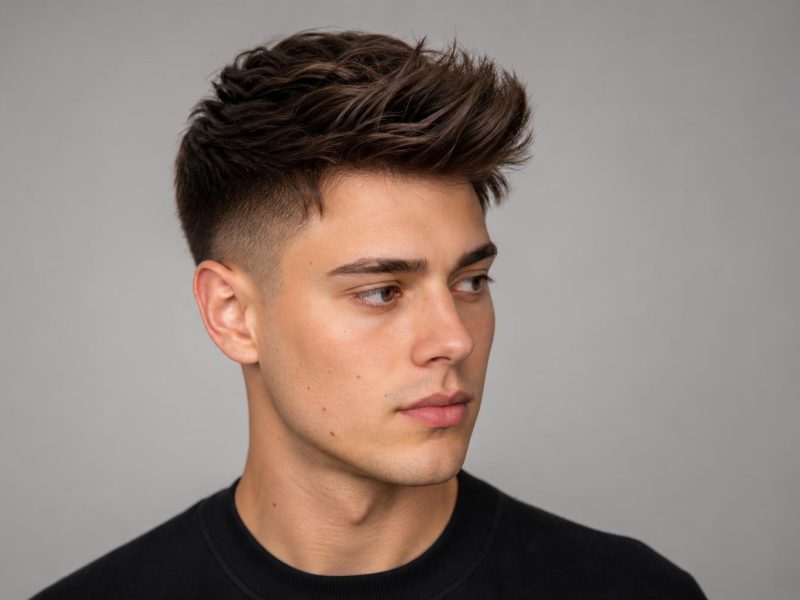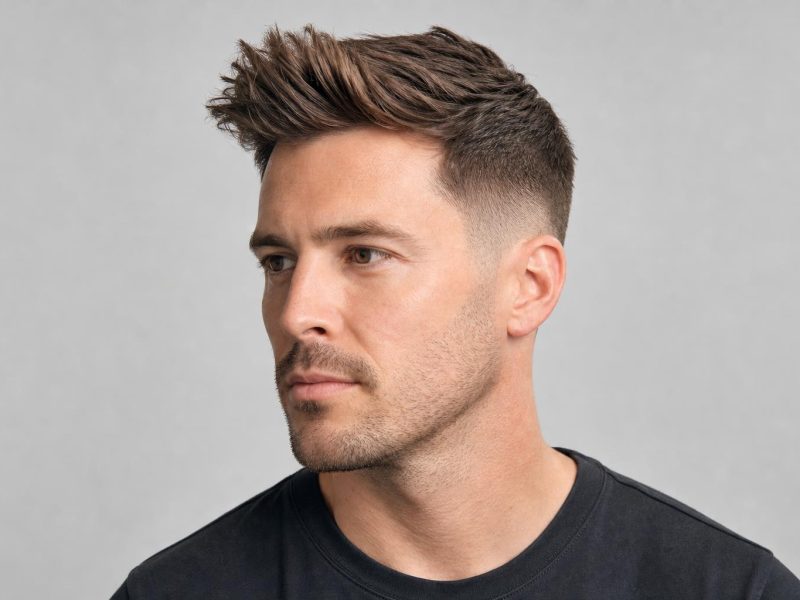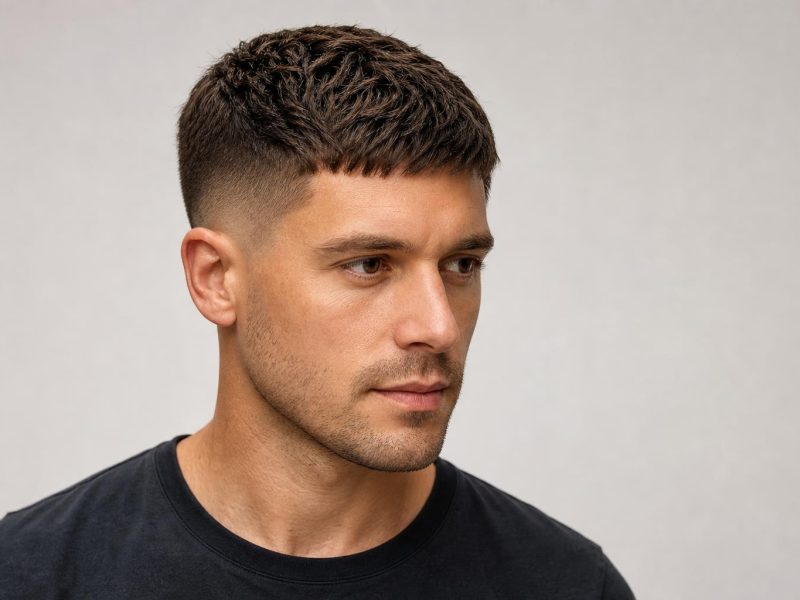

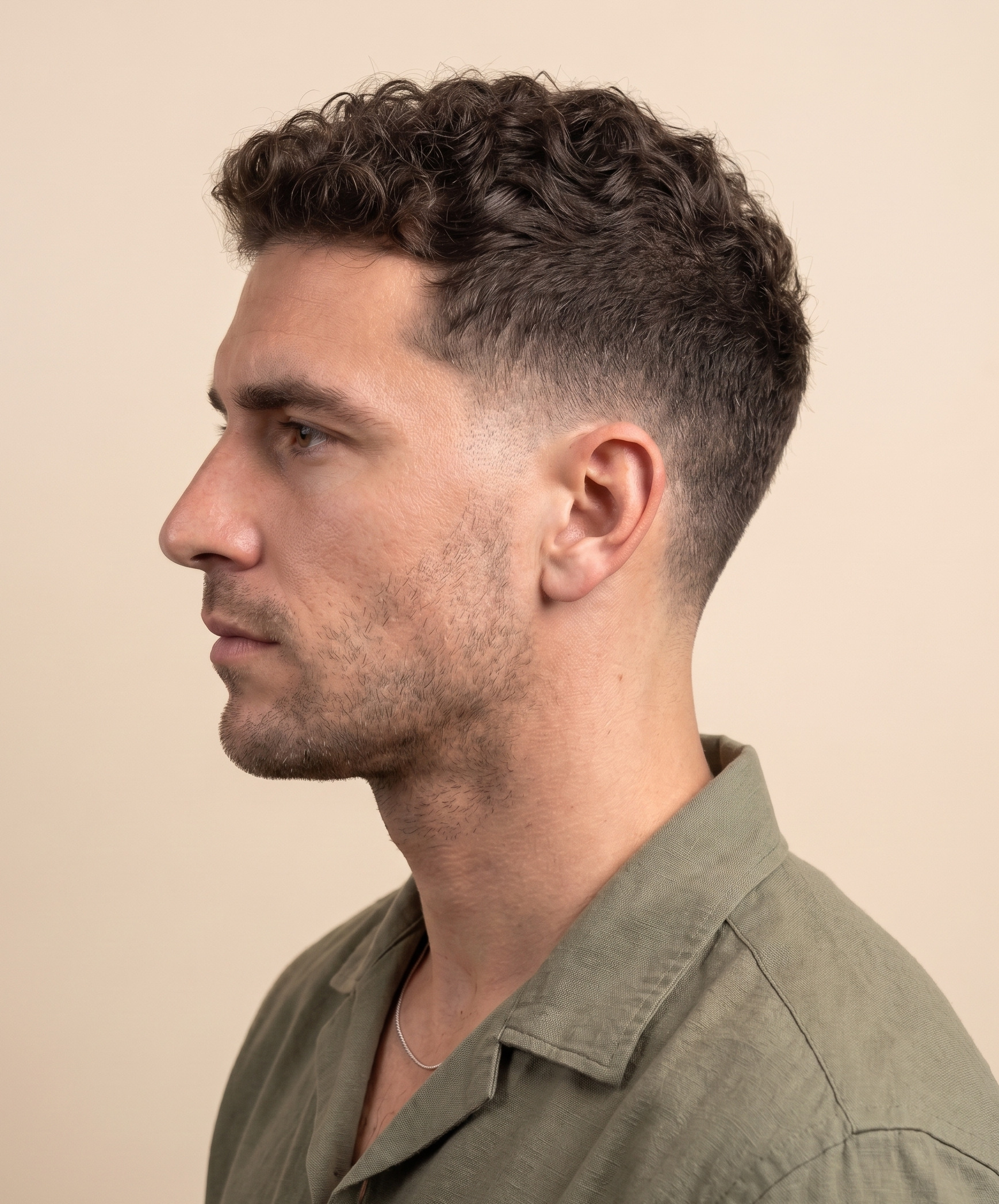
A low drop fade starts just above the ear and arcs downward behind it, combining the low placement of a standard low fade with the curved drop line that follows the head’s natural contour behind the ear — giving the back and sides a cleaner, more sculpted silhouette than a straight-line fade at the same height.
The key distinction between a low drop fade and a standard low fade is that curved arc. A regular low fade runs horizontally around the head at the same height all the way around; the drop fade follows the curve of the skull behind the ear, dropping lower at the back before rising back up. That curve creates a rounder, more finished look at the nape that straight fades at the same height cannot replicate. These 25 styles cover the classic version, curly and textured adaptations, popular top pairings, beard combinations, and specialty variations — each with enough detail to walk into a barbershop and describe what you want with precision.
| Factor | Details |
|---|---|
| Fade height | Begins just above the ear; curves lower behind the ear toward the nape |
| Best for | All hair types; especially clean on curly and textured hair |
| Barber visit frequency | Every 2–3 weeks to keep the fade line sharp |
| Vs. high fade | Low drop sits lower; high fade starts at or above the temple and creates more contrast |
| Vs. mid fade | Low drop is more subtle; mid fade creates a bolder side contrast at temple height |
Classic Low Drop Fade Styles
The clean, unadorned low drop fade is a foundation that works with nearly any top length or texture. Getting it right requires a barber who can guide the blade along the skull’s natural curve rather than using the ear as a flat reference — the drop portion happens behind the ear, not around it, which is a technique distinction that separates a well-executed drop fade from one that just looks like a low fade with uneven sides.
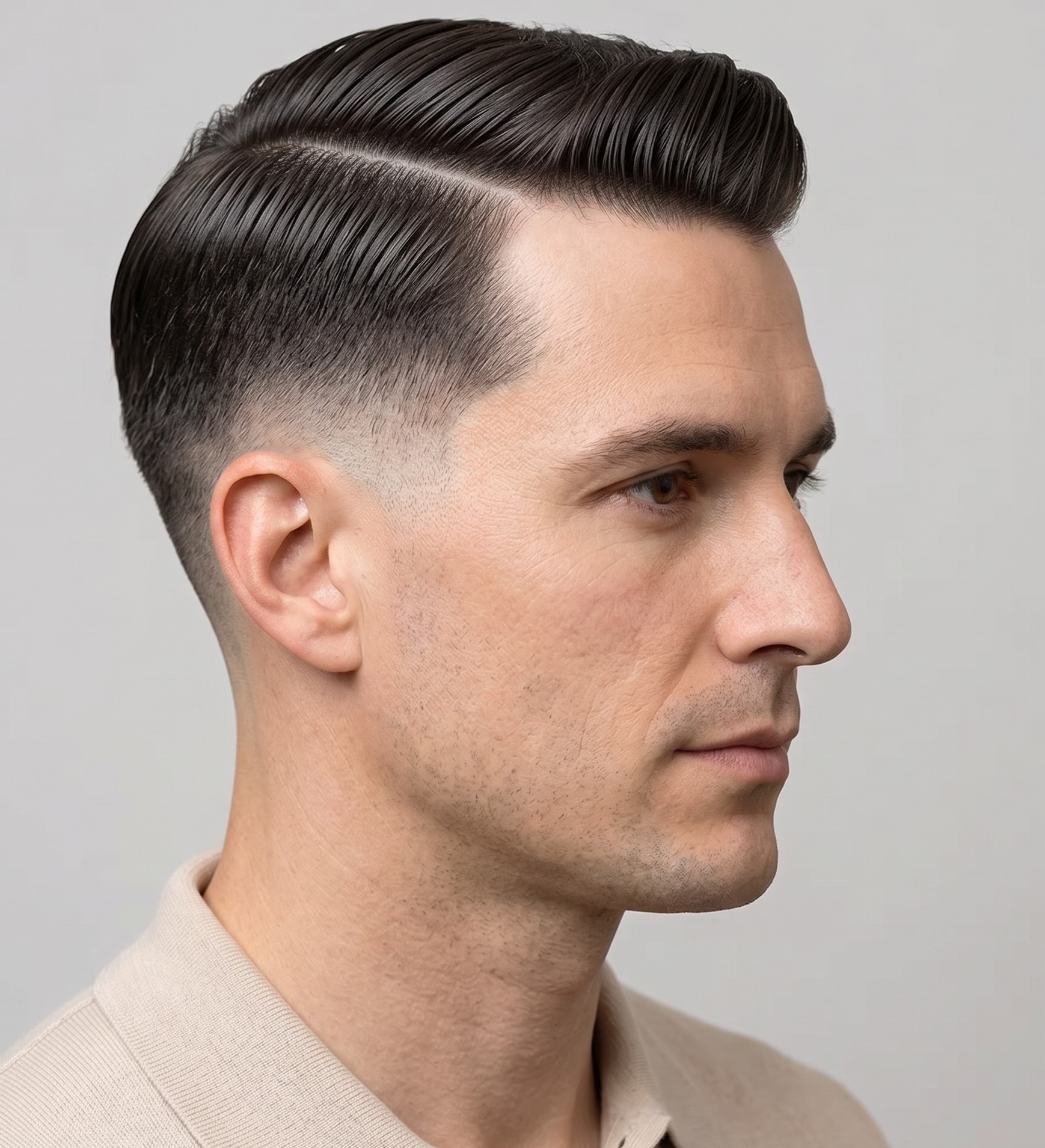
1. Clean Low Drop Fade
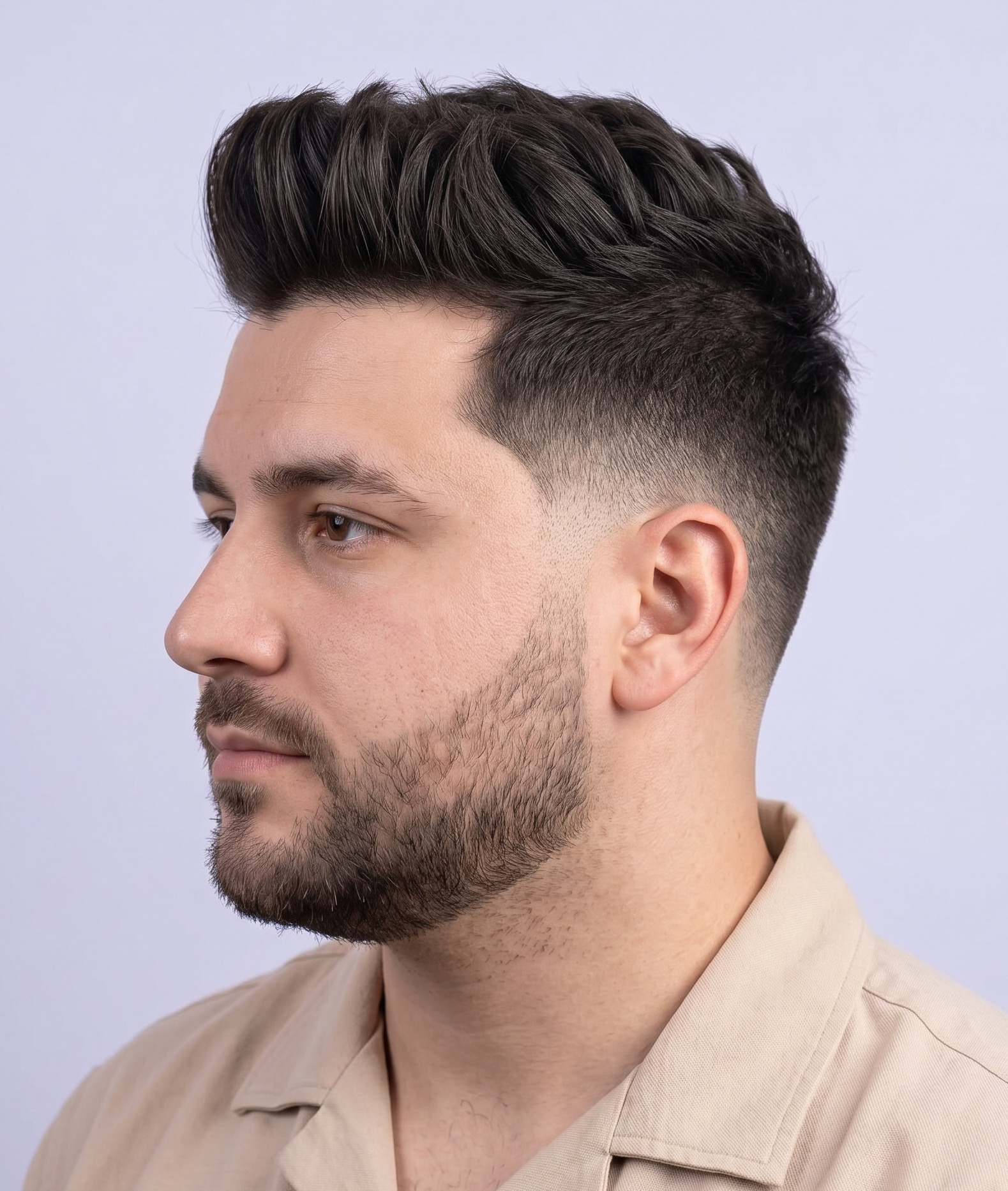
A low drop fade begins with the clipper at a zero or skin setting just above the natural hairline, then curves upward and inward following the ear. Behind the ear, the fade line drops — curving toward the nape at a lower point than it started — before gradually blending from skin to the natural hair length on the sides and back. That arc creates the characteristic sculpted silhouette that distinguishes the low drop fade from a straight-line fade at comparable height. On shorter tops (under two inches), this base style needs no product to look polished.
2. Low Drop Fade with Side Part
Oval and oblong face shapes get the most out of the side part combined with a low drop fade because the horizontal line of the part works in proportion with the elongated face structure without adding unnecessary height. The side part starting point should be set about one inch from where the fade line begins — not at the edge of the fade, which creates a part that looks like it grew out of the fade rather than the top. For round faces, a deep side part (two-thirds of the way across the crown) creates more asymmetry and visual width that balances a fuller jaw.
3. Low Drop Fade on Thick Hair
Thick, coarse hair builds up density around the sides and back that a low drop fade removes cleanly without creating the blunt line that a trim-only approach leaves. On hair with significant density, the barber typically completes two passes with the fade — once to establish the line, once to soften the blend with a shorter guard — because dense hair compresses differently than fine hair under the same guard setting. The fade holds its shape longer on thick hair (often four weeks before significant fade-line softening) compared to fine or straight hair types, which can start looking grown out at two and a half weeks.
4. Low Drop Fade with Textured Crop
Pairing the low drop fade with a textured crop — two to three inches on top with disconnected, choppy tips — creates a clean contrast between the finished fade at the sides and the unstructured texture above it. The disconnection between the top and sides works because the sharp fade line visually separates the two sections, making the messiness on top look deliberate rather than ungroomed. Apply a matte clay or texture paste on the top section after showering while the hair is still 80% dry — product on fully dry hair creates clumps rather than individual strand separation.
5. Low Drop Fade with Classic Taper
Unlike skin fades that require a barbershop visit every two to three weeks to stay sharp, a low drop fade blended into a classic taper at the nape rather than a skin-close finish gives an extra week of clean wear before the fade line softens visibly. The taper variant keeps a thin line of hair at the neck rather than shaving it to skin — a preference for men who grow nape hair quickly or who want the haircut to look maintained for a full three weeks between appointments. This version is also more comfortable for men who experience razor bumps or irritation at the neckline from close shaving.
Low Drop Fade with Curly and Textured Hair
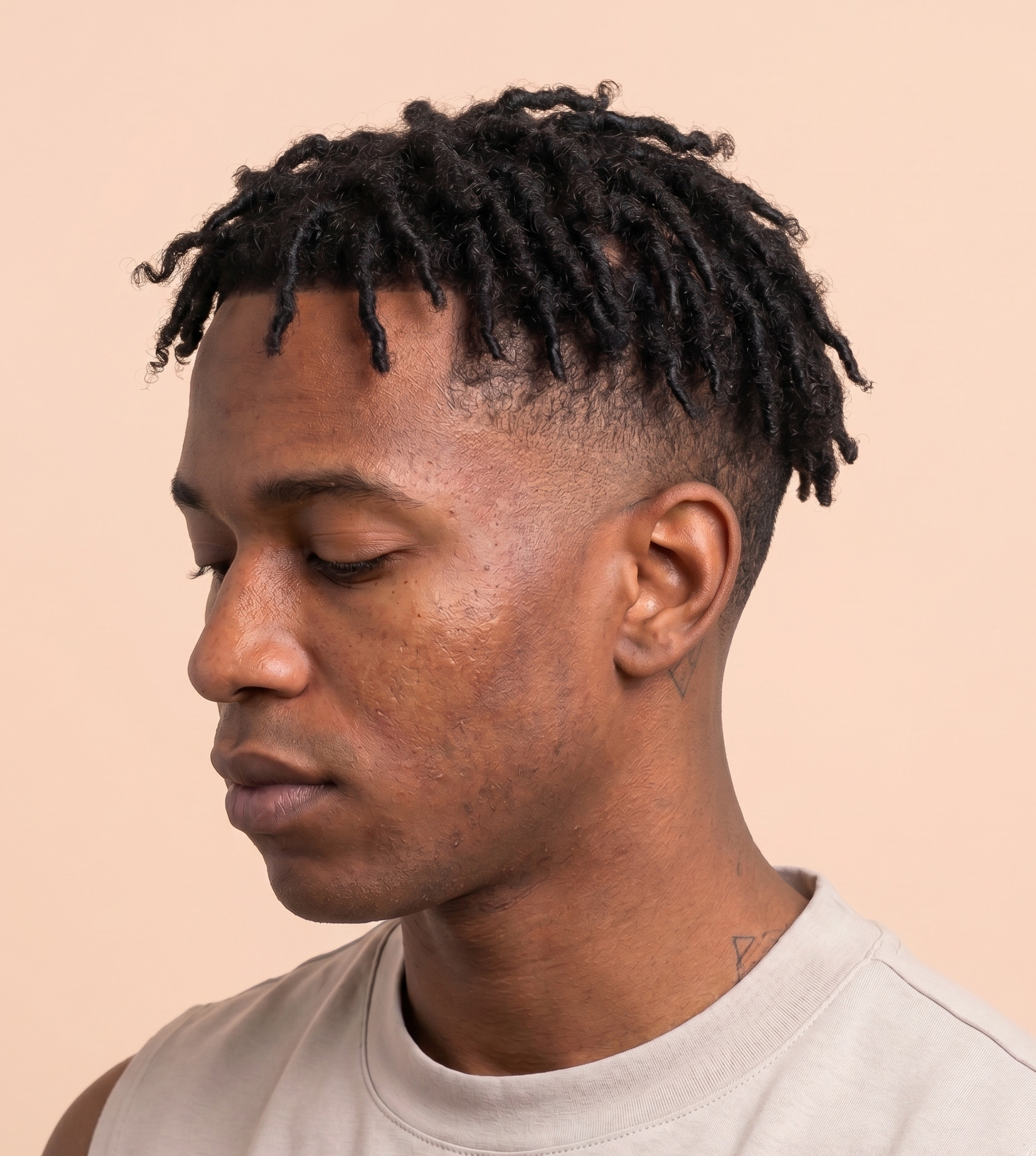
The low drop fade is one of the most complementary fade styles for curly and textured natural hair because the low, curved placement removes density at the sides and back without cutting into the coil pattern at the crown. Curly hair at the sides can obscure the fade line when grown out, so this section covers styles that maintain the contrast between fade and curl at different natural hair types and lengths.
6. Low Drop Fade with Type 3 Curls
On naturally curly type 3a–3c hair, the low drop fade creates contrast between the tight fade at the sides and the loose curl pattern on top without requiring any straightening or manipulation of the curl structure. The barber should fade dry or pick-out hair rather than working on wet curls — wet curls compress and the barber may cut too short, then the curl springs back after drying and shows a fade line significantly higher than intended. Two inches of natural curl on top over a clean low drop fade is often enough to create a full, defined look that does not require daily product.
7. Low Drop Fade with 4c Natural Hair
Square and round face shapes benefit specifically from the low drop fade on 4c natural hair because the drop fade’s curved line behind the ear softens the visual weight of a wide jaw by removing bulk precisely where it would otherwise create a box-like silhouette at the head’s widest point. On 4c hair, the fade works best when the barber uses a lower guard on bone-dry hair — shrinkage can make 4c hair appear shorter than it is on the sides, and a barber working on wet 4c hair may overcut. Leave at least an inch and a half of natural hair on top to preserve enough volume for the fade to have something to blend into.
8. Low Drop Fade with 360 Waves
360 waves require consistent brushing to maintain the wave pattern, and a low drop fade at the sides reinforces the circular, flowing visual of the waves by framing the pattern with a clean edge. The fade should stop just at the point where the waves begin — not above it — so the wave pattern runs to the fade line without a visible gap of unblended hair between the wave section and the fade. A wave cap worn for 30 minutes after brushing each morning keeps the wave direction set through the day and is compatible with any fade height, but the low drop fade specifically maintains enough wave pattern around the sides for the 360 effect to read clearly.
9. Low Drop Fade with High-Top Flat Natural
Building height straight up on a 4a–4c natural top while keeping the sides close with a low drop fade creates the proportion balance that made the high-top flat fade a reference style across decades. The drop arc at the back keeps the silhouette looking rounded rather than boxy when viewed from the side — an advantage over a straight-line low fade at the same height, which can give a squared-off profile at the nape. Height on top works best on oval, heart, and oblong face shapes; very round or square faces may find the additional crown height amplifies rather than balances facial width.
10. Low Drop Fade with Blowout Top
A blowout top combined with a low drop fade creates maximum volume contrast — tight at the sides, full and rounded at the crown. The blowout is achieved by stretching the natural hair outward with a blow-dryer and a round brush or a pick, adding three to four inches of visual height from a natural starting length of one to two inches. For context on how the blowout taper applies this same top technique to a different fade placement, the volume and styling principles translate directly — what changes is the fade arc, not the top styling approach.
Low Drop Fade with Popular Tops
The low drop fade is one of the most pairable fades because its subtle placement does not compete with whatever is happening on top. Where higher fades draw the eye to the sides, the low drop fade keeps visual attention on the top section and the face. That makes it the natural fade choice for styles where the top itself is the focal point of the cut.
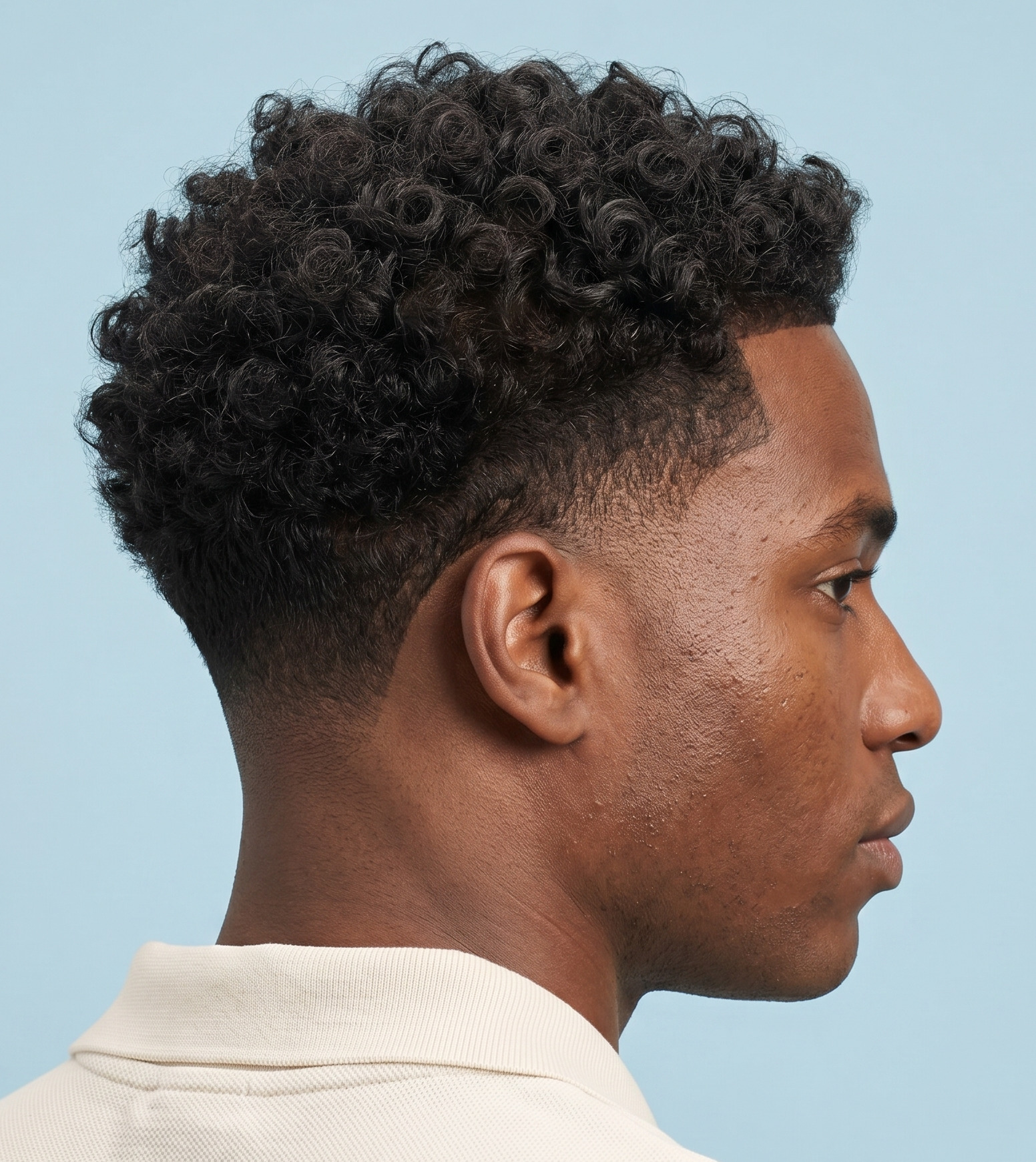
11. Low Drop Fade with Crew Cut
Natural contrast between the tight fade and the uniformly short crew cut on top creates a clean, minimal result that works in both professional and casual contexts. A crew cut at one inch on top over a low drop fade keeps the entire cut within a very narrow length range — the difference between the top and the fade is measured in fractions of an inch — which makes the finished look precise rather than bold. Men who want the least maintenance between barber appointments should keep the top at one inch or above; below that, new growth becomes visible in the crown at the two-week mark rather than three.
12. Low Drop Fade with Edgar Cut
Where the edgar cut uses a blunt, horizontal fringe line across the forehead as its defining feature, pairing it with a low drop fade keeps the overall cut looking sharp without adding the visual weight that a higher fade placement would create at the temples. The edgar cut’s strong horizontal line at the fringe works best over a fade that stays low — a mid or high fade pulls the eye to the sides and disrupts the edgar’s emphasis on the horizontal fringe as the style’s primary detail. The low drop fade supports the edgar format by fading out of the way visually rather than competing with it.
13. Low Drop Fade with Pompadour
Requesting a pompadour with a low drop fade requires one specific clarification at the consultation: the degree of disconnection between the top and the fade. A hard disconnection (skin on the sides meeting a bluntly separated pompadour) is a more modern, editorial version; a gradual blend (the fade softening into the pompadour length with no visible line) is the classic barbershop version. Both are valid — which one you want determines whether the barber leaves a slight ledge of length at the top of the fade or blends it seamlessly upward. Say “disconnected” or “blended” before the clipper comes out.
14. Low Drop Fade with Quiff
Volume pushed forward and upward — the defining feature of the quiff — contrasts cleanly with the close low drop fade at the sides because the directional styling of the quiff pulls attention toward the face while the low fade keeps the sides unobtrusive. On straight or lightly wavy hair, a medium-hold pomade gives the quiff its lift and directional hold. On wavy or coarser hair, a blow-dryer with a round brush applies both heat and direction simultaneously, then a light pomade sets the shape. The quiff suits square and oval face shapes best; heart-shaped faces may find the added forehead-width that a wide quiff creates is something to moderate.
15. Low Drop Fade with Faux Hawk
A faux hawk built on a low drop fade is a lower-commitment version of the full mohawk fade — the sides are faded but not completely shaved, and the central strip of height on top is wider and less severe than a true mohawk shape. The low drop fade placement keeps the overall cut looking approachable while still framing the raised center strip cleanly. Unlike the burst fade mullet, which curves the fade arc around the ear in a full semicircle, the low drop fade behind the ear on a faux hawk stays minimal — the focus stays on the raised top strip, and the fade supports it without competing.
16. Low Drop Fade with Fringe
Fringe that falls toward the temple and partially covers the forehead works well with a low drop fade because both elements create soft, curved lines — the fringe rounds the forehead visually while the drop fade rounds the side and back silhouette. This combination suits heart-shaped and oblong faces because it adds horizontal width at the forehead (via the fringe) while the low drop fade keeps the side silhouette clean and close. Avoid cutting the fringe level with the top of the fade line — the fade should remain visually below and separate from the fringe, not at the same height.
Low Drop Fade with Beard
Beard and fade combinations require the barber to decide whether the beard grows continuously from the sideburn area into the fade or whether there is a visible break between the fade and the beard. Both approaches are used — continuous blending creates a seamless look that suits oval and square faces well; a deliberate break between fade and beard creates a more defined jaw frame that suits rounder faces. Communicate this preference before the barber reaches the sideburn area.
17. Low Drop Fade with Full Beard
Beard growth that continues below the fade line and connects to a full beard creates a clean, gradual transition from shaved skin to full growth. The low drop fade suits full beards particularly well because the low placement leaves the sideburn area — where beard growth typically starts — largely untouched, so the fade and beard blend without a gap. Trim the beard’s upper edge line at the cheekbone to maintain separation between the beard and the fade; letting the cheek line grow unchecked creates an undefined border that makes both the fade and the beard look less finished than either deserves.
18. Low Drop Fade into Beard Fade
Fading the beard into the skin fade at the jawline creates a continuous blended look where the gradual transition from scalp hair to fade to beard to bare jawline is all handled in one smooth flow. The barber uses the same clipper guards for both the scalp fade and the beard fade — this consistency is what creates the seamless visual. Men with 4a–4c hair who also grow beard hair at the same coarse texture benefit most from this approach, because the coarser texture blends more smoothly at matching fade settings than fine beard hair does at the equivalent guard number.
19. Low Drop Fade with Light Stubble
Light stubble grown deliberately to a uniform length — typically three to five days of growth using a beard trimmer set to a 1 or 1.5 guard — creates a subtle color break between the skin fade and the stubbly jaw that frames the lower face without adding beard weight. The contrast in color between the lighter skin of the fade and the darker stubble creates a definition line around the jaw that a clean shave eliminates. Men with dark beard hair and lighter skin get the clearest jaw-framing effect from this approach; men with light beard hair may prefer a slightly longer stubble length for the contrast to be visible at normal conversational distance.
20. Low Drop Skin Fade with Defined Beard Line
A skin fade that reaches zero against the beard’s defined cheek line creates the sharpest possible border between fade and beard. Compared to a blended fade-to-beard transition, the defined line creates a more deliberate, geometric jaw frame that suits oval and square faces — it signals frequent barbershop visits and precise edge work. For men used to the high taper fade, the skin-level low drop with defined beard achieves a similar level of precision at a lower fade placement, changing the proportions without sacrificing sharpness.
21. Low Drop Fade with Beard Lineup
A lineup — the crisp straight line carved along the hairline at the forehead and temples using a trimmer or straight razor — combined with a beard lineup at the cheek and jaw creates the two clean parallel lines that define many contemporary men’s barber styles. Request it explicitly: “I’d like a lineup on the hairline and on the beard edge, and a low drop fade on the sides and back.” Without that instruction, some barbers include the lineup automatically and others wait to be asked — specifying saves the consultation time and ensures the finished cut matches expectation.
Modern and Specialty Variations
Modern variations on the low drop fade extend it into territory that straight descriptions rarely cover — shaved designs, hybrid styles, and length combinations that use the drop fade as a base rather than a destination. These five styles demonstrate the range possible once the basic fade placement is established.
22. Low Drop Fade with Shaved Design
Custom clipper designs cut into the fade section — geometric lines, curved shapes, or initials at the temple — work best when the design sits inside the fade gradient rather than at the very skin-close base, so there is visible contrast within the design rather than light lines cut into already-bare skin. The barber needs either freehand clipper experience or a stencil for clean design edges. On thick or 4c natural hair, the design holds for approximately two weeks before new growth softens the edges; on finer or straighter hair with a lighter fade, the design may look grown out in ten to fourteen days.
23. Low Drop Fade with Mullet
Wearing the back section significantly longer than the sides and top while fading the sides to a low drop creates the contemporary mullet silhouette — shorter on top and sides, longer at the nape — without the jarring length contrast that older mullet interpretations used. The low drop fade placement keeps the sides close enough that the length differential between sides and back is visible without being extreme. The burst fade mullet is the curved-arc variant of this approach; the low drop version uses a straighter side taper with the drop arc limited to behind the ear rather than curving the full side section.
24. Low Drop Fade with Short Dreadlocks
Locs combined with a low drop fade on the sides create a defined contrast between the clean, close fade and the textured loc sections above it. Short locs at the scalp and crown need about three inches of established growth before the fade line has enough length above it to look proportional — below that length the fade overwhelms the loc section visually. The low drop fade’s curved shape at the back of the head particularly complements the rounded silhouette that short loc sections create when still developing, giving the overall shape a more even, polished contour than a straight-line fade at the same height.
25. Low Drop Fade vs. Mid Drop Fade on Short Natural Hair
On short natural hair with one to two inches on top, the practical difference between a low drop fade and a mid drop fade comes down to how much of the side is visible as natural texture versus how much is faded. The low drop fade leaves more texture above the ear — the fade line sits at or below the ear, so everything from the top of the ear upward keeps its natural texture. A mid fade starts at the temple, removing much of the side texture. Men who want more natural texture visible on the sides should choose the low drop fade; men who want maximum side contrast with the top should move to a mid placement.
Low Drop Fade by Face Shape
The low drop fade’s placement — low and curved — tends to suit a wider range of face shapes than higher fade placements because it removes less visual width from the sides of the head, keeping the proportions balanced rather than dramatically altering the silhouette.
| Face Shape | Best Low Drop Fade Pairing | Avoid |
|---|---|---|
| Oval | Any top — crew cut, textured crop, pompadour all work | Nothing specific |
| Round | Quiff or high-top to add crown height; deep side part | Very flat, low top without any height — keeps the silhouette circular |
| Square | Textured crop or fringe to soften forehead corners; beard to balance jaw | Hard-disconnected top that emphasizes the square jaw line |
| Heart | Fringe to add width at the forehead; low fade keeps sides from adding further width | Wide pompadour that broadens the forehead further |
| Oblong | Side-parted crop or fringe; avoid adding crown height | High-top styles that add vertical length to an already long face |
| Diamond | Fringe or side part that adds forehead width; low fade suits the narrow jaw | Very close sides with no fringe — narrows the forehead further |
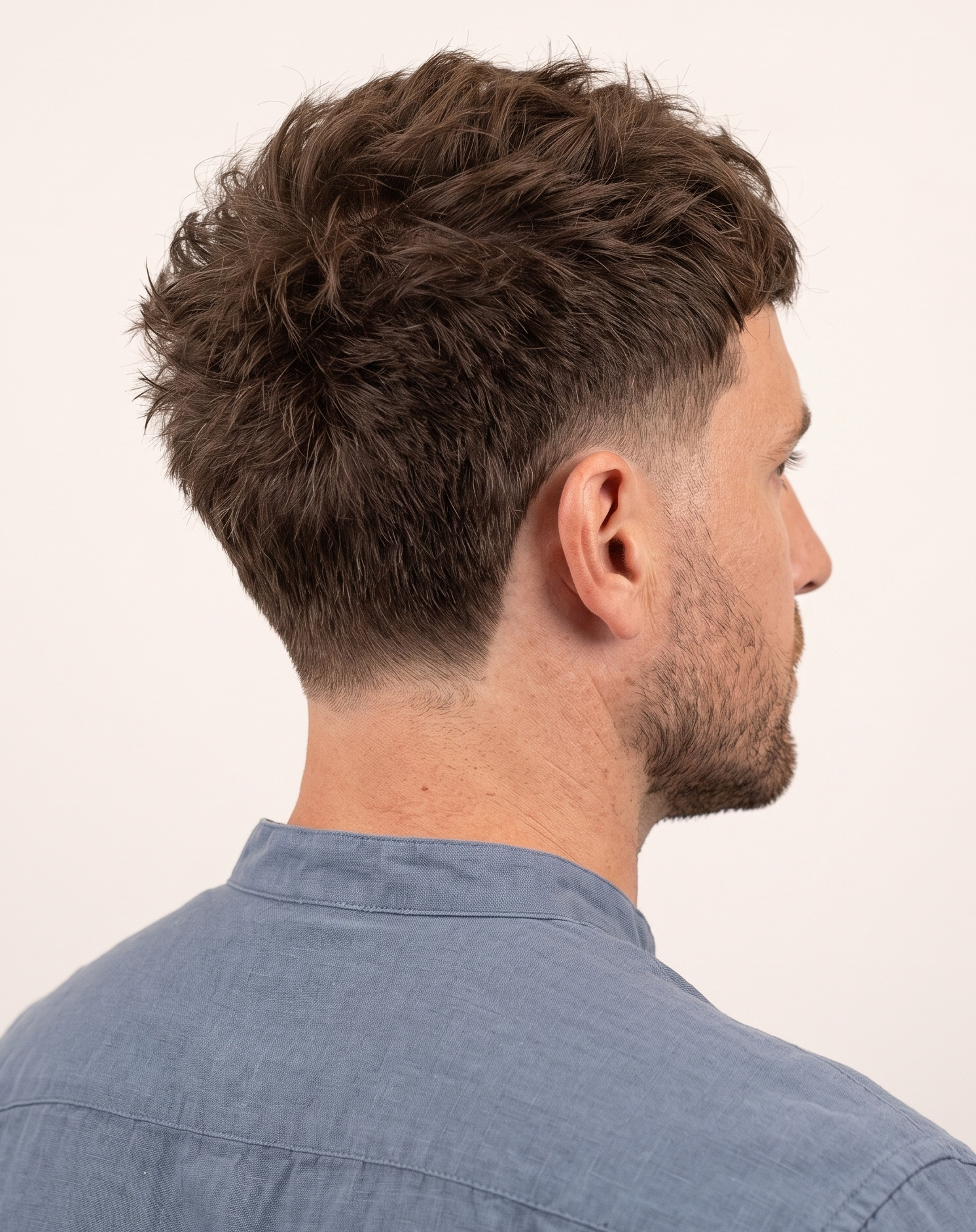
How Long a Low Drop Fade Stays Sharp
The fade line softens as hair grows, but the rate varies by hair texture, fade depth, and how close the skin-level section is. Plan your barber visits around these realistic timelines.
| Hair Type | Visible Fade Life | Maintenance Frequency |
|---|---|---|
| Straight / Fine | 10–14 days before fade line softens visibly | Every 2 weeks for consistently sharp fade |
| Wavy / Medium | 14–18 days | Every 2–3 weeks |
| Curly 3a–3c | 2–3 weeks (curl pattern at the fade edge disguises growth) | Every 3 weeks comfortably |
| Natural 4a–4c | 3–4 weeks (tight curl shrinks new growth visually) | Every 3–4 weeks |
| Skin fade finish | Shortest life — visible shadow in 7–10 days on all types | Every 1.5–2 weeks for zero-shadow maintenance |
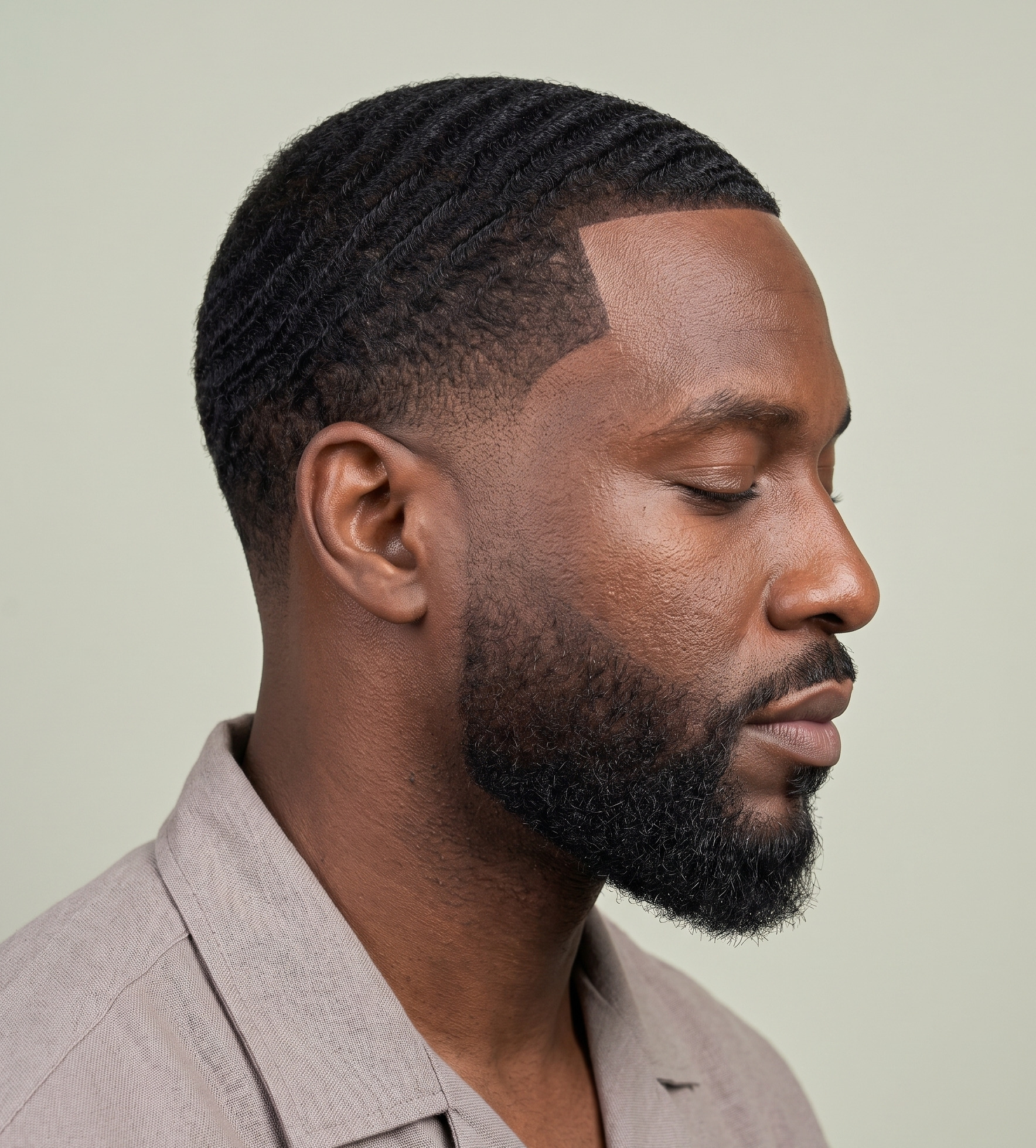
Stylist tip: Men often book a barber appointment when the fade looks grown out from the front — but the back of the low drop fade shows age first because the curved arc behind the ear grows in fastest. Ask a partner or a second mirror to check the nape side before deciding the cut still looks sharp. What looks fine from the front may have softened significantly behind the ear within the previous week.
When a Low Drop Fade Is Not the Right Choice
The low drop fade suits more hair types and face shapes than most fade placements, but specific situations limit what it can achieve or create scalp concerns.
-
Significant scalp psoriasis or seborrheic dermatitis around the ears and nape: Close clipper work directly over an irritated scalp can aggravate flare-ups. Discuss active flare-up areas with your barber before the appointment — a skilled barber can work around affected patches, but you need to communicate where they are.
-
Hair that grows significantly faster at the nape than the sides: Some men experience much faster growth at the neckline, which causes the low drop fade’s lowest point to look grown out disproportionately quickly. A tapered finish at the nape (keeping a thin natural hairline rather than shaving to skin) helps this grow out more gracefully between visits.
-
Wanting significant side contrast with a short top: If the goal is maximum contrast between the sides and a short top — the visual power of a high fade on a one-inch top — a low drop fade will look underwhelming. The low placement leaves too much natural hair visible on the upper sides to create dramatic contrast when the top is very short. A high taper fade or mid fade achieves that contrast more effectively.
What to Tell Your Barber
The most common miscommunication around low drop fades is asking for a “low fade” when you mean a “low drop fade.” Barbers hear these as two different requests — one runs horizontally, the other curves behind the ear. Use the full name and confirm the curve.
Basic request: “I’d like a low drop fade — starting just above the ear and dropping behind the ear at the back. Medium length on top, textured on top, not too short.”
If you want a skin fade: “Same low drop placement, but I want the fade to go down to skin — zero at the hairline. And can you blend the sideburns into the fade rather than leaving a sideburn line?”
If you want the beard included: “I’d like the fade to blend into my beard — so the fade at the side connects to the beard rather than ending with a clean line above it.”
Stylist tip: Clients describing a low drop fade sometimes mean a low taper, sometimes a burst fade, and sometimes exactly a low drop fade. Before touching the clipper to the skin, confirm by asking: “Do you want the fade line to drop lower behind the ear, or should it stay level the whole way around?” That one question eliminates 80% of the finish-line disagreements that happen when the client gets handed a mirror.
FAQ
What Is the Difference between a Low Drop Fade and a Low Fade?
A low fade runs at a consistent height all the way around the head — the fade line stays level with the top of the ear as it goes from temple to nape. A low drop fade starts at the same height at the temple but curves downward behind the ear, dropping to a lower point at the back of the head before coming back up. The drop creates a more rounded, sculpted rear silhouette. Both are low placement fades; the difference is whether the fade line stays straight or curves.
Is a Low Drop Fade Good for Round Faces?
A low drop fade is generally well-suited to round faces because it does not remove significant width from the sides — unlike high fades, which strip the sides down and can make a round face appear wider in proportion to the shortened sides. Pair the low drop fade with a top style that adds crown height (quiff, pompadour, or high-top natural) to create vertical proportion that balances the face’s circular width.
How Short Is a Low Drop Fade?
The base of the low drop fade at the hairline typically starts at a zero or skin guard — hair length is essentially zero at the very bottom. From there, the fade blends upward through increasingly longer guard settings until it reaches the natural hair length above the ear. “How short” describes the fade’s starting point (typically skin level) and its height placement (just above the ear), not the top length, which is a separate conversation with your barber.
How Often Do You Need to Get a Low Drop Fade Cut?
Every two to three weeks for most hair types to maintain a sharp fade line. Curly and tightly coiled hair types can typically extend this to three to four weeks because the curl pattern at the edge of the fade disguises new growth more effectively than straight or wavy hair. A skin-level fade base grows in fastest and may show shadow within ten days on fast-growing hair — those men typically visit every one and a half to two weeks.
What’s the Difference between a Low Drop Fade and a Burst Fade?
A burst fade curves the fade arc in a full semicircle around the ear, creating a rounded burst shape when viewed from the side. A low drop fade curves only behind the ear at a lower point — the arc is shallower and limited to the back section, not the full side. Burst fades are more visually pronounced and work well with mullets and mohawk-adjacent top styles, as with the burst fade mullet. Low drop fades are more subtle and pair cleanly with a wider range of top styles.
Can You Get a Low Drop Fade on Natural Hair?
Yes — the low drop fade is one of the most popular fade placements for natural hair because the low position preserves the maximum amount of natural texture above the ear while still providing a clean, defined fade line. On 4a–4c hair, ask your barber to work on dry, picked-out hair rather than wet or damp hair — curly shrinkage on wet natural hair causes barbers to cut the fade higher than intended when the hair springs back to its natural length after drying.
How Do I Ask for a Low Drop Fade with a Beard?
Specify whether you want the fade to blend into the beard or stop with a defined edge above it: “I’d like a low drop fade that connects into my beard — fading from the ear down and blending into the sideburn and beard rather than leaving a visible line.” If you prefer a defined break, say: “Low drop fade, and keep a clean line at the sideburn — I want the fade to end with a distinct edge above my beard.”
The low drop fade earns its place as one of the most-requested fade placements because it works across hair types, face shapes, and top styles without demanding the frequent maintenance that higher fade placements require. The curved arc behind the ear is what separates it from every other low fade — and it is worth communicating clearly at your next appointment so you leave with exactly the silhouette you wanted rather than a close approximation of it.
Hair results vary based on your natural hair type, texture, density, and condition. Always consult with a licensed barber or stylist before making significant changes. Photos may show styled results that require professional tools and products to replicate.