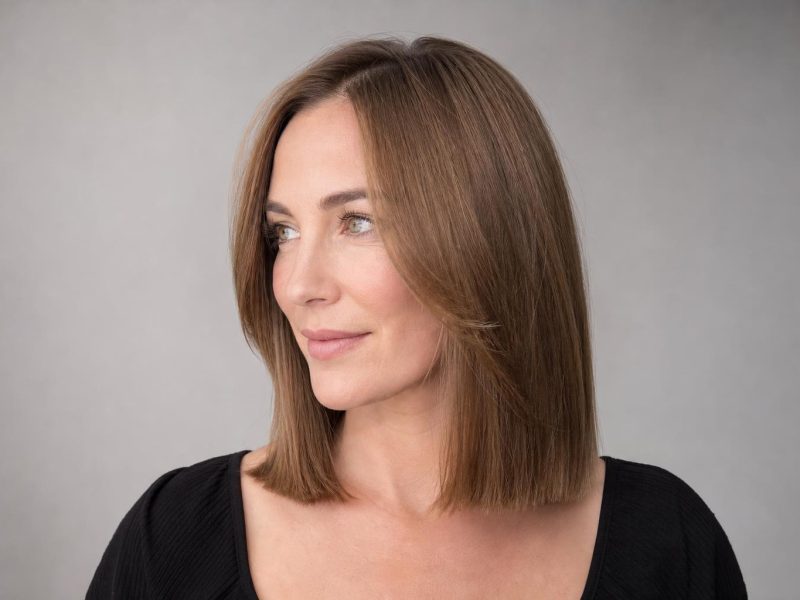

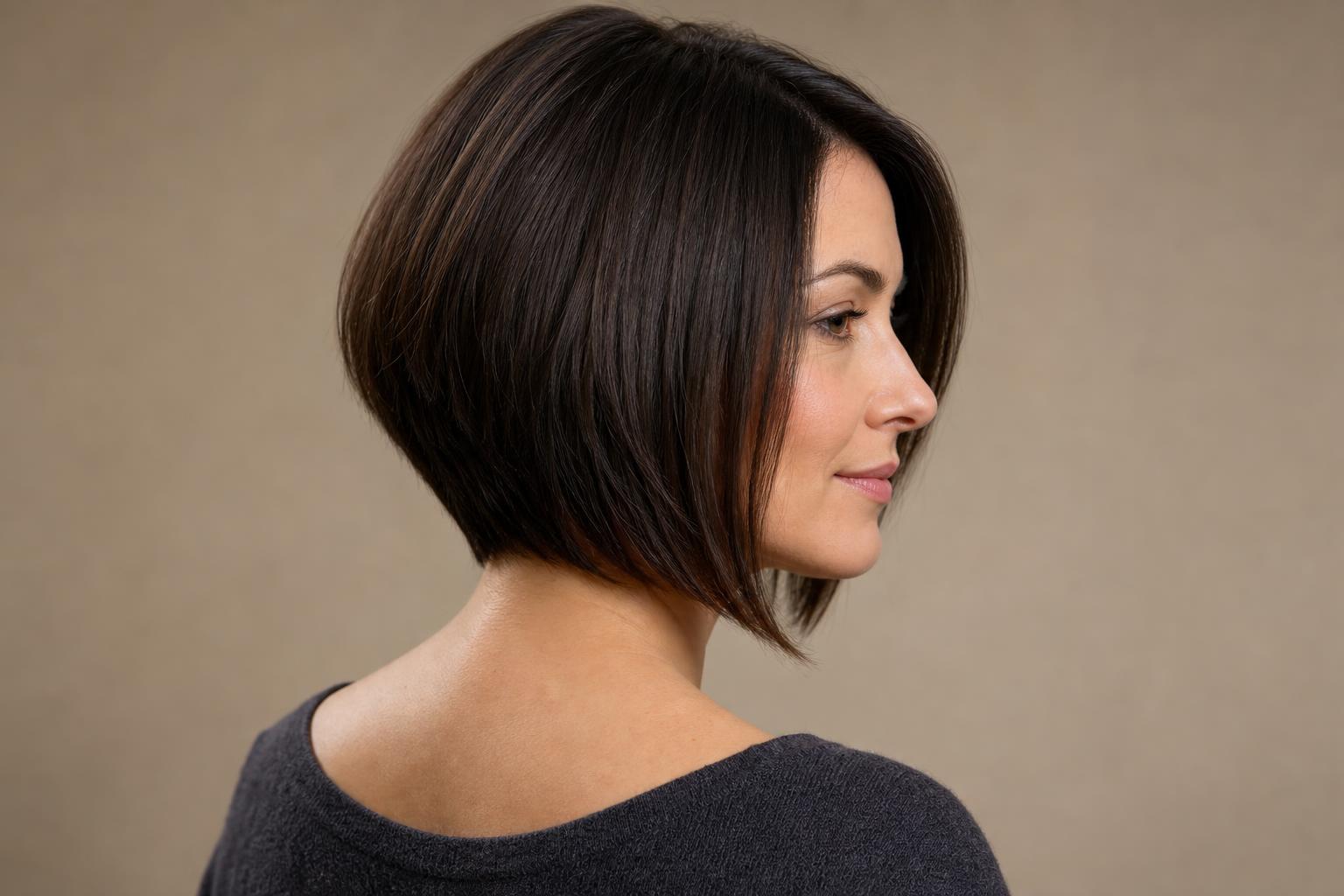
Both cuts are graduated at the back, and the whole argument is about how steeply.
A graduated bob builds weight gradually up the back of the head in a smooth slope, while a stacked bob concentrates much shorter layers into a tight band at the occipital bone to create a visible shelf of volume. Both start with the same technique, cutting the hair at an angle so each section falls slightly longer than the one below it. The difference is elevation: a graduated bob is cut at a low angle over a long stretch, and a stacked bob is cut at a high angle over a short one.
This guide explains what your stylist’s hands are actually doing in each cut, how to tell the two apart from a photo of the back, which hair densities can carry the stacked version, and how each shape behaves as it grows out.
| Feature | Graduated Bob | Stacked Bob |
|---|---|---|
| Back profile | A smooth diagonal slope from nape to crown | A rounded shelf that curves out at the occipital bone |
| Cutting elevation | Low to medium, roughly 30 to 45 degrees | High, 60 degrees and above at the nape |
| Where the weight lands | Spread across the whole back section | Packed into a two to three inch band |
| Visible layers | Blended, hard to see individually | Distinct, deliberately visible tiers |
| Best density | Medium to thick | Fine to medium |
| Trim frequency | 6 to 8 weeks | 4 to 6 weeks |
Both Cuts Use Graduation; Only the Steepness Changes
Graduation is a cutting method, not a haircut. Your stylist lifts each horizontal section of hair away from the head at an angle before cutting it, and because the lifted hair falls back down shorter at the top than at the bottom, the sections stack against each other and build weight. Every bob with volume at the back uses this method to some degree, which is why the two names get used interchangeably in salons that do not distinguish them carefully. The useful distinction is the angle of that lift and the vertical distance across which it is applied.
A Graduated Bob Builds Weight Slowly Across the Whole Back
In a graduated bob the elevation stays modest, often around thirty to forty-five degrees, and it is applied from the nape all the way up toward the crown. Weight accumulates over that entire stretch instead of piling up in one place, so the back profile is a clean diagonal wedge with no sudden step in it. The front is usually left one to three inches longer than the back, which gives the cut a subtle forward angle without turning it into a dramatic A-line.
The payoff is a shape that looks deliberate from every angle without announcing itself. It also survives grow-out better than most short cuts, because a soft slope simply becomes a softer slope, and the perimeter drops evenly rather than one section dropping faster than another. If you have never used the word graduation in a salon, the glossary of salon terminology is worth a scan before your consultation.
A Stacked Bob Packs Short Layers into a Narrow Band
A stacked bob raises the elevation sharply, often past sixty degrees, and applies it across only two to three inches directly over the occipital bone, the round ridge at the back of your skull. Those tightly grouped layers push outward and create a distinct rounded shelf, which is the horseshoe silhouette you see in every stacked bob reference photo. Below the shelf the hair tapers close to the neck, and above it the length blends into the crown.
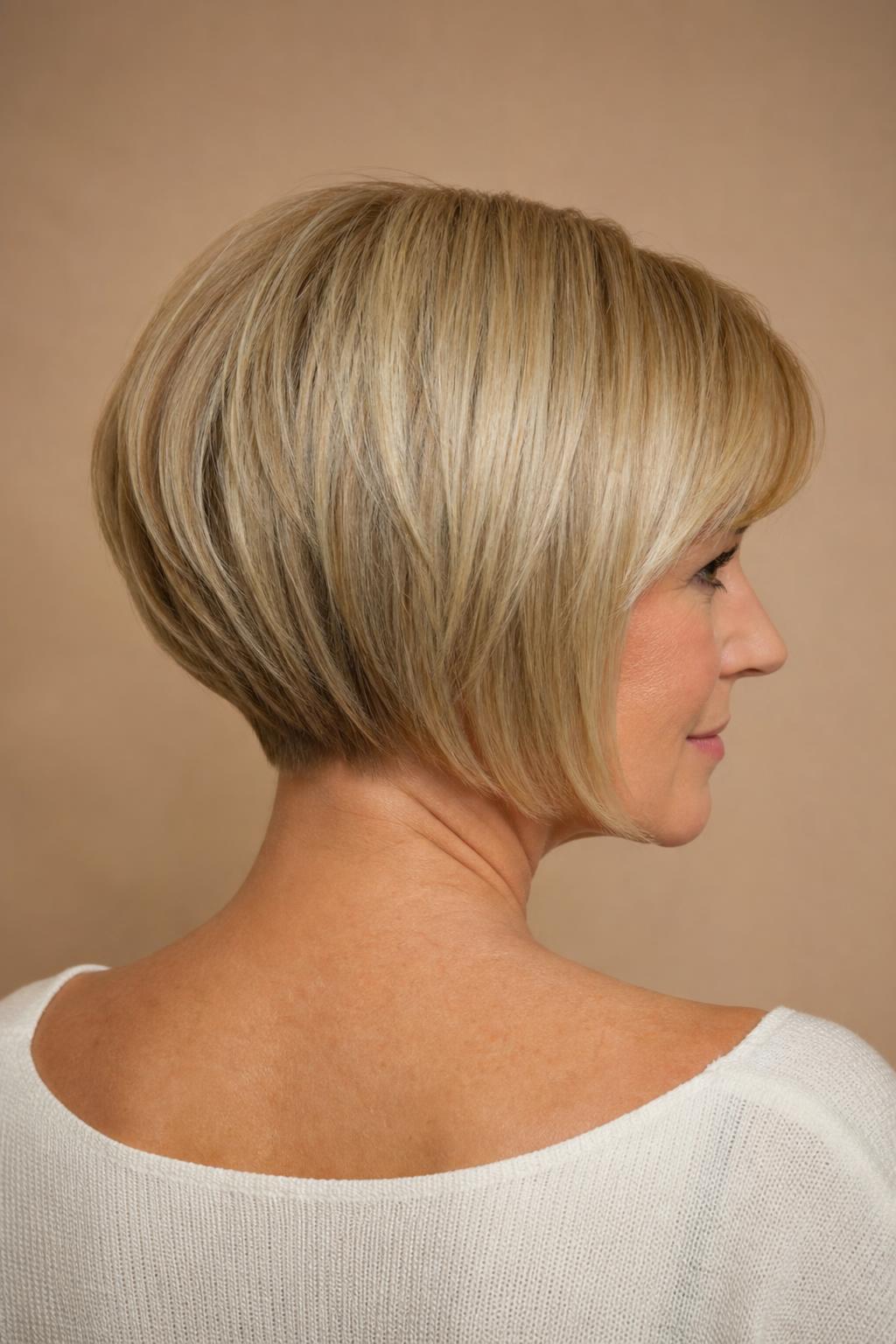
Because so much lift is packed into so little space, a stacked bob delivers far more visible volume than a graduated one on the same head of hair. That makes it the stronger choice for fine hair that collapses at the back, and the riskier choice for thick hair, where the same technique adds bulk to a section that already has plenty. The full range of stacked bob variations shows how differently the shelf can be positioned depending on how high the stylist takes it.
Stylist tip: Run your fingers up the back of your head until you feel the bone curve outward, then note how far that point is above your hairline. If it falls low, close to the nape, a stacked shelf will crowd your neck and a graduated slope will suit you better.
Where Inverted and A-Line Bobs Fit into This
Two more names get thrown into the same conversation, and both describe something happening at the front rather than the back. An A-line bob is defined by its front-to-back length difference, with the front noticeably longer, and it can be cut with or without any graduation at all. An inverted bob combines both ideas: a strong front-to-back angle plus graduation at the back, which is why it looks like a stacked bob from behind and an A-line from the side.
| Name | What Defines It | Where to Look for It |
|---|---|---|
| Graduated | Gentle build-up of weight at the back | The slope from nape to crown |
| Stacked | Concentrated short layers in one band | The shelf above the nape |
| A-line | Front cut longer than the back | The side profile |
| Inverted | A-line angle plus back graduation | Both the side profile and the back |
Naming a cut correctly matters less than describing what you want, but it helps to know that graduated and stacked are back-of-head terms while A-line and inverted are front-to-back terms. You can combine them freely: a graduated A-line is a common request, and so is a stacked bob cut level all the way around. Those combinations are also what separate these shapes from layered and choppy bobs, where the layers appear throughout the interior rather than concentrating at the back.
Hair Density Decides Which One You Can Carry
These two cuts respond in opposite ways to the same hair. Graduation adds apparent volume by stacking weight, so it helps hair that lacks body and hurts hair that already has too much. Work out your density honestly before you choose, because this is the factor most likely to produce a result that does not match the photo.
Fine Hair Gets the Most from a Stacked Back
Fine hair falls flat at the occipital bone faster than anywhere else on the head, and a stacked shelf is the most direct structural fix available. Because the layers are short and tightly grouped, they support each other and hold their lift without product. Keep the perimeter blunt below the shelf so the ends stay dense, and ask your stylist to avoid thinning shears anywhere in the back section.
Thick Hair Needs the Gentler Slope
Thick or coarse hair already carries plenty of bulk at the back, and stacking short layers into it produces a rounded mushroom rather than a sleek shelf. A graduated bob spreads the same weight over a longer stretch, which gives you shape instead of sheer volume. Ask for internal weight removal through the mid-lengths as well, or the graduated section will still expand outward once it dries.
Wavy and Curly Hair Should Skip the Tight Stack
Every wave lifts the hair away from the head, which means a stacked shelf on a 2b to 3a texture ends up an inch higher and two inches wider than the cut suggests. A softly graduated bob leaves enough weight to control that expansion, and the slope hides the natural inconsistency in curl placement. Cut dry so your stylist can see where each wave actually breaks, and the difference between razor and scissor cutting matters here too, since a razor loosens curl clumps that were holding the shape together.
Maintenance Reality: The Stacked Bob Ages Faster
The tighter the stack, the smaller the margin for error as it grows. A concentrated shelf begins losing definition within four weeks because the short layers reach a length where they fold instead of standing up, while a smooth slope has no single point of failure.
| Aspect | Graduated Bob | Stacked Bob |
|---|---|---|
| Shape holds for | 6 to 8 weeks | 4 to 5 weeks |
| Daily styling | 5 to 10 minutes | 10 to 15 minutes, mostly at the back |
| Tools needed | Medium round brush | Small round brush plus a second mirror |
| Key products | Smoothing cream, light hairspray | Root-lift mousse, firm-hold spray |
| Grow-out problem | Slope flattens gradually | Layers fold outward at the nape |
Anyone booking a stacked bob should treat the appointment cycle as fixed rather than flexible, and the same principle applies to any short cut where trim timing keeps a bob in shape. Stretching a stacked bob to eight weeks does not give you a longer stacked bob; it gives you a shapeless one.
When Neither Cut Is the Right Call
Graduation at the back is a commitment to a silhouette you cannot see in your own mirror, and that alone rules it out for some people. Consider a one-length bob instead if any of these apply.
- You have a short neck. Both cuts add visual width exactly where a short neck needs vertical space, and a stacked shelf will make it look shorter still. A blunt bob at jaw length with a tapered nape is the better answer.
- You wear your hair up several days a week. Graduated and stacked backs produce short pieces that escape any ponytail, and no amount of pinning holds them down neatly.
- You are growing your hair out. Both cuts create a length gap between the back and the front that takes six to ten months to close, and the middle of that stretch is genuinely awkward.
- Your hair is coarse and grey. Regrowth at the occipital bone on coarse silver hair pushes stacked layers outward rather than letting them settle, and the shelf turns fluffy within two weeks.
Stylist tip: Ask your stylist to hand you a mirror and photograph the back on your phone at the end of the appointment. It gives you a reference for what the shape is meant to look like, and it is the fastest way to explain the cut to a different stylist later.
What to Tell Your Stylist
Skip the labels and describe the back profile. For the softer version: “Graduate the back at a low elevation from the nape up, keep it blended so I cannot see individual layers, and leave the front about two inches longer.” For the stronger version: “Stack the layers tight over the occipital bone for a rounded shelf, taper close at the nape, and blend the length forward from there.”
Say out loud how much volume you want at the back on a scale from subtle to obvious, because that single sentence resolves most of the ambiguity between the two cuts. Also mention whether you blow-dry, since a stacked shape genuinely needs one and a graduated shape does not. If you have not booked yet, the general framework for requesting a bob covers the length and perimeter half of the conversation.
FAQ
Are Graduated and Stacked Bobs the Same Thing?
They are the same technique applied at different intensities, so many stylists use the terms as synonyms. In practice, graduated describes a gradual weight build over a long section, and stacked describes short layers concentrated into a narrow band for obvious volume. If your stylist uses them interchangeably, describe the back profile you want rather than debating the name.
Which One Is Better for Thin Hair at the Back of the Head?
A stacked bob, because concentrated short layers create lift that thin hair cannot produce on its own. Keep the stack fairly high, closer to the crown than the nape, so it fills the flattest area rather than adding bulk at the neck. Pair it with a blunt perimeter and skip texturizing shears entirely, since removing more weight defeats the purpose.
Can a Stacked Bob Be Long?
Yes, though the stack has to move up the head as the length increases. On a longer bob, the layered band typically starts around ear level and blends down through the back, which produces softer volume than a short stacked cut. Expect the effect to be subtler, since more length below the stack pulls the shape down.
Does a Graduated Bob Work on Curly Hair?
It does, provided the graduation stays gentle and the cut is done dry. Curls already build their own volume at the back, so a low elevation over a long stretch gives you shape without expansion. Ask your stylist to leave more length at the nape than they would on straight hair, because shrinkage lifts that section the most.
Which Cut Suits a Round Face Better?
A graduated bob with a longer front, since the extended front pieces create a vertical line down the sides of the face while the back stays sleek. A tightly stacked bob adds width at the same height as the cheeks when viewed from an angle, which works against a round shape. If you want the stacked volume anyway, ask for the shelf to be placed higher, closer to the crown.
How Do I Tell Which One I Already Have?
Photograph the back of your head and look at the outline. A smooth diagonal from the nape upward means graduated, and a visible outward curve with a step in it means stacked. If the front is also noticeably longer than the back, you have an A-line or inverted variation of whichever one you found.
Deciding between a graduated bob vs stacked bob comes down to how much volume you want at the back and how often you are willing to sit in the chair to keep it. Bring a photo of the back of the head rather than the front, name a volume level in plain words, and let your stylist choose the elevation that gets you there. The technique is the same either way, and the steepness is what you are really choosing.
Hair results vary based on your natural hair type, texture, density, and condition. Always consult with a licensed hairstylist before making significant changes, especially with chemical treatments or dramatic length changes. Photos may show styled results that require professional tools and products to replicate.