


Face shape is the fourth most useful thing to know when you are choosing a hairstyle, and almost every guide online puts it first.
The hairstyle that suits you is decided by five things in this order: your hair texture and density, your growth patterns, how many minutes you will genuinely spend styling each morning, your face shape, and how often you can get to a salon. Texture comes first because it determines what a cut can physically do. A blunt bob on fine straight hair and a blunt bob on thick coily hair are not the same haircut, no matter how similar the reference photo looks.
This guide walks through each factor in the order that matters, shows you how to test a style before committing to it, gives you the exact language to bring to a consultation, and clears up the assumptions that lead most people to the wrong answer. By the end you should be able to rule out three quarters of the options and choose confidently from what remains.
The Five Factors That Decide Which Hairstyle Suits You
Every consultation a good stylist runs covers the same five inputs, usually without naming them. Two of them are fixed and you work around them, two are choices you make honestly, and one is the one everybody starts with and should not. Working through them in order removes most of the guesswork, because each factor narrows the field before the next one applies.
| Factor | What It Decides | How to Find Yours |
|---|---|---|
| Texture and density | Which cuts can physically hold their shape on your hair | Air-dry with no product and look at what your hair does on its own |
| Growth patterns | Where a cut will fight you every morning | Check the crown, front hairline, and nape on wet hair |
| Daily styling time | Whether a cut is realistic or aspirational for you | Time yourself for one honest week, not one good day |
| Face shape | Where the perimeter and volume should land | Measure forehead, cheekbones, jaw, and face length |
| Salon frequency | How structured the shape can be before grow-out ruins it | Count your actual appointments over the last twelve months |
Start with Hair Texture and Density, Not Face Shape
Texture describes the shape of the individual strand, from bone straight through coily. Density describes how many strands you have per square inch. They are independent: you can have fine, dense hair or coarse, sparse hair, and the two combinations behave completely differently under the same cut. Find both by washing, applying nothing, and letting your hair air-dry, because that is the only honest picture of what your hair does without help.
Fine Hair Holds Its Shape Best Above the Collarbone
Fine strands have less internal structure to resist gravity, so past the collarbone the weight of the length pulls everything flat at the root. A bob, lob, or long pixie concentrates what density you have into a smaller area and gives the appearance of more hair. Heavy layering works against you here, since layers on fine hair remove weight from ends that need it, and the result is wispy rather than textured.
Thick Hair Needs Weight Removed from Inside, Not from the Ends
Dense hair builds outward at the widest point of the cut, which is what creates the triangle shape most thick-haired people recognize from a bad haircut. The fix is internal layering, where the stylist removes bulk from underneath the surface and leaves the outer line intact. Understanding the difference between internal and visible layers is the single most useful piece of vocabulary you can bring to a consultation with thick hair.
Curly Hair Should Be Cut Dry at Every Length
Curls shrink when they dry, and the amount varies by pattern from around a quarter of the stretched length on loose 3a waves to half or more on 4c coils. A stylist cutting wet is guessing at where each curl will land. Booking specifically with someone who cuts curls dry matters more than which cut you choose, because the same shape done wet and done dry produce two different haircuts. Your curl pattern determines how much shrinkage to plan for and how far apart the layers need to be spaced.
Wavy Hair Behaves According to How It Is Cut and Dried
Waves are the most changeable texture, which is both the advantage and the trap. The same 2b hair can be smoothed into a sleek bob or scrunched into a shaggy lob, so the cut you choose should match how you actually dry your hair rather than how you occasionally style it. If you air-dry four days out of five, choose the cut that suits air-drying and treat the blow-dried version as the exception.
Stylist tip: Hold a single strand up to the light against a dark background. If you can barely see it, your hair is fine. If it looks like a thin thread, it is medium. If it feels wiry between your fingers, it is coarse. Then look at how much scalp shows when your hair is dry and parted, which tells you density independently.
Growth Patterns Rule Out More Cuts Than Face Shape Does
A cowlick at the front hairline, a double crown, or a strong nape whorl will override any cut you choose, and no amount of product changes the direction hair grows out of the scalp. This is the factor that most often explains why a cut looked perfect in the salon and impossible at home: the stylist blow-dried against your growth pattern, and you cannot reproduce that in five minutes.
Check three places on clean wet hair with no product. At the crown, look for whether the hair spirals from one point or two, since a double crown makes short flat styles nearly impossible to keep down. At the front hairline, push your hair straight back and see whether a section springs forward on its own, which is a cowlick and rules out most blunt fringes. At the nape, look for hair growing upward or sideways rather than down, which affects every short cut that ends at the neck.
Once you know these, they become requirements rather than surprises. A front cowlick means asking for a side-swept or curtain fringe instead of a blunt one. A double crown means keeping enough length at the top for weight to settle the spiral, usually three inches or more. A nape whorl means either keeping the length below it or cutting well above it, never landing exactly on it.
Face Shape Narrows the Options Rather Than Choosing for You
Face shape guidance is useful, but it works on one variable only: where the eye stops. A hairstyle creates lines, and those lines either follow the proportions of your face or work against them. It cannot make a cut suit hair that physically will not hold it, which is why it belongs fourth rather than first. To place yourself accurately, measure forehead width, cheekbone width, jaw width, and face length rather than judging by eye, since most people misidentify their own shape.
| Face Shape | Goal | What Works | What Fights You |
|---|---|---|---|
| Oval | Keep the balance you already have | Almost any length; the widest range of options | Heavy full fringes that hide the proportions |
| Round | Add vertical line, reduce width at the cheeks | Length past the jaw, deep side parts, height at the crown | Chin-length blunt cuts with a center part |
| Square | Soften the corners of the jaw | Soft layers, side-swept pieces, waves around the jaw | A blunt perimeter landing exactly at the jaw corner |
| Heart | Balance a wider forehead against a narrow chin | Fullness at jaw level, curtain fringes, chin-length shapes | Volume piled at the crown, which widens the top further |
| Oblong | Add width, reduce apparent length | Horizontal lines, fringes, waves at cheek level | Long straight length with no layers and high crown volume |
| Diamond | Add width at the forehead and jaw | Face-framing layers, chin-length fullness, soft fringes | Slicked-back styles that expose the narrowest points |
Match the Cut to the Minutes You Will Actually Spend
This is where most hairstyle decisions go wrong, and it has nothing to do with hair at all. People choose the cut they would style if they had twenty minutes, then live with it on the mornings when they have four. Be specific rather than optimistic: count the minutes you spend on a normal Tuesday, not on the morning of an event, and choose for the Tuesday.
| Time You Have | Cuts That Work | Salon Interval |
|---|---|---|
| Under 5 minutes | Textured crops, shags, long layers, wash-and-go curls | 8 to 12 weeks |
| 5 to 10 minutes | Pixies, lobs with soft layers, curtain fringes | 4 to 8 weeks |
| 10 to 20 minutes | Blunt bobs, sleek styles, blunt fringes, defined waves | 5 to 7 weeks |
| Over 20 minutes | Structured blowouts, heavily styled long layers, set curls | 6 to 10 weeks |
Salon frequency deserves the same honesty. A precision bob and a shaggy lob can look similar in a photo, but the bob loses its line by week five while the shag keeps working for ten. If you managed two haircuts in the last year, choose a shape built to grow out gracefully rather than one that depends on a sharp perimeter.
How to Test a Hairstyle Before You Commit
There are three low-cost ways to preview a shorter or different cut before it becomes permanent, and they catch most of the mistakes that lead to regret. None of them takes more than ten minutes.
- The clip test. Tuck the length under and pin it at the height you are considering, then look at yourself in a real mirror in daylight rather than in a phone camera. Front-facing phone cameras distort width at close range, which is enough to change how a length looks.
- The three-photo test. Find three reference photos of the cut on people with your texture and density rather than your favorite celebrity. If you cannot find three, the style may depend on a texture you do not have.
- The two-week rehearsal. Style your current hair the way the new cut would need to be styled every morning for two weeks. If you skip it by day four, the cut is not going to survive contact with your routine.
Stylist tip: Bring one photo of what you want and one photo of what you specifically do not want. Stylists find the second photo more useful than the first, because it defines the boundary rather than the target, and most miscommunication happens over how far to go rather than which direction.
What to Tell Your Stylist
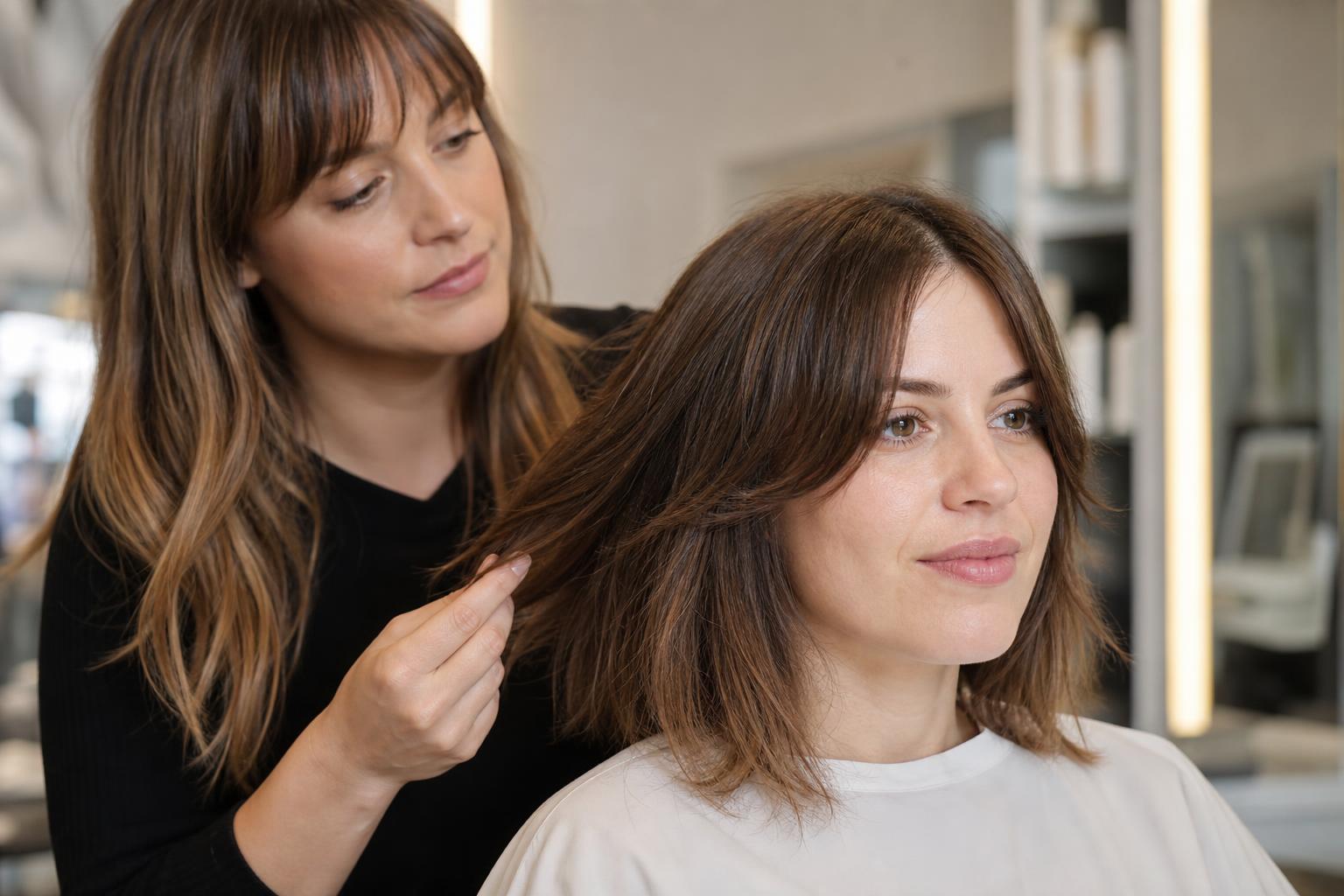
Lead with your routine rather than with a style name. Something like: I wash twice a week, air-dry four mornings out of five, and I have about five minutes. That single sentence rules out half the catalogue before any photo comes out, and it tells your stylist which version of a cut to give you. Follow it with your non-negotiables, whether that is keeping enough length to tie back or never having a fringe again.
Describe length by physical landmarks rather than by adjectives. Collarbone, jaw, chin, earlobe, and cheekbone are precise; short, medium, and long are not. If you are unsure between two lengths, ask for the longer one and check in the mirror before the stylist commits, since going shorter takes minutes and going longer takes months.
Ask two questions before the first cut: what will this look like in six weeks, and what do I have to do to it every morning. A stylist who answers both specifically is giving you a cut that suits your life. If the answer to the second one is vague, ask them to show you the styling on the day so you can judge whether you would repeat it. This matters most on decisions like whether to commit to a fringe, which adds its own separate maintenance cycle.
Common Myths About Choosing a Hairstyle
Myth: There Is One Correct Haircut for Each Face Shape
Reality: Face shape rules out a handful of specific lines, mostly cuts that end level with your widest point. Everything else remains available, and texture decides which of those options will actually work. Two people with identical face shapes and different hair types need different cuts.
Myth: Short Hair Is Lower Maintenance Than Long Hair
Reality: Short hair takes less time each morning and far more time at the salon. A pixie needs shaping every three to four weeks against eight to twelve for long layers, so the annual appointment count roughly triples. What you are choosing is where the maintenance sits, not how much of it there is.
Myth: Layers Add Volume to Any Hair Type
Reality: Layers redistribute weight, which adds apparent volume on medium and thick hair and removes it on fine hair. On a fine head of hair, heavy layering thins the ends and makes the whole shape look sparser. Fine hair gains more from a blunt perimeter and internal texture near the root.
Myth: You Should Choose Based on What Is Trending
Reality: Trend cuts are photographed on the texture that suits them best, which is why the same shape disappoints so many people who ask for it. A trend is worth following when it matches your texture, density, and routine, and worth skipping when it does not, regardless of how good it looks on someone else.
FAQ
How Do I Know What Hairstyle Suits My Face?
Find the widest point of your face by measuring your forehead, cheekbones, and jaw, then choose a cut whose perimeter ends at least an inch above or below that point rather than level with it. That single rule handles most of what face shape guidance is trying to say. Beyond that, texture and density decide far more about whether a style will suit you day to day.
Should I Choose a Hairstyle Based on My Hair Type or My Face Shape?
Hair type first, every time. Face shape tells you where lines should fall, but hair type determines whether your hair can hold those lines at all. A cut that flatters your face shape and fights your texture will look good for the two hours after you leave the salon and never again.
How Do I Find My Face Shape Accurately?
Pull your hair back, take a straight-on photo in even light, and measure four things: forehead width at the widest point, cheekbone width, jaw width, and total face length from hairline to chin. Compare the three widths to each other and the length to the widest width. Most people guess wrong by eye, particularly between oval and oblong, so the measurements are worth the two minutes.
Can I Wear Any Hairstyle If I Have an Oval Face?
Close to it, since balanced proportions mean fewer lines to work against. The limits still come from your hair: an oval face with fine, sparse hair still cannot hold a heavy blunt fringe or long unlayered length convincingly. Treat an oval face as a wide menu rather than an open one.
What Hairstyle Suits Thin or Fine Hair Best?
Anything that keeps weight in the perimeter and stays above the collarbone, so a blunt bob, a lob with minimal layering, or a long pixie with root lift. Avoid heavy layering and razor cutting, both of which remove weight fine hair cannot spare. A blunt line at chin level creates the strongest impression of density of any cut available.
How Do I Choose a Hairstyle If I Have Curly Hair?
Start by identifying your curl pattern and how much your hair shrinks when it dries, then choose length based on the dry result rather than the wet one. Layer spacing matters more than overall length for curls, since layers cut too close together create a triangular shape as the curls stack. Book a stylist who cuts dry and expect a longer appointment than a straight-hair cut takes.
Is It Worth Using an App to See What Hairstyle Suits Me?
They are useful for ruling options out and unreliable for choosing one. Face-mapping apps overlay a style on a still photo without accounting for your density, growth patterns, or how your hair behaves once it dries, which are the three things that determine the real result. Use one to narrow a shortlist, then take the shortlist to a consultation.
Working out which hairstyle suits me is less about finding a perfect match and more about ruling out what will not survive your texture, your growth patterns, and your actual morning. Start with what your hair does when you leave it alone, be honest about the five minutes rather than the twenty, and let face shape fine-tune the shortlist rather than write it. Bring that reasoning to your next consultation and your stylist will do the rest.
Hair results vary based on your natural hair type, texture, density, and condition. Always consult with a licensed hairstylist before making significant changes, especially with chemical treatments or dramatic length changes. Photos may show styled results that require professional tools and products to replicate.


2 responses