
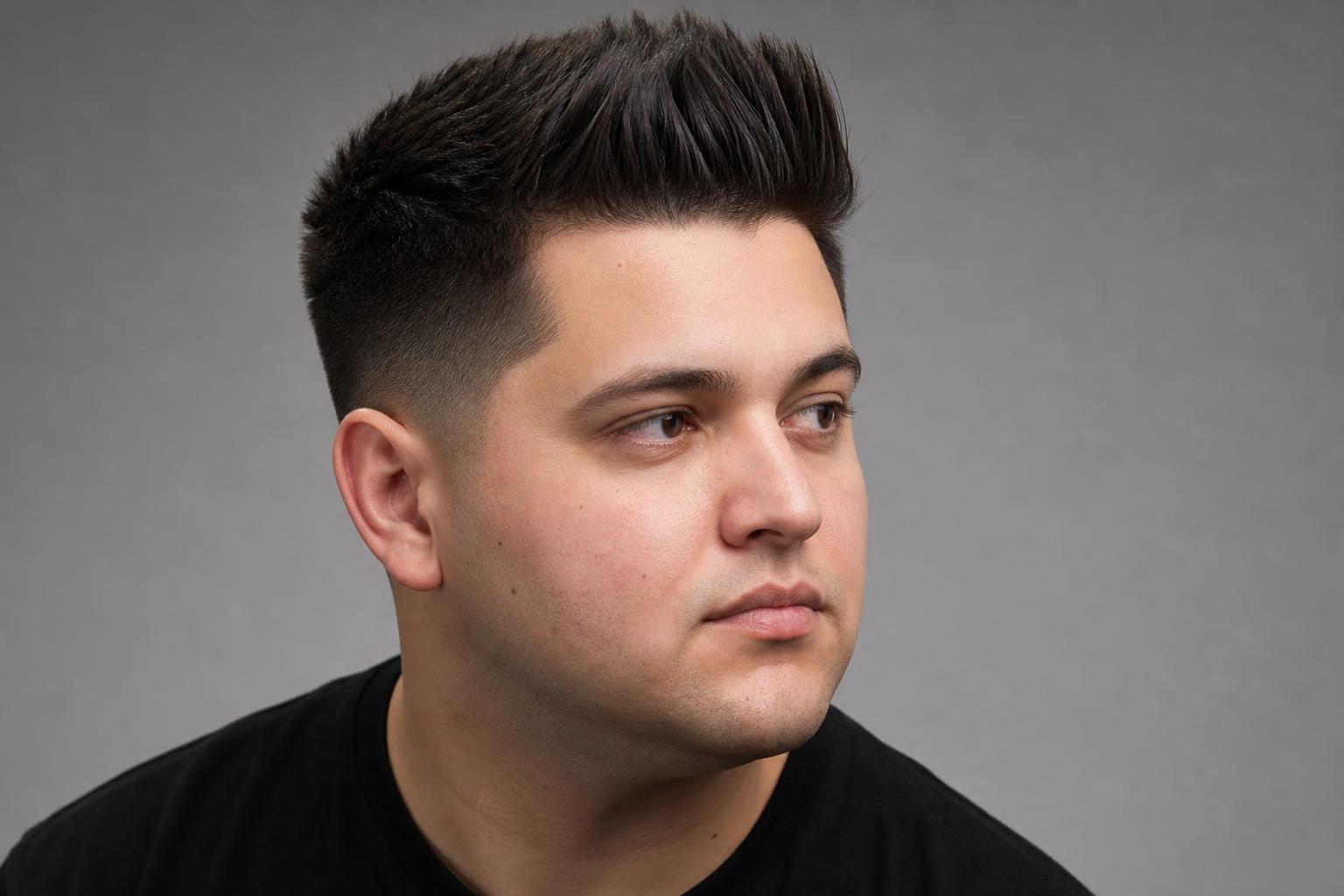
Every cut that flatters a round face does the same two things: it adds height at the top and removes width at the sides.
A round face is roughly as wide as it is long, with soft cheeks and a jaw without hard corners, so the goal is to build a vertical line and introduce angles the face does not supply on its own. In practice that means two to four inches of length on top styled upward or forward, sides taken short enough to sit flat, and a fade or part placed high rather than low. Below are 30 cuts that do this, grouped by the mechanism they use.
The gallery runs from fades that strip width, through cuts built on height, into angular and asymmetric shapes, and finishes with longer and textured options plus versions for curly and thinning hair. After the entries you will find the three rules behind every cut listed, a barber script, notes on beard shapes that support the cut, and an honest section on which popular styles work against a round face.
| Factor | Details |
|---|---|
| Goal | Add vertical height, remove side width, introduce angles |
| Top length | 2 to 4 inches, enough to hold height |
| Side length | Short enough to lie flat; mid or high fade preferred |
| Part placement | High and to one side; asymmetry breaks up roundness |
| Avoid | Uniform buzz cuts, bowl shapes, blunt straight fringes, bulky sides |
| Beard | Length at the chin, short at the cheeks, to lengthen the jaw |
Fades That Strip Width From the Sides
Taking the sides short is the fastest structural change available to a round face, because it physically narrows the widest part of the head. Fade height matters more than fade type here: the higher the blend starts, the more width comes off and the stronger the vertical line running from temple to crown. These eight cuts all use that mechanism with different amounts of drama.
1. High Skin Fade with a Three-Inch Top
The blend starts at the parietal ridge, so nearly the entire side goes to skin and the remaining hair sits as a defined block on top. This is the sharpest width reduction on the list and it suits thick, dark hair that can carry the contrast. The bald fade upkeep cycle runs to two weeks, which is the real cost of the effect.
2. Mid Fade with a Textured Crop
Starting the blend at the temple removes width where the cheeks are fullest without the severity of a high fade. Wavy hair holds the top texture with almost no product, and the forward-falling front shortens the forehead, which balances a face that is already short. Ask for the blend to start level with the top of your eyebrow.
3. Drop Fade with a Longer Crown
The blend arcs downward behind the ear rather than running horizontally, which follows the curve of the skull and softens the transition. Because the line is curved rather than straight, it reads as less harsh on a soft face while still cutting width. Barbers may also call it a drop taper if they work primarily with scissors.
4. Burst Fade with a Faux Hawk Top
Fading in a radius around the ear leaves weight at the back and nape while clearing the sides, and the raised center strip supplies the height a round face needs. This one carries real visual drama, so it works best on men who want the haircut noticed. Keep the center section under three inches or the shape tips into a mohawk.
5. High Taper with Scissor-Cut Length on Top
Instead of clipper-fading to skin, the sides are tapered short with a scissor-cut top left at three inches. Grow-out is far gentler than a skin fade and the appointment cycle stretches to five weeks. Men in conservative workplaces who still need the width removed usually land here.
6. Low Fade with Extra Height on Top
A low fade alone does little for a round face, but pairing it with a genuinely tall top shifts the work from the sides to the vertical line. Blow-dry the front upward for thirty seconds before applying clay, since the height has to be built rather than cut. The low fade in its standard form stays conservative enough for most offices.
7. Skin Fade with a Hard Part
A razored line above the temple introduces a hard angle that a round face does not naturally have, and it splits the top into two unequal masses. The asymmetry is what does the work here rather than the fade itself. Keep the line at roughly an inch and a half so it reads as deliberate.
8. Mid Fade with a Disconnected Top
Nothing blends between the top and the sides; there is a deliberate step at the temple. The hard horizontal break creates the corner a round face lacks, though it demands strong hair density to look intentional. Fine hair produces a thin, floating top with this shape and does better with a blended version.
Cuts Built on Height
Where fades work by subtraction, these cuts work by addition, building enough vertical lift that the face reads as longer than it is. Height is the more forgiving of the two mechanisms because it does not depend on very short sides, which makes this section useful for anyone who cannot commit to a two-week barber cycle.
9. Classic Pompadour with Tapered Sides
Four inches at the front swept up and back over a rounded volume gives the strongest vertical line available. It needs a blow-dryer and a pomade daily, which is genuinely five to eight minutes of work. Thick straight hair holds it best; fine hair collapses by afternoon without a pre-styling mousse.
10. Textured Quiff with a Mid Fade
A quiff is a pompadour with the polish removed, so the front lifts but the surface stays broken up and matte. Round faces get the height without the formality, and the messy finish forgives an uneven blow-dry. Anyone unfamiliar with the request should read up on what to ask for when requesting a quiff before the appointment.
11. Faux Hawk with Short Sides
Hair through the center is left longer and pushed toward a soft ridge, with the sides kept tight but not shaved. The narrow center mass draws the eye vertically and physically narrows the visual width of the head. It is easier to maintain than it looks, needing only clay and thirty seconds of finger work.
12. Brushed-Up Crop with Root Lift
Rather than a defined pompadour shape, the whole top is dried upward at the root and left to stand in separated pieces. Coarse hair does this on its own with clay alone. The look is less formal than a quiff and takes about half the time, which makes it the practical daily version of the same idea.
13. Side Part with Volume at the Crown
A deep side part placed high on the head sends most of the hair across in one direction, creating both height and asymmetry in a single move. Check where your hair naturally splits before committing, because a part cut against your growth pattern needs resetting every morning. Ask for the part to sit on the natural break rather than at a fixed measurement.
14. Slicked-Back Undercut
The top is left long and pushed straight back with no part, while the sides drop to a single short guard with a hard disconnection. Because all the mass sits high and back, the silhouette lengthens sharply. This is a high-shine look, so a pomade rather than a clay is the right product.
15. Ivy League with Front Height
Slightly longer than a crew cut at the front, cut so the hair can be swept up or across, with neat tapered sides. It is the most conservative height-based option and the easiest to wear in a formal setting. A round face gets a modest but real lift from the extra half inch at the hairline.
Angular and Asymmetric Shapes
A round face is short on straight lines and corners, so a cut that supplies them does the work no amount of length can. Angles come from three places: the fringe line, the part, and the edge-up at the temple. These seven cuts each introduce at least one.
16. Angled Fringe Swept Across the Forehead
Cutting the front on a diagonal, longer on one side, lays a slanted line across the forehead that breaks the circular outline of the face. It suits straight and wavy hair equally and needs only a sideways rough-dry. Say “angle the fringe, longer on the left” rather than asking for a side-swept look, which is vaguer.
17. Angular Fringe with a High Fade
Combining the diagonal front with a high fade attacks the roundness from both directions at once, removing width while adding a line. Thick hair carries this best because the fringe needs weight to hold its angle. It is one of the strongest single choices on this list for a face that is markedly round.
18. Sharp Edge-Up at the Temples
A line-up squares off the corners of the hairline, replacing the natural curve with a right angle. On round faces this small detail changes the whole read of the cut, and it pairs with almost anything else here. Regrowth shows within two weeks, so it fits best alongside a fade you are already maintaining on that cycle.
19. Asymmetric Crop with an Off-Center Weight
Leaving noticeably more length on one side than the other puts the visual mass off-center, which stops the eye from reading the head as symmetrical and round. The imbalance should be obvious enough to look deliberate, roughly an inch of difference. Fine hair shows the asymmetry more clearly than thick hair does.
20. Square-Cut Fringe with Corners Left In
Rather than rounding the fringe to follow the hairline, the barber leaves the corners at the temples squared. This is the opposite instruction from the one most barbers default to, so it needs saying explicitly. The result is a hard-edged frame that sharpens a soft forehead.
21. High Fade with a Squared Nape
Most necklines are tapered or rounded; a blocked, squared nape adds a horizontal line at the back that reinforces angularity from behind. It grows out with a visible fuzzy edge after about ten days, so pair it with a short cycle. Worth doing only if you are already in the shop every two weeks.
22. Comb-Over Fade with a Defined Line
Hair combed across from a shaved or razored part, over faded sides, gives a strong diagonal plus a hard edge. The modern version keeps the top matte and textured rather than slick, which stops it from reading as dated. It is more forgiving of thinning at the temples than most cuts here.
Longer and Textured Options
Height and angles do not require short hair. Longer shapes can work on a round face as long as the volume sits on top and back rather than at the sides, which is the failure mode of most grown-out cuts. These five keep the width under control.
23. Mid-Length Flow Pushed Back
Four to five inches worn back off the face, with weight removed from underneath so the sides do not swell outward. The vertical sweep lengthens the face and the appointment cycle stretches to eight weeks. Wavy hair suits this better than straight, which needs a dryer to hold the backward direction.
24. Long Top with a Tight Undercut
Keeping five inches on top over shaved sides gives the maximum contrast between width and height available at any length. Tying it back exposes the narrow sides fully, which is the most flattering way to wear it on a round face. Cuts in the long top and undercut family vary mainly in how the two sections meet.
25. Textured Fringe Kept Above the Brow
A forward fringe shortens the forehead, which sounds wrong for a short face until you see it: reducing forehead height moves the visual balance toward the jaw and makes the face read as less circular. Keep it above the eyebrow rather than at it. A point-cut textured fringe is the version that stays light enough not to add width.
26. Modern Mullet with a Faded Front
Short and tight through the sides and front, longer at the back, so the silhouette extends backward rather than sideways. It is a bolder choice than most of this list and genuinely effective on a round face. Ask for the transition to be gradual, since a hard step at the crown looks dated.
27. Shoulder-Length Hair with Internal Layers
Long hair worn down is the riskiest option here because it frames the cheeks, and the fix is layering that removes bulk from the sides while keeping the perimeter. A center part adds a vertical line that helps. This works on straight and wavy hair, and rarely on tight curls, which build width faster than length.
Round-Face Cuts for Curly and Thinning Hair
Curls and thinning each change the arithmetic. Curly hair grows outward, so width control matters more than usual, while thinning limits how much height can be built. Both are workable with the right adjustment.
28. Curly Top with Tapered Sides
Curl supplies the height a round face needs at no styling cost, but the sides must be tapered short or the curl adds width exactly where you do not want it. A taper rather than a skin fade keeps some curl at the side so the head does not look like a curly cap. Broader cuts shaped around a curl pattern follow the same principle.
29. Short Curly Crop with a High Fade
Taking the sides high and leaving two to three inches of curl on top concentrates all the volume vertically. It is the most efficient round-face solution for 3a to 3c hair. Cut the curls dry so the barber can see where each one sits, since wet curls stretch and the result comes out shorter than intended.
30. Textured Crop for a Thinning Crown
Thinning limits height, so the strategy shifts to width removal plus a forward fringe that covers the front hairline. Keep the sides tapered rather than skin-faded, because a high-contrast fade emphasizes a sparse crown. This is the one entry here where less contrast is the better call.
The Three Rules Behind Every Cut on This List
Strip away the names and each cut above applies at least two of three principles. First, height on top adds vertical length, which is the single most effective change. Second, short sides remove horizontal width at the cheeks. Third, an angle somewhere in the cut, whether a diagonal fringe, a hard part, or a squared temple, supplies the straight lines a round face lacks. A cut that applies all three is more effective than any one of them taken to an extreme, which is why a high fade on its own with a flat top does less than a mid fade with height and a side part.
Before applying any of it, confirm the premise. Plenty of men who assume they have a round face actually have a square or oval one with fuller cheeks, and the recommendations diverge sharply. Measuring properly takes two minutes, and the method for determining your face shape is worth running before you book. If your jaw has visible corners you are working with a square face, not a round one, and you need softening rather than angles.
What to Tell Your Barber
Lead with the goal rather than the style name, because the same cut name produces different results in different shops. A workable request sounds like this: “I want height on top and the sides tight, because my face is round. Leave about three inches at the front, mid fade starting at the temple, and angle the fringe so it is longer on the left.” That names the mechanism, the measurements and the angle in one go.
Stylist tip: ask your barber to check the shape with your hair dry and pushed up before they finish. Round faces are unusually sensitive to the last half inch on top, and the difference between a cut that lengthens the face and one that does nothing is often smaller than most men expect. Standing up out of the chair to look is worth the thirty seconds.
Bring a reference photo of a man with your hair density rather than one you simply like. The same high fade against thick dark hair and against fine light hair produces very different contrast, and a photo of the wrong density sets an expectation the cut cannot meet. If you are unsure which base shape to start from, the four covered in the short men’s cut guide all adapt to a round face with the adjustments above.
Beard Shapes That Support the Cut
A beard is the second half of the equation on a round face, and the rule mirrors the haircut: length at the chin, short at the cheeks. Growing the beard longer under the jaw extends the face downward and creates the vertical line the haircut is also building, while keeping the cheek line low and tight avoids adding width at the widest point. A short boxed beard or a goatee with a defined chin length both do this well.
Stylist tip: set the cheek line lower than feels natural, roughly along a line from the corner of the mouth to the top of the ear. Most men let the cheek growth run high, which widens the face precisely where the haircut is trying to narrow it, and undoes a good deal of what the fade achieved.
When These Cuts Do Not Work
Some popular shapes actively work against a round face, and a few of the cuts above have conditions attached.
- A uniform buzz cut follows the round outline of the skull with nothing to break it, which reinforces exactly what the other cuts here are trying to counteract. Add length on top or accept the effect.
- Bowl cuts and blunt straight-across fringes lay a horizontal line across the widest part of the face and remove all vertical movement.
- Bulky, unfaded sides at chin level add width at the cheeks. If you want longer hair, the volume has to be removed from underneath.
- High skin fades on a thinning crown raise the contrast between sides and top, which makes a sparse crown more obvious rather than less.
- Pompadours and quiffs on fine hair collapse within a few hours without daily blow-drying and a pre-styling product. A textured crop delivers a smaller amount of the same effect with none of the work.
FAQ
What Haircut Suits a Round Face Male?
Cuts with height on top and short sides suit a round face best, with a mid or high fade paired with two to four inches of length being the most reliable combination. Adding an angle somewhere, whether a diagonal fringe or a hard side part, strengthens the effect further. Avoid uniform buzz cuts and blunt straight fringes, which reinforce the roundness rather than counteracting it.
Should Men with Round Faces Get a High Fade or a Low Fade?
A high or mid fade works better, because starting the blend higher removes width at the level of the cheeks where a round face is widest. A low fade leaves the temple area full and does comparatively little. If a high fade feels too dramatic for your workplace, a mid fade with genuine height on top gets most of the benefit.
Does a Beard Help a Round Face?
A beard helps when it is longer at the chin and short at the cheeks, since that shape extends the face downward and creates a jawline that a round face lacks. A full beard grown evenly all round adds width and works against you. Keep the cheek line low, roughly from the corner of the mouth to the top of the ear.
Can Men with Round Faces Have Long Hair?
Long hair works if the volume sits on top and back rather than at the sides, which usually means internal layering to remove bulk and a center part for a vertical line. A long top over an undercut is the most reliable version, because the shaved sides guarantee the width stays controlled. Loose shoulder-length hair worn down around the cheeks is the shape to be careful with.
Is a Buzz Cut Bad for a Round Face?
A uniform buzz follows the outline of the skull and gives the eye nothing to break up the circle, so it emphasizes roundness more than any other short cut. Cutting the top one or two guards longer than the sides restores a small amount of height and improves it noticeably. If you want the low maintenance of a buzz with a better shape, a crew cut is the closer alternative.
How Much Length Should I Keep on Top with a Round Face?
Two to four inches is the working range, with three inches being the most versatile starting point. Under two inches there is not enough material to build height, and past four the top can begin to add its own bulk unless it is styled upward daily. Fine hair should stay at the shorter end, since longer fine hair lies flat and delivers no lift.
Do Curly-Haired Men with Round Faces Need a Different Approach?
Curls supply height for free, so the priority shifts entirely to controlling width at the sides. Taper the sides short rather than leaving curl volume around the ears, and cut the curls dry so the barber can see their resting length. Two to three inches of curl on top over tapered sides is the most efficient round-face shape for textured hair.
Round face shape hairstyles for men come down to a simple test you can apply to any photo: does the cut add height, does it cut width, and does it introduce an angle. A cut doing two of the three will suit you, and one doing all three will suit you noticeably. Take a photo from this collection to your next appointment, say the goal out loud rather than only the style name, and set your beard cheek line lower than instinct suggests.
Hair results vary based on your natural hair type, texture, density, and condition. Always consult with a licensed hairstylist before making significant changes, especially with chemical treatments or dramatic length changes. Photos may show styled results that require professional tools and products to replicate.