

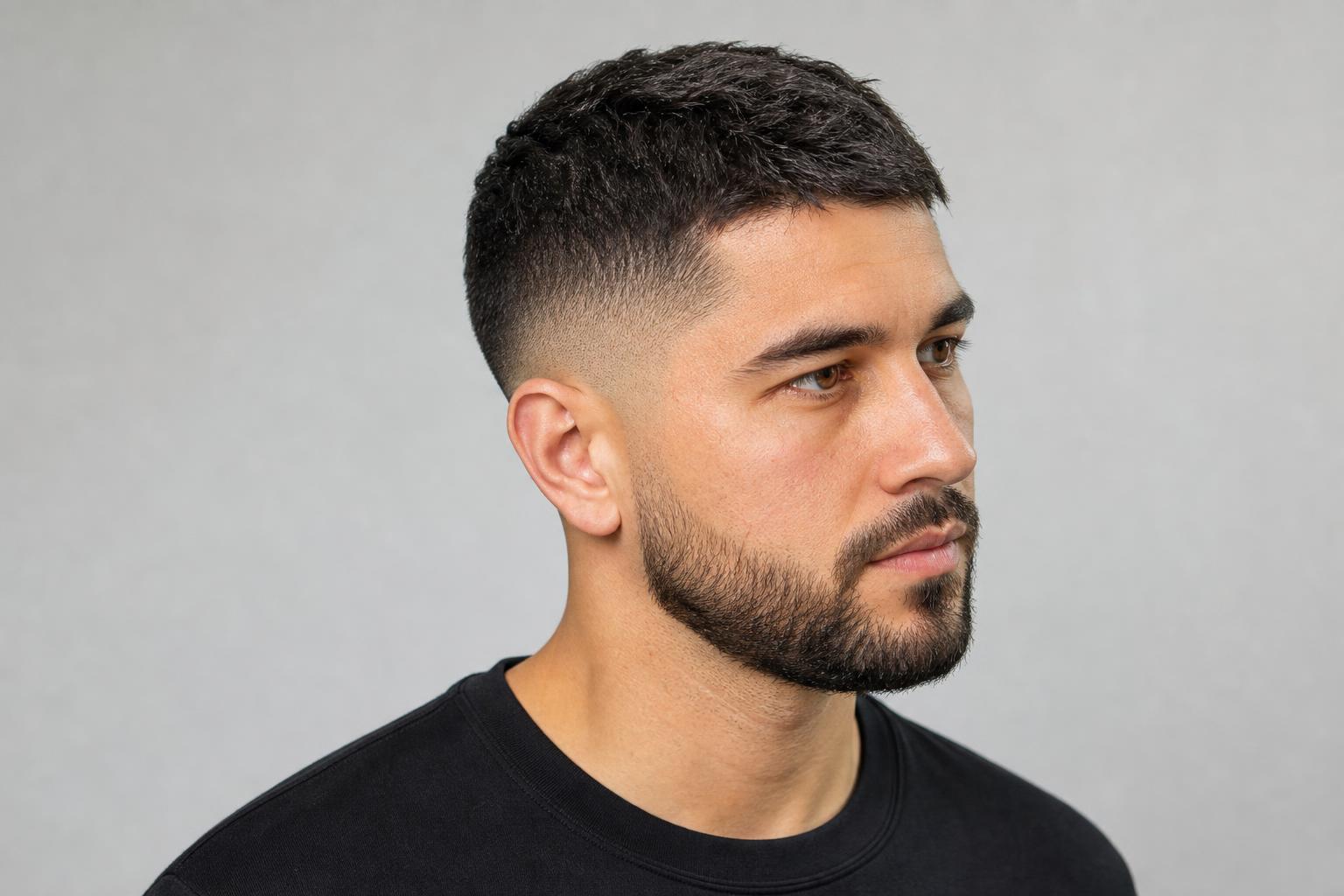
Every fade is the same haircut with one variable changed, which is how high up the head the shortest point starts.
A short fade haircut for men keeps the top between half an inch and two inches and blends the sides down through progressively shorter guard lengths, and the only real decision is where that blend begins. Low fades start about an inch above the ear, mid fades start around the temple, and high fades start at the corner where the top of the head turns down. Below are 30 versions sorted by that starting height, each with the guard numbers to ask for and how long it stays sharp.
The gallery runs from low fades through mid, high and skin fades, then the shaped variations like drop, burst and temple fades. After the styles you will find a fade height and face shape table, the exact guard numbers and neckline language to use at the chair, a regrowth schedule by fade height, and an honest section on when a fade is the wrong call.
| Guard Number | Length Left | Where It Is Used in a Short Fade |
|---|---|---|
| Bare blade or foil | Skin | The lowest point of a skin or bald fade |
| Number 0 | 1/16 inch | The bottom of most fades that stop short of skin |
| Number 1 | 1/8 inch | First blend step above the shortest point |
| Number 2 | 1/4 inch | Mid-blend, or the whole side on a soft taper |
| Number 3 | 3/8 inch | Top of the blend where it meets the length |
| Number 4 | 1/2 inch | The longest guard used on a short fade, usually at the top corner |
Low Fades That Keep the Sides Full
A low fade begins about an inch above the ear and travels down from there, which leaves the whole upper side at one length. That makes it the most conservative fade available and the one that grows out with the least visible line. It also keeps width at the temples, which matters if your face is long or narrow.
1. Low Fade with a Textured Crop
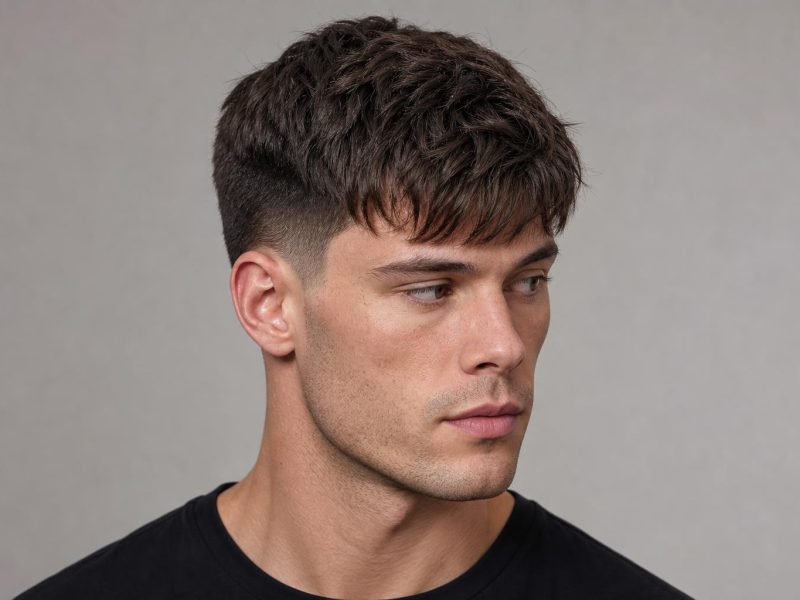
The top is point cut rather than clipper cut, so the ends separate instead of forming a solid block, and the low fade underneath keeps the whole silhouette compact. Ask for the texturizing to be done with scissor tips on dry hair. Around two inches on top is the sweet spot before the crop starts needing product to hold shape.
2. Low Fade with a Number 2 Guard on Top
Say “low fade from a zero up to a two, and take the top down with a two guard as well.” That single instruction produces a near-uniform short cut with a clean gradient at the sides and zero styling requirement. It is the most reliable thing to ask for in an unfamiliar barbershop, and the details behind it are in our breakdown of the low fade and where its blend begins.
3. Low Fade on Coarse Straight Hair
Coarse straight hair shows every blend line, which is why a low fade suits it better than a high one. The shorter travel distance means fewer guard steps and fewer places for a band to appear. Thick hair also stands up on its own here, so the top needs no product to keep height.
4. Low Fade with a Matte Clay Finish
Work a pea-sized amount of matte clay through dry hair with your fingertips, pushing forward and up rather than combing back. Clay grips without shine, which suits the flat gradient of a low fade better than pomade does. Ten seconds of work, no dryer needed.
5. Low Fade with a Tapered Neckline
A tapered neckline fades into the skin at the nape instead of stopping at a squared line, so there is no hard edge to grow out unevenly. That single choice buys roughly two extra weeks of looking tidy. Blocked necklines look sharper on day one and considerably worse by week three.
6. Low Fade with the Sideburn Left Full
Where a low taper takes down only the sideburn and neckline and leaves the rest of the side untouched, a low fade blends the entire lower side into a gradient. The taper is the subtler of the two and the better pick for formal settings; the fade gives more visible contrast for the same length on top. Leaving the sideburn full softens the difference if you want something between them.
7. Low Fade with a Side Part
Long and oblong faces do best with a low fade, since keeping width at the temples stops the head looking narrow, and a side part adds a horizontal line across the top. A high fade on the same face stretches the proportions further. Ask for the part to be combed in rather than cut as a hard line.
Mid Fades for Everyday Wear
The mid fade begins around the temple, roughly halfway between the top of the ear and the corner of the head, which is why it works on more people than any other height. There is enough contrast to look deliberate and enough length left at the upper side to avoid looking severe. If you are unsure which height to ask for, this is the default worth starting from.
8. Mid Fade for an Office Dress Code
Conservative enough for client-facing work while still holding a clean gradient, especially when the top stays under an inch and a half. Nothing about it needs explaining to anyone. A four-week barber rhythm keeps it inside what most workplaces consider tidy without a weekly trim.
9. Mid Fade Blended from a Number 1
Starting the blend at a number one rather than a zero leaves a small amount of density at the lowest point, which softens the whole gradient. The barber then steps up through two and three before meeting the length. On thinning sides this is a better structure than a skin fade, which exposes the scalp completely.
10. Mid Fade with a Scissor-Cut Top
Ask for “a mid fade on the sides and scissor work on top, taking about an inch off and keeping the length through the front.” Barbers default to clippers on top unless told otherwise, and clippers cannot leave the graduated length a scissor cut gives. Our guide to the mid fade and its blend points covers the height question in more detail.
11. Mid Fade on Wavy 2b Hair
Loose waves hide blend lines better than any other texture, which means a mid fade on 2b hair tolerates a less experienced barber. The wave also gives the top natural movement without product. Keep two to three inches on top so the wave pattern has room to form.
12. Mid Fade with a Quiff
Blow-dry the front section upward and back with a vent brush while the hair is damp, then set it with a light pomade rather than a heavy one. The quiff needs about three inches of length at the front to hold height. Budget four to five minutes, which is the longest styling time in this gallery, and the mechanics are covered in our guide to asking a barber for a quiff.
13. Mid Fade at a Four-Week Rhythm
Four weeks is where a mid fade starts looking grown rather than fresh, and the tell is the blend flattening into one length at the temple. Booking the next appointment before leaving is the only reliable way to hold that rhythm. The top can go six weeks; the sides cannot.
14. Mid Fade with a Squared Line Up
Adding a squared line up at the hairline gives a mid fade a much harder edge than the same fade left natural, which is the difference between a cut that looks styled and one that looks maintained. The cost is that a line up needs redoing every two weeks. Skip it if you cannot hold that schedule, because a grown-out line up looks worse than none at all.
15. Mid Fade with a Short Fringe
Square and rectangular faces gain from a short forward fringe here, because breaking the forehead height softens a heavy brow and strong jaw. On a round face the same fringe shortens the visible face further, so keep the top upright instead. The fade height stays the same either way.
High and Skin Fades with Maximum Contrast
High fades start at the parietal ridge, the corner where the top plane of the head turns down toward the ear, so the entire side becomes gradient. This is the sharpest and most graphic option available, and it is also the least forgiving, since there is nothing left to hide an uneven blend. Expect to be back in the chair every two to three weeks.
16. High Skin Fade for Physical Work
Practical in heat and under a hard hat, since there is almost nothing on the sides to hold sweat or catch in a helmet strap. The top can stay long enough to still look like a haircut off the job. Nothing about it needs styling in the morning.
17. High Fade Started at the Parietal Ridge
The blend begins exactly at the corner of the head, which means the barber has the full height of the side to work through and needs four or five guard steps rather than two. More steps means a smoother gradient but more places for a band to show. Ask for the blend to be checked in natural light before the cape comes off.
18. Bald Fade Finished with a Foil Shaver
Say “high bald fade, finished with a foil shaver at the bottom, and keep the top at two inches.” The foil shaver is what produces the genuinely bare finish; a bare clipper blade leaves a faint shadow. Confirm they have one before committing, and see our notes on high fades and taper heights for the variations.
19. High Fade on Type 4 Coily Hair
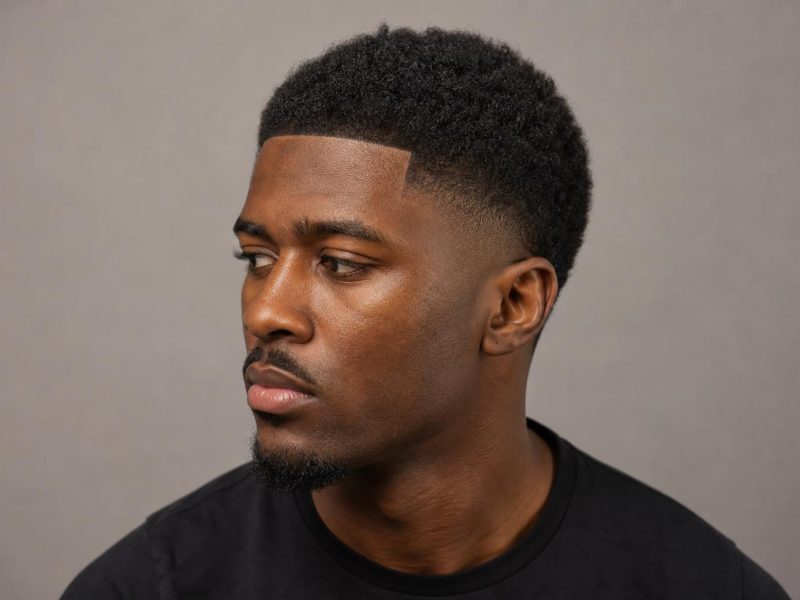
Tightly coiled hair produces the cleanest high fade of any texture, because the density at the top gives a hard visual edge against the bare skin below. The contrast is doing all the work, so the top needs no additional shaping. Moisturize the exposed scalp after every cut, since the skin at the sides is newly uncovered.
20. Skin Fade with a Sponge-Twisted Top
Work a curl sponge in small circles over damp hair to coil the top into defined twists, then seal with a light oil on the scalp. Two minutes of sponge work gives a texture that holds for several days. Refresh with water rather than more product.
21. High Fade at a Two-Week Rhythm
A skin fade is genuinely sharp for about five to seven days and acceptable for two weeks, at which point the bottom has grown into a visible shadow that ruins the gradient. This is the shortest maintenance window of any cut here. Anyone who cannot get to a barber fortnightly should choose a mid fade instead.
22. High Fade with a Hard Part
Unlike a combed part, a hard part is cut into the hair with a clipper edge, giving a permanent line that holds regardless of how the hair moves. The line grows in over about ten days and needs recutting with the fade. It suits straight and wavy hair; on tight coils the line closes up faster.
Drop, Burst, and Shaped Fades
These change the shape of the fade line rather than its height, which is what separates them from the three standard heights above. A drop fade curves downward behind the ear, a burst fade circles the ear only, and a temple fade touches just the front corners. All three are worth knowing by name, because asking for the wrong one produces a noticeably different haircut.
23. Drop Fade That Arcs Behind the Ear
The curved line follows the natural round of the skull, which flatters round and square faces by adding a visual diagonal rather than a horizontal band. On a long face the drop can exaggerate the length, so keep the arc shallow. The drop fade and its variations covers how far the arc can reasonably travel.
24. Burst Fade for a Weekend Look
Less formal than a standard fade because the length behind the ear stays untouched, which suits anyone whose workplace does not call for a hard gradient. It grows out unevenly by design, so nobody notices week three. Popular with anyone keeping length at the back.
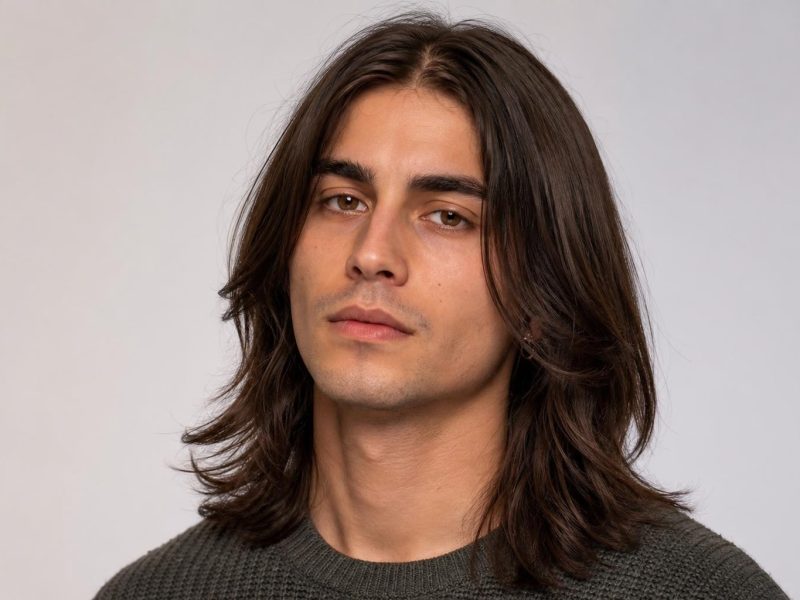
25. Burst Fade with a Mullet Back
The fade circles the ear in a semicircle and stops, leaving the nape section long enough to fall past the collar. The barber works this in two stages, fading the ear area first and then scissor cutting the back separately. Ask for the transition point to be softened where the two meet.
26. Temple Fade with the Length Left On
The phrase to use is “temp fade, just the corners, leave the rest of the side alone.” Some barbers call it a Brooklyn fade, and asking for a low fade instead gets you a much shorter side than intended. It is the smallest amount of fading available, and it works when you want the outline cleaned without losing bulk. Our temp fade guide covers the corner shapes.
27. Drop Fade on Curly Hair
Type 3 curls suit a drop fade because the curved line follows the way curls naturally pile behind the ear, so the shape looks continuous rather than imposed. Cut curly hair dry so the barber can see where the curls fall. There is more on this in our collection of taper fades cut for curly hair.
28. Shape-Up with a Skin Fade
Have the barber square the front hairline and the temple corners with a trimmer after the fade is finished, working from the natural line rather than pushing it back. Never let anyone raise the hairline to make a line straighter, because it does not grow back where it was. Two minutes at the end of the cut.
29. Afro Taper Fade Grown Between Cuts
Because only the perimeter is faded and the top volume stays intact, this holds its shape for five to six weeks rather than two. The taper softens gradually as it grows rather than developing a hard line. It is the longest-lasting option in this gallery for anyone who wants a fade without a fortnightly appointment.
30. Mohawk Fade with a Narrow Strip
Where a standard high fade blends into a full top section, this narrows the top to a strip two or three inches wide and fades everything outside it. That makes it considerably more committal than any other cut here, and growing it out passes through an awkward stage around week six. Worth knowing that the strip width is entirely negotiable, and a wider one is far easier to grow out.
Fade Height and Face Shape
Fade height changes where the eye lands on the head, which is why the same top length looks different depending on where the blend starts. High fades pull attention upward and narrow the sides; low fades keep width and soften the outline. Match the height to what your face needs rather than to what is currently popular.
| Face Shape | Best Fade Height | Top Length | Avoid |
|---|---|---|---|
| Oval | Any height | 1 to 3 inches | Nothing structural |
| Round | High or mid | 2 to 3 inches, worn upright | Low fades with a flat top, which widen the head |
| Square | Mid or drop | 1 to 2 inches, textured | A high skin fade with a flat top, which squares things further |
| Oblong or long | Low | Under 1.5 inches, worn forward | High fades and tall tops, which stretch the face |
| Heart | Mid | 1.5 to 2 inches with a fringe | Slicked-back tops that expose a wide forehead |
| Diamond | Mid or low | 2 inches, kept full at the front | High fades that narrow already-narrow temples |
What to Tell Your Barber
Barbers work in guard numbers and fade heights, not adjectives, and the three things they need from you are the starting height, the shortest guard, and the neckline shape. Give all three at the start and the consultation is finished in fifteen seconds. Leave any of them out and the barber picks a default that may not be yours.
A complete script sounds like this: “Mid fade, starting at the temple, taken down to a number one at the bottom, blended up to a three where it meets the top. Scissor cut on top, take about an inch off. Tapered neckline, please, not blocked.” That single sentence covers every decision. If you want a line up as well, say so, because barbers who do not know you will usually leave the hairline natural.
Stylist tip: Ask for the fade to be checked in natural light or with your glasses back on before the cape comes off. Shop lighting is directional and flattering, and blend bands that are invisible under a downlight show clearly outdoors. Fixing one takes two minutes in the chair and is not possible afterward.
Stylist tip: Ask for a tapered neckline unless you have a specific reason not to. A blocked neckline looks sharpest the day you leave and then grows into a visible squared line an inch below where it started, which is the single most common reason a fade looks untidy in week three. A taper simply softens.
Regrowth Windows by Fade Height
Hair grows roughly half an inch a month, so the higher the contrast in the cut, the sooner that growth becomes visible. A skin fade loses its edge in days because there is no length at the bottom to absorb the change, while a low taper has enough left to hide two or three weeks of growth. Pick the height you can actually maintain rather than the one that looks best on day one.
| Fade Type | Looks Sharp For | Barber Visit | How It Grows Out |
|---|---|---|---|
| High skin or bald fade | 5 to 7 days | Every 2 weeks | A grey shadow appears at the base and flattens the gradient |
| High fade to a number 0 | 10 to 14 days | Every 2 to 3 weeks | Blend steps merge into one length at the top of the side |
| Mid fade | 2 to 3 weeks | Every 4 weeks | Softens evenly; still wearable at week 4 |
| Low fade | 3 weeks | Every 4 to 5 weeks | The short travel distance hides growth well |
| Taper or afro taper | 4 weeks | Every 5 to 6 weeks | The most forgiving option; the outline just softens |
| Any fade with a line up | 10 days | Every 2 weeks regardless of fade height | The squared hairline blurs first and dictates the schedule |
When a Fade Is Not the Right Call
Fades suit most hair and most heads, but there are situations where the contrast works against you or the maintenance is simply not realistic. Each of these has a better alternative rather than no alternative.
- You cannot get to a barber more than every six weeks. Every fade height looks untidy well before that, and a scissor-cut taper holds its shape far longer for the same time in the chair.
- Your hairline is receding at the temples. A high fade narrows the sides and draws the eye straight to the corners, which makes the recession more obvious rather than less. A low or mid fade with length left at the front handles it better.
- You have visible scalp scarring, moles, or a birthmark on the side of the head. A skin fade exposes all of it, and a number one or two at the shortest point gives almost the same look with light coverage.
- Your hair is thinning at the crown rather than the front. Short sides increase the contrast with a sparse top, which makes the crown look thinner. Our guide to cuts for a thinning crown covers the lengths that work instead.
- You want a haircut that looks the same for a month. Fades are a rhythm rather than a one-off, and choosing one means committing to the schedule that goes with it.
- Your hair has a strong cowlick at the crown or a whorl high on the side. Both disrupt a blend and force the barber to work around them, and a longer, textured cut hides what a gradient exposes.
FAQ
What Is the Difference Between a Fade and a Taper?
A taper shortens only the sideburn and the neckline and leaves the rest of the side at one length, while a fade blends the whole lower side into a gradient. Every fade is technically a taper taken further up the head. If a barber asks which you want and you are unsure, a taper is the more conservative choice and the one that grows out more gracefully.
What Guard Number Should I Ask For on a Short Fade?
Ask for the shortest point and the highest point rather than a single number, since a fade is by definition several lengths. A common short fade runs from a number zero or one at the bottom up to a three where it meets the top. If you want less contrast, start at a two instead of a zero and the whole cut softens.
How Often Do Short Fades Need Cutting?
Every two weeks for a skin fade, every four for a mid fade, and every five to six for a taper. The variable is not how fast your hair grows but how much length there is at the shortest point to absorb that growth. Adding a line up shortens whatever schedule you were on to a fortnight.
Which Fade Height Suits a Round Face?
A high or mid fade with two to three inches left on top and worn upright, since the narrow sides and added height counteract the width. Low fades keep bulk at the temples and make a round face look rounder. A drop fade also works, because the curved line adds a diagonal that breaks up the circular outline.
Can I Get a Fade with Curly Hair?
Yes, and curly hair often produces the cleanest gradient because the curl pattern hides small inconsistencies in the blend. Ask for the cut to be done on dry hair so the barber can see where the curls fall, since wet curly hair can be twice its dry length. A drop or burst fade suits curls particularly well, as the curved line follows how the hair naturally piles behind the ear.
Will a Fade Make Thinning Hair Look Worse?
It depends on where the thinning is. Short sides can make a sparse crown more noticeable by increasing the contrast, but they generally help a receding hairline look deliberate rather than accidental. Keep the shortest guard at a one or two rather than going to skin if the sides themselves are thinning.
What Neckline Should I Ask For?
A tapered neckline for almost everyone, because it fades into the skin and has no hard edge to grow out unevenly. Blocked necklines suit thick straight hair and formal settings but need recutting every two weeks to stay sharp. Rounded necklines are worth considering only if your neck is wide, since they soften the corner.
Choosing among short fade haircuts for men comes down to three things, which are the height where the blend starts, the shortest guard number at the bottom, and whether you can hold the barber rhythm that height requires. Walk in with those three answers and a preference on the neckline, and any competent barber will get it right the first time. A mid fade to a number one with a tapered neckline is the safest starting point if you have never asked for a specific height before.
Hair results vary based on your natural hair type, texture, density, and condition. Always consult with a licensed hairstylist before making significant changes, especially with chemical treatments or dramatic length changes. Photos may show styled results that require professional tools and products to replicate.

1 response