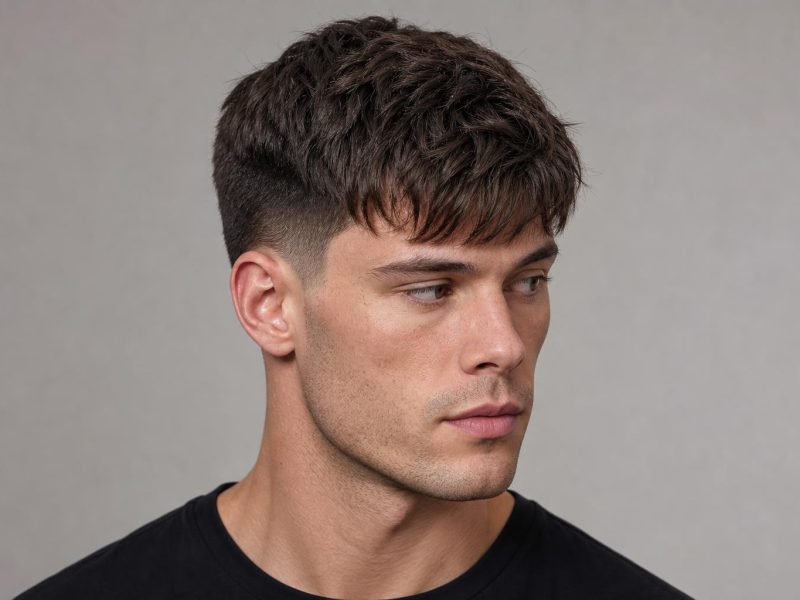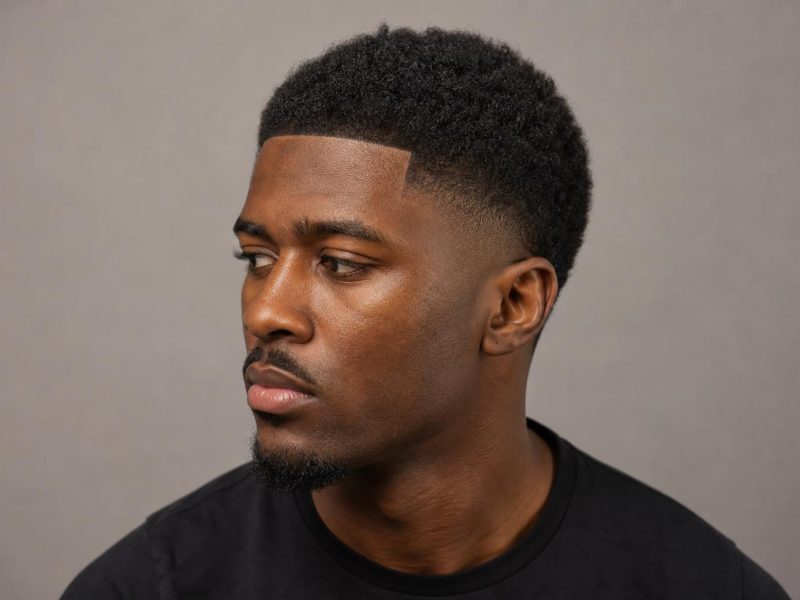

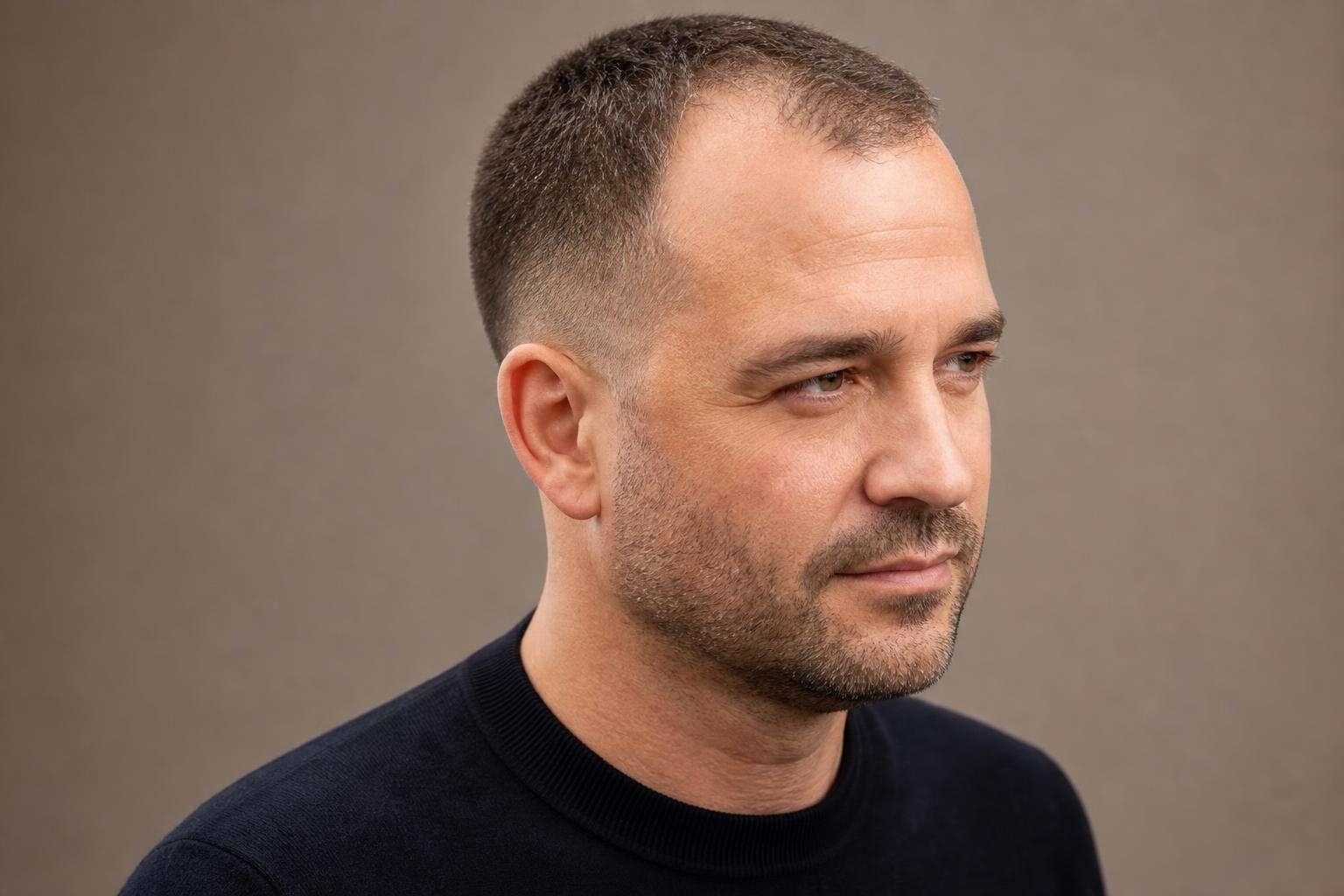
The haircut that works with a receding hairline is almost always shorter than the one you are currently wearing.
A receding hairline haircut works by removing the contrast that makes recession visible, which means short sides, texture rather than length on top, and a matte finish that keeps strands separated instead of clumped. Length works against you here, because more hair above a receding front line draws the eye straight to the gap. Below are 26 cuts organized by how far the recession has progressed, each with the language to use at the barbershop.
The gallery runs from crops for early temple recession through buzz cuts and skin fades, then longer options that still work, and finally cuts built around a beard. After the styles you will find a stage-by-stage table, a barber script, honest product guidance, and a section on the specific styling choices that make a receding hairline more obvious rather than less.
| Factor | Details |
|---|---|
| Best for | Temple recession with a reasonably dense top, at any age |
| Best top length | Half an inch to two inches, worn forward or upright |
| Product finish | Matte clay, paste, or texture powder; never a high-shine pomade or gel |
| Avoid if | You are set on keeping length, a side-parted comb-over, or a wet-look finish |
| Barber visit | 3 to 5 weeks depending on how short the sides are taken |
A Mature Hairline and a Receding Hairline Are Not the Same Thing
Almost every man’s hairline moves back between the late teens and the early thirties, typically by half an inch to an inch at the temples, and settles there permanently. That is a mature hairline, and it produces a slightly squared-off front with softly rounded corners. It is not the beginning of anything, and it needs no strategy beyond a decent haircut.
Pattern recession behaves differently. The temples keep travelling backward and form a distinct M shape with a deeper notch on each side, the hairs at the front line get finer and shorter before they go, and the crown often starts thinning at the same time. If you are unsure which you are looking at, compare a photo from five years ago rather than judging in a mirror. Cutting for recession that has not happened costs you nothing, but knowing which one you have tells you whether the schedule matters, and a separate approach applies when the crown is thinning rather than the front.
Short Crops and Textured Cuts for Early Recession
Early temple recession is best handled by moving hair forward rather than trying to cover the corners, and a crop does exactly that by cutting a short fringe that ends in a broken, textured line across the forehead. The fringe occupies the front of the head without pretending the hairline is somewhere it is not. These are the most wearable cuts at this stage and the ones most barbers will recommend unprompted.
1. French Crop with a Forward Fringe
The top is cut short and combed forward into a straight fringe that ends high on the forehead, well above the eyebrows, with the sides taken down to a fade. Because the fringe ends in a hard line rather than a tapered one, it defines a new front edge that has nothing to do with your natural hairline. Our guide to the French crop and its fringe lengths covers where the line should land.
2. Textured Crop Cut to Two Inches
Ask for “about two inches on top, point cut so it separates, worn forward, with a low fade on the sides.” Barbers hear crop and sometimes deliver something considerably shorter, so state the length in inches. Adding “leave the corners at the front alone” prevents anyone squaring off the recession.
3. Crop on Fine Straight Hair
Fine straight hair suits a crop better than almost anything else, because the forward direction stops individual strands separating and revealing scalp the way a backward sweep does. Density matters more than strand width at this length. Keep it under two inches, since fine hair loses its own support past that.
4. Crop Finished with Matte Texture Powder
Tap a small amount of matte texture powder directly onto dry roots, then work it forward with your fingertips. Powder coats each strand and adds measurable diameter, which is the single most effective product category for a thinning front. It also leaves zero shine, which matters more than the hold does.
5. Caesar Cut at a Four-Week Rhythm
Shorter than a crop and combed straight forward with almost no texture, this holds its shape for roughly four weeks before the fringe grows past where it should end. The sides need attention on the same schedule. It is a low-effort cut in the morning and a moderately demanding one at the barbershop.
6. Crop with a Broken Fringe
Where a blunt fringe creates a hard horizontal edge, a broken fringe is point cut into irregular lengths so it falls in separated pieces. The broken version looks less deliberate about hiding something, which is generally the effect you want. It also grows out with less of a stepped line.
7. Crew Cut with Height at the Front
Long and oblong faces suit a crew cut better than a forward-worn crop, because a low forward fringe shortens an already narrow face while a little height at the front balances it. On a round face reverse that and keep the fringe forward. The sides stay the same either way.
Buzz Cuts and Skin Fades for Advancing Recession
Once the recession is deep enough that a fringe no longer covers the front comfortably, cutting everything short removes the comparison entirely. A buzz cut has no long hair next to short hair, so there is nothing for the eye to measure the recession against. It is the most reliable answer at this stage and the one most men arrive at eventually.
8. Number 2 Buzz Cut All Over
Practical for anyone who wants zero morning routine and does not want to think about hair again. A quarter inch all over looks like a deliberate choice rather than a response to anything. Most men who try it report the transition being far easier than the anticipation suggested.
9. Buzz Cut with a Faded Perimeter
The top stays at a number two while the sides blend down through a one and a zero, which adds shape to what would otherwise be a uniform length. That contrast reintroduces some structure without introducing any length to compare against, and the same logic runs through the whole range of short fade haircuts sorted by fade height. The fade also makes the head look narrower from the front.
10. Induction Buzz with No Guard
Say “bare clipper all over, no guard, and leave the hairline natural.” The last part matters, because a barber squaring the front line on a receding hairline produces an artificial edge that looks like a drawn-on shape. Natural is always the right answer here, and our collection of very short cuts for men covers the range below a number two.
11. Buzz Cut on Coarse Grey Hair
Coarse grey hair buzzes exceptionally well because the wiry texture stands up on its own and the lighter color reduces the contrast against the scalp. Grey and receding together is a considerably easier combination than dark and receding. Nothing about it needs product.
12. Shaved Head Finished with a Matte Balm
Shave with the grain first and against it only on a second pass, then finish with a matte scalp balm rather than a moisturizer with any shine to it. A shiny scalp catches light unevenly and draws attention; a matte one does not. Two minutes every other day once the routine is established.
13. Skin Fade Buzz at a Two-Week Rhythm
Taking the sides to skin under a buzzed top gives the sharpest version of this cut and the shortest maintenance window in the gallery, because the bare section grows into a visible shadow within about a week. Anyone who cannot get to a barber fortnightly should stop the fade at a number one instead. The look barely changes and the schedule doubles.
14. Buzz Cut with the Hairline Left Natural
Unlike a lined-up buzz where the front edge is squared with a trimmer, this leaves every corner exactly where it grows. A line up on a receding hairline creates a hard edge that emphasizes the notch it was meant to disguise, and it needs redoing every fortnight to avoid looking half-grown. Natural corners age far better between cuts.
Longer Styles That Work with a Receding Hairline
Length is not automatically wrong, but it only works when the top is still genuinely dense and the style directs hair forward or upward rather than back or across. The failure mode is always the same, which is hair combed over the recession from a low side part. These six manage length without falling into that.
15. Textured Quiff with Height at the Front
Square and heart-shaped faces gain most here, since vertical height at the front balances a strong jaw or a wide forehead. The quiff also moves the visual focus above the hairline rather than onto it. Round faces get the same benefit but need the sides taken shorter to avoid widening.
16. Slicked Back with a Matte Finish
Honestly, this only works at the earliest stage of recession and only when the top is still thick, since sweeping hair backward puts the hairline on full display. If that describes you, it is a genuinely good option and looks confident rather than evasive. Use a matte paste, never a wet-look pomade.
17. Messy Medium Length with Point-Cut Ends
The ends are point cut so the hair falls in separated pieces rather than a solid sheet, and the whole cut is worn without a defined part. Removing the part removes the straight line of exposed scalp that a part creates. Roughly three inches on top is the ceiling before the weight flattens it.
18. Side Part Kept Off the Recession
Say “a soft side part, but set it above the temple rather than at it, and comb the front forward rather than across.” Barbers default to parting where the hair naturally splits, which on a receding hairline is often right at the deepest point of the notch. Moving it an inch changes the whole result.
19. Curly Top on Type 3 Hair
Type 3 curls are the single most forgiving texture for a receding hairline, because the curl pattern breaks up the front line and occupies volume the scalp would otherwise show through. Cut it dry so the barber can see where the curls fall. There is more on this in our guide to cutting curly hair for men.
20. Medium Length Set with Sea Salt Spray
Spray sea salt onto damp hair, rough dry with a hairdryer on medium heat while pushing the hair forward with your fingers, and leave it alone once dry. Salt spray grips the strands into separated pieces, which occupies more space than smooth hair does. Skip it if your hair is already coarse, since it can turn the texture wiry.
Cuts That Pair with a Beard
A beard is the most underrated tool available to a receding hairline, because it adds visual weight to the lower half of the face and shifts the balance point downward. The effect is genuinely significant and costs nothing beyond the trimming routine. Every cut in this section is chosen for how it works alongside facial hair rather than on its own.
21. Buzz Cut with a Full Beard
The combination holds its balance for a long time because both halves grow at a similar rate, so the proportions stay right for three or four weeks. A full beard needs shaping every two weeks even if the buzz does not. Budget more time on the beard than on the hair.
22. Crop with a Short Stubble Beard
Where a full beard creates a heavy lower half that suits a shaved head, short stubble is the lighter option that pairs better with a cut that still has length on top. The stubble adds definition without competing with the fringe. It also takes about a minute a week to maintain.
23. Shaved Head with a Sculpted Beard
Round and square faces both benefit from a beard shaped longer at the chin than at the cheeks, since the added length below lengthens the face and offsets a bare scalp above. Keep the cheek line natural rather than carved high. On a long face, keep the beard shorter at the chin instead.
24. Crew Cut with a Goatee
A practical middle ground for anyone whose workplace is fine with facial hair but not with a full beard. The goatee concentrates weight at the chin without covering the jaw. It suits men who cannot grow even cheek coverage, which is more common than the internet suggests.
25. Textured Top with a Faded Beard Line
The barber fades the beard into the sideburn so there is no visible join between the hair and the facial hair, which makes the whole head look like one continuous shape. That continuity is what stops the eye stopping at the hairline. Ask for the fade to run through the sideburn rather than starting below the ear.
26. Buzz with a Beard Taken to a Number 3
The instruction is “number two on the head, number three on the beard, faded into the sideburns, and leave the neckline just above the Adam’s apple.” Keeping the beard one guard longer than the hair is the ratio that reliably shifts weight downward. Anything more than two guards apart starts looking disconnected.
Matching the Cut to Your Norwood Stage
Barbers and hair professionals use the Norwood scale to describe how far pattern recession has progressed, and knowing roughly where you fall makes the conversation much quicker. The stages run from a full hairline through temple recession to a horseshoe of hair around the sides and back. Use the table as a rough map rather than a diagnosis, since these categories overlap in practice.
| Stage | What It Looks Like | Best Cuts | Avoid |
|---|---|---|---|
| Norwood 2 | Slight, even temple recession; the mature hairline most men settle at | Almost anything, including quiffs and slicked-back styles | Nothing structural; only wet-look finishes |
| Norwood 3 | Distinct M shape with deeper notches at both temples | French crop, textured crop, Caesar cut, crew cut | Slicked-back styles and low side parts |
| Norwood 3 vertex | Temple recession plus a thinning patch at the crown | Short textured crop, crew cut, number 3 to 4 buzz | Any length that increases contrast with the crown |
| Norwood 4 | Deeper recession and a visible crown patch with a band between | Number 1 to 2 buzz, buzz with a faded perimeter | Comb-overs bridging the front to the crown |
| Norwood 5 to 6 | The band between front and crown thins or breaks | Induction buzz, shaved head, both with a beard | Any attempt to retain length on top |
| Norwood 7 | A horseshoe of hair around the sides and back only | Shaved head, or the horseshoe buzzed to a number 1 | Leaving the sides long against a bare top |
What to Tell Your Barber
Most barbers will spot a receding hairline before you say anything and quietly cut around it, but quietly is the problem, because what they do by default may not be what you want. Two instructions cover almost every case. The first is a length, and the second is a request to leave the hairline alone.
A workable script: “I am receding at the temples, so I want the top short enough to work forward, about an inch and a half, point cut so it separates. Low fade on the sides. Please leave the front hairline exactly where it is, no line up and no squaring the corners.” If you would rather more contrast, swap in a mid fade blended from the temple and keep everything else the same. That last sentence is the one that matters most, and it is the one men most often forget to say.
Stylist tip: Never let anyone square off or line up a receding hairline. A trimmer can only remove hair, so squaring a notched corner means cutting back to the deepest point of the notch across the whole front, which permanently reveals more forehead until it grows back. A natural, irregular edge always looks less like recession than a drawn one does.
Stylist tip: Ask the barber to cut and check the top dry, standing up, rather than wet and combed flat. Wet hair lies against the scalp and hides how much coverage you actually have, which is how men end up with a length that looked fine in the chair and thin by the time they got home. Dry is the only honest view.
Products and Daily Styling
Product choice matters more with a receding hairline than with almost any other hair situation, because the wrong finish undoes a good haircut in seconds. The rule is simple: anything that adds shine clumps hair into separated strands and lets the scalp show between them. Matte finishes do the opposite and keep strands spread across the surface.
| Product | Use It For | Verdict |
|---|---|---|
| Matte texture powder | Root lift and added strand diameter on a short crop | The most useful single product for a thinning front |
| Matte clay | Holding a forward-worn crop or a textured top | Reliable; use a pea-sized amount on dry hair |
| Sea salt spray | Separation and grip on medium lengths | Good, but drying on coarse hair |
| Matte scalp balm | Finishing a shaved head without shine | Worth it; ordinary moisturizer usually reflects light |
| High-shine pomade or gel | Wet-look and slicked styles | Avoid; it clumps strands and exposes scalp between them |
| Heavy wax | Firm hold on thick hair | Avoid; the weight flattens a thinning top against the scalp |
What Makes a Receding Hairline More Obvious
A handful of specific choices reliably make recession more visible, and all of them are things men do while trying to hide it. Each one has a straightforward alternative.
- A comb-over from a low side part. Sweeping hair across the top from one side creates a visible track of scalp along the part and moves in the wind. Move the part above the temple, or drop it entirely and wear the hair forward.
- Growing the fringe longer to cover the corners. Longer hair at the front is heavier, so it separates and hangs in strands that reveal more scalp than a short fringe would. A short, blunt or broken fringe covers the same area with more density.
- Any wet-look or high-shine finish. Shine gathers hair into distinct pieces and makes the gaps between them obvious. Matte clay or powder solves this on its own.
- Leaving the sides long while the top thins. The contrast between dense sides and a sparse top is what the eye actually notices, more than the hairline itself. Shorter sides narrow the gap in both directions.
- A squared-off line up at the front. It replaces an irregular natural edge with a hard geometric one, which looks artificial and needs recutting every fortnight to avoid looking half-grown.
- Expecting the haircut to be a treatment. A good cut changes how recession looks, not whether it progresses. If slowing the loss matters to you, that is a separate conversation with a doctor or pharmacist, and our overview of hair regrowth treatment options covers the categories that exist.
FAQ
What Is the Best Haircut for a Receding Hairline?
A short textured crop worn forward is the best single answer for most men with temple recession, because the fringe defines a new front line and the short sides remove the contrast that makes thinning visible. If the recession has progressed past the point where a fringe covers it comfortably, a number one or two buzz with a faded perimeter is the more reliable choice. Both work at any age and neither needs more than a minute in the morning.
Should I Shave My Head If My Hairline Is Receding?
Not necessarily, and not yet if a crop still looks good on you. Shaving becomes the better option once the top is thin enough that no length looks dense, or when the band between the front and the crown starts to break. A number two buzz is a useful intermediate step, since it gets you most of the way there and grows back in a fortnight if you dislike it.
Does a Fade Help or Hurt a Receding Hairline?
A low or mid fade helps, because shorter sides reduce the contrast against a thinning top and keep the whole head in proportion. A high skin fade can work against you by narrowing the sides and drawing the eye straight to the temple corners. Keep the fade height low to mid, and stop the shortest point at a number one rather than going to skin if your temples are the main concern. The gradient on a low fade starting an inch above the ear is the safest starting point.
Is My Hairline Receding or Just Maturing?
A mature hairline moves back evenly across the front with softly rounded corners and then stops, usually by the early thirties. Pattern recession keeps going, forms deeper notches at each temple in a distinct M shape, and often comes with finer, shorter hairs along the front line. Comparing a photo from a few years ago is far more reliable than assessing it in a mirror, where you see it daily and adapt to the change.
Can a Haircut Stop a Hairline from Receding?
No. Cutting hair has no effect on the follicle, on the rate of loss, or on how thick the regrowth is, which is also why the old advice about shaving making hair grow back thicker is untrue. What a haircut changes is entirely visual, and it changes it substantially. Anything aimed at slowing the loss itself belongs in a conversation with a doctor or pharmacist rather than a barber.
What Length Should I Keep on Top?
Between half an inch and two inches for most men, with the shorter end suiting deeper recession. Past two inches the hair starts to hang under its own weight and separate into pieces, which reveals scalp rather than covering it. The test worth applying is whether the hair still stands away from your head at the end of the day, since anything that has flattened by the afternoon is too long.
Do Beards Actually Help with a Receding Hairline?
Yes, and more than most men expect. A beard adds visual weight to the lower half of the face, which shifts the balance point downward and stops the eye settling on the hairline. Keeping the beard one clipper guard longer than the hair on your head is the ratio that works most consistently, and fading the beard into the sideburn removes the visible join between the two.
Choosing a receding hairline haircut is mostly a matter of going shorter than feels comfortable and then discovering it looks better than what you were doing before. Take the top down to somewhere between half an inch and two inches, ask for it point cut and worn forward, keep the sides low or mid faded, and tell the barber explicitly to leave your natural hairline alone. Swap any shiny product for a matte clay or powder on the same day, since that single change does as much work as the cut itself.
Hair results vary based on your natural hair type, texture, density, and condition. Always consult with a licensed hairstylist before making significant changes, especially with chemical treatments or dramatic length changes. Photos may show styled results that require professional tools and products to replicate.