

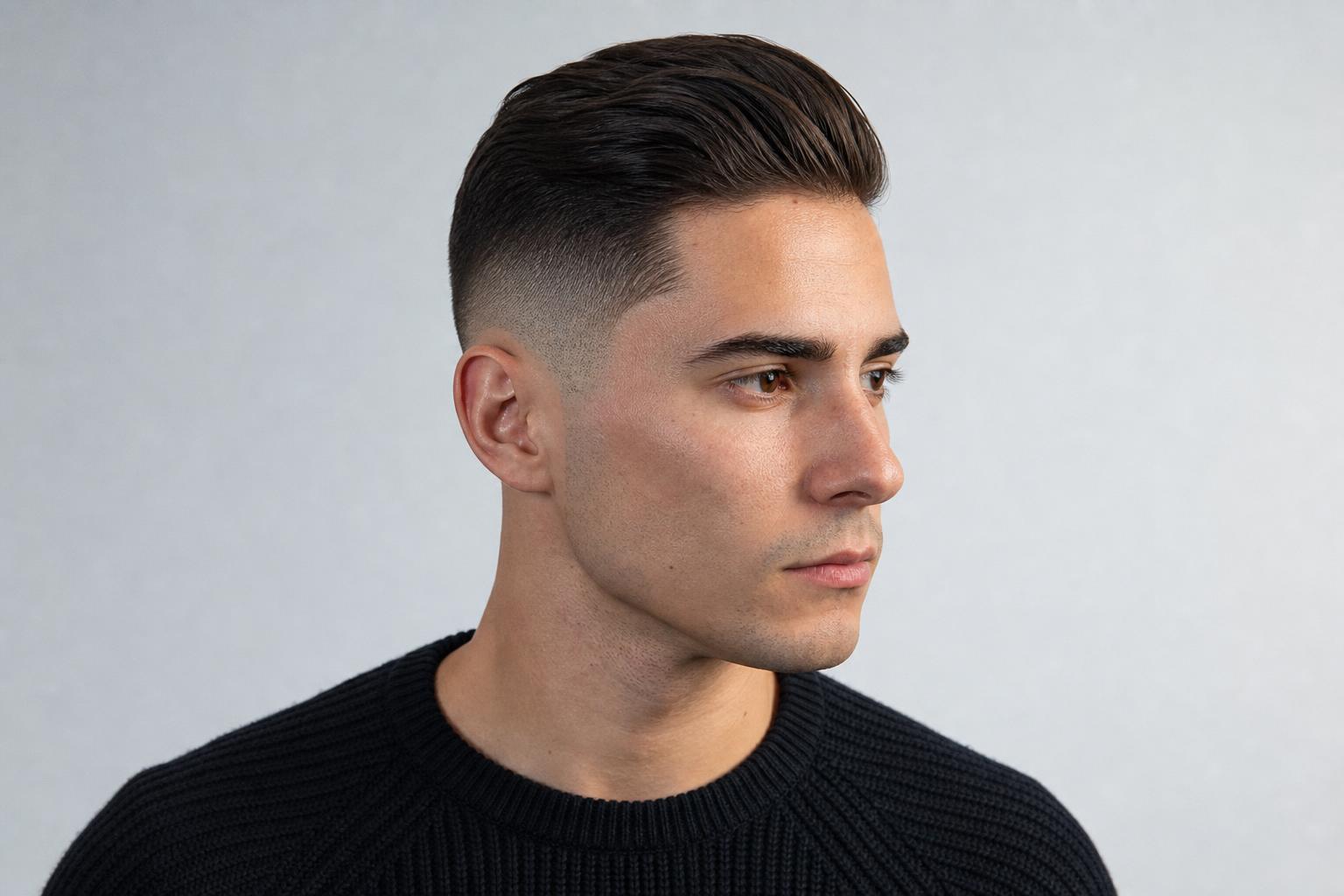
A high fade is the one haircut that shows your actual head shape, because it strips the sides down to skin above the temple where nothing is left to disguise the bone underneath.
A high fade takes the shortest length up to or above the parietal ridge, the corner where the side of the head turns into the top. That placement is the whole definition: a low fade stays just above the ear, a mid fade reaches the temple, and a high fade climbs past it. The result is the sharpest contrast between top and sides of any fade, and the shortest window between haircuts, at ten to fourteen days.
The 28 styles below are grouped by what happens on top, since that is the decision that actually changes the haircut. After the gallery you will find a fade height comparison, an honest section on which head shapes a high fade suits, the exact words to give your barber, and a maintenance schedule with realistic numbers.
| Factor | Details |
|---|---|
| Best for | Oval and round faces, even head shapes, thick hair that needs weight removed |
| Where the fade starts | At or above the parietal ridge, roughly level with the top of the temple |
| Barber time | 30 to 50 minutes, longer with a beard blend or line work |
| Upkeep | Every 10 to 14 days, the shortest cycle of any fade height |
| Works with | Straight, wavy, curly, and coily hair, at any length on top |
| Avoid if | The back of your head is flat, or the crown is thinning |
High Skin Fades
A skin fade takes the shortest point down to bare scalp with a foil shaver or a zero-gapped blade, then climbs through progressively longer guards. Combined with a high starting point, it produces the maximum contrast available in a men’s haircut. These seven are the cleanest versions, and all of them show grow-out within a week, which is the honest cost of the look.
1. High Skin Fade with a Sharp Line-Up
The line-up is a separate service from the fade, cut with a trimmer to square off the front hairline and temples into clean right angles. Barbers work it after the fade is blended so the two edges meet without a step.
2. High Bald Fade with a Rounded Corner
Square and angular faces gain from letting the barber round the front corner rather than cutting it to a hard 90 degrees, since the softer curve balances a strong jaw instead of doubling down on it. Longer faces can take the sharp corner.
3. High Skin Fade on Coarse Straight Hair
Dense, coarse hair produces the crispest gradient of any texture, because each guard change is clearly visible against the solid block of hair above it. Fine hair blurs the same fade into something softer, which some people prefer and others find disappointing.
4. High Fade Buzz Cut
Run a #2 or #3 over the whole top and fade the sides to skin from the parietal ridge down, which takes about twenty minutes and needs zero styling product afterward. Our guard size chart covers exactly what each number leaves if you want to be specific with your barber.
5. High Skin Fade with a Faded Neckline
Asking for a tapered rather than blocked neckline adds a week to how long the cut looks fresh, because a blocked line grows into a visible shelf while a taper simply softens. It costs nothing extra and most barbers will do it by default if asked once.
6. High Skin Fade with a Bleached Top
Lightening only the top section against dark faded sides makes the fade line function as a hard border between two colors, which is far more striking than either element alone. Expect a root touch-up every four weeks and a toner refresh sooner than that.
7. High Fade with a Hard Part
Ask for a shaved parting line by name, and specify where you want it: your natural part, or a fixed distance from the temple. Barbers cut this with a trimmer corner before the fade is finished, and the line grows out visibly after about ten days.
High Fades with Length on Top
Leaving real length on top is what turns a high fade from a short haircut into a styled one, and it is where most of the versatility lives. All seven below need a styling product and two to five minutes each morning. The longer the top, the more the fade height matters, since a high fade under a long top creates the most dramatic silhouette available.
8. High Fade Pompadour
Unlike a quiff, which is swept up and back loosely, a pompadour is combed up and back into a defined volume with a smooth surface. It needs four inches of length on top and a firm-hold pomade to keep the shape all day.
9. High Fade Quiff
The quiff is built at the front hairline only, with the hair lifted and pushed slightly back while the rest lies flatter. Blow-dry the front section forward first, then back, which is what creates the volume without the stiffness a product-only approach gives.
10. High Fade with a Side Part
Round faces benefit from a side part over a high fade, because the asymmetry plus the vertical lift adds visible height and breaks up the width across the cheekbones. Keep the part on your natural growth line rather than fighting it.
11. High Fade Slick Back on Fine Hair
Fine hair suits the slick back better than most textures, since there is no bulk to make the shape look heavy and the exposed sides remove any impression of thinness. Use a matte clay rather than a shiny pomade, which makes fine hair look sparse.
12. High Fade Faux Hawk
Push the center section of the top upward and inward from both sides with a strong clay, working from the front hairline to the crown. A blow-dryer on medium heat while your fingers hold the shape sets it far better than product on dry hair.
13. High Fade Crew Cut
Two to three inches on top faded high at the sides is the lowest-maintenance styled option here, needing about a minute of product a day and holding its shape for two weeks. The trade-off is that it looks noticeably grown out at week three rather than acceptably longer.
14. High Fade with an Ash Blonde Top
Cool ash tones on the top section pair better with a high fade than warm blondes, because the fade already creates a graphic, hard-edged look that warm gold softens against. Ash needs a purple shampoo every third wash to hold its tone.
High Fades with Texture and Curl
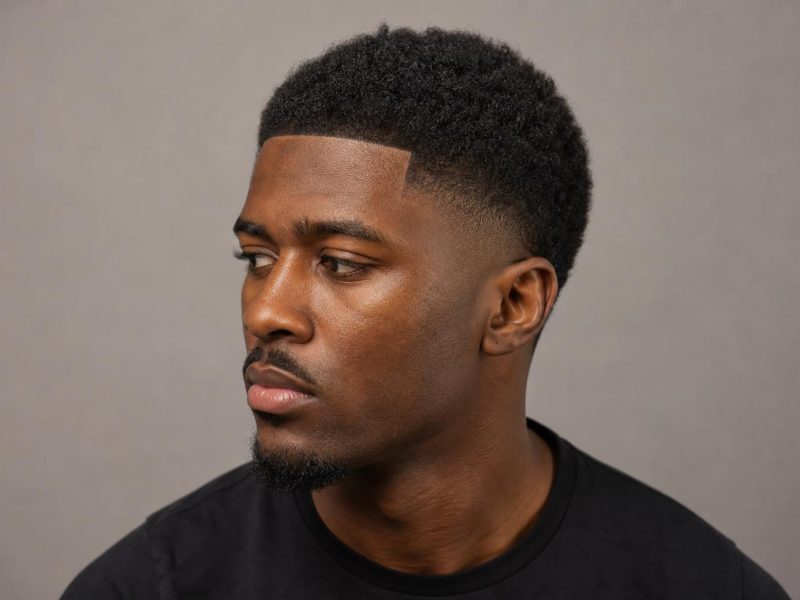
Curly and coily hair takes a high fade exceptionally well, because the contrast between skin at the sides and dense texture on top is naturally dramatic without any product doing the work. The critical detail is how the barber handles the transition zone, where curls meet the fade. Ask for that corner to be softened rather than cut square, or the top can look like a hat perched on the head.
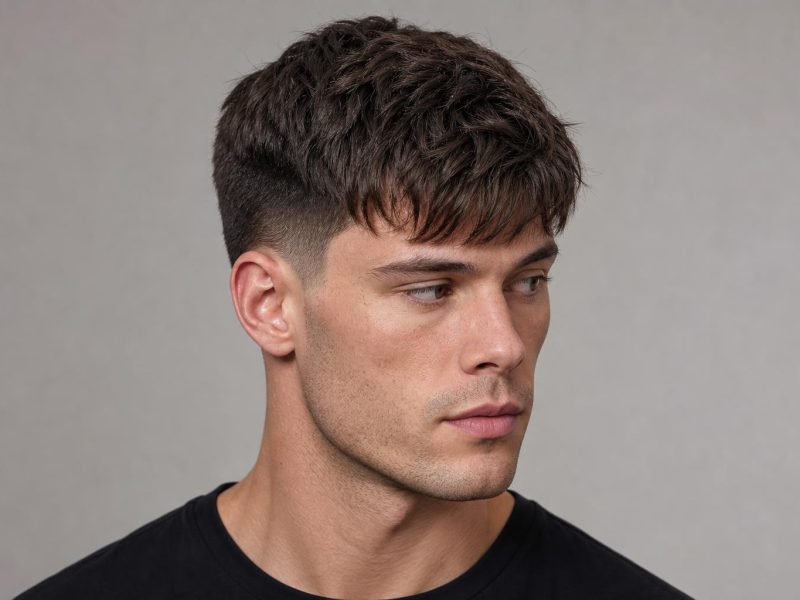
15. High Fade with a Textured Crop
Ask for a crop with a blunt fringe and point-cut texture through the top, and say whether you want the fringe straight across or slightly angled. Those are two different looks and barbers default to their own preference otherwise.
16. High Drop Fade with Curls
Where a standard high fade runs level around the head, a drop fade curves downward behind the ear, following the natural hairline instead of cutting across it. On curly hair the curve looks softer, and other versions live in our drop fade collection.
17. High Fade with a Sponge Twist Top
Twists are created by rotating a textured sponge over damp, product-coated hair in small circles until each coil forms. The top needs at least two inches to twist properly, and results hold three to five days before a refresh.
18. High Fade with an Afro Top
Oval and heart-shaped faces carry a high fade with a rounded afro top particularly well, since the width at the top balances a narrower chin. Rounder faces should keep the afro taller than it is wide to avoid adding visual width.
19. High Fade on Wavy Hair
Loose 2b and 2c waves need enough weight left on top to keep the wave pattern visible, which usually means three inches or more. Cut too short, wavy hair loses its pattern and behaves like frizzy straight hair.
20. High Fade with a Messy Fringe
Work a sea-salt spray through damp hair, rough-dry with your fingers pushing the fringe forward, then break up the pieces with a matte paste. Combing at any stage flattens the separation that makes this look work.
21. High Fade with Short Twists
Two-strand twists on top over a high fade hold for one to two weeks, which is roughly the same cycle as the fade itself, so both get refreshed at the same appointment. Sleep in a durag to keep the twists from flattening on one side.
High Fades with Designs, Beards, and Extras
These seven add a second element to the fade, and each one adds cost and appointment time. They also shorten the refresh cycle, since a design or a beard blend looks untidy faster than the fade alone does. Worth it if you are already going every two weeks, and less so if you stretch appointments.
22. High Fade with a Burgundy Top
Deep burgundy over dark hair looks subtle in most light and clearly colored in sunlight, which makes it the easiest color to wear with a high fade in a conservative workplace. Red pigment fades faster than any other, so expect to refresh every four to six weeks.
23. High Fade with a Beard Blend
Ask specifically for the fade to blend into the beard rather than stopping at a hard line, and say where you want the cheek line and the neckline to fall. A blend means the barber carries the gradient through the sideburn into the beard, which takes an extra fifteen minutes.
24. High Burst Fade
Unlike a standard high fade that runs straight around the head, a burst fade radiates outward in a semicircle around the ear and leaves the back length untouched. The result is far less severe from behind, and more options are in our burst fade gallery.
25. High Fade with Line Designs
Designs are shaved with a trimmer corner or a straight razor into the faded area, usually one to three lines rather than complex patterns, which hold their shape better as they grow. Simple parallel lines stay legible for about ten days; detailed work blurs within five. Our roundup of haircut design ideas covers what holds up and what does not.
26. High Fade with a Temple Taper
Receding or uneven temples look better with a taper at the corner rather than a hard line-up, because a squared edge draws attention to exactly where the hairline has moved. Ask for the temples tapered and the front left natural.
27. High Fade with Locs on Top
Mature locs need a barber who will fade around them without catching a loc in the clipper, which means working with a trimmer close to the boundary rather than a guarded clipper. Retwisting the perimeter locs after the fade keeps the line clean.
28. High Fade Mohawk
Leave a strip two to four inches wide down the center and fade everything either side to skin, then lift the strip with a strong-hold clay applied at the roots. Blow-drying upward while the product is still wet is what gets genuine height rather than a lean.
High, Mid, Low, and Taper: What Actually Separates Them
These four terms get used interchangeably in conversation and mean specific, different things in the chair. Fade height is measured by where the shortest length stops climbing, and a taper is a different thing entirely rather than a fourth height. Getting the vocabulary right is the single biggest improvement most people can make to their barber conversations.
| Type | Where the Short Length Reaches | Contrast | Refresh Cycle |
|---|---|---|---|
| Low fade | Just above the ear, below the temple | Subtle, most of the side hair stays | 3 weeks |
| Mid fade | Level with the temple | Balanced, the most versatile height | 2 to 3 weeks |
| High fade | At or above the parietal ridge | Maximum, the sides are almost fully removed | 10 to 14 days |
| High taper | High, but only at the sideburns and neckline | Low, the bulk of the side hair is kept | 4 to 6 weeks |
| Drop fade | Curves down behind the ear at any height | Softer from behind than a level fade | 2 to 3 weeks |
The high fade and the high taper fade cause the most confusion, and the difference is significant: a high fade removes the side hair across the whole panel, while a high taper only shortens the edges and leaves the bulk intact. Ask for a taper if you want to keep length at the sides, and a fade if you want it gone. If a high fade feels like too much, a mid fade gives most of the effect with a longer refresh window.
Barber tip: Ask your barber to show you where the fade will start by pressing a finger against your head before any clipper touches it. High fade means different heights to different barbers, and a two-centimeter disagreement is the difference between the cut you wanted and one you live with for two weeks.
Head Shape Decides Whether a High Fade Suits You
This is the part almost no guide covers honestly. A high fade removes nearly all the hair from the sides and back, which means the shape of your skull becomes the shape of your haircut. That works beautifully on an evenly rounded head and less well on others, and it is worth knowing before the clipper starts rather than after.
A flat back of the head shows clearly under a high fade, because there is no hair left to build the illusion of roundness. The fix is not to avoid the fade but to leave more length at the crown and back of the top section, which a good barber will do automatically if you mention it. A prominent occipital bone has the opposite problem and benefits from a slightly lower fade line at the back with a level line at the sides.
Wide temples and a narrow crown produce a top-heavy look under a high fade, since removing side volume at temple level emphasizes the width that remains above it. A mid fade with a side part serves that head shape better. Face shape matters less here than head shape, though round faces do gain from the vertical lift a high fade with length on top creates.
Maintenance and What It Really Costs
Ten to fourteen days is the honest cycle, and anyone telling you three weeks has not worn a high skin fade. The reason is arithmetic: hair grows about half an inch a month, so a skin-faded section has visible stubble within five days and a clearly blurred gradient by day twelve. At two visits a month, budget roughly double what a mid or low fade costs you annually.
Between appointments, a trimmer at home on the neckline buys you three or four extra days and is the one piece of self-maintenance worth learning. Do not attempt to touch up the fade itself, since re-blending a gradient without seeing the back of your own head is how a two-week cut becomes a buzz cut. Wash the scalp at the faded area properly, because exposed skin that has never seen daylight gets oily and flaky faster than you would expect.
Barber tip: Book your next appointment before you leave the chair, at twelve days rather than fourteen. Every barbershop is busiest in the two days before a weekend, and a high fade that has to wait until day eighteen because nothing was available is a different haircut entirely.
What to Tell Your Barber
Four pieces of information cover a high fade completely: where the fade starts, how short the shortest point goes, what happens on top, and what you want at the neckline and temples. A workable script: “High skin fade starting just above the parietal ridge, level all the way around, leave about three inches on top with some texture through it, tapered neckline, and taper the temples rather than a hard line-up.”
Two clarifications save most misunderstandings. Say whether you want the fade level around the whole head or dropped behind the ear, since barbers have strong defaults. And say whether “skin” means genuinely bald or a very short guard, because a #0 and a foil-shaved skin fade look different and grow out on different timelines. Bring a photo taken from behind rather than the front, since the back is where fade height is most visible and least discussed.
When a High Fade Is Not the Right Choice
A high fade is a commitment to short cycles and an exposed skull. Choose differently in these cases:
- Your crown is thinning. Removing all the side volume makes the density difference at the top far more obvious, not less. A mid fade with more length on top disguises it better, and our guide to cuts for a thinning crown covers the alternatives.
- You cannot get to a barber every two weeks. A high fade at week four looks unkempt in a way a low fade never does, because the whole point is a gradient that has already blurred by then.
- Your workplace or school has grooming standards that rule out visible skin or designs. A high taper gives a similar tidiness with none of the exposure.
- You have scars, moles, or an uneven scalp you would rather not display. A high fade puts all of it on show, and a low fade keeps most of it covered.
- Your hair grows unusually fast. Some people see a visible line within four days, which turns a two-week cycle into a weekly one and stops being practical.
FAQ
What Is a High Fade Haircut?
A high fade takes the sides and back down to their shortest length at or above the parietal ridge, the corner where the side of the head turns into the top. It produces more contrast than any other fade height because almost none of the side hair remains. The shortest point can be a skin fade or a short guard, and that is a separate choice from the height.
What Is the Difference Between a High Fade and a High Taper Fade?
A high fade removes hair across the entire side panel, while a high taper only shortens the edges at the sideburns and neckline and leaves the bulk of the side hair in place. The taper looks far more conservative and holds its shape for four to six weeks instead of two. If you want to keep length at the sides, ask for a taper.
How Often Do You Need to Get a High Fade Cut?
Every ten to fourteen days for a skin fade, and up to three weeks if the shortest point is a #1 rather than bare skin. Grow-out shows fastest in the shortest section, so the higher and shorter the fade, the tighter the cycle. Trimming your own neckline between visits adds a few days without risking the blend.
Does a High Fade Suit a Round Face?
Yes, particularly with height left on top, since the vertical lift plus the removed side volume makes a round face look longer and narrower. Keep the top at least three inches and style it upward rather than forward. What matters more than face shape is head shape, and a flat back of the head is the one feature a high fade genuinely struggles with.
Can You Get a High Fade With Curly Hair?
Curly and coily hair is one of the best textures for a high fade, because the density on top against skin at the sides creates natural contrast without product. Ask the barber to soften the corner where the curls meet the fade so the top does not look detached. Curls also disguise the first week of grow-out better than straight hair does.
Is a High Fade the Same as a Bald Fade?
No, and they are often combined. High describes where the fade starts on the head, while bald or skin describes how short the shortest point goes. You can have a low bald fade or a high fade that bottoms out at a #1 rather than skin. Specify both when you book, since assuming one implies the other is a common source of surprise.
What Should I Ask For If a High Fade Is Too Much?
Ask for a mid fade, which starts level with the temple and gives most of the same sharpness with a three-week cycle instead of two. If the concern is exposure rather than height, a high fade bottoming out at a #1 rather than skin keeps a shadow of hair across the whole side. Both changes are one sentence at the start of the appointment.
A high fade haircut comes down to three decisions made before the clipper moves: how high the fade line climbs, whether the shortest point goes to skin or a guard, and how much length stays on top to balance it. Bring a photo taken from behind, tell your barber where you want the line by pointing to your own head, and book the next appointment at twelve days rather than hoping for the best.
Hair results vary based on your natural hair type, texture, density, and condition. Always consult with a licensed hairstylist before making significant changes, especially with chemical treatments or dramatic length changes. Photos may show styled results that require professional tools and products to replicate.

2 responses