

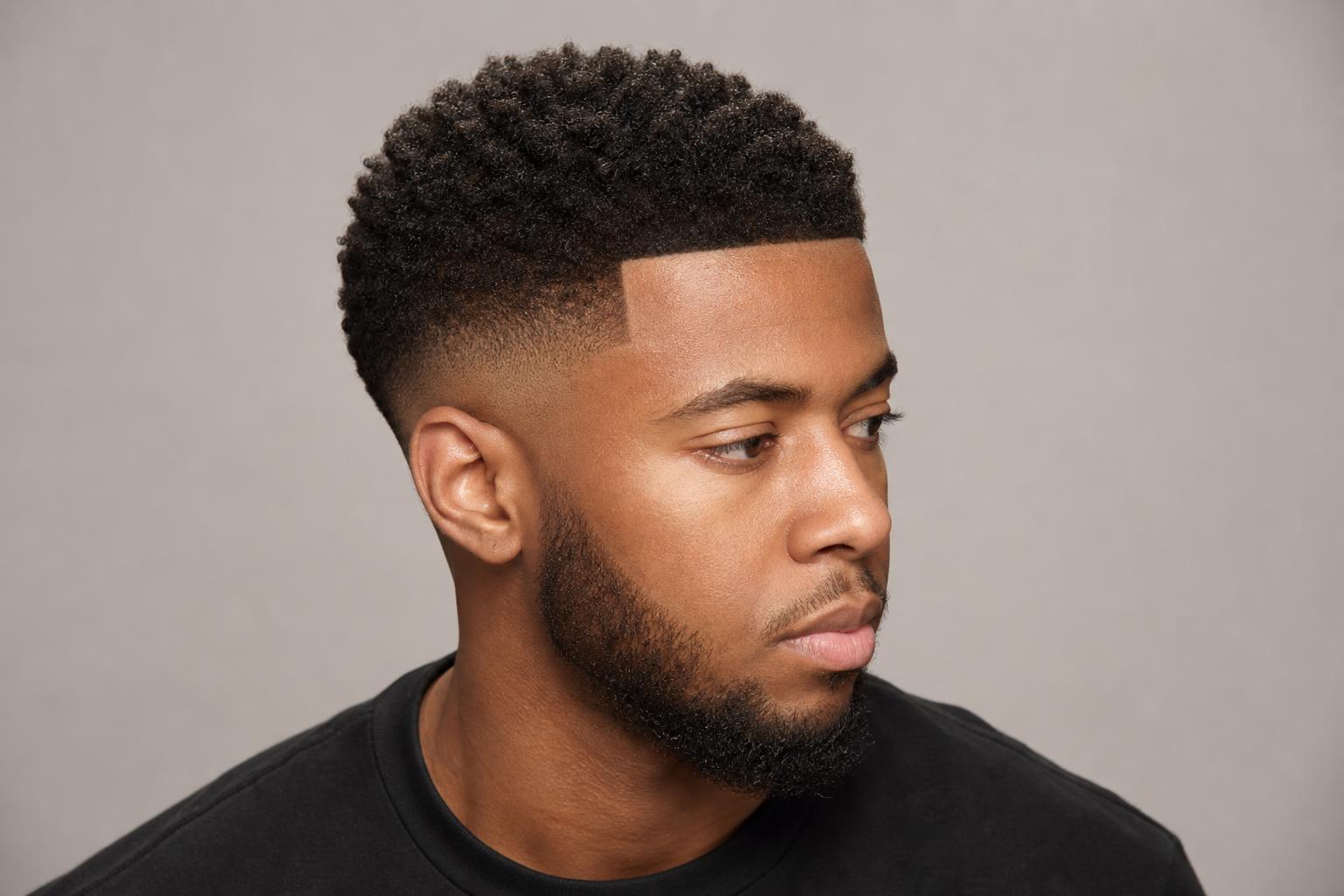
On type 4 hair, a mid fade is decided by two things the standard fade guides skip: how fast your density grows back, and what happens on top.
A mid fade begins its blend at the temple, halfway between the ear and the parietal ridge, and on coily 4a to 4c hair it produces the sharpest contrast available between clean sides and full texture up top. The fade itself is the easy part. What separates a cut that looks right for three weeks from one that looks soft after eight days is the line-up schedule, the top texture you choose, and whether your barber cut the coils stretched or shrunken.
This guide covers where the mid fade sits and why it suits type 4 density, the five top options that change the whole look, the technical adjustments coily texture demands from a barber, why the line-up is a separate decision from the fade, the exact wording for the chair, and a realistic upkeep schedule.
Where a Mid Fade Sits and Why It Suits Type 4 Density
The blend starts level with the temple and works down to its shortest point above the ear, leaving the top and the crown untouched. That midpoint is what makes it the most balanced of the three heights: a low fade barely clears the ear and does little against dense texture, while a high fade takes nearly the whole side and can leave a very full top looking top-heavy. The mid sits between them and reads as deliberate on almost every head shape.
Coily hair benefits more from this height than straighter textures do because type 4 density grows outward rather than downward. Volume builds at the sides quickly, and clearing the temple area stops the head from widening as the top fills in. It also creates a visible boundary between the shaped sides and the natural texture, which is what makes the coils on top read as a chosen style rather than as hair that has not been cut. Compared with the higher blend that starts at the parietal ridge, a mid keeps more of that texture in play.
Five Top Options That Change the Whole Cut
The fade is roughly a third of the decision. What sits above it determines the character of the cut, the daily routine and how often you need to be back in the chair. All five below pair with the same mid fade.
A Sponge-Coiled Top Defines the Curl Pattern
A curl sponge worked in small circles over damp hair pulls the coils into defined, uniform curls across the top section. It works on 4a through 4c and takes about two minutes once you have the motion. Apply a leave-in conditioner first and work the sponge lightly, since pressing hard tangles the hair rather than defining it. This is the lowest-effort way to make a mid fade look finished rather than plain.
Waves Need the Fade Cut Around Them
A wave pattern is built by brushing consistently in one direction over a short, even length, and a mid fade frames it by keeping the sides clean without cutting into the pattern. Ask the barber to keep the top at a consistent guard rather than tapering it, because uneven length breaks the wave. Brushing twice daily and covering at night with a durag is what maintains the pattern between cuts.
A Short Afro Keeps Natural Volume on Top
Two to four inches of unaltered texture above a clean mid fade is the most straightforward option and needs no styling beyond moisturizing. The shape depends entirely on the barber cutting the top level, which is harder than it sounds on coily hair because shrinkage hides unevenness until it dries. A pick used at the root rather than through the length builds height without disturbing the coil.
Twists and Short Locs Sit Cleanly Above a Fade
Two-strand twists or starter locs on top with faded sides give a defined, low-maintenance shape that holds for weeks. The fade needs recutting more often than the twists need redoing, so the two run on different schedules. Tension at the hairline is the thing to watch, since twists installed too tightly at the front edge pull on the most fragile hair on the head.
A Taper Into a Textured Fringe Softens the Front
Leaving the front slightly longer and pushing it forward gives a coily fringe above the fade, which covers a high forehead and softens a square hairline. It suits looser 4a texture better than tight 4c, which tends to stand up rather than fall forward. Broader cuts shaped around a curl pattern use the same principle at longer lengths.
Coily Texture Changes How the Fade Is Cut
A barber who fades straight hair well does not automatically fade type 4 hair well, because coily texture behaves differently under a guard. Three adjustments matter, and all three are worth raising before the clippers start rather than after.
Shrinkage Makes Guard Numbers Read Shorter
Coils compress under a clipper guard and spring back once released, so a number 2 on 4c hair leaves visibly less than a number 2 on straight hair. Experienced barbers account for this by going one guard longer than the target and checking before committing. If you are at a new shop, say what guard worked last time rather than naming a length in inches, since the guard number is the more reliable unit here. A refresher on what each guard actually leaves behind makes that conversation easier.
Density Grows Outward, So the Fade Softens Faster
Denser, coarser texture fills in the faded area more visibly than fine hair does, which is why a mid fade that looked razor-sharp on day one reads as soft by week two. This is a property of the hair rather than a fault in the cut. Plan the schedule around it instead of blaming the barber, and expect a genuine touch-up cycle of two to three weeks.
Blending Against the Coil Requires Slower Passes
Coils grow in every direction at once, so a single pass leaves patches the clipper never engaged. A barber working on type 4 hair should be making multiple overlapping passes from several angles rather than clean vertical sweeps. If the fade shows faint lines a day later, that is usually incomplete passes rather than a blade problem.
A Skin Finish Carries a Real Irritation Risk
Taking the shortest point to bare skin on coarse coily hair leaves a sharp tip that can curl back into the skin as it grows, which is the mechanism behind the raised bumps many men get along the fade line and jaw. The American Academy of Dermatology advises against shaving too closely for exactly this reason on coarse or curly hair. Stopping at a number 0 or 0.5 instead of skin keeps almost all of the visual effect, and the difference is invisible from a normal distance. Anyone weighing the two should read what a bald fade actually commits you to before choosing.
The Line-Up Is a Separate Decision From the Fade
The line-up, also called an edge-up or shape-up, is the razored outline along the forehead, temples and sometimes behind the ears. It is what makes a cut look freshly done, and it runs on its own schedule: most men need one every seven to ten days while the fade itself holds for two to three weeks. Many shops will do a line-up alone at a reduced rate, which is the single most cost-effective way to keep a mid fade looking sharp.
There is a cost to doing it too aggressively. Each edge-up that pushes the hairline back a fraction takes ground that does not come back, and over years of fortnightly appointments a squared line can end up noticeably higher than the natural one. Ask your barber to follow your existing hairline rather than straightening it, and be wary of any request to make the line “even,” since natural hairlines are rarely symmetrical.
Stylist tip: take a photo of your hairline in good light before your first line-up at a new shop, and compare it in three months. Hairline creep from over-enthusiastic edge-ups happens gradually enough that nobody notices it in the mirror, and a photo is the only reliable way to catch a barber who is squaring off a little more each visit.
What to Tell Your Barber
Name four things: the fade height, where the shortest point stops, what you want on top, and whether you want a line-up. A complete request sounds like this: “Mid fade starting at the temple, take it down to a zero rather than skin, keep about three inches on top and I will sponge it, and give me a line-up following my natural hairline.” That covers every decision a barber would otherwise make for you.
Bring a photo of the cut on hair with your texture and density. A mid fade on 3c hair and the same fade on 4c look different enough that the wrong reference sets an expectation the cut cannot meet, and this is the most common source of disappointment. If you liked a previous cut, the guard numbers used are more useful information than any photo.
Stylist tip: ask the barber to check the fade with your head upright and the hair fully dry before you leave the chair. Coily hair looks even while it is compressed and damp from a spray bottle, and unevenness only appears once the coils spring back. Standing up and looking from both sides takes thirty seconds and catches most problems while they are still fixable.
Fade height is the one thing worth naming explicitly, since low, mid and high produce different balance on a full top. If a mid feels too sharp for your workplace, the lower blend that starts just above the ear is the conservative alternative and grows out more gently.
Maintenance and Upkeep
Two cycles run at once: the outline and the fade. Treating them as one appointment is what makes this cut feel expensive, and separating them is what makes it manageable.
| Task | Frequency | Why |
|---|---|---|
| Line-up only | Every 7 to 10 days | The outline softens well before the fade does |
| Full fade | Every 2 to 3 weeks | Dense texture fills the blend faster than fine hair |
| Moisturize the top | Daily or every other day | Coily hair loses moisture along the shaft fastest |
| Durag or satin cover at night | Every night | Preserves waves, twists and coil definition; prevents cotton friction |
| Wash | Every 7 to 10 days | Frequent washing strips the oils coily hair needs to stay pliable |
Nighttime coverage does more for this cut than any daytime product. Cotton pillowcases pull moisture out of coily hair and flatten whatever definition the sponge or brush created, so a durag, a satin bonnet or at minimum a satin pillowcase is a working part of the routine rather than an optional extra. The distinction between silk and satin as a sleeping surface matters far less than simply not sleeping on cotton.
When a Mid Fade Is Not the Right Choice
The cut suits most heads and there are clear cases where something else works better.
- A recession that has passed the temples. A mid fade blends right through the area where a receding hairline shows, which draws attention to it. A lower fade or a shorter uniform cut manages it better.
- Recurring razor bumps along the fade line. Stop at a zero guard rather than skin, and skip the line-up entirely during a flare rather than razoring over inflamed skin.
- A schedule that cannot absorb a shop visit every two to three weeks. A taper holds its shape for five or six weeks with no hard line to grow out.
- Scalp scarring or uneven pigmentation at the temple. The mid fade takes the hair shortest exactly where that area sits, putting it on display.
- Very fine or thinning coily hair. The contrast between a clean fade and a sparse top makes the thinning more obvious rather than less, and a shorter overall cut usually looks better.
FAQ
What Is a Mid Fade on Black Hair?
A mid fade blends the sides from longer to shortest starting at the temple, roughly halfway between the top of the ear and the parietal ridge, leaving the top and crown untouched. On type 4 hair it creates a clear boundary between clean, shaped sides and full natural texture. It sits between a low fade, which barely clears the ear, and a high fade, which takes nearly the whole side.
How Often Does a Mid Fade Need to Be Touched Up on 4C Hair?
Every two to three weeks for the fade itself, and every seven to ten days for the line-up. Coarse, dense texture grows outward and fills the faded area faster than finer hair, so the blend softens sooner than the same cut on straight hair would. Booking line-ups separately, which most shops charge less for, keeps the cut sharp without paying for a full fade every week.
Should I Get a Mid Fade Down to Skin or a Zero Guard?
A zero guard is the safer choice on coarse coily hair, because cutting to bare skin leaves a sharp hair tip that can curl back into the skin and cause raised bumps. The visual difference between a zero and skin is minimal at conversational distance. If you have never had bumps and want maximum contrast, skin works, but a zero is the sensible starting point.
What Should I Do on Top with a Mid Fade?
The five common options are a sponge-coiled top, a brushed wave pattern, a short natural afro, twists or short locs, and a longer front pushed into a coily fringe. A sponge takes about two minutes daily and is the easiest way to make the cut look finished. Waves take the most consistency, since the pattern only develops through daily brushing over weeks.
Does a Mid Fade Suit a Round Face?
A mid fade works well on a round face because clearing the temple area removes width where the face is widest, and keeping height in the top adds a vertical line. Keep at least two to three inches of texture on top so the height is genuinely there. A low fade does much less for a round face, since it leaves the width at the temples intact.
Why Does My Fade Look Uneven a Day After the Cut?
Coily hair compresses while damp and springs back once fully dry, so unevenness that was invisible in the chair can appear the next morning. It usually means the barber made too few overlapping passes rather than that the blade was faulty. Ask for the fade to be checked with your hair dry and your head upright before you leave, which catches this while it is still correctable.
Do I Need to Wear a Durag with a Mid Fade?
A durag or satin bonnet is worth wearing nightly if your top is waves, twists or sponge-defined coils, since cotton friction flattens the pattern and pulls moisture from the hair. With a plain short afro it matters less, though a satin pillowcase still helps retain moisture. Covering at night does more for how the cut looks than any daytime product.
A mid fade for Black men works best when you treat the outline and the fade as two separate schedules, stop the blend at a zero rather than skin unless you know your skin tolerates it, and pick a top texture you will actually maintain. Tell your barber the guard numbers that worked last time rather than describing a length, and check the fade dry and upright before you leave the chair.
Hair results vary based on your natural hair type, texture, density, and condition. Always consult with a licensed hairstylist before making significant changes, especially with chemical treatments or dramatic length changes. Photos may show styled results that require professional tools and products to replicate.

1 response