Crochet braids succeed or fail on the cornrow base underneath, not on the hair you loop into it.
Crochet braids are pre-made extensions pulled through a cornrowed base with a latch hook, which is why a full head takes two to four hours instead of the six to twelve a comparable braided style would need. The hair you choose decides the texture. The base pattern decides whether you can part it, whether the rows are visible, and whether the finished head moves like real hair or like a row of loops. Below are 22 styles, each with the base pattern it actually requires.
Every crochet guide online lists the hair types and stops there. This one covers the three base patterns and what each one makes possible, the two knotting methods and which one keeps the knots invisible, realistic pack counts and install times per style, wash frequency, takedown, and the situations where a crochet install is the wrong call.
Curly and Wavy Crochet Styles
Curly hair is the most forgiving crochet texture, because the curl pattern breaks up the horizontal lines that give a crochet install away. It also hides the knots without any special technique. All seven of these work on a beehive or circular base, which is what lets the curls fall outward in every direction instead of down in rows.
1. Loose Spiral Curls to the Shoulder
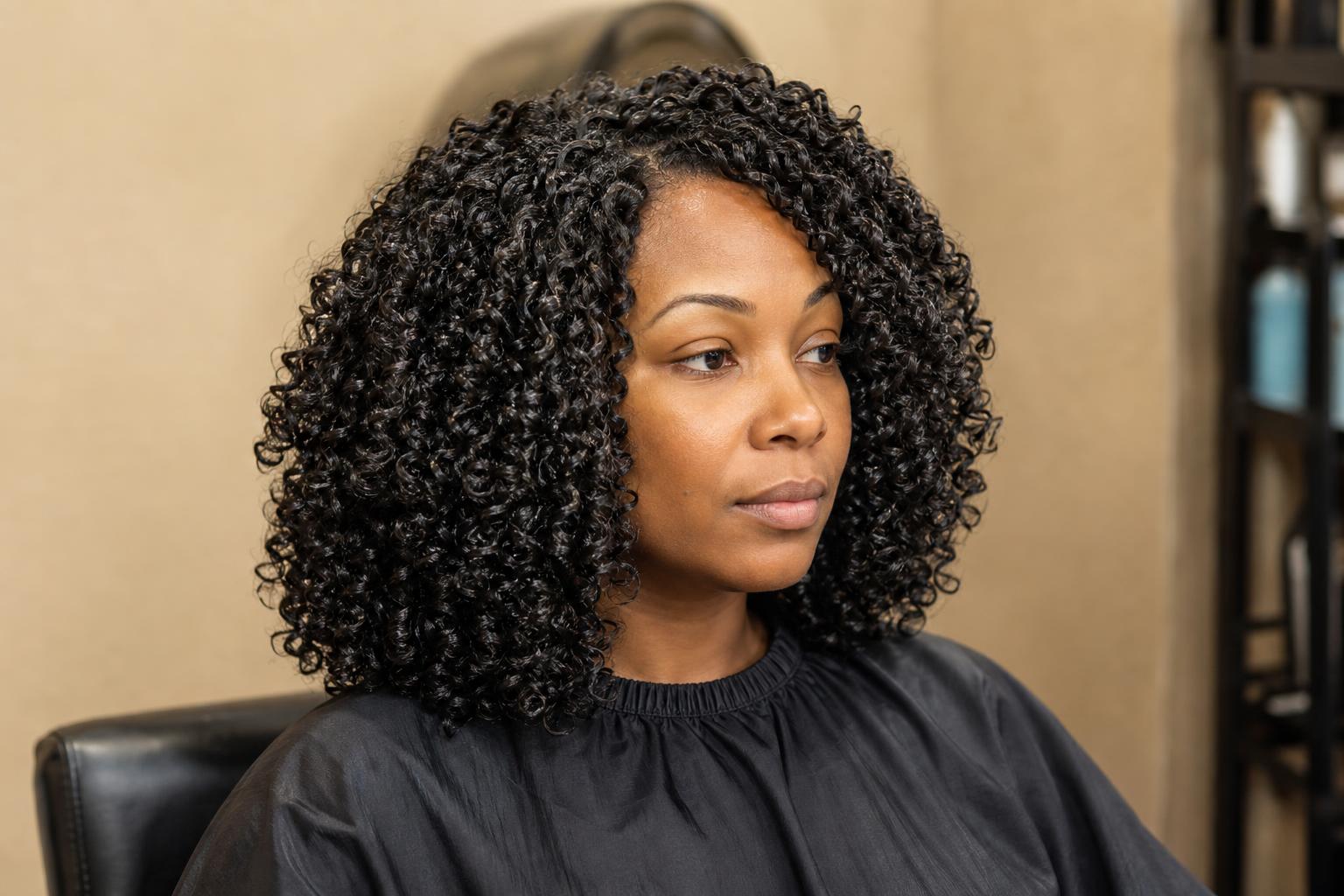
Pre-looped spiral curls at shoulder length are the standard first crochet install, and the one most salons quote when you book without specifying. Six to eight packs covers a full head. Separate each curl clump into two or three pieces after installing, or the style looks bulkier than the photo you brought.
2. Water Wave Crochet in Bulk Hair
Water wave bulk hair is looped in as loose lengths rather than pre-formed curls, so you control how much wave falls in each section. It gives the most natural result of any crochet texture and takes the longest of this group to install. Best on a circular base with no part at all.
3. Deep Wave Crochet Past the Shoulder Blade
The tighter S-pattern of deep wave holds its shape through more washes than loose spirals do, which makes it the better choice for a full eight-week wear. Longer lengths need an extra pack or two compared to shoulder length. Oval and heart face shapes carry the added volume at the bottom well.
4. Kinky Curly Crochet for a Natural Blend
Kinky curly fiber matches 4a to 4c natural texture closely enough that leaving your own edges out looks like one head of hair rather than an install. That blend is the whole point of this texture. Use a light leave-in on your own leave-out daily so the two textures stay consistent.
5. Beach Wave Crochet With a Side Part
A side part in a crochet install needs a dedicated base: the front section gets cornrowed toward the part line rather than straight back, so the hair falls away from it cleanly. Ask for this before the braiding starts, because it cannot be added afterward. Beach wave is loose enough that the part looks convincing.
6. Curly Crochet Bob With a Beehive Base
A chin-length curly crochet bob uses three or four packs and installs in about ninety minutes, making it the fastest full style on this list. Round faces do better with the bob ending just below the jaw than exactly at it. Trim the perimeter after installing, since pre-looped curls arrive at one blunt length.
7. Jumbo Curl Crochet for a Fast Install
Larger curl clumps looped in fewer, wider sections cut the install to under two hours and use fewer packs than tight curls of the same length. The trade is that jumbo curls separate visibly at the base as they loosen, so plan a four-week wear rather than eight.
Twist and Marley Crochet Styles
Pre-twisted crochet hair gives you the look of a twist style in a fraction of the time, since the twisting is already done and only the looping remains. These hang in a defined direction rather than falling outward, which means a straight-back base works and a beehive does not. Expect a visible parting line unless the base is zigzagged.
8. Havana Twists Looped in Pre-Twisted
Chunky pre-twisted Havana hair gives the thickest twist silhouette of this group and installs in roughly two hours. Six to eight packs is typical at shoulder blade length. The weight suits anyone whose own hair cannot support hand-twisted extensions.
9. Senegalese Twist Crochet With Sealed Ends
Senegalese twists arrive smoother and rope-like compared with Marley’s matte finish, and the ends come pre-sealed so no hot water dip is needed. Square faces benefit from the softer edge the rope texture gives around the jaw. Keep them off the face for the first few days while the base settles.
10. Marley Twist Crochet on a Zigzag Base
Marley hair has a matte, coily finish that blends into natural texture better than any other twist fiber. A zigzag cornrow base matters more here than elsewhere, because the matte fiber does not reflect light and straight rows look like stripes. Our collection of two-strand twist styles done by hand is worth comparing if you want the same look installed traditionally.
11. Passion Twist Crochet in Water Wave Fiber
Crocheting pre-made passion twists takes about two hours against six or more for the hand-twisted version, and the finished look is close enough that most people cannot tell. The difference appears at week four, when crocheted twists start rotating at the base. The hand-installed passion twist method and the fiber it needs holds longer if you have the time.
12. Spring Twist Crochet at Shoulder Length
Spring twists are light, springy and short enough that the base barely carries any weight, which makes this the gentlest style here on the hairline. Five packs covers shoulder length. A good option for a first install or for anyone coming out of a heavier style. Spring twist styling and wear times apply the same way whether they are crocheted or installed by hand.
13. Two-Tone Twist Crochet With Honey Ends
Mixing two pack colors, dark at the top and honey through the bottom half, gives dimension that a single-color install cannot. Loop the lighter packs into the lower rows only rather than alternating throughout. Warmer honey tones suit deeper skin better than ash blonde, which can go flat against warm undertones.
Faux Locs and Braided Crochet Styles
Loc and braid styles are where crochet saves the most time, since a hand-installed set of faux locs can run eight hours or more. The pre-made versions loop in at about a quarter of that. These are the heaviest styles in the crochet range, so the base has to be braided firmly enough to hold the weight without being tight at the hairline.
14. Crochet Faux Locs in a Distressed Finish
Pre-made distressed locs arrive already frayed and wrapped, so the install is pure looping and finishes in two to three hours. Twenty to thirty locs is a full head at medium thickness. Ask for the front row to be attached to a deliberately loose cornrow, because loc weight concentrates at the hairline.
15. Butterfly Locs Looped in Pre-Made
Butterfly locs get their looped, airy texture from the wrapping technique rather than from the fiber, and the crochet version copies it closely. They are lighter than distressed locs of the same length. Compare against the hand-wrapped butterfly loc method if you want the loops placed exactly where you choose.
16. Goddess Locs With Curly Ends Left Out
Locs with a curly end and a few curly pieces along the length soften a style that otherwise falls in straight columns. Order packs with the curl already attached rather than adding it after, which never blends convincingly. Longer soft loc installs and their wear limits follow the same weight rules.
17. Pre-Looped Box Braid Crochet
Pre-braided box braids looped through a base give the box braid silhouette in about two hours instead of six to eight. The giveaway is the top inch, where the braid meets the loop rather than starting at the scalp. Wear a middle part or a headwrap style for the first week while the base settles into place.
18. Knotless-Look Crochet Braids to Mid-Back
Packs sold as knotless-style crochet have a tapered top that lies flatter against the base than a standard pre-looped braid. It is the most convincing braided crochet available and costs more per pack accordingly. Mid-back length needs eight to ten packs.
Short, Straight and Styled Crochet Looks
Short and straight crochet are the hardest textures to install well, because there is no curl or twist pattern to break up the rows and hide the knots. Both need the zigzag base and the invisible knot method described further down. Done properly they give the most versatile result in the whole crochet range.
19. Short Crochet Curls Above the Shoulder
Cropped curly crochet uses three packs, installs in about an hour and carries almost no weight, which makes it the lowest-commitment protective style available. Heart and diamond face shapes gain from the volume gathering at cheekbone level. Fluff the crown with your fingers each morning rather than combing.
20. Straight Crochet Hair With a Middle Part
Straight crochet hair shows every row and every knot, so it needs a zigzag base and a part section cornrowed toward the middle line. Done right it passes for a sew-in. Done on a straight-back base it is immediately obvious, which is why most salons quietly steer clients away from straight crochet.
21. Crochet Pixie With Tapered Sides
A crochet pixie uses one or two packs of short curly hair, cut and shaped after installing rather than before. The sides get tapered with scissors against the head. It is the only crochet style that genuinely needs a stylist to finish, since the shaping is a real haircut.
22. Crochet Updo Gathered Into a High Bun
Gathering a curly crochet install into a high bun works only if the base cornrows run toward the crown rather than straight back, because the rows become visible at the nape when everything is pulled up. Decide on updos before the base is braided. Keep the gather loose, since a high bun loads the whole install onto the front rows.
The Cornrow Base Decides How Crochet Braids Look
This is the decision that separates a crochet install that passes for hair from one that passes for a wig cap. The base is braided first, it cannot be changed once the looping starts, and it fixes where the hair falls, whether a part is possible, and whether the rows show through. Choose the base from the style you want, not from what is fastest to braid.
| Base Pattern | What It Allows | Best For | Weakness |
|---|---|---|---|
| Straight back | Hair falls backward in defined rows | Twists, locs, braided crochet | No parting, and rows show on straight hair |
| Beehive or circular | Hair falls outward in every direction | Curly and wavy textures worn loose | Cannot be gathered up without the spiral becoming visible |
| Zigzag rows | Breaks the straight line between rows | Straight hair, Marley twists, anything matte | Takes longer to braid than straight back |
| Straight back with a part box | A genuine middle or side part | Any style worn with a visible part | Must be specified before braiding starts |
| Braided toward the crown | Updos, high buns, gathered styles | Anyone who wears hair up most days | Looks wrong worn down for long |
Stylist tip: Tell your braider how you intend to wear it, not just which hair you bought. “Down, no part, curly” and “up in a bun most days” need two completely different bases, and the conversation takes thirty seconds at the start and cannot be had at the end.
How Many Packs and How Long Each Style Takes
Crochet uses less hair than a comparable braided style because nothing is being wrapped around your own strands, and it is faster for the same reason. Pack counts below assume a full head with no leave-out. Add one pack if you are leaving your own edges and crown out, since the remaining area still needs full coverage.
| Style | Packs | Install Time | Realistic Wear |
|---|---|---|---|
| Short curly crop | 2 to 3 | 1 to 1.5 hours | 4 weeks |
| Curly bob | 3 to 4 | 1.5 to 2 hours | 4 to 6 weeks |
| Shoulder curls or waves | 6 to 8 | 2 to 3 hours | 6 weeks |
| Pre-twisted twists | 6 to 8 | 2 to 3 hours | 6 to 8 weeks |
| Faux locs | 20 to 30 locs | 2 to 4 hours | 6 to 8 weeks |
| Pre-looped braids to mid-back | 8 to 10 | 3 to 4 hours | 6 to 8 weeks |
The Knot Method Changes Whether the Knots Show
Every loop has to be secured somehow, and the method used decides whether you can wear a part, gather the hair up, or wear a straight texture at all. Most braiders default to whichever method they learned, so this is worth naming at the consultation. The standard knot is faster and the invisible method is tidier.
| Method | How It Works | Use It For |
|---|---|---|
| Standard knot | Loop pulled through and tied once around the cornrow | Curly and coily textures that hide the knot anyway |
| Invisible or folded | Loop folded flat against the base and secured underneath | Straight hair, parted styles, anything worn up |
| Thread or sewn | Loop secured to the cornrow with needle and thread | Heavy locs, long installs, anything over six weeks |
Stylist tip: Ask for the invisible method on the front two rows even if the rest of the head is standard knotted. Those are the rows anyone actually looks at, and the extra ten minutes buys most of the benefit for none of the time cost.
What to Tell Your Stylist
Bring the four decisions, not just the hair. Crochet appointments go wrong when the client specifies the texture and the stylist guesses at everything else, and by the time the base is braided, three of the four are already locked in.
The sentence to bring: “Crochet install, water wave curly, beehive base with no part, invisible knots on the front two rows, and please keep the hairline cornrows loose.” Then confirm the pack count you brought is enough before the first cornrow goes in.
Ask whether they will trim the ends after installing. Pre-looped hair arrives at a single blunt length, and an untrimmed crochet install has a distinctive flat bottom edge that gives it away immediately. A five-minute shaping at the end changes the whole result, and not every stylist offers it unless asked. The same finishing principle applies to any long-wear protective style with added hair.
Washing, Wear and Takedown
Wash every two weeks, not weekly. Water loosens crochet knots faster than it loosens a braided anchor, because the knot relies on friction rather than on being wrapped around your own hair. Dilute a gentle shampoo in a squeeze bottle, apply it along the cornrow rows only, and let the runoff do the rest. Never scrub the loose extension hair.
Dry the base thoroughly, ideally with a cool blow-dryer on the cornrows themselves. Damp cornrows under a bonnet for several nights running are the main cause of scalp odor in crochet installs, and it happens faster here than in braided styles because the extension hair traps moisture against the base.
Takedown is where crochet earns back the time it saved. Cut each loop just below the knot with small scissors, well away from your own hair, then unravel the cornrows. It takes twenty minutes against the two or three hours a braided style needs. Take the install down at six to eight weeks depending on the style, and give your hair at least three loose days before anything goes back in.
When Crochet Braids Are Not the Right Choice
Crochet is the gentlest way to wear added hair for most people, because the tension rests on the cornrow rather than on individual strands. There are still situations where it is the wrong answer.
- Your hair is too short to cornrow. You need roughly two inches to braid a base that will hold. Below that, the cornrows slip and the whole install comes loose in a week.
- You want to wash your hair often. Anything more than every two weeks loosens knots, and a style that needs frequent washing will not last its six weeks.
- You want straight hair and the salon only braids straight back. Straight crochet on a straight-back base looks exactly like what it is. Either find someone who braids zigzag bases with invisible knots, or choose a curly texture.
- You have active scalp irritation or recent breakage at the hairline. The base still puts sustained tension on the front rows, even if it is less than a braided style would. Let the scalp settle first.
- You want the install to last three months. It will not. Crochet tops out at eight weeks, and stretching it past that means matting at the base and a much harder takedown. A feed-in Ghana braid install holds its structure longer if that is the priority.
FAQ
How Long Do Crochet Braids Last?
Four to eight weeks depending on the style, with curly textures on the shorter end and twists or locs on the longer. Short crops loosen fastest because the lighter hair moves more against the knot. Take them out at eight weeks at the latest, since the base starts matting after that and takedown gets considerably harder.
Are Crochet Braids Better for Your Hair Than Box Braids?
They are generally gentler, because the tension is spread across the cornrow base instead of pulling on individual strands at each braid. The install is also two to three times faster, which means far less time in the chair with your hair under tension. The one risk crochet adds is moisture trapped against the base, so drying properly after a wash matters more here than with box braids.
How Many Packs of Hair Do I Need for Crochet Braids?
Six to eight packs for a full head at shoulder length, three or four for a bob, and eight to ten for mid-back lengths. Faux locs are counted in individual locs rather than packs, with twenty to thirty covering a full head. Buy one spare pack from the same batch, because color and curl pattern vary between production runs.
Can You Wash Crochet Braids?
Yes, every two weeks, cleansing the cornrow base with diluted shampoo from a squeeze bottle rather than scrubbing the extension hair. More frequent washing loosens the knots and shortens the wear by weeks. Dry the base completely afterward, ideally with a cool dryer, because damp cornrows under a bonnet develop odor quickly.
Do Crochet Braids Look Natural?
Curly and coily textures do, because the curl pattern hides both the knots and the row lines. Straight crochet hair only looks natural on a zigzag base with invisible knots, and most installs do not use either. If a natural result matters more than the texture you had in mind, choose curly.
How Much Do Crochet Braids Cost Compared to Braids?
Usually well under half, because the install takes a third of the time and uses less hair. The labor saving is the bigger part of the difference. Pre-made loc and knotless-style packs cost more per pack than basic curly hair, which narrows the gap on those specific styles.
Can I Do Crochet Braids Myself?
The looping is genuinely learnable at home and the latch hook is inexpensive. Cornrowing your own base is the hard part, and an uneven base is visible through everything you loop into it. A practical middle ground is paying a braider for the base and doing the looping yourself over an evening.
Crochet braids are the fastest protective style available and one of the easiest to get wrong, and the difference is almost always the base rather than the hair. Decide how you want to wear it before you book, name the base pattern and the knot method at the consultation, and buy one spare pack from the same batch. The wider range of protective styles and braided looks is worth comparing if you are weighing crochet against a hand-installed alternative.
Hair results vary based on your natural hair type, texture, density, and condition. Always consult with a licensed hairstylist before making significant changes, especially with chemical treatments or dramatic length changes. Photos may show styled results that require professional tools and products to replicate.