
A middle part mullet is two separate decisions stacked on one head, and the part is the one your barber cannot fix after the fact.
A middle part mullet only holds its shape when the front sections reach at least jaw level. Anything shorter and the hair flips outward at the cheekbone instead of falling down beside the face, which is the single most common reason the cut looks wrong in the mirror a week later. The back, the sides and the fade are all adjustable later. Front length is not.
This guide covers the front-length minimum that makes the part work, the growth-pattern check to run before you book, the four versions barbers actually cut, how each one lands on different face shapes, the exact words to use in the chair, and the weeks where the grow-out gets awkward.
| Factor | Details |
|---|---|
| Front length needed | Jaw level at minimum; chin level is where most parts hold cleanly |
| Best for | Straight to loosely wavy hair, medium density, oval and square faces |
| Avoid if | You have a strong off-center crown whorl or a front hairline cowlick |
| Barber time | 35 to 50 minutes, longer if the sides are faded rather than tapered |
| Trim cycle | Sides every 4 to 5 weeks, front and back every 8 to 10 |
| Daily styling | 3 to 6 minutes, almost all of it spent training the part |
A Middle Part Mullet Is a Length Decision Before It Is a Part
The mullet wants weight at the back. The middle part wants weight at the front. Those two pulls are not in conflict on paper, but they are on a real head, because a mullet’s front sections usually get cut shorter to keep the shape from turning into a straight curtain. Cut them too short and you lose the part. That is the whole tension in this haircut, and everything else follows from it.
Hair falls down beside the face once its own weight overcomes the bend it picks up at the root. On most straight and wavy hair, that tipping point lands somewhere between the cheekbone and the jaw. Above the cheekbone the sections stand off the head and wing outward. At jaw level they hang. This is why a middle part looks effortless on longer hair and fights you constantly on short hair, and it applies to the front of a mullet exactly the same way.
Wavy hair needs a little more length than straight hair to reach the same tipping point, because the wave lifts the section before gravity gets hold of it. Add half an inch to whatever your straight-haired friend needed. Coarse, thick hair also needs more length than fine hair, since a thicker section springs back harder at the root.
Stylist tip: Before your appointment, push your hair flat down the center with wet fingers and look at where the front pieces stop. If they stop above your cheekbone, you are not ready for this cut yet. Grow it six to eight weeks and book then, because asking a barber to give you a middle part on hair that cannot reach means they will cut the back shorter to compensate, and you will end up with a shag instead.
Your Growth Pattern Decides Whether the Part Will Hold
The other half of this haircut has nothing to do with scissors. Every head has a crown whorl and most have at least one cowlick at the hairline, and both of them push hair in a fixed direction that no product overrides for a full day. A center part cuts straight through the middle of your head, which is exactly where those growth patterns are strongest. Some heads take a middle part with no argument. Others will drift back to a side part by lunchtime no matter what you do.
A Crown Whorl Off Center Pulls the Part With It
Find the spiral at your crown in a mirror with your phone camera. If it lands roughly on the center line of your skull, a middle part will track straight and stay put. If it lands noticeably to one side, the hair leaving that spiral fans across the top and lands on the opposite side, which drags the front part line off center within an hour or two. You can still wear this cut, but the honest version is a slightly off-center part that follows the whorl, and it looks better than a forced center line that keeps sliding.
A Front Cowlick Pushes One Side Across the Forehead
Cowlicks at the front hairline are more stubborn than crown whorls because they are right where the part begins. Wet the front, comb it straight back, and let it dry with no product. Whichever way the front inch throws itself is the direction that will win. A cowlick on one side of the center can often be beaten by drying the hair against it with a blow dryer for thirty seconds, but only if the front is long enough to weigh itself down afterward. Short hair plus a cowlick is a losing combination.
| What You Find | How the Part Behaves | What to Do |
|---|---|---|
| Centered crown whorl, no front cowlick | Holds all day with no product | Cut it as a true center part |
| Whorl one to two inches off center | Drifts within two hours | Shift the part to follow the whorl and leave it there |
| Front hairline cowlick | One side lifts and crosses the forehead | Grow the front to chin level so weight can hold it down |
| Double crown | The top splits on its own in two places | Keep the top longer so the two spirals blend under the weight |
| Very high front hairline | Part line runs long and draws the eye up | Ask for a shorter part that stops an inch behind the hairline |
The Four Middle Part Mullets Barbers Actually Cut
Photo galleries make this look like twenty different haircuts. In a barber chair there are four, and they differ by how much length lives at the front and how hard the sides are cut. Knowing which one you want turns a vague reference photo into a bookable request.
The Curtain Mullet Keeps the Front Longest
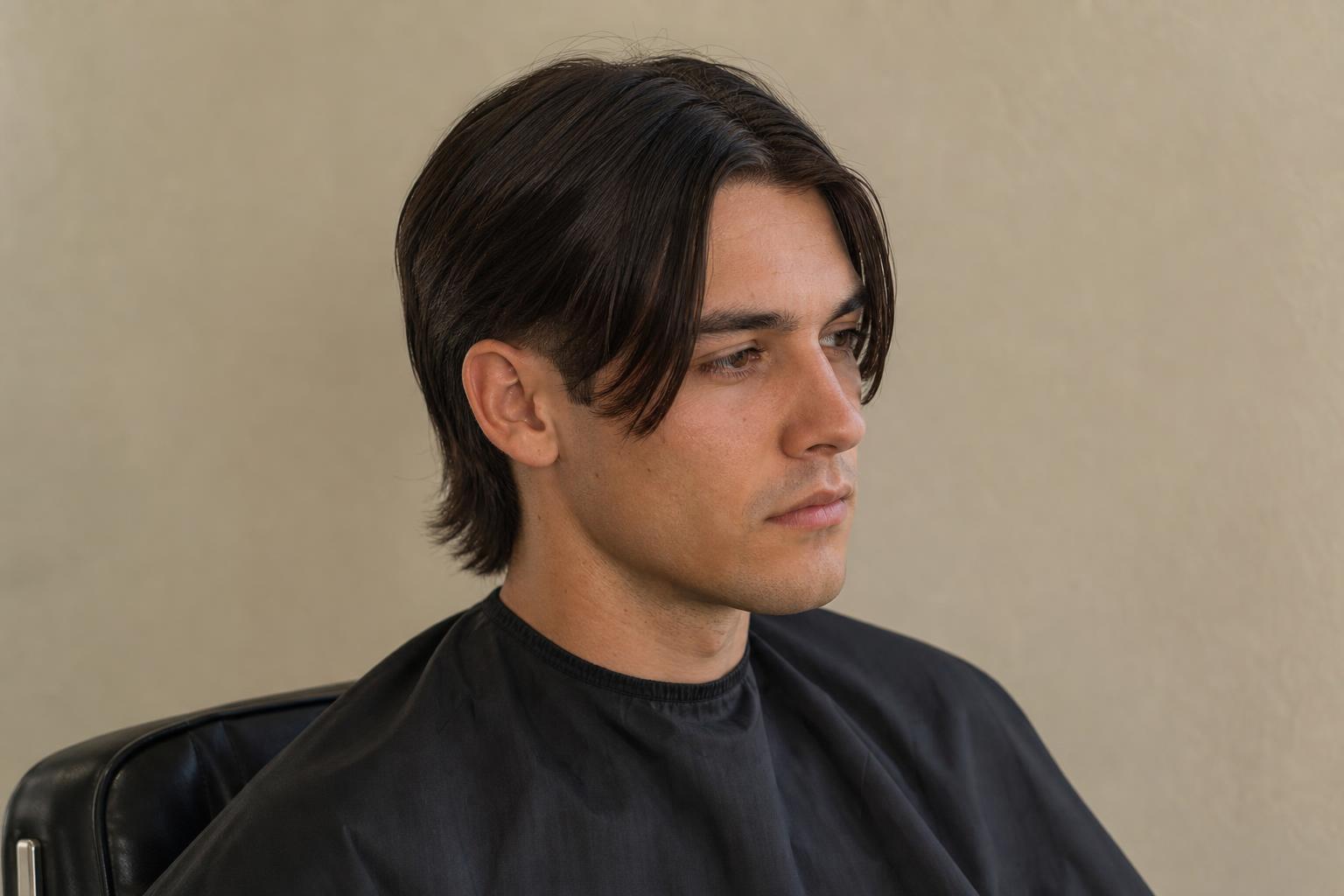
The front sections run to the jaw or past it and fall on either side of the face like a set of curtains, while the back is left long enough to cover the nape. Sides are tapered rather than faded so there is no hard line to interrupt the flow. This is the softest version and the one that holds a part most reliably, because there is real weight hanging on both sides. It borrows its front geometry straight from curtain styles for men and adds mullet length behind the ears.
The Tapered Middle Part Mullet Is the Workplace Version
Same front length, but the sides are taken down closer with a scissor taper or a low guard, and the back is trimmed to just brush the collar. Nothing is disconnected, so the whole cut blends when you push it back. Most men who want the shape without announcing it pick this one, and it is the easiest to grow out of if you change your mind in three months.
The Faded Middle Part Mullet Puts a Hard Edge Under the Length
Here the sides drop to a mid or low fade while the top and back stay long, which creates a visible step between the faded panel and the hair falling over it. It photographs sharply and it needs a barber every four weeks without fail, since a grown-out fade under a long top looks unfinished rather than relaxed. If you like that contrast, ask for the fade to stop below the temple so the step falls behind the length rather than in front of it.
The Short Middle Part Mullet Trades Curtain Length for Movement
Popularized through Korean barbering, this one keeps the front at cheekbone to jaw and relies on a slight inward bend rather than weight to keep the part open. It is the only version that works on hair too short for true curtains, but it is also the only version that genuinely needs a round brush most mornings. Skip it if you will not style.
| Version | Front Length | Sides | Daily Effort | Barber Every |
|---|---|---|---|---|
| Curtain mullet | Jaw to collarbone | Soft taper, nothing disconnected | 2 to 3 min | 8 to 10 weeks |
| Tapered | Jaw | Scissor taper or low guard | 3 to 4 min | 6 to 8 weeks |
| Faded | Jaw | Low or mid fade with a visible step | 4 to 5 min | 4 weeks |
| Short | Cheekbone to jaw | Tapered, kept tight above the ear | 6 to 8 min | 5 to 6 weeks |
How a Middle Part Mullet Lands on Different Face Shapes
A center part draws a vertical line down the middle of your face and drops two more lines on either side of it. That adds apparent height and takes away apparent width, which helps some faces and works against others. The mullet length at the back does not change any of this, so judge the part on its own before you judge the cut.
| Face Shape | Best Version | Where the Front Should Stop | Avoid |
|---|---|---|---|
| Oval | Any of the four | Jaw | Nothing structural; pick on lifestyle |
| Round | Curtain mullet | Past the jaw | Short version, which stops at the widest point |
| Square | Curtain or tapered | Just past the jaw corner | A hard fade that squares the head off further |
| Heart | Tapered | Chin | Heavy volume at the top of the head |
| Long or oblong | Short middle part mullet | Cheekbone | Curtain length, which adds more vertical line |
| Diamond | Faded, with width kept low | Jaw | Width at cheekbone height |
What to Tell Your Barber
Photos of this cut are usually styled with a dryer and a brush, so the reference alone will not get you there. Name the three measurements instead. Try this: “Keep the front long enough to reach my jaw when I comb it straight down. Taper the sides, do not fade them. Leave the back to the bottom of my collar. I want to wear it parted down the middle, so please check where my crown falls before you set the part line.”
Ask your barber to cut the two front sections to the same length while your head is upright, not tipped forward. Tipping the head forward stretches the front panel and makes one side land shorter when you straighten up, which is the mechanical reason so many center parts look uneven on one cheek. It takes ten extra seconds to check and it fixes the most common complaint about this cut.
Stylist tip: Ask for a light internal thinning through the crown, not the ends. The crown is where the two halves of a middle part fight each other, and removing a little bulk underneath lets the hair release into the part instead of standing up in a ridge along the center line. Thinning the ends instead makes the curtain look stringy within two weeks.
Styling and Maintenance Are Mostly About Training the Part
Set the part when the hair is wet, not dry. Comb the whole top straight back first, then draw the part with the tail of a comb and push each side down and slightly forward with your palm. Rough dry on medium heat with your fingers, pointing the airflow down the length rather than at the roots. That downward direction is what keeps the front from lifting later in the day.
Product should be light. A sea-salt spray or a soft cream gives the front enough grip to stay put without weighing the back down into a flat sheet. Skip pomade and wax here, because both of them glue the part open in a way that looks artificial from the front and greasy by evening. If your hair is fine and the part refuses to hold, one pass with a dryer against the growth direction for twenty seconds beats any product you can buy.
Grow-out is the honest downside. Weeks 5 through 7 are the awkward stretch, when the sides have caught up to the top and the whole shape puffs out sideways before the back gains enough length to balance it. Booking a sides-only trim at week 4 or 5 and leaving the front and back untouched carries you through that window, which is how most men wear this cut long term. Full detail on how the shape is built is in the step-by-step mullet cutting guide.
When a Middle Part Mullet Is Not the Right Choice
- A receding hairline at the temples. A center part runs a bare line straight into the thinnest area and widens it visually. Men in this position get more from a textured forward-facing crop, and the options in our guide to haircuts for a thinning crown address the same problem without the part.
- Tight curls at 3c and above. The part will open but the front sections will not fall, so the curtain effect never arrives. A curly mullet built on shape rather than a part is the better route.
- Hard hat, helmet or headset all day. Anything pressing on the top flattens the part into a crease that will not comb out until the next wash.
- Zero styling tolerance. Only the curtain version is close to wash and go. The other three need three to eight minutes every morning to keep the part where you set it.
- Very fine hair at low density. The part exposes scalp along the whole center line, which looks thinner than a side part on the same head.
Two Myths Worth Clearing Up
Myth: You Can Switch a Side Part Mullet to a Middle Part Whenever You Like
Reality: Not without a cut. A side part mullet is usually cut with one front section longer than the other so the sweep has something to travel with. Move that to the center and you get an obvious length difference between the two cheeks. Either commit to the center part at the appointment or accept a few weeks of uneven fronts while the shorter side catches up.
Myth: A Mullet Is Low Maintenance Because the Back Is Just Long
Reality: The back is the easy part. The sides on a mullet are cut close, which means they show grow-out at the same speed as any short men’s cut, roughly four to six weeks. What you save is styling time, not barber visits. The same is true of the modern mullet variations that look most relaxed in photos.
FAQ
How Long Does My Hair Need to Be for a Middle Part Mullet?
The front needs to reach your jaw when combed straight down, which is roughly five to six inches of length at the hairline on most men. From a short back and sides that is about six to nine months of growing, since hair averages around half an inch a month. The back and sides can be cut into shape at any point along the way, so you do not have to wait in a shapeless phase the whole time.
Will a Middle Part Mullet Work on Wavy Hair?
Yes, and wavy hair often carries it better than straight hair because the bend gives the front sections a natural inward curve. Add about half an inch to the front-length minimum, since waves take up length that straight hair would spend falling. Air drying with a curl cream and no brush gives the most natural result on a 2a to 2c wave.
Is a Middle Part Mullet the Same as a Wolf Cut?
No. A wolf cut is layered heavily through the crown so the top is shorter than the perimeter all the way around, while a mullet keeps length concentrated at the back with short sides. The middle part version of a mullet can drift toward a wolf cut if the barber layers the crown too heavily, which is worth naming out loud before they start. If you want the layered shape instead, our guide on how to ask for a wolf cut covers the wording for it.
Can I Get a Middle Part Mullet With a Skin Fade?
You can, and it produces the sharpest contrast of the four versions, but it locks you into a four-week barber cycle permanently. A skin fade grows into visible stubble by week three and the mismatch between fuzzy sides and a long top is more noticeable than on a standard fade. If you travel or cannot commit to a fixed schedule, a low taper gives ninety percent of the effect with half the upkeep.
Why Does My Middle Part Keep Sliding to One Side?
Almost always the crown whorl, occasionally a front cowlick. Both push hair in a fixed direction and neither responds to product for a full day. Shift your part line a half inch toward the whorl and it will usually hold on its own, which looks better than a perfectly centered line that migrates by noon.
Does a Middle Part Mullet Suit Older Men?
It suits any age where the hairline at the temples is still full, and that matters far more than the number. The tapered version with the front at jaw level is the most wearable across ages because there is no hard fade line and no exaggerated back length. Grey and salt-and-pepper hair actually holds a part better than dark hair, since the coarser texture of grey strands gives the section more grip.
How Much Should a Middle Part Mullet Cost?
Prices vary widely by city and by whether you see a barber or a stylist, so treat any single figure with caution. What matters more is finding someone who cuts long men’s hair regularly, because the front sections need scissor work over the fingers rather than clipper work. Browsing our men’s haircut guides and bringing two photos that show the same front length is the cheapest way to avoid a bad first attempt.
The middle part mullet asks for one thing before anything else, and that is front length you can actually hang a part on. Check your crown in a mirror, comb your front straight down to see where it stops, then book the version whose upkeep you will realistically keep. Bring one photo of the front and one of the back, because the two halves of this cut are decided separately in the chair.
Hair results vary based on your natural hair type, texture, density, and condition. Always consult with a licensed hairstylist before making significant changes, especially with chemical treatments or dramatic length changes. Photos may show styled results that require professional tools and products to replicate.