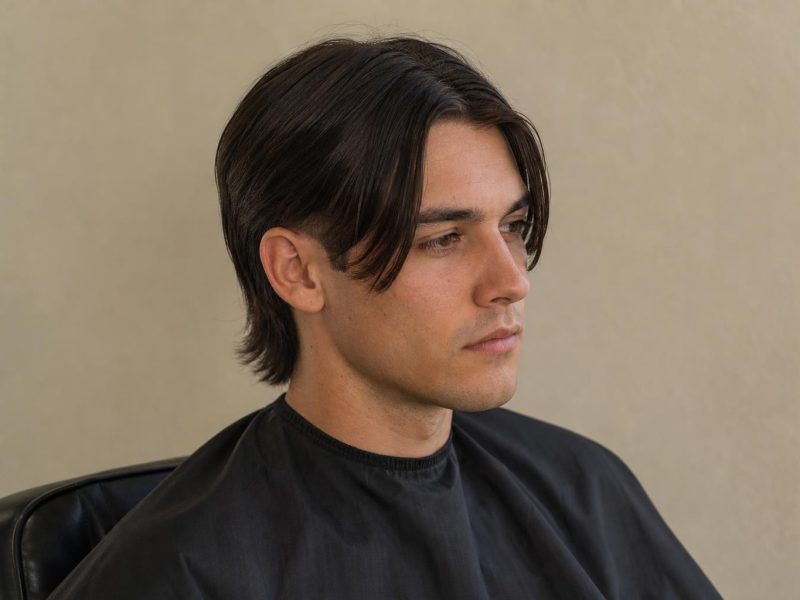

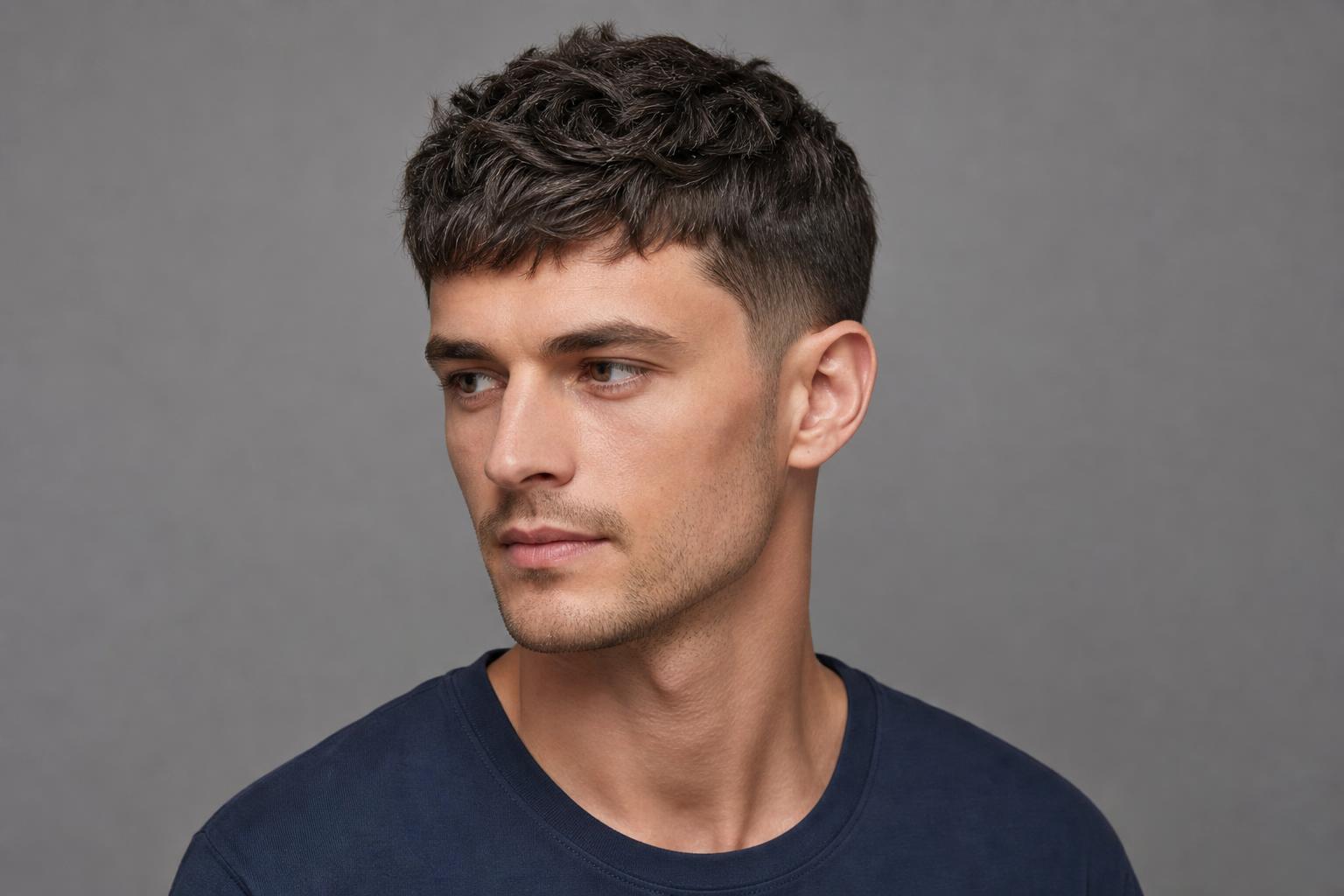
Nearly every short haircut works on an oval face, so the real choice comes down to your forehead, your hairline and how much height you put on top.
The best short haircuts for men with oval faces are the crew cut, textured crop, buzz cut and short side part, because an oval face is already about one and a half times longer than it is wide with no hard angles, and none of these cuts has to correct anything. The one real mistake is height: a quiff or pompadour taller than about 1.5 inches stretches the face and loses the balance that makes an oval shape easy to cut.
Below are 20 short cuts grouped from clipper-short up to textured and curly styles, each with top length and guard numbers, followed by a forehead and hairline table, the exact wording for your barber and a maintenance chart. For short cuts across every face shape and hair type, start with our guide to choosing a short haircut for men.
| Cut Family | Length on Top | Sides | Barber Every |
|---|---|---|---|
| Buzz and clipper cuts | 1/8 to 1/2 inch | Same guard or a fade | 2 to 3 weeks |
| Crew and Ivy League | 1 to 2 inches | Number 2 to 3 taper | 3 to 5 weeks |
| Crops and fringes | 1 to 2.5 inches, forward | Mid or high fade | 3 to 4 weeks |
| Quiffs and side parts | 2 to 2.5 inches at the front | Number 2 to 3 or a fade | 4 to 5 weeks |
| Curly and coily short cuts | 1/2 to 2 inches | Taper or drop fade | 2 to 4 weeks |
Buzz Cuts and Clipper Cuts
On an oval face a buzz cut hides nothing, and it does not need to. The balanced length and width that define an oval face are exactly what a very short cut puts on display, so the deciding factors are the shape of your skull, any scars and the line of your hairline rather than the face itself.
1. Even Number 3 Buzz Cut
One guard, one length: a number 3 leaves 3/8 inch all over, enough to cover the scalp on most dark hair. The barber runs the clipper against the grain across the whole head, then fades the neckline by hand so it does not end in a hard shelf. Our buzz cut guide shows how each guard length looks on different hair colors.
2. Burr Cut With a Skin Fade
Oval faces are one of the few shapes that can go down to a number 1 on top without looking narrow or long. A burr cut keeps the top at a number 1 or 2 and fades the sides down to bare skin, which puts the jawline and cheekbones front and center. Skip it if the back of your head is flat, since there is no length left to round it out.
3. Butch Cut With a Squared Front
Thick, coarse hair that grows straight up is the ideal match for a butch cut, because a number 4 on top stands evenly and holds a flat, squared outline. Fine hair at the same length lies down and looks patchy.
4. Buzz Cut With a Sharp Line-Up
All the styling happens at the barber: after a number 2 all over, the trimmer squares off the forehead line, the temples and the edges around the ears. A weekly touch-up with a detail trimmer at home keeps it crisp for two weeks between visits. It suits men with a straight, full hairline, since a sharp line drawn along receding temples points straight at them.
Crew Cuts and Ivy League Cuts
A crew cut leaves the top slightly longer at the front and tapers the sides; an Ivy League is the same shape left long enough to part. Both are the safest short cuts for an oval face because they add a little shape on top without changing its proportions.
5. Classic Crew Cut
Plan on a barber visit every 3 to 4 weeks. Hair grows roughly half an inch a month, so by week five the front loses its lift and the sides turn fuzzy over the ears. The cut itself is a number 2 or 3 on the sides with about an inch on top, graduating from slightly longer at the hairline to shorter at the crown, and it needs no product at all.
6. Ivy League With a Side Part
Salt-and-pepper hair looks its best in an Ivy League, where the longer top lets the mix of dark and white strands show instead of cropping it into flat gray. The top stays at 1.5 to 2 inches, combed to a natural side part over a number 3 taper. A light matte cream holds the part without the shine that makes gray hair look greasy.
7. Crew Cut With a Low Taper
Ask for “a crew cut, number 3 on the sides with a low taper at the ears and neckline, an inch at the front going shorter toward the crown.” The low taper keeps more hair around the temples, a softer finish for men who dislike the hard outline of a fade. Bring a photo taken from the side, because taper height is where most crew cuts go wrong.
8. Textured Crew Cut on Thick Hair
Unlike a classic crew cut, which is clippered to a smooth, even top, this version is scissor-cut and point-cut so the top breaks into short separate pieces. The difference matters most on thick hair, where a smooth crew turns into a dense block after two weeks of growth.
Textured Crops and Forward Fringes
Crops push hair forward over the forehead. On an oval face that covers part of the forehead and shortens the face slightly, so they work best on men with a medium or tall forehead and are worth skipping if yours is already short.
9. Textured Crop With a Mid Fade
Point cutting and texturizing shears break the top into choppy pieces 1.5 to 2.5 inches long, while a mid fade clears the sides up to about the temples. The fringe is cut to land an inch or more above the brows. Top-length options and the cutting sequence are in our textured crop haircut guide.
10. French Crop With a Blunt Fringe
A straight horizontal fringe is the one element that visibly shortens a face, which makes the French crop a smart pick for an oval face that leans long. Keep the fringe at mid-forehead, because a fringe cut just above the eyebrows can make a well-proportioned face look squashed. For different fade heights and fringe weights, browse these French crop styles.
11. Short Caesar Cut
Straight or slightly wavy hair that lies flat without product gives the cleanest Caesar, since the top is cut short and even and brushed forward. Very curly hair springs up out of the forward shape unless it is kept under an inch. On an oval face the short, level fringe keeps everything in proportion with almost no styling.
12. Messy Crop on Wavy Hair
Scrunch a little sea salt spray into damp hair, rough-dry it with your fingers pushing the front forward, then twist a few pieces with a pea-sized amount of matte clay. The whole routine takes about three minutes and lets natural wave do most of the work.
Short Quiffs, Side Parts and Slick Backs
Styles that lift hair up and away from the forehead show the whole face, which is fine on an oval shape with one limit: keep the height under about 1.5 inches. Anything taller adds length to a face that does not need it.
13. Short Quiff
A quiff needs the most daily work in this list, around five minutes with a blow-dryer and a light cream, plus a trim every 4 to 5 weeks before the front grows too heavy to lift. The top is left about 2.5 inches at the front and shorter toward the crown, with a number 2 or 3 on the sides. Our guide on how to ask for a quiff lists the exact front and back lengths to request.
14. Hard Part Side Part
Dark hair makes the most of a hard part, because the shaved line stands out against the color; on blond or light gray hair it nearly disappears within a week. The barber shaves a thin line where your natural part falls and keeps 2 inches on top over a mid taper.
15. Short Slick Back With a Taper
Say “about two inches on top so it can comb straight back, number 2 taper on the sides, and please don’t thin out the top.” Thinning shears remove the weight that helps slicked hair lie flat. A water-based pomade gives the shine and rinses out without the buildup of oil-based versions.
16. Low Short Pompadour
Compared with a classic pompadour, which rolls up to 3 inches or more at the front, this short version stops at about 1.5 inches, so the face keeps its length-to-width balance. The sides are faded, and the shape comes from the contrast between tight sides and a rounded front. It is one of the more striking cuts here for how little height it actually uses.
Short Cuts for Curly and Coily Hair
Curly and coily hair builds width on its own, and that fullness at the sides suits an oval face well. The cuts below keep the texture visible while holding the outline tight enough to look sharp for two to four weeks.
17. Curly Top With a Drop Fade
Curls are cut dry with scissors to about 2 inches so the barber can see each one at its natural resting length, then the fade drops behind the ear so the back stays fuller. Cutting curls wet makes it hard to predict how short they will spring up. More curl-specific shapes are in our collection of haircuts for men with curly hair.
18. Short Sponge Twists With a Taper
On an oval face, the even, rounded texture of sponge twists keeps the head shape balanced without adding height. The top is left 1 to 1.5 inches and twisted with a sponge brush, with the sides tapered down to a number 1. For more coily cuts from fades to Caesars, see our list of short hairstyles for Black men.
19. 360 Waves on a Low Caesar
Coarse, coily hair cut to about half an inch is what forms waves, which take daily brushing and a durag at night for four to six weeks before the pattern sets. The Caesar shape keeps the hairline low and straight.
20. Short Textured Cut for a Thinning Crown
Keep the top at about an inch and style it forward and slightly messy with a matte paste; slicked or parted hair separates and exposes the scalp at the crown. A number 2 on the sides reduces the contrast between full sides and a sparser top. Most men with early thinning find this length hides more than growing the top longer.
How to Tell If Your Face Is Really Oval
Pull your hair back and look straight into a mirror. An oval face is about one and a half times as long as it is wide, widest at the cheekbones, with a forehead slightly wider than a rounded jaw. If length and width are close to equal, your face is round, and our guide to hairstyles for men with round faces will suit you better. A jaw as wide as the forehead with sharp corners points to square, and a face nearly twice as long as it is wide is oblong, where the fringes in this list matter more and quiffs should stay very low.
Your Forehead and Hairline Decide the Short Cut
Because an oval face has no proportion to fix, the forehead and hairline do the deciding. A tall forehead welcomes a fringe, a short one wants hair lifted away, and a receding hairline changes which lines you should avoid drawing.
| Forehead and Hairline | Best Short Cuts | Avoid |
|---|---|---|
| Tall forehead, full hairline | Textured crop, French crop, Caesar | Slick backs and quiffs that expose the whole forehead |
| Medium forehead, full hairline | Any cut on this list | Fringes low enough to hide the brows |
| Short forehead | Crew cut, short quiff, side part, slick back | Heavy forward fringes that shorten the face further |
| Receding temples | Textured crop, Caesar, number 2 to 3 buzz | Sharp line-ups and hard parts that trace the recession |
| Thinning crown | Short textured top, buzz cut | Slick backs and quiffs that split at the crown |
| Strong cowlick at the front | Crop styled in the cowlick’s direction, buzz cut | Blunt straight fringes that split open |
What to Tell Your Barber
Barbers work in guard numbers and inches, so give them both. On standard clipper guards, a number 1 leaves 1/8 inch, a 2 leaves 1/4 inch, a 3 leaves 3/8 inch and a 4 leaves 1/2 inch; our hair clipper size chart runs through the full range. Cover these four points in one sentence each:
- Top: the length in inches and whether you want it cut with scissors or clippers.
- Sides: the guard number plus the fade or taper height, low (just above the ear), mid (at the temple) or high (where the head starts to curve).
- Neckline: blocked (square), rounded or tapered, which grows out the most gracefully.
- What you do not want: for example “no thinning shears on top” or “don’t push my hairline back with the line-up.”
Stylist tip: Describe how you style your hair on an ordinary weekday, not how you want it to look in the chair. A quiff cut for someone who never picks up a blow-dryer becomes a flat, heavy fringe by day two, while a crop cut for the same man looks right with thirty seconds of paste.
Maintenance by Cut
Shorter is not always less work. Buzz cuts need no styling but lose their outline fastest, while short quiffs can go longer between cuts and ask for more time at the mirror.
| Cut | Barber Every | Daily Styling | Product |
|---|---|---|---|
| Buzz or burr cut | 2 to 3 weeks | None | Sunscreen on the scalp outdoors |
| Crew cut or Ivy League | 3 to 5 weeks | 0 to 2 minutes | Light matte cream |
| Textured or French crop | 3 to 4 weeks | 2 to 3 minutes | Matte clay or paste |
| Short quiff or pompadour | 4 to 5 weeks | About 5 minutes | Pre-styling spray plus cream or pomade |
| Hard part or slick back | 3 to 4 weeks, part line every 2 | About 3 minutes | Water-based pomade |
| Sponge twists or waves | 2 to 3 weeks | 5 to 10 minutes of brushing | Moisturizer and wave pomade |
Stylist tip: Growing from a buzz cut into a crop or quiff? Ask for sides-only tidy-ups for the first six to eight weeks and leave the top untouched. Most men give up on a grow-out because the barber trims the top each visit out of habit.
When a Short Haircut Is Not the Best Choice
An oval face handles short hair well, but other features can make a longer cut the better call.
- Ears that stick out: short, faded sides expose them fully, so keep the sides at a number 4 or longer, or have them scissor-cut.
- A flat back of the head or visible scars: very short clipper cuts show both, while an inch or more of length on top and at the crown hides them.
- A tall forehead with a receding hairline you want covered: a slightly longer textured fringe does more, and our receding hairline haircut guide covers which fringes help and which draw attention.
- No time for a barber every three to four weeks: medium-length cuts with scissor-cut sides can stretch to six or eight weeks, which short fades cannot.
FAQ
What Is the Best Short Haircut for an Oval Face Male?
A crew cut or a textured crop is the best all-round short haircut for an oval face. Both keep the face’s natural proportions and need only a minute or two of styling. Pick the crop if your forehead is tall and the crew cut if it is short.
Does a Buzz Cut Look Good on an Oval Face?
Yes, a buzz cut suits an oval face better than most other shapes. With no angles or width to balance, the face looks proportioned even at a number 1 or 2. The shape of your skull and your hairline matter more than your face shape here.
Should Men With Oval Faces Wear a Fringe?
A fringe is optional on an oval face and works best when your forehead is tall. Keep it at mid-forehead or higher, since a fringe resting on the brows can make a balanced face look shorter and heavier. Men with short foreheads usually look better with hair lifted up and back.
How Short Can I Go on the Sides With an Oval Face?
You can go all the way to a skin fade on the sides with an oval face. Short sides do not make an oval face look long, as long as the top stays under about 1.5 inches of height. If your ears stick out, stay at a number 3 or 4 instead.
Can a Short Haircut Make an Oval Face Look Longer?
Yes, a short haircut with too much height on top, such as a tall quiff or pompadour, can make an oval face look longer. Tight faded sides under a tall top exaggerate the effect. Keeping the top low or styling it forward avoids it.
How Often Should I Get a Short Haircut?
Most short haircuts need a barber every 3 to 4 weeks. Buzz cuts and skin fades lose their outline sooner, at 2 to 3 weeks, while crew cuts with a low taper can stretch to 5 weeks. Book your next visit before the sides start covering the tops of your ears.
Short haircuts for oval faces give men more freedom than any other face shape, which is why the details matter more than the cut name. Check your forehead height and hairline, keep height on top modest, and give your barber a guard number, a top length in inches and a side-view reference photo so the cut you walk out with matches the one you pictured.
Hair results vary based on your natural hair type, texture, density, and condition. Always consult with a licensed barber or hairstylist before making significant changes, especially with dramatic length changes. Photos may show styled results that require professional tools and products to replicate.