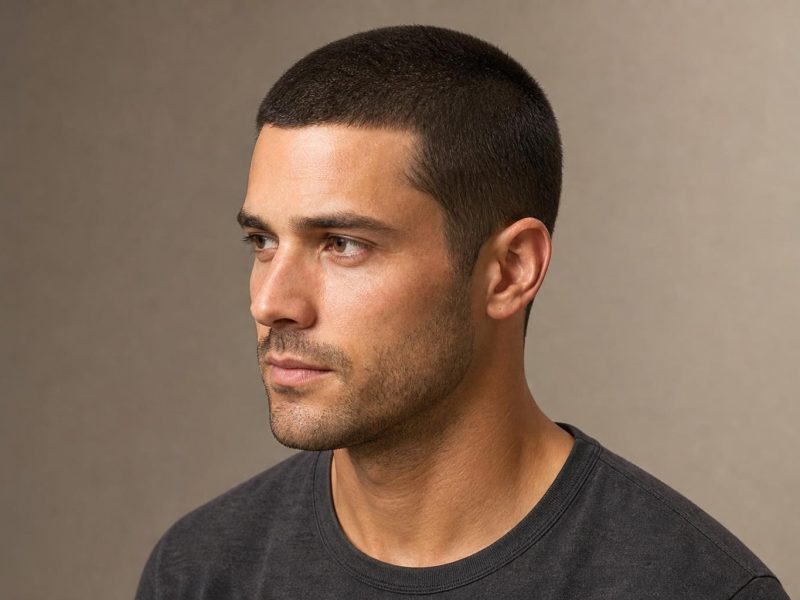

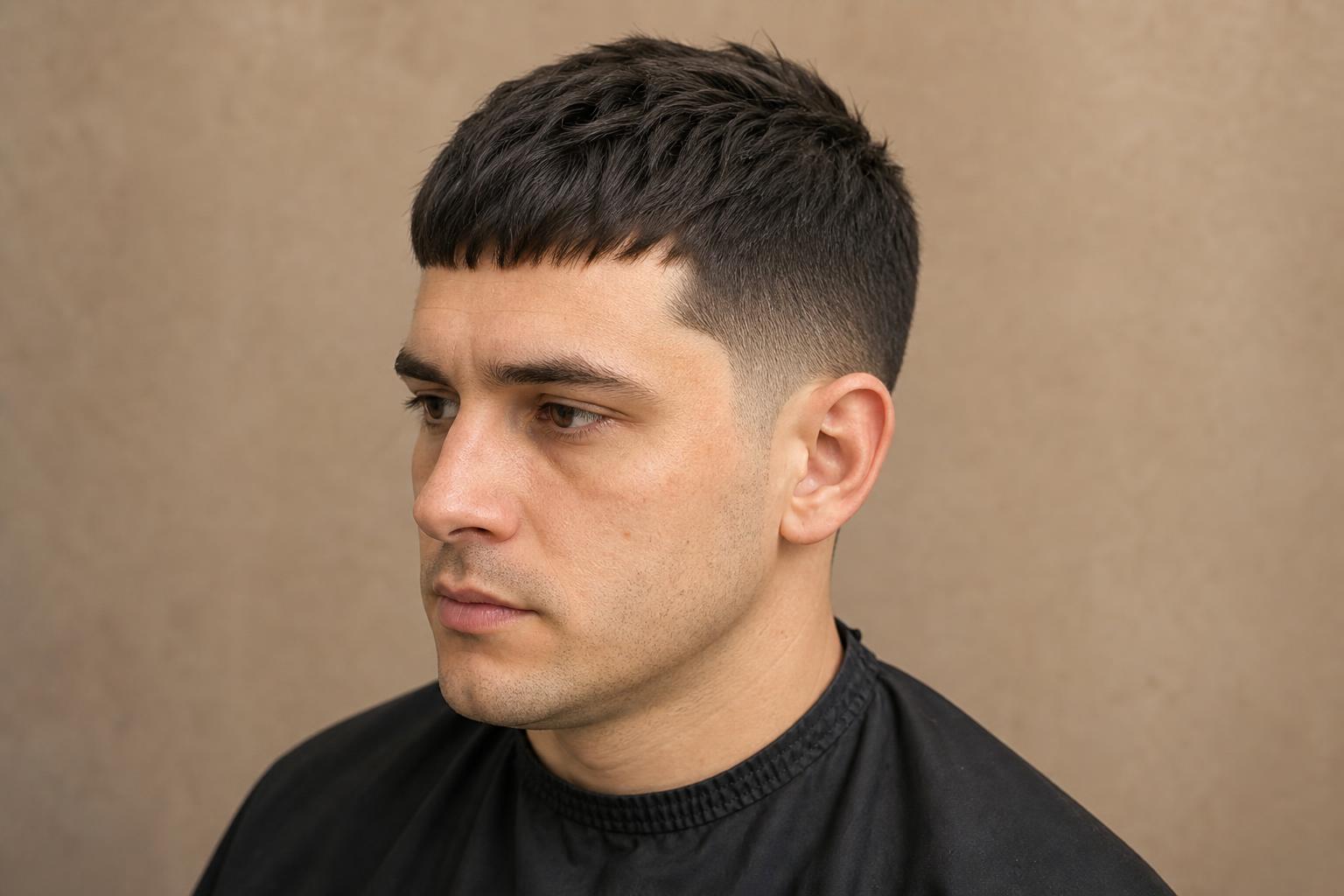
The Caesar is the shortest and bluntest of the three forward-fringe cuts, which is exactly why it grows out better than the other two.
A Caesar haircut is a short cut with one to one and a half inches of hair on top, brushed forward into a straight, blunt fringe that ends high on the forehead, over sides that are tapered or faded shorter. It differs from a French crop by being shorter all over with a flatter, less textured fringe, and from a textured crop by having almost no choppiness on top. It suits thick straight hair, coily hair worn with waves, and hairlines that have started to recede.
The 20 versions below are grouped by side treatment and hair type, from the classic scissor Caesar through faded, coily and thinning-hair versions. After the gallery you will find a table separating the Caesar from the French crop and textured crop by the numbers, a guard-number guide, a face shape table, the exact words to use in the chair, and how the cut got its name.
| Factor | Details |
|---|---|
| Top length | 1 to 1.5 inches, the same length from crown to fringe |
| Fringe | Straight and blunt, ending on the upper third of the forehead |
| Sides | Scissor taper, or a number 1 to 4 guard faded up |
| Morning styling | Under a minute: brush forward, small amount of matte product |
| Barber cycle | 3 to 4 weeks with a fade, 5 to 6 with a scissor taper |
| Avoid if | You have a strong cowlick at the front hairline or a long, narrow face |
Classic Caesar Cuts with Scissor Sides
The original Caesar is cut almost entirely with scissors, so there is no clipper line anywhere. The top and sides are close in length, and the whole shape is round and even. It is the most conservative version and the easiest to grow out.
1. Scissor-Cut Classic Caesar
The top is cut to about an inch and a half, layered so it lies flat and forward, and the sides are tapered by hand to around three quarters of an inch. Because nothing is faded, the cut looks tidy for five or six weeks. This is the shape George Clooney made famous in the 1990s.
2. Short Caesar with a Rounded Neckline
Oval and heart-shaped faces carry the shortest version well, with just an inch on top and a softly rounded neckline at the back. The rounded nape keeps the outline soft as it grows. Ask for the fringe to end about an inch and a half above the brows.
3. Caesar with a Slightly Longer Fringe
Leaving the front half inch longer than the rest of the top lets the fringe rest lower on the forehead. It helps men with a high forehead who find the classic Caesar too exposed. The difference is small in inches but obvious in the mirror.
4. Grey Caesar with a Soft Taper
Grey and salt-and-pepper hair shows the even texture of a Caesar more than dark hair, since the lower contrast against the skin softens every edge. A soft scissor taper, rather than a fade, keeps the grey looking deliberate and polished.
Caesar Cuts with a Fade or Taper
Adding a fade to the sides turns the Caesar from a classic cut into a sharper, more current one. The top stays the same, but the contrast between the short sides and the forward fringe becomes the focus. The trade-off is that a fade needs refreshing more often.
5. Caesar with a Low Fade
Unlike a mid or high fade, a low fade only starts just above the ear, so most of the side stays full enough to frame the fringe. It is the gentlest way to add a fade without losing the Caesar’s rounded shape. Book every three to four weeks to keep the gradient clean.
6. Caesar with a Mid Skin Fade
Ask for a mid skin fade blended to a number 2 at the parietal ridge, with the top left at an inch and a quarter. The skin at the temples makes the forward fringe look heavier by comparison.
7. High Fade Caesar
Round faces benefit from the high fade, since clearing the sides almost to the top of the head adds height and removes width. Keep the fringe short so the top does not look like a cap. It is the most dramatic of the faded versions.
8. Caesar with a Drop Fade
The fade curves down behind the ear toward the nape, following the natural shape of the head. That curve softens the outline from the side and suits men who find a straight fade line too harsh.
9. Caesar with a Taper and Hard Line-Up
A crisp line-up at the forehead and temples frames the fringe with a sharp edge. On straight hair this needs a very steady hand, because the fringe falls onto the line. Expect to have the line-up refreshed every two weeks.
The Caesar on Coily and Wavy Hair
In many Black barbershops, the Caesar is one of the most requested cuts. On coily hair the top is cut shorter and even, often with a brush-trained wave pattern, and the front is shaped with a line-up rather than a fringe. The shape is the same idea: short, even, and rounded.
10. Caesar with 360 Waves
Keep the top at a number 1 or 2 guard, brush daily in the direction of growth, and wear a durag at night to train the pattern. The even length of a Caesar is what lets waves form across the whole head. The first clear waves usually take several weeks of consistent brushing.
11. Caesar with a Taper Fade on Coily Hair
Tell your barber you want a Caesar on top with a taper fade at the temples and nape only. The afro taper fade shows the same side treatment on longer tops if you want to grow it out later.
12. Caesar with a Sharp Line-Up and Beard
Square jaws work especially well here: the beard is shaped to match the line-up at the temples, so the two frame the face in one continuous outline. The top stays at a number 1 so the line-up does the visual work.
13. Low Caesar on 4C Hair
Very tight coils look fuller at a short, even length than at a longer one, because they shrink and clump. A number 1 guard all over the top, with a gentle taper at the sides, gives a clean, uniform surface. Moisturize the scalp with a light oil to prevent flaking.
14. Wavy Caesar on 2B Hair
Wavy hair tends to lift at the fringe in a Caesar, so the barber should thin it slightly with point cutting to make it lie flat. A light cream, rather than a clay, keeps the waves soft without puffing.
Caesar Cuts for Thinning Hair and Receding Hairlines
The Caesar has a long history as a cut for thinning hair, since combing the top forward covers the temples and front hairline. Kept short and matte, it hides a receding hairline better than almost any other cut.
15. Caesar for a Receding Hairline
The forward fringe falls over the temple recession, blurring where the hairline has moved back. Keep the fringe blunt and slightly heavier at the corners. More options by stage of recession are in our guide to the best haircuts for a receding hairline.
16. Caesar for a Thinning Crown
Salon-wise, the most important instruction is to keep the crown the same length as the rest of the top. A shorter crown shows more scalp, while an even length disguises it. A matte clay, never a pomade, keeps the surface from reflecting light.
17. Caesar with a Number 2 Top
When hair is thinning across the whole top, the shortest Caesar at a number 2 guard reduces contrast between hair and scalp. It falls halfway between a Caesar and a buzz cut, and it is the lowest-maintenance version on this list.
Textured and Modern Caesar Variations
These versions borrow a little texture or length from the crops on either side of the Caesar. They are still recognizably a Caesar, with a short, forward fringe, but with more movement on top.
18. Lightly Textured Caesar
Point-cutting the top adds slight separation without the choppiness of a textured crop. Work a pea-sized amount of matte paste through dry hair with fingertips and push it forward.
19. Caesar with a Curved Fringe
Instead of a straight horizontal line, the fringe curves slightly down toward the temples. That curve softens a square or angular face, and it grows out more naturally than a dead-straight edge.
20. Messy Caesar for Thick Hair
Thick, coarse hair can look boxy in a neat Caesar, so this version is thinned out through the top and left slightly messy. Towel dry, rough it forward with fingers, and let it air dry.
Caesar vs French Crop vs Textured Crop
These three cuts are often confused because all three push the top forward into a fringe. The differences come down to length, fringe line, and how much texture is cut in. If you want more movement than a Caesar allows, the French crop is the next step up, and the textured crop adds the most choppiness of the three.
| Feature | Caesar | French Crop | Textured Crop |
|---|---|---|---|
| Top length | 1 to 1.5 inches | 1.5 to 2.5 inches | 2 to 3 inches |
| Fringe | Short, blunt, high on the forehead | Longer, blunt or lightly textured | Choppy and uneven |
| Texture on top | Minimal | Moderate | Heavy point cutting |
| Typical sides | Scissor taper or low fade | Mid to high fade | Mid to skin fade |
| Styling time | Under 1 minute | 1 to 2 minutes | 2 to 3 minutes |
| Grow-out | Most forgiving | Fringe gets heavy by week 5 | Loses shape by week 4 |
Clipper Guard Numbers for a Caesar
The top of a Caesar is usually cut with scissors or clipper-over-comb, but barbers use guard numbers for the sides and for the shortest coily-hair versions. A number 1 guard leaves about 1/8 inch, a 2 leaves 1/4 inch, a 3 leaves 3/8 inch, and a 4 leaves 1/2 inch. Most classic Caesars use a 3 or 4 at the sides, while faded versions blend down from a 2 to skin.
How to Choose a Caesar for Your Face Shape
The Caesar puts a horizontal line across the forehead and keeps the head close in shape. That horizontal line shortens the face, which helps some shapes and works against others. Use the table as a starting point, and see our round face hairstyles for men if your face is wider than it is long.
| Face Shape | Best Caesar | Avoid |
|---|---|---|
| Oval | Any version | Very heavy fringes that hide a balanced forehead |
| Round | High fade Caesar with a short fringe | Full scissor sides that add width |
| Square | Curved fringe with a low fade | Dead-straight fringe and skin fade together |
| Oblong | Classic scissor Caesar with a longer fringe | High fades that lengthen the face further |
| Heart | Short Caesar with a rounded neckline | High skin fades that exaggerate a wide forehead |
| Diamond | Scissor Caesar with fuller sides at the temples | Skin fades that expose narrow temples |
What to Tell Your Barber
Many barbers will cut a French crop if you just say “Caesar,” so give numbers. For straight hair: “A Caesar with about an inch and a quarter on top, the same length from crown to front, brushed forward into a straight blunt fringe about an inch and a half above my eyebrows. Scissor taper on the sides, no texturizing on top.” Swap the scissor taper for “low fade from a number 2” if you want a sharper look.
For coily hair: “Caesar with a number 1 on top, even all over, taper at the temples and nape, and a line-up that follows my natural hairline.” Say whether you are training waves, since the barber will cut with the grain.
Stylist tip: Ask the barber to check the fringe with your hair dry and brushed forward before finishing. A fringe cut wet often shrinks up another quarter inch as it dries, and a Caesar fringe that ends too high looks accidental rather than planned.
Maintenance and Styling
A Caesar is one of the easiest men’s cuts to style. Towel dry, brush forward, and use a small amount of matte clay or paste if the fringe tends to lift. The maintenance depends on the sides: a scissor taper lasts five to six weeks, a low fade three to four, and a skin fade or line-up about two. The top grows slowly out of shape, so it is the fringe that tells you when it is time to go back.
Stylist tip: Between appointments, never trim the fringe yourself with scissors straight across. Hair cut blunt at home almost always ends up crooked. If it is getting into your eyes, push it slightly to the side with a little product for a week instead.
Where the Caesar Cut Gets Its Name
The name comes from Julius Caesar, whose surviving portraits show short hair combed forward from the crown. Roman writers described him as sensitive about his thinning hair and combing it forward to cover it, which is why the Caesar still works so well on receding hairlines today. The modern version became a mainstream request in the 1990s after George Clooney wore it on television.
When a Caesar Is Not the Right Cut
A Caesar is simple, but it does not suit every head of hair.
- A strong cowlick at the front hairline will lift the short fringe, so try a textured version or a side-swept cut that goes with the swirl instead of against it.
- A long, narrow face gets longer with a high fade Caesar, so keep a scissor taper and a slightly lower fringe.
- Very fine, straight hair can look flat and see-through at an inch, so add a little length and point cutting on top to build body.
- If you want to change your style often, a Caesar is too short to part, slick back or push up, so a longer top gives more options.
FAQ
What Is a Caesar Haircut?
A Caesar haircut is a short men’s cut with an inch to an inch and a half on top, brushed forward into a straight, blunt fringe. The sides are tapered or faded shorter. It is shorter and flatter on top than a French crop.
What Is the Difference Between a Caesar and a French Crop?
A Caesar is shorter, with a higher, blunter fringe and very little texture. A French crop has more length on top, a longer fringe, and usually a higher fade. The Caesar is the easier of the two to maintain.
Is a Caesar Haircut Good for a Receding Hairline?
Yes, it is one of the best cuts for a receding hairline. The forward fringe covers the temples and blurs the line where the hair has moved back. Keep it matte and blunt so it does not separate and show the scalp.
How Often Do You Need to Cut a Caesar?
Every three to six weeks, depending on the sides. A scissor taper lasts about five to six weeks, while fades need attention every three to four. Line-ups need refreshing about every two weeks.
Can You Get a Caesar with Curly Hair?
Yes, and on coily hair it is one of the most common barbershop cuts. The top is usually cut to a number 1 or 2 guard and often paired with 360 waves and a line-up. Looser curls need the top thinned slightly so the fringe lies forward.
How Do I Style a Caesar Haircut?
Towel dry, brush the hair forward, and add a small amount of matte clay or paste if needed. Most Caesars take under a minute to style. For more short, low-effort shapes, browse our men’s haircuts collection.
The Caesar haircut has lasted because it is short enough to need no styling, simple enough to grow out without an awkward stage, and forward enough to hide a hairline that has started to move. Give your barber the inches and the fringe height, choose your sides by how often you can come back, and it will look the same on week five as it did on day one.
Hair results vary based on your natural hair type, texture, density, and condition. Always consult with a licensed hairstylist before making significant changes, especially with chemical treatments or dramatic length changes. Photos may show styled results that require professional tools and products to replicate.