

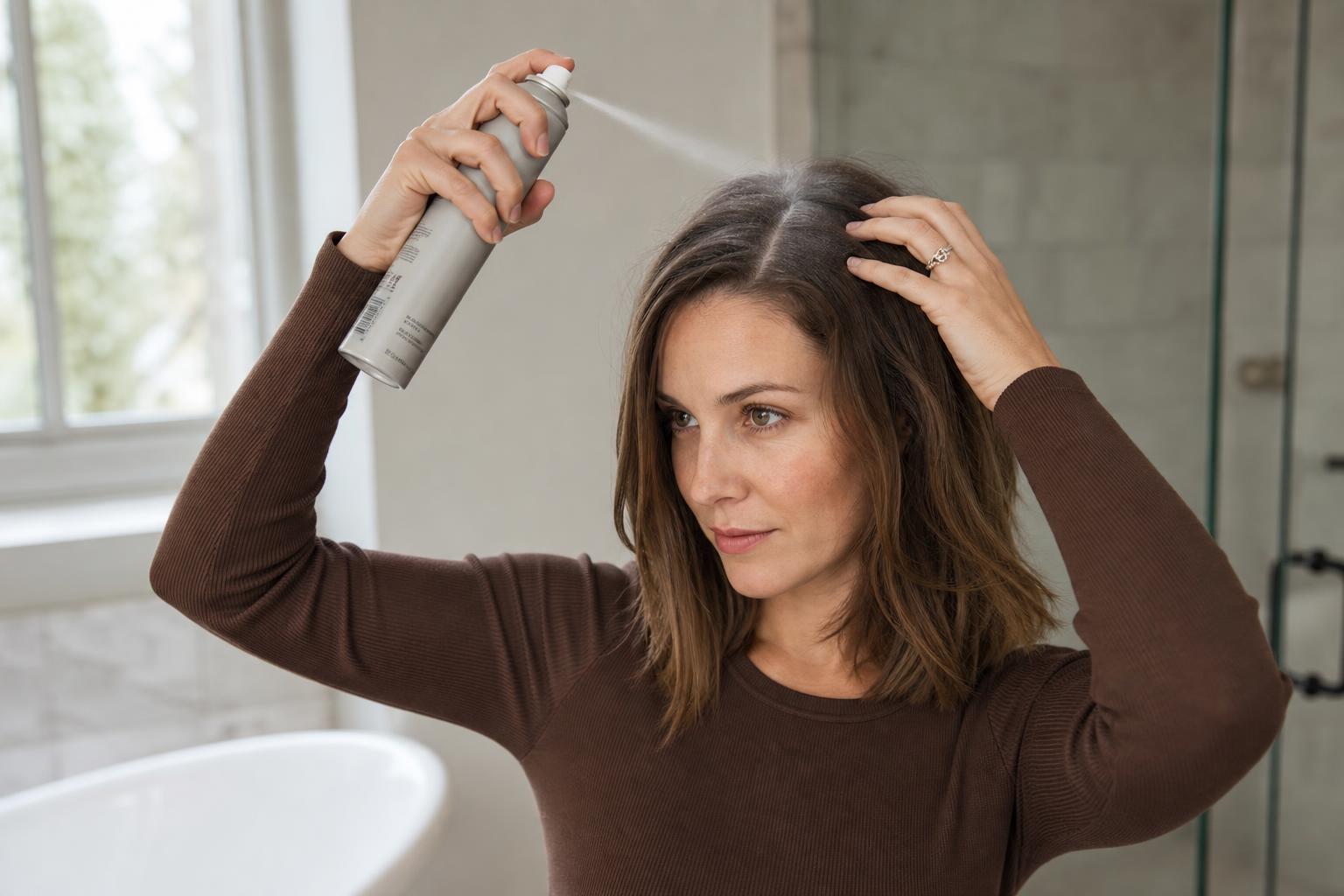
Dry shampoo works best on hair that does not look greasy yet, which is why applying it the night before beats reaching for it in a panic on day three.
Hold the can 6 to 10 inches from your scalp, spray in short bursts along parted sections rather than over the top of your hair, wait at least two minutes for the powder to absorb, then work it in with your fingertips and brush it through. Skipping the wait and the brush-out is what leaves the white cast, the gritty texture, and the buildup people blame on the product itself. Most dermatologists put the safe ceiling at one to two uses between washes, not consecutive days stacked on top of each other.
This guide covers what dry shampoo is actually doing to the oil on your scalp, the five-step application that gets a clean result, which format suits your hair type, how often you can realistically use it, and the specific situations where reaching for it makes your hair worse rather than better.
Dry Shampoo Absorbs Oil, It Does Not Clean Hair
Every dry shampoo is built around an absorbent powder, usually rice starch, tapioca starch, or a clay such as kaolin. That powder binds to the sebum sitting on your roots so the hair no longer clumps and reflects light the way oily hair does. Aerosol versions suspend the powder in alcohol and a propellant, which is why they feel cool on the scalp and appear to work faster: the alcohol flashes off and leaves the powder behind.
What matters is the word absorb. The oil does not go anywhere. It stays on your scalp, now mixed with the powder, until you actually wash it out with water and surfactant. That is the mechanism behind every complaint about buildup, itching, and flaking, and it is also why dry shampoo cannot substitute for washing no matter how good the result looks in the mirror.
Stylist tip: The distinction between hair loss and breakage matters here. There is no good evidence that dry shampoo causes hair to fall from the root, but the powder plus the vigorous brushing people do to remove it absolutely causes shaft breakage at the roots, which shows up as short broken pieces standing up around your part. If you are seeing those, the fix is gentler removal, not less brushing.
How to Apply Dry Shampoo Correctly
Almost every problem people have with dry shampoo traces back to application rather than the product. The sequence below takes about ninety seconds of active work plus a short wait, and it is the difference between hair that looks freshly styled and hair that looks dusty.
Step 1: Start on Completely Dry Hair, Ideally Before It Looks Oily
What you need: dry hair, and the honesty to apply it a day earlier than feels necessary.
How: apply on the evening of your second day, or the night before you plan to skip a wash, while your roots still look acceptable.
Why: the powder can only absorb a finite amount of oil. Applied to hair that is already saturated, it turns to paste instead of absorbing, which is exactly the grey greasy film everyone dislikes. Applied earlier, it intercepts the oil as it is produced overnight.
Common mistake: using it as an emergency rescue on visibly greasy hair, then concluding the product does not work.
Step 2: Part the Hair and Spray Section by Section
What you need: a tail comb or just your fingers to make horizontal parts about an inch apart.
How: shake the can hard, part a section, hold the nozzle 6 to 10 inches away, and give two short bursts along the exposed root line. Work through the crown, the hairline, and around the temples, which oil first on most people, then check the nape.
Why: spraying over the top of your hair coats the mid-lengths, which have no oil to absorb and end up dull and coated, while the scalp underneath stays untouched.
Common mistake: holding the can two inches from the scalp. Close range dumps a concentrated pile of powder in one spot instead of a fine even layer, and that pile is what turns into visible buildup and an itchy patch.
Step 3: Wait at Least Two Minutes Before Touching Anything
What you need: nothing but patience.
How: leave it alone. Brush your teeth, get dressed, make coffee. Two minutes is the working minimum; five is better on thick or very oily roots.
Why: absorption is not instant. Rubbing the product in immediately just spreads wet powder around before it has bound to anything, which is the main cause of the white cast on dark hair.
Common mistake: spraying and immediately brushing, then adding more product because the first pass “did not work.”
Step 4: Massage It In with Your Fingertips
What you need: clean fingertips, not nails.
How: use small circular movements across the whole scalp, the way you would work in a scalp treatment. Thirty seconds is enough.
Why: this distributes the saturated powder evenly and lifts the roots mechanically, which is where most of the volume dry shampoo appears to add actually comes from.
Common mistake: scratching with nails, which irritates a scalp that already has product sitting on it.
Step 5: Brush the Excess Out, Every Time
What you need: a boar-bristle or mixed-bristle brush, not a plastic paddle brush.
How: brush from the scalp through to the ends in slow full strokes, flipping your head forward for the underneath sections.
Why: the natural bristles pick up and carry the powder down the hair shaft rather than pushing it deeper into the scalp, and they redistribute some of the remaining oil to dry ends where it is useful.
Common mistake: skipping this step entirely. Unbrushed dry shampoo is the single biggest contributor to the flaking that people mistake for dandruff, and telling the two apart is covered in our comparison of dandruff and a dry scalp.
Match the Format to Your Hair Type and Color
Aerosol dominates the shelf, but it is not the right pick for everyone, and the failures are predictable by hair type. Fine hair is easy to overload, textured hair rarely needs the alcohol, and dark hair shows powder that lighter hair hides. Use the table to pick a format before blaming a specific bottle.
| Format | Best For | How It Behaves | Watch Out For |
|---|---|---|---|
| Aerosol spray | Fine to medium straight or wavy hair | Fine even layer, adds noticeable grip and lift | Alcohol content dries out already-dry lengths |
| Loose powder | Very oily roots, thick hair | Highest absorption per application, no propellant | Easy to over-apply; hard to place precisely |
| Tinted spray or powder | Dark brown to black hair, dark root regrowth | Cancels the white cast completely | Transfers to pillowcases, collars, and hands |
| Foam or paste | Coily and tightly curled hair, locs | Cleans without the drying alcohol base | Needs genuine rinse-free rubbing in; slower |
| Cornstarch or arrowroot | Light blonde and grey hair, sensitive scalps | Absorbs well, no fragrance or propellant | Very visible on anything darker than light blonde |
Curly and coily textures are the group most often let down by standard aerosols. The alcohol strips moisture the curl pattern needs, and the grip that fine straight hair wants reads as crunch on a curl. If your goal is a second or third day of definition rather than oil control, the technique in our guide to refreshing curls between washes will serve you better than any dry shampoo.
How Often You Can Use Dry Shampoo Without Causing Problems
The frequently repeated advice is one to two applications between washes, and that holds up as a general ceiling. What it misses is that the limit depends far more on your scalp than on your hair. An oily scalp producing enough sebum to need dry shampoo daily is a scalp that also needs washing more often, and stacking product on it for four days running is where irritation and folliculitis start.
| Scalp Type | Applications Between Washes | Wash Reset Needed |
|---|---|---|
| Oily, fine hair | 1, on the second day | Every 2 to 3 days |
| Normal, medium density | 1 to 2 | Every 3 to 4 days |
| Dry scalp, thick or coarse hair | 2, spaced out | Every 5 to 7 days |
| Curly or coily | 1, foam or paste format | Every 7 to 10 days |
| Flaking, itching, or sore | 0 until it settles | Clarify, then reassess |
Once every few weeks, wash with a clarifying shampoo rather than your usual one, because standard conditioning shampoo does not always fully remove starch and clay residue. If you also have mineral deposits from your water supply the two problems compound, and our guide to hard water and coated-feeling hair explains why a chelating formula is the better choice in that case. How much of this you need at all depends on your baseline wash schedule, which we break down by hair type in our guide to how often you should wash your hair.
When to Skip Dry Shampoo Entirely
Dry shampoo is a styling shortcut, not a scalp treatment, and there are situations where it makes an existing problem worse. Skip it in each of the following cases.
- Your scalp is already itching, flaking, or tender. Adding an absorbent layer on top of an irritated scalp prolongs it. Wash first, then address the underlying cause.
- You are sweating heavily or working out. Sweat rewets the powder into a paste against the scalp. Apply after the shower on a rest day instead, and rinse after training.
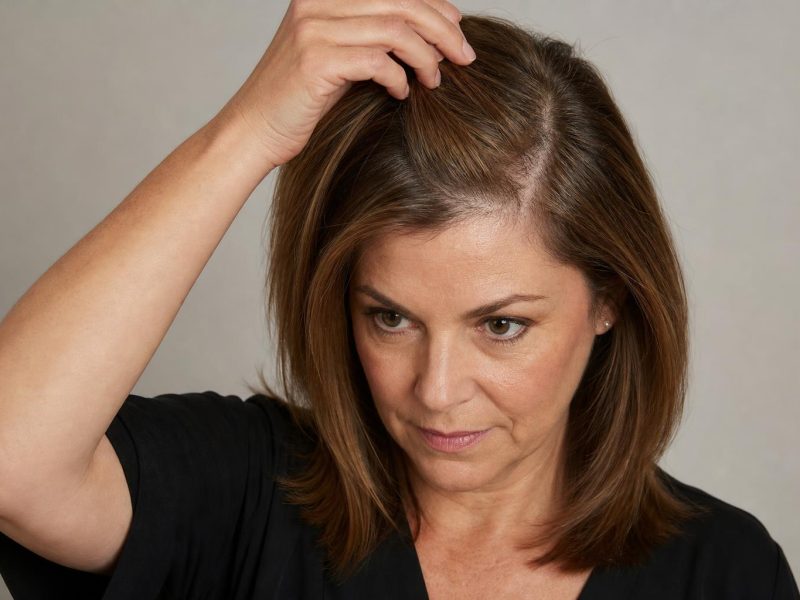
- You are dealing with active hair shedding or thinning. Root buildup and the aggressive brushing needed to remove it add mechanical stress you do not want. Our styling options for hair that has started thinning lean on cut and volume rather than product.
- You have a scalp condition being treated with a medicated shampoo. Product residue can sit between the treatment and the skin it needs to reach. Check with whoever prescribed it.
- It has already been three or more days since a wash. At that point there is more oil than any powder can absorb, and you are just adding a second substance to remove.
Stylist tip: If you use dry shampoo mainly to stretch a blowout, apply it to a clean scalp on the same night you have your hair done, before any oil appears at all. The powder gives the roots grip while they are still fresh, which holds the shape a full day longer than applying it later, and it pairs well with the sectioning approach in our walkthrough of a salon-style blowout at home.
Common Dry Shampoo Myths
Myth: Dry Shampoo Cleans Your Hair
Reality: it absorbs oil and adds fragrance and texture. Nothing is removed from your head until water and a surfactant do the work. The name is marketing, and treating it literally is how people end up with four days of accumulated sebum and starch on their scalp.
Myth: The White Cast Means You Bought the Wrong Product
Reality: on hair darker than mid-brown, some visible residue is normal from any untinted formula, and it disappears with the two-minute wait plus a proper brush-through. If it survives both, the fix is a tinted version rather than a different brand of the same untinted powder.
Myth: Dry Shampoo Causes Hair Loss
Reality: dermatologists consistently report no evidence linking it to loss at the follicle. What it genuinely causes with overuse is breakage of the hair shaft near the root, plus irritation and occasionally folliculitis from clogged follicles. Those are real problems worth avoiding, but they are not the same as going bald, and the distinction changes how you fix it.
Myth: More Product Means Better Oil Absorption
Reality: absorption is limited by contact time and even distribution, not by quantity. A light layer left for five minutes outperforms a heavy layer brushed out after ten seconds, and it leaves far less to remove later.
FAQ
Can I Sleep with Dry Shampoo in My Hair?
Yes, and one overnight application is actually the most effective way to use it. What causes problems is doing it night after night without washing in between, which is how the powder and oil layer accumulates on the scalp. One night on, then a wash within the next day or two, is a reasonable rhythm. Brush it through before bed so it is distributed rather than sitting in a band along your part.
Does Dry Shampoo Work on Curly Hair?
It works for oil control at the roots, but standard alcohol-based aerosols dry out the lengths and disturb curl clumps. Choose a foam or paste format and apply it only at the scalp, using your fingers to work it in rather than a brush, since brushing curls dry breaks up the pattern. For tight coils and locs, a rinse-free foam is usually the only format worth using.
Why Does My Scalp Itch After Using Dry Shampoo?
Most often it is residue: powder plus oil sitting on the skin, particularly if you skipped the brush-out or applied from close range. Alcohol in aerosol formulas and added fragrance are the other two common triggers. Wash with a clarifying shampoo, give your scalp a few product-free days, and if the itch persists after a clean reset, it is worth having the scalp itself looked at rather than continuing to troubleshoot the product.
Is Dry Shampoo Bad for Color-Treated Hair?
It is generally neutral for color, and stretching washes actually helps color last longer since water and shampoo are what fade it. The caveat is tinted formulas, which can shift tone on very light blonde or pastel shades if the tint sits in porous hair. Use an untinted or translucent formula on light color, and keep it at the roots rather than through the lengths.
Can I Use Cornstarch or Baby Powder Instead?
Cornstarch and arrowroot powder both absorb oil effectively and are a reasonable low-cost option on light hair, applied with a makeup brush along the parts. They are far more visible on dark hair than a formulated product and offer no texture or hold. Avoid anything talc-based on the scalp, and avoid the fragranced baby powders, which add irritants for no benefit.
How Do I Get Dry Shampoo Buildup Out of My Hair?
Use a clarifying shampoo and shampoo twice, since the first pass mostly lifts surface product and the second reaches the scalp. Apply it to dry hair before wetting if the buildup is heavy, which lets the surfactant reach the residue without competing with water. Follow with conditioner on the mid-lengths and ends only, and give your scalp a couple of days off before using dry shampoo again.
Should I Apply Dry Shampoo Before or After Styling with Heat?
Before, if you are using it for grip and volume, and after only if you are managing oil on already-styled hair. Applied before blow-drying it gives roots texture to hold a lift. What you should not do is spray it on and then take a hot tool straight to the same section, since aerosol formulas contain alcohol and a flammable propellant. Let it dissipate for a few minutes and brush through first.
Getting a good result from dry shampoo comes down to timing and removal far more than to which bottle you own. Apply it before your roots need rescuing, hold the can further away than feels natural, give it the full two minutes, and brush it out properly every single time. Treat it as a way to stretch a good hair day rather than a substitute for washing, and the buildup problems that make people give up on it never start.
Hair results vary based on your natural hair type, texture, density, and condition. Always consult with a licensed hairstylist before making significant changes, especially with chemical treatments or dramatic length changes. Photos may show styled results that require professional tools and products to replicate.


1 response