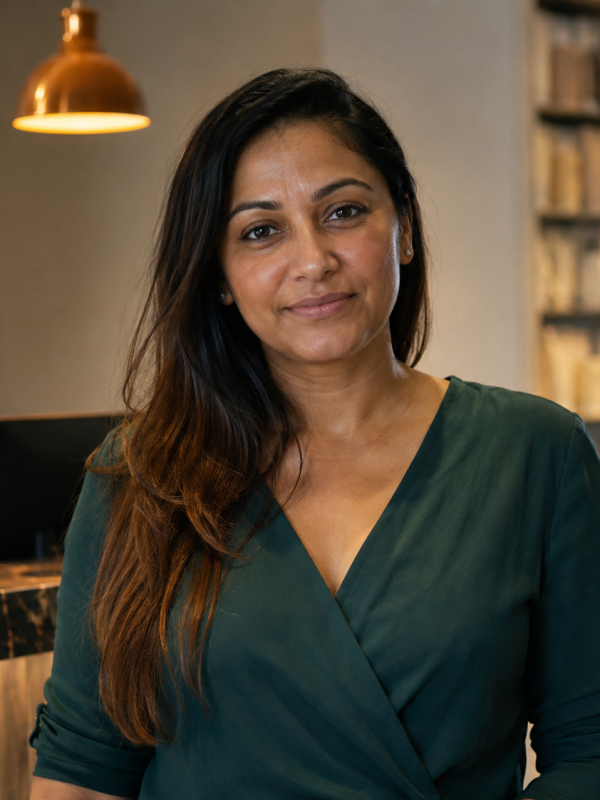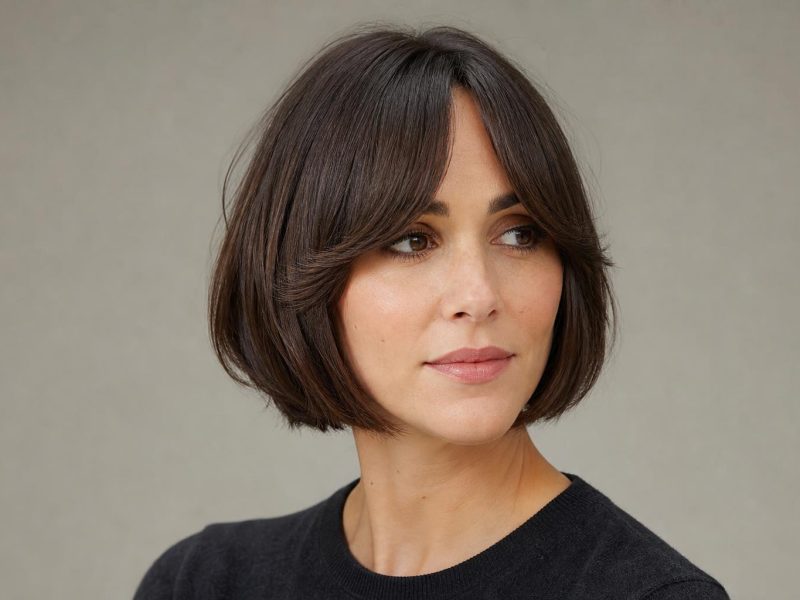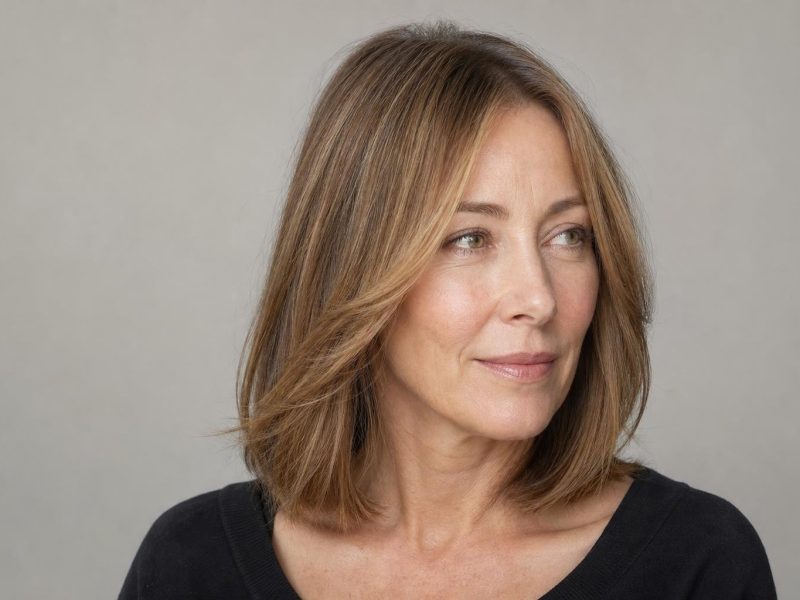

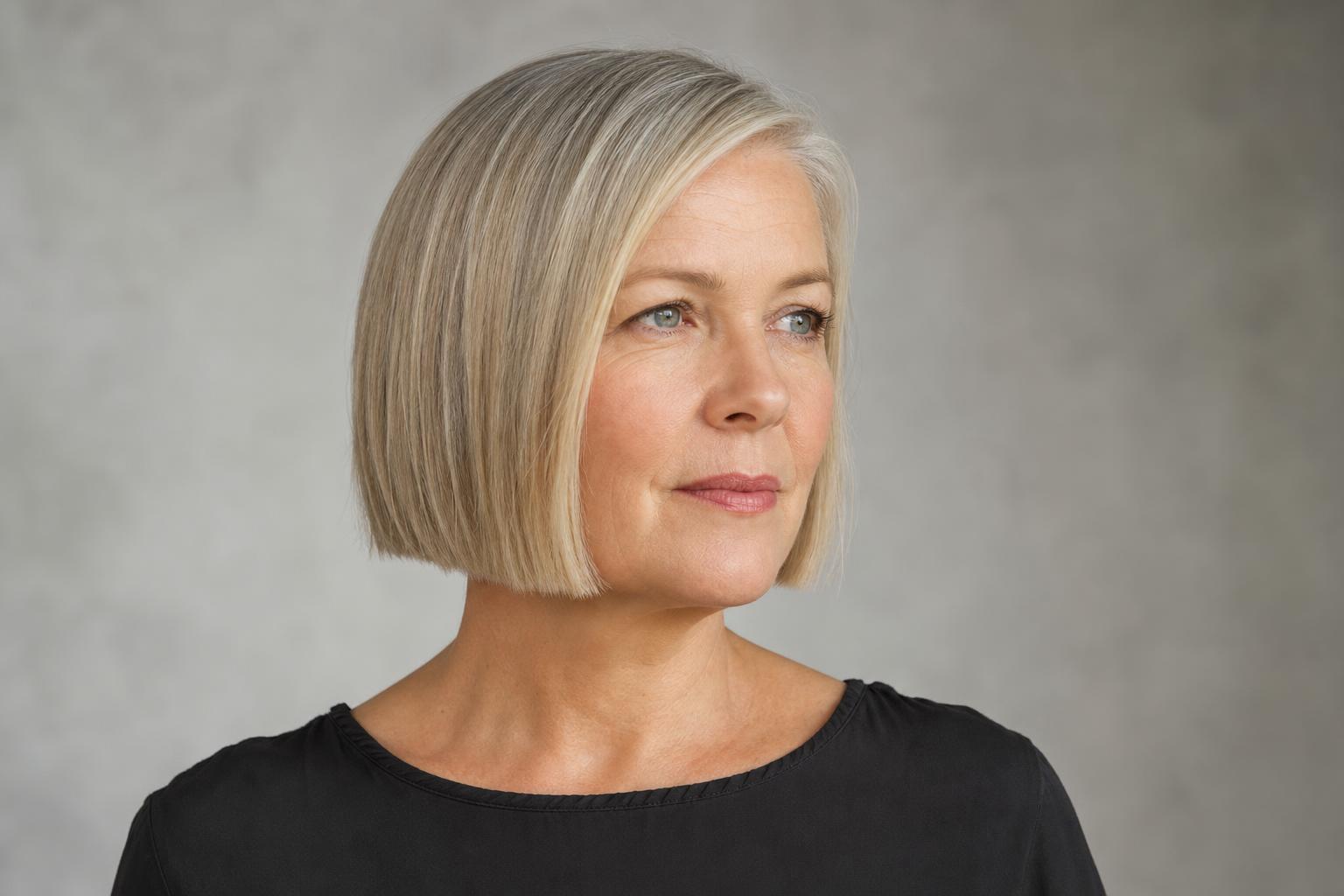
What makes a bob look dated is almost never the length; it is the graduation at the back and the amount of round-brush volume built into the crown.
A modern bob after 50 keeps its weight at the perimeter and its crown flat, while the version most people picture when they hear mom bob does the opposite: short stacked graduation at the back, a steep angle toward the front, and volume blown into the top. These 25 bobs are grouped by structure, from blunt one-length cuts through lobs and cropped textured shapes.
Each entry names the cutting structure and who it suits. Past the gallery there is a breakdown of the specific features that date a bob and what replaces them, a face shape table, the exact salon wording to avoid ending up with graduation you did not ask for, realistic trim intervals, and the cases where a bob is the wrong choice entirely.
Blunt and One-Length Bobs
One-length bobs carry all their weight at the bottom edge, which is why they hold a shape without daily styling. The perimeter line does the work that layers and a round brush do in a graduated cut. On hair that has lost density after 50, this concentration of weight at the ends is the single most useful structural choice available.
1. Jaw-Length Blunt Bob with a Clean Perimeter
Cutting straight across at jaw level with no graduation puts every strand at the same length, producing a solid edge that holds its own shape. The line should be cut with the head upright rather than tipped forward, which is what keeps the back from creeping shorter than the front. Any elevation in the cutting angle starts building the stacked shape this cut exists to avoid.

2. Blunt Bob for Square and Strong Jawlines
A strong jaw softens when the bottom edge lands below the jaw corner rather than level with it. Cutting level draws a horizontal line across the widest, most angular point of the face and doubles it. Dropping the length by an inch changes the effect completely, so name the jaw specifically at the consultation instead of asking for chin length.
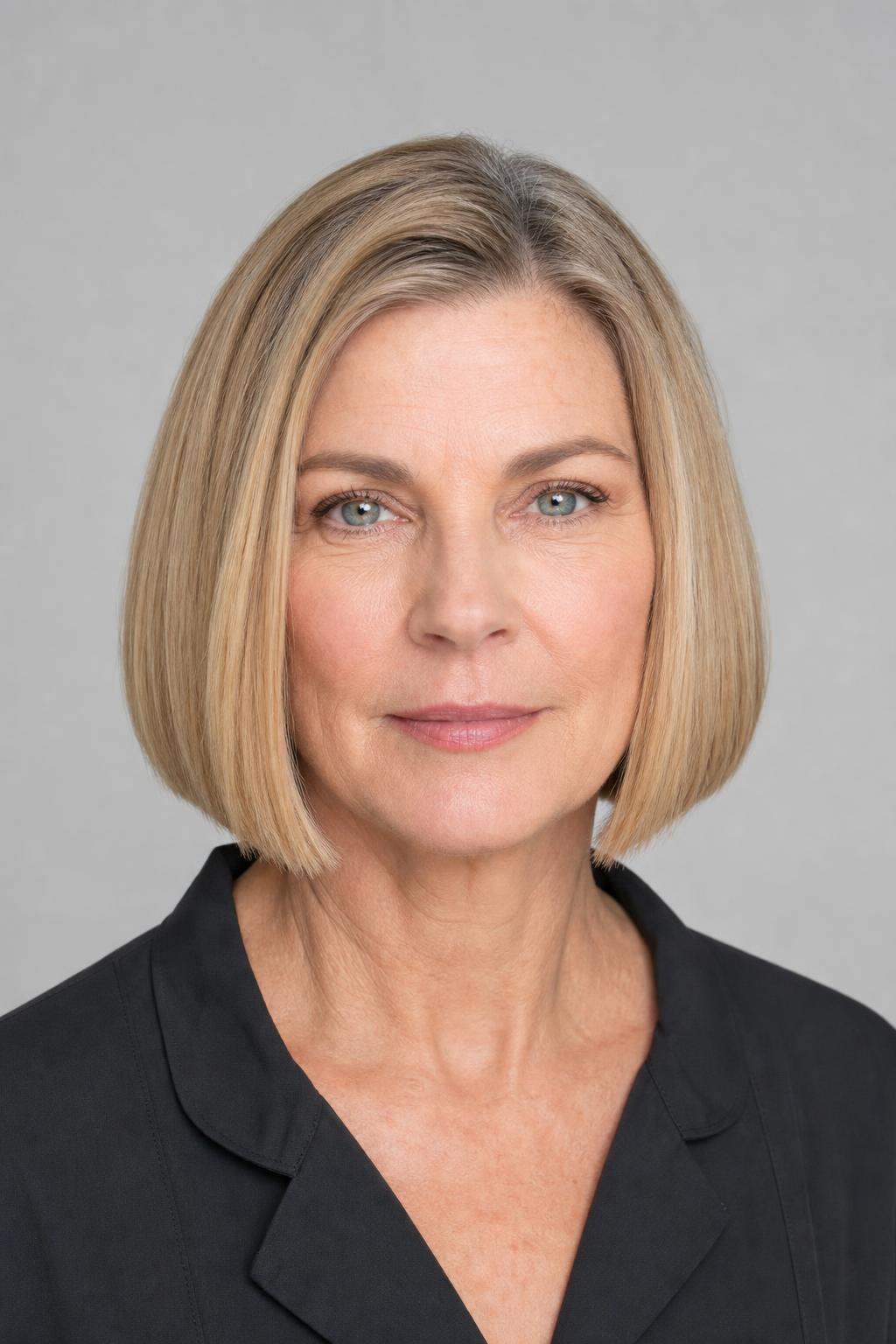
3. One-Length Bob for Fine, Straight Hair
Fine hair has no bulk to spare, so every layer removed from the interior shows up as thinner-looking ends. Keeping the cut to a single length preserves the density that makes the bottom edge look full. Fine hair over 50 gains more from an untouched perimeter than from any volumizing technique applied afterward.

4. Blunt Bob Styled with a Flat Iron Bend
Rather than curling a blunt bob, run a flat iron down the length and turn the wrist slightly inward in the last two inches. Work in one-inch sections at medium heat and stop before the very tips so the ends stay straight. The whole thing takes about six minutes and gives movement without the rounded helmet a curling iron produces at this length.

5. Blunt Bob That Holds Its Line for Six Weeks
A blunt perimeter is the least forgiving shape as it grows, because the edge that defines it goes soft first. Expect 5 to 6 weeks before the line loses definition, which is more often than a layered bob needs. That is the honest trade for a cut that requires almost nothing in the morning.
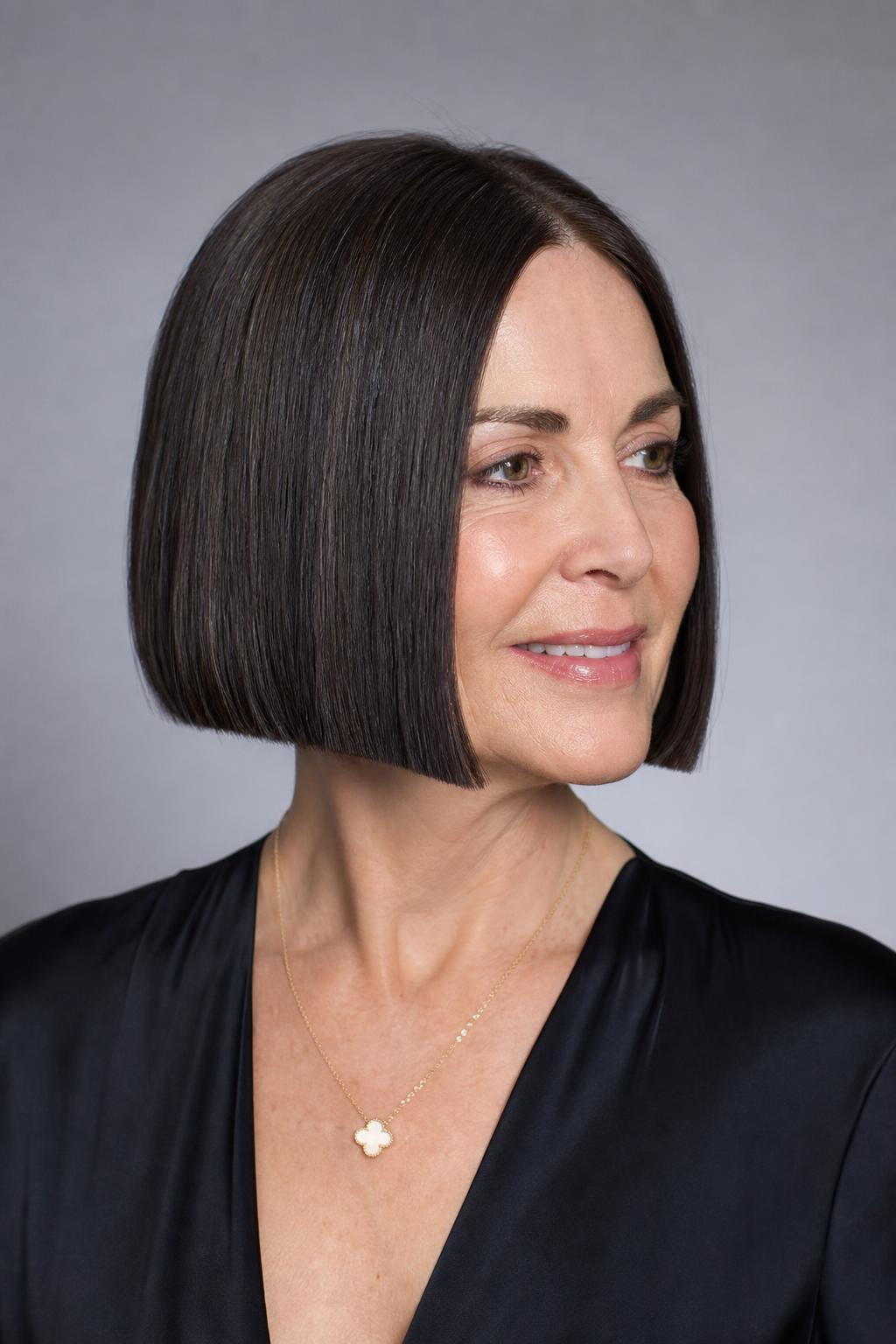
6. Blunt Bob with a Cool Ash Gloss
A demi-permanent ash gloss over the whole length knocks back the warmth that gray-blending color tends to leave behind. It adds shine to the bottom edge, which is where a blunt bob catches light. Reapplying every 6 to 8 weeks keeps the tone from drifting brassy, and it does no lifting, so there is no line of regrowth to manage.
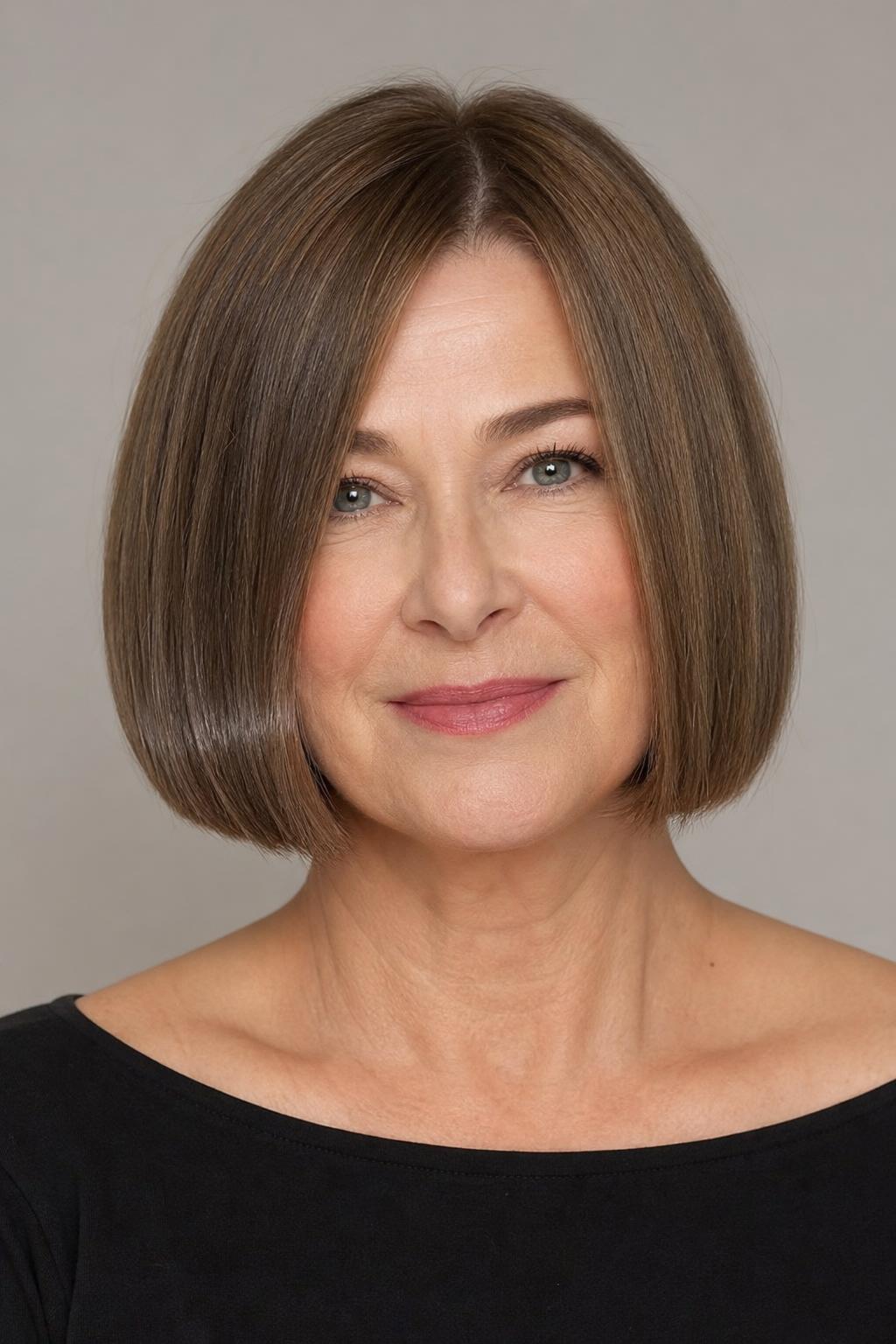
Soft Layered Bobs Without the Helmet Shape
Layers are not the problem in a dated bob; where they are placed is. Layers cut into the crown build height at the top of the head, which is the single feature that ages the shape fastest. Layers cut inside the length remove bulk without touching the silhouette, and that distinction is what separates the two versions.
7. Bob with Internal Layers Only
The request that gets this right is internal layers to remove weight, nothing on the surface, and no length taken off the crown. Say the last clause out loud, because crown layering is the reflex most stylists reach for when a client asks for volume. Reading up on how internal layers differ from visible ones before the appointment makes the conversation much shorter.

8. Soft Layered Bob with Blended Weight
Where a stacked bob builds a shelf of graduated layers at the back, this version blends the same weight gradually over four or five inches so no step is visible. The difference in silhouette is the difference between a rounded back and a flat one. Anyone weighing the two structures will find the graduated and stacked bob comparison clarifies which produces the shape they actually want.
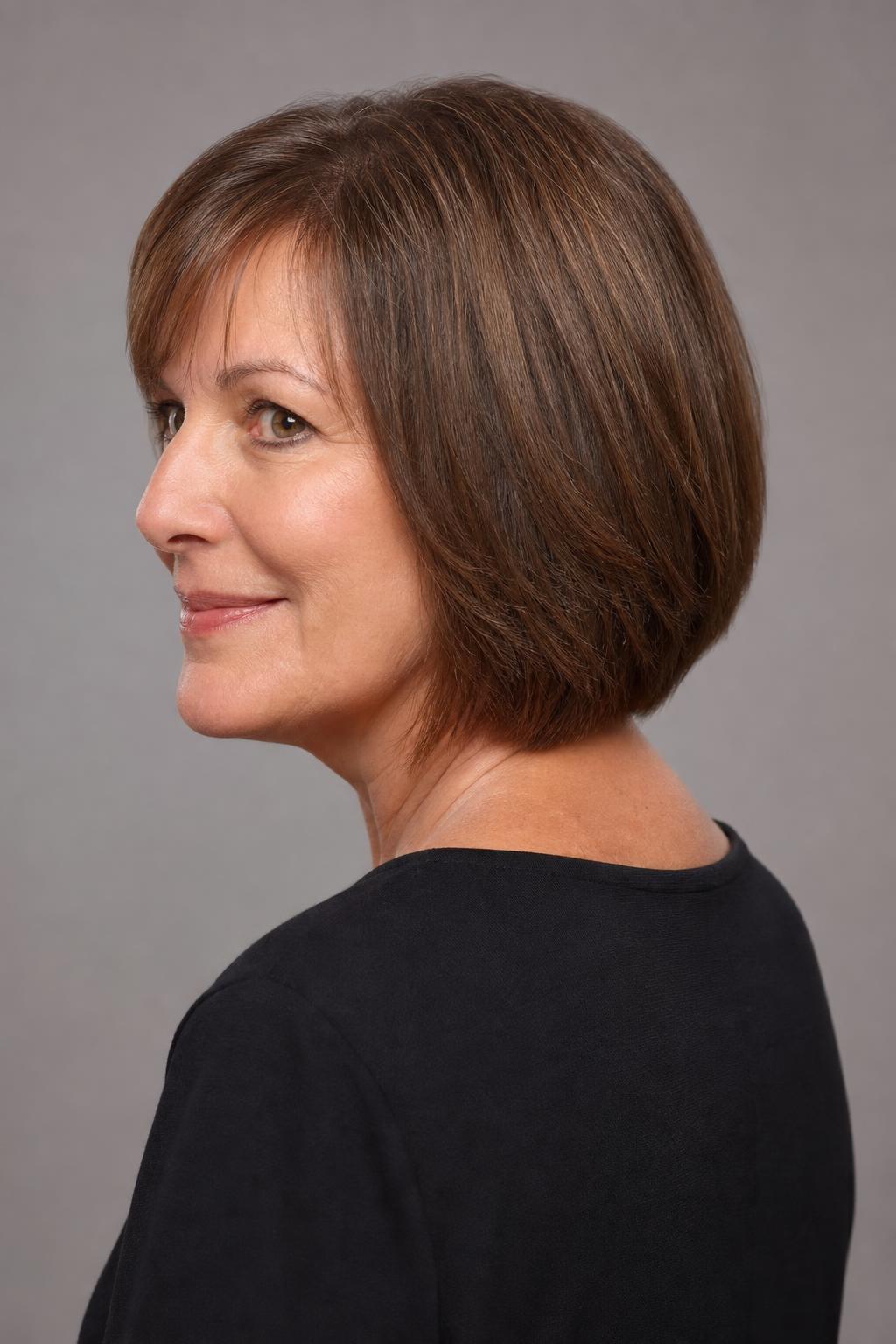
9. Chin-Length Bob with Point-Cut Ends
Point cutting means the scissors go into the ends vertically, taking small notches rather than a straight line. It softens the perimeter by a few millimeters without removing the weight that holds the shape. On hair that has coarsened with age, this stops the bottom edge from looking hard under overhead light.

10. Layered Bob for Round Faces
Round faces need vertical lines, so the longest pieces should fall past the jaw and the shortest should start no higher than the mouth. Layers beginning at cheekbone level widen the face at its broadest point, which works against the shape. Keeping the sides close and the length below the jaw is the whole strategy.

11. Layered Bob for Thick, Coarse Hair
Thick hair widens at the ears in a one-length bob because there is nowhere for the bulk to go. Removing weight from the interior between the ear and the jaw solves it without touching the outline. Coarse texture holds this shape well, and it typically stretches to 8 weeks between trims.

12. Layered Bob Air-Dried with a Sea Salt Spray
Mist a sea-salt-based texturizing spray through the mid-lengths of damp hair, scrunch twice, then leave it completely alone until dry. Touching it while it dries is what turns texture into frizz. On a layered bob this produces a lived-in finish in about 25 minutes of doing nothing.

Longer Bobs and Lobs
Length between the jaw and the collarbone gives the most flexibility after 50, because it can be worn down, tucked, or tied back. It also removes the pressure to style every day, since a lob holds an acceptable shape air-dried in a way a chin-length bob rarely does. The weight of the extra two inches keeps the crown flat on its own.
13. Collarbone Lob That Grows Out Quietly
A lob with a soft perimeter and no graduation has no crisp feature to lose, so the grow-out reads as length rather than as a cut going out of shape. Ten to twelve weeks between appointments is realistic here against 5 to 6 for a blunt bob. For anyone counting salon visits, that is roughly three fewer a year.
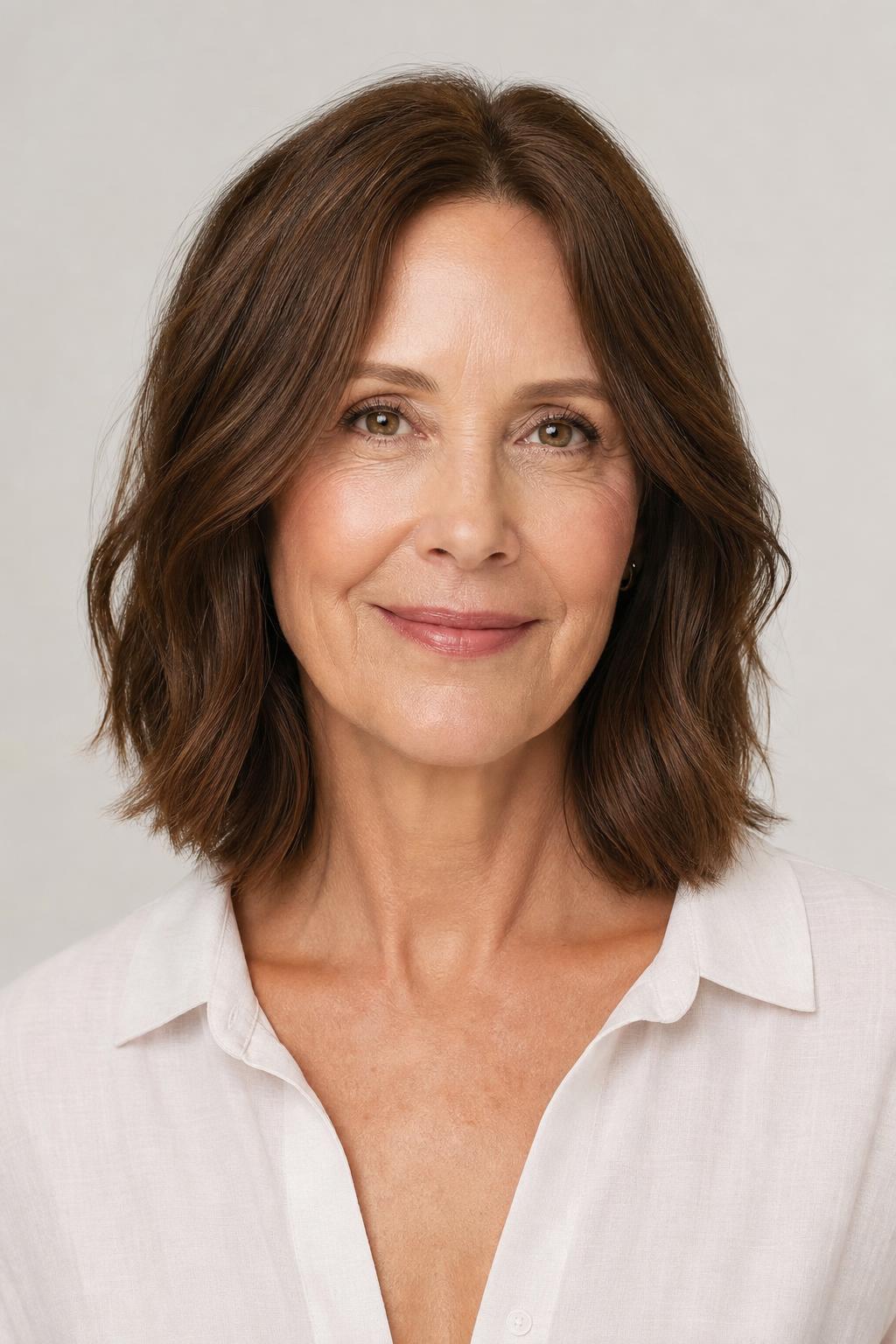
14. Lob with a Root Shadow and Soft Dimension
A root shadow two levels deeper than the length keeps regrowth from arriving as a hard line, which matters more after 50 when gray comes in at the part first. The depth at the scalp also makes the hair look denser where it counts. Touch-ups stretch to 10 or 12 weeks because there is no defined line to chase.

15. Collarbone Lob Asked for in Three Sentences
The wording that produces this cut is: collarbone length, cut with no elevation, and the shortest layer no higher than my chin. Adding no stacking at the back closes the last gap. Three specific sentences beat a photo, because photos get interpreted and measurements do not.

16. Collarbone Lob with a Defined Bottom Edge
Unlike long layers, which taper the perimeter into a soft V and lose their outline as they grow, a lob keeps a defined horizontal edge at the bottom. That edge is what makes it look cut rather than merely long. On hair thinning at the ends, it is the more forgiving of the two structures by a wide margin.

17. Angled Lob with a Longer Front
A modern angle drops about an inch from back to front over the full length, not the four or five inches an early 2000s A-line took. The gentler slope gives a forward-moving line without the dramatic wedge shape. Cut it with the head upright and the difference stays where it was intended.
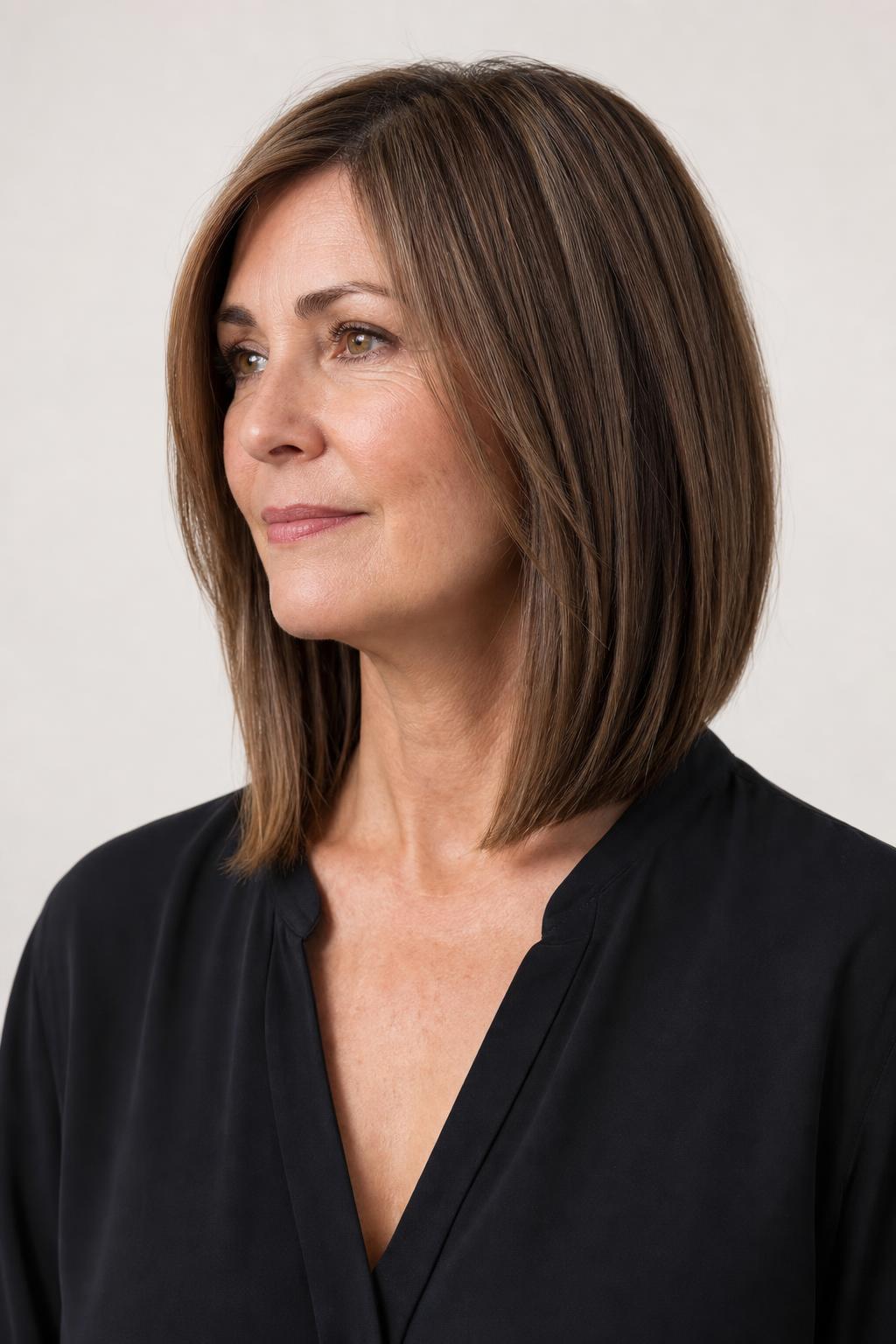
18. Lob for Heart-Shaped Faces
Heart-shaped faces carry width at the forehead and taper to a narrow chin, so the fullest part of the cut belongs at or below the jaw. A lob ending at the collarbone with soft pieces starting at the chin builds volume exactly where the face narrows. Height at the crown is the thing to leave out.

Textured, Shaggy and Cropped Bobs
Shorter and more textured shapes suit anyone who wants the cut itself to supply the interest rather than the styling. These require a stylist comfortable with dry cutting, since the texture is created by how the ends are broken up rather than by product. Density matters here more than in any other section, because texturizing removes weight that thinning hair cannot spare.
19. Shaggy Bob for Wavy 2b Texture
Natural 2b waves already carry movement, so the cut only needs to give them somewhere to go. Short pieces around the face and a slightly disconnected perimeter let the wave fall into shape without a tool. Anyone whose waves loosened in their 50s will get more from this than from adding layers throughout.

20. Textured Bob Styled with a Diffuser
Apply a light mousse to soaking wet hair, then diffuse on low speed and medium heat with the head tipped to one side. Cup sections into the bowl and hold each for 20 seconds at the root rather than chasing the ends. Ten minutes gets a textured bob to about 90 percent dry, and the rest is better left to air.

21. Bixie with a Grown-Out Nape
Leaving the nape a half inch longer than a true bixie removes the sharp line that needs recutting every four weeks. The shape then holds acceptably for 7 or 8 weeks instead. Growing it out is also gentler, since there is no tapered section to blur into the length.
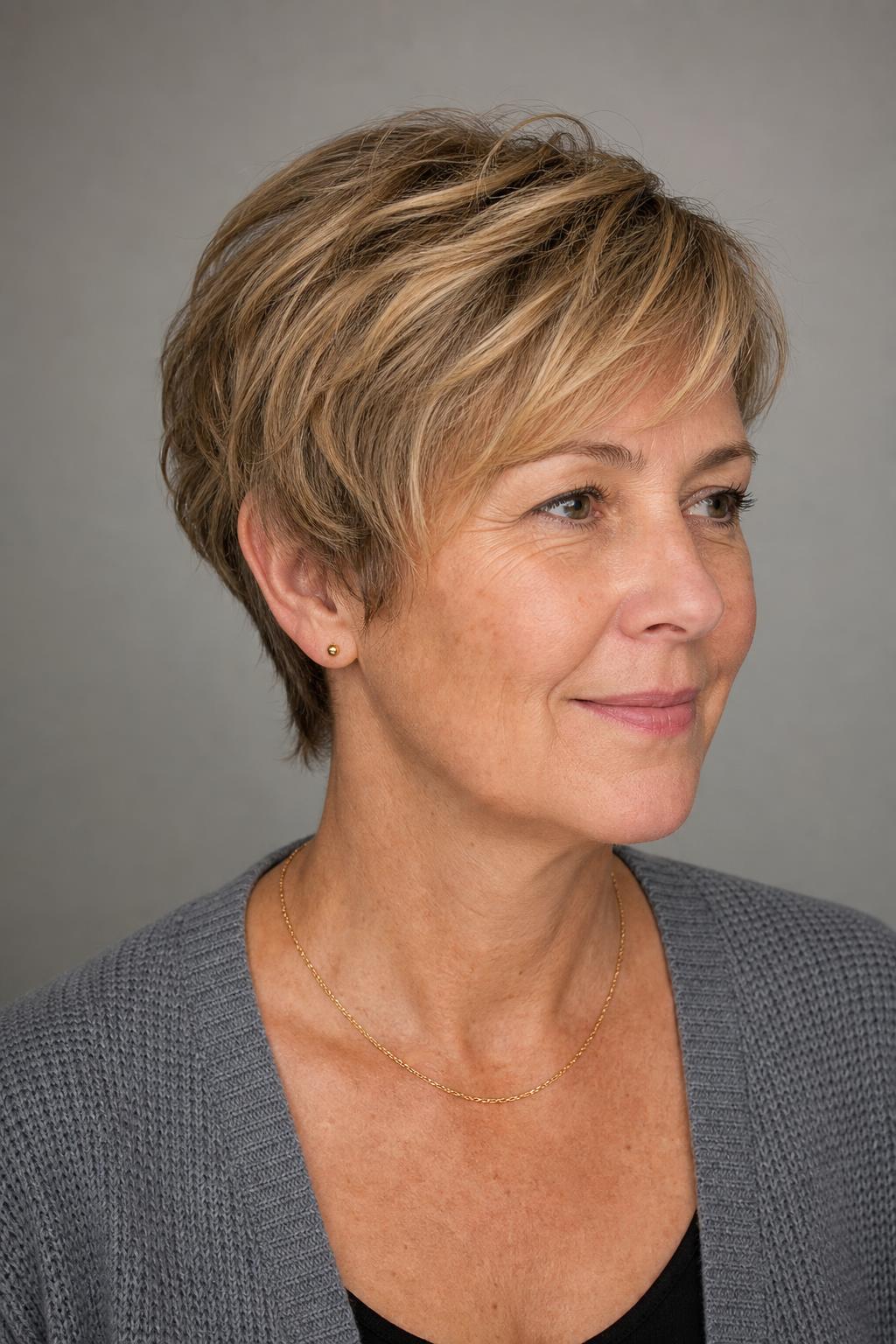
22. Cropped Bob with Warm Lowlights
Weaving lowlights two levels deeper through a cropped bob creates shadow between the pieces, and shadow is what the eye takes for thickness. On short hair the placement has to follow where the pieces separate, which means the colorist works with the cut rather than in straight foil rows. It refreshes at 8 to 10 weeks.

23. French Bob Asked for by Name
Naming this one directly saves a long conversation, since French bob is understood in most salons to mean chin length, blunt, with a fringe. Confirm the fringe length in the same breath, because eyebrow-grazing and full-coverage produce very different results. Working through how to phrase a named bob request beforehand keeps the details from getting lost.
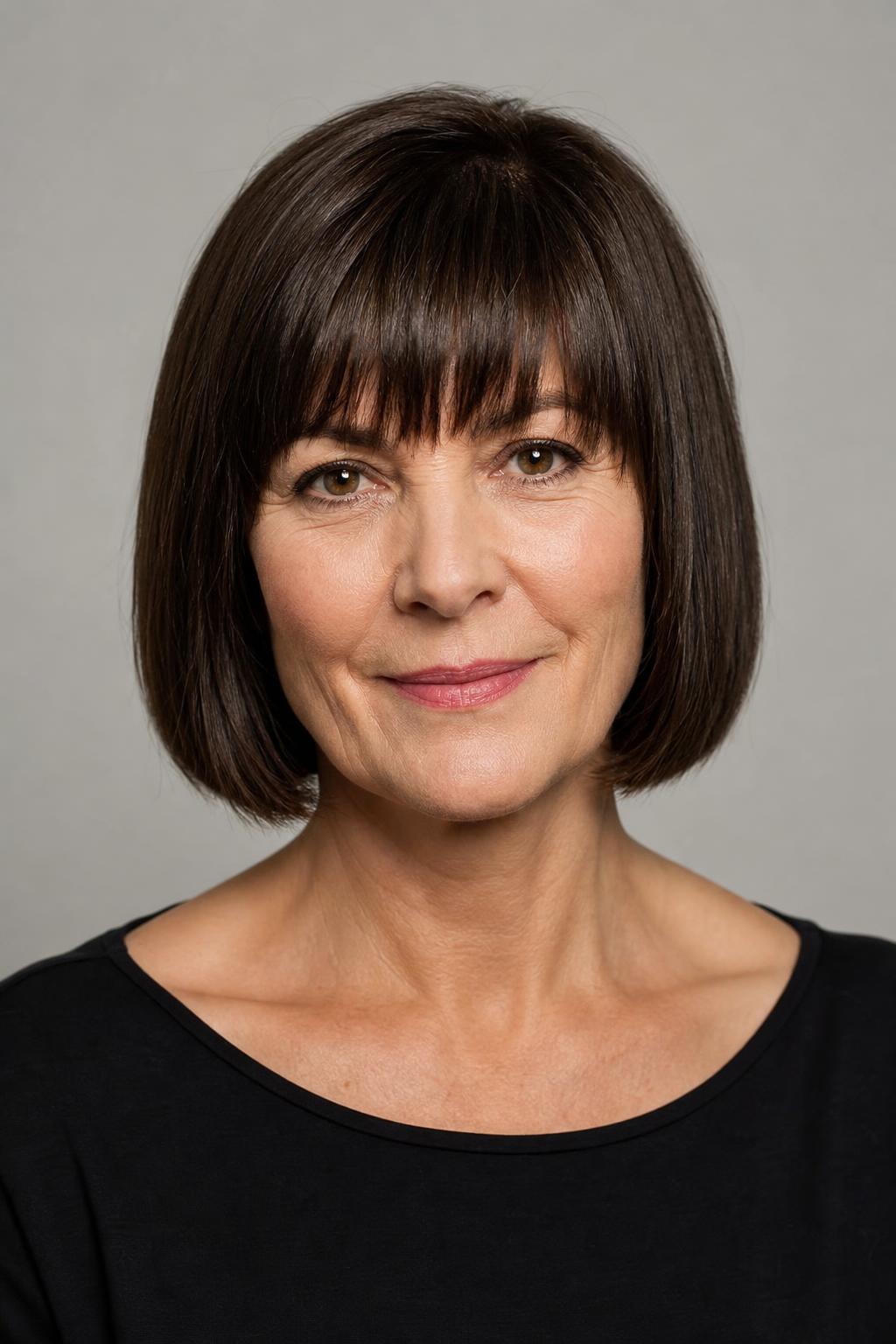
24. Bixie with a Rounded Silhouette
A bixie keeps enough length through the sides and back to form a rounded outline, where a true pixie tapers tight to the head and exposes the neck. That extra half inch is why a bixie suits anyone who is not ready for the commitment of a pixie but wants the ease of one. It also grows into a bob rather than into an awkward stage.
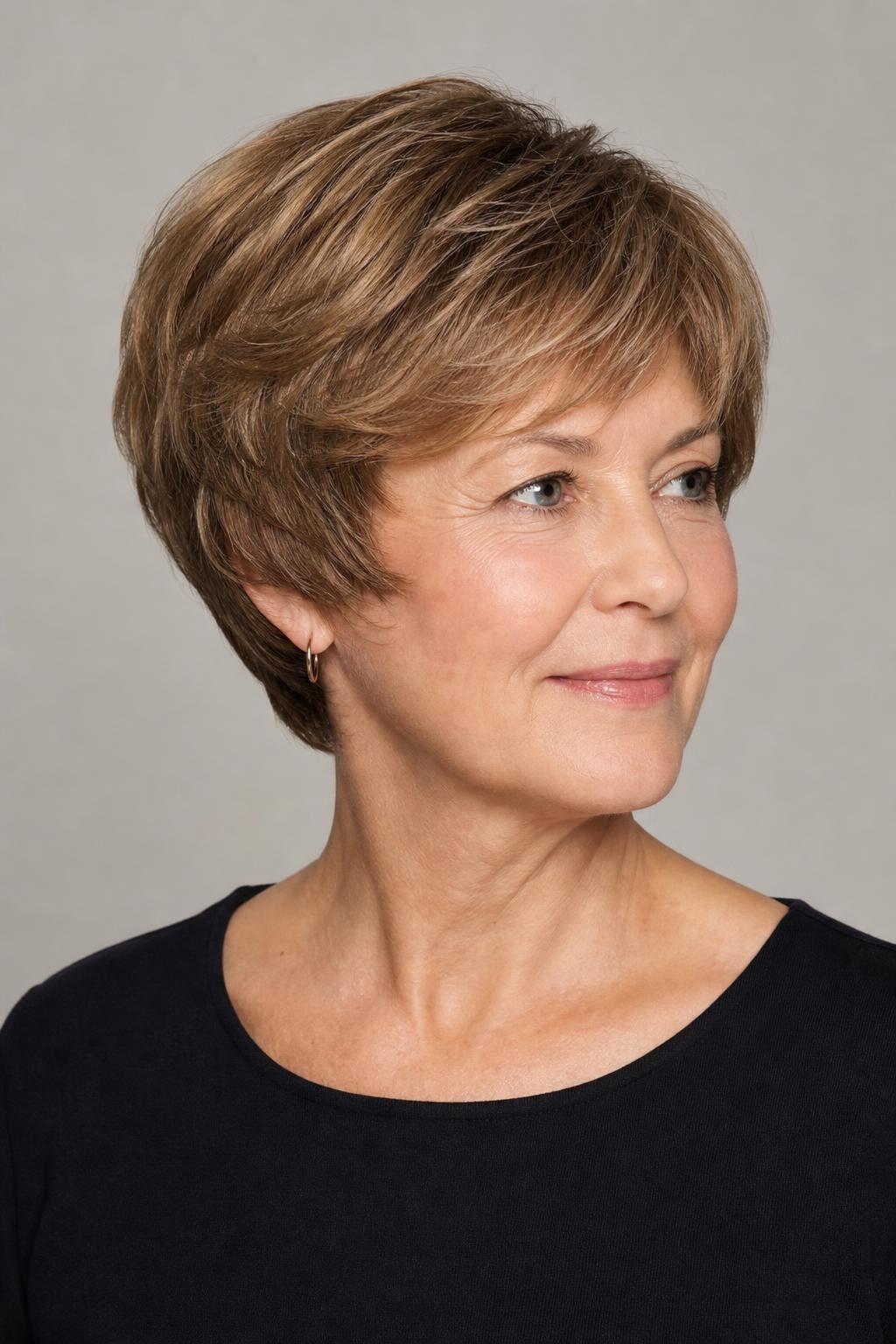
25. Micro Bob with a Razored Interior
A razor drawn through the interior at a shallow angle removes bulk while leaving the perimeter blunt, which is what keeps a very short bob from looking boxy. The razor only works on hair with enough density to lose some, so it is a poor fit for fine texture. Cut at the earlobe, this is the shortest length that still qualifies as a bob.

What Actually Makes a Bob Look Dated
The mom bob is a real and specific shape rather than a vague insult, and it comes down to four structural decisions made at the chair. Every one of them has a current equivalent that produces a very different silhouette from the same length of hair. Knowing which is which turns a difficult salon conversation into a short one.
| Dated Feature | What It Does | Current Equivalent |
|---|---|---|
| Heavy stacked graduation at the back | Builds a rounded shelf above the nape and shortens the back sharply | A flat back cut with no elevation, or graduation blended over 4 to 5 inches |
| Round-brush volume at the crown | Adds height at the top of the head and a domed outline | A flat crown with movement placed in the mid-lengths instead |
| A steep A-line front | Drops 4 or 5 inches from back to front for a wedge silhouette | A gentle slope of about an inch, or a straight one-length perimeter |
| Layers starting at the cheekbone | Creates width at the widest part of the face and a tiered look | Shortest layer no higher than the chin, or internal layers only |
Stylist tip: Ask your stylist to cut with your head upright and your chin level rather than tipped forward. Tipping the head forward is standard practice for speed, but it shortens the back relative to the front by an inch or more, which quietly rebuilds the angled shape you asked them to leave out.
Choosing a Bob Shape for Your Face Shape
Length and perimeter shape do most of the work here. The table pairs each face shape with the structure that balances it and names the one feature to leave out.
| Face Shape | Best Bob Structure | Ideal Length | Avoid |
|---|---|---|---|
| Oval | Almost any; blunt one-length is the safest starting point | Chin to collarbone | Heavy full fringe, which covers balanced proportions |
| Round | Longer bob with a deep side part and close sides | Past the jaw to collarbone | Chin length with a center part, which widens the face |
| Square | Soft layered bob with the edge below the jaw corner | An inch below the jaw | A blunt line level with the jaw, which squares it further |
| Heart | Lob with fullness at and below the jaw, flat crown | Jaw to collarbone | Crown height, which widens an already broad forehead |
| Oblong | Chin-length blunt bob with a fringe | Chin length | A long bob with no fringe, which lengthens the face further |
| Diamond | Chin-length bob with soft pieces at the jaw | Chin to jaw | Volume at cheekbone level, the widest point already |
What to Tell Your Stylist
Four short phrases cover the structural decisions that matter: cut with no elevation, keep the back flat, shortest layer no higher than my chin, and nothing removed from the crown. Those four sentences prevent the specific features listed in the table above from appearing by default. A reference photo helps, but only alongside the wording, since photos of a finished blow-dry hide the cut underneath.
It is also worth stating the length as a landmark on your own face rather than in inches. Jaw level, an inch below the jaw, and collarbone are unambiguous; two inches shorter means different things to different people. If a fringe is part of the plan, the length matters more than the shape, so agree on eyebrow-grazing or below before anything is cut.
Stylist tip: Book the appointment for a day when your hair is at its normal texture rather than freshly washed and blown out. Stylists generally recommend seeing how the hair falls on its own, because a smooth blow-dry hides cowlicks and growth patterns at the nape that determine whether a blunt line will actually lie flat.
Maintenance and Styling
Shorter and sharper means more frequent trims, and that relationship is close to linear. The number worth knowing before choosing is how many salon visits a year each shape commits you to.
| Cut | Trim Frequency | Daily Styling | Key Products | Grow-Out Behavior |
|---|---|---|---|---|
| Blunt bob | 5 to 6 weeks | 6 to 10 min | Heat protectant, smoothing serum | The edge goes soft first, visible by week 5 |
| Soft layered bob | 8 weeks | 10 min | Texturizing spray, light mousse | Forgiving; layers blend as they grow |
| Collarbone lob | 10 to 12 weeks | 5 to 10 min | Leave-in conditioner, salt spray | Grows into length rather than out of shape |
| Bixie or micro bob | 4 to 6 weeks | 5 min | Texturizing paste, light hold spray | Nape and sides lose the line by week 5 |
One counter-intuitive point worth planning around: a blunt bob is lower effort day to day but higher commitment at the salon, while a longer layered lob is the reverse. If the deciding factor is your calendar rather than your morning routine, the lob is the more practical of the two, and a side-by-side look at bob, lob and midi lengths makes the trade clearer.
When a Bob Is Not the Right Cut
Bobs suit a wide range of hair, but there are situations where the shape works against what the hair is doing. Each of these calls for a modification rather than a different cut entirely.
- You have a strong cowlick at the nape. A blunt perimeter will not lie flat over it and the ends will flip out; ask for the back left slightly longer so the weight overcomes the growth pattern, or choose a lob.
- Your hair is very fine and has thinned at the crown. A bob concentrates attention at the top of the head; keep length at the collarbone where a fuller perimeter draws the eye downward instead.
- You wear your hair tied back most days. A chin-length bob is too short to secure and too long to leave loose comfortably; a lob is the shortest length that still goes into a low ponytail.
- Your hair is tightly curly and has never been cut dry. A bob shape on curls cut wet finishes far shorter than agreed and can widen into a triangle; the shape needs a stylist who works curl by curl, as in a curly bob cut for the pattern.
FAQ
What Is the Difference Between a Mom Bob and a Modern Bob?
The difference is structural, not a matter of length or age. A dated bob combines stacked graduation at the back, crown volume, a steep A-line front, and layers starting at the cheekbone. A current one keeps the back flat, the crown low, the front slope gentle or absent, and the shortest layer no higher than the chin, all at the same length of hair.
Is a Bob or a Lob Better after 50?
A lob is the more forgiving choice for most people, mainly because it needs trimming every 10 to 12 weeks against 5 to 6 for a blunt bob. It also holds a decent shape air-dried and can be tied back. A chin-length bob is the better pick if you want a defined shape with almost no daily styling and do not mind the salon frequency.
Can I Wear a Blunt Bob with Fine Hair?
Yes, and it is usually the better choice for fine hair than a layered version. Layers remove weight from the interior, which makes already-fine ends look sparser, while a single length keeps every strand contributing to the bottom edge. If the hair falls flat at the roots, the fix is styling technique and product rather than adding layers, since a blunt bob that goes flat is usually a root-lift problem.
How Do I Stop My Stylist from Stacking the Back?
Say cut with no elevation and keep the back flat before the first section is taken, and ask them to cut with your head upright. Elevation is the technical term for lifting hair away from the head before cutting, which is what creates graduation, so naming it directly is clearer than asking for no layers. Checking the back with a hand mirror partway through catches it early enough to correct.
Do Bobs Make You Look Older?
No, but specific features within a bob can, and they are the four in the table above. Crown volume and heavy back graduation are the two that carry the strongest association with an older silhouette, because they were the standard salon default for decades. The same length cut flat and blunt looks entirely different.
How Short Can a Bob Go before It Becomes a Pixie?
The earlobe is roughly the dividing line. At or below it the hair still falls in a continuous perimeter and counts as a micro bob; above it the sides and back have to taper toward the head and the cut becomes a bixie or pixie. Anyone unsure about going that short can stop at the earlobe and reassess at the next appointment.
Will a Bob Work with Gray or Silver Hair?
It works well, and the blunt versions suit gray better than layered ones. Gray strands are coarser and more wiry, so cut ends within a layered interior tend to stand away from the shape rather than blending into it. A solid perimeter contains that texture, and a demi-permanent gloss every 8 weeks keeps the tone clean without lifting any color.
Choosing between modern bobs for women over 50 is less about picking a picture than about naming four structural decisions before the first cut: elevation, crown height, front slope, and where the shortest layer starts. Decide those, say them in plain language at the consultation, and the same length of hair will produce a shape you recognize as current rather than one that arrives by default. Bring the wording rather than only the photo.
Hair results vary based on your natural hair type, texture, density, and condition. Always consult with a licensed hairstylist before making significant changes, especially with chemical treatments or dramatic length changes. Photos may show styled results that require professional tools and products to replicate.