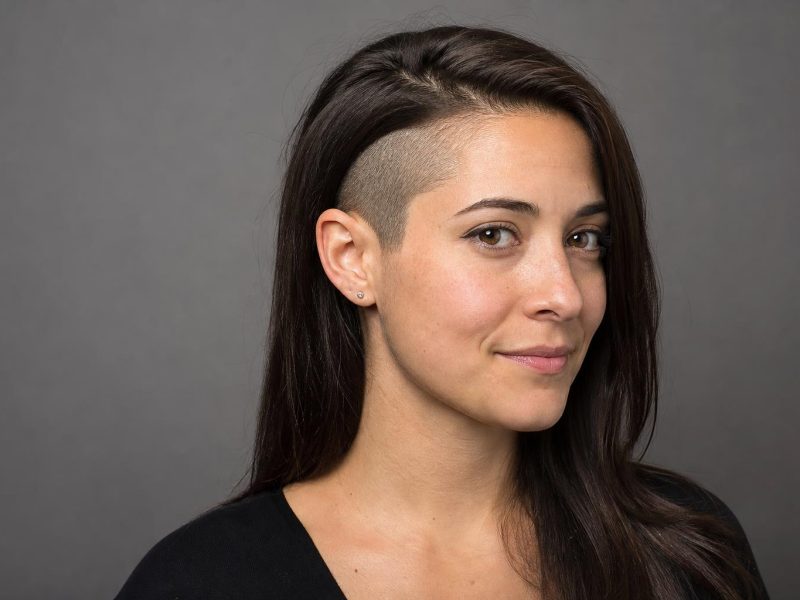


Walk in with four specific words and you will walk out with the cut you actually pictured.
To ask for an Italian bob, tell your stylist you want a chin-length blunt perimeter with the weight left in, long internal layers only, and rounded corners at the front. That single sentence covers the four decisions that separate an Italian bob from every other chin-length cut, and it stops the most common outcome of a vague request, which is a flat, over-layered bob with no body at the ends.
This guide gives you the exact wording to use in the chair, the follow-up questions worth asking during the consultation, how to adjust the request for fine, thick, or wavy hair, the phrases that quietly sabotage the cut, and the trim schedule that keeps the shape alive between appointments.
| Factor | Details |
|---|---|
| Length to ask for | Chin level to one inch below the jaw, cut level rather than angled forward |
| Perimeter | Blunt and heavy, with only light point cutting to soften the very edge |
| Layers | Long internal layers starting below the cheekbone; no short crown layers |
| Best for | Medium to thick straight or wavy hair; oval, heart, and square faces |
| Avoid if | Very fine, low-density hair or tight 3c to 4c curls without a modified cut |
| Salon time | 45 to 75 minutes for the cut and finish; longer with a fringe consultation |
What an Italian Bob Actually Is
An Italian bob is a chin-to-jaw length bob that keeps almost all of its weight at the perimeter, so the ends stay dense enough to bend and swing instead of hanging flat. The layering happens inside the shape rather than on the surface, which means the outline stays strong while the interior loses just enough bulk to move. That combination of a heavy edge and a hollowed-out middle is what gives the cut its body, and it is also what most stylists will not do unless you ask for it directly.
The name is a styling reference more than a technical one. Salons in Milan and along the coast popularized the look on hair left mostly to its own texture, air-dried or roughly blown out, without a fixed part. Your stylist may know it as a Riviera bob or a coastal chin-length bob, and both terms describe the same construction.
Stylist tip: Ask whether your stylist plans to cut the perimeter with shears held horizontally or vertically. Horizontal shear work builds the blunt weight line this cut depends on. Vertical or slide cutting on the perimeter thins the edge and quietly turns an Italian bob into a soft layered bob.
The Exact Words to Use in the Chair
Stylists work from four variables when they build a bob: length, perimeter weight, layer placement, and how the front corners are finished. Name all four and there is very little left to interpret. Name only the length and you are handing over three decisions to someone who has not seen the picture in your head. Read the request below out loud once before your appointment so the vocabulary feels natural when you say it.
Say this: “I would like an Italian bob. Chin length to just below the jaw, cut level all the way around with no forward angle. Keep the perimeter blunt and heavy, and add long internal layers starting below my cheekbone so it has movement without losing the weight at the ends. Soften the front corners so they curve toward my face rather than ending in a point. No fixed part.”
Length Is Measured from the Chin, Not from the Shoulder
Give your stylist a physical landmark instead of an inch count, because inches mean different things on different densities and textures. Touch the point on your jaw or neck where you want the ends to land and say “here, dry.” The word dry matters on any hair with a wave pattern, since hair cut wet at that landmark will spring up an inch or more once it dries. A true Italian bob lands between the chin and one inch below the jaw, which is slightly longer than a classic French bob cut at mid-cheek.
A Blunt Perimeter Is the Non-Negotiable Part of the Cut
The phrase to use is “keep the weight line.” A weight line is the dense band of hair at the very bottom of the cut, and it is the engine of the whole shape, because a heavy edge folds under and holds a curve on its own. If your stylist texturizes it away with a razor or thinning shears, the ends go wispy and the bob collapses against your neck by lunchtime. Light point cutting into the last quarter inch is fine and stops the line from looking severe.
Long Internal Layers Belong Below the Cheekbone
Ask for layers by starting point rather than by name, since “long layers” means something different in every salon. The useful sentence is “start the layers below my cheekbone and keep them long enough that they blend into the perimeter.” That placement removes interior bulk so the bob does not look like a solid helmet, while leaving the top two inches of length untouched so nothing pops up at the crown. Short crown layers are the single fastest way to lose the Italian shape.
Rounded Front Corners Replace the Angled Bob Ask
Most chin-length bobs are cut with a slight forward angle, so the front hangs longer than the back. The Italian version stays level and instead softens the two front corners into a gentle curve. Say “round the corners at the front, no angle from back to front,” and your stylist will know to bevel those sections in rather than graduating the whole cut. The result frames the jaw without creating the sharp forward point of an inverted or A-line bob shape.
Adjusting the Request for Your Hair Type
The four-part script works as written on medium-density straight or wavy hair. On other textures it needs one deliberate change, and knowing which change to request is what stops a good cut from going wrong on your particular head. The adjustment is always about where the weight lives, never about the length.
Fine Hair Needs the Perimeter Left Completely Untouched
On fine hair, ask for the internal layers to be kept minimal and the perimeter to stay fully blunt with no point cutting at all. Fine strands have very little weight to spare, and the density of an unbroken edge is the only thing creating the impression of thickness. Keep the length at the shorter end of the range, right at chin level, where the hair has not yet been pulled down by its own weight. Our collection of bob shapes built for fine hair shows how much difference an inch makes at this density.
Thick Hair Needs Interior Weight Removed, Never Edge Texture
Thick hair turns triangular in a blunt bob if nothing is taken out of the middle, so the request changes to “remove weight from the interior with deep internal layers, and leave the perimeter blunt.” Some stylists reach for thinning shears near the ends to solve this, which is the wrong fix, because it frizzes the edge and leaves the width exactly where it was. Weight removal on bobs cut for thick, dense hair belongs two to three inches above the ends, tucked out of sight.
Wavy and Curly Hair Should Be Cut Dry at This Length
Anything from a loose 2b wave upward should be cut dry, and it is worth saying so before the cape goes on. At bob length, shrinkage of an inch and a half turns a jaw-grazing cut into an ear-length one, and there is no recovering that in the chair. Ask for the perimeter to be cut with the curl pattern falling naturally rather than combed straight, which keeps the weight line from turning into a stair-step once the hair springs back. Longer versions of curl-specific bob cutting follow the same principle.
Stylist tip: Before your stylist starts, ask one question: “Where will the shortest piece land?” It takes ten seconds to answer and it catches almost every length misunderstanding while the hair is still on your head.
Italian Bob and French Bob Are Two Different Asks
These two get requested interchangeably and they are not interchangeable cuts. Bringing a French bob photo while saying “Italian bob” gives your stylist contradictory instructions, and whichever one they follow, half of your expectation goes unmet. The table below covers the four differences that matter during a consultation.
| Feature | Italian Bob | French Bob |
|---|---|---|
| Length | Chin to one inch below the jaw | Mid-cheek to jaw, noticeably shorter |
| Layers | Long internal layers below the cheekbone | Minimal to none; one solid length |
| Fringe | Usually none, or long and side-swept | Often a blunt fringe above the brow |
| Finish | Full and bouncy, styled with body at the ends | Flatter and more undone, close to the head |
| Trim cycle | 6 to 8 weeks | 4 to 5 weeks, sooner with a fringe |
Phrases That Quietly Ruin the Cut
Some very ordinary consultation language pushes a stylist toward a different shape without either of you noticing. These four requests all sound reasonable and all work against an Italian bob.
- “Just take off the weight.” This is a direct instruction to thin the perimeter, which removes the exact density the cut relies on. Say “remove weight from the inside only” instead.
- “Add some layers so it isn’t so heavy.” Open-ended layering usually starts at the cheekbone or higher, and short layers at that height flatten the crown. Name a starting point below the cheekbone every time.
- “Something like a bob, whatever you think.” Handing over the decision produces the salon default, which in most chairs is a soft angled bob with face-framing layers.
- “Can you texturize the ends a bit?” Texturizing the ends is the single change that turns this cut into a shaggy bob within two washes.
When an Italian Bob Is the Wrong Ask
This cut has real limits, and recognizing yours before the appointment saves an expensive correction. The honest picture, cut by cut, looks like this.
- Very fine, low-density hair. A heavy weight line needs hair to make the weight from. Below a certain density the ends look sparse rather than blunt, and a chin-length graduated shape with a stacked back builds more visible fullness.
- Tight 3c to 4c curl patterns. The blunt perimeter that creates swing on straight hair creates width on tight coils. A rounded, curl-specific shape with graduated length through the sides works better than a modified Italian bob.
- A round face with a shorter neck. Level chin-length hair with volume at the ends adds width exactly where a round face already carries it. A bob shaped for a rounder face keeps the same weight principle but drops the length past the jaw.
- No tolerance for a 6-week salon cycle. The shape depends on a clean edge, and a blunt line goes soft faster than a layered one. If you stretch appointments to three months, a textured bob will look better in month three than this one will.
Maintenance After You Leave the Chair
An Italian bob asks for less daily styling than most people expect and slightly more salon commitment than they hope. Daily effort is around five to ten minutes: a lightweight mousse at the roots on damp hair, then either a rough blow-dry with your fingers or a medium round brush turned under for the last two inches. The full picture across a typical year looks like the schedule below.
| Aspect | What to Expect |
|---|---|
| Trim frequency | Every 6 to 8 weeks to keep the weight line clean |
| Daily styling | 5 to 10 minutes, mostly at the ends |
| Key products | Lightweight volumizing mousse, heat protectant, a light finishing cream |
| Key tool | A medium round brush, roughly 2 inches across the barrel |
| Grow-out behavior | Graceful into a collarbone lob; the edge softens around week 9 |
Here is the part that surprises people: the grow-out is genuinely pleasant. Because the layers are long and internal, there is no awkward stage where a shorter section flips out at the nape. The cut simply lengthens into a soft longer chin-length shape and then a lob, which means you can stretch to a full salon cycle without the cut looking neglected, as long as you accept a softer edge in the final fortnight.
FAQ
What Do I Say if My Stylist Has Never Heard of an Italian Bob?
Drop the name entirely and describe the construction, since every stylist understands the technical terms even when trend names have not reached their salon. Say: “A chin-length bob, cut level with no forward angle, blunt perimeter with the weight left in, long internal layers starting below the cheekbone.” That description is complete on its own. Bringing one photo alongside it removes any remaining ambiguity.
How Long Does My Hair Need to Be to Get This Cut?
Your hair needs to reach at least an inch below your jaw before the cut, so there is enough length to establish the weight line and still land at chin level. Coming in from shoulder-length or longer is ideal, since it gives your stylist room to adjust the landing point after seeing how your hair falls. If your hair is currently shorter than your jaw, ask for a growing-out plan first rather than forcing the length now.
Can I Ask for an Italian Bob with Bangs?
Yes, but the fringe should be long and side-swept rather than blunt and straight across, or the cut drifts into French bob territory. Ask for a curtain-style fringe that starts at the cheekbone and blends into the front sections, which keeps the outline soft and preserves the level perimeter. A heavy blunt fringe also commits you to a four-week trim cycle for the fringe alone.
Will This Cut Work if I Have a Cowlick at the Nape?
A nape cowlick is worth flagging in the consultation, because a level blunt perimeter shows every irregularity in the hairline. Ask your stylist to cut the nape section slightly longer to give the cowlick weight to lie against, which is a two-minute adjustment made during the cut rather than a reason to avoid the style. Left unmentioned, a strong cowlick pushes the back edge up and out within a week.
Should I Wash My Hair Before the Appointment?
Come with clean, dry, unstyled hair, which is genuinely more useful here than arriving with a fresh salon blowout. Your stylist needs to see the natural fall, wave pattern, and growth direction before deciding where the internal layers start. Skip the flat iron and any heavy product, since both hide the texture the cut is meant to work with.
How Much Length Will I Lose at Each Trim?
Expect half an inch to an inch every 6 to 8 weeks, which is enough to reset the weight line without shortening the overall shape. Tell your stylist “dust the perimeter and refresh the internal layers, keep the length where it is” if you want the cut maintained rather than restarted. Without that sentence, many trims quietly climb half an inch higher each visit.
Knowing how to ask for an Italian bob comes down to controlling four things and saying them in order: length from the chin, a blunt weight line, long layers below the cheekbone, and rounded front corners. Write those four on your phone before the appointment and read them out during the consultation rather than trusting your memory in the chair. A stylist who hears all four specifics will give you the cut you pictured, and one who hears only “a bob” will give you their default.
Hair results vary based on your natural hair type, texture, density, and condition. Always consult with a licensed hairstylist before making significant changes, especially with chemical treatments or dramatic length changes. Photos may show styled results that require professional tools and products to replicate.