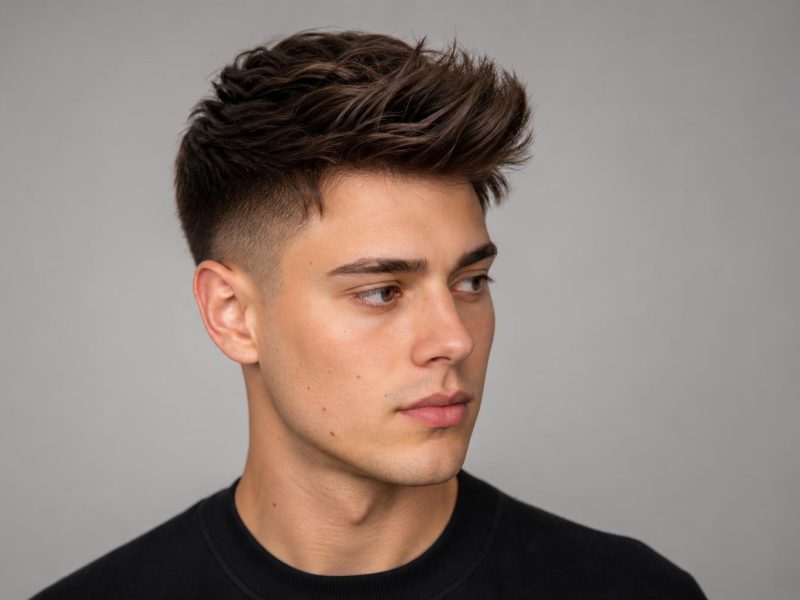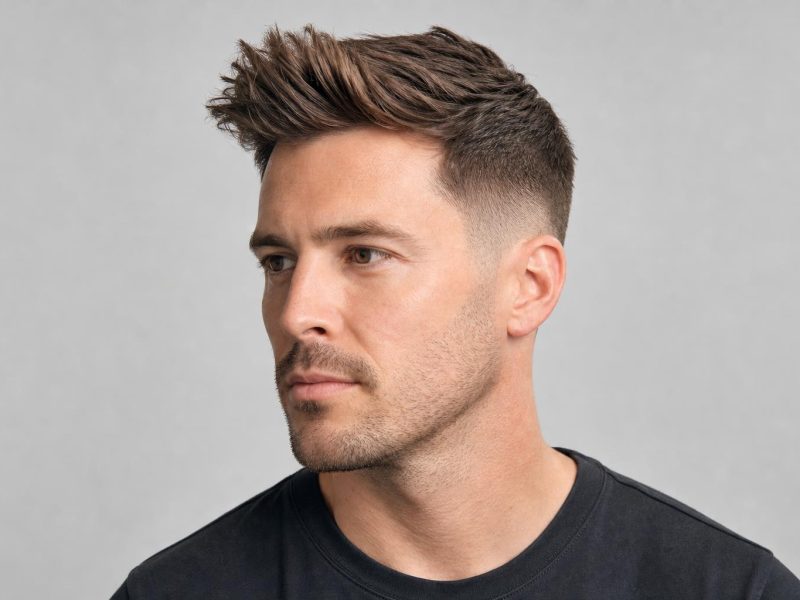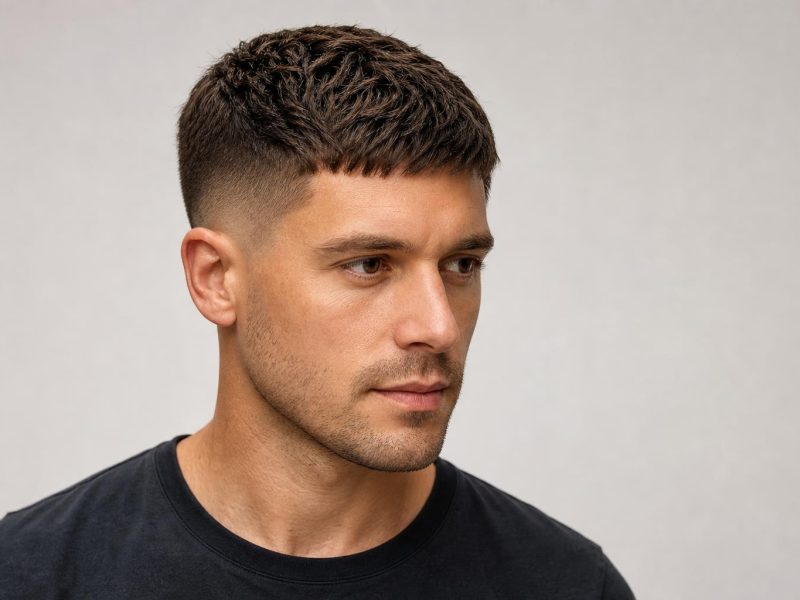



A burst fade curves around the ear in a rounded arc rather than dropping straight down, and this single structural detail makes it more versatile than a standard fade on most face shapes.
The curved fade line of a burst fade follows the natural contour of the ear and extends outward in a semicircular shape, which softens the side profile and draws attention to the top of the head differently than a straight drop fade or a taper. The height at which the arc peaks determines the character of the whole cut: a low burst barely rises above ear level and reads as clean and subtle; a mid burst creates a more pronounced contrast; a high burst makes the curved shape the main visual statement. These 25 ideas organize every major burst fade variation by fade height, style combination, and hair type so you can find the specific version that fits your hair and face.
Each section below includes what to tell your barber, face shape guidance, and maintenance reality. A comparison section covers how a burst fade differs from a drop fade and a traditional taper, so you can confirm which silhouette is actually right before the clippers start.
| Factor | Details |
|---|---|
| Fade shape | Curved arc around the ear; not a straight drop or side taper |
| Height options | Low (near ear), mid (midway up sides), high (near temples) |
| Trim frequency | Every 2-3 weeks for a sharp look; 4 weeks before it loses definition |
| Best for | All hair types; most defined on straight to wavy; very popular on 4A-4C natural hair |
| Common pairings | Mullet, mohawk strip, textured crop, fringe, natural afro top |
| Barber time | 30-50 minutes; longer if paired with a hard part or design line |
Low Burst Fade
A low burst fade arcs around the ear starting close to the natural hairline and peaks just above ear level. The curve is subtle enough that the fade can pass as a conservative, neat look while still carrying the distinctive semicircular shape that separates it from a standard low taper. Low burst fades work on most face shapes and suit professional settings where a high-contrast fade would be too bold. They also grow out more gracefully than higher variants, since the faded zone is narrower. If you want the burst fade shape but aren’t sure how bold to go, starting low is the practical choice.
1. Classic Low Burst Fade Structure
Cutting a low burst fade starts with a skin or zero-guard line at the natural sideburn hairline, then curves outward and upward around the back of the ear before blending into the natural-length hair above. The key technical detail is that the curve should peak behind the ear rather than at the ear — peaking at the ear flattens the rounded shape into something closer to a standard side fade. Ask the barber to “arc the blend behind the ear, not at it” to get the correct burst shape.
2. Low Burst Fade on Round Faces
Round face shapes gain more from a low burst fade than from a high one because the lower arc keeps volume away from the widest part of the face. A high burst fade on a round face can accidentally add visual width at the temple level, emphasizing roundness. The low burst keeps the sides clean near the ear while leaving enough natural-length hair above to direct the eye upward rather than outward. Pair with a textured or voluminous top to add height, which further counteracts the circular proportion.
3. Low Burst Fade on Straight Hair
Straight hair shows the fade gradient more cleanly than wavy or coily hair, since there’s no curl spring to blur the transition line. On straight hair, a low burst fade with a zero at the sideburn creates a very distinct gradient from skin to natural length in a narrow zone around the ear, which reads as precise and sharp. The top can be worn flat with a comb-over, tousled with product, or textured with a crop for variety. Keep the top at least 1.5 inches long so there’s enough contrast between the faded sides and the top length.
4. Low Burst Fade with Textured Top
Adding texture to the top of a low burst fade with a sea salt spray or matte clay creates a casual, natural look where the faded sides are the cleanest element and the top appears deliberately unfinished. Apply product to damp hair, scrunch upward from the roots to create diffuse volume, and allow to air-dry rather than blow-drying smooth. The contrast between the precise fade shape and the textured top creates most of the visual interest without needing length, color, or additional styling steps.
5. Low Burst Fade Maintenance Reality
Low burst fades grow out more slowly than high burst fades because the faded zone is smaller, but the curved shape still becomes noticeably less defined after 3-4 weeks as the sideburn hair begins to fill back in. A trim-only appointment every 3 weeks that addresses the fade without cutting the top is the most cost-effective approach for maintaining a low burst between full cuts. Tell the barber to refresh only the fade line and curve, not the overall length, to keep the appointment under 20 minutes.
Mid Burst Fade
A mid burst fade arcs from skin or near-skin at the bottom of the sideburn and peaks midway up the sides of the head, creating a more pronounced curve than a low burst and more of a visual statement. The higher arc makes the rounded shape more visible and gives the top section more apparent separation from the sides. Mid burst fades are the most commonly requested height for everyday wear: bold enough to look intentional without the extreme contrast of a high or skin fade. They’re particularly versatile on natural hair textures where the contrast between the faded zone and the coily top creates definition without any styling product.
6. Natural Tones with Mid Burst Fade
Medium and darker natural hair colors show the mid burst arc most clearly because the contrast between the faded zone and the natural-length top is visible without color enhancement. On medium-brown or black hair, the gradient from near-skin at the sideburn to full length above creates a defined, three-dimensional arc that lifts the overall silhouette. Avoiding hair dye on a mid burst fade with natural hair keeps the barber’s technical work as the visual focus rather than competing with color.
7. What to Tell the Barber for a Mid Burst Fade
Tell the barber: “Mid burst fade — zero or skin at the sideburn, curving up and around the ear to blend out at about mid-temple level. Keep the arc tight behind the ear before it opens out.” Then specify the top: length in inches, whether you want it textured, and any part or styling direction. Bringing a photo that shows the fade height from the side profile is more useful than describing the height verbally, since barbers judge fade height visually rather than by measurement.
8. Mid Burst vs Low Burst: When to Choose Each
A low burst fade suits conservative settings, round faces, and men who want a subtle version of the shape. A mid burst is appropriate for everyday-to-smart-casual settings, works on most face shapes, and creates a more visible curved line that functions as the defining feature of the cut. The choice often comes down to workplace expectations: if tight fades are common in your setting, mid burst reads as a natural upgrade; if clean and conservative is the norm, low burst is the safer starting point. Either can be adjusted at the next appointment.
9. Mid Burst Fade with Drop at the Neckline
Combining a mid burst at the sides with a drop at the neckline creates a curved fade that follows the natural contour of the entire head rather than just the ear area. The neckline drop creates a U-shaped or V-shaped arc at the back, which mirrors the burst arc at the sides and gives the back of the head the same rounded, following-the-skull quality. Ask the barber to “drop the neckline to match the burst arc so both curves follow the head rather than cutting straight across.”
10. Mid Burst Fade on Square Faces
Square face shapes with strong jaw angles benefit from a mid burst fade because the curved arc creates a rounded element on the sides that softens the overall angularity without hiding it. Pair with a rounded or curled top rather than a flat-top or boxy shape, since adding more angles to the top on an already angular face emphasizes the squareness. Keep the burst arc clean and tight so the sides appear long and slim rather than wide, which lengthens the face proportion slightly.
11. Mid Burst Fade on Wavy Hair
Wavy hair on top of a mid burst fade creates a natural volume and movement contrast with the faded sides. The waves add width above the fade line, which works best on longer or narrower face shapes where adding width at the top is flattering rather than problematic. Style the waves with a curl-enhancing cream applied to damp hair and diffused on low heat, or let them air-dry for a looser result. The fade keeps the overall look structured despite the relaxed top.
High Burst Fade
A high burst fade arcs from skin at the sideburn up to temple level or above, leaving very little natural-length hair on the sides below the arc peak. The contrast between bare sides and the full-length top is maximum at this height, and the curved shape of the burst becomes the most visually prominent feature of the cut. High burst fades work best on men who want a bold, fashion-forward look and are comfortable with a more frequent maintenance schedule. They pair particularly well with mohawk strips, textured crops, and natural coily tops where the contrast between the faded sides and the textured top creates a strong architectural silhouette.
12. High Burst Fade with Mohawk Strip
Leaving a strip of natural-length hair through the center of the head while applying a high burst fade on both sides creates a mohawk shape where the burst arc frames each side of the central strip. The mohawk strip on top does not need to be spiked to work: a flat, textured, or natural strip at any length from an inch to several inches benefits from the high burst frame. Ask the barber to keep the fade arc at temple level on both sides so the strip has maximum visual separation from the faded zone. A mohawk fade using a burst rather than a standard fade has a rounder, less severe silhouette.
13. High Burst Fade Maintenance Schedule
High burst fades require more frequent maintenance than low or mid variants because the faded zone covers more of the head and the contrast between faded and natural-length areas is greater, making grow-out more obvious. Plan for a fade refresh every 2 weeks if you want the burst shape to remain sharp and the skin line clean. After 3 weeks, the sideburn and temple hair begin to fill in noticeably and the arc shape becomes undefined. Some men extend to 3-week intervals and accept a slightly less sharp fade in the final week; this is a personal preference.
14. High Burst Fade with High Contrast Color
Bleached or significantly lightened top hair against a high burst skin fade creates one of the highest-contrast men’s haircut combinations available. The light top and bare sides make the burst arc shape extremely visible because the color difference emphasizes where the fade transitions from skin to natural length. If you want this level of contrast, plan a bleach appointment separate from the cut so the fade can be done fresh after the color is set, rather than the reverse — color applied over a week-old fade looks less precise.
15. Briefing a Barber on a High Burst Fade
Specify: “High burst fade — skin at the sideburn, arcing up to [temple/above temple] level. Keep the arc curved rather than angular at the peak, and blend tightly so there’s no visible line between the skin section and the short guard blend above.” For the back, say whether you want the neckline to drop or stay squared. For the top, give the length in inches and whether you want a hard part, design line, or clean fade into the top. The more specific the brief, the fewer correction passes needed after the first reveal.
16. High Burst Fade vs Skin Fade: Key Difference
A skin fade drops straight down the sides in a vertical or diagonal line; a high burst fade follows a curved arc around the ear. Both can reach the same fade level (skin or near-skin), but the direction of the transition line is different. On straight-sided heads, the difference between a high skin fade and a high burst fade is most visible from the back: the burst has a curved arc at the neckline while the skin fade typically has a straighter taper. The burst shape is generally more flattering on round or wider face shapes because the curve follows the natural contour of the skull rather than imposing a hard vertical line.
Burst Fade Style Combinations
Pairing a burst fade with a distinctive top style multiplies the visual options far beyond the fade height alone. The curved arc of the burst works as a frame rather than just a side treatment, which makes it compatible with long tops, mullet shapes, fringe, and coily naturals in ways that a standard drop fade or taper cannot replicate. The combination style determines the character of the finished look far more than the fade height does, which is why most searches for burst fade cuts are actually searches for burst fade plus something: mullet, mohawk, curly, crop.
17. Burst Fade Mullet
The burst fade mullet uses a mid or high burst at the sides with the back left significantly longer than the top, creating a sharp contrast between the clean faded sides, the shorter top, and the longer back. The burst shape is particularly suited to the mullet because it creates a rounded arc that frames the transition from short sides to longer back rather than having the fade end in a hard line. The back length on a burst fade mullet can range from a few inches to collar-length depending on how pronounced a mullet effect you want.
18. Burst Fade with Fringe on Top
Leaving a forward-facing fringe on top while applying a burst fade on the sides creates a style that combines the clean fade lines of a French crop or textured fringe cut with the curved arc structure of the burst. The fringe should fall at eyebrow level or slightly past for the contrast between the forward-facing top and the bare sides to work proportionally. Ask the barber to keep the fade at mid height on the sides so the fringe has a visible pedestal of natural-length hair behind it rather than transitioning directly to skin. For boys and teens, this pairing is covered in more detail in the boy fringe haircut guide.
19. Burst Fade on Thick Hair
Thick hair requires more blending passes on a burst fade than fine or medium hair because the density makes the transition from short to natural-length appear abrupt rather than gradual. Ask the barber to take the fade to skin at the base and use multiple guard levels in close succession (0, 0.5, 1, 1.5) through the arc zone rather than jumping from skin to a longer guard. The blending takes longer on thick hair — plan for an additional 10-15 minutes compared to a standard burst fade appointment. The finished result on thick hair is typically more defined because the hair holds the fade line sharply.
20. Burst Fade for Oval Faces with Mohawk Shape
Oval face shapes have balanced proportions that work with virtually any burst fade height and top combination. A mohawk-strip top with a high burst fade is particularly effective on oval faces because the height at the center of the head and the clean sides both complement the natural proportions without needing adjustments for face-shape compensation. If the oval face skews slightly longer, keep the top at a moderate length rather than adding extreme height, which would elongate the face further. A wide mohawk strip rather than a narrow one adds horizontal balance for longer oval shapes.
21. Burst Fade Combination Grow-Out
Burst fade combinations with distinctive tops (mullet, mohawk, fringe) require maintaining both the top style and the fade simultaneously, which creates two separate grow-out timelines. The fade needs attention every 2-3 weeks while the top can often go 4-6 weeks between trims depending on the style. Scheduling a fade-only appointment at weeks 2 and 4, then a full cut at week 6 or 8, keeps both elements of the combination looking fresh without booking more appointments than necessary. The fade appointment takes 15-20 minutes; the full appointment takes 40-60 minutes.
22. Burst Fade with Line-Up Design
Adding a line-up (a shaved geometric line at the hairline or within the fade zone) to a burst fade is a common customization in Black barbering. The line-up can follow the burst arc, create a hard part in the top section, or introduce a curved or angular design within the faded area. Ask specifically for “line-up work” after the fade is complete and show a photo of the design direction you want. Line-up designs require the same trim frequency as the fade itself since they lose precision as the hairline grows, so factor in the additional detail when scheduling appointments.
Burst Fade by Hair Type
The burst fade is one of the few fade styles that works across all hair textures, but the execution and styling approach changes significantly by type. Straight hair shows the precise gradient; wavy hair softens it naturally; coily and 4C natural hair creates a dramatic high-contrast version where the fade boundary is sharp and the coily top above it appears visually larger than it is. Understanding how your hair type affects the result helps set realistic expectations before the appointment.
23. Curly Burst Fade
Curly hair types (2c through 3c) create a natural volume difference between the faded sides and the full-length top that is less about the fade itself and more about the curl spring. When the top hair curls and expands, the fade zone appears even more defined by contrast. Style the top with a curl-defining cream or light gel applied to soaking-wet hair and allow it to dry without touching to prevent frizz. For guidance on pairing fade styles with natural curl patterns at the sides, the low taper fade on curly hair covers curl-compatible blending techniques that apply equally to burst fades.
24. Burst Fade on 4C Natural Hair
4C hair has the most shrinkage of any hair type, meaning the fade-to-natural transition appears even more dramatic than on looser textures because the natural-length top appears short while holding significant length. The burst arc on 4C hair is typically executed with a skin or zero-guard base and blended into the coily top, which holds a defined rounded shape above the fade. Moisture retention is critical on 4C hair after a fade: apply a light oil or leave-in conditioner to the natural-length top immediately after the cut to prevent the exposed scalp at the fade line from drying out. A skilled barber with experience on 4C hair will cut the top dry to account for shrinkage.
25. Burst Fade vs Drop Fade vs Taper: The Practical Difference
A taper reduces the hair length gradually from the crown downward but doesn’t reach skin at the sides; a drop fade drops in a curved or angled line from the temple to the neckline and often reaches skin; a burst fade curves in a semicircular arc around the ear specifically. The practical difference: tapers grow out most gracefully and need the least frequent maintenance. Drop fades create a strong side-profile statement. Burst fades create the most defined rounded shape around the ear and pair best with tops that benefit from a curved rather than linear frame — particularly mullets, mohawks, and natural coily styles. If you want the clean structure of a high taper without the curved element, a standard taper fade is the simpler choice.
Face Shape Guide for Burst Fades
Fade height affects how the burst arc interacts with face shape. The table below maps each face shape to the burst fade height and top combination that works best proportionally:
| Face Shape | Best Burst Fade Height | Top Recommendation |
|---|---|---|
| Round | Low or mid | Height-adding textured top; avoid wide mohawk strips |
| Oval | Any height | Works with all top styles; high burst mohawk particularly effective |
| Square | Mid or high | Rounded or textured top; the burst arc softens jaw angles |
| Long or Oblong | Mid | Wider top or voluminous curls; avoid extreme height on top |
| Heart | Low or mid | Textured or side-swept top; avoid high burst which widens forehead |
| Diamond | Low or mid | Fuller top to add width at forehead; burst arc adds width at ear level |
Barber Communication Guide
Burst fade results vary more by barber technique than almost any other fade style because the curved arc requires freehand blending rather than the straight-line approach of most tapers. Specific communication prevents the most common errors.
Stylist tip: Use the words “burst fade” specifically rather than “curved fade” or “arc fade.” These terms mean different things to different barbers. “Burst fade” is the established industry term for the semicircular arc around the ear, and most experienced barbers will know immediately what shape you want. If your barber asks what a burst fade is, show a photo before the appointment starts rather than describing it verbally.
Standard burst fade brief by height:
- Low burst: “Low burst fade — zero at the sideburn, arc curves around the ear and blends out just above ear level. Tight blend behind the ear.”
- Mid burst: “Mid burst fade — skin at the sideburn, arc to mid-temple. The curve should peak behind the ear and open upward at the temple. Blend with multiple guards so there’s no line.”
- High burst: “High burst fade — skin from the sideburn up to temple level, tight arc around the ear. Keep the blend in the top section gradual so the transition from fade to natural length takes at least an inch.”
Stylist tip: If you want a line-up or design work within the fade, request it after the fade is complete and the initial shape is clear. Requesting design work before the fade is done can result in the design being placed in the wrong zone or obscured by the blending. The barber should show you the fade first, then add the design as a second pass.
When a Burst Fade Is NOT the Right Choice
A burst fade is not universally the best fade option, and understanding when another approach works better saves appointment time and avoid grow-out frustration.
- Very conservative dress codes: In settings where any fade reads as too casual, a longer natural taper that blends without reaching skin is a better fit. The burst shape is recognizable as a fashion fade, which some professional environments do not accept.
- Men who can’t maintain 2-3 week schedules: High burst fades look poorly maintained within 3 weeks and become unrecognizable by week 4. If you can’t commit to regular trims, a low burst fade or a standard taper that grows out more gracefully will look better longer.
- Receding hairlines: A burst fade that arcs up to temple level on a receding hairline can make the recession more prominent by removing the hair that normally frames it. A lower burst or a taper that keeps more hair at the temple is usually more flattering.
- Barbers unfamiliar with the shape: A burst fade executed by a barber who hasn’t done the shape before often results in a standard fade with an imprecise arc that looks like an error rather than a deliberate design. If your usual barber hasn’t done burst fades before, ask to see examples of their work before booking.
Frequently Asked Questions
Direct answers to common questions about burst fade hairstyles:
What is a burst fade haircut?
A burst fade is a men’s fade where the sides are cut from skin or very short hair at the sideburn and blended upward in a curved, semicircular arc around the ear, rather than fading in a straight vertical or angled line. The rounded shape resembles a burst or explosion radiating outward from the ear area, which is where the name comes from.
How is a burst fade different from a drop fade?
A drop fade drops the fade line in a downward curve from the temple toward the neckline, creating an arc that follows the back of the head; a burst fade curves outward in a semicircle specifically around the ear. The drop fade emphasizes the back silhouette; the burst fade emphasizes the side profile around the ear. Both can reach the same fade level (skin or near-skin) but create distinctly different shaped transitions.
How often do you need to trim a burst fade?
A burst fade needs refreshing every 2-3 weeks for a sharp, defined arc shape. The sideburn and ear-area hair grows back into the faded zone faster than the overall top length, so the arc shape becomes undefined first. A fade-only trim every 2-3 weeks, without cutting the top, is the most efficient maintenance approach between full appointments.
What face shapes suit a burst fade?
A burst fade works on all face shapes with height adjustments. Round faces do best with a low or mid burst that doesn’t add width at the temples. Oval faces support any burst height. Square faces benefit from the rounded arc which softens angular jaw lines. Long or oblong faces should stick to mid burst heights and avoid extreme top volume that adds length. Heart-shaped faces work best with lower burst heights that don’t widen the forehead.
Does a burst fade work on curly or natural hair?
Yes, a burst fade is one of the most popular fade styles on curly and natural hair precisely because the high contrast between the faded sides and the coily or curly top creates a dramatic, defined silhouette. On 4C natural hair especially, the burst arc boundary appears very clean, and the natural shrinkage of the top makes the faded sides look proportionally wider by contrast. Ensure your barber has experience cutting natural and coily hair textures before booking.
Can a burst fade be done on thin hair?
Yes, though thin hair shows the fade gradient differently from thick hair. Thin hair blends more easily from skin to natural length, which can make the arc appear softer or less defined than on thick hair. Ask the barber to keep the skin line at the base sharp and well-defined even if the blend above it is gradual, to preserve the recognizable burst shape despite finer hair density. A low or mid burst is usually more flattering than a high burst on very thin hair, since high contrast fades on thin hair can make the scalp visible in the top section.
From a low burst that keeps the look subtle to a high burst mohawk that makes the curved arc the centerpiece of the cut, the burst fade hairstyle adapts to most hair types, face shapes, and style preferences. The curved arc around the ear is what defines it as a burst fade rather than a standard taper, and getting that arc sharp and well-blended is the single most important thing to communicate to the barber before the appointment starts.
Results vary by hair texture, density, and individual growth rate. Fade shapes grow out at approximately half an inch per month, meaning the arc definition changes noticeably within 2-3 weeks. Consult a professional barber experienced with burst fades for personalized recommendations based on your specific hair type and face shape.