

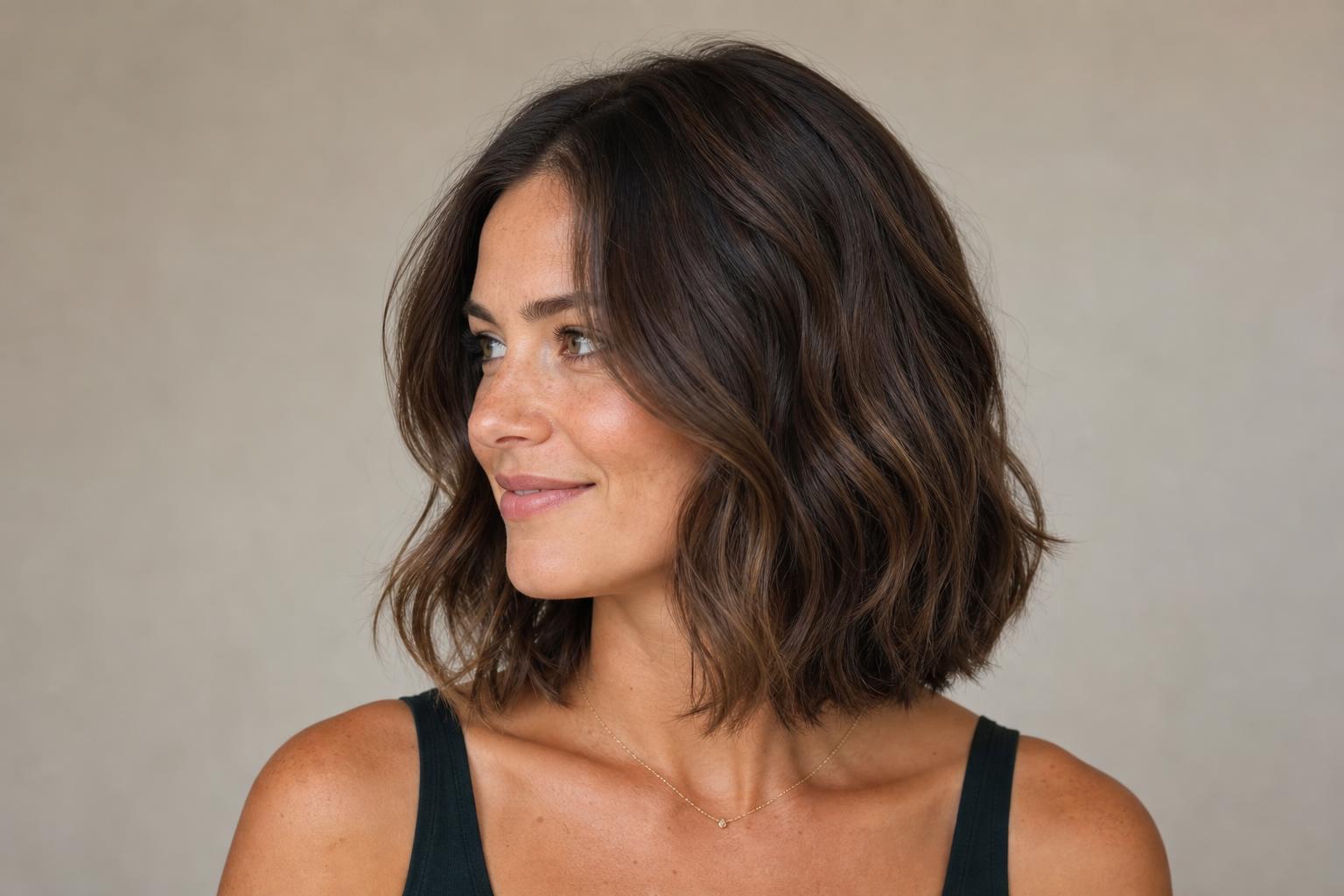
A 2C wave needs a bob cut for how it dries, not how it hangs wet.
A wavy bob for 2C hair works best between the jaw and the collarbone, because that band gives the S-wave enough length to form a full bend without piling weight at the ends. 2C is the tightest wave in the type 2 family, thick through the mid-shaft and quick to frizz, so the cut has to remove bulk without cutting into the wave pattern itself. Here are 25 variations sorted by length, from chin-grazing to collarbone, plus the layering and bang options that hold up on this texture.
Each entry names the specific cut structure, who it suits, and what to ask for. After the gallery you will find a shrinkage chart that translates wet cutting length into finished dry length, a face shape table, salon-ready wording, a realistic trim schedule, and an honest list of situations where a bob is the wrong call for 2C waves. If you are still deciding between a bob and a longer shape, our wider guide to haircuts built for 2C wavy hair covers the full length range.
| Factor | Details |
|---|---|
| Best for | Medium to thick 2C waves, oval, square, and heart face shapes |
| Maintenance | Trim every 8 to 12 weeks, 5 to 15 minutes of styling on wash day |
| Works with | Jaw to collarbone lengths, internal layers, curtain bangs, balayage |
| Avoid if | You blow-dry straight daily, or your waves start below the ear |
| Salon time | 60 to 90 minutes for a dry cut, 3 hours with balayage |
Chin and Jaw-Length Wavy Bobs
Short 2C bobs are the riskiest length and the most rewarding when they land right. At the jaw, the wave has room for roughly one full S-bend, which registers as shape rather than fluff, but there is no spare length to hide a heavy perimeter. Every cut in this section removes weight from the ends rather than the interior, which is what keeps a short 2C bob from widening into a triangle.
1. Chin-Length Wavy Bob with Point-Cut Ends
Point cutting into the perimeter at a steep angle breaks the blunt line into staggered lengths, so the wave can spring up in pieces instead of one solid block. On 2C hair the difference is immediate: a blunt chin bob shelves outward at the ends, while a point-cut one falls in separated waves. Ask for the point cutting to go about half an inch into the length, no deeper.

2. Jaw-Grazing Wavy Bob with a Deep Side Part
Round faces gain the most from a jaw-grazing bob taken off a deep side part, because the diagonal sweep across the forehead adds a vertical line that a center part erases. The heavier side falls just past the jaw corner, which narrows the widest point of the face. Keep the shorter side tucked behind the ear on wash day to stop both sides from expanding at once.
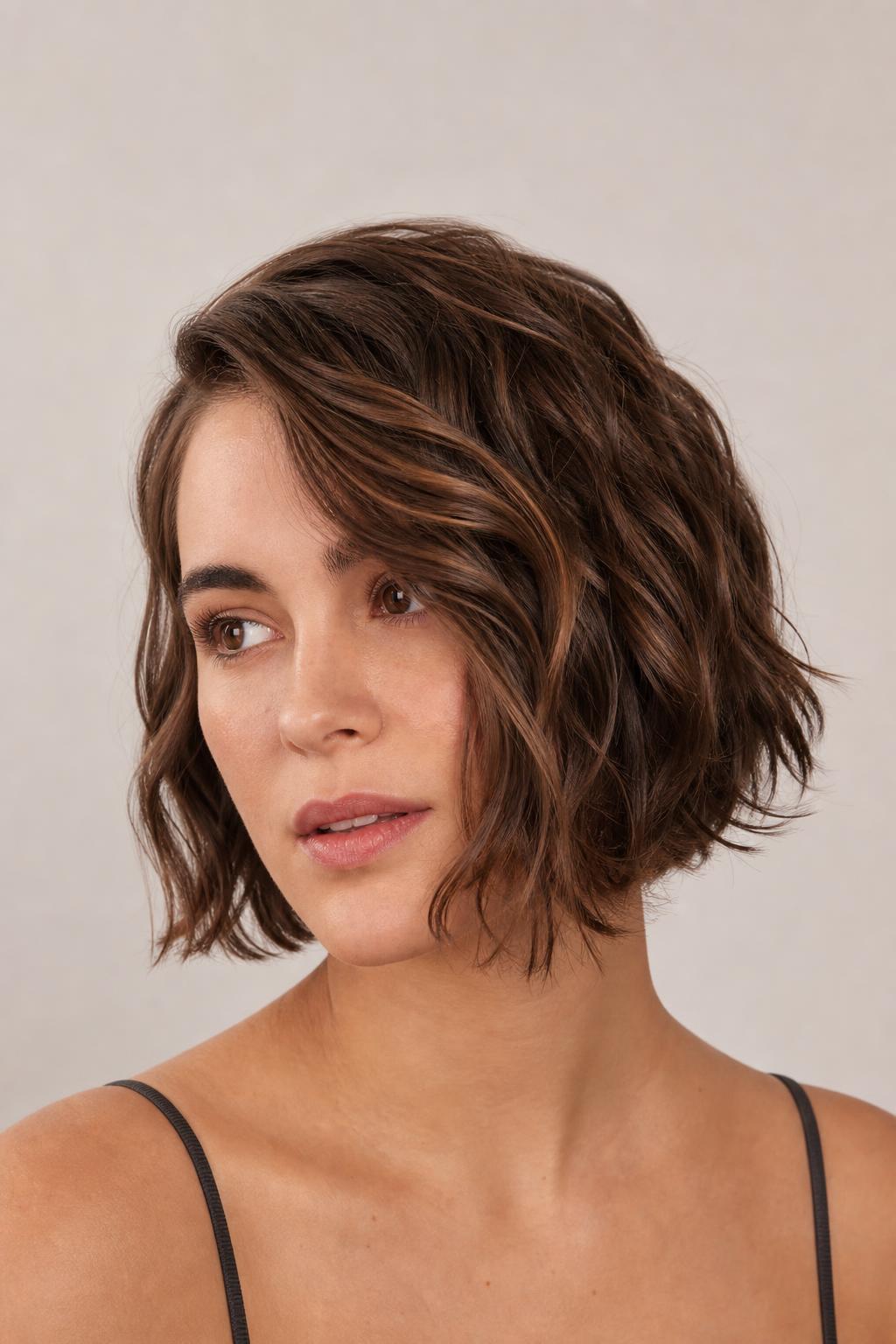
3. Debulked Jaw Bob for Coarse 2C Density
Coarse 2C hair carries most of its bulk in the mid-shaft, roughly from the ear down to the jaw, and a short bob concentrates all of it in one place. Vertical channel cutting through the interior thins that band without touching the outer layer, so the surface stays smooth while the volume drops. Density this heavy usually needs two rounds of interior work at the first appointment.

4. Diffused Chin-Length Wavy Bob
Hover the diffuser bowl under each section for 20 seconds without moving it, then lift straight to the scalp and hold. On a chin bob that stationary drying sets the wave before gravity pulls it flat, which matters more at short lengths than long. Finish on cool air for the final minute to lock the cuticle down.

5. Low-Upkeep Jaw Bob with a Soft Perimeter
Because the perimeter is left soft rather than sharp, this shape stays wearable for 10 to 12 weeks instead of the 5 to 6 a blunt bob allows. Grow-out lands the length at the collarbone, which is still a usable shape, so there is no awkward stage to push through. Trim frequency is the single biggest cost difference between two bobs that look similar in photos.

6. Warm Chestnut Chin Bob with a Root Shadow
Warm chestnut with a slightly deeper root gives a short 2C bob visual depth in the areas where waves overlap and cast their own shadows. Flat single-process color on a chin bob tends to look like a wig on this texture, since the wave already creates shade lines the color has to work with. Two tones a level apart is usually enough.

7. Soft A-Line Wavy Bob
The words that get this cut right are “a gentle A-line, about an inch of length difference from back to front, nothing stacked.” Stylists hear A-line and often reach for graduation at the back, which builds a shelf that 2C waves rest on top of. Say the difference out loud at the consultation and confirm the back stays one length.
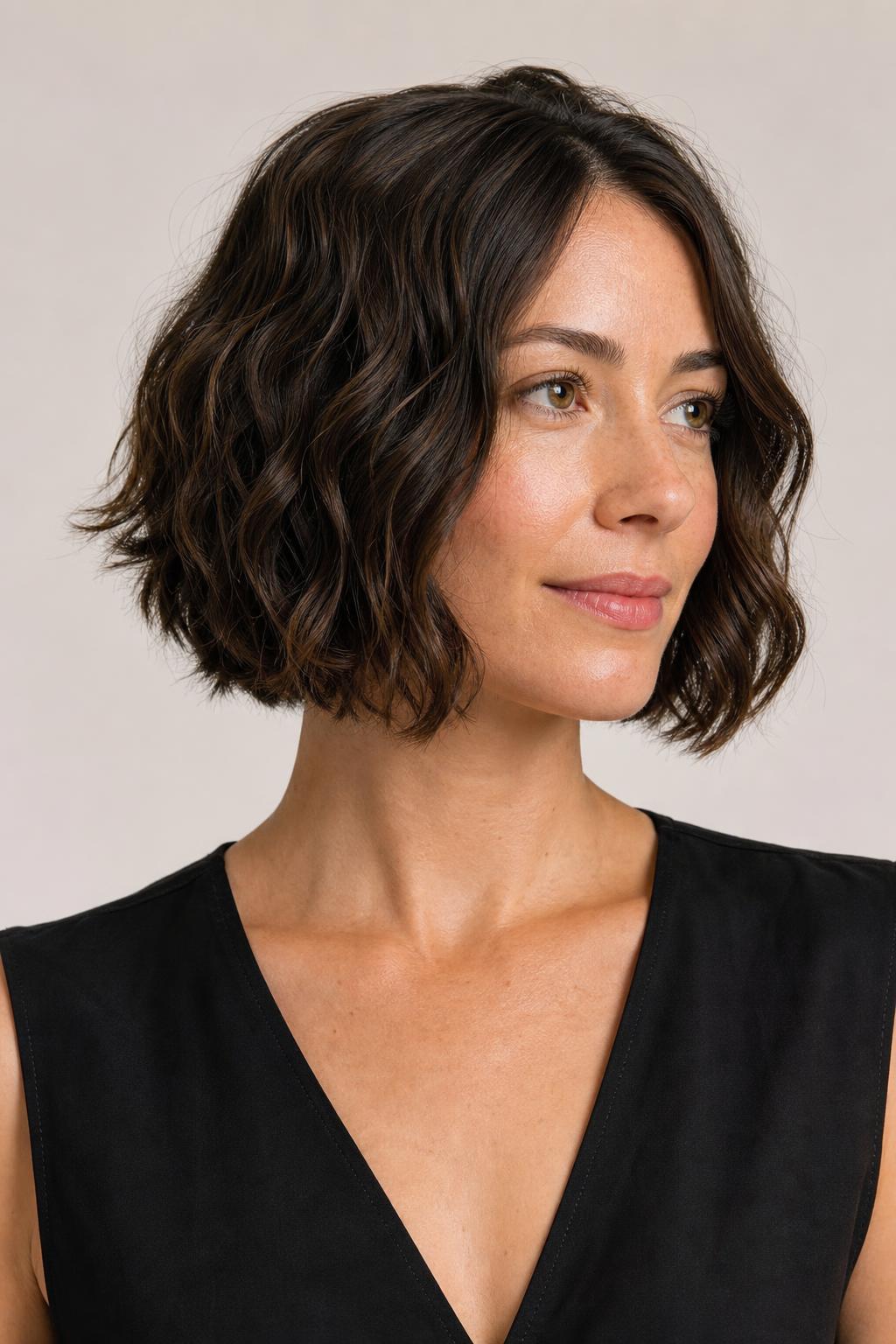
Collarbone Wavy Bobs and Lobs
Collarbone length is the safest entry point for 2C waves, and it is where most people land after one short bob teaches them how much their hair shrinks. The extra two to three inches give the wave room for a second full bend, and the weight of that length pulls the pattern into a longer, calmer S. Anyone weighing this against a shorter shape will find the trade-offs laid out in our comparison of bob, lob, and midi lengths.
8. Collarbone Lob with a Blunt Perimeter
Unlike the chin bobs above, a blunt line works at collarbone length because there is enough weight below the widest part of the wave to pull it down rather than out. The same blunt cut three inches shorter would flare. Blunt perimeters also give 2C hair its cleanest air-dry finish, since there are no staggered ends to separate unevenly.

9. Razor-Softened Collarbone Bob
A razor drawn down the last two inches at a shallow angle tapers each strand to a finer tip, which lets the wave close into a spiral at the very end instead of stopping in a blunt hook. This only works on healthy, medium to coarse 2C hair. On fine or damaged strands the razor shreds and frizz doubles within a week.
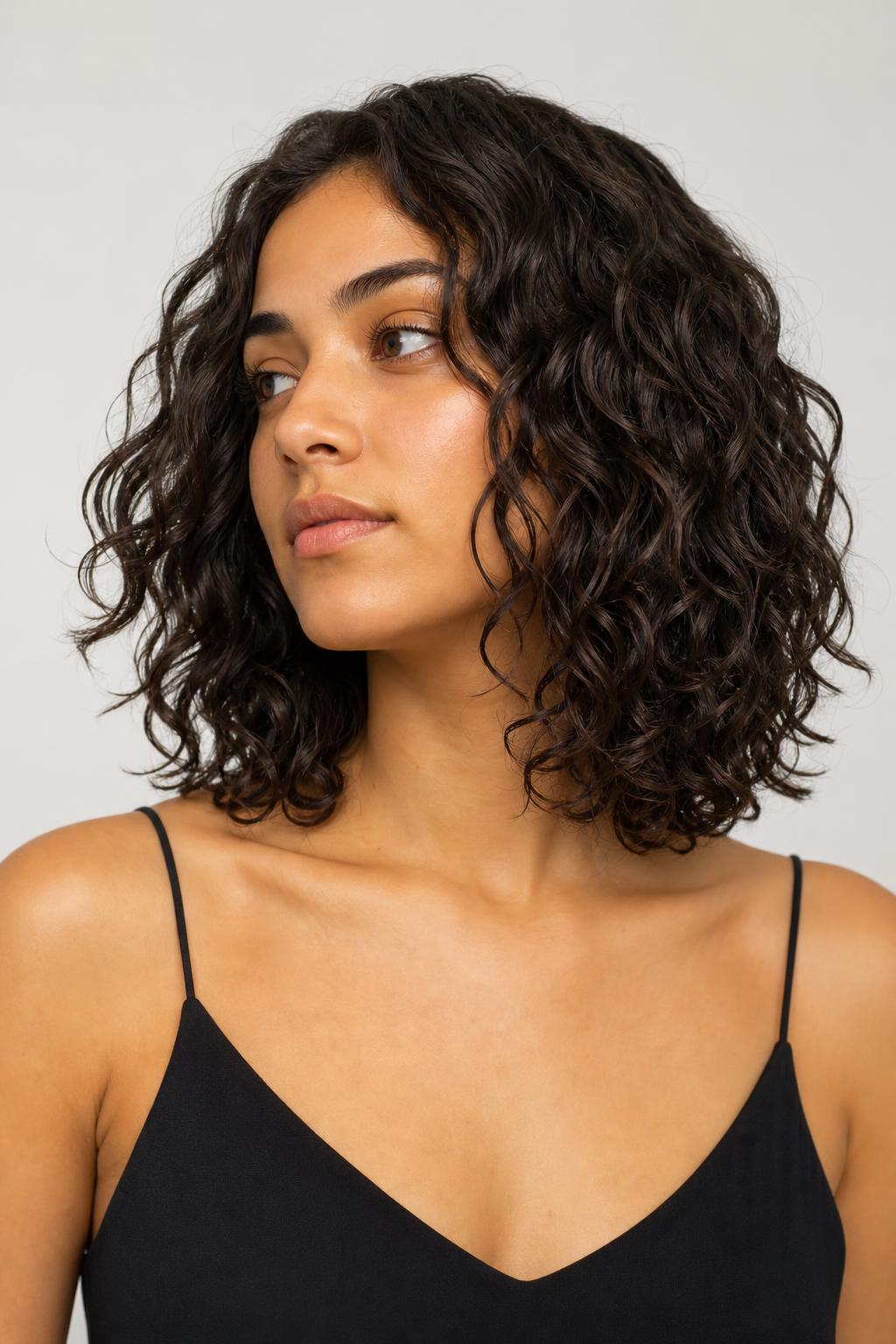
10. Collarbone Bob for a Square Jawline
Square jawlines soften when the widest part of the hair falls below the jaw rather than level with it, and collarbone length puts the fullest section of a 2C wave right at the neck. The corners of the jaw stay visible without being framed by volume. Keep face-framing pieces starting at the mouth, not the cheekbone, or the width returns.

11. Collarbone Bob for Fine 2C Waves
Fine 2C hair is common and badly served by most wavy-hair advice, which assumes thickness. Skip the interior thinning entirely and keep the perimeter close to one length, letting the wave pattern supply all the texture. A light mousse worked into soaking wet hair does more for fine waves than any cutting technique.

12. Air-Dried Collarbone Wavy Bob
Apply a coin-sized amount of curl cream followed by a light gel to hair still dripping wet, then clip the roots and leave it completely alone until it is 90 percent dry. Touching wet 2C waves is what creates frizz, not the humidity. Scrunch out the gel cast at the very end with a drop of oil on your palms. Our breakdown of air-drying methods compared side by side covers which of these steps you can skip.
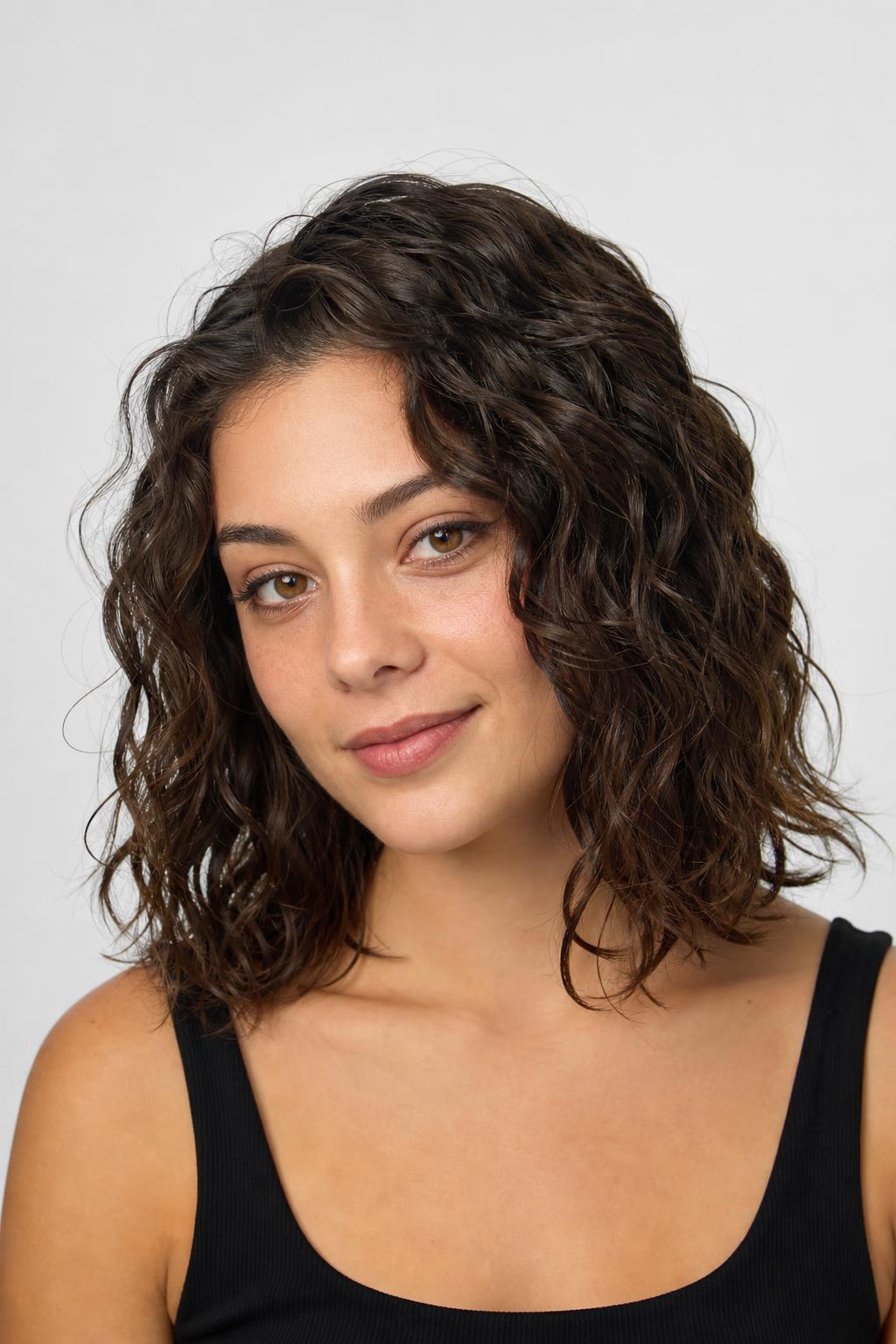
13. Grow-Out-Friendly Collarbone Bob
Cut with long, connected layers rather than short ones, this shape passes through three months of growth without a single stage where it looks unfinished. The layers simply move down the head and keep their relationship to each other. Realistic schedule: a shape-up at week 12, a proper reshape at week 24.

14. Collarbone Bob with Face-Framing Balayage
Balayage painted only on the two front sections lightens the pieces that catch the most light when a wave turns, which is why hand-painted color looks dimensional on 2C hair while foils look like stripes. Keep the lift to two levels above base. Anything brighter and the wave pattern starts to look sectioned rather than blended.

Layered and Textured Wavy Bobs
Layering is where most 2C bobs go wrong, because the layers get placed by eye on wet hair and land two inches higher than intended once the wave contracts. The shapes below all use interior or long-connected layering, which keeps the outer silhouette intact while the weight comes out from underneath. The distinction matters enough that we broke down graduated versus stacked bob shapes separately.
15. Internally Layered Wavy Bob
The phrase to use is “internal layers only, please keep my outline one length.” That wording tells a stylist to remove weight from beneath the surface without shortening any visible piece, which is exactly what a heavy 2C bob needs. Adding “no visible layers around my face” prevents the most common misread of that request.

16. Textured Wavy Bob with Shag Influence
Where a standard layered bob keeps its layers below the ear, a shag-influenced version starts them at the cheekbone and builds a shorter crown. The result carries more visible movement up top and a lighter perimeter. Worth knowing before you commit: this shape needs product every wash day, where a plain layered bob does not.

17. Slide-Cut Wavy Bob
Slide cutting runs open shears down a twisted section, removing a thin ribbon of weight along the whole length rather than at one point. On 2C hair it produces layers with no visible start line, which is the opposite of what thinning shears do. Ask for it on the underneath sections and the back only.

18. Rounded Layered Bob for Heart-Shaped Faces
Heart-shaped faces need fullness low and restraint at the temples, so layers on this bob begin below the jaw and build outward toward the ends. The widest part of the silhouette lands level with the mouth, balancing a narrower chin against a broader forehead. Avoid crown volume here, since it stretches the top of the face further.

19. Weight-Removed Bob for Very Thick 2C Hair
Very thick 2C hair has a specific failure mode: the top two inches lie flat while everything below expands, producing a mushroom outline. Removing weight in horizontal sections from the occipital bone down, and leaving the crown untouched, corrects the proportion. Density this heavy can lose a third of its bulk and still look full.

20. Scrunched Wavy Bob with Sea Salt Texture
Mist a sea-salt-based texturizing spray onto damp, not wet, hair, then cup sections in your palm and press upward toward the scalp for five seconds each. Salt sprays on soaking wet 2C hair dilute to nothing. On damp hair the same amount grips and holds the bend through the day.

Wavy Bobs with Bangs and Face-Framing
Bangs on 2C hair are a commitment, but they are not the disaster the internet suggests. The rule is length: any fringe cut on this texture must be long enough that shrinkage still leaves it below the eyebrow, which usually means cutting to the bridge of the nose when dry. Everything in this section respects that margin.
21. Wavy Bob with Curtain Bangs
Curtain bangs on 2C waves need re-trimming every 4 to 5 weeks, roughly twice as often as the bob itself, because a quarter inch of growth changes where the shortest piece falls on the cheekbone. Budget that as a separate quick appointment. Most salons do a bang trim free between cuts if you ask when booking.

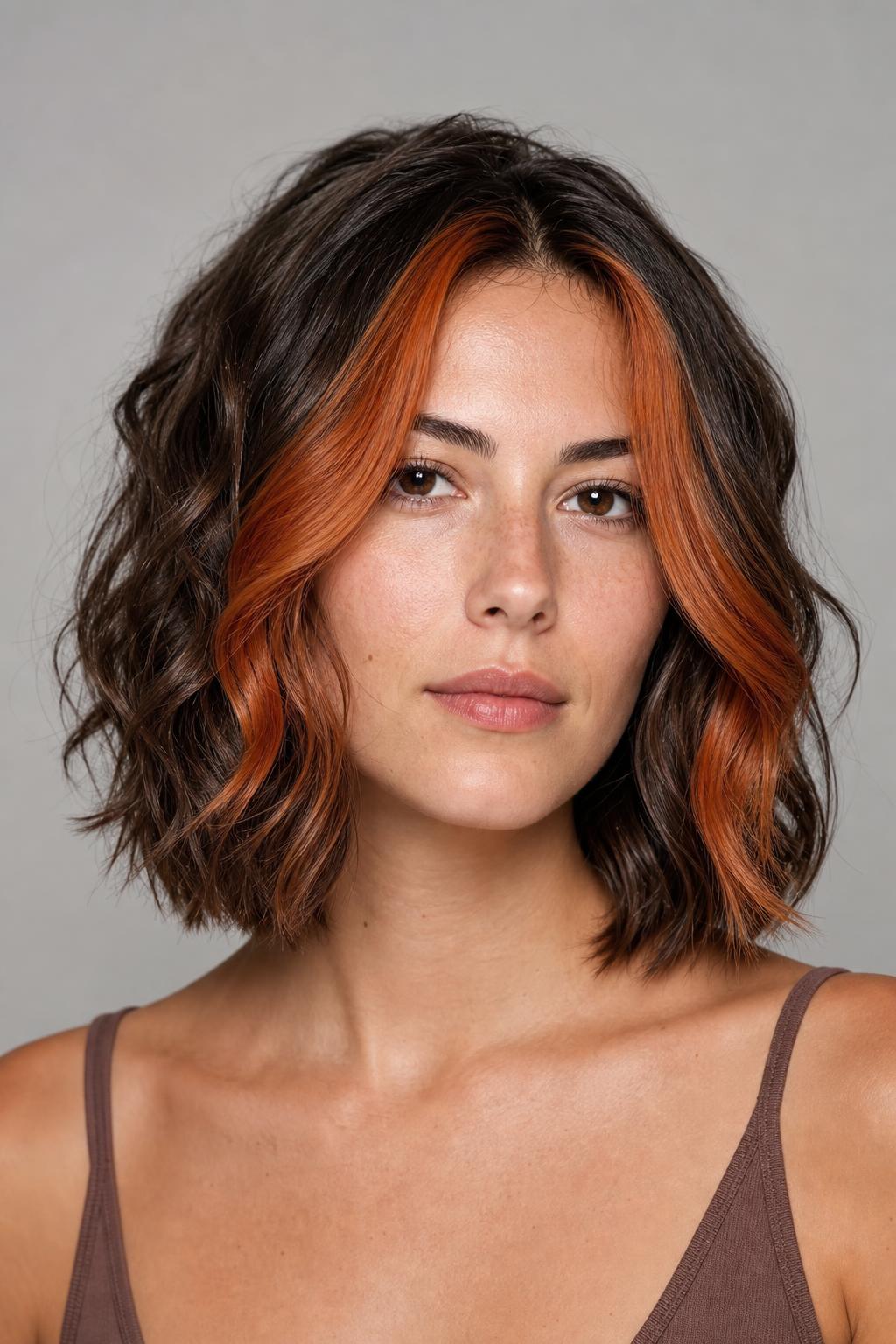
22. Wavy Bob with a Copper Money Piece
A copper money piece brightens the two sections closest to the face, and on a wavy bob those pieces move constantly, so the color flashes rather than staying still. Copper on 2C hair fades faster than the same shade on straight hair because the raised cuticle releases pigment more easily. A color-depositing conditioner every third wash holds it for about eight weeks.
23. Wavy Bob with a Wispy Fringe
Ask for “a wispy fringe cut dry, with the shortest piece hitting my eyebrow after it dries, and please leave the sides connected to my face-framing layers.” The connection point is what stops a fringe from looking like a separate piece glued to the front. Bring a photo of the fringe dry and unstyled if you have one.

24. Asymmetrical Wavy Bob
Compared with the A-line earlier in this gallery, an asymmetrical bob keeps the length difference between the two sides rather than front to back. One side reaches the collarbone, the other stops at the jaw. The uneven weight actually helps 2C hair, since the shorter side springs tighter and the longer side stays calm, which breaks up the uniform width this texture defaults to.

25. Wavy Bob with a Nape Undercut
A small undercut section at the nape, no wider than three inches and clipped to about half an inch, removes the densest patch of hair on most 2C heads. Nothing about it is visible when the hair is down. The effect is a bob that lies closer to the neck and dries a good 15 minutes faster.
How Much 2C Hair Shrinks When It Dries
2C waves lose roughly 15 to 25 percent of their stretched length once dry, which is the single most common reason a wavy bob comes out shorter than the reference photo. The table below converts wet cutting length into finished dry length so you can check the numbers at the mirror before any scissors move. If your stylist is cutting wet, these figures are the conversation you need to have first, and our guide to wet cutting versus dry cutting a bob explains why dry cutting removes the guesswork entirely.
| Wet Cutting Length | Dry Result on Loose 2C | Dry Result on Tight 2C | What You Actually Get |
|---|---|---|---|
| Chin | Corner of the mouth | Below the ear | A very short bob most people did not ask for |
| Jaw | Chin | Corner of the mouth | A true chin-length wavy bob |
| Collarbone | Base of the neck | Jaw | A jaw to neck bob, the safest starting point |
| Two inches past collarbone | Collarbone | Base of the neck | A collarbone lob with room to move |
Stylist tip: Pull one dry wave straight, hold a finger where it ends, then let it go and watch where it lands. The gap between those two points is your personal shrinkage, and it is more reliable than any percentage, because 2C ranges widely from person to person.
Choosing a Wavy Bob for Your Face Shape
Face shape decides where the widest part of a wavy bob should fall, and on 2C hair that widest point is dictated by the cut length far more than by styling. The goal is to keep volume away from whatever the face is already widest at. Use the table as a starting point, then adjust half an inch either way based on your neck length.
| Face Shape | Best Wavy Bob | Ideal Length | Avoid |
|---|---|---|---|
| Oval | Almost any version, including blunt and A-line | Jaw to collarbone | Heavy full bangs, which hide balanced proportions |
| Round | Deep side part with a soft A-line | Collarbone or longer | Chin length with a center part, which widens the cheeks |
| Square | Long connected layers, fullness below the jaw | Collarbone | Blunt jaw-length lines that trace the jaw corners |
| Heart | Rounded layers starting below the jaw | Chin to collarbone | Crown volume, which widens an already broad forehead |
| Oblong | Chin-length bob with curtain bangs | Chin to jaw | Length past the collarbone with no fringe |
| Diamond | Face-framing pieces starting at the mouth | Jaw to collarbone | Volume level with the cheekbones |
What to Tell Your Stylist
Bring two photos of hair with a wave pattern close to yours, both unstyled, and say plainly that you want the cut done dry. Then use this wording: “I have 2C waves. I want a bob that finishes at my collarbone when dry, so please cut to length on dry hair. Take weight out from underneath with vertical sections, keep my outline connected, and no thinning shears near the ends.” That single sentence rules out the three techniques behind most 2C bob regret.
Two questions worth asking at the consultation: where will the shortest layer land when it dries, and how will this shape look at week ten. A stylist who answers both specifically has cut this texture before. One who says the cut will “work with your natural texture” without naming a length has not.
Stylist tip: Arrive with your hair washed, air-dried, and completely unstyled, even if it looks rough. A stylist cutting 2C hair needs to see where your waves naturally break and which sections are looser than others, and a blowout hides both.
Maintenance and Styling
A wavy bob on 2C hair asks for less daily work than a straight bob and more product knowledge. Wash days need 5 to 15 minutes of product application and drying setup, and the two or three days after need almost nothing beyond a water mist. Trims run every 8 to 12 weeks depending on layering, which is longer than the 5 to 6 weeks a blunt straight bob demands. Our realistic bob trimming schedule breaks that down by cut type.
| Bob Version | Trim Frequency | Wash Day Styling | Key Products | Grow-Out Behavior |
|---|---|---|---|---|
| Blunt collarbone lob | 10 to 12 weeks | 5 to 8 minutes | Curl cream, light gel | Very forgiving, stays wearable past week 14 |
| Internally layered bob | 8 to 10 weeks | 8 to 12 minutes | Leave-in conditioner, medium-hold gel | Weight returns around week 9, shape holds |
| Chin-length wavy bob | 6 to 8 weeks | 10 to 15 minutes | Mousse, diffuser, light oil | Widens noticeably by week 7 |
| Shag-influenced bob | 8 to 10 weeks | 10 to 15 minutes | Sea salt spray, texturizing cream | Crown layers flatten first, around week 8 |
| Bob with curtain bangs | 8 weeks, fringe every 4 to 5 | 12 to 15 minutes | Curl cream, round brush for the fringe | Fringe outgrows the cut roughly twice as fast |
Between washes, a spray bottle of water with a teaspoon of leave-in conditioner revives a flattened wavy bob in under a minute, and the shorter the bob the better it responds. The full range of between-wash options appears in our guide to reviving waves without rewashing.
When a Wavy Bob Is Not the Right Cut for 2C Hair
Plenty of 2C heads should not get a bob, and the reasons are predictable enough to check in advance. Each situation below has a workable alternative rather than a flat no.
- Your waves start below the ear rather than at the root. A bob removes the length that was creating the bend, and you end up with straight roots and one wave at the ends. A collarbone or longer shape keeps the pattern intact.
- You blow-dry straight several times a week. Short 2C hair straightened repeatedly loses its wave memory at the ends first, and a bob has nothing but ends. Keep the length if straightening is your default.
- Your hair is fine and low density on top of being wavy. A bob concentrates what little bulk exists into a narrow band and can look sparse at the perimeter. A one-length lob at collarbone is more flattering.
- You have a short neck and a broad jaw together. A chin bob compresses the space between jaw and shoulder visually. Going past the collarbone restores the vertical line.
- You are three months out from a chemical straightening or a heavy bleach service. Cutting a bob into partially damaged length means the new shape is built from the weakest hair you own. Wait for a grow-out.
FAQ
Should a Wavy Bob for 2C Hair Be Cut Wet or Dry?
Dry, in almost every case. 2C waves contract 15 to 25 percent as they dry, so a wet cut relies on the stylist estimating that shrinkage across every section, and estimates vary by an inch or more. A dry cut lets both of you see the finished length as it is created. The one exception is a purely blunt perimeter with no layering, where a wet cut plus a generous length allowance works fine.
How Short Can I Go with 2C Waves?
Jaw length is the practical floor for most 2C hair, and chin length works if your waves start high on the head. Above the jaw, a 2C wave does not have enough length to complete a single S-bend, so it lifts outward rather than falling, which produces width at the ears. If you want shorter than jaw length, ask for a nape undercut to remove density before shortening the outline.
Will Layers Make My 2C Bob Frizzier?
Badly placed layers will, well placed ones will not. Layers cut with thinning shears create hundreds of short broken ends that stick out of the wave pattern, which is what most people mean when they say layers caused frizz. Internal layering with vertical sections or slide cutting removes the same weight without producing those short ends. Specify the technique, not just the word “layers”.
What Is the Difference Between 2C and 3A Hair for Cutting Purposes?
2C forms a wide S that lies mostly flat against the head, while 3A forms a defined loop with a visible spiral roughly the diameter of a wine cork. That difference changes where a stylist can safely place a layer: 3A hair hides a layer inside the spiral, 2C hair displays it on the surface. If your pattern is closer to loops than waves, the approaches in our guide to cuts shaped for 3A curls will serve you better.
Can I Get a Blunt Bob with 2C Hair?
Yes, at collarbone length or longer. Below that, the blunt line falls above the widest point of the wave and the hair flares outward at the perimeter instead of hanging down. At collarbone, the weight of the hair underneath the blunt line pulls the shape down and the result is clean. Blunt also gives the most consistent air-dry finish of any 2C bob.
How Do I Stop My Wavy Bob Widening at the Sides?
Width comes from bulk gathering between the ear and the jaw, so the fix is weight removal in that band specifically, not more layers overall. Ask for vertical channel cutting through the interior on the sides only. On wash days, clipping the roots at the part while the hair dries also pulls the top flat and narrows the whole silhouette.
A wavy bob for 2C hair succeeds or fails on two decisions made before any cutting starts: whether the hair is cut dry, and where the finished length falls once the wave contracts. Pick a length from the shrinkage table, take the salon wording above with you, and ask your stylist to show you the dry length in the mirror before the second side is cut. The variations in this collection all work on real 2C hair, which is more than can be said for most bob inspiration photos.
Hair results vary based on your natural hair type, texture, density, and condition. Always consult with a licensed hairstylist before making significant changes, especially with chemical treatments or dramatic length changes. Photos may show styled results that require professional tools and products to replicate.